

LSEG’s move to surface licensed market data inside Microsoft Copilot Studio marks a clear inflection point: the heavy lifting of engineering integrations and bespoke data pipelines is being replaced by low-code agent orchestration that lets domain experts create working AI assistants in minutes rather than months.
The London Stock Exchange Group (LSEG) has begun making large tranches of its licensed financial data available to customers inside Microsoft’s Copilot Studio environment via a managed Model Context Protocol (MCP) server, enabling financial services teams to build and deploy custom AI agents grounded in LSEG’s datasets. This initiative is being presented as a production-ready integration that reduces the integration friction that historically made enterprise-grade, licensed data difficult to use in model-driven workflows.
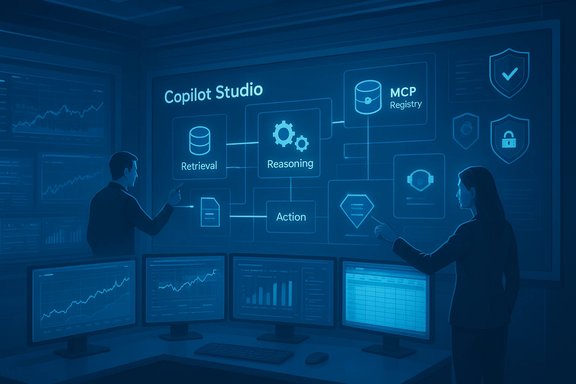
At its core this announcement pairs three trends that have been maturing across enterprise AI in 2024–2025: (1) the rise of agent-first architectures that chain reasoning, retrieval, and actions; (2) standardization efforts—most visibly the Model Context Protocol—that make connectors discoverable and reusable across agent runtimes; and (3) a shift from developer-only model plumbing to low-code/no-code authoring surfaces that empower business practitioners to construct and iterate on agents inside productivity tools.
The practical result is speed. What used to require a formal project plan, budget sign-off, and weeks of engineering work can now be prototyped inside a single meeting. Copilot Studio’s authoring flows and the MCP connector model mean that an analyst can specify intent, select knowledge sources, and wire an agent to LSEG data with far less friction. Vendors and partner materials cite reductions in development cycles from weeks to minutes for basic agent setups; independent readers should treat exact timing claims as indicative rather than contractual guarantees.
Note: some accounts attribute MCP’s early provenance to third-party initiatives; attribution and precise historical timelines vary across vendor materials and should be treated as background context rather than settled fact. Where attribution matters (for example, when mapping protocol governance), organisations should confirm vendor roadmaps and protocol governance documents directly.
However, the upside requires operational rigor. The technical plumbing is now easier, but the people, process, and compliance disciplines remain the gating factors for safe scaling. Organisations that treat the integration as an engineering problem only will discover the gap: the integration is easier, but the downstream obligations—auditing, entitlements, cost governance and model risk—become more visible and operationally demanding.
That democratization is real and valuable—provided institutions treat the result as an operational program, not a one-off experiment. Proper governance, connector hardening, cost controls, and an insistence on evidence-backed outputs will determine whether these agents produce sustainable value or create new operational exposures. The technology makes the work possible; disciplined execution will decide whether it becomes transformative.
Source: Technology Record LSEG’s Emily Prince discusses the democratising power of AI
 Background
The London Stock Exchange Group (LSEG) has begun making large tranches of its licensed financial data available to customers inside Microsoft’s Copilot Studio environment via a managed Model Context Protocol (MCP) server, enabling financial services teams to build and deploy custom AI agents grounded in LSEG’s datasets. This initiative is being presented as a production-ready integration that reduces the integration friction that historically made enterprise-grade, licensed data difficult to use in model-driven workflows.At its core this announcement pairs three trends that have been maturing across enterprise AI in 2024–2025: (1) the rise of agent-first architectures that chain reasoning, retrieval, and actions; (2) standardization efforts—most visibly the Model Context Protocol—that make connectors discoverable and reusable across agent runtimes; and (3) a shift from developer-only model plumbing to low-code/no-code authoring surfaces that empower business practitioners to construct and iterate on agents inside productivity tools.
Why this matters: from gated data to self-service agents
Financial institutions have long faced a classic trade-off: licensed market data is trustworthy and auditable, but the cost and time to integrate it into experimental AI pipelines is high. The LSEG–Microsoft approach reframes that trade-off by providing a standardized, MCP-exposed endpoint that Copilot Studio agents can call directly. This reduces custom middleware, minimizes bespoke API maintenance, and lets subject-matter experts build with licensed data without deep engineering involvement.The practical result is speed. What used to require a formal project plan, budget sign-off, and weeks of engineering work can now be prototyped inside a single meeting. Copilot Studio’s authoring flows and the MCP connector model mean that an analyst can specify intent, select knowledge sources, and wire an agent to LSEG data with far less friction. Vendors and partner materials cite reductions in development cycles from weeks to minutes for basic agent setups; independent readers should treat exact timing claims as indicative rather than contractual guarantees.
Overview of the technical pieces
Copilot Studio: the authoring surface
Copilot Studio is Microsoft’s low-code/no-code environment for designing, validating, and publishing agents that operate inside Microsoft 365 Copilot, Teams, and other channels. It provides:- Natural‑language authoring and templates for common use cases.
- Reusable components and agent flows that combine retrieval, reasoning, and action.
- Runtime options that can execute code (Python code interpreter), call connectors, and integrate with Power Platform flows.
Model Context Protocol (MCP): standardizing access
MCP is a protocol designed to make external tools and knowledge sources discoverable to agents. An MCP server exposes a catalog of callable resources—datasets, functions, or actions—that agents can discover and invoke in a consistent way. MCP reduces brittle one-off adapters by establishing a registry-and-tool model: agents query the MCP registry, learn an endpoint’s capabilities, and then invoke the resources using standardized semantics. Microsoft has made MCP a first-class integration point inside Copilot Studio so agents can use MCP-hosted data sources, such as LSEG’s managed MCP server, with minimal custom work.Note: some accounts attribute MCP’s early provenance to third-party initiatives; attribution and precise historical timelines vary across vendor materials and should be treated as background context rather than settled fact. Where attribution matters (for example, when mapping protocol governance), organisations should confirm vendor roadmaps and protocol governance documents directly.
LSEG’s managed MCP server and the data footprint
LSEG’s narrative to partners emphasizes a very large data footprint—reported figures in partner materials mention in excess of 33 petabytes of historical and reference content made accessible through the platform. That scale underlines the value proposition: not just real‑time tick data but a deep historical record that enables backtesting, signal generation, and richer retrieval-augmented generation (RAG) grounding. Readers should note vendor materials recommend validating dataset inventories and lineage reports when negotiating contracts.Democratising AI for domain experts
LSEG and Microsoft frame the integration as a capability that lowers the barrier to entry for creating production-grade agents. There are three distinct ways this democratization shows up:- Self-service authoring: Copilot Studio Lite and in‑Copilot authoring let analysts and product owners sketch and publish agents without dedicated engineering capacity. This reduces backlog and speeds experimentation.
- Grounded retrieval: By connecting agents to trusted, licensed data via MCP, outputs can be traced back to authoritative sources—lowering the risk of hallucination and making outputs auditable.
- Embedded workflows: Agents can deliver outputs directly into Excel, PowerPoint, or Teams, keeping work in the tools users already use rather than in separate portals. This improves adoption and keeps outputs aligned to operational contexts.
Real-world financial use cases
The integration is immediately relevant to several high-value financial workflows. Below are representative scenarios that leverage LSEG data inside Copilot Studio agents.- Credit analysis agent
- Aggregates time-series pricing, reference data, and issuer-level news.
- Executes validation logic against contractual data sources.
- Sends rule-triggered alerts to portfolio managers or populates a preformatted Excel risk sheet.
- Signal agent for event-driven trading or surveillance
- Monitors market events, sentiment signals, and anomaly detectors.
- Triggers downstream workflows (emails, Teams notifications, or order-book checks) that are auditable and time-stamped.
- Client reporting and pitch-book generation
- Uses LSEG historical content to populate charts and tables, then generates a PowerPoint-ready narrative draft that an analyst can review and edit. This reduces the time from data pull to client-ready materials.
- Operations & reconciliation assistants
- Agents that reconcile trade records against reference data, flag exceptions, and automatically create tickets in downstream systems using Power Platform connector flows.
Governance, licensing and compliance: hard problems made easier, not eliminated
Making licensed data accessible via a managed MCP server lowers integration risk, but it does not remove the need for rigorous governance. Key considerations include:- Licensing and contractual constraints
- Agents that access licensed data must enforce entitlements at the invocation layer; admin controls and contractual guardrails must match expected usage patterns. Procurement teams should request dataset inventories and lineage documentation to verify coverage and permitted uses.
- Auditability and lineage
- Production agents must log which datasets were queried, which model versions were invoked, and which downstream actions were executed. Copilot Studio and MCP-based connectors support richer telemetry, but organisations must define retention and audit policies that meet regulators’ expectations.
- Data residency and privacy
- Sensitive datasets and personally identifiable information (PII) must be kept under tenant controls; where necessary, customer-managed keys, private endpoints, and dedicated environments should be used to reduce exposure. Microsoft tooling surfaces tenant-level environment controls for Copilot Studio to help with geography and residency concerns.
- Cost governance
- Agent activity consumes compute and platform credits (Copilot Credits); uncontrolled agent proliferation can cause unexpected bills. Practical guardrails include agent-level monthly caps, consumption alerts, and clear chargeback models.
- Model risk management
- Model choice, update cadence, and bias testing should be part of the agent lifecycle. Integrations that let tenants supply their own models or host models in Azure Foundry add flexibility but increase the number of moving parts to govern.
Strengths: why this is important for financial services
- Speed of experimentation: Teams can iterate quickly on agent logic, enabling a test-and-learn approach to automating routine workflows.
- Trusted grounding: Agents that cite licensed LSEG sources reduce the risk of hallucinated assertions in analyst-facing outputs.
- Interoperability: MCP standardization enables multiple agents and tools to use the same connector without bespoke code, reducing duplication and integration debt.
- Embedded UX: Delivering agent outputs into Excel, PowerPoint, and Teams enhances adoption and reduces context switching.
Risks and unresolved questions
- Overstated scale and vendor-reported figures
- The commonly cited “33 petabytes” figure appears in partner materials and marketing narratives; procurement teams should validate exact dataset contents, retention, and update cadence before concluding the contractual scope. Vendor numbers can be directional but not automatically a contractual guarantee.
- Security surface expansion via MCP and agent-to-agent communications
- MCP increases the number of integration points that must be secured. Agent-to-agent orchestration introduces lateral-movement concerns that require strict connector provenance and runtime enforcement. Administrators should gate which MCP clients are allowed and require admin consent for new connectors.
- Hidden costs from agent proliferation
- Copilot Credits and compute consumption are real costs. Without mature chargeback and monitoring mechanisms, agent usage can exceed budgets quickly. Set consumption forecasts and caps before broad rollouts.
- Hallucination and quality control at scale
- Grounding with licensed data reduces hallucinations but does not remove them. Design patterns such as retrieval-augmented generation (RAG), evidence citation, and human-in-the-loop validation remain essential for high-stakes outputs.
- Protocol provenance and governance
- Some public narratives attribute MCP’s origins to external projects; organisations should confirm protocol governance, versioning, and interoperability commitments with vendors to ensure long-term stability. Where protocol attribution affects compliance or vendor lock-in risk, seek independent confirmation.
Practical rollout guidance for IT and data teams
- Inventory and classify use cases
- Start with a short list of high-value, low-risk pilots (reporting assistants, reconciliation, internal productivity agents). Prioritise cases where outputs will be reviewed by humans before downstream action.
- Establish MCP connector governance
- Maintain an approved registry of MCP endpoints and require explicit admin consent for new connectors. Validate connector input/output schemas, auth mechanisms, and security posture.
- Harden identity and access
- Use Entra ID (Azure AD) conditional access, least-privilege service principals, and customer-managed keys for sensitive data flows. Map agent identities to explicit roles and limit publish rights to approved authors.
- Control consumption and costs
- Configure Copilot Credit budgets per environment and define monthly caps at the agent level. Surface consumption metrics to business owners and set alerts for threshold breaches.
- Require evidence and traceability
- Agents that produce recommendations must attach evidence snippets, provenance links, and the model or retrieval version used. Keep agent logs and action traces for audit and red-teaming exercises.
- Run red-team and acceptance tests
- Validate agents against adversarial prompts, injection vectors, and realistic edge cases. Test the full end-to-end flow—including MCP connector failures and data latency—before wide deployment.
- Human-in-the-loop for high-risk actions
- For any agent that can change business state (trade execution, ledger updates), require explicit human confirmation and maintain an approval trail. Use flows that escalate uncertain outputs to reviewers.
The strategic takeaway: operationalising data + agents
LSEG’s MCP-backed availability inside Copilot Studio is a practical example of a broader industry pattern: vendors are packaging domain knowledge and licensed content as “consumable” services for agent runtimes, and platform vendors are building the authoring and governance surfaces that make those services usable by non‑engineers. When paired responsibly—meaning with accurate inventories, clear licensing contracts, and robust governance—this pattern can convert dormant data assets into repeatable, auditable agentic services that materially change how teams work.However, the upside requires operational rigor. The technical plumbing is now easier, but the people, process, and compliance disciplines remain the gating factors for safe scaling. Organisations that treat the integration as an engineering problem only will discover the gap: the integration is easier, but the downstream obligations—auditing, entitlements, cost governance and model risk—become more visible and operationally demanding.
Looking ahead: what to watch
- Adoption metrics and usage patterns
- Will institutions treat these agent capabilities as sandbox toys or as mission‑critical services? Watch for evidence that firms are moving from pilots to tenant-wide governance and ROI measurement.
- Protocol maturity and interoperability
- MCP registries and connector ecosystems must mature. Examine how connectors are certified, versioned, and monitored. Divergent implementations could recreate the fragmentation MCP intends to solve.
- Regulatory and audit expectations
- Regulators will focus on traceability and decision provenance in financial workflows. Firms should document agent decisions, datasets used, and human approvals to meet supervisory scrutiny.
- Cost and commercial models
- The economics of Copilot Credits, data licensing, and managed MCP hosting will determine which use cases scale. Expect commercial pilots to focus on measurable time savings and risk reduction before broad adoption.
Conclusion
The LSEG–Copilot Studio integration is an important milestone in making enterprise‑grade, licensed financial data usable by the people who need it most: analysts, portfolio managers, risk specialists and client teams. By exposing curated datasets through a managed MCP server and pairing them with Copilot Studio’s low‑code authoring, LSEG and Microsoft have lowered the technical barrier and sped time‑to‑prototype in ways that can change day‑to‑day workflows.That democratization is real and valuable—provided institutions treat the result as an operational program, not a one-off experiment. Proper governance, connector hardening, cost controls, and an insistence on evidence-backed outputs will determine whether these agents produce sustainable value or create new operational exposures. The technology makes the work possible; disciplined execution will decide whether it becomes transformative.
Source: Technology Record LSEG’s Emily Prince discusses the democratising power of AI
