

LTIMindtree’s expanded collaboration with Microsoft marks a clear acceleration in enterprise AI adoption — one that blends deep cloud engineering, Microsoft’s Copilot-era AI services, and an aggressive go‑to‑market push designed to move customers from pilots to production at scale. The agreement amplifies LTIMindtree’s role as a strategic systems integrator for Azure, formalizes a Microsoft‑centric set of AI offerings (including Azure OpenAI and Copilot families), and layers new capabilities — from Azure Expert MSP services to a Microsoft Cloud Generative AI Center of Excellence — intended to shorten customers’ time to measurable business outcomes.
LTIMindtree emerged from the LTI and Mindtree combination as a full‑stack services firm that aims to differentiate through industry‑specific AI and cloud solutions. The company promotes a vision of “AI in Everything, Everything for AI, AI for Everyone” and has steadily expanded Microsoft‑aligned credentials across infrastructure, data & AI, security, business applications, and modern workplace specializations. LTIMindtree already maintains a substantial Microsoft engagement footprint, including Azure Expert Managed Services Provider status and a Microsoft Cloud Generative AI Center of Excellence. Microsoft’s cloud and AI product suite — Azure infrastructure, Azure OpenAI Service, Copilot for Microsoft 365, Microsoft Copilot for Security, Azure Kubernetes Service (AKS), Microsoft Fabric and Azure AI services — has become the chosen platform for many enterprise AI programs. Microsoft’s own messaging stresses enterprise readiness, security controls and partner‑led implementations as core to scaling generative AI safely and effectively. LTIMindtree’s updated strategic alignment with Microsoft is therefore an expected, competitive move to capture the next wave of cloud and AI transformation projects.
That said, the technical and commercial complexities of enterprise AI mean outcomes are not automatic. Success will depend on realistic scoping, strong governance, transparent economics, and disciplined change management. Enterprises should treat the new packages as accelerators — not turnkey guarantees — and demand measurable KPIs before they award large production contracts.
Where LTIMindtree scores is in combining Microsoft‑native technical choices (Copilot, Azure OpenAI, AKS) with delivery artefacts (GenAI CoE, migration factories, Azure Expert MSP). For customers committed to Azure, that alignment will likely shorten timelines and reduce integration risk. For others weighing multicloud, vendor portability and sovereign data concerns, the decision will require deeper technical and legal diligence.
The partnership expansion positions LTIMindtree as a major channel for Microsoft’s enterprise AI ambitions while giving customers access to packaged Azure + Copilot solutions backed by managed services. For enterprises prepared to adopt Azure‑native AI, the proposition reduces friction and offers an established delivery engine. For others, the strategic tradeoffs — lock‑in, regulatory constraints, and execution risk — remain material. The coming 12–24 months of customer deployments will be the real test: whether these offerings convert pilot optimism into measurable, secure, and repeatable business outcomes at scale.
Source: TipRanks LTIMindtree Expands Microsoft Partnership to Boost Azure and AI Transformation - TipRanks.com
 Background
LTIMindtree emerged from the LTI and Mindtree combination as a full‑stack services firm that aims to differentiate through industry‑specific AI and cloud solutions. The company promotes a vision of “AI in Everything, Everything for AI, AI for Everyone” and has steadily expanded Microsoft‑aligned credentials across infrastructure, data & AI, security, business applications, and modern workplace specializations. LTIMindtree already maintains a substantial Microsoft engagement footprint, including Azure Expert Managed Services Provider status and a Microsoft Cloud Generative AI Center of Excellence. Microsoft’s cloud and AI product suite — Azure infrastructure, Azure OpenAI Service, Copilot for Microsoft 365, Microsoft Copilot for Security, Azure Kubernetes Service (AKS), Microsoft Fabric and Azure AI services — has become the chosen platform for many enterprise AI programs. Microsoft’s own messaging stresses enterprise readiness, security controls and partner‑led implementations as core to scaling generative AI safely and effectively. LTIMindtree’s updated strategic alignment with Microsoft is therefore an expected, competitive move to capture the next wave of cloud and AI transformation projects. What the partnership expansion actually includes
LTIMindtree’s announcements and public statements about the expanded Microsoft partnership emphasize several concrete pillars:- A joint go‑to‑market strategy focused on accelerating Azure adoption and AI use cases, including packaged offers for Copilot for Microsoft 365 adoption and targeted industry AI solutions.
- Investment in skill development and an expanded Microsoft business unit to scale delivery capabilities and sales motions across regions.
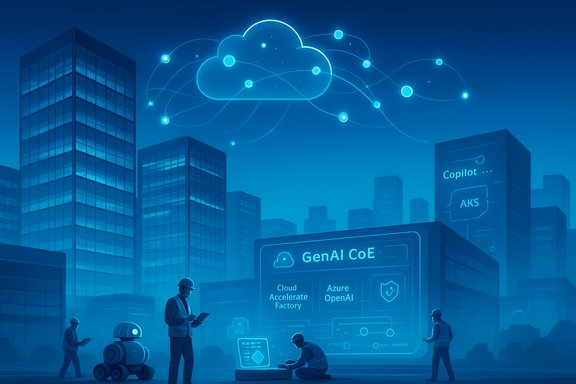
- Deployment of a Microsoft Cloud Generative AI Center of Excellence (GenAI CoE) to incubate and scale secure, enterprise‑grade generative AI solutions.
- Azure technical accreditations and managed services credentials (including Azure Expert MSP) to support migration, operations, security, and governance at scale.
Why this matters to enterprise IT buyers
Enterprises deciding where to run mission‑critical AI and cloud workloads must balance speed, risk, cost and vendor interoperability. The LTIMindtree–Microsoft expansion offers immediate pragmatic benefits for many customers:- Faster adoption via packaged Copilot migrations and standardized migration factories that reduce custom engineering overhead.
- Reduced integration risk because LTIMindtree brings industry domain knowledge (banking, manufacturing, healthcare, retail) and pre‑built connectors and agents tested on Azure.
- Stronger security and governance when Copilot, Azure OpenAI and Microsoft security stacks are integrated by a compliant partner that holds Microsoft designations and MSP certifications.
Technical scope — what solutions are being offered and how they map to Azure
LTIMindtree’s public materials and joint announcements highlight a basket of Azure and Microsoft AI capabilities that will be central to their joint deliveries. These include:- Azure OpenAI Service — for enterprise‑grade LLM access, retrieval‑augmented generation (RAG) patterns, and Copilot‑style assistants.
- Copilot for Microsoft 365 — packaged adoption offerings to embed Copilot into everyday productivity tools and drive measurable productivity gains.
- Microsoft Copilot for Security & Azure Sentinel — integrated security playbooks and AI‑augmented incident response for SOC modernization.
- AKS, Azure Kubernetes, and cloud native platforms — to containerize inference workloads, scale GPU clusters and host microservices.
- Azure AI Services (Search, Video Indexer, Language Studio) — for multimodal processing and enterprise search/knowledge engineering.
Financial and market context
LTIMindtree’s business momentum and valuation frame the commercial logic behind the partnership. The company reports roughly 86,000 employees and a presence in 40+ countries, positioning it as a global mid‑cap integrator with scale to staff large transformation programs. Public investor materials and Microsoft customer stories corroborate those headcount and footprint figures. From a market perspective, LTIMindtree’s capitalization sits in the low‑trillion‑INR range (around INR 1.7T as of recent market snapshots), reflecting investor appetite for growth in cloud‑services providers. Market data platforms show market caps consistent with this order of magnitude, though intraday values vary with share price movement. These balance‑sheet and market realities make large, multi‑year Azure engagements commercially meaningful for both LTIMindtree and Microsoft. Caution on data points: some third‑party summaries (for example, aggregator snippets in investor feeds) list an average trading volume of 10,523 and a “Technical Sentiment: Strong Buy” for LTIM stock — figures that do not match other market data providers that show average volumes in the hundreds of thousands. That discrepancy suggests either a data‑slice (different exchange, time window) or an error; investors should validate volume and analyst signals against primary exchanges or major financial terminals before drawing conclusions.Strengths of the expanded collaboration
- Built‑in enterprise governance and security — By leaning on Microsoft’s security portfolio and integrating Microsoft Copilot for Security patterns, LTIMindtree can offer stronger, auditable controls for sensitive workloads. This reduces one of the biggest barriers enterprises face when moving LLMs into production.
- Operational scale and delivery IP — LTIMindtree’s Cloud Accelerate Factory, migration bots, and industry accelerators promise predictable delivery rhythms — a decisive advantage over bespoke consulting engagements that struggle to move beyond pilots.
- Microsoft certifications and partner status — Azure Expert MSP designation and multiple Microsoft solution partner designations streamline procurement and reassure customers that audits, SLAs and runbooks are in place.
- Go‑to‑market alignment — Joint GTM investment means Microsoft will likely refer customers to LTIMindtree for Azure migrations and Copilot transformations, increasing pipeline velocity and deal size potential.
Risks, tradeoffs and open questions
- Vendor concentration vs. multicloud flexibility. The partnership is intentionally Microsoft‑centric. For customers who require multicloud redundancy or have existing commitments to AWS/Google Cloud, tight coupling to Azure services (especially Azure OpenAI and Copilot) may create lock‑in that complicates future procurement choices.
- Large‑deal dependency and revenue lumpiness. LTIMindtree’s fastest growth has come from a handful of very large, multi‑year deals. While these deals boost revenue visibility, they also create sensitivity to contract renewals and client consolidation trends. Reuters and company disclosures both warn that a small number of large contracts can swing results materially.
- Security and model governance complexities. While Microsoft provides enterprise controls, generative AI risks — hallucinations, data leakage, cross‑tenant exposure — remain real operational challenges. The presence of a GenAI CoE improves the odds of safe deployment, but customers must still demand transparent model‑lineage, red‑teaming, and compliance attestations for regulated workloads.
- Talent and execution risk. Scaling engineering teams with deep Azure, MLOps and domain expertise remains competitive. LTIMindtree’s headcount gives it an advantage, but hiring, retention and training in a tight market could pressure margins and delivery metrics.
- Regulatory and geopolitical headwinds. Cross‑border data flows, AI model export controls and local data residency rules can complicate global Azure rollouts, especially for customers in regulated sectors or sensitive jurisdictions. Project scoping must surface these constraints early.
What enterprise IT teams should look for before engaging
If your organization is evaluating LTIMindtree + Microsoft as an option to accelerate Azure and AI transformation, insist on a short list of deliverables and governance safeguards:- A measured pilot with clear KPIs (time saved, cost reduction, accuracy, compliance metrics) and a defined migration pathway to production.
- Data residency and model governance contracts that explicitly cover data used for prompts, model fine‑tuning, and telemetry.
- Security architecture blueprints that show how Copilot, Azure OpenAI, and Microsoft security tools (Sentinel, Defender for Cloud) are integrated and where third‑party controls operate.
- Operational runbooks and SLAs for model retraining, drift detection, incident response and privacy breach scenarios.
- Exit and portability plans that describe how to migrate assets or retrain models on another cloud if business requirements change.
How competitors are likely to respond
Large integrators and hyperscalers are already racing to create similar partner plays. Competing strategies will fall into three categories:- Deep cloud vendor alignment (AWS, Google Cloud partners duplicating Azure offerings).
- Horizontal AI platforms focusing on model‑agnostic tooling and portability (to reduce lock‑in).
- Boutique industry specialists embedding domain models with tight compliance postures.
Bottom line — measured optimism, not inevitability
The LTIMindtree–Microsoft expansion is a significant, logical step for a services firm positioning itself as a principal delivery partner for Azure‑centric AI transformation. The partnership lowers friction for customers that want to embrace Microsoft’s AI ecosystem with a trusted integrator who brings vertical experience, engineering scale, and managed services.That said, the technical and commercial complexities of enterprise AI mean outcomes are not automatic. Success will depend on realistic scoping, strong governance, transparent economics, and disciplined change management. Enterprises should treat the new packages as accelerators — not turnkey guarantees — and demand measurable KPIs before they award large production contracts.
Where LTIMindtree scores is in combining Microsoft‑native technical choices (Copilot, Azure OpenAI, AKS) with delivery artefacts (GenAI CoE, migration factories, Azure Expert MSP). For customers committed to Azure, that alignment will likely shorten timelines and reduce integration risk. For others weighing multicloud, vendor portability and sovereign data concerns, the decision will require deeper technical and legal diligence.
Final recommendation for enterprise decision‑makers
- Validate vendor claims: Request proof‑of‑value case studies that match your industry and regulatory footprint.
- Require governance materials: Model‑risk policies, red‑team results, and an auditable chain of custody for training data.
- Start small, measure fast: Use one or two high‑impact pilots with explicit ROI metrics before broad rollouts.
- Insist on portability: Define escape hatches and data portability targets to avoid strategic lock‑in.
- Verify market metrics: Cross‑check any financial or market data (average volume, market cap, analyst sentiment) against exchange or major financial terminals.
The partnership expansion positions LTIMindtree as a major channel for Microsoft’s enterprise AI ambitions while giving customers access to packaged Azure + Copilot solutions backed by managed services. For enterprises prepared to adopt Azure‑native AI, the proposition reduces friction and offers an established delivery engine. For others, the strategic tradeoffs — lock‑in, regulatory constraints, and execution risk — remain material. The coming 12–24 months of customer deployments will be the real test: whether these offerings convert pilot optimism into measurable, secure, and repeatable business outcomes at scale.
Source: TipRanks LTIMindtree Expands Microsoft Partnership to Boost Azure and AI Transformation - TipRanks.com
