

LTIMindtree’s announcement that it is deepening its strategic collaboration with Microsoft marks a clear, deliberate push to turn enterprise interest in cloud and generative AI into repeatable, production-ready outcomes—bundling Azure OpenAI, Microsoft 365 Copilot, Microsoft Fabric and the full Microsoft security stack into a partner play designed to accelerate Azure adoption, optimize consumption commitments, and scale AI across industry verticals.
LTIMindtree is the post-merger combination of L&T Infotech (LTI) and Mindtree, now positioning itself as a Global System Integrator (GSI) with a Microsoft-native delivery model and a growing catalogue of Microsoft-aligned product IP. The company has publicly described a dedicated Microsoft Business Unit, a Microsoft Cloud Generative AI Center of Excellence (GenAI CoE), and a set of transactable offerings that map Microsoft Azure services to industry accelerators and managed services. This announcement is part of a broader trend: hyperscalers and GSIs are converging around “data + AI + governance” stacks where cloud platform, managed services, and packaged copilots form the core pathway from PoC to production. Microsoft’s recent product moves—making Copilot and a multi-model Foundry available to enterprises, expanding Fabric, and emphasizing an integrated security surface—create an ecosystem partners can operationalize at scale. LTIMindtree’s messaging explicitly ties its delivery assets (Canvas.AI, BlueVerse, Cloud Accelerate Factory) to these Azure capabilities.
Key technical elements in LTIMindtree’s play:
For IT leaders committed to an Azure-first strategy, LTIMindtree presents a compelling, lower-friction route to scale generative AI and Copilot across the organization—provided that procurement teams demand contractual clarity on costs, data residency, model hosting, portability and auditable governance. For those prioritizing multi-cloud flexibility or requiring strict model sovereignty, the path requires careful negotiation and technical safeguards.
LTIMindtree’s public materials and Microsoft customer stories demonstrate real operational progress—Copilot for Security integration, large endpoint consolidations and productized AI offerings—yet buyers should validate partner claims against independent partner directories and request written confirmations of featured partner statuses and SLAs before committing large MAACs or multi-year cloud investments. When disciplined governance, clear KPIs and robust exit mechanisms accompany the technical promise, the LTIMindtree–Microsoft play can materially shorten the journey from experiment to enterprise productivity.
Source: Bisinfotech LTIMindtree Deepens Microsoft Alliance to Drive AI Transformation
 Background
LTIMindtree is the post-merger combination of L&T Infotech (LTI) and Mindtree, now positioning itself as a Global System Integrator (GSI) with a Microsoft-native delivery model and a growing catalogue of Microsoft-aligned product IP. The company has publicly described a dedicated Microsoft Business Unit, a Microsoft Cloud Generative AI Center of Excellence (GenAI CoE), and a set of transactable offerings that map Microsoft Azure services to industry accelerators and managed services. This announcement is part of a broader trend: hyperscalers and GSIs are converging around “data + AI + governance” stacks where cloud platform, managed services, and packaged copilots form the core pathway from PoC to production. Microsoft’s recent product moves—making Copilot and a multi-model Foundry available to enterprises, expanding Fabric, and emphasizing an integrated security surface—create an ecosystem partners can operationalize at scale. LTIMindtree’s messaging explicitly ties its delivery assets (Canvas.AI, BlueVerse, Cloud Accelerate Factory) to these Azure capabilities. What LTIMindtree and Microsoft Announced
- A formalized Microsoft Business Unit inside LTIMindtree to coordinate joint GTM, co-sell, and technical delivery across Azure and Microsoft 365 products.
- Embedding Azure OpenAI (via Microsoft Foundry) into LTIMindtree’s Canvas.AI and BlueVerse IP to power domain copilots and knowledge applications.
- Acceleration packages for Microsoft 365 Copilot adoption using a governance-first rollout model, with staged pilots, DLP and Entra‑based access controls.
- Data modernization centricity around Microsoft Fabric and OneLake to create the “data spine” that feeds copilots and analytics.
- Security and governance as a backbone: deployment and integration of Defender XDR, Microsoft Sentinel, Intune, Windows Autopatch and Entra ID across large endpoint estates as part of managed security offerings. LTIMindtree cites large endpoint standardization wins as operational proof points.
- Commercial mechanics to drive consumption: optimized Azure Consumption Commitment (MAAC) advisory, co-sell motions and marketplace transactable offerings to shorten procurement and time-to-value.
Technical Architecture and Product Mapping
Azure OpenAI + Foundry: Enterprise LLM pipelines
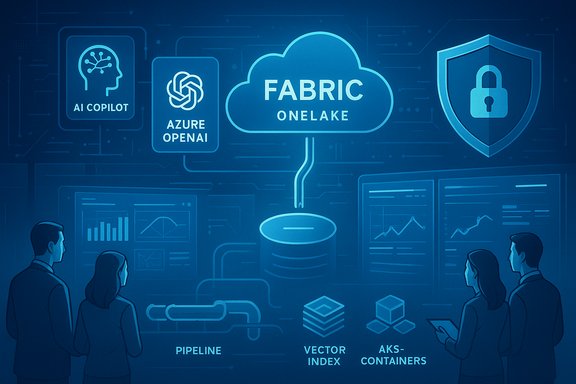
LTIMindtree describes an enterprise LLM architecture consistent with contemporary best practices: ingest and transform enterprise data into governed stores, create semantic/vector indexes (or use Fabric indexes), and run inference against Azure-hosted models via Azure OpenAI or models surfaced through Microsoft Foundry. This retrieval-augmented generation (RAG) pattern keeps sensitive data inside customer Azure tenancies and positions Microsoft’s Foundry as the governance control plane for model selection and runtime.Key technical elements in LTIMindtree’s play:
- Vector or semantic indexes for fast retrieval and grounding.
- Fabric/OneLake as the unified data store and catalog.
- Managed inference through Azure OpenAI / Foundry for production SLAs.
- AKS or GPU-backed container clusters to host custom model runtimes and microservices where required.
Microsoft 365 Copilot: governance-first rollouts
LTIMindtree’s internal Copilot adoption follows a staged, governance-first approach: pilot cohorts, DLP and Entra policy mapping, red-teaming and output redaction workflows, and progressive integration into line-of-business processes (sales enablement, legal, HR). This reduces exposure risk while enabling measurable productivity gains when Copilot is embedded deliberately in workflows. The Microsoft customer story on LTIMindtree’s security adoption documents Copilot for Security integration with Sentinel and Defender telemetry as an early operational example.Microsoft Fabric: the data spine
LTIMindtree positions Microsoft Fabric as the foundational data fabric—OneLake as single storage, Fabric pipelines for data engineering and stream processing, and Real-Time Intelligence for event-driven analytics feeding copilots. The practical benefit: unify data once and re-use it for reporting, analytics, and LLM inputs without multiplying data copies or governance gaps. LTIMindtree cites Fabric Featured Partner recognition; however, independent public verification of specific “Real‑Time Intelligence featured partner” listings for LTIMindtree is limited at the time of publication and should be requested in writing by buyers.Security and Governance: The Partnership’s Core Claim
Security is central to LTIMindtree’s messaging. The company reports deploying the full Microsoft security stack at scale—Microsoft Defender XDR, Microsoft Sentinel, Intune, Windows Autopatch and Entra ID—across tens of thousands of endpoints as part of its device management and SOC modernization work. Microsoft’s own customer materials corroborate Copilot for Security and integrated Sentinel/Defender deployments as part of LTIMindtree’s practice. What this means operationally:- Automated telemetry ingestion and AI-assisted incident triage using Copilot for Security.
- Endpoint standardization via Intune and Windows Autopatch to reduce patching variability and attack surface.
- Entra ID-centered identity controls to gate Copilot and LLM access to sanctioned data sources.
- Sentinel playbooks and Logic Apps to operationalize detection-to-remediation workflows with AI‑assisted runbooks.
Commercial Mechanics: MAAC, Co-Sell and Marketplace
LTIMindtree’s GTM emphasizes two commercial levers to accelerate Azure adoption:- Microsoft Azure Consumption Commitment (MAAC) advisory to convert committed spend into migration sprints and transactable services.
- Co-sell and Azure Marketplace distribution to simplify procurement, billing and accelerate deployments.
Real-World Evidence and Independent Signals
LTIMindtree’s public case history and Microsoft’s customer narratives provide supporting evidence for several claims:- Copilot for Security integration and Intune-based endpoint consolidation are documented in Microsoft customer stories as production deployments.
- LTIMindtree’s product portfolio—Canvas.AI, BlueVerse—and the GenAI CoE are referenced across LTIMindtree press materials and partner announcements.
Strengths: What LTIMindtree Brings to the Table
- Platform-native execution: LTIMindtree’s Azure Expert MSP credentials and solution partner designations lower procurement friction and provide validated delivery frameworks for migrations and managed services.
- Productization and IP: Canvas.AI and BlueVerse are examples of productized accelerators that compress the time from pilot to production compared to fully bespoke engagements.
- Security-first posture: The company has demonstrable experience integrating Copilot for Security, Sentinel and Defender to automate SOC workflows—this reduces a primary regulatory barrier for many customers.
- Scale and delivery muscle: With a global headcount and multi-region footprint, LTIMindtree claims the capacity to staff and run large, multi-year Azure programs for enterprise clients.
Risks, Trade-offs and What Buyers Must Insist On
- Vendor concentration and portability risk
A deeply Azure-native approach simplifies integration but increases vendor lock-in. Enterprises with multi-cloud mandates must negotiate portability—including containerized inference, neutral data export formats, and retraining playbooks—to avoid strategic dependence. - Consumption volatility and hidden LLM costs
Generative AI workloads are cost-variable. MAAC deals help with discounts but expose buyers to forecast risk. Require detailed cost models, monthly reconciliation, and rightsizing strategies in contracts. - Claims that need verification
Some designation claims (e.g., specific Fabric Featured Partner categories) and quantified metrics should be validated against Microsoft’s partner portal or by requesting written confirmation. If a partner cites customer figures (endpoint counts, consumption savings), ask for audited case studies that map to your industry and regulatory context. - Model governance and data residency
Microsoft’s openness to multi-model hosting (including Anthropic and other vendors) increases capability but complicates data flow guarantees—enterprises must insist that any third-party model use be documented, and that inference data residency and telemetry retention meet compliance needs. - Operationalizing AI is cultural and procedural
Technology alone does not create value. Copilot projects succeed when tied to clear KPIs, executive sponsorship, and focused adoption plans. Expect change-management, training, and process redesign investments in addition to the technical spend.
Practical Checklist for Enterprise Buyers
- Request written proof-of-value case studies that match your regulatory and technical environment.
- Insist on explicit model-hosting statements for Azure OpenAI / Foundry and any third-party models used by partner IP.
- Require cost governance: monthly MAAC reconciliation, tagging and rightsizing obligations, and a re-baselining clause.
- Ask for a security blueprint showing integration points across Defender, Sentinel, Intune, Windows Autopatch and Entra ID, plus a red-team report for Copilot outputs.
- Negotiate exit and portability terms: exportable vector indexes, retrainable model artefacts, and a documented migration runbook.
Strategic Implications for the Market
LTIMindtree’s move is symptomatic of a broader market shift: systems integrators are packaging platform-specific IP to capture the value created as enterprises move from PoCs to production. For Microsoft, deepening partner relationships with GSIs like LTIMindtree expands the reach of Azure AI and Copilot into regulated industries, while partners gain co-sell leverage and marketplace distribution. Competitors—both hyperscaler-aligned GSIs and model-agnostic consultancies—will respond with their own productized IP and portability narratives, making enterprise procurement a comparative exercise between speed-to-value and long-term strategic flexibility.Conclusion
LTIMindtree’s expanded alliance with Microsoft is a significant, pragmatic play: it couples a Microsoft‑native technical stack (Azure OpenAI, Microsoft Fabric, Microsoft 365 Copilot) with partner productization, managed services and security-first operations to accelerate enterprise AI adoption. The partnership offers genuine benefits—faster time-to-value, integrated security, and industry accelerators—but it also raises familiar enterprise questions around consumption economics, vendor concentration, model governance, and measurable KPIs.For IT leaders committed to an Azure-first strategy, LTIMindtree presents a compelling, lower-friction route to scale generative AI and Copilot across the organization—provided that procurement teams demand contractual clarity on costs, data residency, model hosting, portability and auditable governance. For those prioritizing multi-cloud flexibility or requiring strict model sovereignty, the path requires careful negotiation and technical safeguards.
LTIMindtree’s public materials and Microsoft customer stories demonstrate real operational progress—Copilot for Security integration, large endpoint consolidations and productized AI offerings—yet buyers should validate partner claims against independent partner directories and request written confirmations of featured partner statuses and SLAs before committing large MAACs or multi-year cloud investments. When disciplined governance, clear KPIs and robust exit mechanisms accompany the technical promise, the LTIMindtree–Microsoft play can materially shorten the journey from experiment to enterprise productivity.
Source: Bisinfotech LTIMindtree Deepens Microsoft Alliance to Drive AI Transformation
