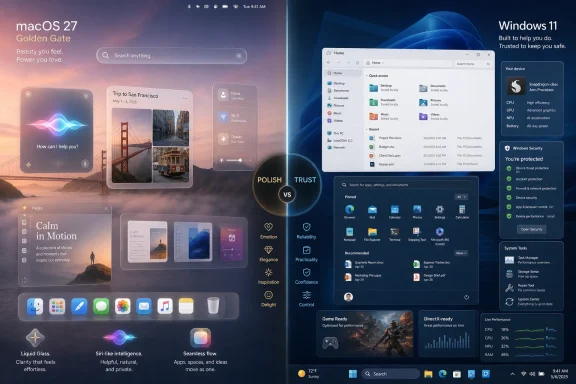
Apple used WWDC 2026 on June 8 to preview macOS 27 Golden Gate, a Mac operating system built around Apple Intelligence, a redesigned Siri experience, Liquid Glass refinements, and a fall release window for Apple silicon Macs. The show was polished, the demos were disciplined, and Apple’s message was obvious: the Mac is now another surface for the company’s AI platform. But the more interesting comparison is not whether Apple’s chatbot looks slicker than Microsoft’s. It is whether macOS is solving the desktop problems that still decide where people actually work, play, develop, and manage fleets.
That is where Windows 11 suddenly looks less like the aging incumbent and more like the operating system with the more serious 2026 agenda. Microsoft’s AI messaging remains messy, and Copilot has yet to become the universal productivity layer the company keeps promising. But Windows is being pulled in a more pragmatic direction: fewer annoyances, better hardware range, stronger gaming support, more developer attention, and an implicit admission that the desktop still matters before the agentic future arrives.
Apple’s advantage at WWDC was the kind of advantage Apple usually has: coherence. macOS 27 Golden Gate appears as part of a synchronized platform story across iOS, iPadOS, watchOS, visionOS, and the Mac. Liquid Glass gets another round of tuning, Siri becomes more visibly central, and Apple Intelligence is treated less like a bolt-on feature than a system layer.
That matters. Apple’s best software moments happen when the company makes a feature feel inevitable across devices. A Mac user who also owns an iPhone, iPad, Apple Watch, and AirPods will likely see Golden Gate as another tightening of the ecosystem rather than a standalone desktop release.
But the keynote also revealed Apple’s current constraint. The company is now so focused on making AI feel native that some older Mac frustrations barely get oxygen. Mac gaming remains a secondary story. Android integration remains practically nonexistent. Window management has improved over the years, but the Mac still does not feel as flexible for all workflows as Windows does. And the end of Intel Mac support in Golden Gate marks a clean architectural break that will be rational for Apple but painful for users who bought capable Intel Macs not very long ago.
Microsoft, by contrast, has spent years squandering goodwill with web search in the Start menu, inconsistent settings surfaces, Edge nudges, Copilot hype, and an update cadence that often feels like a product manager’s calendar more than a user’s need. Yet the Windows story coming out of Build 2026 is notable because it sounds less like a moonshot and more like a repair plan. If Microsoft is serious about letting users disable Bing in Start search, improving File Explorer reliability, standardizing around WinUI, and tuning Windows for developers, gamers, and power users, then it is attacking the complaints that have made Windows 11 feel needlessly hostile.
That is not as glamorous as a new Siri. It may be more important.
Apple’s strategy is easy to understand. The company wants AI to appear where users already are, not as a separate destination. That is the correct instinct for consumer computing. Most people do not want to “use AI” any more than they want to “use sync.” They want messages rewritten, photos found, documents summarized, appointments understood, and settings changed without a fight.
The issue is that the Mac is not just a consumer appliance. It is also a development machine, a creative workstation, a Unix-adjacent power-user box, a fleet device in schools and companies, and for some people a luxury laptop that should last long after Apple’s marketing cycle has moved on. A Mac update that foregrounds AI while leaving platform breadth largely untouched risks feeling lopsided.
That is especially true because Apple’s hardware transition is no longer the exciting new chapter it was in 2020 and 2021. Apple silicon is mature. The performance-per-watt story is established. The MacBook Air is excellent, the MacBook Pro is formidable, and the Mac mini and Mac Studio remain compelling machines for users who fit Apple’s mold. The next question is not whether Apple can build fast Macs. It is whether macOS can become more accommodating without weakening the qualities that make it Apple-like.
Golden Gate’s answer appears to be cautious. Apple is polishing the house, not adding doors.
That approach would be especially risky now. Windows 11 is still settling into its role as the default PC operating system for consumers and enterprises, while Windows 10’s long tail remains a practical reality for many organizations. A major new version would create another migration story before Microsoft has fully earned trust in the current one.
A steadier Windows 11 roadmap is the better move. File Explorer speed matters more than a new logo. Start menu search that respects local intent matters more than a Copilot panel that cannot reliably justify its place. Native UI consistency matters more than yet another settings migration that leaves three generations of control panels behind.
This is the strange thing about operating systems in 2026: the winning features are often the least demo-friendly. A Start menu that finds the app you typed. A file manager that does not hesitate on network paths. A settings app that does not route you through archaeological layers of Windows history. A graphics stack that lets games, handhelds, and external displays behave predictably. A developer platform that makes native apps feel worth building again.
If Microsoft delivers those improvements, Windows 11’s reputation will change faster than another AI rebrand ever could.
But a fortress is not the same thing as a city. Windows is messier because it has to be. It runs on budget laptops, workstation towers, gaming handhelds, corporate desktops, home-built PCs, Arm laptops, x86 machines, tablets, and increasingly strange hybrid devices. It has to accommodate Nvidia, AMD, Intel, Qualcomm, printer vendors, anti-cheat vendors, accessibility tools, enterprise agents, ancient peripherals, and applications whose installers look like they were last touched during the Obama administration.
That mess is why Windows users complain. It is also why Windows remains indispensable.
The PCMag argument lands because it identifies platform breadth as more than a spec-sheet virtue. Windows connects better with Android phones. Windows is the default target for PC gaming. Windows is where most anti-cheat systems, launchers, drivers, mods, and peripheral ecosystems are designed to work first. Windows is also where many enterprise tools assume they will live.
Apple can point to quality; Microsoft can point to range. In 2026, range is not a small advantage. As computing fragments into handheld PCs, AI workstations, Arm laptops, cloud-connected dev boxes, and local-agent experiments, the operating system that tolerates more hardware and more use cases has a strategic opening.
In practice, Windows remains the center of gravity. The biggest releases, the broadest back catalogs, the most consistent controller and peripheral support, the most mature anti-cheat compatibility, and the most active modding communities all point toward the PC. Valve’s work with Proton and the Steam Deck has shown that platform barriers can be softened with enough engineering will. Apple has not shown comparable urgency.
That matters because gaming is not a niche desktop use case. It is one of the main reasons many households keep a Windows PC around even when they also own Apple devices. It drives GPU purchases, display upgrades, storage decisions, input devices, streaming setups, and increasingly handheld hardware. It is also a cultural force among the same younger users Apple wants to keep as they age from iPhones into laptops and desktops.
Apple does not need to become a gaming company. But it does need to decide whether the Mac is content to be a premium productivity island while the largest entertainment category in software continues to treat macOS as optional. Golden Gate’s AI story does not answer that question.
Windows, meanwhile, does not have to be elegant to win here. It has the games. It has the hardware partners. It has Xbox integration, Game Pass, handheld PC momentum, and decades of developer assumptions working in its favor. Microsoft can fumble the interface and still retain the platform because the ecosystem is too valuable to abandon.
From a user standpoint, it still stings. Some Intel Macs remain perfectly usable machines. They browse, compile, edit, stream, write, and run office workloads without obvious distress. The fact that they are now outside the next major macOS release underscores the difference between Apple’s hardware excellence and Apple’s lifecycle philosophy.
Microsoft has its own support cliff problem, most notably with Windows 11’s hardware requirements and the looming pressure on Windows 10 holdouts. But Windows as a platform still covers a broader range of silicon and machine types. Traditional x86 PCs remain central, while Windows on Arm continues to improve. If Nvidia’s deeper Arm ambitions produce more serious Windows devices and better application support, Microsoft could gain something Apple no longer seeks: architectural pluralism.
Apple’s silicon transition was cleaner because Apple controls the stack. Windows’ transition is slower because Microsoft does not. But slow does not always mean weak. A Windows ecosystem that can support Intel, AMD, Qualcomm, Nvidia, desktops, laptops, handhelds, and workstations may be better positioned for the next hardware cycle than a Mac ecosystem optimized around Apple’s own excellent but closed path.
That does not make Apple wrong. It makes Apple narrower.
Neither company has fully earned the victory lap. Apple’s earlier Apple Intelligence rollout was criticized for delays and uneven capability, making Golden Gate’s Siri push as much a redemption effort as a launch. Microsoft’s Copilot branding has been even more chaotic, spreading across Windows, Microsoft 365, Edge, GitHub, security products, and enterprise tools until the word sometimes feels less like a product than a corporate reflex.
For Windows users, the question is not whether Microsoft can say “agent” more often than Apple says “intelligence.” It is whether Microsoft can make AI features feel trustworthy on a machine people use for sensitive work, gaming, coding, banking, and personal storage. Recall damaged that trust before it even became a mainstream feature. Copilot’s usefulness remains uneven. And many users still suspect that any new Windows intelligence layer will arrive with ads, account nudges, telemetry questions, and default settings that favor Microsoft’s business model over user intent.
That is why the practical Windows improvements matter so much. If Microsoft wants users to accept local agents, it first has to show that it can respect the basics. A faster File Explorer is not just a performance improvement; it is a credibility signal. A Start menu less polluted by web results is not just a convenience; it is an admission that users know what they are trying to open. A stronger native app framework is not just developer housekeeping; it is a bet that Windows can feel coherent again.
Apple starts with more trust. Microsoft has to rebuild it. But rebuilding trust through mundane fixes may be exactly the right strategy.
But Windows is still the broader developer battlefield. It is where enterprise software lives, where PC games ship, where hardware utilities run, where many AI workloads will be tested locally, and where cross-platform frameworks must prove themselves. Microsoft’s challenge has been less reach than coherence. Windows development has too often felt like a menu of overlapping eras: Win32, UWP, WPF, WinUI, Electron, WebView, .NET variants, packaged apps, unpackaged apps, Store apps, non-Store apps, and framework promises that seemed to arrive with expiration dates.
If Microsoft is now serious about WinUI standardization and native app quality, that is a big deal. Windows does not need every app to be native, but it does need native development to feel modern, documented, and worth the effort. Too many Windows apps have become web wrappers not because developers love the memory overhead, but because the native path has felt unstable or unrewarding.
AI raises the stakes. Local agents will need permissions, UI surfaces, file access, semantic indexing, hardware acceleration, and predictable integration points. Developers will not build serious agentic software for a platform they perceive as incoherent. Microsoft has the pieces: Windows, DirectML, ONNX Runtime, developer tools, Azure, GitHub, and a massive installed base. The question is whether it can align them without burying developers under branding fog.
Apple’s developer story is cleaner. Microsoft’s opportunity is larger.
That is why Nvidia’s reported role in high-end Windows on Arm hardware is strategically significant. If Arm Windows machines are no longer seen only as thin-and-light productivity laptops, the platform changes. Developers pay attention when performance devices appear. Game makers pay attention when GPU vendors and anti-cheat providers have a reason to care. Enterprises pay attention when the hardware map starts to include credible options beyond one chip supplier.
Apple proved that Arm laptops can be excellent mainstream computers. Microsoft’s harder task is proving that Arm can work in the chaotic Windows world. That means emulation, drivers, games, enterprise agents, VPNs, security tools, creative apps, and hardware accessories. It is not enough for Word and a browser to run well.
If Microsoft and its partners pull this off, Windows gains something Apple cannot copy without changing its philosophy: a competitive Arm ecosystem with multiple vendors. Apple silicon will likely remain more vertically optimized. Windows on Arm could become more diverse. In technology markets, diversity often looks inefficient until it produces unexpected winners.
Microsoft’s insistence on web results in Start search has long felt like a small betrayal repeated many times a day. It collapsed the distinction between local intent and online discovery. It made Windows feel less like a tool and more like a funnel. It also gave users the impression that Microsoft could not resist turning even the most basic OS interaction into a Bing growth surface.
An option to disable Bing search in the Start menu would not fix every complaint about Windows 11. But it would be symbolically powerful because it concedes the user’s point. Local search should be local when the user wants it to be. The operating system should not second-guess that intent for engagement metrics.
This is where Microsoft’s practical turn could gain traction. Not because every user will find the toggle. Not because IT admins will suddenly forgive years of policy wrestling. But because the company would be moving in the correct direction: toward Windows as a user-respecting platform rather than Windows as a delivery mechanism for adjacent services.
Apple rarely makes this exact mistake because its business model does not require the same web-search pressure inside macOS. But Apple has its own version of the problem: an ecosystem that often assumes the user’s other devices are Apple devices, their preferred services are Apple-friendly, and their software needs fit Apple’s rules. Microsoft’s challenge is overreach. Apple’s challenge is exclusion.
Apple’s version of this future is privacy-forward, vertically integrated, and experience-led. Microsoft’s version is developer-heavy, cloud-adjacent, enterprise-aware, and hardware-diverse. Both are plausible. Both are incomplete.
For WindowsForum readers, the practical difference is control. Windows users tend to tolerate rough edges when they can configure around them, replace components, choose hardware, script workflows, and run the software they need. The fear is that AI will reduce that control by inserting opaque mediation between user and machine. The opportunity is that AI could increase control by making complex operations easier to express and execute.
A local Windows agent that can safely manage files, summarize logs, configure development environments, troubleshoot drivers, or automate repetitive admin tasks would be valuable. A cloud-first assistant that nags users toward subscriptions and misreads context would not. The same goes for Apple. A Siri that understands the Mac and respects boundaries would be useful. A glossy chatbot that mostly repackages web answers would not change the desktop balance.
The operating system that wins will not be the one with the most theatrical AI demo. It will be the one that makes users feel more capable.
That may be the correct business decision. Apple’s most profitable users like the ecosystem because it is integrated. The company has little incentive to make the Mac a neutral platform when neutrality would weaken the pull of the iPhone. Every Android bridge not built is also an iPhone moat preserved.
Microsoft does not have that luxury. Windows has to be the neutral ground because its ecosystem depends on everyone showing up. Phone Link has to care about Android. Game Mode has to care about handhelds. Windows on Arm has to care about legacy x86 applications. Enterprise Windows has to care about old line-of-business software. Developers have to care about multiple frameworks because Microsoft has accumulated decades of them.
That burden creates dysfunction, but it also creates relevance. Windows remains the place where incompatible worlds are forced to negotiate. In 2026, that may be more valuable than Apple’s polish.
That sequencing matters. Users do not reject AI because they hate the future. They reject AI when it arrives as compensation for neglect. A Copilot button does not make File Explorer faster. A generative summary does not make the Start menu respect local search. An agentic workflow does not fix inconsistent UI frameworks. Microsoft’s smartest move is to treat those basics not as legacy chores but as prerequisites.
Apple has the opposite problem. Its basics are strong enough that it can make AI feel like the main event. But that confidence can shade into complacency. If macOS becomes more intelligent without becoming more flexible, Apple may delight the faithful while giving Windows a clearer claim on everyone who needs a broader machine.
This is why the PCMag piece resonates beyond brand preference. It identifies a rare moment when Microsoft’s less glamorous roadmap may be the more consequential one. Apple is showing what a polished AI-first desktop can look like. Microsoft is hinting that a general-purpose desktop can still get better at being general-purpose.
That is where Windows 11 suddenly looks less like the aging incumbent and more like the operating system with the more serious 2026 agenda. Microsoft’s AI messaging remains messy, and Copilot has yet to become the universal productivity layer the company keeps promising. But Windows is being pulled in a more pragmatic direction: fewer annoyances, better hardware range, stronger gaming support, more developer attention, and an implicit admission that the desktop still matters before the agentic future arrives.
 Apple Wins the Keynote, Microsoft Wins the Maintenance Window
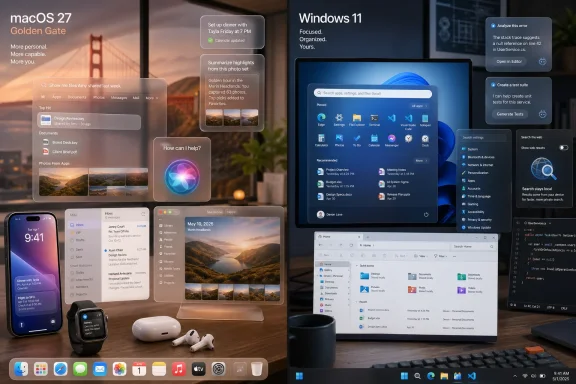
Apple’s advantage at WWDC was the kind of advantage Apple usually has: coherence. macOS 27 Golden Gate appears as part of a synchronized platform story across iOS, iPadOS, watchOS, visionOS, and the Mac. Liquid Glass gets another round of tuning, Siri becomes more visibly central, and Apple Intelligence is treated less like a bolt-on feature than a system layer.That matters. Apple’s best software moments happen when the company makes a feature feel inevitable across devices. A Mac user who also owns an iPhone, iPad, Apple Watch, and AirPods will likely see Golden Gate as another tightening of the ecosystem rather than a standalone desktop release.
But the keynote also revealed Apple’s current constraint. The company is now so focused on making AI feel native that some older Mac frustrations barely get oxygen. Mac gaming remains a secondary story. Android integration remains practically nonexistent. Window management has improved over the years, but the Mac still does not feel as flexible for all workflows as Windows does. And the end of Intel Mac support in Golden Gate marks a clean architectural break that will be rational for Apple but painful for users who bought capable Intel Macs not very long ago.
Microsoft, by contrast, has spent years squandering goodwill with web search in the Start menu, inconsistent settings surfaces, Edge nudges, Copilot hype, and an update cadence that often feels like a product manager’s calendar more than a user’s need. Yet the Windows story coming out of Build 2026 is notable because it sounds less like a moonshot and more like a repair plan. If Microsoft is serious about letting users disable Bing in Start search, improving File Explorer reliability, standardizing around WinUI, and tuning Windows for developers, gamers, and power users, then it is attacking the complaints that have made Windows 11 feel needlessly hostile.
That is not as glamorous as a new Siri. It may be more important.
Golden Gate Shows Apple’s AI Confidence and Its Desktop Caution
Golden Gate is not an empty update. A dedicated Siri AI experience on macOS could become genuinely useful if it can reason across local context, apps, files, and user intent without becoming another chatbot window begging for prompts. Improvements to search indexing across Spotlight, Photos, and Mail could touch daily Mac usage more often than the headline demos suggest. Liquid Glass refinements are also welcome after a year in which Apple’s visual direction sometimes seemed more certain in concept videos than in practical readability.Apple’s strategy is easy to understand. The company wants AI to appear where users already are, not as a separate destination. That is the correct instinct for consumer computing. Most people do not want to “use AI” any more than they want to “use sync.” They want messages rewritten, photos found, documents summarized, appointments understood, and settings changed without a fight.
The issue is that the Mac is not just a consumer appliance. It is also a development machine, a creative workstation, a Unix-adjacent power-user box, a fleet device in schools and companies, and for some people a luxury laptop that should last long after Apple’s marketing cycle has moved on. A Mac update that foregrounds AI while leaving platform breadth largely untouched risks feeling lopsided.
That is especially true because Apple’s hardware transition is no longer the exciting new chapter it was in 2020 and 2021. Apple silicon is mature. The performance-per-watt story is established. The MacBook Air is excellent, the MacBook Pro is formidable, and the Mac mini and Mac Studio remain compelling machines for users who fit Apple’s mold. The next question is not whether Apple can build fast Macs. It is whether macOS can become more accommodating without weakening the qualities that make it Apple-like.
Golden Gate’s answer appears to be cautious. Apple is polishing the house, not adding doors.
Windows 11’s Best 2026 Feature May Be Restraint
The most encouraging thing about Microsoft’s current Windows posture is not any single feature. It is the reported decision not to rush toward Windows 12. For years, Microsoft has been tempted to treat Windows as a branding problem. If users are unhappy, rename the era, redesign a few surfaces, and tell everyone the next thing is cleaner.That approach would be especially risky now. Windows 11 is still settling into its role as the default PC operating system for consumers and enterprises, while Windows 10’s long tail remains a practical reality for many organizations. A major new version would create another migration story before Microsoft has fully earned trust in the current one.
A steadier Windows 11 roadmap is the better move. File Explorer speed matters more than a new logo. Start menu search that respects local intent matters more than a Copilot panel that cannot reliably justify its place. Native UI consistency matters more than yet another settings migration that leaves three generations of control panels behind.
This is the strange thing about operating systems in 2026: the winning features are often the least demo-friendly. A Start menu that finds the app you typed. A file manager that does not hesitate on network paths. A settings app that does not route you through archaeological layers of Windows history. A graphics stack that lets games, handhelds, and external displays behave predictably. A developer platform that makes native apps feel worth building again.
If Microsoft delivers those improvements, Windows 11’s reputation will change faster than another AI rebrand ever could.
Apple’s Ecosystem Is a Fortress, but Windows Is Still a City
Apple’s ecosystem integration is a competitive weapon. The Mac works beautifully with the iPhone in ways Windows still cannot fully match. AirDrop, Universal Clipboard, iMessage, FaceTime, Continuity Camera, and device handoff remain powerful reasons to stay inside Apple’s world. Golden Gate will almost certainly deepen that advantage for people already invested in Apple hardware.But a fortress is not the same thing as a city. Windows is messier because it has to be. It runs on budget laptops, workstation towers, gaming handhelds, corporate desktops, home-built PCs, Arm laptops, x86 machines, tablets, and increasingly strange hybrid devices. It has to accommodate Nvidia, AMD, Intel, Qualcomm, printer vendors, anti-cheat vendors, accessibility tools, enterprise agents, ancient peripherals, and applications whose installers look like they were last touched during the Obama administration.
That mess is why Windows users complain. It is also why Windows remains indispensable.
The PCMag argument lands because it identifies platform breadth as more than a spec-sheet virtue. Windows connects better with Android phones. Windows is the default target for PC gaming. Windows is where most anti-cheat systems, launchers, drivers, mods, and peripheral ecosystems are designed to work first. Windows is also where many enterprise tools assume they will live.
Apple can point to quality; Microsoft can point to range. In 2026, range is not a small advantage. As computing fragments into handheld PCs, AI workstations, Arm laptops, cloud-connected dev boxes, and local-agent experiments, the operating system that tolerates more hardware and more use cases has a strategic opening.
Gaming Remains the Mac’s Most Obvious Unforced Error
The Mac gaming story has improved, but it is still not good enough. Apple silicon is capable. The GPUs in higher-end Macs are not toys. The displays are excellent, the speakers are strong, and the laptops are quiet and efficient. On paper, many Macs should be superb gaming machines.In practice, Windows remains the center of gravity. The biggest releases, the broadest back catalogs, the most consistent controller and peripheral support, the most mature anti-cheat compatibility, and the most active modding communities all point toward the PC. Valve’s work with Proton and the Steam Deck has shown that platform barriers can be softened with enough engineering will. Apple has not shown comparable urgency.
That matters because gaming is not a niche desktop use case. It is one of the main reasons many households keep a Windows PC around even when they also own Apple devices. It drives GPU purchases, display upgrades, storage decisions, input devices, streaming setups, and increasingly handheld hardware. It is also a cultural force among the same younger users Apple wants to keep as they age from iPhones into laptops and desktops.
Apple does not need to become a gaming company. But it does need to decide whether the Mac is content to be a premium productivity island while the largest entertainment category in software continues to treat macOS as optional. Golden Gate’s AI story does not answer that question.
Windows, meanwhile, does not have to be elegant to win here. It has the games. It has the hardware partners. It has Xbox integration, Game Pass, handheld PC momentum, and decades of developer assumptions working in its favor. Microsoft can fumble the interface and still retain the platform because the ecosystem is too valuable to abandon.
The End of Intel Macs Is Rational, Ruthless, and Revealing
Golden Gate’s reported Apple silicon-only support is not surprising. Apple has been moving toward this moment since the first M1 Macs arrived. From an engineering standpoint, dropping Intel simplifies testing, enables tighter optimization, and lets Apple focus on the neural engines, memory architecture, GPU capabilities, and security model of its own chips.From a user standpoint, it still stings. Some Intel Macs remain perfectly usable machines. They browse, compile, edit, stream, write, and run office workloads without obvious distress. The fact that they are now outside the next major macOS release underscores the difference between Apple’s hardware excellence and Apple’s lifecycle philosophy.
Microsoft has its own support cliff problem, most notably with Windows 11’s hardware requirements and the looming pressure on Windows 10 holdouts. But Windows as a platform still covers a broader range of silicon and machine types. Traditional x86 PCs remain central, while Windows on Arm continues to improve. If Nvidia’s deeper Arm ambitions produce more serious Windows devices and better application support, Microsoft could gain something Apple no longer seeks: architectural pluralism.
Apple’s silicon transition was cleaner because Apple controls the stack. Windows’ transition is slower because Microsoft does not. But slow does not always mean weak. A Windows ecosystem that can support Intel, AMD, Qualcomm, Nvidia, desktops, laptops, handhelds, and workstations may be better positioned for the next hardware cycle than a Mac ecosystem optimized around Apple’s own excellent but closed path.
That does not make Apple wrong. It makes Apple narrower.
The AI Race Is Less Important Than the Trust Race
Both Apple and Microsoft want the personal computer to become more agentic. They imagine systems that understand context, carry out multistep tasks, summarize what matters, and bridge apps without requiring the user to become a prompt engineer. The difference is that Apple is better at presenting this future as a user experience, while Microsoft is more visibly trying to build the plumbing for developers and local workloads.Neither company has fully earned the victory lap. Apple’s earlier Apple Intelligence rollout was criticized for delays and uneven capability, making Golden Gate’s Siri push as much a redemption effort as a launch. Microsoft’s Copilot branding has been even more chaotic, spreading across Windows, Microsoft 365, Edge, GitHub, security products, and enterprise tools until the word sometimes feels less like a product than a corporate reflex.
For Windows users, the question is not whether Microsoft can say “agent” more often than Apple says “intelligence.” It is whether Microsoft can make AI features feel trustworthy on a machine people use for sensitive work, gaming, coding, banking, and personal storage. Recall damaged that trust before it even became a mainstream feature. Copilot’s usefulness remains uneven. And many users still suspect that any new Windows intelligence layer will arrive with ads, account nudges, telemetry questions, and default settings that favor Microsoft’s business model over user intent.
That is why the practical Windows improvements matter so much. If Microsoft wants users to accept local agents, it first has to show that it can respect the basics. A faster File Explorer is not just a performance improvement; it is a credibility signal. A Start menu less polluted by web results is not just a convenience; it is an admission that users know what they are trying to open. A stronger native app framework is not just developer housekeeping; it is a bet that Windows can feel coherent again.
Apple starts with more trust. Microsoft has to rebuild it. But rebuilding trust through mundane fixes may be exactly the right strategy.
Developers Still Decide the Desktop’s Future
The desktop operating system wars are not only about end users. Developers shape what a platform can become. Apple’s developer story is strong when the target is Apple’s ecosystem. Swift, SwiftUI, Xcode, TestFlight, and the App Store economy give developers a clear route into Apple’s world. The Mac also remains beloved in many software circles because of its Unix foundation and high-quality hardware.But Windows is still the broader developer battlefield. It is where enterprise software lives, where PC games ship, where hardware utilities run, where many AI workloads will be tested locally, and where cross-platform frameworks must prove themselves. Microsoft’s challenge has been less reach than coherence. Windows development has too often felt like a menu of overlapping eras: Win32, UWP, WPF, WinUI, Electron, WebView, .NET variants, packaged apps, unpackaged apps, Store apps, non-Store apps, and framework promises that seemed to arrive with expiration dates.
If Microsoft is now serious about WinUI standardization and native app quality, that is a big deal. Windows does not need every app to be native, but it does need native development to feel modern, documented, and worth the effort. Too many Windows apps have become web wrappers not because developers love the memory overhead, but because the native path has felt unstable or unrewarding.
AI raises the stakes. Local agents will need permissions, UI surfaces, file access, semantic indexing, hardware acceleration, and predictable integration points. Developers will not build serious agentic software for a platform they perceive as incoherent. Microsoft has the pieces: Windows, DirectML, ONNX Runtime, developer tools, Azure, GitHub, and a massive installed base. The question is whether it can align them without burying developers under branding fog.
Apple’s developer story is cleaner. Microsoft’s opportunity is larger.
Windows on Arm Is Finally Becoming More Than a Qualcomm Story
Windows on Arm has spent years as a technology that was always improving and never quite arriving. The first waves were compromised by performance gaps, app compatibility concerns, limited device variety, and a sense that users were being asked to accept less for the promise of battery life. Qualcomm’s recent Snapdragon-powered PCs improved the situation substantially, but the ecosystem still needed broader validation.That is why Nvidia’s reported role in high-end Windows on Arm hardware is strategically significant. If Arm Windows machines are no longer seen only as thin-and-light productivity laptops, the platform changes. Developers pay attention when performance devices appear. Game makers pay attention when GPU vendors and anti-cheat providers have a reason to care. Enterprises pay attention when the hardware map starts to include credible options beyond one chip supplier.
Apple proved that Arm laptops can be excellent mainstream computers. Microsoft’s harder task is proving that Arm can work in the chaotic Windows world. That means emulation, drivers, games, enterprise agents, VPNs, security tools, creative apps, and hardware accessories. It is not enough for Word and a browser to run well.
If Microsoft and its partners pull this off, Windows gains something Apple cannot copy without changing its philosophy: a competitive Arm ecosystem with multiple vendors. Apple silicon will likely remain more vertically optimized. Windows on Arm could become more diverse. In technology markets, diversity often looks inefficient until it produces unexpected winners.
The Start Menu Is a Symbol Because It Is the Front Door
Few Windows complaints are as emotionally charged as Start menu search. That may seem disproportionate until you remember what the Start menu represents. It is the front door of the operating system. When a user types “Notepad,” “Device Manager,” or the name of a local file, they are not asking for a web journey. They are asking the computer in front of them to do the obvious thing.Microsoft’s insistence on web results in Start search has long felt like a small betrayal repeated many times a day. It collapsed the distinction between local intent and online discovery. It made Windows feel less like a tool and more like a funnel. It also gave users the impression that Microsoft could not resist turning even the most basic OS interaction into a Bing growth surface.
An option to disable Bing search in the Start menu would not fix every complaint about Windows 11. But it would be symbolically powerful because it concedes the user’s point. Local search should be local when the user wants it to be. The operating system should not second-guess that intent for engagement metrics.
This is where Microsoft’s practical turn could gain traction. Not because every user will find the toggle. Not because IT admins will suddenly forgive years of policy wrestling. But because the company would be moving in the correct direction: toward Windows as a user-respecting platform rather than Windows as a delivery mechanism for adjacent services.
Apple rarely makes this exact mistake because its business model does not require the same web-search pressure inside macOS. But Apple has its own version of the problem: an ecosystem that often assumes the user’s other devices are Apple devices, their preferred services are Apple-friendly, and their software needs fit Apple’s rules. Microsoft’s challenge is overreach. Apple’s challenge is exclusion.
The PC Is Becoming Personal Again, but Not in the Way Marketers Mean
The phrase “personal computer” has been worn smooth by decades of use, but AI gives it new tension. A genuinely personal computer would understand the user’s files, habits, projects, devices, contacts, and constraints. It would help without leaking. It would automate without surprising. It would learn without becoming creepy. It would be local when locality matters and cloud-connected when scale matters.Apple’s version of this future is privacy-forward, vertically integrated, and experience-led. Microsoft’s version is developer-heavy, cloud-adjacent, enterprise-aware, and hardware-diverse. Both are plausible. Both are incomplete.
For WindowsForum readers, the practical difference is control. Windows users tend to tolerate rough edges when they can configure around them, replace components, choose hardware, script workflows, and run the software they need. The fear is that AI will reduce that control by inserting opaque mediation between user and machine. The opportunity is that AI could increase control by making complex operations easier to express and execute.
A local Windows agent that can safely manage files, summarize logs, configure development environments, troubleshoot drivers, or automate repetitive admin tasks would be valuable. A cloud-first assistant that nags users toward subscriptions and misreads context would not. The same goes for Apple. A Siri that understands the Mac and respects boundaries would be useful. A glossy chatbot that mostly repackages web answers would not change the desktop balance.
The operating system that wins will not be the one with the most theatrical AI demo. It will be the one that makes users feel more capable.
The Real Golden Gate Test Is What Apple Chose Not to Cross
Apple’s naming is almost too convenient. Golden Gate evokes a bridge, but macOS 27 appears to reinforce Apple’s side of the bay more than it opens new crossings. The Mac becomes more intelligent, more visually refined, and more consistent with Apple’s other devices. It does not become meaningfully more welcoming to Android users, more serious as a gaming platform, or more open as a compatibility target.That may be the correct business decision. Apple’s most profitable users like the ecosystem because it is integrated. The company has little incentive to make the Mac a neutral platform when neutrality would weaken the pull of the iPhone. Every Android bridge not built is also an iPhone moat preserved.
Microsoft does not have that luxury. Windows has to be the neutral ground because its ecosystem depends on everyone showing up. Phone Link has to care about Android. Game Mode has to care about handhelds. Windows on Arm has to care about legacy x86 applications. Enterprise Windows has to care about old line-of-business software. Developers have to care about multiple frameworks because Microsoft has accumulated decades of them.
That burden creates dysfunction, but it also creates relevance. Windows remains the place where incompatible worlds are forced to negotiate. In 2026, that may be more valuable than Apple’s polish.
Redmond’s Most Persuasive Pitch Is Finally Less Futuristic
Microsoft has spent much of the past few years trying to convince users that the future of Windows is AI. The more persuasive message now is that the future of Windows is Windows, repaired. That does not mean AI disappears. It means AI has to wait its turn behind reliability, performance, user choice, gaming, developer confidence, and hardware support.That sequencing matters. Users do not reject AI because they hate the future. They reject AI when it arrives as compensation for neglect. A Copilot button does not make File Explorer faster. A generative summary does not make the Start menu respect local search. An agentic workflow does not fix inconsistent UI frameworks. Microsoft’s smartest move is to treat those basics not as legacy chores but as prerequisites.
Apple has the opposite problem. Its basics are strong enough that it can make AI feel like the main event. But that confidence can shade into complacency. If macOS becomes more intelligent without becoming more flexible, Apple may delight the faithful while giving Windows a clearer claim on everyone who needs a broader machine.
This is why the PCMag piece resonates beyond brand preference. It identifies a rare moment when Microsoft’s less glamorous roadmap may be the more consequential one. Apple is showing what a polished AI-first desktop can look like. Microsoft is hinting that a general-purpose desktop can still get better at being general-purpose.
The Windows Advantage Hides in the Unglamorous Fixes
The next year of desktop computing will not be decided by keynote applause. It will be decided by whether the promised improvements survive contact with real machines, corporate policies, game launchers, driver stacks, and impatient users. For now, the most concrete reading is straightforward.- Apple’s macOS 27 Golden Gate appears to be a polished Apple silicon-era release centered on Apple Intelligence, Siri, Liquid Glass refinement, and cross-platform consistency.
- Microsoft’s Windows 11 strategy looks more compelling when it focuses on core experience repairs rather than treating AI as a substitute for operating-system discipline.
- Windows still has the stronger gaming ecosystem, broader hardware support, and better Android-adjacent story, which matter more to many users than another assistant demo.
- Apple’s move away from Intel Macs is technically logical but reinforces the Mac’s narrower, more controlled future.
- The most important Windows improvements may be the least flashy ones: local-first search behavior, faster File Explorer, better native UI consistency, and renewed attention to developers and power users.
- AI will matter on both platforms, but users will reward the company that makes the computer feel more capable rather than more promotional.
References
- Primary source: PCMag
Published: Tue, 09 Jun 2026 14:29:14 GMT

Apple's macOS 27 Golden Gate Looks Slick, But Windows 11 Wins Where It Counts
Golden Gate makes Macs smarter, but Microsoft is making Windows less frustrating—a difference that matters more in everyday use.www.pcmag.com
- Related coverage: axios.com

Apple debuts software updates amid Siri overhaul
The announcements comes as Apple holds its annual developer conference.www.axios.com
- Related coverage: tomsguide.com
macOS 27: 5 biggest WWDC 2026 announcements we expect | Tom's Guide
WWDC 2026 is days away, and we'll soon learn about all the new features coming to macOS 26. Here's what we expect to hear, based on rumors and reports.www.tomsguide.com - Related coverage: techradar.com
Forget Siri — these are the 5 things I actually want iOS 27 to fix on my iPhone at WWDC 2026 | TechRadar
You can do this, Applewww.techradar.com - Related coverage: tomshardware.com
Apple demonstrates cross-platform Siri upgrades in macOS 27 Golden Gate at WWDC — update brings Liquid Glass improvements and unifies AI strategy | Tom's Hardware
macOS 27 brings new AI features and, finally, matching corner radii.www.tomshardware.com - Related coverage: macrumors.com

Everything Apple Announced at WWDC 2026 in 10 Minutes
Apple held its WWDC 2026 keynote today, introducing iOS 27, macOs 27, iPadOS 27, watchOS 27, visionOS 27, and tvOS 27. It took Apple an hour and a half to walk through the major new features in the updates, but we have a quicker 10 minute recap for those who want the highlights. Subscribe to the... www.macrumors.com
- Related coverage: macworld.com

macOS 27 guide: All the new features coming to compatible Macs in 2026
macOS 27 will introduce major Apple Intelligence upgrades, changes to Siri, and improvements across core apps. Here's what you need to know. www.macworld.com
- Related coverage: appleinsider.com
macOS 27 'Golden Gate' Liquid Glass, Siri
Apple has unveiled its next Mac operating system, macOS Golden Gate, with Apple promising better performance, the improved Siri, and more.appleinsider.com - Related coverage: techcrunch.com

WWDC 2026: Everything announced on Siri AI, iOS 27, Apple Intelligence and more | TechCrunch
Apple primarily made the case for an improved experience with its longstanding Siri assistant, which like most other announcements had a hefty helping of AI. techcrunch.com
- Related coverage: digitaltrends.com
Apple unveils macOS 27 Golden Gate with standalone Siri AI app and smarter Apple Intelligence features - Digital Trends
Apple has previewed macOS 27 Golden Gate with a standalone Siri AI app, smarter Spotlight search, Apple Intelligence upgrades, and refreshed Liquid Glass visuals.www.digitaltrends.com - Related coverage: gigazine.net
macOS 27のコードネームは「Golden Gate」、Siriの単体アプリを搭載しLiquid Glassの視認性も向上 - GIGAZINE
日本時間の2026年6月9日(火)午前2時から開催されているAppleの年次開発者会議「WWDC26」の基調講演で、iOS・iPadOS・macOS・watchOS・tvOS・visionOS にバージョン27が登場することが発表されました。macOS 27のコードネームは「Golden Gate」になります。gigazine.net - Related coverage: shacknews.com
MacOS 27 AKA 'Golden Gate' announced at Apple WWDC 26 | Shacknews
Apple is boasting a boost in app loading speed, as well as adjustments and improvements to the Liquid Glass UI feature.www.shacknews.com - Related coverage: abit.ee

Apple WWDC 2026: New Siri Powered by Google Gemini, macOS 27 Golden Gate and visionOS 27
Apple at WWDC 2026 unveiled a rebuilt Siri AI powered by Google Gemini, announced macOS 27 Golden Gate with Liquid Glass refinements, and updated visionOS 27 for Vision Pro.abit.ee
- Related coverage: applesfera.com

Resumen de la WWDC 2026: Siri AI, iOS 27 y todas las novedades que Apple ha presentado
Apple ha presentado una nueva hornada de software y, como veremos, Siri —o mejor dicho, Siri AI— es la gran protagonista. Está integrada en todos los sistemas...www.applesfera.com
- Related coverage: los40.com
WWDC 2026: Siri AI, macOS "Golden Gate" y el fin de una era en Apple | Tecnología | LOS40
La última keynote liderada por Tim Cook como CEO, nos ha dado una profunda renovación de sistemas operativos y una agresiva integración de la inteligencia artificial nativa a través de Apple Intelligence.los40.com - Related coverage: 9to5mac.com
Apple announces macOS Golden Gate 27 - 9to5Mac
During the WWDC26 keynote today, Apple announced macOS Golden Gate 27, the next major OS version for the Mac. Here are the details.9to5mac.com - Related coverage: omni.se
Golden Gate, ”liquid glass” och Siri – det här visade Apple upp på årets WWDC
Apple presenterade en rad nyheter när den årliga utvecklarkonferensen WWDC inleddes på måndagskvällen.omni.se - Related coverage: elpais.com

WWDC 2026: Apple presenta una Siri renovada con IA generativa que no podrán usar los iPhone y iPads en Europa
El popular asistente de voz inteligente tendrá este otoño, solo en inglés, las funciones de inteligencia artificial ya prometidas hace dos años por la empresa tecnológica, que no ha aclarado si llegarán a ser compatibles con la normativa europeaelpais.com
- Related coverage: cincodias.elpais.com