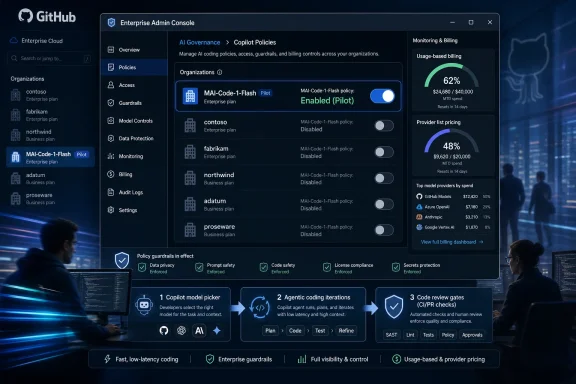
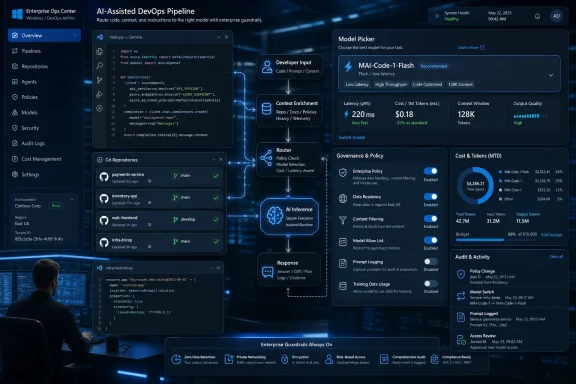
Microsoft made MAI-Code-1-Flash generally available for GitHub Copilot Business and Copilot Enterprise on June 26, 2026, giving organization administrators a new policy-controlled coding model built by Microsoft AI for low-latency, high-volume Copilot workflows. The announcement is small in changelog form but large in strategy. Microsoft is not merely adding another model to a picker; it is trying to make Copilot cheaper to run, easier to govern, and more dependent on Microsoft’s own AI stack. For enterprise developers, that shift matters as much as the model’s benchmark score.
MAI-Code-1-Flash arrives with the language of speed: “fast,” “low-latency,” “iterative,” and “agentic.” That is not marketing filler. In the Copilot era, latency is product quality, and token efficiency is business model survival.
GitHub Copilot began life as an autocomplete miracle. It is now being pulled toward something more expensive: an always-on coding agent that reads repositories, proposes changes, runs tools, explains failures, and loops through tasks that once belonged to a developer’s uninterrupted afternoon. A single prompt can now mean a short answer, a long reasoning chain, a test-writing session, or a multi-step repository operation. Those are not equivalent workloads, even if the interface makes them feel like one chat box.
That is why MAI-Code-1-Flash should be read alongside GitHub’s broader move toward usage-based billing. A model optimized for Copilot, trained around Copilot’s production harnesses, and priced under provider list pricing is a tool for making the economics of agentic coding less volatile. Microsoft wants the convenience of Copilot to keep expanding without every long-running agent session becoming an expensive dependency on someone else’s frontier model.
The most important word in the announcement may be in-house. Microsoft has spent the past several years both benefiting from and being constrained by its partnerships with outside AI model providers. With MAI-Code-1-Flash, the company is signaling that at least some of Copilot’s future will be built on Microsoft-owned models tuned for Microsoft-owned developer surfaces.
General availability for Copilot Business and Copilot Enterprise is a different threshold. It means the model has crossed from developer novelty into admin policy, procurement, auditability, and spend management. In those environments, the question is not “Can I try it?” but “Who can use it, what will it cost, and can we explain the decision later?”
GitHub’s changelog makes that governance line explicit. Copilot Enterprise and Copilot Business administrators must enable the MAI-Code-1-Flash policy in Copilot settings before users can access it. That opt-in design is not accidental. Enterprises do not want every new model automatically appearing in production developer workflows, especially when the model has distinct billing behavior and may affect code generation, data handling assumptions, and internal support expectations.
The policy gate also gives Microsoft a neat answer to two constituencies. Developers get another model option. Administrators get to say no, or at least not yet. That split is now the defining tension of AI-assisted software development inside large organizations.
In enterprise Copilot, model choice is also a spending control. MAI-Code-1-Flash is billed at provider list pricing under usage-based billing, which means the unit economics sit closer to API-style consumption than the old mental model of “I pay for Copilot, therefore Copilot is paid for.” That is a dramatic cultural shift for teams that adopted Copilot as a predictable per-seat subscription.
The trouble is that software development does not consume AI evenly. A developer may use Copilot lightly for days, then burn through a large amount of inference during a difficult migration, a generated test suite, or a stuck agent loop. Multiply that by a few hundred engineers and the budget conversation quickly becomes less about whether Copilot is useful and more about whether the organization understands its own usage patterns.
Microsoft’s answer is not to stop agentic coding. It is to provide a cheaper, faster model tier that is good enough for many common coding tasks and optimized for the environment where those tasks happen. MAI-Code-1-Flash is therefore not positioned as the one model to rule all coding work. It is positioned as the model you can afford to use often.
A coding assistant that is theoretically superior but slow can feel worse than a slightly weaker model that stays in rhythm. Developers live in loops: ask, inspect, edit, run, fail, ask again. A model that returns useful output quickly can keep that loop intact, especially when the task is narrow enough that the best answer is not a dissertation.
Microsoft says MAI-Code-1-Flash was designed for fast, efficient assistance in everyday developer workflows and that it can adjust its response length to the complexity of the task. That adaptive behavior is the real product promise. If the model can stay terse for obvious refactors and spend more effort on harder tasks, it reduces both latency and unnecessary token burn.
That is the ideal version. The enterprise version will be messier. Developers will still need to learn when the model is appropriate, when to escalate to a heavier model, and when Copilot’s confidence outpaces its grasp of a codebase. A fast wrong answer is still wrong; it is simply wrong sooner.
That matters because a generic coding model and a Copilot-tuned model do not face the same job. Copilot has context windows, repository tools, IDE state, extension behavior, user prompts, organizational policies, and agentic scaffolding around it. A model trained and evaluated against those conditions can be optimized for the messy reality of developer assistance rather than abstract coding puzzles.
Microsoft has said the model was trained around GitHub Copilot production harnesses and evaluated on software engineering tasks, repository question answering, refactoring, and telemetry-grounded tasks adapted from Copilot usage. That is exactly the sort of integration advantage platform companies like to exploit. If you own the IDE surface, the repository platform, the cloud backend, and the model, you can optimize across boundaries that third-party model providers can only observe from the outside.
The strategic upside for Microsoft is clear. The more Copilot depends on Microsoft-tuned models, the less it is merely a storefront for OpenAI, Anthropic, Google, or anyone else. The risk is equally clear: if customers suspect model routing is being driven more by Microsoft’s margin than by developer outcomes, trust in the picker and the “auto” experience will erode.
That decision will vary by organization. A startup-style engineering group inside a larger company may want the model enabled immediately because speed matters and the team already experiments with model routing. A regulated enterprise may want security, legal, and procurement teams to review documentation before developers can select it. A cost-sensitive IT department may see the model as a way to move routine Copilot usage away from more expensive alternatives.
The awkward middle ground is where most organizations live. They want developers to move faster, but they do not yet have mature internal practices for AI coding governance. They may have Copilot licenses assigned, but not clear rules around agentic workflows, generated code review, model selection, or spending limits.
MAI-Code-1-Flash will force those conversations sooner. It is not because the model is uniquely risky. It is because every new model makes the Copilot estate look less like a single product and more like a portfolio of compute choices.
Data handling is only one part of that contract. Customers also care about whether generated code is reliable, whether model updates change output quality without warning, whether “generally available” means suitable for critical work, and whether usage reports are detailed enough to support chargeback or budget enforcement. The governance surface must expand because the product surface has expanded.
There is also a subtle support issue. When a developer says “Copilot gave me bad advice,” the next question is increasingly “Which model?” A bug report tied to MAI-Code-1-Flash may not mean the same thing as one tied to a heavier frontier model or a different provider’s coding model. Enterprise support teams will need to capture that context, and GitHub will need to make it visible enough to be useful.
This is the less glamorous side of model choice. Choice improves flexibility, but it also creates configuration drift. In a large company, two teams using “Copilot” may now be using meaningfully different AI systems under the same brand.
For WindowsForum readers, that should sound familiar. Microsoft has often won by turning a capability into a platform dependency. Office integration strengthened Windows. Active Directory strengthened enterprise Windows. Azure strengthened Microsoft’s cloud-era identity and management story. Copilot is now becoming the connective tissue across developer tools, productivity apps, Windows, and cloud services.
Owning more of the model stack gives Microsoft three kinds of leverage. It can reduce exposure to external provider pricing, tune models for specific Microsoft workflows, and decide how aggressively to bundle or meter AI features across its products. That does not mean Microsoft will abandon third-party models. Copilot’s value partly comes from giving users access to a range of capable systems. But Microsoft clearly wants a stronger home-field option.
The phrase “built for GitHub Copilot” is therefore doing two jobs. It describes a technical optimization, and it advertises a strategic direction. Microsoft wants customers to believe that the best Copilot experience may come from models designed inside the same house.
Those moments matter because coding assistants are not only judged by correctness. They are judged by interruption cost. A model that produces plausible but slightly misaligned code can waste more time than it saves, especially if the developer has to audit every line with suspicion.
The “Flash” model category also raises expectations around responsiveness. If Microsoft pitches the model as a low-latency workhorse, developers will be less forgiving of stalls, verbose answers, or agent loops that consume time and budget without converging. Speed is a promise that users notice immediately when it breaks.
The most likely outcome is not universal love or rejection. MAI-Code-1-Flash will probably find a role in the middle of the coding-assistant spectrum: better than minimal autocomplete, cheaper and faster than heavier models, and useful for the repeated tasks that make up much of professional software work. That is not glamorous, but it is exactly where a lot of enterprise value lives.
A mature rollout should not simply flip the switch and hope for the best. Admins need to know whether usage-based billing is enabled, what budgets apply, which teams are allowed to experiment, and how model usage will be monitored. They also need to communicate that model choice can affect cost, latency, and output quality.
This is where many organizations will discover that their AI governance is still mostly aspirational. They may have rules about not pasting secrets into chat tools, but fewer rules about agentic edits, automated pull request reviews, or model-specific spending. Copilot’s expanding model menu turns those gaps into operational questions.
The Windows admin lesson is old but applicable: defaults become infrastructure. If MAI-Code-1-Flash becomes the default or commonly recommended option for enterprise Copilot users, its behavior will shape thousands of small engineering decisions. That deserves more scrutiny than a changelog line usually receives.
MAI-Code-1-Flash adds to that complexity. A user may think they are using Copilot, while the administrator thinks they are managing a policy, the finance team thinks they are monitoring AI Credits, and Microsoft thinks it is routing workloads across a model portfolio. All of those views are true, but they are not the same view.
The risk is confusion at the exact moment enterprises need clarity. If pricing, model availability, and feature behavior vary across plans, admins must become translators. They have to explain why one developer sees a model and another does not, why a task costs more than expected, or why a model that appeared in VS Code is not enabled for the organization.
Microsoft can manage this if the tooling is good. Clear admin controls, transparent billing reports, and predictable model documentation would go a long way. Without that, the model picker becomes another place where developer enthusiasm collides with enterprise caution.
What it does is mark a meaningful step in Copilot’s maturation. The product is moving from a single assistant experience toward a governed, usage-metered, multi-model developer platform. In that world, Microsoft’s ability to supply its own fast coding model is a strategic asset.
The announcement also shows how AI features are becoming more like cloud services. They have policies, meters, provider pricing, routing decisions, and budget implications. That is familiar terrain for IT pros, even if the user interface looks like a friendly chat pane inside an editor.
For developers, the best case is simple: another useful model, faster responses, lower cost for routine work, and less friction in iterative coding. For administrators, the best case is a controllable model option that lets teams adopt agentic workflows without handing the entire bill to the most expensive model in the menu. For Microsoft, the best case is bigger: Copilot becomes a distribution channel for its own AI models.
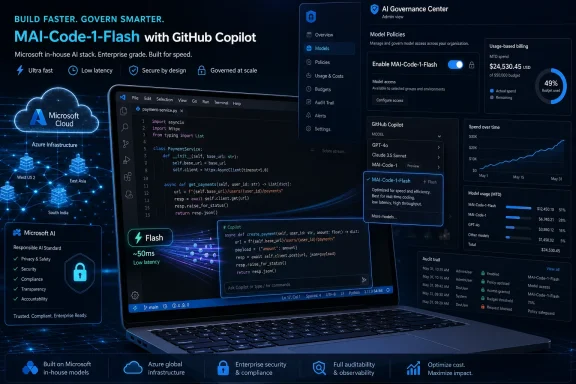 Microsoft’s New Coding Model Is Really a Copilot Cost-Control Story
MAI-Code-1-Flash arrives with the language of speed: “fast,” “low-latency,” “iterative,” and “agentic.” That is not marketing filler. In the Copilot era, latency is product quality, and token efficiency is business model survival.GitHub Copilot began life as an autocomplete miracle. It is now being pulled toward something more expensive: an always-on coding agent that reads repositories, proposes changes, runs tools, explains failures, and loops through tasks that once belonged to a developer’s uninterrupted afternoon. A single prompt can now mean a short answer, a long reasoning chain, a test-writing session, or a multi-step repository operation. Those are not equivalent workloads, even if the interface makes them feel like one chat box.
That is why MAI-Code-1-Flash should be read alongside GitHub’s broader move toward usage-based billing. A model optimized for Copilot, trained around Copilot’s production harnesses, and priced under provider list pricing is a tool for making the economics of agentic coding less volatile. Microsoft wants the convenience of Copilot to keep expanding without every long-running agent session becoming an expensive dependency on someone else’s frontier model.
The most important word in the announcement may be in-house. Microsoft has spent the past several years both benefiting from and being constrained by its partnerships with outside AI model providers. With MAI-Code-1-Flash, the company is signaling that at least some of Copilot’s future will be built on Microsoft-owned models tuned for Microsoft-owned developer surfaces.
General Availability Moves the Model From Curiosity to Procurement Problem
The model first appeared earlier in June for GitHub Copilot individual users, beginning in Visual Studio Code. That rollout made sense as a proving ground. Individual developers tolerate rough edges, switch models casually, and often treat the model picker as a playground.General availability for Copilot Business and Copilot Enterprise is a different threshold. It means the model has crossed from developer novelty into admin policy, procurement, auditability, and spend management. In those environments, the question is not “Can I try it?” but “Who can use it, what will it cost, and can we explain the decision later?”
GitHub’s changelog makes that governance line explicit. Copilot Enterprise and Copilot Business administrators must enable the MAI-Code-1-Flash policy in Copilot settings before users can access it. That opt-in design is not accidental. Enterprises do not want every new model automatically appearing in production developer workflows, especially when the model has distinct billing behavior and may affect code generation, data handling assumptions, and internal support expectations.
The policy gate also gives Microsoft a neat answer to two constituencies. Developers get another model option. Administrators get to say no, or at least not yet. That split is now the defining tension of AI-assisted software development inside large organizations.
The Model Picker Has Become a Budget Interface
For years, developers were trained to think of AI model choice as a quality decision. Pick the smartest model for hard work, the faster model for small work, and the cheapest model when you are experimenting. That distinction is still useful, but Copilot’s business plans now make it incomplete.In enterprise Copilot, model choice is also a spending control. MAI-Code-1-Flash is billed at provider list pricing under usage-based billing, which means the unit economics sit closer to API-style consumption than the old mental model of “I pay for Copilot, therefore Copilot is paid for.” That is a dramatic cultural shift for teams that adopted Copilot as a predictable per-seat subscription.
The trouble is that software development does not consume AI evenly. A developer may use Copilot lightly for days, then burn through a large amount of inference during a difficult migration, a generated test suite, or a stuck agent loop. Multiply that by a few hundred engineers and the budget conversation quickly becomes less about whether Copilot is useful and more about whether the organization understands its own usage patterns.
Microsoft’s answer is not to stop agentic coding. It is to provide a cheaper, faster model tier that is good enough for many common coding tasks and optimized for the environment where those tasks happen. MAI-Code-1-Flash is therefore not positioned as the one model to rule all coding work. It is positioned as the model you can afford to use often.
“Flash” Is Microsoft’s Bet That Developers Prefer Momentum to Majesty
The model’s name borrows from a familiar AI-industry pattern: Flash implies speed, responsiveness, and cost discipline rather than maximum reasoning depth. That framing is important because developer productivity tools are not judged like leaderboard entries. They are judged in the half-second before a developer loses patience.A coding assistant that is theoretically superior but slow can feel worse than a slightly weaker model that stays in rhythm. Developers live in loops: ask, inspect, edit, run, fail, ask again. A model that returns useful output quickly can keep that loop intact, especially when the task is narrow enough that the best answer is not a dissertation.
Microsoft says MAI-Code-1-Flash was designed for fast, efficient assistance in everyday developer workflows and that it can adjust its response length to the complexity of the task. That adaptive behavior is the real product promise. If the model can stay terse for obvious refactors and spend more effort on harder tasks, it reduces both latency and unnecessary token burn.
That is the ideal version. The enterprise version will be messier. Developers will still need to learn when the model is appropriate, when to escalate to a heavier model, and when Copilot’s confidence outpaces its grasp of a codebase. A fast wrong answer is still wrong; it is simply wrong sooner.
Microsoft Wants Copilot to Be a Workload, Not Just a Wrapper
The Copilot story has often been told as a user-interface story: put AI into the IDE, into GitHub, into pull requests, into the command line. MAI-Code-1-Flash points to a deeper shift. Microsoft is trying to make the model itself part of the Copilot product architecture.That matters because a generic coding model and a Copilot-tuned model do not face the same job. Copilot has context windows, repository tools, IDE state, extension behavior, user prompts, organizational policies, and agentic scaffolding around it. A model trained and evaluated against those conditions can be optimized for the messy reality of developer assistance rather than abstract coding puzzles.
Microsoft has said the model was trained around GitHub Copilot production harnesses and evaluated on software engineering tasks, repository question answering, refactoring, and telemetry-grounded tasks adapted from Copilot usage. That is exactly the sort of integration advantage platform companies like to exploit. If you own the IDE surface, the repository platform, the cloud backend, and the model, you can optimize across boundaries that third-party model providers can only observe from the outside.
The strategic upside for Microsoft is clear. The more Copilot depends on Microsoft-tuned models, the less it is merely a storefront for OpenAI, Anthropic, Google, or anyone else. The risk is equally clear: if customers suspect model routing is being driven more by Microsoft’s margin than by developer outcomes, trust in the picker and the “auto” experience will erode.
Business and Enterprise Customers Get Control, But Also Another Decision
The admin policy requirement is a sensible enterprise feature, but it also creates another layer of operational work. Someone now has to decide whether MAI-Code-1-Flash should be enabled, which users should get it, how its cost should be tracked, and whether it should become a recommended default for certain workflows.That decision will vary by organization. A startup-style engineering group inside a larger company may want the model enabled immediately because speed matters and the team already experiments with model routing. A regulated enterprise may want security, legal, and procurement teams to review documentation before developers can select it. A cost-sensitive IT department may see the model as a way to move routine Copilot usage away from more expensive alternatives.
The awkward middle ground is where most organizations live. They want developers to move faster, but they do not yet have mature internal practices for AI coding governance. They may have Copilot licenses assigned, but not clear rules around agentic workflows, generated code review, model selection, or spending limits.
MAI-Code-1-Flash will force those conversations sooner. It is not because the model is uniquely risky. It is because every new model makes the Copilot estate look less like a single product and more like a portfolio of compute choices.
The Enterprise AI Contract Is Still Being Written
GitHub’s enterprise pitch has always leaned on controls: policy settings, organization management, and business data protections. Those remain critical. But as Copilot becomes more model-diverse and usage-priced, enterprise customers will demand a clearer contract around behavior, cost, and accountability.Data handling is only one part of that contract. Customers also care about whether generated code is reliable, whether model updates change output quality without warning, whether “generally available” means suitable for critical work, and whether usage reports are detailed enough to support chargeback or budget enforcement. The governance surface must expand because the product surface has expanded.
There is also a subtle support issue. When a developer says “Copilot gave me bad advice,” the next question is increasingly “Which model?” A bug report tied to MAI-Code-1-Flash may not mean the same thing as one tied to a heavier frontier model or a different provider’s coding model. Enterprise support teams will need to capture that context, and GitHub will need to make it visible enough to be useful.
This is the less glamorous side of model choice. Choice improves flexibility, but it also creates configuration drift. In a large company, two teams using “Copilot” may now be using meaningfully different AI systems under the same brand.
Microsoft’s In-House Model Push Is About Leverage
MAI-Code-1-Flash is part of a larger Microsoft AI model family announced earlier in June, alongside models for reasoning, image generation, voice, and transcription. That matters because it suggests Microsoft is not treating in-house models as a side project. It is building a layer of product-specific AI capabilities that can be inserted into Microsoft’s own software estate.For WindowsForum readers, that should sound familiar. Microsoft has often won by turning a capability into a platform dependency. Office integration strengthened Windows. Active Directory strengthened enterprise Windows. Azure strengthened Microsoft’s cloud-era identity and management story. Copilot is now becoming the connective tissue across developer tools, productivity apps, Windows, and cloud services.
Owning more of the model stack gives Microsoft three kinds of leverage. It can reduce exposure to external provider pricing, tune models for specific Microsoft workflows, and decide how aggressively to bundle or meter AI features across its products. That does not mean Microsoft will abandon third-party models. Copilot’s value partly comes from giving users access to a range of capable systems. But Microsoft clearly wants a stronger home-field option.
The phrase “built for GitHub Copilot” is therefore doing two jobs. It describes a technical optimization, and it advertises a strategic direction. Microsoft wants customers to believe that the best Copilot experience may come from models designed inside the same house.
Developers Will Judge the Model in the Boring Places
Benchmarks will attract attention, especially Microsoft’s comparisons against Claude Haiku 4.5 on coding tasks. But most developers will form their opinion of MAI-Code-1-Flash in much duller situations. Does it explain a failing test without inventing a framework feature? Does it make a small refactor without touching unrelated files? Does it understand the difference between a quick patch and a design discussion?Those moments matter because coding assistants are not only judged by correctness. They are judged by interruption cost. A model that produces plausible but slightly misaligned code can waste more time than it saves, especially if the developer has to audit every line with suspicion.
The “Flash” model category also raises expectations around responsiveness. If Microsoft pitches the model as a low-latency workhorse, developers will be less forgiving of stalls, verbose answers, or agent loops that consume time and budget without converging. Speed is a promise that users notice immediately when it breaks.
The most likely outcome is not universal love or rejection. MAI-Code-1-Flash will probably find a role in the middle of the coding-assistant spectrum: better than minimal autocomplete, cheaper and faster than heavier models, and useful for the repeated tasks that make up much of professional software work. That is not glamorous, but it is exactly where a lot of enterprise value lives.
Sysadmins Should Read This as a Governance Warning
For administrators, the immediate action is straightforward: the model is not available to Copilot Business and Enterprise users until the relevant policy is enabled. The harder action is deciding what policy should mean in practice.A mature rollout should not simply flip the switch and hope for the best. Admins need to know whether usage-based billing is enabled, what budgets apply, which teams are allowed to experiment, and how model usage will be monitored. They also need to communicate that model choice can affect cost, latency, and output quality.
This is where many organizations will discover that their AI governance is still mostly aspirational. They may have rules about not pasting secrets into chat tools, but fewer rules about agentic edits, automated pull request reviews, or model-specific spending. Copilot’s expanding model menu turns those gaps into operational questions.
The Windows admin lesson is old but applicable: defaults become infrastructure. If MAI-Code-1-Flash becomes the default or commonly recommended option for enterprise Copilot users, its behavior will shape thousands of small engineering decisions. That deserves more scrutiny than a changelog line usually receives.
The Copilot Brand Is Stretching Under Its Own Success
Copilot now covers a sprawling set of experiences: inline suggestions, chat, pull request help, coding agents, command-line assistance, and integrations across GitHub and IDEs. The brand’s strength is that users know where to find it. The brand’s weakness is that “Copilot” no longer tells you enough about what is happening underneath.MAI-Code-1-Flash adds to that complexity. A user may think they are using Copilot, while the administrator thinks they are managing a policy, the finance team thinks they are monitoring AI Credits, and Microsoft thinks it is routing workloads across a model portfolio. All of those views are true, but they are not the same view.
The risk is confusion at the exact moment enterprises need clarity. If pricing, model availability, and feature behavior vary across plans, admins must become translators. They have to explain why one developer sees a model and another does not, why a task costs more than expected, or why a model that appeared in VS Code is not enabled for the organization.
Microsoft can manage this if the tooling is good. Clear admin controls, transparent billing reports, and predictable model documentation would go a long way. Without that, the model picker becomes another place where developer enthusiasm collides with enterprise caution.
The Practical Shape of This Release Is Smaller Than the Strategic One
It is tempting to overstate every AI model release as a watershed moment. MAI-Code-1-Flash is not that by itself. It does not instantly change how every enterprise writes software, nor does it settle the contest among coding models.What it does is mark a meaningful step in Copilot’s maturation. The product is moving from a single assistant experience toward a governed, usage-metered, multi-model developer platform. In that world, Microsoft’s ability to supply its own fast coding model is a strategic asset.
The announcement also shows how AI features are becoming more like cloud services. They have policies, meters, provider pricing, routing decisions, and budget implications. That is familiar terrain for IT pros, even if the user interface looks like a friendly chat pane inside an editor.
For developers, the best case is simple: another useful model, faster responses, lower cost for routine work, and less friction in iterative coding. For administrators, the best case is a controllable model option that lets teams adopt agentic workflows without handing the entire bill to the most expensive model in the menu. For Microsoft, the best case is bigger: Copilot becomes a distribution channel for its own AI models.
The Changelog Line That Should Make Admins Open Copilot Settings
The near-term lesson is not that every organization should enable MAI-Code-1-Flash immediately. It is that Copilot model governance has become a real administrative responsibility. A model release like this is small enough to miss and consequential enough to regret ignoring.- MAI-Code-1-Flash is now generally available for GitHub Copilot Business and Copilot Enterprise, but administrators must enable its policy before users can access it.
- The model is designed for fast, low-latency coding assistance in high-volume and iterative agentic workflows.
- GitHub says the model is billed at provider list pricing under usage-based billing, so organizations should review budgets and usage reporting before broad rollout.
- The release extends an earlier June rollout that brought MAI-Code-1-Flash to individual Copilot users, starting with Visual Studio Code.
- The broader significance is Microsoft’s push to make Copilot less dependent on third-party models and more tightly integrated with Microsoft’s own AI stack.
- Developers should treat the model as a fast workhorse for common coding tasks, not as a guaranteed replacement for heavier reasoning models in complex architectural work.
References
- Primary source: The GitHub Blog
Published: Fri, 26 Jun 2026 16:35:06 GMT
MAI-Code-1-Flash for Copilot Business and Copilot Enterprise - GitHub Changelog
MAI-Code-1-Flash, Microsoft AI’s in-house coding model, is now generally available for GitHub Copilot Business and Copilot Enterprise, building on its recent expansion across Copilot surfaces. Purpose-built for coding and optimized…github.blog
- Official source: docs.github.com
Requests in GitHub Copilot (legacy) - GitHub Docs
Learn about requests in Copilot, including premium requests, how they work, and how to manage your usage effectively. docs.github.com
- Official source: github.com
GitHub Copilot · Plans & pricing · GitHub
GitHub Copilot works alongside you directly in your editor, suggesting whole lines or entire functions for you. github.com
- Related coverage: unerr.dev
GitHub Copilot pricing explained: premium requests, AI Credits, and the agentic bill shock — unerr | unerr
Copilot moved to usage-based AI Credits on June 1, 2026 — and power users saw agentic bills jump 10–50×. What changed, which features are still unlimited, and how to keep agent workflows from draining a month of credits in a day.www.unerr.dev
- Related coverage: awesomeagents.ai
MAI-Code-1-Flash | Awesome Agents
Microsoft's first in-house coding model, a 137B sparse MoE built natively for GitHub Copilot, beating Claude Haiku 4.5 on SWE-Bench Pro by 16 points.awesomeagents.ai - Related coverage: 24-ai.news
GitHub Copilot usage-based billing: AI Credits from June 1, 2026 | 24 AI
GitHub Copilot moves to AI Credits on June 1, 2026. Code completions remain unlimited; chat and agents consume credits at model API rates.24-ai.news
- Related coverage: aidose.in
Microsoft Launches MAI-Code-1-Flash Coding Model Across GitHub Copilot Plans
Microsoft rolled out MAI-Code-1-Flash, its first in-house coding model, to every GitHub Copilot plan. The model outperforms Claude Haiku 4.5 across core coding benchmarks and solves harder problems with up to 60 percent fewer tokens.www.aidose.in - Related coverage: decodethefuture.org
Microsoft MAI-Code-1-Flash: Copilot's New Coding Model
Microsoft's MAI-Code-1-Flash is its first in-house coding model for GitHub Copilot: 137B MoE, 256K context, $0.75/$4.50 per 1M tokens. What it means. decodethefuture.org
- Related coverage: smartscope.blog
Microsoft MAI-Code-1-Flash in GitHub Copilot: Availability, Pricing, and Performance - SmartScope
MAI-Code-1-Flash is now rolling out in GitHub Copilot. This guide explains plan availability, VS Code rollout, AI Credits pricing, benchmark positioning, and how to use the model responsibly. smartscope.blog
- Related coverage: itpro.com
Everything you need to know about the GitHub Copilot pricing changes | IT Pro
GitHub Copilot pricing changes mean users will be charged based on consumption, rather than a set number of credits.www.itpro.com - Related coverage: tomshardware.com
Github Copilot customers report up to 100-fold price hikes — AI sticker shock bites as Microsoft switches to usage-based pricing | Tom's Hardware
The AI investment chickens have come home to roost.www.tomshardware.com - Related coverage: windowscentral.com
Microsoft's new AI delivers 10x faster responses with lower latency | Windows Central
Microsoft recently unveiled a new small language model called Phi-4-mini-flash-reasoning designed to bolster adaptive learning platforms and on-device due to its reduced latency, improved throughput, and math reasoning.www.windowscentral.com - Official source: microsoft.ai
Introducing MAI-Code-1-Flash | Microsoft AI
 microsoft.ai