

Microsoft’s MAI‑Image‑1 has quietly gone from preview to product: Microsoft now offers a homegrown text‑to‑image model inside Bing Image Creator and Copilot, positioning a fast, photorealism‑focused generator alongside existing options such as OpenAI’s DALL·E 3 and GPT‑4o and signaling a deliberate move to own more of the generative stack that powers its consumer and productivity surfaces.
Microsoft’s MAI program (Microsoft AI) has expanded rapidly through 2025 with a clear product‑first thesis: build smaller, purpose‑tuned models that trade headline parameter counts for low latency, integration depth, and predictable behavior inside apps most people already use. MAI‑Image‑1 is the company’s first image model developed entirely in‑house and follows MAI‑Voice‑1 (speech) and MAI‑1‑preview (text LLM). Microsoft framed the launch as an answer to practical creator needs — realistic lighting, natural scenes, and faster generation that supports iteration inside Copilot and Bing Image Creator. This release matters for three organizational reasons:
What MAI‑Image‑1 brings to the table:
First, the model‑level governance gap. Microsoft claims “rigorous data selection” and a safety‑first posture, but it has not published a comprehensive dataset manifest or model card for MAI‑Image‑1 at launch. That opacity raises three questions for enterprises:
Second, the corporate partnership context. Microsoft’s new definitive agreement with OpenAI (announced in late October 2025) extended Microsoft’s IP rights and Azure exclusivity windows through 2032 and clarified how both companies will handle a potential AGI milestone, among other terms. The deal preserves Microsoft’s privileged commercial relationship with OpenAI while giving both sides more independence; it also explicitly extends Microsoft’s IP rights to models and products through 2032 (with nuanced carve‑outs for “research IP” and consumer hardware). That contractual certainty matters: it gives Microsoft the runway to pursue in‑house models while continuing to commercialize OpenAI technology where it makes sense. Taken together, the new MAI family plus the reworked OpenAI pact creates a hybrid landscape where Microsoft can:
Why dethroning is hard in the near term:
Will MAI‑Image‑1 immediately dethrone DALL·E 3 or GPT‑4o? Not in the short term. Incumbency, documented safety pipelines, and contractual clarity give established providers an advantage. But Microsoft’s investment in an in‑house imaging stack, backed by a long‑term commercial arrangement with OpenAI that runs through 2032, creates a credible path for MAI‑Image‑1 to become a first‑class option for millions of users — provided Microsoft follows through with transparency, independent safety validation, and enterprise‑grade licensing assurances. For Windows Forum readers: the immediate recommendation is pragmatic experimentation — treat MAI‑Image‑1 as a valuable new tool for rapid creative workflows, but insist on the documentation and contractual clarity necessary to turn early wins into production‑grade adoption.
Source: Windows Central Microsoft launches its first custom AI image creator on Bing — could it ever dethrone OpenAI’s DALL·E 3 and GPT-4o?
 Background / Overview
Microsoft’s MAI program (Microsoft AI) has expanded rapidly through 2025 with a clear product‑first thesis: build smaller, purpose‑tuned models that trade headline parameter counts for low latency, integration depth, and predictable behavior inside apps most people already use. MAI‑Image‑1 is the company’s first image model developed entirely in‑house and follows MAI‑Voice‑1 (speech) and MAI‑1‑preview (text LLM). Microsoft framed the launch as an answer to practical creator needs — realistic lighting, natural scenes, and faster generation that supports iteration inside Copilot and Bing Image Creator. This release matters for three organizational reasons:- It reduces Microsoft’s operational dependency on third‑party image models.
- It gives Microsoft the option to route image requests between models (MAI, OpenAI, others) based on fidelity, cost or contractual constraints.
- It allows Microsoft to tailor moderation, provenance, and features directly into product flows across Windows, Microsoft 365, and Copilot.
What Microsoft says MAI‑Image‑1 does — and what’s verifiable
Microsoft’s public messaging highlights three strengths for MAI‑Image‑1: photorealism (especially lighting and reflections), speed, and diversity of outputs (less “samey” results). The company emphasizes iterative, product‑grade behavior: rapid generations suitable for moodboards, product mockups, social assets, and quick prototyping inside Copilot or Bing. Independent coverage and early hands‑on impressions broadly corroborate Microsoft’s claims about the model’s taste and speed, noting particularly good outputs for nature scenes, food photography, and scenes using nuanced lighting. Mustafa Suleyman, Microsoft AI’s CEO, publicly announced the rollout and explicitly listed those strengths — artistic lighting, nature scenes, and food — while inviting users to try the model in Bing and Copilot. What is not yet verifiable from published material:- Precise model architecture, parameter count, or training‑data inventory (Microsoft has not released a full model card or dataset manifest at the time of the launch).
- Independent, standardized benchmarks of latency and throughput measured across consistent hardware.
- Comprehensive adversarial safety evaluations or third‑party audits that quantify worst‑case failure modes (deepfakes, identity replication, memorized copyrighted content).
Where you can use it today — availability and product placement
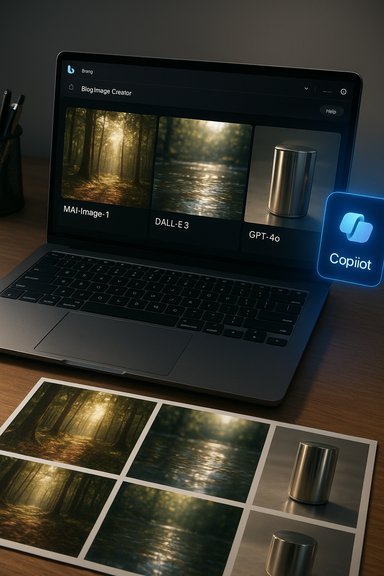
MAI‑Image‑1 is live inside Bing Image Creator and Copilot Audio Expressions/ Copilot interfaces in many markets, and users can now select MAI‑Image‑1 as a model option alongside DALL·E 3 and GPT‑4o in the Bing Image Creator UI. Microsoft’s official MAI blog and independent outlets confirm the product rollout and emphasize that the model is being exposed to users through the product surfaces where image generation already lived. Practical notes on availability:- The model was announced for broad rollout and is accessible via bing.com/create, the Bing app, and in‑app Copilot flows where model selection is available.
- Microsoft has flagged regional differences: some markets, notably the EU, were mentioned as a coming‑soon region in early communications. That limited regional availability is likely driven by regulatory and contractual checks required for commercial rollout in jurisdictions with stricter data‑protection or AI rules. Users in the U.S., U.K., Canada and other markets reported early access; EU availability was expected soon but had not been instantaneous at launch.
How MAI‑Image‑1 compares to DALL·E 3 and GPT‑4o — an honest assessment
Microsoft is not removing DALL·E 3 or GPT‑4o from the experience; it is adding MAI‑Image‑1 as a complementary option. That choice reflects a multi‑model strategy where different systems coexist and are routed based on user needs.What MAI‑Image‑1 brings to the table:
- Speed and iteration — optimized for low latency so creators can iterate faster within Copilot workflows. This lowers friction between ideation and refinement, a practical win for productivity‑oriented usage.
- Photorealistic lighting and scene fidelity — early outputs and Microsoft’s messaging emphasize better handling of bounce light, reflections, and landscape composition versus some larger but slower models.
- Product integration — tight UX integration inside Copilot and Bing Image Creator, enabling single‑surface prompt to final image flows (including story‑mode audio art in Copilot Audio Expressions).
- DALL·E 3 (OpenAI) — mature, well‑tested moderation and usage policies, long operational history in chat apps, and established developer contracts and indemnities that enterprises trust. DALL·E’s behavior across many prompt classes is well understood due to years of operational data.
- GPT‑4o (OpenAI) — a natively multimodal model that was already integrated into Bing Image Creator earlier in 2025 to give users an additional option. GPT‑4o’s strengths include strong prompt understanding and multimodal continuity that suits complex, multi‑turn image generation and conversational refinement.
Legal, IP, and governance implications — why enterprises should pay attention
Two strategic currents flow through this launch: Microsoft’s desire to own the product experience and the broader legal architecture binding Microsoft and OpenAI.First, the model‑level governance gap. Microsoft claims “rigorous data selection” and a safety‑first posture, but it has not published a comprehensive dataset manifest or model card for MAI‑Image‑1 at launch. That opacity raises three questions for enterprises:
- Could the model have residual memorization or copyrighted content that affects commercial reuse?
- What indemnities or licensing rights do customers receive when they export images for revenue‑generating uses?
- How robust are the guardrails against identity replication, trademark misuse, or non‑consensual imagery?
Second, the corporate partnership context. Microsoft’s new definitive agreement with OpenAI (announced in late October 2025) extended Microsoft’s IP rights and Azure exclusivity windows through 2032 and clarified how both companies will handle a potential AGI milestone, among other terms. The deal preserves Microsoft’s privileged commercial relationship with OpenAI while giving both sides more independence; it also explicitly extends Microsoft’s IP rights to models and products through 2032 (with nuanced carve‑outs for “research IP” and consumer hardware). That contractual certainty matters: it gives Microsoft the runway to pursue in‑house models while continuing to commercialize OpenAI technology where it makes sense. Taken together, the new MAI family plus the reworked OpenAI pact creates a hybrid landscape where Microsoft can:
- Route high‑volume customer image requests to MAI models (cost and latency advantages),
- Continue offering OpenAI models to customers who specifically want DALL·E or GPT‑4o behavior,
- Negotiate enterprise licensing and indemnities with clearer pathways for each scenario.
Practical testing and governance checklist for IT and creators
For Windows‑centric teams and creative departments planning to trial MAI‑Image‑1, a structured approach will minimize surprises.- Pilot design (non‑mission critical to start)
- Use MAI‑Image‑1 for internal design tasks, moodboards, and draft marketing visuals only.
- Run the exact same prompts across MAI‑Image‑1, DALL·E 3, and GPT‑4o to capture qualitative differences.
- Technical and legal due diligence
- Request a model card and safety risk assessment from Microsoft.
- Confirm licensing terms and indemnities for commercial reuse and export of generated images.
- Adversarial and edge testing
- Run prompts that simulate risk: trademarked style mimicry, public figure likeness replication, text‑in‑image fidelity, and prompts that attempt to reveal training data.
- Test moderation triggers and logging: what is blocked, what is transformed, and what is allowed.
- Operational architecture
- Log all prompts and outputs for auditability.
- Add Content Credentials / watermark metadata in exported assets where possible.
- Architect multi‑model routing so pipelines can switch to a fallback model based on SLA or legal requirements.
- Metrics to capture
- Per‑image latency and per‑image cost at representative loads.
- Human preference scores (blind A/B tests across teams).
- Safety incident rate and moderation false positive/negative counts.
Can MAI‑Image‑1 dethrone DALL·E 3 and GPT‑4o?
Short answer: not immediately, but the potential exists — if several conditions are met.Why dethroning is hard in the near term:
- Incumbency and trust: OpenAI’s models have years of production telemetry, well‑understood failure modes, and established enterprise contract language that reduces legal friction. That institutional trust keeps many enterprises loyal.
- Transparency and audits: OpenAI and other major model providers have published at least partial model cards and matured moderation pipelines. Microsoft will need to publish comparable documentation and open itself to independent testing to win enterprise confidence.
- Ecosystem lock‑in: Many apps and partner integrations already assume OpenAI behaviors; migrating a large set of users and partners to MAI‑Image‑1 would require seamless parity or clear improvements and contractual alignment.
- Product fit and speed: For millions of Copilot/Bing users who prioritize getting an idea on screen quickly and integrating results into Office or Windows workflows, a faster, product‑tuned model is a meaningful differentiator. Microsoft is optimizing for these workflows — a pragmatic play rather than a leaderboard race.
- Cost and routing control: Owning an in‑house inference stack allows Microsoft to lower per‑image costs and route requests intelligently across MAI and partner models, optimizing for cost, latency, or contractual constraints. That operational control can scale into major cost savings at billions of requests per year.
- Commercial and contractual runway: Microsoft’s refreshed agreement with OpenAI through 2032 gives the company both the incentive and the breathing room to push MAI models into production while continuing to rely on OpenAI where that makes sense. This hybrid strategy reduces the risk of a single‑engine dependency.
Risks and unanswered questions
- Dataset provenance and copyright exposure. Without a published dataset manifest or verifiable provenance statements, the industry‑wide risks of copyright litigation and memorized content remain concerns. Microsoft’s claim of “rigorous data selection” is positive but not a substitute for transparency.
- Safety in adversarial conditions. LMArena placements and early human preference signals are useful for surface quality but do not measure robustness to adversarial prompts or worst‑case behaviors. Independent adversarial testing is required to validate safety claims.
- Moderation tradeoffs. Past episodes with Bing Image Creator upgrades show that moderation tuning can degrade perceived quality; Microsoft must strike a balance that protects users without over‑sanitizing creative output. Historical rollbacks demonstrate that user trust can be sensitive to moderation changes.
- Region‑specific regulation. EU availability was flagged as delayed; regulatory scrutiny and data‑localization rules could force product differences across jurisdictions, complicating a single global product experience.
Quick how‑to: try MAI‑Image‑1 and compare (three steps)
- Open the Bing Image Creator (bing.com/create) or the Copilot image generation flow where model selection is present. Select MAI‑Image‑1 as the generator if available.
- Run side‑by‑side tests: use identical prompts across MAI‑Image‑1, DALL·E 3, and GPT‑4o to compare:
- Prompt fidelity (does output match the prompt?
- Lighting and photorealism (bounce light, reflections)
- Text rendering and object consistency
- Log outputs and moderation decisions, and record latency and cost per image under realistic loads. If planning to use outputs commercially, confirm licensing and export terms with Microsoft prior to scaling.
Conclusion — what this means for Windows users and creators
MAI‑Image‑1 is an important strategic step for Microsoft: a product‑focused image model built to be fast, photorealistic and tightly integrated into Copilot and Bing. For everyday creators, that means a new option that may shorten ideation cycles and remove friction from getting work into design tools and Office apps. For IT and procurement teams, it signals both opportunity and the need for governance: pilot the model, demand documentation and safeguards, and design fallbacks into production pipelines.Will MAI‑Image‑1 immediately dethrone DALL·E 3 or GPT‑4o? Not in the short term. Incumbency, documented safety pipelines, and contractual clarity give established providers an advantage. But Microsoft’s investment in an in‑house imaging stack, backed by a long‑term commercial arrangement with OpenAI that runs through 2032, creates a credible path for MAI‑Image‑1 to become a first‑class option for millions of users — provided Microsoft follows through with transparency, independent safety validation, and enterprise‑grade licensing assurances. For Windows Forum readers: the immediate recommendation is pragmatic experimentation — treat MAI‑Image‑1 as a valuable new tool for rapid creative workflows, but insist on the documentation and contractual clarity necessary to turn early wins into production‑grade adoption.
Source: Windows Central Microsoft launches its first custom AI image creator on Bing — could it ever dethrone OpenAI’s DALL·E 3 and GPT-4o?
