

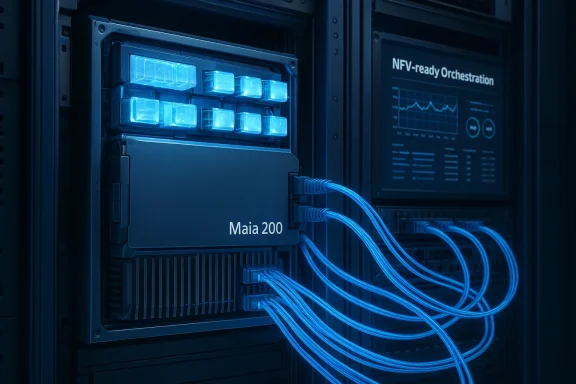
Microsoft’s unveiling of the Maia 200 AI accelerator and its companion system marks a deliberate push by a major cloud vendor into the hardware space—and it could reshape how telcos deploy AI at the edge and in their core networks. The new silicon promises large memory capacity, a fabric built on a standard Ethernet-based interconnect, and a systems-level design that appears optimized for the distributed, high-throughput, low-latency workloads telcos care about. For carriers trying to add AI-powered services without rebuilding their networking stacks, Maia 200 is being framed as a pragmatic, integration-friendly option—and that positioning deserves a close read.
Telcos and service providers face a unique set of constraints that set them apart from hyperscale cloud operators and enterprise data centers. They need to run latency-sensitive workloads close to users, meet strict reliability and security SLAs, and often operate in environments where existing networking expertise is centered on Ethernet and IP. Over the last several years, demand for AI in the network—everything from intelligent routing and anomaly detection to real-time media processing and generative services—has accelerated. But deploying large AI models in distributed environments introduces challenges around model placement, memory capacity, bandwidth between accelerators, and software interoperability.
Microsoft’s Maia 200 lands squarely at those pain points by combining an accelerator designed for heavy-memory workloads with a fabric approach grounded in Ethernet. That combination signals an attempt to reduce integration friction, leverage telcos’ existing networking skill sets, and enable scale-out AI that feels natural to network operators.
Benefits of an Ethernet approach for telcos include:
However, the real test will be in details and execution. Telcos will judge Maia 200 not by press statements but by whether the device integrates cleanly with orchestration frameworks, delivers predictable latency under load, and offers a competitive cost and power profile compared with incumbent accelerators. Software maturity, tooling, and long-term ecosystem support will be as important—if not more important—than the chip’s raw specs.
In short, Maia 200 is a promising and pragmatic step toward bringing large-model inference into the network, but careful evaluation, realistic pilot programs, and a clear view on operational integration will determine whether it becomes a telco staple or a niche, early-adopter product.
Source: Fierce Network https://www.fierce-network.com/cloud/my-oh-maia-microsofts-new-chip-could-be-big-win-telcos/
Source: Fierce Network https://www.fiercewireless.com/cloud/my-oh-maia-microsofts-new-chip-could-be-big-win-telcos/
 Background
Telcos and service providers face a unique set of constraints that set them apart from hyperscale cloud operators and enterprise data centers. They need to run latency-sensitive workloads close to users, meet strict reliability and security SLAs, and often operate in environments where existing networking expertise is centered on Ethernet and IP. Over the last several years, demand for AI in the network—everything from intelligent routing and anomaly detection to real-time media processing and generative services—has accelerated. But deploying large AI models in distributed environments introduces challenges around model placement, memory capacity, bandwidth between accelerators, and software interoperability.Microsoft’s Maia 200 lands squarely at those pain points by combining an accelerator designed for heavy-memory workloads with a fabric approach grounded in Ethernet. That combination signals an attempt to reduce integration friction, leverage telcos’ existing networking skill sets, and enable scale-out AI that feels natural to network operators.
What Microsoft showed: the Maia 200 and system-level approach
Maia 200 is not just another inference chip; Microsoft presented it as a system-oriented product with a focus on memory, connectivity, and manageability. The key public takeaways from the initial announcement are:- Large on-chip or module-level memory aimed at reducing off-chip memory traffic and enabling larger model instances to run without heavy partitioning.
- An Ethernet-based interconnect that connects accelerators in a system fabric, emphasizing compatibility with standard networking equipment and operational models.
- A systems design aimed at telcos and edge operators who prefer familiar networking technology and operational simplicity over proprietary fabrics.
Why memory matters for telco AI workloads
Many telco AI tasks—such as real-time speech processing, multi-stream video analytics, session-level personalization, and network function inference—benefit from running larger model instances locally rather than sharding tiny pieces across many devices. Larger model instances reduce cross-node synchronizations and can provide better model fidelity and lower response variability.- Fewer network round-trips: Bigger memory lets models live on a single device, reducing the need for distributed model sharding that increases latency.
- Simpler orchestration: Operators can map workloads to on-site hardware without complex model parallelism.
- Cost predictability: Running a model whole on a device simplifies resource accounting, which aligns well with telcos’ billing and SLA regimes.
The Ethernet-based interconnect: pragmatic, not flashy
The decision to use an Ethernet-based interconnect is strategically significant. Many modern accelerator fabrics opt for proprietary high-speed interconnects or RDMA variants to maximize throughput and minimize latency. By contrast, an Ethernet-first fabric trades the absolute lowest latency for operational compatibility and the ability to integrate with existing telco network hardware, cabling, and management tooling.Benefits of an Ethernet approach for telcos include:
- Familiar networking model and tooling for carriers
- Reuse of existing expertise in managing Ethernet fabrics at scale
- Easier physical deployment and cabling in edge and central offices
- Potential for leveraging commodity switches and optics
Deep dive: technical implications and likely design choices
Microsoft’s announcement emphasized system-level capabilities rather than microarchitectural minutiae. That leaves open questions—and opportunities for operators—to infer how Maia 200 might actually behave in the field.Memory architecture and the model locality thesis
When a vendor highlights “beefy memory,” it typically implies:- Larger per-accelerator DRAM capacity or stacked memory to hold significant portions of model weights and activations.
- Reduced reliance on PCIe-attached host memory for model parameters, lowering latency and CPU involvement.
- An emphasis on inference and model sizes that previously required distributed memory across multiple nodes.
Network fabric: Ethernet as a first-class interconnect
Using Ethernet as the primary accelerator interconnect suggests the system will rely on Ethernet switch capabilities to route accelerator-to-accelerator traffic. For telcos this is appealing, but architects must watch these factors closely:- Switch buffer and QoS: To preserve deterministic behavior, telcos must ensure switch buffers and QoS policies are tuned for accelerator traffic. Unbounded burstiness can hurt model latency.
- Congestion control: Accelerator clusters running model parallel workloads can create traffic patterns unfamiliar to traditional network configurations. Careful tuning of congestion control (e.g., ECN, pacing) will be required.
- Deterministic latency: Ethernet historically has higher and more variable tail latency than custom interconnects; mitigating that requires careful network engineering.
Integration and orchestration
A system that integrates with existing orchestration frameworks matters. Telcos prefer hardware that can be managed via:- Standard orchestration layers (Kubernetes variants, NFV MANO platforms)
- SNMP/NETCONF/YANG or modern API-driven hardware management
- Standard telemetry and logging outputs
What Maia 200 could enable for telcos (practical use cases)
The combination of larger on-device memory and Ethernet fabric maps neatly to several telco-centric use cases:- Real-time media processing and enhancement: Low-latency speech and video inference (noise suppression, codecs, real-time translation) done close to the user improves call quality and reduces backhaul.
- Network observability and anomaly detection: Running sophisticated models at the edge enables faster detection of routing anomalies, DDoS patterns, and performance faults.
- Private 5G and MEC services: Multi-tenant edge compute for localized AI inference can support private network customers with low-latency applications such as AR/VR or industrial automation.
- Customer experience personalization: In-line personalization and content optimization (e.g., per-session transcoding choices) without sending all metadata to central clouds.
- AI-augmented network functions: Embedding inference directly in network functions for predictive scaling, automated fault remediation, and smarter traffic steering.
Strengths and strategic wins
Microsoft’s Maia 200 approach includes several clear strengths that will appeal to telcos and edge operators:- Operational compatibility: Leveraging Ethernet reduces integration friction and taps into telcos’ existing skills and infrastructure investments.
- Model-locality-first design: Prioritizing memory over raw FLOPS matches real-world needs for inference-heavy, latency-sensitive workloads.
- Systems-level thinking: Presenting Maia as a component of a larger system (not just a chip) acknowledges that software, orchestration, and physical network integration are equally important.
- Potential for easier deployment at scale: By minimizing the need for proprietary fabrics and specialized cabling, operators can deploy accelerators across distributed sites more predictably.
Risks, limitations, and unanswered questions
Even well-conceived hardware faces pragmatic hurdles. Several risks and open questions should inform any telco’s evaluation.Performance versus incumbent accelerators
A key question is how Maia 200’s performance (throughput, latency, model support) compares with established accelerators in raw metrics. If the chip trades extreme peak performance for memory and Ethernet compatibility, telcos must weigh the trade-offs in cost per inference, power efficiency, and model throughput.- Will Maia 200 match the energy efficiency of the latest GPU designs optimized for AI?
- What is the performance profile on large LLMs, multimodal models, or streaming workloads?
Software and ecosystem maturity
Silicon is only as useful as its software stack. Telcos will need:- Mature drivers and runtime libraries
- Support for standard AI frameworks and efficient runtimes for inference
- Debugging and profiling tools tailored for distributed inference over Ethernet
Latency guarantees and tail behavior
Ethernet-based fabrics can display more variable tail latency than custom interconnects. For telco workloads that need firm latency guarantees, this variability is a problem unless software and network-level mitigation strategies are effective.- How will Maia 200 handle jitter under contention?
- Are there recommended switch configurations, QoS parameters, and telemetry hooks to guarantee predictable performance?
Interoperability and vendor lock-in
Telcos will assess whether Maia 200 forces them into a Microsoft-centric stack. Questions include:- Does the system require proprietary orchestration, or does it interoperate with open standards and common orchestration tools?
- How portable are deployed models and orchestration flows between Maia systems and other accelerators?
Security and supply chain concerns
Deploying specialized accelerator hardware at distributed edge sites raises security questions:- Are firmware and hardware roots of trust well-defined?
- How will updates and patches be delivered securely to thousands of edge nodes?
- Can carriers integrate Maia 200 into audited secure boot and attestation frameworks?
How telcos should evaluate Maia 200: a practical checklist
For telcos considering trials or rollouts, a structured evaluation will shorten the adoption curve and control risk.- Define target workloads and success metrics (latency, throughput, power, cost per inference).
- Conduct small-scale pilots that mirror production traffic patterns (including worst-case bursts).
- Test network configurations for switch QoS, ECN, and buffer tuning to control tail latency.
- Validate the software stack: framework support, drivers, observability, and tooling.
- Verify security: secure boot, firmware update mechanisms, and attestation.
- Evaluate lifecycle management: hardware provisioning, remote diagnostics, and OTA updates.
- Assess vendor interoperability and exit strategies to avoid lock-in.
Competitive and market implications
Maia 200’s arrival is another sign of a growing trend: cloud providers designing specialized silicon tailored for their customers and use cases. For telcos, this has several strategic implications.- Diversification of supplier options: Operators may see more choices beyond the traditional GPU-heavy ecosystem, enabling tailored deployments that prioritize memory and operational compatibility.
- From centralized to distributed AI: Hardware designed for edge-friendly deployment could accelerate the move of real-time AI away from centralized data centers and into the network edges where telcos control infrastructure.
- Pressure on incumbents to adapt: If Maia 200 proves cost-effective for telco workloads, existing accelerator vendors may need to offer comparable memory-heavy options or better software integration with telco platforms.
- Collaboration opportunities: Telcos might find value in co-developing use cases with Microsoft (or other cloud vendors) to optimize system-level performance and operational playbooks.
Practical deployment scenarios and recommended architectures
When thinking about real-world deployments, operators should consider a few architectural patterns where Maia 200 could fit best.Edge micro-data centers
For small on-premises sites or edge colocation points, Maia 200 devices could host inference workloads that must run per-site—such as local media processing, security analytics, or localized LLM instances for customer support kiosks. These sites benefit from Ethernet-based fabrics because they avoid complex new cabling and switch investments.Distributed network function acceleration
Embedding Maia-class accelerators into NFV stacks can offload compute-heavy elements of network functions—like DPI with AI-enhanced classification or real-time optimization—allowing operators to combine network and AI workloads in the same footprint, provided orchestration supports co-scheduling.Regional aggregation hubs
At regional PoPs, clusters of Maia 200 devices can handle a mix of aggregated traffic for latency-sensitive tasks and provide failover or model caching for smaller edge sites. Here, the ability to scale out via Ethernet and manage multi-tenant deployments is particularly relevant.Open technical questions operators should demand answers to
Before signing off on significant deployments, telcos should ask vendors for specifics:- Exact memory capacity per accelerator and effective memory bandwidth under realistic workloads.
- End-to-end latency profiles for common telco workloads (percentile numbers, not just averages).
- Supported AI frameworks and the roadmap for model support, including quantization and mixed-precision inference.
- Details on driver lifecycle, firmware update mechanisms, and integration with common orchestration platforms.
- Recommended switch configurations, buffer sizing, and QoS settings to guarantee deterministic behavior.
- Power, thermal, and physical footprint specifications for edge and central deployments.
Final analysis: pragmatic design that may narrow the gap between cloud AI and the network
Microsoft’s Maia 200 announcement is strategically smart: it acknowledges telcos’ operational realities and attempts to shrink the integration gap by leaning on Ethernet and memory-centric design. That positioning could make it easier for carriers to deploy larger AI models at the edge without rewriting their operational playbooks.However, the real test will be in details and execution. Telcos will judge Maia 200 not by press statements but by whether the device integrates cleanly with orchestration frameworks, delivers predictable latency under load, and offers a competitive cost and power profile compared with incumbent accelerators. Software maturity, tooling, and long-term ecosystem support will be as important—if not more important—than the chip’s raw specs.
In short, Maia 200 is a promising and pragmatic step toward bringing large-model inference into the network, but careful evaluation, realistic pilot programs, and a clear view on operational integration will determine whether it becomes a telco staple or a niche, early-adopter product.
Source: Fierce Network https://www.fierce-network.com/cloud/my-oh-maia-microsofts-new-chip-could-be-big-win-telcos/
Source: Fierce Network https://www.fiercewireless.com/cloud/my-oh-maia-microsofts-new-chip-could-be-big-win-telcos/
