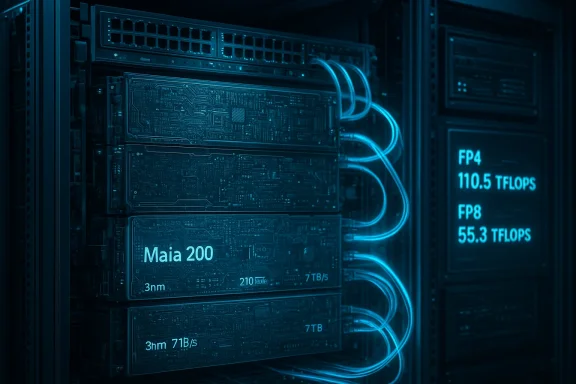
Microsoft’s Maia 200 is a deliberate, high‑stakes response to the economics of modern generative AI: a second‑generation, inference‑first accelerator built on TSMC’s 3 nm process, designed to cut per‑token cost and tail latency for Azure and Microsoft’s Copilot and OpenAI‑hosted services. economics of AI have shifted. Training remains monstrously expensive, but inference — the repeated work of generating tokens for every user query and API call — is where cloud providers pay again and again. Microsoft’s Maia program started as an internal experiment (Maia 100) to explore co‑design of silicon, servers and racks; Maia 200 is the productionized follow‑on explicitly optimized to serve inference at hyperscaler scale.
Microsoft framed thinference workloads are dominated by data movement and memory locality, not just raw FLOPS. To attack that bottleneck Microsoft re‑engineered the SoC, memory subsystem and datacenter fabric around token throughput, deterministic latency, and operational cost. Maia 200 is the result of that systems‑level focus.
However, lower precision is not universally applicable. Some models, operators, or safety‑critical inference paths still require BF16/FP16/FP32. On Maia 200 those higher‑precision paths fall back to vector processors, which reduces training throughput and changes performance profiles for mixed tasks. Organizations must therefore validate quantization strategimory subsystem: on‑package HBM3e + on‑die SRAM
One of the clearest architectural choices is memory capacity and hierarchy. Maia 200 pairs roughly 216 GB of HBM3e with hundreds of megabytes of on‑die SRAM and a specialized DMA/NoC fabric. The intention is to:
This is a notable design gamble: Ethernet provides operational familiarity and commodity switch options, but achieving low‑latency, lossless collective performance at scale requires careful transport engineering and co‑designed software (Microsoft’s Collective Communication Library, MCCL).
For WindowsForum readers and IT leaders: Maia 200 is a major development worth rapid, careful experimentation. Pilot tests, quantization validation, and TCO modeling will determine whether Maia‑backed instances can deliver the promised token‑level savings for your production workloads. Microsoft has staked a bold claim; the industry will now measure whether Maia 200 converts technical ambition into predictable, real‑world cost and latency advantages.
In short: Maia 200 is Microsoft’s bet that inference should be engineered differently from training — that memory, data movement and low‑precision compute are the right levers to lower the recurring cost of AI. The chip and its system packaging are designed to prove that bet in Azure; the outcome will be decided by software maturity, model fidelity under quantization, and independent workload benchmarks that validate Microsoft’s perf/$ assertions.
Source: Techlusive Why Microsoft built Maia 200 custom chip just for AI inference
Microsoft framed thinference workloads are dominated by data movement and memory locality, not just raw FLOPS. To attack that bottleneck Microsoft re‑engineered the SoC, memory subsystem and datacenter fabric around token throughput, deterministic latency, and operational cost. Maia 200 is the result of that systems‑level focus.
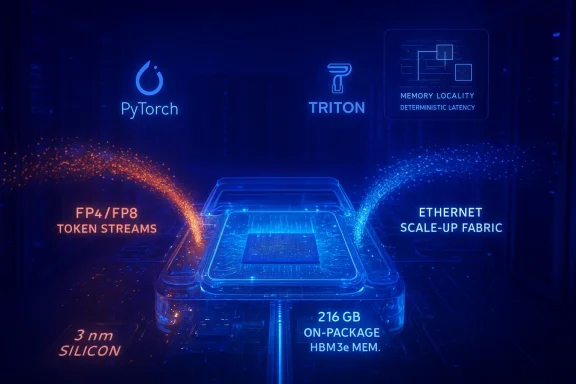 What Maia 200 is (headline summar inference accelerator, not a general‑purpose training GPU.
- Fabrication: TSMC 3 nm class process.
- Transistor budgereport over 140 billion transistors (firts).
- Precision: native support for FP4 and FP8 low‑precision tensor math, with narrower precisions ghput.
- Memory: ~216 GB of HBM3e on‑package (roughly 7 TB/s aggregate memory bandwidth) plus ~272 MB on‑die SRAM for cachinering.
- Peak vendor‑stated throughput: >10 petaFLOPS (FP4) and >5 petaFLOPS (FP8) per accelerator.
- Power envelope: a package TDP in the **~zed into liquid‑cooled racks).
- Interconnect: a two‑tier, Ethernet‑based scale‑up fabric with innd a Maia AI transport layer, exposing ~2.8 TB/s bidirectional scale‑up bandwidth per acceleratoters up to 6,144** accelerators.
- Software: a preview Maia SDK with PyTorch support, a Triton compiler, optimized kernel libraries and a low‑level programming language (NPL) plus simulators and cost tools.
- Initial deployment: rolling with US Central, with Microsoft first‑party services (e.g., Microsoft 365 Copilot, internal Superintelligence work and hosted OpenAI models) as launch consumers.
Why Microsoft prihe strategic argument)
Inference economics matter more for day‑to‑day AI costs
Every interactive AI feature, every Copilot suggestion, and every API token returns a marginal compute cost that adds up across millions of queregic calculus is straightforward: a durable reduction in per‑token cost materially improves margins for subscription services and cloud revenue at scale. Building a custom inference accelerator is a lever to capture that saving.Memory and data movement dominate inference performance
Large language model inference often requires streaming significant slices of model weights and the KV cache into compute units for each token. That makes memory bandwidth, on‑chip memory capacity, and **predictable collective cing factors — not raw general‑purpose FLOPS. Maia 200’s architecture explicitly targets those levers.Supply and strategic independence
The hyperscaler market has faced periodic GPU supply tightness and price pressure. Owning a first‑party inference accelerator gives Microsoft leverage in capacity, pricing predictability, and differentiation — particularly for Microsoft‑first workloads. Maia 200 reduces some depe accelerators while integrating tightly with Azure’s fleet.Technical deep dive
Compute: low‑precision first
Maia 200’s tensor engines are optimized for narrow datatypes: FP4 and FP8. These low‑precision formats let Microsoft pack far more arithmetic density per watt and per transistor when models tolerate quantization. Vendor metrics highlight multi‑petaFLOPS throughput at FP4 and Fo higher token generation throughput for quantized workloads.However, lower precision is not universally applicable. Some models, operators, or safety‑critical inference paths still require BF16/FP16/FP32. On Maia 200 those higher‑precision paths fall back to vector processors, which reduces training throughput and changes performance profiles for mixed tasks. Organizations must therefore validate quantization strategimory subsystem: on‑package HBM3e + on‑die SRAM
One of the clearest architectural choices is memory capacity and hierarchy. Maia 200 pairs roughly 216 GB of HBM3e with hundreds of megabytes of on‑die SRAM and a specialized DMA/NoC fabric. The intention is to:
- Keep more model weights local to the accelerator and reduce off‑package fetches.
- Use on‑die SRAM as a buffer collective communications.
- Reduce model sharding and the number of devices needed to host large parameter sets, thereby lowering synchronization overhead and tail latency.
Interconnect and scale‑up fabric: Ethernet, not proprietary mesh
Rather than adopting proprietary fabrics (e.g., vendor‑specific NVLink or InfiniBand variants), Microsoft built a two‑tier scale‑up network on standard Ethernet I transport layer and integrated NICs. Inside a tray, four Maia accelerators are fully connected with direct, non‑switched links (Fully Connected Quad or FCQ), while the ross racks with topology and transport optimizations for collective operations. Microsoft claims this design reduces cost and operational complexity while supporting deterministic, low‑latency collectives across thousands of devices.This is a notable design gamble: Ethernet provides operational familiarity and commodity switch options, but achieving low‑latency, lossless collective performance at scale requires careful transport engineering and co‑designed software (Microsoft’s Collective Communication Library, MCCL).
System integration: racks, cooling and management
Maia 200 is presented as a rack‑scale solution, not just a die. Microsoft integrates the accelerato uses second‑generation closed‑loop liquid cooling (Heat Exchanger Units) and ties devices into Azure’s control plane for telemetry, security and diagnostics. The SoC’s thermal and power profile (~750 W) pushes the infrastructure envelope but is designed to be manageable at hyperscale when aged racks.Software and developer story
Microsoft shipped a Maia SDK (preview) to ease model porting and exploitation of the new hardware. Key components include:- PyTorch integrations so existing training and inference stacks can be adapted.
- A Triton compiler to target Maia kernels and generate optimized code.
- An optimized kernel library and a low‑level programming language (NPL) for fine control.
- Simulators and cost calculators to estimate perf/$ for porting decisionmmitment is crucial. Hardware without mature toolchains and quantization workflows will struggle to displace established accelerators in production. Microsoft’s previewing of SDKs and inviting early academic and community contributors signals an intent to accelerate software maturity, but adoption will require proven, model‑level accuracy and latency validation.
Where Microsoft intends to use Maia 200
Microsoft says it will deploy Maia 200 across Azure workloads with a phased reg in US Central and expanding to US West 3 and beyond. Initial consumers include Microsoft’s internal Superintelligence teams, Microsoft 365 Copilot, Microsoft Foundry, and OpenAI models hosted on Azure. The chip’s first production footprints are framed as both internal cost‑savers and a pathway to offering cheaper inference capacity to Azure customers.Strengths: what M table
- Inference‑first optimization: By designing for FP4/FP8, large on‑package memory and on‑die SRAM, Maia 200 targets the exact bottlenecks that matter for token throughput.
- Systems thinking: Microsoft doesn’t sell a chip — it delivers a rack‑scale system with cooling, network, telemetry and a software stack integrated into Azure. That reduces integration friction for Azure tenants.
- Operational familiarity: Building the scale‑up fabric over Ethernet simplifies datacenter dependor lock‑in at the switch level.
- Potential cost advantage: Microsoft claims roughly 30% better performance‑per‑dollar for inference vs its prior fleet, a meaningful TCO improvement if validated under representative woy resilience**: Owning the design and working with TSMC for fabrication gives Microsoft more control over long‑term capacity planning.
Risks, caveats and open questions
While the Maia 200 story is compelling, sts deserve emphasis.Vendor‑provided metrics need independent validation
Peak petaFLOPS and comparative claims (e.g., “3× FP4 vs Trainium Gen‑3” or FP8 ) are vendor measurements with varying test vectors. Real‑world model performance depends on quantization pipelines, compiler maturity, kernel coverage, and operator shape — not just peak arithmetic throughrs as indicative, not definitive, until external benchmarks appear.Quantization and model fidelity
Aggressive FP4 quantization can deliver ks accuracy degradation if not handled carefully. Many enterprise models require calibrated quantization, retraining, or per‑operator fallbacks. Enterprises will need to test representative workloads end‑to‑end before migrating production inference. Microsoft’s SDK helps, but the hard work is model‑by‑model.Software maturity and ecosystem lock‑in
Maia’s promise depends on the SDK, Triton integration and optimized libraries. Early access is valuable, but production readiness requires broad operator coverage, profiling tools, and community momentum. There is also a praptimized deployments tied tightly to Azure’s Maia instances may complicate multi‑cloud portability.Thermal, power and datacenter ops
At ~750 W per chip, Maia 200 pushes rack cooling and power budgets. While Microsoft has engineered liquid cooling solutions, not every enterprise datacenter can absorb similar density without redesign. For Azure customers this is hidden, but edge or private cloud adopteion costs.Competitive response and benchmarking arms race
AWS, Google and Nvidia will continue evolving their own silicon and offerings. Maia 200 matters to Azure’s economics, but the competitive landscape will be decided by workload‑level benchmarks, pricing, availability, and software portability over the coming quarters.Practical guidance for IT leaders and developers
Maia‑backed instances for production inference, follow a disciplined approach:- Pilot with representative workloads. Run your live prompt distributions, evaluation suites and safety checks on Maia preview instances to measure real latency, accuracy and throughput.
- Validate quantization pipelines. Test FP8 and FP4 quantization straterators and edge cases; measure any accuracy drift and consider mixed‑precision fallbacks where needed.
- Measure full‑system TCO. Include developer time, toolchain maturity, expected speedups, and any migration or retraining costs when computing perf/$ advantages.
- Preserve portability. Use abstraction layers wheruntimes, model compilers) so you can move workloads across Azure and alternative accelerators if needed.
- Insist on independent benchmarks. Vendor claims are useful but independent, workload‑level benchmarks are necessary before making wholesale migrations.
Market and strategic implications
Maia 200 is the clearest public signal thirst‑party silicon to be a strategic lever in the cloud AI era. If Microsoft’s perf/$ and operational advantages materialize, cloud buyers will increasingly treat first‑party accelerators as a native decisions. That changes competitive dynamics:- Azure could offer differentiated pricing or SLAs for inference that competitors must match.
- Enterprises might s profile: training on commodity GPU pools, production inference on Maia‑like accelerators.
- The industry will see an acceleration in co‑design: silicon + racks + runtime + networecific AI workloads.
Final analysis — balanced take
Microsoft’s decision to build Maia 200 is strategic and technically sensible: design choices reflect a clear reading of modern inference bottlenecks and the economics of token generation. The chip’s memory‑centric architecture, large on‑die SRAM, Ethernet‑based scale‑up fabric, and low‑precision focus align with the ized LLM inference at hyperscale. Microsoft’s integration of rack, cooling and software promises a production‑grade offering for Azure cure important caveats. The most load‑bearing numbers are vendor‑provided; they should be validated by independent benchmarks and by rumodels end‑to‑end. FP4/FP8 quantization is powerful but not frictionless; model fidelity, software maturity and operator coverage will determine how broadly and quickly customers can benefit. Operational constraints — notably power and cooling — are manageable at Azure ons for other environments.For WindowsForum readers and IT leaders: Maia 200 is a major development worth rapid, careful experimentation. Pilot tests, quantization validation, and TCO modeling will determine whether Maia‑backed instances can deliver the promised token‑level savings for your production workloads. Microsoft has staked a bold claim; the industry will now measure whether Maia 200 converts technical ambition into predictable, real‑world cost and latency advantages.
In short: Maia 200 is Microsoft’s bet that inference should be engineered differently from training — that memory, data movement and low‑precision compute are the right levers to lower the recurring cost of AI. The chip and its system packaging are designed to prove that bet in Azure; the outcome will be decided by software maturity, model fidelity under quantization, and independent workload benchmarks that validate Microsoft’s perf/$ assertions.
Source: Techlusive Why Microsoft built Maia 200 custom chip just for AI inference