

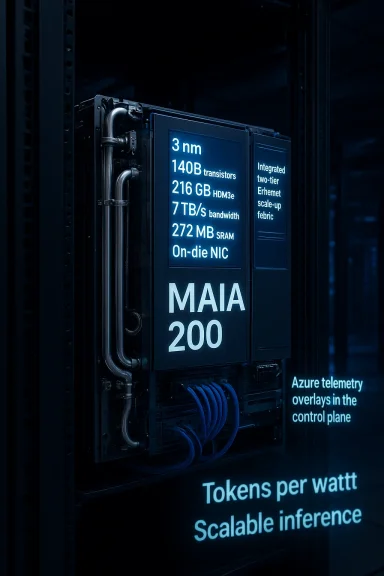
Microsoft’s Maia 200 is the clearest signal yet that the cloud era has moved from a race for raw compute to a contest over how many useful tokens you can squeeze out of every available watt of power. Announced as an inference-first, vertically integrated accelerator and already showing up in Azure’s US Central racks, Maia 200 is more than a chip: it’s a systems play that stitches custom silicon, memory, rack design, liquid cooling, an Ethernet “scale‑up” fabric and native Azure orchestration into a single engineering project aimed at improving tokens-per-watt and tokens-per-dollar at hyperscale. The pattern Microsoft describes — and the industry reaction it has provoked — makes one thing clear: data-center economics and grid constraints now sit at the center of AI infrastructure strategy. m](https://blogs.microsoft.com/blog/20...erator-built-for-inference/?utm_source=openai))
Background / Overview
Since Microsoft first revealed the Maia program at Ignite 2023, the company has positioned Maia not as a single product but as a multi‑generation silicon program tightly bound to Azure’s operational model. That early reveal established the strategic ambition: to co‑design hardware and software stacks so that Azure can run its own and partner models (including hosted OpenAI workloads) with better predictability and cost structure than a one‑size‑fits‑all GPU approach. The Maia lineage started with Maia 100, a first‑generation accelerator that validated the hypothesis that close integration with cloud software and racks delivers operational advantages. The Maia 200 announcement on January 26, 2026 pushed that thesis into production-scale reality with a clear, measurable target: materially lower cost per inference token when running production AI services.Why this matters now: global energy and grid realities are changing the constraints on scaling AI. The International Energy Agency (IEA) projects that global data‑center electricity demand will more than double to around 945 TWh by 2030 under its Base Case, with AI workloads supplying most of that growth. In the United States, a DOE‑commissioned analysis by Lawrence Berkeley National Laboratory estimated U.S. data‑center electricity consumption could rise from roughly 176 TWh in 2023 to between 325 and 580 TWh by 2028 in plausible scenarios — a range that translates to data centers consuming 6.7%–12% of U.S. electricity in that timeframe. Those macro constraints reframe the question for hyperscalers: if you can’t simply buy more megawatts overnight, how do you increase useful AI capacity? The answer Microsoft is pursuing is vertical integration across silicon, networking, cooling and orchestration to increase tokens per watt.
Maia 100: the foundation of a systems-first approach
What Maia 100 taught Microsoft (and the market)
Maia 100 was the practical prototype: a custom accelerator built on TSMC’s N5 process, intended to validate the idea that cloud‑native ASICs can be more energy‑efficient for production workloads than general‑purpose GPUs when integrated into coordinated racks and software. The Ignite 2023 press materials framed Maia 100 alongside the Cobalt CPU family as part of a broader push to own more of the infrastructure stack and to tune designs for Azure’s workload mix. Independent technical summaries and industry analysis from that period described Maia 100 as a large, HBM‑fed accelerator optimized for low‑precision tensor math and liquid cooling in rack deployments.Several industry analysts and trade outlets later reported transistor counts and memory choices for Maia 100; those accounts indicate Microsoft iterated quickly on packaging and validation so early deployments could feed back into subsequent generations. Public commentary from independent analysts stressed a key lesson: first‑gen custom silicon validates systems thinking, but successive generations are where meaningful per‑token economics are realized.
The limits of what’s publicly verifiable about Maia 100
A number of detailed hardware figures circulated in niche analyses and reports (including transistor counts and certain memory and power numbers). Some of those numbers are consistent across a handful of paid‑analysis outlets; others appear only in single‑source writeups or speculative posts. Where multiple reputable outlets or Microsoft itself confirmed figures, those are incorporated below. Where claims are present only in single, non‑public analyses, I flag them as not fully verifiable in public records and treat them with caution in the technical narrative. This distinction matters for readers who may see precise die-area, TDP or bandwidth figures repeated in the rumor mill: Microsoft’s public material from 2023 established the design intent and process node; third‑party estimates filled in many of the detailed physical metrics.Maia 200: what Microsoft says — and what multiple outlets confirm
The public, load‑bearing specs
On January 26, 2026 Microsoft publicly introduced Maia 200 as an inference‑first accelerator designed for hyperscale token generation. Microsoft’s official blog post (and concurrent Azure press materials) list the core platform claims:- Fabricated on TSMC’s 3‑nanometer process with more than 140 billion transistors.
- A memory‑centric design that integrates 216 GB of on‑package HBM3e, delivering roughly 7 TB/s of memory bandwidth and 272 MB of on‑chip SRAM.
- Peak compute targets of >10 petaFLOPS at FP4 and ~5 petaFLOPS at FP8, wrapped in a 750 W SoC thermal envelope (Microsoft reports practical provisioning closer to a 750 W TDP in many inference configurations).
- A two‑tier Ethernet scale‑up architecture with a custom AI transport layer and an integrated NIC on the die, enabling predictable collective operations across thousands of accelerators without proprietary fabric. Microsoft claims scale‑up domains in the thousands (example cited: clusters up to 6,144 accelerators).
What the new design actually changes
Maia 200’s architecture reflects three engineering shifts:- Move memory and bandwidth closer to compute. The large HBM3e pool and increased on‑die SRAM reduce off‑chip hopping and the energy penalty of shuttling activations across multiple devices. This reduces both latency and energy per token on large context models.
- Treat networking as first‑class system power. By embedding a NIC and tuning Ethernet transport for collective operations, Microsoft reduces the watts consumed by switching, discrete NICs and external interconnects — especially for tensor‑parallel operations common in LLM inference.
- Tight Azure telemetry integration. The accelerator exposes micro‑telemetry directly into Azure’s control plane, enabling power‑aware scheduling, predictive maintenance and cross‑rack utilization balancing to avoid idle, power‑wasting hardware.
Ethernet scale‑up, on‑die NICs, and the AI transport layer
Why network design is now part of the energy equation
Historically, high-performance clusters relied on specialized fabrics (InfiniBand, custom interconnects) for low-latency collectives. Those fabrics excel at throughput and latency but come with complexity, cost and power overhead. Microsoft’s Maia 200 shows a purposeful pivot: instead of adding another third‑party switch/NIC layer, it integrates networking on the accelerator die and builds a two‑tier Ethernet scale‑up fabric optimized for AI collectives.That approach reduces the number of hops for high‑frequency tensor exchanges and trims the external switching footprint — lowering both capital and operating power costs at rack and pod scale. Microsoft frames this as one of the key multipliers for tokens per watt: when collective traffic stays local and avoids repeated traversals through power‑hungry switches, energic waste is eliminated at scale.
The tradeoffs
Adopting Ethernet with a custom transport layer sacrifices some of the specialized features of proprietary fabrics for the benefits of commodity interoperability and overall system simplicity. The risk profile includes:- Needing substantial software engineering to match collectives’ semantics and performance expectations on Ethernet.
- Potential vendor lock‑in at the rack/cluster level if Microsoft’s transport layer requires specific hardware or software to get full benefit.
- Migration friction for customer workloads not written to Maia‑optimized collectives.
Tokens‑per‑watt: putting the math together
To convert conceptual claims into engineering reality, Microsoft and other hyperscalers must optimize an interacting set of variables that determine energy per inference token:- Accelerator power draw (chip TDP and typical operating envelope)
- Memory bandwidth efficiency and locality (HBM, on‑die SRAM)
- Networking and switching overhead (external NICs/switches vs. on‑die NICs)
- Cooling and facility overhead (PUE and whether liquid cooling reduces overhead)
- Utilization — fraction of time hardware is actively generating tokens versus idle
Energy per token = (Chip compute energy + memory and IO energy + network energy + cooling overhead) / tokens generated
Small improvements across each term compound. For example, cutting the network energy per operation by 10% and reducing idle time by 5% can yield a meaningful drop in cost per 1,000 tokens — and at the scale of millions of daily requests, those savings multiply. Microsoft’s architecture intentionally targets each term: more memory per chip to reduce cross‑chip traffic, Ethernet scale‑up and on‑die NICs to trim network hops, and deep Azure telemetry to keep utilization high and hotspots manageable.
Grid realities, cooling, and the limits of efficiency
The structural limits
Even with dramatic efficiency gains at the chip and rack level, hyperscalers face structural limits outside their control: permitting and building new grid capacity is slow; local substations and transmission lines can be saturated; and large‑scale generation projects have multi‑year timelines. The IEA and DOE/LBNL analyses both underline the core reality: demand from AI and data centers is large, growing quickly, and concentrated in specific hubs — and that concentration drives local constraints that efficiency alone cannot fully remove. The operating implication for Microsoft and peers is clear: efficiency buys time and capacity, but it doesn’t eliminate the need for new generation, transmission investments or creative on‑site generation strategies.Cooling is now a strategic capital decision
Rack densities for modern AI clusters are far beyond what conventional air cooling can practically sustain. Liquid cooling (direct‑to‑chip, immersion and other variants) is rapidly moving from optional to essential in high‑density AI clusters. Microsoft’s Maia program explicitly couples the accelerator design with liquid cooling and custom heat‑exchanger units; this is necessary not only to prevent thermal throttling but to maximize PUE and overall tokens per watt. Industry reporting shows liquid cooling adoption and advanced packaging demand are major constraints and capital priorities for hyperscalers.Supply‑chain and packaging constraints: the hidden bottleneck
Maia 200’s reliance on advanced packaging (CoWoS-like 2.5D integration to stack HBM and logic) exposes it to a well‑documented backend bottleneck: CoWoS and similar high‑density packaging capacity has been stretched by demand from multiple giants (NVIDIA, AMD and hyperscalers), creating a packaging‑level scarcity that affects delivery schedules and per‑unit costs. Industry analysis and packaging‑industry trackers indicate packagers and foundries are expanding capacity but that demand outpaces supply — meaning successful vertical integration requires not just design excellence but long lead‑time procurement and supplier coordination. Microsoft’s early agreements with memory suppliers and TSMC capacity allocations are therefore strategic as much as technical.Strategic analysis: strengths, risks, and what Maia means for Azure customers
Notable strengths
- Systemic optimization: Maia 200 is engineered as a full stack: silicon, packaging, rack power, liquid cooling, Ethernet scale‑up and Azure control‑plane telemetry. That co‑design gives Microsoft levers to improve tokens per watt that commodity GPUs can’t match without system changes.
- Operational leverage: Native control‑plane integration enables power‑aware scheduling, predictive maintenance and utilization smoothing — tools that materially reduce wasted energy at scale. That’s where cloud operators can realize the largest dollar savings per watt.
- Supply diversification and bargaining power: Building first‑party inference capacity buys Microsoft optionality in vendor negotiations with companies like NVIDIA; it also hedges against single‑supplier constraints on the high end of the GPU market. Public statements from Microsoft leadership emphasize continued partnerships with vendors even as in‑house silicon scales.
Material risks and open questions
- Supply‑chain fragility: Advanced packaging (CoWoS) capacity and HBM availability remain bottlenecks. If packagers prioritize larger customers or fail to scale quickly enough, Maia deployments could be limited by supply rather than design. Industry trackers and packaging analysts flag this as a persistent constraint.
- Software portability and ecosystem lock‑in: Maia’s transport and low‑level programming models are optimized for Azure. Enterprises wanting portability across clouds may face migration friction, even if Microsoft provides PyTorch/Triton tooling. The broader software ecosystem (CUDA, TensorRT‑LLM, other cloud‑native toolchains) still matters for adoption outside Azure.
- Verification of detailed claims: Some nuanced physical metrics for first-generation Maia 100 (die area, TDP provisioned in rack, exact bandwidth numbers reported in some leak‑style writeups) are not uniformly corroborated across independent public sources. Analysts’ estimates exist and Microsoft’s public materials for Maia 200 are verifiable; readers should treat single‑source details about Maia 100 with caution unless confirmed by multiple independent outlets or by Microsoft itself.
- The limits of efficiency vs. grid growth: Even if Maia 200 delivers 30% better performance per dollar and meaningful tokens‑per‑watt improvements, the IEA and DOE projections show that overall demand may still outstrip incremental efficiency gains in many regions. Hyperscalers will still need to invest in grid upgrades, on‑site generation, storage and creative siting decisions. Efficiency delays, rather than avoids, the need for those investments.
What this means for customers, competitors and regulators
- Azure customers will likely see improved economics for inference‑heavy workloads hosted in Maia‑backed regions — particularly when Microsoft exposes Maia capacity and a clear pricing signal for inference instances. Enterprises that depend on long contexts, heavy reranking or many model passes per request will gain the most from Maia’s design focus on memory and network locality.
- Competitors (AWS, Google, others) will continue to deepen their own silicon programs (Trainium, TPU families and others). The short‑term market dynamic is not winner‑takes‑all; instead, we should expect a multi‑vendor world in which hyperscalers combine first‑party silicon with merchant GPUs to match matching workload requirements and supply realities. Microsoft’s public statements emphasize this mixed strategy.
- Regulators and grid operators must treat hyperscaler capacity as a strategic load. IEA and DOE/LBNL projections imply that local planning, permitting and rate structures will increasingly influence where and when large AI facilities can expand. Expect more joint planning programs and conditional approvals that connect new capacity to firm commitments for grid investments or on‑site generation.
Conclusion: Maia as a systems bet on constrained resources
Maia 200 is Microsoft’s bold architectural bet that, in a world constrained by grid capacity and advanced packaging, the decisive advantage belongs to the team that can co‑engineer silicon, memory, networking, cooling and orchestration toward a single economic metric: more useful tokens for every megawatt and every dollar spent. That focus — tokens per watt, tokens per dollar — reframes the hardware arms race away from pure peak FLOPS and toward sustained and predictable production efficiency.The technical accomplishments Microsoft announced for Maia 200 are notable and, importantly, corroborated by multiple mainstream and specialist outlets. But real world impact will hinge on supply‑chain execution, the pace of packaging capacity expansion, the ability to deliver robust developer tooling and the industry’s broader responses to grid and cooling constraints. If Microsoft succeeds, the result will be a durable operational advantage for Azure in inference economics. If supply or software hurdles emerge, the story will be one of incremental capacity improvements in a world that still needs new substations, storage and generation.
Either way, Maia makes plain an industry‑level truth: the next phase of AI scaling will be fought at the intersection of chips, racks, power and networks — not only in raw silicon speed. The cloud providers that master that intersection will determine who can deliver the most intelligence per watt to customers worldwide.
Source: Intelligent Living Microsoft Maia's Power Explained: Ethernet Scale-Up, Vertical Integration, and the Future of AI Economics
