

Microsoft's MapUrlToZone URL‑classification logic contains a security feature bypass that can make remote or network resources appear more trusted than they are, and the recently publicized entry for CVE‑2025‑59208 sits inside that family of issues — though public CVE mappings and advisory details for this specific identifier show inconsistencies that require verification against Microsoft's Security Update Guide before deployment decisions are finalized.
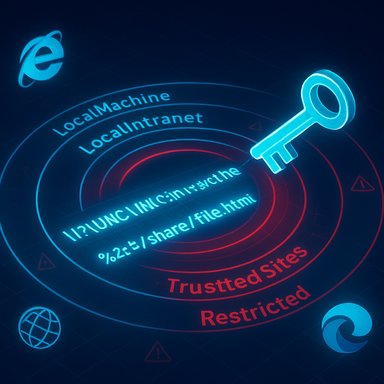
MapUrlToZone is a long‑standing Windows API used by Internet Explorer‑era components, WinINet/Urlmon libraries, Microsoft Office hyperlink handling, and various legacy integrations to determine a URL's security zone (Local machine, Local intranet, Trusted sites, Internet, Restricted sites). That zonal decision informs whether content is allowed to run, whether ActiveX or scripts are permitted, and whether special warnings or additional prompts are shown. A set of MapUrlToZone vulnerabilities disclosed in early 2025 expose improper path normalization and equivalence resolution weaknesses that let crafted inputs be misclassified into more‑trusted zones.
Multiple independent trackers and vendor writeups describe the same technical pattern: inconsistent canonicalization of UNC/long‑path prefixes, percent‑encoded segments, dot‑segments, and alternate separators allow an attacker to present a URL that textually looks benign (or local) while actually pointing to a remote/untrusted resource — and MapUrlToZone may return the wrong zone as a result. That misclassification is a security feature bypass rather than a direct remote code execution (RCE) bug, but it is a powerful enabler when chained with other flaws or social‑engineering techniques.
Common primitives attackers use:
Security teams should not conflate medium base scores with low urgency: the practical severity depends on environment, exposure, and whether legacy zone policies are in place.
Actionable takeaway: treat MapUrlToZone vulnerabilities as high priority for remediation planning — patch quickly, tighten zone policies, and harden or modernize any application that delegates trust decisions to legacy OS APIs.
Source: MSRC Security Update Guide - Microsoft Security Response Center
 Background
MapUrlToZone is a long‑standing Windows API used by Internet Explorer‑era components, WinINet/Urlmon libraries, Microsoft Office hyperlink handling, and various legacy integrations to determine a URL's security zone (Local machine, Local intranet, Trusted sites, Internet, Restricted sites). That zonal decision informs whether content is allowed to run, whether ActiveX or scripts are permitted, and whether special warnings or additional prompts are shown. A set of MapUrlToZone vulnerabilities disclosed in early 2025 expose improper path normalization and equivalence resolution weaknesses that let crafted inputs be misclassified into more‑trusted zones.Multiple independent trackers and vendor writeups describe the same technical pattern: inconsistent canonicalization of UNC/long‑path prefixes, percent‑encoded segments, dot‑segments, and alternate separators allow an attacker to present a URL that textually looks benign (or local) while actually pointing to a remote/untrusted resource — and MapUrlToZone may return the wrong zone as a result. That misclassification is a security feature bypass rather than a direct remote code execution (RCE) bug, but it is a powerful enabler when chained with other flaws or social‑engineering techniques.
What CVE‑2025‑59208 (MapUrlToZone information disclosure / bypass) is claiming
High‑level summary
- The vulnerability revolves around MapUrlToZone incorrectly resolving certain URL text forms to an incorrect security zone, effectively relaxing protections that should normally block or sandbox the resource.
- Attackers can craft URLs using UNC long‑path prefixes (for example, \?\UNC..., encoded dot‑segments (%2e%2e), mixed slashes, or Unicode/NULL embedding to confuse canonicalization logic.
- The result: content that should be treated as Internet or Restricted may be treated as Intranet or Trusted, removing prompts or allowing behaviors that would otherwise be blocked.
Evidence and verifiability
Public advisories and vendor trackers document a cluster of MapUrlToZone vulnerabilities in early 2025 that share the same root cause (improper resolution of path equivalence). However, CVE numbers and their mapping to Microsoft KBs or update packages can be inconsistent across mirrors and secondary trackers; some reports note that the exact CVE identifier you supplied may not appear in every public database snapshot and should be validated against Microsoft’s authoritative Security Update Guide entry for final KB/build mappings. Treat per‑CVE patch identifiers as authoritative only after cross‑checking Microsoft’s update entries.Technical analysis: how the bypass works
Canonicalization and path equivalence failures
The MapUrlToZone decision depends on interpreting a URL string and mapping it to a zone using canonicalized origin data. If canonicalization is inconsistent or incomplete, two equivalent resource references can look different at the textual level but resolve to the same endpoint — and the classification logic can treat them differently.Common primitives attackers use:
- Extended path prefix: \?\UNC\host\share\file.html
- Mixed encoding: percent‑encoded dot segments (%2e%2e), embedded NULLs (%00)
- Mixed separators: forward and backward slashes combined in unexpected sequences
- Unicode confusables and alternate normalization forms that divide decoding responsibilities across layers
Why this is an enabling bug, not always an immediate RCE
A MapUrlToZone bypass does not directly overwrite memory or execute code by itself; it changes the security posture applied to a resource. That makes it valuable to attackers because it can:- Suppress UI prompts that would warn users about unsafe content
- Permit loading of ActiveX, scripts, or other legacy capabilities in contexts that would normally block them
- Allow content to access local resources or reduce sandboxing that would otherwise restrict actions
Affected systems and real‑world attack scenarios
Who and what is at risk
- Windows clients and servers that still include legacy WinINet / Urlmon / IE‑compatibility stacks are affected, because those components call MapUrlToZone for zone decisions.
- Office applications that follow hyperlinks or render previews and that rely on system zone decisions.
- Line‑of‑business (LOB) apps that consult MapUrlToZone rather than performing their own validated URL checks.
- Enterprises that use Group Policy or registry ZoneMap entries heavily, especially those with broad or wildcard intra‑zone definitions.
Typical attack flow
- Attacker hosts malicious payload on an externally controlled server or a compromised network share.
- Craft a URL using canonicalization tricks (long path prefixes, encoded separators, etc..
- Deliver the URL via spear‑phishing, malicious document, or an app that automatically resolves links (email preview, document preview, LOB automation).
- MapUrlToZone misclassifies the origin into a higher‑trust zone.
- The system allows risky content to run or suppresses prompts, enabling follow‑on actions: script execution, credential capture, or download of additional payloads.
Severity, metrics, and confidence
CVSS and the nuance of "medium" scores
Independent trackers often assign medium CVSS base scores for raw MapUrlToZone bypasses because the flaw alone is a feature bypass (no direct memory corruption). Yet operational impact is often larger: when the bypass is combined with social engineering or other vulnerabilities, it becomes a force multiplier enabling RCE, privilege escalation, or data exfiltration.Security teams should not conflate medium base scores with low urgency: the practical severity depends on environment, exposure, and whether legacy zone policies are in place.
Confidence in the vulnerability details
Multiple vendor writeups, vulnerability trackers, and research summaries corroborate the core technical pattern (improper path equivalence and UNC/encoding tricks). However, CVE numbering and exact vendor KB mappings sometimes diverge across mirrors. Before applying any KB patch or altering production configurations, confirm the specific CVE→KB mapping and per‑build applicability in Microsoft’s Security Update Guide. Any claim about a patch’s exact KB number or per‑SKU impact that cannot be found in Microsoft’s authoritative entries should be treated as unverified until Microsoft’s advisory is consulted.Mitigations and recommended actions
Immediate actions (short term)
- Patch fast: Apply Microsoft updates that specifically address MapUrlToZone issues as soon as they are available and validated in your environment. Vendor KB pages and update catalogs are authoritative for package identifiers.
- Harden zone mappings: Review and tighten ZoneMap registry entries (HKEY_CURRENT_USER and HKEY_LOCAL_MACHINE) and Group Policy settings. Remove broad wildcards from Trusted and Intranet zones.
- Disable legacy components: Where possible, disable Internet Explorer legacy mode, ActiveX, and other legacy handlers that rely on MapUrlToZone. Migrate to modern browsers (Chromium‑based Edge, Chrome) or updated app stacks that perform their own auditable URL validation.
- Enforce SmartScreen / URL reputation: Keep Microsoft Defender SmartScreen and equivalent URL‑reputation services enabled to add an additional layer of checking beyond MapUrlToZone.
Application and developer guidance
- Perform canonicalization where you call MapUrlToZone: Do not treat MapUrlToZone as the only authoritative source; perform your own input validation and canonicalization before using its result.
- Sanitize file:// and UNC inputs in applications that accept user‑supplied paths. Reject or strictly normalize long‑path prefixes and percent‑encoded control characters before handing values to system APIs.
- Modernize LOB apps that depend on legacy zone behavior; re‑architect trust decisions to use explicit allow/deny lists or rely on token‑based authentication rather than implicit zone trust.
Network and monitoring controls
- Block suspicious path patterns at web proxies or secure web gateways (encoded dot segments, \?\UNC\ prefixes in inbound links).
- Monitor telemetry for unusual use of file:// URIs, unexpected UNC access patterns, and anomalous zone mapping decisions in endpoint logs.
- EDR rules: Create detections that flag processes resolving external UNC paths, or that perform network retrievals after zone classification anomalies.
Detection, incident response, and forensics
Indicators of compromise to watch for
- Unexpected zone IDs associated with user‑initiated link events (e.g., an Internet URL being logged as Intranet/Trusted).
- Outbound connections to unusual hosts immediately following document preview or hyperlink clicks.
- Downloads from remote shares that bypassed usual UI prompts or executed without expected elevation prompts.
- Changes to ZoneMap registry keys or group policy updates that expand trusted sets.
Response playbook (high level)
- Isolate affected endpoints suspected of exploitation.
- Collect forensic artifacts: process trees, browser history, Office document metadata, Zone.Identifier streams, and relevant registry hives.
- Look for chained behaviors: subsequent downloads, persistence modifications, or privilege escalation evidence.
- Remediate: apply vendor patches, roll back to known‑good images if needed, and reset compromised credentials or keys.
- Hunt for lateral movement patterns where the bypass may have been used to access internal shares or services.
Strategic analysis: strengths, risks, and long‑term implications
Notable strengths of the mitigation model
- Microsoft’s layered update and advisory mechanisms allow vendors and enterprises to target high‑risk assets quickly when a family of MapUrlToZone issues appears.
- Built‑in reputation services (SmartScreen) and modern browser sandboxes reduce reliance on MapUrlToZone for many users who have migrated away from legacy stacks.
Persistent risks and systemic weaknesses
- Legacy inertia: Many enterprises still depend on IE compatibility, file:// canonicalization, and zone‑based trust for LOB apps. Those environments are disproportionately exposed.
- CVE/K‑B mapping confusion: As reported, public mirrors and secondary trackers sometimes diverge on identifiers and advisories, creating validation friction for patch managers. This increases the chance of misapplied or delayed remediation.
- Chaining potential: Because the bypass affects a trust decision, attackers can combine it with otherwise lower‑severity execution flaws to achieve high‑impact outcomes. The feature bypass nature tends to underestimate real operational impact in simple CVSS readings.
Enterprise priorities (practical ranking)
- Patch endpoints and servers that host legacy IE components and Office automation first.
- Harden ZoneMap policies and minimize Trusted/Intranet entries.
- Deploy network filtering rules for UNC/long‑path and encoded path patterns.
- Accelerate migration away from legacy components in high‑risk business processes.
Conclusion
CVE‑2025‑59208 sits inside a recognized family of MapUrlToZone security feature bypasses that abuse path equivalence and canonicalization inconsistencies to misclassify URL zones. While the bug class is not a direct memory‑corruption RCE in isolation, its ability to weaken platform‑level trust decisions makes it a serious operational risk — particularly in environments that still rely on legacy Internet Explorer components, broad Trusted/Intranet zone definitions, or automatic handling of UNC/file:// URIs. Multiple independent analyses describe the same exploitation patterns and recommend prompt patching, zone hardening, and migration away from legacy reliance; however, exact CVE→KB mappings and per‑SKU patch details sometimes vary across public trackers and should be verified against Microsoft’s Security Update Guide before deployment.Actionable takeaway: treat MapUrlToZone vulnerabilities as high priority for remediation planning — patch quickly, tighten zone policies, and harden or modernize any application that delegates trust decisions to legacy OS APIs.
Source: MSRC Security Update Guide - Microsoft Security Response Center
