

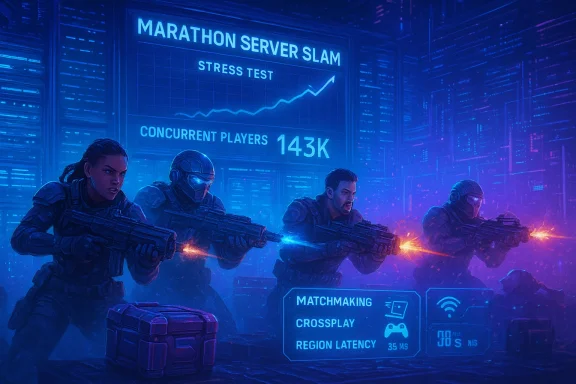
Bungie’s new extraction shooter, Marathon, blew past expectations during its open Server Slam stress test, peaking at roughly 143,621 concurrent players on Steam during the first day of testing — a result that both validates strong market interest and raises urgent technical and strategic questions for Bungie as the title approaches its full launch on March 5, 2026. The figure is notable because it represents only PC players on one storefront; with PlayStation 5 and Xbox Series X|S players participating in the same public test, the actual simultaneous user load on Bungie’s backend was significantly larger. What began as a weekend preview quickly read like an early proof-of-concept for player demand — but demand and long-term success are not the same thing. This feature unpacks what the early numbers mean, how they compare to recent extraction-shooter launches, what technical and player-experience issues emerged during the Server Slam, and the risks and opportunities facing Marathon in the fragile — and fiercely competitive — live-service shooter market.
Marathon’s Server Slam was an open, free preview designed to stress-test matchmaking, servers, and crossplay ahead of the game’s commercial release. The test window ran from February 26 through March 2, 2026, and was available on Steam for PC and on current-gen consoles. Because Bungie enabled crossplay and a public test client, the Server Slam was effectively a live-fire rehearsal for the types of load spikes and concurrency patterns Bungie expects at launch.
Steam-tracked metrics showed a peak concurrent Steam player count of approximately 143,621 on the first day of the Server Slam. Those numbers place Marathon among the higher-attendance early-playtest events this year and suggest that the extraction-shooter format — PvPvE loops where players extract loot while contending with other teams — remains attractive. For further context, comparable open tests for other extraction-focused titles in the last 12–18 months produced similar early surges; some later sustained and grew, others did not.
That player interest is important. But it’s just one input. Live-service success depends on technical stability, retention mechanics, monetization strategy, content cadence, and a community that feels heard and rewarded. The Server Slam provided early evidence across each of these vectors — both positive and cautionary.
Players also praised:
Key metrics to watch after launch:
Marathon’s early Steam peak is an important milestone, but it’s only the opening chapter. The next moves — emergency patches, matchmaking tuning, honest community communication, and thoughtful monetization — will determine whether Marathon becomes a mainstay of the extraction-shooter space or a well-attended but short-lived experiment. For players and industry watchers alike, the next forty-eight hours and the launch week will be the clearest indicators of which path Bungie intends to follow.
Source: Windows Report https://windowsreport.com/marathon-...ayers-on-steam-during-early-server-slam-test/
 Background
Marathon’s Server Slam was an open, free preview designed to stress-test matchmaking, servers, and crossplay ahead of the game’s commercial release. The test window ran from February 26 through March 2, 2026, and was available on Steam for PC and on current-gen consoles. Because Bungie enabled crossplay and a public test client, the Server Slam was effectively a live-fire rehearsal for the types of load spikes and concurrency patterns Bungie expects at launch.Steam-tracked metrics showed a peak concurrent Steam player count of approximately 143,621 on the first day of the Server Slam. Those numbers place Marathon among the higher-attendance early-playtest events this year and suggest that the extraction-shooter format — PvPvE loops where players extract loot while contending with other teams — remains attractive. For further context, comparable open tests for other extraction-focused titles in the last 12–18 months produced similar early surges; some later sustained and grew, others did not.
That player interest is important. But it’s just one input. Live-service success depends on technical stability, retention mechanics, monetization strategy, content cadence, and a community that feels heard and rewarded. The Server Slam provided early evidence across each of these vectors — both positive and cautionary.
What the numbers actually tell us
Peak concurrency vs. sustained population
A single peak figure is an attention-grabbing headline, but it’s only one dimension of health. Peak concurrency measures instantaneous interest, often inflated by news cycles, weekend availability, free access, and cross-platform hype. What it doesn’t tell you is whether those players stayed, whether matchmaking times were reasonable for the majority of time zones, or whether concurrent population stabilized at healthy levels after the initial spike.- A strong first-day peak shows curiosity and hype.
- What matters more for a live-service game is DAU/MAU, retention curves, and average daily concurrency across multiple days and weeks.
Steam-only counts understate total load
The Steam number is a conservative lower bound. Marathon’s crossplay test included PlayStation and Xbox users, who are not counted in Steam metrics. In other words, the real-world concurrent load on Bungie’s infrastructure during the Server Slam was materially higher than the Steam figure implies. This has two implications:- Server stress during peak times likely exceeded the Steam-reported number, meaning backend resilience was truly tested.
- Observed issues on Steam may have been mirrored, amplified, or different on console platforms depending on matchmaking and platform-specific telemetry.
Comparisons to other extraction shooters
Comparisons to other open tests are useful but must be contextualized. Several extraction-shooter tests drew hundreds of thousands on day one, but each title’s platform mix, marketing spend, and player expectations differ.- Marathon’s first-day Steam peak put it in the same ballpark as other high-profile server stress tests in recent memory.
- Comparisons with past titles that later increased or declined underscore that initial turnout is only one early metric in a broader performance dataset.
What players experienced during the Server Slam
Praise: population, crossplay, and first impressions
Many players reported quick matchmaking in populated regions, lively PvPvE encounters, and gratifying loot loops during high-popularity hours. The crossplay-enabled matches often populated quickly, which is one of the clearest short-term benefits of a high concurrent population.Players also praised:
- The variety of loadout and progression systems visible during the preview.
- The visual fidelity and polish in core combat loops.
- Cross-platform accessibility for friends groups, which lowers friction for early adoption.
Problems flagged: bugs, chat issues, and input concerns
Alongside praise came substantive player complaints that Bungie acknowledged it was tracking. Common themes included:- Chat and social system bugs that hampered player coordination in-game.
- Input and sensitivity inconsistencies, particularly for controllers vs. mouse-and-keyboard players.
- Matchmaking edge cases where new users occasionally encountered long queues depending on region and mode.
- Server hiccups: momentary desyncs and session drops were reported, particularly during peak load surges.
Technical implications for Bungie’s infrastructure
Real-world stress testing was the goal — and it worked
Bungie’s Server Slam was explicitly designed to replicate launch-like load. A sudden surge to ~143k Steam concurrent players — plus consoles — exercises matchmaking services, session authority servers, crossplay reconciliation, player-data services, and persistent economy endpoints. The test delivered that load. The engineering team now has concrete telemetry showing where the system buckled and where it remained stable.Critical backend components to watch
- Matchmaking and session authority: How gracefully the system creates, assigns, and returns sessions when the population cycles rapidly is crucial. Failure modes here lead to long queue times or match integrity issues.
- Player data and progression services: If progression rewards are lost or inconsistent under load, player goodwill evaporates quickly. Ensuring idempotent and durable writes is mandatory.
- Cross-region latency and regional pools: High crossplay activity means careful management of regional matchmaking pools to prevent excessively long travel times or unfair latency advantages.
- Telemetry and observability: The test validated the need for high-fidelity observability; quick root-cause identification reduces mean time to remediation.
Short-term engineering priorities post-test
- Fix the highest-frequency causes of player disconnects and lost progression writes.
- Tune matchmaking pools and fallback logic to reduce queue times for underpopulated regions.
- Smooth controller/KB input parity issues through client-side patches.
- Harden chat and social layer to tolerate packet-loss and partial failures without blocking core gameplay.
Business model, monetization, and retention mechanics
Marathon launches into a crowded extraction and live-service space where monetization design can make or break long-term success. Early test behavior offers clues about potential retention, but not guarantees.What keeps players coming back?
For extraction shooters, retention depends on a mix of:- Meaningful progression that feels rewarding without becoming grindy.
- Regular content drops and seasonal events to refresh the meta.
- Competitive integrity — if the player base believes the matchmaking and balancing are fair, engagement increases.
- Social systems and guilding — communities and friend groups are the glue for live services.
Monetization tension points
- Cosmetic vs. pay-to-win: Players have low tolerance for monetization that affects competitive balance. Cosmetic sales, battle passes, and optional convenience items are generally better accepted.
- Friction vs. conversion: Monetization must be non-intrusive during early adoption. Aggressive prompts during the Server Slam would have dissuaded trial players.
- Retention-led monetization: The best revenue often comes from a loyal base, so early retention is the most valuable predictor of long-term ARPU (average revenue per user).
Competitive landscape and market positioning
Extraction shooters are back in the spotlight
The extraction-sim subgenre has seen renewed interest from both triple-A and indie studios. Marathon benefits from:- A recognizable studio pedigree with Bungie’s live-service experience.
- A polished, cross-platform launch window that makes it widely accessible.
- Player-first design choices (fair matchmaking, attachments, and progression).
- Bungie’s brand trust from past live-service titles.
- Content cadence and event design that keep the meta fresh.
Timing and launch-window dynamics
Launching amid multiple high-profile tests and playtests (for other AAA titles) raises the risk of audience fragmentation. However, Marathon’s genre appeal and social incentives may mitigate that. The weekend Server Slam was smart from an acquisition standpoint; it created word-of-mouth and populated matches early.Player sentiment and community moderation
Early community signals
Community feedback during the Server Slam was a mixture of enthusiasm and constructive criticism. High-level trends included:- Positive sentiment around the core loop and polish.
- Vocal complaints about specific bugs and perceived harshness in some extraction mechanics.
- Active community engagement in official channels to provide bug reports and suggestions.
Moderation and toxicity risks
High concurrency invites community moderation challenges. If in-game voice and chat systems become hubs for toxic behavior, new players may be repelled. The Server Slam surfaced some moderation edge cases and spam vulnerabilities, which Bungie must address quickly to maintain a hospitable environment for new players.Risks and failure modes to monitor
- Post-test dropoff: High initial peaks followed by rapid decay is a classic failure mode. If daily active users fall too quickly, matchmaking and monetization both suffer.
- Unfixed progression bugs: Players punished by lost or inconsistent rewards will vocalize outrage and may not return.
- Market competition: A crowded launch window can siphon players, particularly if rival titles offer similar loops or more generous early access.
- Monetization backlash: Overly aggressive or poorly-communicated microtransactions can turn early adopters away. Cosmetic-first approaches with clear earnable paths mitigate this risk.
- Server instability at launch: If the infrastructure fails under the full launch load, player trust erodes fast and is costly to regain.
What Bungie needs to get right before launch
- Rapidly patch the highest-impact stability issues identified in the Server Slam.
- Confirm that progression writes and reward systems are durable and auditable.
- Calibrate matchmaking pools so that regional players see reasonable queue times, even off-peak.
- Communicate clearly with the community about fixes, timelines, and what to expect at launch.
- Roll out a measured monetization approach: cosmetic-first, transparent, and respectful of competitive balance.
Short- and medium-term outlook
In the short term, Marathon’s Server Slam performance is encouraging. A Steam peak of ~143k demonstrates appetite and creates momentum. Over the medium term (weeks to the first season), retention trends — particularly how many Server Slam players return for the paid launch and how ARPU develops — will determine whether Marathon cements itself as a steady live service.Key metrics to watch after launch:
- Day 1 / Day 7 / Day 30 retention rates
- Peak and average concurrent users across all platforms
- Matchmaking queue times in major regions
- Revenue per active user and cosmetics conversion rates
- Community sentiment trends in official and third-party channels
Final analysis: reasons to be optimistic — and cautious
There are multiple reasons to be optimistic:- The Server Slam attracted a very large pool of players quickly, validating interest in the core gameplay loop.
- Crossplay and accessibility lowered adoption friction and produced populated matches.
- Bungie’s experience with live services provides institutional knowledge for the hard work ahead.
- Peak numbers alone don’t guarantee retention or monetization success.
- The Server Slam exposed technical and social vulnerabilities that must be fixed promptly.
- Market competition and timing pose real threats to sustained growth.
Marathon’s early Steam peak is an important milestone, but it’s only the opening chapter. The next moves — emergency patches, matchmaking tuning, honest community communication, and thoughtful monetization — will determine whether Marathon becomes a mainstay of the extraction-shooter space or a well-attended but short-lived experiment. For players and industry watchers alike, the next forty-eight hours and the launch week will be the clearest indicators of which path Bungie intends to follow.
Source: Windows Report https://windowsreport.com/marathon-...ayers-on-steam-during-early-server-slam-test/
