

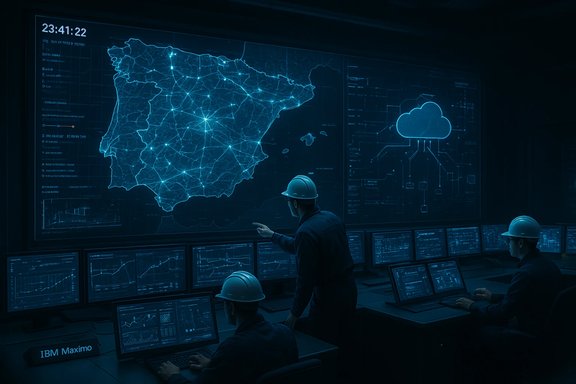
A day-long blackout in the Iberian Peninsula in April 2025 exposed a stark operational reality for modern energy systems: when data is fragmented or delayed, even advanced grids can fail in ways that are hard to predict and hard to investigate afterward. The European Network of Transmission System Operators for Electricity (ENTSO‑E) and subsequent reporting identified cascading overvoltages and a lack of complete, high‑quality telemetry as core issues that complicated both the response and the post‑incident analysis—an urgent reminder that visibility across assets, networks and control systems is not optional for critical infrastructure.
Background
The 28 April 2025 outage left much of continental Spain and Portugal without power for hours, disrupting trains, flight operations, communications and banking services. Investigators described the event as unprecedented in Europe and highlighted oscillatory voltage behaviour and sudden generation trips before the collapse. They also flagged significant difficulties in assembling consistent, time‑aligned telemetry across multiple generators, TSOs and distribution operators—limitations that prolonged the inquiry and clouded root‑cause certainty. Against that backdrop, enterprise asset management (EAM) vendors and cloud providers have pushed a narrative of predictive, AI‑driven operations: unify telemetry, apply analytics and AI to detect anomalies earlier, use digital twins to simulate responses and make decision support available to frontline crews. IBM’s Maximo Application Suite (MAS), positioned to run on Microsoft Azure, is a leading example of this approach—combining asset lifecycle workflows, AI‑assisted analytics and integrations into IoT and digital twin ecosystems. IBM and partner materials highlight MAS running on Azure Red Hat OpenShift, ingesting data via Azure IoT services, leveraging watsonx.ai for conversational and generative AI, and being amenable to Copilot‑style interfaces for field technicians.Why the Iberia blackout matters for EAM and utilities
The blackout crystallised three operational gaps that EAM + cloud architectures aim to close:- Real‑time, high‑fidelity telemetry: Investigators repeatedly noted that missing or low‑quality measurement data hampered sequence reconstruction and root‑cause analysis. For energy utilities, the lesson is that SCADA, PMU, generation and substation telemetry must be captured with consistent time stamps and held in resilient, queryable repositories.
- Cross‑system visibility and coordination: Cascading faults travel across transmission, generation and distribution boundaries. Isolated data silos make it difficult to see how a local fault propagates into a regional failure, increasing the chance of misdiagnosis or conflicting corrective actions.
- Operational decision support under stress: When protection schemes, human operators and plant controllers all act within seconds, clear situational awareness and pre‑tested response playbooks are essential. The ability to simulate contingencies, predict likely cascade paths, and dispatch crews quickly is now part of resilience planning.
What IBM Maximo Application Suite on Azure actually offers
IBM Maximo Application Suite is not a single point product; it’s a suite of modular applications and platform services designed for enterprise asset lifecycle management (EAM), asset performance management (APM) and related workflows. Recent IBM documentation and partnership announcements make several concrete claims about deploying MAS on Azure and how it supports energy and utility use cases:- MAS is containerised and validated to run on Red Hat OpenShift on Azure (Azure Red Hat OpenShift / ARO), with deployment patterns, Ansible automation and marketplace options to ease provisioning and lifecycle operations. This validated architecture reduces the friction for MAS customers moving from older Maximo 7.x environments to the modern MAS stack.
- MAS includes AI and analytics modules—including condition‑based monitoring, predictive maintenance and reliability tools—and IBM positions watsonx as the enterprise AI foundation that powers conversational assistants, RAG (retrieval‑augmented generation) workflows and automated job‑plan generation tied back into Maximo work orders and asset records. Partners and IBM case studies show implementations where watsonx services surface technical manuals, create structured job plans and summarise historical failure patterns.
- Azure services such as IoT Hub, IoT Edge and Azure Digital Twins are explicitly referenced in partner architectures and Azure documentation as the mechanisms to collect device and sensor telemetry, perform edge compute preprocessing, and model asset environments for twin‑based analytics—allowing MAS or adjacent tools to ingest and act on real‑time signals.
- IBM and Microsoft have positioned Maximo to be delivered either as a client‑managed deployment via the Azure Marketplace, or as a managed offering (for example through IBM Consulting’s Maximo ManagePlus) that runs on Azure infrastructure and is monitored for SLOs and patching cadence. The result is flexible hosting and commercial options for utilities with differing cloud strategies.
How telemetry and digital twins fit into the operational picture
Digital twins and IoT are not buzzwords in this context—they are practical tools for turning dispersed sensor streams into actionable insights. Azure Digital Twins provides the graph model, device twins and runtime event system; IoT Hub and IoT Edge provide device connectivity and edge preprocessing. When these services feed a system such as MAS, operators gain:- unified asset models that link sensors to equipment hierarchies,
- normalized, timestamped data flows for analytics and root‑cause reconstruction,
- the ability to run scenario simulations against current operational states (digital twin ‘what‑if’), and
- direct triggers from analytics into maintenance workflows, work orders and crew scheduling.
Strengths: where the MAS + Azure approach can materially improve resilience
The combination of a modern EAM (MAS), cloud platform (Azure) and enterprise AI (watsonx/Copilot patterns) offers several powerful advantages for energy operators:- Unified asset lifecycle management — MAS centralises asset records, work‑order history, inspection reports and spare parts inventories, reducing friction in maintenance execution and lifecycle decision‑making. That single source of truth is essential for coordinated restoration and forensic investigations.
- Faster detection and prediction — With time‑synchronised telemetry and APM models, utilities can detect anomalous operating envelopes earlier, generating prescriptive recommendations (schedule a turbine inspection, adjust tap changers, dispatch hot‑line crews) before failures cascade.
- Human‑centric AI interfaces — IBM and systems integrators are deploying conversational assistants and generative AI to make analytics accessible to frontline staff. Plain‑language queries and generative job‑plan creation reduce dependency on specialist data scientists for everyday decisions. Case studies and partner materials document implementations using watsonx to automate job plans and to provide contextual answers for technicians.
- Edge to cloud continuity — Azure IoT Edge allows preprocessing and local decisioning during network partitions; MAS on Azure supports ingestion of that processed data for reconciliation and analytics once connectivity is restored.
- Operational extensibility — Copilot and Copilot‑style custom copilots (built with Microsoft Copilot Studio and Azure AI services) can create task‑specific conversational interfaces that integrate with Maximo APIs and backend systems—useful for voice‑enabled, hands‑free data capture for field work. IBM’s co‑innovation centres and partner demos explicitly showcase this pattern.
Risks and practical limitations — the caveats the sales pitch often skips
No platform, by itself, prevents grid instability. The technology stack described above is powerful, but there are clear, practical risks and implementation challenges that utilities must manage if they are to achieve the advertised resilience gains.- Data quality and instrumentation gaps — The ENTSO‑E report emphasised lack of complete, high‑quality data. Installing MAS and cloud pipelines will not fix missing PMUs, poorly‑configured SCADA historian time bases, or non‑synchronised device clocks. Investments in instrumentation, precise time synchronisation (e.g., GPS/IEEE‑1588) and telemetry retention policies are prerequisites for meaningful analytics.
- Integration complexity and project risk — MAS deployments frequently entail migrating decades of records, mapping asset taxonomy, integrating ERP, GIS, SCADA and DER (distributed energy resource) systems, and validating business workflows. IBM’s guidance highlights multiple deployment options (marketplace templates, ARO, self‑managed OpenShift), but each path has operational trade‑offs. Poorly planned migrations can introduce data regressions and operational friction.
- Latency and edge decisioning — Some grid protections operate at millisecond scales; cloud analytics cannot replace local relays and protection logic. Edge compute helps, but utilities must carefully delineate what remains on‑device versus cloud‑managed analytics to avoid introducing new failure modes.
- Model governance and AI hallucination — Generative AI and LLM‑driven assistants are useful for summarisation and job‑plan drafting, but they can produce plausible‑sounding—but incorrect—guidance. Utilities must enforce model governance, evidence‑anchoring (RAG), audit trails and human‑in‑the‑loop validation for any AI‑delivered operational action. Industry partners point to watsonx and RAG patterns as controls, but operational governance remains a heavy lift.
- Cybersecurity and supply chain risk — Centralising operational data and connecting OT telemetry to cloud services creates new attack surfaces. Any MAS + cloud deployment must be hard‑secured with network segmentation, strong identity and access management (IAM), encryption, and integrated monitoring. Migration and third‑party integrations increase supply‑chain complexity; vendor patching cadence and managed services SLAs must be audited.
- Dependence on vendor ecosystems and vendor lock‑in — Running MAS on Azure, using watsonx and adding Copilot integrations creates a multi‑vendor tapestry. While interoperability efforts exist, organisations must plan for portability, data exportability and multi‑cloud disaster recovery to avoid being bound to a single vendor stack.
Adoption realities: from proof‑of‑concept to operational service
For utilities considering this model, the implementation pathway typically follows three phases:- Discovery and instrumentation upgrade
- Inventory telemetry sources (SCADA points, PMUs, inverter logs), check timestamping and determine where additional sensors or PMU deployment is needed.
- Align asset taxonomy and data models (DTDL or equivalent) so device streams map to asset records.
- Pilot and integration
- Deploy a scoped MAS module (e.g., Manage + Health) on an ARO or marketplace instance.
- Integrate an Azure IoT ingestion path (IoT Hub, IoT Edge) and a digital twin model for a subset of critical substations or renewable farms.
- Use watsonx‑backed assistants to prototype job‑plan automation and conversational queries for field teams.
- Operationalise and govern
- Add SRE processes, security hardening, incident runbooks and model governance.
- Expand digital twin coverage and APM models by iterating on anomaly detection thresholds, workflows and maintenance strategies.
- Introduce Copilot experiences carefully—with guarded actions, audit logging and escalation paths—so that conversational interfaces augment rather than replace operational controls.
What to look for in contracts and SLAs
When a utility signs for an MAS + Azure deployment or a managed Maximo service, procurement teams should scrutinise:- Telemetry retention and export clauses — Ensure raw measurements and historian data are retained long enough and that you can export them in forensic formats (e.g., CSV with high‑precision timestamps, binary PMU streams).
- Uptime and restoration SLAs across stack layers — It’s not enough to have an Azure SLA; you need coordinated SLOs that cover OpenShift clusters, MAS application availability, and data ingestion pipelines.
- Security incident response — Contracts should specify joint incident response playbooks, forensic access, and notification timelines for OT and IT breaches.
- Model and change governance — For AI‑assisted decisioning, require documentation of model training data, drift detection, and a rollback plan for faulty model outputs.
- Interoperability and exit rights — Guarantee data portability and clear, tested migration paths if you want to change cloud providers or self‑host in the future.
Final assessment: realistic optimism with disciplined execution
The fundamental case for combining a modern EAM like IBM Maximo Application Suite with Azure IoT, digital twins and enterprise AI is compelling: utilities gain a unified asset record, richer telemetry and the ability to push AI‑driven insights to both planners and field engineers. IBM’s documented support for Azure Red Hat OpenShift deployments, watsonx integrations and partner‑led Copilot demos show the ecosystem is mature enough for serious pilots and early production use. However, the Iberia blackout serves as a blunt reminder: technology alone will not cure incomplete instrumentation, poor timestamping, brittle integration or lax governance. The real gains come from disciplined investments across three dimensions: (1) high‑quality sensors and synchronized telemetry, (2) robust integration and operational processes that tie analytics to validated actions, and (3) rigorous cybersecurity and AI governance that prevent new failure modes. ENTSO‑E’s investigation shows that data availability and quality are the constraints that determine whether analytics and AI can actually improve resilience—or merely complicate post‑incident analysis. For energy organisations that approach MAS + Azure as a program—starting with instrumentation, then integrating pilots, and finally operationalising governance and security—the payoff can be meaningful: fewer unplanned outages, shorter restoration times, better forensic traceability, and a clearer pathway to managing hybrid portfolios of conventional and renewable assets. For those that treat it as a product swap, the risk is high: complexity, compliance gaps and the illusion of intelligence without substance.Practical checklist for energy leaders evaluating MAS + Azure deployments
- Ensure PMUs, SCADA historians and IoT sensors have consistent, high‑precision timestamps before relying on analytics.
- Start with a critical‑asset pilot (one substation, one wind farm) to validate ingestion, twin models and job‑plan automation.
- Require “evidence‑anchored” AI: every generative recommendation must include the source documents, telemetry traces and confidence scores.
- Define clear operational limits: which actions the system can suggest versus which actions require explicit human sign‑off.
- Enforce end‑to‑end security: segmented OT/IT networks, strong IAM, encryption at rest and in transit, and joint IR playbooks.
- Contractually require raw data access and export capabilities to preserve forensic sovereignty.
The future of energy operations is not simply cloud‑native or AI‑enabled—it is data‑disciplined. Platforms such as IBM Maximo Application Suite running on Azure provide the technical scaffolding to unify assets, telemetry and AI, but their value depends on the real‑world plumbing around them: sensors, time synchronisation, integration discipline and governance. When those foundations are in place, utilities can move from reactive firefighting to predictive, intelligent operations; when they are not, even the best analytics cannot prevent the kinds of systemic failures that investigators saw in the Iberian blackout.
Source: Technology Record Energising operations: Caleb Northorp reveals how IBM helps energy firms move to predictive, intelligent operations
