Matthew McConaughey’s decision to trademark short video and audio clips of himself — including a registered sound mark for the now‑iconic line “Alright, alright, alright” — marks a notable escalation in how public figures are trying to protect their identity from AI‑driven impersonations and deepfakes, and it raises immediate questions about whether trademark law can realistically police an era of synthetic voices and images.
Expect courts, platforms, and legislators to weigh in quickly. For performers and brand owners, McConaughey’s move is instructive: a multi‑pronged approach — combining registrations, contracts, platform policy engagement, and legislative advocacy — will be necessary to meaningfully shape how AI treats personhood, consent, and attribution going forward. The next few test cases will determine whether trademarks become a reliable circuit breaker for AI impersonations or simply one arrow in a much larger legal and technical quiver.
Source: PCMag Middle East https://me.pcmag.com/en/ai/34775/matthew-mcconaughey-trademarks-himself-to-fight-ai-impersonations]
 Background
What McConaughey registered — the basics
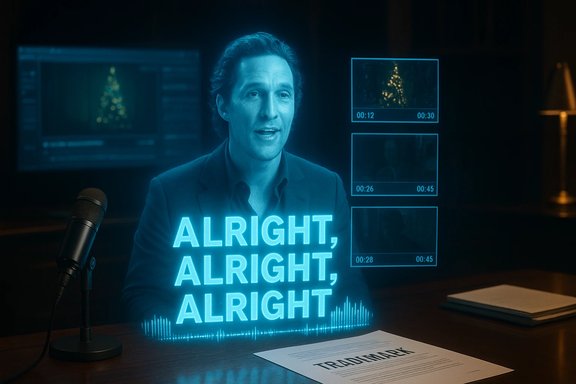
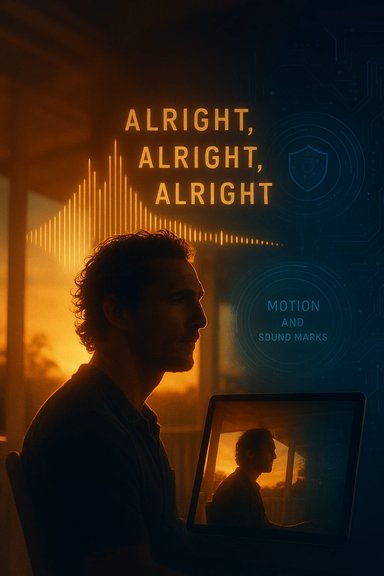
Over the last several months the U.S. Patent and Trademark Office (USPTO) approved eight trademark applications tied to Matthew McConaughey’s voice, short video clips of his likeness, and characterful audio snippets, including a registered sound mark for his famous “Alright, alright, alright” delivery. These filings — submitted by entities connected to his J.K. Livin brand and handled by attorneys at Yorn Levine — are explicitly described as motion and sound marks that capture how he speaks certain lines as well as short visual vignettes of his gestures and presence. Attorney statements and McConaughey’s own remarks frame the move as prophylactic: to make consent and attribution the default norm when an AI system reproduces his voice, image, or cadence, and to create a federal cause of action that could be enforced in court quickly if unauthorized uses appear online. His lawyers say the trademark route supplies a clearer federal enforcement mechanism than piecemeal state publicity rights.Timeline and provenance
- Trademark applications for select clips were filed around December 2023 and, according to public reporting, at least some registrations were granted in December 2025.
- The material registered ranges from a few‑second video of McConaughey on a porch to a three‑second festive clip to short audio segments that capture his cadence and pitch on specific lines.
- McConaughey has publicly partnered with AI voice vendor ElevenLabs to produce authorized Spanish translations of his newsletter voice recordings — demonstrating simultaneous interest in permitted AI use as well as defensive legal measures.
Why this matters now: AI impersonations, deepfakes and the practical gap in the law
The practical problem
Advances in generative AI have lowered the technical bar to produce convincing audio, video, and image impersonations. Deepfake tools can clone voices and faces from short samples, and text‑to‑speech models can reproduce cadence, timbre, and inflection to a degree once limited to professional studios. That technological capability has collided with a legal landscape that historically treated persona protection as a state law matter (right of publicity) or as an IP/licensing issue in commerce — neither of which offers a tidy, immediate, uniform federal remedy for internet‑scale impersonation. McConaughey’s trademark strategy is an attempt to bootstrap a federal remedy into that gap.Why trademark, not only publicity rights?
- Right of publicity is a state‑law claim and varies across jurisdictions; enforcement can be slow and patchwork.
- Trademark law provides a federal cause of action and powerful remedies (injunctions, damages, statutory fees in select circumstances) when a mark is used in commerce in a way that causes consumer confusion or implies sponsorship/endorsement. McConaughey’s team argues that a registered motion or sound mark gives him the ability to stop unlicensed uses in federal court more quickly than relying solely on disparate state rules.
Anatomy of the filings: motion marks and sound marks
What the registrations actually capture
The USPTO already recognizes non‑traditional marks — sound marks and motion marks — for brands (think of NBC’s chimes, Intel’s five‑note bong, or a trademarked video sting). McConaughey’s filings follow that pattern but apply it to a human performer. One registered sound mark literally transcribes the pitch pattern of “Alright, alright, alright” — the application even describes where the syllables sit in pitch relative to each other — while motion marks cover very short video clips that show his appearance and gestures. Those are permissible trademark formats in the abstract, and the USPTO has registered similar non‑traditional marks for corporate brands before.Why the pitch and cadence matter
By specifying pitch, cadence, and micro‑timing, the filings aim to differentiate an identified, proprietary rendition of a phrase from generic uses. That specificity strengthens the argument that the registered marks uniquely identify McConaughey’s persona in commerce — a key factor the USPTO assesses for sound and motion marks. But it also means enforcement will depend on whether a contested AI output matches the registered rendition closely enough to be considered a use of the mark.Legal strengths: what trademarks can realistically achieve
- Federal jurisdiction and remedies. Registered marks allow federal suits and can produce preliminary injunctions, takedowns, and monetary remedies more quickly than state‑only claims in many cases. McConaughey’s team emphasizes that leverage.
- Clear commercial bargaining chip. Holding registered marks strengthens licensing negotiations and gives a clear contractual leash to authorize certain AI uses while blocking others. The arrangement with ElevenLabs shows how permissioned uses can coexist with protective enforcement.
- Platform leverage. Trademark owners can use takedown mechanisms or platform policies to remove unauthorized content and to press platforms like social networks and app stores to restrict offending apps or models that rely on misappropriated marks.
Legal limits and practical risks — why this strategy will be tested
1) Trademark law is a tool built for commerce, not identity policing
Trademarks traditionally address consumer confusion and source identification in the marketplace. A parody, news report, or private (non‑commercial) deepfake may fall outside core trademark applications. Courts will have to decide whether an AI clip that mimics a celebrity without trying to sell something or imply endorsement constitutes a trademark use. Early commentary warns that trademark doctrine may be an imperfect fit for the full range of AI misuse scenarios.2) Free speech and parody defenses
Parody, satire, and commentary are protected forms of expression. If an AI impersonation is clearly transformative or commentary, trademark claims may face First Amendment defenses. The balance between protecting identity and preserving expressive freedoms will be litigated and is far from settled.3) Geographic and cross‑platform enforcement friction
Trademarks are territorial; a U.S. registration does not, by itself, stop actors or platforms operating outside the U.S. from distributing synthetic impersonations. International enforcement requires additional filings and cross‑border legal strategies, which increase cost and complexity.4) Proving a match in court is technical and adversarial
AI model outputs vary; proving that an unauthorized clip “uses” the registered sound or motion mark will necessitate forensic audio/video analysis and expert testimony. Slight variations in cadence or an adversary’s attempt to disguise a sample may defeat the contention that a trademark was used. Expect high‑stakes technical battles at trial.5) Chilling effects and escalation
If celebrities broadly register momentary expressions and their agents treat any unlicensed mimicry as infringement, platforms, creators, and small businesses may face chilling legal risk. The strategy could fuel an arms race of registrations and takedowns, raising speech and innovation concerns. Commentators urge careful, proportionate use of IP tools to avoid overreach.How enforcement might play out (practical scenarios)
- Automated takedown: a social platform receives a trademark complaint and removes videos that clearly match the registered motion mark. Affected users may see content removed and accounts flagged. GPL and platform abuse appeals will follow.
- App‑store and API control: an app replicating McConaughey’s voice is removed from app stores due to trademark complaints or platform policy violations. The app’s developer may need to re‑engineer or obtain a license.
- Litigation against model operators: if an AI vendor uses scraped data to produce a voice that closely replicates a registered sound mark, McConaughey’s team could seek an injunction and damages in federal court based on trademark infringement and unfair competition theories. Success would depend on showing “use in commerce” and likelihood of consumer confusion.
Broader implications for celebrities, platforms and AI companies
- Celebrities and creators will likely follow suit selectively: those with global brands and monetizable personas have an obvious incentive to convert signature lines, vocal cadences, and short clips into enforceable marks. But widespread adoption will be costly and legally fraught.
- Platforms face growing pressure to clarify policies and build better detection tools while balancing valid expression and parody. Trademark notices are an immediate lever, but they’re blunt tools that can be misused for takedowns.
- AI companies that synthesize voices or faces must enhance provenance, consent mechanisms, and licensing workflows to avoid litigation. Firms offering voice‑cloning technologies will need clearer consent protocols and opt‑out mechanisms for protected persons.
Critical analysis: strengths, weaknesses and the path ahead
Notable strengths of McConaughey’s move
- Pre‑emptive clarity. By registering specific marks now, McConaughey places potential infringers on notice and creates a visible legal perimeter. That matters for platforms and vendors that prefer decisive, documented rights before acting.
- Federal leverage. Trademark registrations facilitate federal claims and faster court remedies that can be more effective at scale than a patchwork of state litigation.
- Controlled permissive use. The strategy allows for explicit, paid or curated uses (like the ElevenLabs cooperation) while enabling a default block on unauthorized reproductions.
Real risks and unresolved weaknesses
- Doctrinal mismatch. Trademark doctrine is not tailored to identity policing in the age of synthetic media; courts will have to stretch or adapt longstanding tests to fit new use cases. That may produce inconsistent precedent.
- Free speech and fair use friction. Parody, commentary, and news reporting remain powerful defenses; overreliance on trademark claims could generate bad precedent or public backlash.
- Enforcement costs and technical uncertainty. For every successful takedown, defenders may need costly forensics and global enforcement. Smaller creators and public figures without deep pockets will remain vulnerable.
What to watch next — legal and industry signals
- Litigation: expect test cases where registered motion or sound marks are asserted against AI outputs that mimic cadence or appearance. The outcomes will be instructive for the limits of trademark law.
- Platform policy changes: app stores and social networks will likely update policies for synthetic media and define clearer pathways for disputed content where registered marks exist.
- Legislative response: Congress and state legislatures are already considering “No Fakes” type measures and right‑of‑publicity reforms; statutory fixes could render some trademark strategies unnecessary or redefine permissible enforcement approaches.
Practical takeaways for Windows users, creators, and AI practitioners
- If you build or distribute AI synthesis tools, institute robust consent and provenance requirements, and provide easy opt‑out processes for protected individuals. Transparent policies reduce litigation risk and promote trust.
- Creators should consider licensing or permission workflows when using recognizable voices or likenesses; relying on generic or altered vocal styles may still be safest for small projects.
- Enterprises that integrate synthetic media into products should consult IP counsel about registration strategies, contracts with talent, and platform compliance. Trademarks can be part of an IP toolkit — but they are not a standalone solution.
Caveats and unverifiable points
- Some outlets have described McConaughey’s filings as the first time an actor has used trademark law in this way. While widely reported, that precise “first” claim should be treated cautiously; individual celebrities, brands, or estates have previously pursued non‑traditional marks, and legal historians may identify prior analogs. The characterization is notable, but it rests on journalistic synthesis rather than a definitive legal registry study. Treat language that asserts absolute novelty as potentially imprecise.
- Public reporting cites USPTO approval dates and filing windows that vary slightly across outlets (filings in December 2023, approvals reported in December 2025). Those details come from reporting based on USPTO filings and journalism; anyone needing precise docket information should consult the USPTO database directly to verify serial numbers, registration dates, and exact mark descriptions.
Conclusion
Matthew McConaughey’s trademark filings are a bold, pragmatic test of how legacy IP systems can be repurposed to confront AI impersonation. The registrations give his team immediate federal levers and a packaged legal posture that combines protection with the ability to license authorized AI uses. Yet trademarks were not designed to be a universal shield for personal identity in an era of cheap synthetic replication, and this strategy will be tested on doctrinal, technical, and policy grounds.Expect courts, platforms, and legislators to weigh in quickly. For performers and brand owners, McConaughey’s move is instructive: a multi‑pronged approach — combining registrations, contracts, platform policy engagement, and legislative advocacy — will be necessary to meaningfully shape how AI treats personhood, consent, and attribution going forward. The next few test cases will determine whether trademarks become a reliable circuit breaker for AI impersonations or simply one arrow in a much larger legal and technical quiver.
Source: PCMag Middle East https://me.pcmag.com/en/ai/34775/matthew-mcconaughey-trademarks-himself-to-fight-ai-impersonations]