

Anthropic’s decision to donate the Model Context Protocol (MCP) to a newly created Agentic AI Foundation (AAIF) hosted under the Linux Foundation signals a deliberate industry move to treat the plumbing of agentic AI—how models discover, call and govern external tools—as neutral, community‑governed infrastructure rather than proprietary vendor lock‑in.
One year after open‑sourcing MCP, Anthropic, together with OpenAI and Block, announced the formation of the Agentic AI Foundation as a directed fund under the Linux Foundation and contributed three foundational artifacts: Anthropic’s Model Context Protocol (MCP), OpenAI’s AGENTS.md, and Block’s goose agent framework. Major cloud and platform players—Google, Microsoft, AWS, Cloudflare and Bloomberg among them—are listed as initial backers of AAIF, giving the new foundation immediate technical weight and industry visibility. This transfer is explicitly pitched as a durability and neutrality play: projects that solve the recurring engineering problem of connecting language models with real‑world services should sit in a stewarded, community‑driven body rather than a single vendor’s IP estate. The announcement frames MCP, AGENTS.md and goose not as academic specs but as working plumbing already embedded in developer tools and enterprise products.
Open protocols historically reduced friction and enabled third‑party ecosystems to flourish (think HTTP, SMTP, OAuth). Placing MCP and companion artifacts in a neutral foundation aims to reproduce that dynamic for agentic AI: reduce integration cost, enable portability of agent workflows across platforms, and create an ecosystem of registries, conformance tools and certified connectors.
Key elements:
Strengths:
Major risk classes:
Immediate tactical steps:
For Windows platform teams and enterprise architects, the right response is deliberate: pilot early with strong policy and observability controls, build internal registries and attestation workflows, and engage with AAIF governance to help shape the safety defaults that enterprises will rely on at scale.
Source: ERP Today Anthropic Set to Donate MCP to New Linux Foundation Agentic AI Foundation
 Background
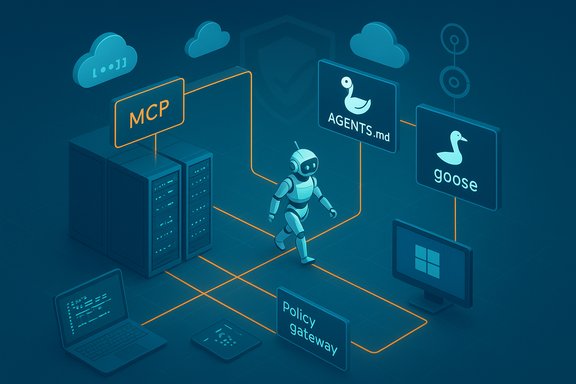
One year after open‑sourcing MCP, Anthropic, together with OpenAI and Block, announced the formation of the Agentic AI Foundation as a directed fund under the Linux Foundation and contributed three foundational artifacts: Anthropic’s Model Context Protocol (MCP), OpenAI’s AGENTS.md, and Block’s goose agent framework. Major cloud and platform players—Google, Microsoft, AWS, Cloudflare and Bloomberg among them—are listed as initial backers of AAIF, giving the new foundation immediate technical weight and industry visibility. This transfer is explicitly pitched as a durability and neutrality play: projects that solve the recurring engineering problem of connecting language models with real‑world services should sit in a stewarded, community‑driven body rather than a single vendor’s IP estate. The announcement frames MCP, AGENTS.md and goose not as academic specs but as working plumbing already embedded in developer tools and enterprise products. What the donation actually includes
The Model Context Protocol (MCP)
MCP is an HTTP/JSON‑style protocol designed to standardize how models and agent runtimes discover, describe and invoke external capabilities—filesystems, databases, SaaS APIs, shells and other tools—via networked connectors (commonly called “MCP servers”). The spec defines tool descriptors, transports (streaming, stdio, etc., discovery/registry semantics, invocation models and extension points for asynchronous and stateless operation. Anthropic’s donation places MCP under AAIF stewardship while promising that maintainership and community input will continue. Anthropic’s public materials claim strong adoption metrics for MCP—more than 10,000 active public MCP servers and broad integration across developer and product tooling (including ChatGPT Apps, Microsoft Copilot, Gemini, Visual Studio Code and others). The company also reports a November 2025 spec update adding async operations, stateless modes, server identity features, and official SDKs with very high download volumes. These claims are prominent in the launch narrative but are vendor‑reported and therefore warrant cautious interpretation and independent validation.AGENTS.md and goose
- AGENTS.md is a lightweight, repository‑level Markdown convention that provides machine‑readable project guidance—build/test commands, files to avoid, environment setup and constraints—so coding agents behave predictably within a repository. OpenAI reports AGENTS.md has been adopted in 60,000+ open‑source projects and frameworks since its August 2025 release.
- goose, contributed by Block, is an open‑source, local‑first agent runtime designed to demonstrate secure, model‑agnostic agent patterns with tight MCP integration. Goose functions as a runnable reference implementation that surfaces real‑world security and UX trade‑offs that a mere spec would not.
Why this matters: interoperability, scale and the “plumbing” problem
Agentic AI systems—agents that plan, call tools and carry out multi‑step tasks—shift the architecture of AI from single‑turn chat to orchestrated, stateful workflows. That shift exposes a classic fragmentation problem: without shared interfaces, every agent runtime must build bespoke connectors to each service, creating engineering duplication, brittle integrations and divergent safety controls.Open protocols historically reduced friction and enabled third‑party ecosystems to flourish (think HTTP, SMTP, OAuth). Placing MCP and companion artifacts in a neutral foundation aims to reproduce that dynamic for agentic AI: reduce integration cost, enable portability of agent workflows across platforms, and create an ecosystem of registries, conformance tools and certified connectors.
Verification: what’s provable and what’s vendor‑reported
A responsible technical analysis must separate what is documented and verifiable from vendor‑reported metrics that need independent attestation.- Anthropic’s announcement that MCP has been donated to the Linux Foundation’s Agentic AI Foundation and the AAIF’s existence are verifiable facts, documented by Anthropic, the AAIF press page and Linux Foundation materials.
- The AAIF launch and the three contributions (MCP, AGENTS.md, goose) are corroborated across multiple independent outlets (TechCrunch, Wired, The Verge and press wires), confirming the formation and the list of founders/backers.
- Adoption metrics—“10,000+ active public MCP servers”, “97M+ monthly SDK downloads” for MCP SDKs, and “60,000+ AGENTS.md projects”—are stated explicitly in Anthropic and OpenAI announcements and are widely quoted in trade press. These numbers are company‑reported telemetry and have not (at time of writing) been independently audited by a neutral third party available in public reporting. Treat them as directional indicators of momentum rather than ironclad market statistics.
- Vendor claims about product integrations (ChatGPT, Copilot, Gemini, VS Code, Cursor, etc. are verifiable in product documentation and public feature notes from the respective vendors; cross‑checking those integrations across vendor docs or product release notes is advised for any operational decision. Examples of corroborating product mentions appear in company blogs and tech press coverage.
Technical anatomy of MCP (short, practical primer)
MCP is intentionally pragmatic: it provides a machine‑readable connector schema and a discovery model so agents can find and call services without bespoke glue code.Key elements:
- MCP Server: Hosts that advertise tools, action schemas, quotas and security constraints. Agents call these servers to perform actions.
- Tool Descriptors: JSON or schema objects describing input/output shapes, side‑effects, and authentication requirements.
- Transports: Transport‑agnostic intent—common transports include HTTP with streaming (SSE), stdio for local processes, and websocket/GRPC variants.
- Registry & Discovery: A community registry to publish MCP servers and enable agent runtimes to discover connectors.
- Extensions: Official extension points for async operations, stateless invocation modes, server identity/attestation and telemetry hooks.
- Agents can call the same connector regardless of underlying model or runtime.
- Enterprises can centralize governance in the connector (policy enforcement, audit logging, auth) rather than scattering it across client SDKs.
- Async and stateless modes help with long‑running jobs and horizontal scaling across connector fleets.
Governance and political risk: directed fund under the Linux Foundation
AAIF is established as a directed fund under the Linux Foundation. That structure combines Linux Foundation operational infrastructure with directed initial funding and membership tiers, but it also raises governance questions that matter in practice.Strengths:
- Linux Foundation’s experience in stewarding large projects (Kubernetes, PyTorch, Node.js) brings proven governance processes, legal oversight and neutral host services.
- Directed funding enables rapid resourcing of initial priorities while the community builds steering committees and technical governance.
- Large incumbents listed as platinum members—Google, Microsoft, AWS, Bloomberg, Cloudflare—bring resources and production use cases but also the potential for disproportionate influence over priorities, certification and ecosystem economics.
- Membership dues and managed services from cloud providers could create de facto control points: if enterprises preferentially adopt certified managed MCP stacks from cloud vendors, that commercial layer could reintroduce centralization around ostensibly neutral standards.
- Directed funds are not identical to fully independent foundations; the initial contributors retain practical influence during the bootstrap phase. Transparent chartering, open technical steering committees, and clear contributor/maintainer rules are essential to limit capture risk.
Security and operational risks
Standardizing connector interfaces reduces engineering duplication but increases potential systemic risk vectors that require careful mitigation.Major risk classes:
- Tool invocation abuse: Agents with broad connector privileges can perform destructive actions (delete data, alter infrastructure, call financial APIs).
- Registry poisoning / supply‑chain attacks: Public registries listing MCP servers become attractive targets for counterfeit or malicious connectors.
- Tool descriptor poisoning: Manipulating a tool’s metadata (inputs, constraints) can trick agents into incorrect or harmful behavior.
- Identity and attestation gaps: Without robust server identity and attestation, agents can be directed to malicious endpoints appearing legitimate.
- Telemetry and observability gaps: Aggregating agent actions across systems requires consistent logging, provenance and audit trails to support incident response.
- Enforce least‑privilege and scoped tokens for connector calls; require human approvals for high‑risk scopes.
- Use gateway/proxy layers that centralize policy enforcement and auditing between agents and production services.
- Require connector attestation (code signing, TLS plus hardware-backed identity) and registry verification programs.
- Build conformance test suites and add continuous monitoring for abnormal invocation patterns.
- Segment testing/staging registries from production connectors and run canaries before adding new MCP servers to production registries.
What enterprises and Windows platform teams should do next
Enterprises and Windows‑focused IT teams must treat this as an operational shift, not just a standards announcement.Immediate tactical steps:
- Establish an internal MCP sandbox and policy gateway for controlled experiments.
- Inventory high‑risk operations and define connector‑level access controls (e.g., no unchecked file system write, no production DB admin calls).
- Require AGENTS.md or equivalent repository guidance for codebases where agents are permitted to operate. Integrate AGENTS.md checks into CI/PR flows.
- Create a staging registry and a transparent vetting process before publishing connectors to a shared enterprise MCP registry.
- Add observability hooks and standardized logging formats for connector calls so security telemetry can be correlated with endpoint detection tools.
- Maintain an allowlist for connector hosts and require mutual TLS + signed manifests for connectors performing privileged operations.
- Include legal and compliance teams in scope approval when agents can access regulated data.
- Treat MCP SDKs and connector implementations like any other third‑party dependency: run dependency scans, pin versions, and require signed releases.
- Use goose or similar reference runtimes in sandboxed environments to understand failure modes and permission boundaries before rolling out agents on developer workstations or Windows endpoints.
Strategic implications: winners, losers and market structure
Short‑term winners:- Developer tool vendors and observability/security vendors that quickly build certified MCP connectors, registries, conformance test suites and policy gateways.
- Enterprises that adopt open standards early and build internal governance layers, gaining portability and reduced integration cost.
- Open standard success: AAIF stabilizes MCP as the de facto connector protocol; independent registries, certified connectors and a thriving third‑party ecosystem emerge.
- Managed consolidation: Cloud providers create managed MCP offerings (connector hosting, observability, policy services) that become de facto defaults for many enterprises—commercializing the horizontal plumbing while moving differentiation up the stack to skills and agent‑specific capabilities.
- Fragmentation: If competing standards or proprietary extensions proliferate, the industry may revert to the same integration complexity AAIF intends to solve.
Strengths, weaknesses and final assessment
Strengths- Practicality: MCP solves a concrete, high‑frequency engineering problem in agentic workflows.
- Momentum: Multiple vendors and developer tools have already begun integrating MCP‑style connectors, giving the protocol real adoption signals.
- Neutral host: Linux Foundation stewardship increases the chance of long‑term maintenance and community governance rather than single‑vendor ownership.
- Vendor‑reported metrics: The most bullish adoption numbers are company‑sourced and should be validated independently before being treated as market truth.
- Governance pressure: Large corporate backers may influence early priorities and certification choices—watch the AAIF’s charter and steering‑committee formation closely.
- Security externalities: Standardizing connectors amplifies shared attack surfaces and requires enterprise discipline in registry vetting, attestation and policy enforcement.
Practical roadmap for adoption (three‑month plan)
- Pilot (weeks 0–4)
- Stand up an internal MCP sandbox and registry.
- Run goose (or similar reference runtime) in a sandbox to exercise connectors and AGENTS.md flows.
- Create AGENTS.md templates and CI checks for critical repositories.
- Harden (weeks 5–8)
- Implement a policy gateway for connector calls and enforce least‑privilege tokens.
- Add logging and tracing for connector invocations; integrate with SIEM and EDR systems.
- Require attestation and signed manifests for connectors before promotion to an enterprise registry.
- Scale (weeks 9–12)
- Pilot user groups with limited production scopes and measure incident/telemetry metrics.
- Define certification expectations for third‑party connectors and a process for review.
- Participate in AAIF working groups to influence governance, registry policy and conformance tests.
Conclusion
Anthropic’s donation of MCP to the Linux Foundation’s Agentic AI Foundation is an important, pragmatic step toward making agentic AI interoperable and enterprise‑ready. The move brings working protocol, repo conventions and a reference runtime into a neutral home and signals broad industry interest in open standards for agents. That said, headline adoption metrics are vendor‑reported and warrant independent audit, governance dynamics must be monitored to prevent capture, and security posture will determine whether the promise of interoperable agents becomes a durable productivity gain or an expanded attack surface.For Windows platform teams and enterprise architects, the right response is deliberate: pilot early with strong policy and observability controls, build internal registries and attestation workflows, and engage with AAIF governance to help shape the safety defaults that enterprises will rely on at scale.
Source: ERP Today Anthropic Set to Donate MCP to New Linux Foundation Agentic AI Foundation
