

MediaTek and FOXTRON have entered a global, multi-year agreement to bring MediaTek’s Dimensity AX C-X1 automotive platform to premium vehicle solutions, with NVIDIA supplying GPU, AI, and graphics technology. The deal was announced on June 1, 2026, not July 13, and represents a concrete design win for MediaTek’s push into vehicle computing.
FOXTRON, the vehicle arm backed by Foxconn, plans to integrate the 3nm C-X1 platform across its automotive ecosystem. According to MediaTek’s announcement, the chip is aimed primarily at “intelligent cockpit” systems: the displays, infotainment, connectivity and in-car AI functions presented to drivers and passengers.
The companies have not named specific vehicles, launch dates, regions, or OEM customers. That leaves this as a platform adoption announcement rather than confirmation that a C-X1-powered vehicle is ready for sale.
The Dimensity AX C-X1 combines MediaTek’s compute and wireless connectivity with NVIDIA GPU and AI technology. MediaTek says it supports 5G telematics, Wi-Fi, Bluetooth, high-end multimedia, multimodal interaction, advanced safety functions, and personalized “agentic AI” services.
In practical terms, this is the class of silicon that can run multiple cabin displays, voice interfaces, navigation, media, vehicle controls and local AI workloads. It is not a statement that FOXTRON is deploying a fully autonomous-driving stack, despite the broad industry language around AI-defined vehicles.
NVIDIA’s involvement is notable because the platform is designed around its graphics and AI ecosystem. MediaTek also promotes CUDA compatibility, potentially giving automakers and suppliers a familiar development route for GPU-accelerated workloads. The partnership does not establish which operating system or application stack FOXTRON vehicles will use, however, so it should not be read as a Windows Automotive deployment.
FOXTRON brings vehicle-platform and manufacturing capabilities; NVIDIA contributes a software and accelerated-computing ecosystem; MediaTek supplies the cockpit SoC and connectivity. That division of labor mirrors the way newer vehicles are being designed: not around a single infotainment chip, but around a tightly integrated set of compute, networking, graphics, AI and software components.
MediaTek’s claims around AI should still be treated as product positioning until customer vehicles and production software arrive. The company has described use cases including voice-and-visual interaction, responsive vehicle controls, entertainment and passenger personalization, but real-world capability will depend on the automaker’s implementation, local regulations, data policies and ongoing software support.
For Windows enthusiasts and IT administrators, the immediate impact is limited: this is automotive silicon rather than a PC platform, and no Windows product or service has been announced. The next meaningful milestone will be named FOXTRON vehicle programs and delivery timing for the C-X1-based cockpit systems.
FOXTRON, the vehicle arm backed by Foxconn, plans to integrate the 3nm C-X1 platform across its automotive ecosystem. According to MediaTek’s announcement, the chip is aimed primarily at “intelligent cockpit” systems: the displays, infotainment, connectivity and in-car AI functions presented to drivers and passengers.
The companies have not named specific vehicles, launch dates, regions, or OEM customers. That leaves this as a platform adoption announcement rather than confirmation that a C-X1-powered vehicle is ready for sale.
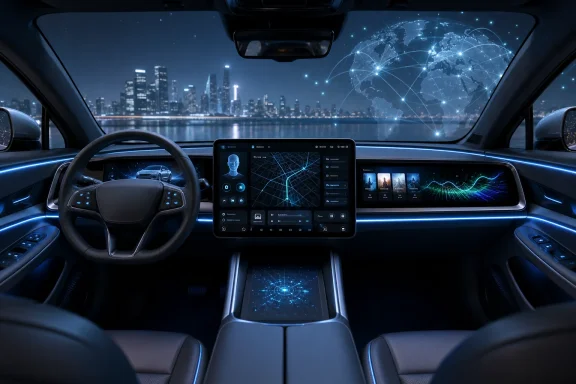 A cockpit SoC, not an autonomous-driving computer
The Dimensity AX C-X1 combines MediaTek’s compute and wireless connectivity with NVIDIA GPU and AI technology. MediaTek says it supports 5G telematics, Wi-Fi, Bluetooth, high-end multimedia, multimodal interaction, advanced safety functions, and personalized “agentic AI” services.In practical terms, this is the class of silicon that can run multiple cabin displays, voice interfaces, navigation, media, vehicle controls and local AI workloads. It is not a statement that FOXTRON is deploying a fully autonomous-driving stack, despite the broad industry language around AI-defined vehicles.
NVIDIA’s involvement is notable because the platform is designed around its graphics and AI ecosystem. MediaTek also promotes CUDA compatibility, potentially giving automakers and suppliers a familiar development route for GPU-accelerated workloads. The partnership does not establish which operating system or application stack FOXTRON vehicles will use, however, so it should not be read as a Windows Automotive deployment.
Why it matters
As reported by DigiTimes, the arrangement places the C-X1 in premium EV-oriented vehicle programs. For MediaTek, that is an important step beyond announcing automotive silicon and developer platforms. The company has long dominated smartphone and connectivity chips but faces entrenched competition in vehicle cockpits from Qualcomm, NVIDIA and established automotive suppliers.FOXTRON brings vehicle-platform and manufacturing capabilities; NVIDIA contributes a software and accelerated-computing ecosystem; MediaTek supplies the cockpit SoC and connectivity. That division of labor mirrors the way newer vehicles are being designed: not around a single infotainment chip, but around a tightly integrated set of compute, networking, graphics, AI and software components.
MediaTek’s claims around AI should still be treated as product positioning until customer vehicles and production software arrive. The company has described use cases including voice-and-visual interaction, responsive vehicle controls, entertainment and passenger personalization, but real-world capability will depend on the automaker’s implementation, local regulations, data policies and ongoing software support.
For Windows enthusiasts and IT administrators, the immediate impact is limited: this is automotive silicon rather than a PC platform, and no Windows product or service has been announced. The next meaningful milestone will be named FOXTRON vehicle programs and delivery timing for the C-X1-based cockpit systems.
References
- Primary source: The Futurum Group
Published: 2026-07-13T19:00:12.887218
FOXTRON's Adoption of Dimensity AX C-X1 Validates MediaTek's Automotive Ambitions - Futurum
FOXTRON's adoption of Dimensity AX C-X1 highlights MediaTek's push into AI-defined vehicles through integrated AI, connectivity, and cockpit platforms.futurumgroup.com - Related coverage: mediatek.com
FOXTRON and MediaTek Collaborate to Advance AI-Powered Intelligent Vehicle Experiences with NVIDIA
FOXTRON and MediaTek Collaborate to Advance AI-Powered Intelligent Vehicle Experiences with NVIDIA.www.mediatek.com
- Related coverage: digitimes.com
MediaTek and Foxtron partner to bring C-X1 AI cockpit platform to premium EVs
MediaTek announced a long-term global collaboration with Foxtron, the Foxconn-backed automotive unit, to deploy the Dimensity Auto Cockpit Platform C-X1 in premium electric vehicles, accelerating AI-enabled smart car development. The agreement, unveiled by the firms, will combine MediaTek’s...www.digitimes.com - Related coverage: medcom.id
MediaTek dan Foxtron Kolab, Garap AI Buat Kokpit Kendaraan
Pusat dari kolaborasi ini adalah penggunaan platform MediaTek Dimensity AX C-X1. Chipset ini dirancang dengan proses fabrikasi 3nm.www.medcom.id
