

Mercedes-Benz said on July 16, 2025, that it is expanding its Microsoft partnership to put Teams meetings, Intune device management, and eventually Microsoft 365 Copilot into MB.OS, starting with the new CLA and its fourth-generation MBUX infotainment system. The announcement, detailed by Mercedes-Benz and amplified by coverage from outlets including Windows Central and Motor1, is being sold as a productivity upgrade. It is really something larger: the car is being recruited into the corporate endpoint fleet. That makes this less a story about video calls in traffic than about where Microsoft’s workplace stack goes once the laptop is no longer enough.
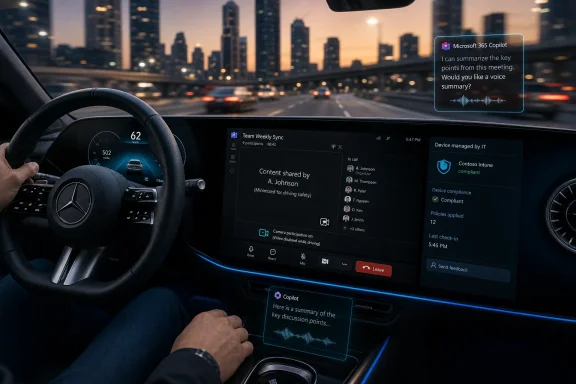
The most eye-catching part of the announcement is also the easiest to mock. Mercedes-Benz will let drivers join Microsoft Teams meetings using the vehicle’s built-in camera, including while the car is moving where local rules permit it. That sentence alone sounds engineered to trigger every sysadmin, safety advocate, and weary knowledge worker who has ever fantasized about escaping Teams by closing a laptop.
But the Teams camera is not the most consequential piece. The deeper move is that Mercedes is natively integrating Microsoft Intune into MB.OS, which means enterprise identity, policy enforcement, and business-account separation are being treated as first-class vehicle features. In practical terms, the car is no longer merely a Bluetooth accessory for a phone or a screen for Apple CarPlay and Android Auto. It is becoming an authenticated workplace device.
That shift explains why Mercedes’ language leans so heavily on productivity and security. Ola Källenius, the company’s chief executive, framed the integration as a way to help customers remain productive “on the move” without compromising safety. Microsoft, for its part, gets another surface for Microsoft 365: not a new app category, exactly, but a new environment in which the old apps can follow the user.
The wager is obvious. If work already spills from the office to the home, from the desktop to the phone, and from Teams rooms to airport lounges, the premium car cabin is a tempting next frontier. Mercedes is betting that enough of its customers live in that always-connected tier of professional life to make “join from car” feel like a feature rather than a threat.
That is a meaningful guardrail, but it does not settle the matter. Anyone who has sat through a Teams meeting knows that visual distraction is only one part of the cognitive load. A meeting is not a phone call with better branding; it is a social and managerial environment that asks the participant to track context, respond to cues, absorb decisions, and occasionally defend a spreadsheet.
The more important technical detail is Intune. Mercedes says it is the first automaker to embed Microsoft’s endpoint and app-management platform directly into the vehicle operating system. That lets corporate IT departments manage business accounts, apply policies, and keep work data separate from personal vehicle use.
For WindowsForum readers, this is where the story becomes familiar. Intune has spent years expanding from phones and PCs into a broader management fabric for corporate devices and applications. A car with native Intune support is not just a luxury cabin with Teams bolted on; it is a managed node with wheels, sensors, cameras, microphones, cloud connectivity, and a user who may be traveling at highway speed.
That raises hard questions for enterprise IT. Who owns the support boundary when a vehicle fails conditional access? What does help desk triage look like when the endpoint is a CLA in a parking garage? How does an organization write acceptable-use policy for a device that is both a personal vehicle and a corporate communications terminal?
The new CLA is the launch vehicle for this phase, with fourth-generation MBUX powered by MB.OS. Mercedes has said the productivity enhancements will begin rolling out with that platform, with availability depending on region, vehicle configuration, subscriptions, and local regulations. The Eastleigh Voice report notes that Europe and the United States are the initial focus, while Kenya is not included in the first rollout.
That regional caveat matters. In-car video participation is not simply a software feature; it intersects with traffic law, telecom infrastructure, privacy rules, enterprise identity systems, and cultural tolerance for workplace intrusion. Mercedes can ship the same broad technical platform globally, but it cannot assume the same legal or social permission everywhere.
The move also shows how automakers are trying to redefine premium value. Horsepower, trim materials, and brand status still matter, but software ecosystems increasingly shape the ownership experience. The CLA is not just being sold as an electric or hybrid-era Mercedes; it is being sold as a connected computing environment that happens to include seats and steering.
This is where Microsoft benefits from the car industry’s software pivot. Automakers want credible cloud, identity, AI, and enterprise partners. Microsoft wants its productivity stack to be ambient. The partnership gives each side something it lacks alone: Mercedes gets workplace legitimacy; Microsoft gets a new endpoint class inside a high-income customer segment.
Unlike a video call, Copilot can plausibly be framed as reducing distraction. If a driver can ask for a meeting summary instead of reading email on a phone, that is potentially safer than the behavior many people already engage in illegally or recklessly. Voice interfaces, when done well, can move some tasks away from screens.
But Microsoft 365 Copilot is not just a voice command layer. It is an AI system tied to organizational data, permissions, meetings, email, chats, files, and calendars. Putting that inside a car raises familiar questions about data access, retention, prompts, audit trails, and accidental disclosure, only now the setting includes passengers, valets, family members, rental arrangements, and used-vehicle resale.
Mercedes’ Intune integration is supposed to help by separating business and personal data. That separation will be essential if Copilot becomes useful in the vehicle. A driver asking for client updates in a car with a passenger nearby is a different risk than asking the same question in a private office.
There is also the matter of reliability. AI summaries are useful when they are accurate and dangerous when they are confidently wrong. In a vehicle context, the tolerance for ambiguity should be lower, not higher, because the user’s attention is divided. A Copilot answer that requires verification may save no time at all if the driver cannot safely verify it.
Still, the safety story cannot stop at UI restrictions. Driver distraction research has long distinguished between visual, manual, and cognitive distraction. A system can keep your eyes mostly forward and your hands on the wheel while still consuming the attention needed to react to a pedestrian, construction zone, or sudden braking ahead.
The car industry has a long history of describing interfaces as “minimal distraction” while steadily adding more tasks to the dashboard. Touchscreens replaced buttons in the name of elegance. Voice assistants promised natural interaction but often demanded repeated corrections. Now AI is being proposed as the layer that makes everything easier.
The uncomfortable truth is that productivity itself can be the distraction. A manager asking a driver for a decision, a sales call that requires negotiation, or a Copilot-generated summary of a tense email thread can all pull mental focus away from the road. Mercedes can dim the screen, but it cannot simplify the workplace dynamics entering the cabin.
Regulators may eventually treat this category more seriously. If automakers make video participation and AI work tools native to the vehicle, crash investigators, insurers, and lawmakers will want to know when those features were active. That could turn meeting logs and infotainment telemetry into evidence, a prospect that should make both privacy lawyers and fleet managers pay attention.
The support scenarios practically write themselves. A user cannot join a meeting from the car because conditional access blocks the session. A vehicle OS update changes app behavior. A corporate account remains associated with a car after an employee leaves the company. A company-owned vehicle is shared by multiple employees with different privileges. A personal Mercedes becomes a work endpoint through bring-your-own-device policies no one anticipated.
Microsoft and Mercedes will likely present these as solvable management problems. In many cases, they are. Intune exists precisely because organizations need centralized control over distributed, mobile, and partially personal devices. The technical architecture can be made coherent.
The policy architecture is harder. Many companies already struggle to define acceptable use for personal phones. A car adds safety, liability, and ownership layers that are not present on a smartphone. If an executive takes a confidential Teams call from a vehicle with passengers, is that a technology failure, a training failure, or simply predictable human behavior?
There is also a class divide hidden inside the feature. This is not productivity for every worker; it is productivity for professionals whose vehicles, subscriptions, Microsoft 365 licenses, and corporate policies align. The in-car office is being built first for executives, consultants, sales teams, and high-status mobile workers. That does not make it irrelevant, but it does make the marketing language about productivity feel more selective than universal.
That is powerful, and it is also exhausting. The post-pandemic workplace already suffers from blurred boundaries. Teams on phones made workers reachable away from desks. Copilot promises to compress administrative work, but it also creates expectations that more can be done in every spare moment. The car was one of the last socially defensible gaps in the workday.
Mercedes is not forcing anyone to take a meeting while driving, and Microsoft is not solely responsible for work culture. But platforms shape norms. Once joining from the car becomes easy, some organizations will treat it as acceptable. Once it becomes acceptable, some managers will treat it as expected.
The irony is that luxury cars have historically sold escape: quiet cabins, isolation from the outside world, control over the environment. This integration sells the opposite. It makes the cabin permeable to the calendar, the meeting invite, the unread thread, and the AI-generated briefing.
That tension will define the user response. Some buyers will love it because their workday is already mobile and chaotic. Others will see it as the final collapse of a boundary they were trying to protect. Both reactions are rational.
This matters because automakers increasingly treat software features as recurring revenue opportunities. Heated seats, driver-assistance packages, navigation services, entertainment apps, and connectivity features have all been tested as subscription candidates across the industry. Productivity tools fit neatly into that model because business users are accustomed to paying monthly for software.
For consumers, the question is whether the car they bought remains fully functional without a growing bundle of digital services. For enterprises, the question is whether vehicle-based productivity becomes another line item in licensing and fleet management. A company car may soon require not just insurance, maintenance, and fuel or charging reimbursement, but identity governance and app entitlement review.
The subscription angle also affects longevity. Cars last longer than phones and laptops. Microsoft 365 changes constantly. Teams clients evolve. Copilot capabilities and licensing terms shift. MB.OS will need to bridge automotive support cycles with cloud software cycles, and those two worlds have very different expectations.
A five-year-old car should not feel obsolete because its meeting client ages out. Yet anyone who has supported smart TVs, Android head units, or abandoned connected-car apps knows how quickly “software-defined” can become “software-stranded.” Mercedes is promising a premium digital environment; it will need to support that promise long after the launch reviews are written.
It is easy to dismiss that response as internet cynicism. It is more useful to read it as a stress test. Technical communities often react viscerally when a vendor extends enterprise software into a domain where the social cost has not been fully accounted for. The joke is funny because the underlying fear is plausible.
The backlash also reveals a gap between executive use cases and everyday IT experience. A board member or consultant may see in-car Teams as a way to avoid wasting time between appointments. A sysadmin sees another endpoint with identity, compliance, update, support, privacy, and liability concerns. A driver sees one more reason the workday cannot end.
Mercedes and Microsoft will have to win trust by showing restraint. That means conservative defaults, transparent privacy controls, clear regional compliance, reliable account removal, and no dark patterns nudging users into meetings from the road. It also means acknowledging that “possible” and “wise” are not synonyms.
If the feature remains a controlled, optional tool for specific scenarios, it may become a useful convenience. If it becomes a symbol of corporate reach into every idle minute, it will become a punchline with a logo.
The most concrete takeaways are not about whether Teams in a Mercedes sounds dystopian or convenient. They are about how the car, the cloud, and the corporate identity stack are converging.
 Mercedes Turns the Commute Into a Managed Workspace
The most eye-catching part of the announcement is also the easiest to mock. Mercedes-Benz will let drivers join Microsoft Teams meetings using the vehicle’s built-in camera, including while the car is moving where local rules permit it. That sentence alone sounds engineered to trigger every sysadmin, safety advocate, and weary knowledge worker who has ever fantasized about escaping Teams by closing a laptop.But the Teams camera is not the most consequential piece. The deeper move is that Mercedes is natively integrating Microsoft Intune into MB.OS, which means enterprise identity, policy enforcement, and business-account separation are being treated as first-class vehicle features. In practical terms, the car is no longer merely a Bluetooth accessory for a phone or a screen for Apple CarPlay and Android Auto. It is becoming an authenticated workplace device.
That shift explains why Mercedes’ language leans so heavily on productivity and security. Ola Källenius, the company’s chief executive, framed the integration as a way to help customers remain productive “on the move” without compromising safety. Microsoft, for its part, gets another surface for Microsoft 365: not a new app category, exactly, but a new environment in which the old apps can follow the user.
The wager is obvious. If work already spills from the office to the home, from the desktop to the phone, and from Teams rooms to airport lounges, the premium car cabin is a tempting next frontier. Mercedes is betting that enough of its customers live in that always-connected tier of professional life to make “join from car” feel like a feature rather than a threat.
The Video Call Is the Bait; Intune Is the Hook
The public debate will revolve around distraction, and rightly so. Mercedes says the system is designed to reduce risk: shared content is hidden while driving, and the incoming video feed from other participants is disabled when the vehicle is in motion. Other meeting participants may still see the driver through the in-car camera, but the driver is not supposed to be watching slides, faces, or screen shares while navigating traffic.That is a meaningful guardrail, but it does not settle the matter. Anyone who has sat through a Teams meeting knows that visual distraction is only one part of the cognitive load. A meeting is not a phone call with better branding; it is a social and managerial environment that asks the participant to track context, respond to cues, absorb decisions, and occasionally defend a spreadsheet.
The more important technical detail is Intune. Mercedes says it is the first automaker to embed Microsoft’s endpoint and app-management platform directly into the vehicle operating system. That lets corporate IT departments manage business accounts, apply policies, and keep work data separate from personal vehicle use.
For WindowsForum readers, this is where the story becomes familiar. Intune has spent years expanding from phones and PCs into a broader management fabric for corporate devices and applications. A car with native Intune support is not just a luxury cabin with Teams bolted on; it is a managed node with wheels, sensors, cameras, microphones, cloud connectivity, and a user who may be traveling at highway speed.
That raises hard questions for enterprise IT. Who owns the support boundary when a vehicle fails conditional access? What does help desk triage look like when the endpoint is a CLA in a parking garage? How does an organization write acceptable-use policy for a device that is both a personal vehicle and a corporate communications terminal?
MB.OS Becomes the Real Product
Mercedes has spent years positioning MB.OS as more than another infotainment layer. The system is meant to give the company deeper control over the digital experience in its cars, rather than surrendering the center stack entirely to phones. The Microsoft partnership fits that strategy because it gives MB.OS a reason to matter beyond navigation, music, climate controls, and vehicle settings.The new CLA is the launch vehicle for this phase, with fourth-generation MBUX powered by MB.OS. Mercedes has said the productivity enhancements will begin rolling out with that platform, with availability depending on region, vehicle configuration, subscriptions, and local regulations. The Eastleigh Voice report notes that Europe and the United States are the initial focus, while Kenya is not included in the first rollout.
That regional caveat matters. In-car video participation is not simply a software feature; it intersects with traffic law, telecom infrastructure, privacy rules, enterprise identity systems, and cultural tolerance for workplace intrusion. Mercedes can ship the same broad technical platform globally, but it cannot assume the same legal or social permission everywhere.
The move also shows how automakers are trying to redefine premium value. Horsepower, trim materials, and brand status still matter, but software ecosystems increasingly shape the ownership experience. The CLA is not just being sold as an electric or hybrid-era Mercedes; it is being sold as a connected computing environment that happens to include seats and steering.
This is where Microsoft benefits from the car industry’s software pivot. Automakers want credible cloud, identity, AI, and enterprise partners. Microsoft wants its productivity stack to be ambient. The partnership gives each side something it lacks alone: Mercedes gets workplace legitimacy; Microsoft gets a new endpoint class inside a high-income customer segment.
Copilot in the Cabin Changes the Risk Profile
Mercedes is also working to bring Microsoft 365 Copilot into the vehicle, and that may prove more consequential than Teams video. A voice-driven assistant that can summarize messages, prepare for meetings, draft emails, and retrieve business context is exactly the kind of feature that sounds reasonable in a car. It also pushes the boundary between convenience and overreach.Unlike a video call, Copilot can plausibly be framed as reducing distraction. If a driver can ask for a meeting summary instead of reading email on a phone, that is potentially safer than the behavior many people already engage in illegally or recklessly. Voice interfaces, when done well, can move some tasks away from screens.
But Microsoft 365 Copilot is not just a voice command layer. It is an AI system tied to organizational data, permissions, meetings, email, chats, files, and calendars. Putting that inside a car raises familiar questions about data access, retention, prompts, audit trails, and accidental disclosure, only now the setting includes passengers, valets, family members, rental arrangements, and used-vehicle resale.
Mercedes’ Intune integration is supposed to help by separating business and personal data. That separation will be essential if Copilot becomes useful in the vehicle. A driver asking for client updates in a car with a passenger nearby is a different risk than asking the same question in a private office.
There is also the matter of reliability. AI summaries are useful when they are accurate and dangerous when they are confidently wrong. In a vehicle context, the tolerance for ambiguity should be lower, not higher, because the user’s attention is divided. A Copilot answer that requires verification may save no time at all if the driver cannot safely verify it.
Safety Theater Will Not Be Enough
Mercedes deserves some credit for not pretending that full meeting visuals belong in the driver’s line of sight. Disabling participant video and hiding shared content while driving are sensible decisions. They acknowledge that a moving vehicle is not just another room with a screen.Still, the safety story cannot stop at UI restrictions. Driver distraction research has long distinguished between visual, manual, and cognitive distraction. A system can keep your eyes mostly forward and your hands on the wheel while still consuming the attention needed to react to a pedestrian, construction zone, or sudden braking ahead.
The car industry has a long history of describing interfaces as “minimal distraction” while steadily adding more tasks to the dashboard. Touchscreens replaced buttons in the name of elegance. Voice assistants promised natural interaction but often demanded repeated corrections. Now AI is being proposed as the layer that makes everything easier.
The uncomfortable truth is that productivity itself can be the distraction. A manager asking a driver for a decision, a sales call that requires negotiation, or a Copilot-generated summary of a tense email thread can all pull mental focus away from the road. Mercedes can dim the screen, but it cannot simplify the workplace dynamics entering the cabin.
Regulators may eventually treat this category more seriously. If automakers make video participation and AI work tools native to the vehicle, crash investigators, insurers, and lawmakers will want to know when those features were active. That could turn meeting logs and infotainment telemetry into evidence, a prospect that should make both privacy lawyers and fleet managers pay attention.
Enterprise IT Inherits a Stranger Endpoint
For sysadmins, the Mercedes announcement is both impressive and faintly horrifying. Native Intune support means the vehicle can participate in the same management world as phones, tablets, and PCs. It also means yet another device type may appear in policy discussions that were already too complicated.The support scenarios practically write themselves. A user cannot join a meeting from the car because conditional access blocks the session. A vehicle OS update changes app behavior. A corporate account remains associated with a car after an employee leaves the company. A company-owned vehicle is shared by multiple employees with different privileges. A personal Mercedes becomes a work endpoint through bring-your-own-device policies no one anticipated.
Microsoft and Mercedes will likely present these as solvable management problems. In many cases, they are. Intune exists precisely because organizations need centralized control over distributed, mobile, and partially personal devices. The technical architecture can be made coherent.
The policy architecture is harder. Many companies already struggle to define acceptable use for personal phones. A car adds safety, liability, and ownership layers that are not present on a smartphone. If an executive takes a confidential Teams call from a vehicle with passengers, is that a technology failure, a training failure, or simply predictable human behavior?
There is also a class divide hidden inside the feature. This is not productivity for every worker; it is productivity for professionals whose vehicles, subscriptions, Microsoft 365 licenses, and corporate policies align. The in-car office is being built first for executives, consultants, sales teams, and high-status mobile workers. That does not make it irrelevant, but it does make the marketing language about productivity feel more selective than universal.
Microsoft’s Real Ambition Is Ambient Work
Microsoft has spent the past decade making work less tied to a specific machine. OneDrive follows files. Teams follows conversations. Entra ID follows identity. Intune follows policy. Microsoft 365 Copilot follows context. The Mercedes partnership is a natural extension of that strategy: if the user is in a car, the work graph should still be reachable.That is powerful, and it is also exhausting. The post-pandemic workplace already suffers from blurred boundaries. Teams on phones made workers reachable away from desks. Copilot promises to compress administrative work, but it also creates expectations that more can be done in every spare moment. The car was one of the last socially defensible gaps in the workday.
Mercedes is not forcing anyone to take a meeting while driving, and Microsoft is not solely responsible for work culture. But platforms shape norms. Once joining from the car becomes easy, some organizations will treat it as acceptable. Once it becomes acceptable, some managers will treat it as expected.
The irony is that luxury cars have historically sold escape: quiet cabins, isolation from the outside world, control over the environment. This integration sells the opposite. It makes the cabin permeable to the calendar, the meeting invite, the unread thread, and the AI-generated briefing.
That tension will define the user response. Some buyers will love it because their workday is already mobile and chaotic. Others will see it as the final collapse of a boundary they were trying to protect. Both reactions are rational.
The Subscription Footnote Is Doing Real Work
The feature set is not simply arriving as a universal software update for every Mercedes owner. Mercedes says availability depends on the Entertainment Package Plus, a data subscription, vehicle configuration, and regional rollout. That means the in-car Microsoft stack is part of the broader subscription economy reshaping vehicle ownership.This matters because automakers increasingly treat software features as recurring revenue opportunities. Heated seats, driver-assistance packages, navigation services, entertainment apps, and connectivity features have all been tested as subscription candidates across the industry. Productivity tools fit neatly into that model because business users are accustomed to paying monthly for software.
For consumers, the question is whether the car they bought remains fully functional without a growing bundle of digital services. For enterprises, the question is whether vehicle-based productivity becomes another line item in licensing and fleet management. A company car may soon require not just insurance, maintenance, and fuel or charging reimbursement, but identity governance and app entitlement review.
The subscription angle also affects longevity. Cars last longer than phones and laptops. Microsoft 365 changes constantly. Teams clients evolve. Copilot capabilities and licensing terms shift. MB.OS will need to bridge automotive support cycles with cloud software cycles, and those two worlds have very different expectations.
A five-year-old car should not feel obsolete because its meeting client ages out. Yet anyone who has supported smart TVs, Android head units, or abandoned connected-car apps knows how quickly “software-defined” can become “software-stranded.” Mercedes is promising a premium digital environment; it will need to support that promise long after the launch reviews are written.
The Forum Backlash Is a Warning Signal, Not Just Snark
Online reaction has been predictably sharp. Motor1 joked that Mercedes had given customers the thing they “always wanted”: Microsoft Teams. Reddit threads in sysadmin and car communities leaned into the absurdity, with users imagining conditional access failures, help desk tickets from vehicles, and managers normalizing calls from the driver’s seat.It is easy to dismiss that response as internet cynicism. It is more useful to read it as a stress test. Technical communities often react viscerally when a vendor extends enterprise software into a domain where the social cost has not been fully accounted for. The joke is funny because the underlying fear is plausible.
The backlash also reveals a gap between executive use cases and everyday IT experience. A board member or consultant may see in-car Teams as a way to avoid wasting time between appointments. A sysadmin sees another endpoint with identity, compliance, update, support, privacy, and liability concerns. A driver sees one more reason the workday cannot end.
Mercedes and Microsoft will have to win trust by showing restraint. That means conservative defaults, transparent privacy controls, clear regional compliance, reliable account removal, and no dark patterns nudging users into meetings from the road. It also means acknowledging that “possible” and “wise” are not synonyms.
If the feature remains a controlled, optional tool for specific scenarios, it may become a useful convenience. If it becomes a symbol of corporate reach into every idle minute, it will become a punchline with a logo.
The CLA Is Now a Test Lab for the Office on Wheels
The immediate rollout is narrow, but the implications are broad. The new CLA becomes a test case for whether premium-car buyers want native productivity deeply integrated into the vehicle OS. It also becomes a test case for whether enterprise IT can treat a car as a managed workplace surface without losing its mind.The most concrete takeaways are not about whether Teams in a Mercedes sounds dystopian or convenient. They are about how the car, the cloud, and the corporate identity stack are converging.
- Mercedes-Benz is bringing an improved Meetings for Teams app to the new CLA through fourth-generation MBUX on MB.OS.
- The system can use the vehicle’s built-in camera for Teams participation, while hiding shared content and disabling incoming participant video when the car is moving.
- Mercedes says it is the first automaker to integrate Microsoft Intune natively into a vehicle operating system.
- Microsoft 365 Copilot is planned as a future in-car productivity layer for tasks such as summaries, preparation, and drafting through voice prompts.
- Availability depends on region, vehicle configuration, subscriptions, and applicable traffic regulations.
- The real enterprise impact is not video calling itself, but the arrival of cars as managed, identity-aware workplace endpoints.
References
- Primary source: The Eastleigh Voice
Published: 2026-07-06T20:42:16.764663
Mercedes-Benz partners with Microsoft to bring video calls, AI tools into cars | The Eastleigh Voice
Mercedes-Benz is working to incorporate Microsoft 365 Copilot into its infotainment system, one of the first implementations of AI-based productivity.eastleighvoice.co.ke - Related coverage: group.mercedes-benz.com
- Related coverage: motor1.com
Mercedes Gives Customers the One Thing They've Always Wanted: Microsoft Teams
Just when you thought in-car technology couldn’t get any worse, Mercedes and Microsoft have teamed up to put Teams in your vehicle. www.motor1.com
- Related coverage: windowscentral.com
Mercedes-Benz cars will let you join Teams meetings and chat with Copilot | Windows Central
Mercedes and Microsoft partner up to deliver generative AI and productivity features to its cars, letting you attend Teams meetings and chat with Microsoft 365 Copilot while you drive to and from work.www.windowscentral.com - Related coverage: dvo.be
DVO | Mercedes-Benz integreert Microsoft 365 Copilot en Intune in…
Mercedes-Benz breidt zijn samenwerking met Microsoft uit en wordt de eerste autofabrikant die Microsoft 365 Copilot, Microsoft Intune en een geavanceerde… www.dvo.be
- Related coverage: team-bhp.com
Mercedes-Benz to offer integrated Microsoft Teams in its cars | Team-BHP
German carmaker Mercedes-Benz has tied up with Microsoft to offer a new suite of in-car technology that will let you attend meetings on the go. So essentially, you will get to use Microsoft Teams in your car.www.team-bhp.com
- Related coverage: imprintent.org
Mercedes-Benz Expands Collaboration with Microsoft to Boost In-Car Productivity with Enhanced Meetings for Teams App, Intune Integration and Microsoft 365 Copilot
Mercedes-Benz sets a new standard for in-car productivity with the latest suite of Microsoft business and collaboration tools. Starting with the all-new CLA, customers will be able to access the latest version of the Meetings for Teams app. It brings enhanced functionality and the ability to use... imprintent.org
- Related coverage: abiresearch.com
Mercedes and Microsoft Team up to Turn the Car into a Smarter, Safer Workplace
 www.abiresearch.com
- Related coverage: techweez.com
Mercedes-Benz Brings Microsoft Teams Video Calls to Its Cars
Mercedes Benz now supports Microsoft Teams video meetings in its new CLA models, using an in-car camera and the MBUX infotainment system.techweez.com - Official source: microsoft.com
</rdf:Alt> </dc:title> <dc:description> <rdf:Alt> <rdf:li xml:lang="x-default"/> </rdf:Alt> </dc:description> <dc:creator> <rdf:Seq> <rdf:li>Lukas V
</rdf:Alt> </dc:description> <dc:creator> <rdf:Seq> <rdf:li>Lukas Velushwww.microsoft.com
- Related coverage: techriver.com
- Official source: cdn-dynmedia-1.microsoft.com
Microsoft Copilot for Microsoft 365
Microsoft Copilot for Microsoft 365cdn-dynmedia-1.microsoft.com
- Official source: techcommunity.microsoft.com
