

Merge has launched Agent Handler on Microsoft’s Agent Store for Microsoft 365 Copilot, giving organizations a managed way to connect AI agents to third-party business systems across the Microsoft 365 ecosystem in June 2026. The announcement is small in the way most platform integrations are small: one more catalog entry, one more partner tile, one more workflow surface. But the larger story is that Microsoft’s AI strategy is becoming less about a single Copilot interface and more about turning Microsoft 365 into the operating layer for enterprise agents. Merge is arriving at the point where the market’s question is no longer whether agents can talk, but whether anyone can govern what they do after they are given tools.
The Microsoft 365 Agent Store was introduced as a curated hub where users and administrators can discover, install, and manage agents inside Microsoft 365 Copilot. That sounds familiar because it borrows the old grammar of app stores, add-ins, Teams apps, and enterprise catalogs. The difference is that these are not static productivity extensions; they are software actors that can reason over prompts, call tools, retrieve data, and potentially initiate changes in business systems.
That distinction matters. A Word add-in that formats citations has a limited blast radius. An AI agent that can read CRM records, update tickets, draft emails, query HR systems, and post to Slack has a very different governance profile. Microsoft’s Agent Store therefore is not merely a distribution channel. It is a trust boundary.
Microsoft’s documentation frames the Agent Store as a central hub for agents from Microsoft, partners, and an organization’s own builders. The Store supports prebuilt agents, Copilot Studio agents, externally built agents, and integrations that use Agent 365 capabilities. That breadth reveals Microsoft’s real ambition: it does not want Copilot to be just a chatbot inside Office. It wants Microsoft 365 to become the place where enterprise agents are found, approved, assigned, monitored, and eventually retired.
Merge’s Agent Handler fits neatly into that ambition because it attacks one of the uglier parts of agent deployment: tool access. Agents are most useful when they can do things beyond generating text. They are also most dangerous at precisely that moment.
Merge describes Agent Handler as a tool-calling platform for AI agents. In practical terms, that means it gives agents access to third-party services through connectors, with controls for authentication, scoping, data-loss prevention, and audit trails. The company says its connectors cover services such as Salesforce, Slack, Jira, GitHub, HubSpot, NetSuite, and Workday, among others.
For developers, the appeal is obvious. Building one reliable connector is tedious. Building dozens is an operating burden. Maintaining them as APIs change, authentication models evolve, and customer tenants vary is worse. The promise of Merge is that a developer can give an agent a governed set of tools without writing and maintaining every integration path from scratch.
For administrators, the promise is different. They do not care whether a connector was elegant to build. They care whether they can answer basic questions after an incident: which agent acted, on whose behalf, against which system, using what permissions, with what prompt context, and with what result. That is where the agent market is beginning to mature. The winners will not be the platforms that make the flashiest demo. They will be the ones that make the postmortem survivable.
That sounds like a subtle shift, but it changes the security model. A traditional integration often follows a predictable pattern: sync these objects, update these fields, poll this endpoint, write that record. An agent may decide which tool to use based on a prompt, a retrieved document, or a chain of intermediate reasoning. The integration layer has to assume more variability.
Agent Handler’s features are therefore less about raw connectivity than about constraining autonomy. Tool packs define what an agent can act on. Authentication can be per end user or shared across a group. Calls can be scanned for sensitive data before leaving the platform. Audit logging captures arguments, results, latency, user context, redactions, and errors.
That is the right vocabulary for the moment. The agent industry spent the last two years demonstrating that models can call tools. The enterprise market is now asking whether those tool calls can be scoped, inspected, and explained. Merge is trying to be the layer that turns tool calling from a developer trick into an IT-manageable capability.
This is also why the Microsoft Agent Store launch matters more than a normal marketplace listing. Microsoft 365 is where many enterprises already enforce identity, compliance, and software governance. If Agent Handler is discoverable and deployable through Microsoft’s agent ecosystem, it becomes part of the procurement and administration path that IT already understands.
That entity model is the quiet revolution. Once an agent has an identity, it can be governed more like a user, service principal, app registration, or workload. It can be assigned permissions. It can be monitored. It can be blocked. It can be required to follow least-privilege rules. It can appear in admin surfaces instead of living as invisible code behind a chatbot.
For Windows and Microsoft 365 administrators, that is the difference between an experiment and a production system. Shadow AI has already become a management headache, with employees pasting sensitive data into consumer tools and teams spinning up unsanctioned automations. Agent sprawl would be worse because agents do not merely receive information; they may act on it.
The Agent Store, Agent 365, Copilot Studio, Microsoft 365 Agents Toolkit, and partner integrations are all pieces of the same architecture. Microsoft wants one catalog, one policy plane, and one set of familiar administrative rituals around a messy and fast-moving ecosystem. It is the Microsoft playbook: absorb novelty into enterprise manageability.
The risk is that the playbook can make complexity look solved before it really is. A catalog entry and an admin approval flow do not automatically mean an agent is safe, useful, or well matched to a business process. They mean the agent has entered the bureaucracy. That is necessary, but it is not sufficient.
Merge’s documentation emphasizes “MCP-ready” connectors, which is precisely the pitch the market wants to hear. Enterprises do not want each agent platform to invent its own connector universe. Developers do not want to rebuild the same access layer for every model provider, IDE, chatbot, and workflow engine. Standardization is attractive because agent tooling otherwise becomes a maze of wrappers, plugins, manifests, and platform-specific adapters.
But MCP also intensifies the governance problem. If connecting tools becomes easier, then the number of connected tools will grow. If agents can more readily discover and invoke actions, then administrators need better ways to limit what is exposed. Connectivity without policy becomes a liability.
This is where Merge and Microsoft are complementary. Microsoft is building the workplace control plane. Merge is offering cross-SaaS tool access with enterprise controls. The combination suggests a future where an agent in Microsoft 365 Copilot can reach beyond Microsoft’s own cloud into the systems that actually define a company’s operating rhythm: CRM, ticketing, finance, HR, code repositories, and collaboration platforms.
That is powerful. It is also exactly the kind of power that security teams will insist on slowing down.
Microsoft’s Agent Store model gives admins a review path. They can inspect agent details, capabilities, data and tools, security and compliance information, certification details, and usage activity. They can assign agents to the entire organization, specific users, or smaller groups. They can block or remove access.
That is the right scaffolding, but agent review will still demand judgment. A conventional app declares permissions. An agent declares capabilities, but its real behavior may depend on prompts, retrieved context, available tools, model behavior, and the quality of its guardrails. Two agents with similar connector access can behave very differently depending on design.
Merge’s role is to make part of that review more legible. Tool packs, audit logs, security gateway controls, and per-user authentication give administrators something concrete to evaluate. Instead of asking whether an agent has “access to Salesforce,” they can ask which Salesforce actions are exposed, which users can invoke them, whether sensitive data is redacted, and how calls are logged.
That is where agent governance will either become operationally real or collapse into theater. If IT teams are given only marketing descriptions and broad permission labels, they will either block useful agents or approve risky ones blindly. If they are given granular tool surfaces and usable telemetry, they have a fighting chance.
AI agents are simply the next and more volatile version of that pattern. They combine elements of apps, bots, workflows, service accounts, and human assistants. They may sit inside Teams, Outlook, Word, Excel, or the Microsoft 365 Copilot app. They may call Microsoft Graph, third-party APIs, or custom internal services. They may operate with user-delegated credentials or application-level permissions.
That hybridity is why administrators should resist simplistic thinking. An agent is not “just another app,” because its behavior can be more dynamic. It is not “just another user,” because it may not have human accountability or intuition. It is not “just another automation,” because its decision path can be probabilistic rather than strictly procedural.
The more useful framing is that agents are a new workload class. They need identity, permission boundaries, lifecycle management, monitoring, incident response, and change control. Microsoft’s Agent Store and Agent 365 give that workload class a home. Merge is adding the connector layer that makes the workload useful outside Microsoft’s own property lines.
These are the scenarios that make executives lean forward. They are also the scenarios that produce the most sensitive governance questions. What happens when an agent retrieves a customer record and includes too much of it in a Teams message? What happens when it updates the wrong ticket based on an ambiguous prompt? What happens when a user with broad access asks an agent to perform a task that should have required managerial approval?
The first generation of enterprise AI anxiety focused on data leakage through prompts. The next wave will focus on action leakage through tools. A model that says the wrong thing is a reputational problem. A model that does the wrong thing in Salesforce, NetSuite, Workday, GitHub, or Jira can become an operational problem.
That does not mean organizations should avoid agents. It means the deployment model must assume mistakes and design for containment. Tool access should be narrow at first. High-impact actions should require human confirmation. Logs should be retained in a place security and compliance teams can query. Sensitive data controls should be tested with adversarial examples, not merely accepted as checkbox claims.
Merge is speaking to those concerns with data-loss prevention, audit trails, and tool scoping. Microsoft is speaking to them with admin approval, Entra identity, Purview and Defender integration, and Agent 365 observability. The open question is whether customers will use those controls rigorously or treat the Agent Store as another convenience catalog.
That is why partners matter. The Agent Store needs trusted third parties to fill the gaps between Microsoft’s own apps and the messy reality of enterprise work. Merge’s value is that it can bring a broad range of third-party systems into reach without requiring each agent developer to become an integration vendor.
But partner ecosystems create dependency chains. A Microsoft 365 user may interact with Copilot, which invokes an agent, which calls Merge Agent Handler, which authenticates to a third-party SaaS platform, which returns data that is then used in a generated response or downstream action. Each handoff is a place where permissions, logging, latency, error handling, and data minimization matter.
That chain is not necessarily bad. In fact, it is how modern enterprise software already works. The difference is that agentic workflows may compress many steps into a single natural-language request. The user may not see the intermediate operations unless the interface exposes them clearly.
For admins, transparency should be a procurement requirement. If a vendor cannot explain where data goes, what is logged, how tool calls are scoped, how credentials are stored, and how failures are handled, the agent should not be treated as production-ready. “It works in Copilot” is not a security argument.
Merge makes that proposition stronger by reducing integration burden. A developer can focus on the agent’s workflow, reasoning, and user experience while relying on a connector platform for the long tail of SaaS access. That is the same abstraction story that made payment APIs, communications APIs, and identity platforms so influential.
But enterprise distribution comes with enterprise expectations. Agents that operate in Microsoft 365 environments will be judged by administrators who care about certification, tenant controls, auditability, data handling, and supportability. Developers who are used to shipping fast will need to document what their agents can do, how they fail, and how they are constrained.
This may reshape the agent startup market. The first wave rewarded demos that looked autonomous. The next wave may reward products that look boring in exactly the right ways: predictable permissions, clean logs, clear rollback paths, stable connector behavior, and comprehensible admin surfaces.
Merge’s Agent Handler launch is therefore not just a feature expansion. It is a signal that the agent market is professionalizing. The connective tissue is becoming a product category, and the winners will be judged by reliability as much as imagination.
This is the familiar bargain of platform consolidation. Enterprises get a single administrative surface and tighter integration with identity and compliance tools. In exchange, they accept more of Microsoft’s assumptions about workflow, security, licensing, and extensibility. For many IT departments, that trade will be acceptable because the alternative is a fragmented swarm of AI tools with inconsistent controls.
The competitive implications are obvious. Agent platforms that want enterprise adoption will need to coexist with Microsoft 365, not merely compete against it. A standalone agent that cannot be governed through Microsoft’s admin surfaces may face more friction in Microsoft-heavy organizations. Conversely, Microsoft benefits when connector providers like Merge make non-Microsoft systems accessible from inside the Microsoft 365 experience.
This is not Microsoft closing the garden so much as making the garden the place where other vendors must bring their plants. That is a subtler and more durable form of platform power.
Organizations will discover that many workflows are not ready for agents because the underlying permissions are too broad, the data is too dirty, or the process depends on informal human judgment. They will find that some users overtrust agents, while others refuse to use them. They will learn that audit logs are only useful if someone knows how to read them and has time to investigate anomalies.
They will also find genuine productivity gains. The boring workflows are where agents may shine first: ticket enrichment, account research, document assembly, status updates, meeting follow-ups, and cross-system lookups. These are not science-fiction scenarios. They are the daily administrative drag that makes knowledge work feel less intelligent than the software around it claims to be.
Merge’s launch on the Agent Store should be read in that pragmatic frame. It is not a declaration that agents are now safe by default. It is a step toward making them governable enough to try in serious environments.
A few lessons stand out from Merge’s Agent Handler move into Microsoft’s agent ecosystem:
If Microsoft and its partners are right, the future of work inside Microsoft 365 will involve many specialized agents acting across many systems under central governance. If they are wrong, enterprises will rediscover an old truth in a new form: automation without accountability scales mistakes as efficiently as it scales productivity. Merge’s launch does not settle that tension, but it sharpens it, and that is why a connector announcement deserves attention from anyone responsible for keeping Windows and Microsoft 365 environments useful, secure, and governable in the agent era.
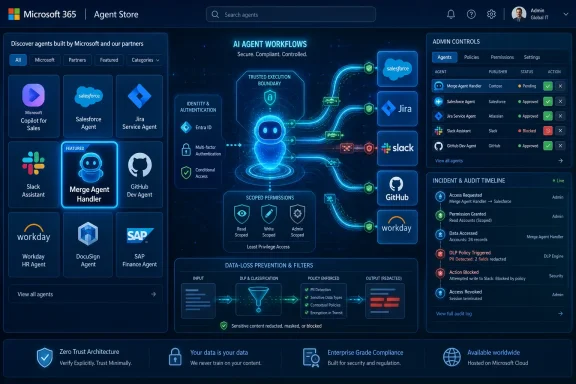 Microsoft’s Agent Store Is Becoming the Front Door for Enterprise AI
The Microsoft 365 Agent Store was introduced as a curated hub where users and administrators can discover, install, and manage agents inside Microsoft 365 Copilot. That sounds familiar because it borrows the old grammar of app stores, add-ins, Teams apps, and enterprise catalogs. The difference is that these are not static productivity extensions; they are software actors that can reason over prompts, call tools, retrieve data, and potentially initiate changes in business systems.That distinction matters. A Word add-in that formats citations has a limited blast radius. An AI agent that can read CRM records, update tickets, draft emails, query HR systems, and post to Slack has a very different governance profile. Microsoft’s Agent Store therefore is not merely a distribution channel. It is a trust boundary.
Microsoft’s documentation frames the Agent Store as a central hub for agents from Microsoft, partners, and an organization’s own builders. The Store supports prebuilt agents, Copilot Studio agents, externally built agents, and integrations that use Agent 365 capabilities. That breadth reveals Microsoft’s real ambition: it does not want Copilot to be just a chatbot inside Office. It wants Microsoft 365 to become the place where enterprise agents are found, approved, assigned, monitored, and eventually retired.
Merge’s Agent Handler fits neatly into that ambition because it attacks one of the uglier parts of agent deployment: tool access. Agents are most useful when they can do things beyond generating text. They are also most dangerous at precisely that moment.
The Hard Part Was Never the Chat Window
The popular image of an AI agent is still a conversational pane with a blinking cursor. That is the least interesting part of the architecture. The hard problem is connecting that agent to the dozens or hundreds of systems where business work actually happens, and doing so without turning every integration into a bespoke security exception.Merge describes Agent Handler as a tool-calling platform for AI agents. In practical terms, that means it gives agents access to third-party services through connectors, with controls for authentication, scoping, data-loss prevention, and audit trails. The company says its connectors cover services such as Salesforce, Slack, Jira, GitHub, HubSpot, NetSuite, and Workday, among others.
For developers, the appeal is obvious. Building one reliable connector is tedious. Building dozens is an operating burden. Maintaining them as APIs change, authentication models evolve, and customer tenants vary is worse. The promise of Merge is that a developer can give an agent a governed set of tools without writing and maintaining every integration path from scratch.
For administrators, the promise is different. They do not care whether a connector was elegant to build. They care whether they can answer basic questions after an incident: which agent acted, on whose behalf, against which system, using what permissions, with what prompt context, and with what result. That is where the agent market is beginning to mature. The winners will not be the platforms that make the flashiest demo. They will be the ones that make the postmortem survivable.
Merge Is Selling the Plumbing Microsoft Needs
Merge is best known for unified APIs that help software companies integrate with categories of business apps. Agent Handler extends that logic into the agent era. Instead of treating integrations as static data pipes, it treats them as callable tools that an AI system may invoke during a workflow.That sounds like a subtle shift, but it changes the security model. A traditional integration often follows a predictable pattern: sync these objects, update these fields, poll this endpoint, write that record. An agent may decide which tool to use based on a prompt, a retrieved document, or a chain of intermediate reasoning. The integration layer has to assume more variability.
Agent Handler’s features are therefore less about raw connectivity than about constraining autonomy. Tool packs define what an agent can act on. Authentication can be per end user or shared across a group. Calls can be scanned for sensitive data before leaving the platform. Audit logging captures arguments, results, latency, user context, redactions, and errors.
That is the right vocabulary for the moment. The agent industry spent the last two years demonstrating that models can call tools. The enterprise market is now asking whether those tool calls can be scoped, inspected, and explained. Merge is trying to be the layer that turns tool calling from a developer trick into an IT-manageable capability.
This is also why the Microsoft Agent Store launch matters more than a normal marketplace listing. Microsoft 365 is where many enterprises already enforce identity, compliance, and software governance. If Agent Handler is discoverable and deployable through Microsoft’s agent ecosystem, it becomes part of the procurement and administration path that IT already understands.
Microsoft Is Rebuilding the Enterprise App Model Around Agents
Microsoft’s broader Agent 365 work shows where this is headed. The company has positioned Agent 365 as a control plane for AI agents, with Entra-backed identity, policy enforcement, observability, and managed access to Microsoft 365 data. The language is telling. Microsoft is not describing agents as features. It is describing them as entities.That entity model is the quiet revolution. Once an agent has an identity, it can be governed more like a user, service principal, app registration, or workload. It can be assigned permissions. It can be monitored. It can be blocked. It can be required to follow least-privilege rules. It can appear in admin surfaces instead of living as invisible code behind a chatbot.
For Windows and Microsoft 365 administrators, that is the difference between an experiment and a production system. Shadow AI has already become a management headache, with employees pasting sensitive data into consumer tools and teams spinning up unsanctioned automations. Agent sprawl would be worse because agents do not merely receive information; they may act on it.
The Agent Store, Agent 365, Copilot Studio, Microsoft 365 Agents Toolkit, and partner integrations are all pieces of the same architecture. Microsoft wants one catalog, one policy plane, and one set of familiar administrative rituals around a messy and fast-moving ecosystem. It is the Microsoft playbook: absorb novelty into enterprise manageability.
The risk is that the playbook can make complexity look solved before it really is. A catalog entry and an admin approval flow do not automatically mean an agent is safe, useful, or well matched to a business process. They mean the agent has entered the bureaucracy. That is necessary, but it is not sufficient.
The MCP Moment Turns Connectors Into a Competitive Battlefield
The rise of the Model Context Protocol has given the agent world a common way to talk about tools and context. In plain English, MCP is a way for AI systems to connect to external data sources and actions through standardized interfaces. It is not magic, and it does not remove the need for security review, but it has given developers a shared pattern for making tools available to agents.Merge’s documentation emphasizes “MCP-ready” connectors, which is precisely the pitch the market wants to hear. Enterprises do not want each agent platform to invent its own connector universe. Developers do not want to rebuild the same access layer for every model provider, IDE, chatbot, and workflow engine. Standardization is attractive because agent tooling otherwise becomes a maze of wrappers, plugins, manifests, and platform-specific adapters.
But MCP also intensifies the governance problem. If connecting tools becomes easier, then the number of connected tools will grow. If agents can more readily discover and invoke actions, then administrators need better ways to limit what is exposed. Connectivity without policy becomes a liability.
This is where Merge and Microsoft are complementary. Microsoft is building the workplace control plane. Merge is offering cross-SaaS tool access with enterprise controls. The combination suggests a future where an agent in Microsoft 365 Copilot can reach beyond Microsoft’s own cloud into the systems that actually define a company’s operating rhythm: CRM, ticketing, finance, HR, code repositories, and collaboration platforms.
That is powerful. It is also exactly the kind of power that security teams will insist on slowing down.
The Agent Store Makes Discovery Easier, but Approval Becomes the Real Product
Consumer app stores made installation frictionless. Enterprise app catalogs made installation governable. Agent stores must do both while also answering a harder question: what is this thing allowed to decide?Microsoft’s Agent Store model gives admins a review path. They can inspect agent details, capabilities, data and tools, security and compliance information, certification details, and usage activity. They can assign agents to the entire organization, specific users, or smaller groups. They can block or remove access.
That is the right scaffolding, but agent review will still demand judgment. A conventional app declares permissions. An agent declares capabilities, but its real behavior may depend on prompts, retrieved context, available tools, model behavior, and the quality of its guardrails. Two agents with similar connector access can behave very differently depending on design.
Merge’s role is to make part of that review more legible. Tool packs, audit logs, security gateway controls, and per-user authentication give administrators something concrete to evaluate. Instead of asking whether an agent has “access to Salesforce,” they can ask which Salesforce actions are exposed, which users can invoke them, whether sensitive data is redacted, and how calls are logged.
That is where agent governance will either become operationally real or collapse into theater. If IT teams are given only marketing descriptions and broad permission labels, they will either block useful agents or approve risky ones blindly. If they are given granular tool surfaces and usable telemetry, they have a fighting chance.
Windows Admins Should See the Pattern From Earlier Platform Shifts
For WindowsForum readers, this story should feel familiar. Microsoft has repeatedly turned unruly software categories into managed enterprise surfaces. Win32 applications became packaged and deployed through management tools. Browser extensions became policy-controlled objects. Teams apps entered admin centers. OAuth applications became something identity teams had to inventory and constrain.AI agents are simply the next and more volatile version of that pattern. They combine elements of apps, bots, workflows, service accounts, and human assistants. They may sit inside Teams, Outlook, Word, Excel, or the Microsoft 365 Copilot app. They may call Microsoft Graph, third-party APIs, or custom internal services. They may operate with user-delegated credentials or application-level permissions.
That hybridity is why administrators should resist simplistic thinking. An agent is not “just another app,” because its behavior can be more dynamic. It is not “just another user,” because it may not have human accountability or intuition. It is not “just another automation,” because its decision path can be probabilistic rather than strictly procedural.
The more useful framing is that agents are a new workload class. They need identity, permission boundaries, lifecycle management, monitoring, incident response, and change control. Microsoft’s Agent Store and Agent 365 give that workload class a home. Merge is adding the connector layer that makes the workload useful outside Microsoft’s own property lines.
The Productivity Pitch Is Obvious; the Risk Ledger Is Longer
The upside of Agent Handler inside the Microsoft ecosystem is easy to imagine. A sales operations agent could summarize an account, update CRM fields, draft a follow-up, and create a task in a project system without sending a worker through four browser tabs. A support agent could correlate a customer email with tickets, documentation, and engineering issues. A finance workflow could retrieve vendor records, flag anomalies, and prepare a message for approval.These are the scenarios that make executives lean forward. They are also the scenarios that produce the most sensitive governance questions. What happens when an agent retrieves a customer record and includes too much of it in a Teams message? What happens when it updates the wrong ticket based on an ambiguous prompt? What happens when a user with broad access asks an agent to perform a task that should have required managerial approval?
The first generation of enterprise AI anxiety focused on data leakage through prompts. The next wave will focus on action leakage through tools. A model that says the wrong thing is a reputational problem. A model that does the wrong thing in Salesforce, NetSuite, Workday, GitHub, or Jira can become an operational problem.
That does not mean organizations should avoid agents. It means the deployment model must assume mistakes and design for containment. Tool access should be narrow at first. High-impact actions should require human confirmation. Logs should be retained in a place security and compliance teams can query. Sensitive data controls should be tested with adversarial examples, not merely accepted as checkbox claims.
Merge is speaking to those concerns with data-loss prevention, audit trails, and tool scoping. Microsoft is speaking to them with admin approval, Entra identity, Purview and Defender integration, and Agent 365 observability. The open question is whether customers will use those controls rigorously or treat the Agent Store as another convenience catalog.
Partner Ecosystems Are Microsoft’s Force Multiplier and Its Exposure Point
Microsoft cannot build every business-specific agent or connector. No platform company can. The enterprise software world is too fragmented, and the workflows that matter most are often buried in vertical systems, custom databases, and deeply customized SaaS deployments.That is why partners matter. The Agent Store needs trusted third parties to fill the gaps between Microsoft’s own apps and the messy reality of enterprise work. Merge’s value is that it can bring a broad range of third-party systems into reach without requiring each agent developer to become an integration vendor.
But partner ecosystems create dependency chains. A Microsoft 365 user may interact with Copilot, which invokes an agent, which calls Merge Agent Handler, which authenticates to a third-party SaaS platform, which returns data that is then used in a generated response or downstream action. Each handoff is a place where permissions, logging, latency, error handling, and data minimization matter.
That chain is not necessarily bad. In fact, it is how modern enterprise software already works. The difference is that agentic workflows may compress many steps into a single natural-language request. The user may not see the intermediate operations unless the interface exposes them clearly.
For admins, transparency should be a procurement requirement. If a vendor cannot explain where data goes, what is logged, how tool calls are scoped, how credentials are stored, and how failures are handled, the agent should not be treated as production-ready. “It works in Copilot” is not a security argument.
Developers Gain Reach, but They Also Inherit Enterprise Expectations
For developers building agents, Microsoft’s ecosystem is attractive because it offers distribution across the places knowledge workers already live: Teams, Outlook, Word, Excel, PowerPoint, and the Microsoft 365 Copilot app. The Agent Store can put an agent in front of users without forcing yet another standalone destination into the workday.Merge makes that proposition stronger by reducing integration burden. A developer can focus on the agent’s workflow, reasoning, and user experience while relying on a connector platform for the long tail of SaaS access. That is the same abstraction story that made payment APIs, communications APIs, and identity platforms so influential.
But enterprise distribution comes with enterprise expectations. Agents that operate in Microsoft 365 environments will be judged by administrators who care about certification, tenant controls, auditability, data handling, and supportability. Developers who are used to shipping fast will need to document what their agents can do, how they fail, and how they are constrained.
This may reshape the agent startup market. The first wave rewarded demos that looked autonomous. The next wave may reward products that look boring in exactly the right ways: predictable permissions, clean logs, clear rollback paths, stable connector behavior, and comprehensible admin surfaces.
Merge’s Agent Handler launch is therefore not just a feature expansion. It is a signal that the agent market is professionalizing. The connective tissue is becoming a product category, and the winners will be judged by reliability as much as imagination.
The Microsoft 365 Center of Gravity Keeps Getting Heavier
Every new agent integration increases Microsoft 365’s gravitational pull. If the Agent Store becomes the place where companies discover and govern agents, Microsoft gains leverage over how enterprise AI is packaged, approved, and consumed. That could benefit customers by creating a more coherent governance model. It could also make Microsoft’s ecosystem even harder to avoid.This is the familiar bargain of platform consolidation. Enterprises get a single administrative surface and tighter integration with identity and compliance tools. In exchange, they accept more of Microsoft’s assumptions about workflow, security, licensing, and extensibility. For many IT departments, that trade will be acceptable because the alternative is a fragmented swarm of AI tools with inconsistent controls.
The competitive implications are obvious. Agent platforms that want enterprise adoption will need to coexist with Microsoft 365, not merely compete against it. A standalone agent that cannot be governed through Microsoft’s admin surfaces may face more friction in Microsoft-heavy organizations. Conversely, Microsoft benefits when connector providers like Merge make non-Microsoft systems accessible from inside the Microsoft 365 experience.
This is not Microsoft closing the garden so much as making the garden the place where other vendors must bring their plants. That is a subtler and more durable form of platform power.
The Real Test Will Be the First Messy Deployment
The polished version of this story is straightforward: Merge brings secure third-party tool access to Microsoft’s Agent Store, customers get more capable agents, developers get easier integrations, and administrators get governance controls. The real version will be messier.Organizations will discover that many workflows are not ready for agents because the underlying permissions are too broad, the data is too dirty, or the process depends on informal human judgment. They will find that some users overtrust agents, while others refuse to use them. They will learn that audit logs are only useful if someone knows how to read them and has time to investigate anomalies.
They will also find genuine productivity gains. The boring workflows are where agents may shine first: ticket enrichment, account research, document assembly, status updates, meeting follow-ups, and cross-system lookups. These are not science-fiction scenarios. They are the daily administrative drag that makes knowledge work feel less intelligent than the software around it claims to be.
Merge’s launch on the Agent Store should be read in that pragmatic frame. It is not a declaration that agents are now safe by default. It is a step toward making them governable enough to try in serious environments.
The Admin Checklist Hidden Inside the Hype
The practical consequences of this launch are concrete enough that IT teams should start thinking less like spectators and more like gatekeepers. The question is not whether agents will enter Microsoft 365 environments. They already are. The question is whether they arrive through sanctioned, observable paths or through side doors.A few lessons stand out from Merge’s Agent Handler move into Microsoft’s agent ecosystem:
- Organizations should treat agent tool access as a privileged capability, not as a convenience feature that can be broadly enabled without review.
- Administrators should require clear documentation of which third-party systems an agent can reach, which actions it can perform, and whether those actions run under user-delegated or shared credentials.
- Security teams should test data-loss controls with realistic sensitive information before trusting an agent with production workflows.
- Developers should design agents around narrow tool surfaces and explicit confirmation steps for actions that modify records, send messages, or trigger business processes.
- Procurement teams should ask vendors how audit trails, redaction events, tool-call failures, and credential handling integrate with the organization’s existing compliance and incident-response practices.
- Early deployments should favor low-risk, high-friction workflows where the cost of agent error is containable and the productivity gain is measurable.
If Microsoft and its partners are right, the future of work inside Microsoft 365 will involve many specialized agents acting across many systems under central governance. If they are wrong, enterprises will rediscover an old truth in a new form: automation without accountability scales mistakes as efficiently as it scales productivity. Merge’s launch does not settle that tension, but it sharpens it, and that is why a connector announcement deserves attention from anyone responsible for keeping Windows and Microsoft 365 environments useful, secure, and governable in the agent era.
References
- Primary source: Mid Florida Newspapers
Published: Tue, 02 Jun 2026 19:05:59 GMT
Merge Launches Agent Handler on the Microsoft Agent Store, Expanding Agent Connectivity Across the Microsoft 365 Ecosystem
With Merge Agent Handler available on the Microsoft Agent Store, every Microsoft 365 customer can give agents secure, governed access to hundreds of business systems in Microsoft 365 Copilot, Microsoftwww.midfloridanewspapers.com
- Official source: learn.microsoft.com
Ecosystem partner agents available in Agent 365 | Microsoft Learn
Discover the ecosystem partner agents that are pre-integrated with Agent 365 at launch and learn what each agent can do in your Microsoft 365 environment.learn.microsoft.com - Official source: devblogs.microsoft.com
Introducing the Agent Store: Build, publish, and discover agents in Microsoft 365 Copilot
The Agent Store offers a new, immersive experience within Microsoft 365 Copilot that enables users to browse, install, and try agents tailored to their needs.devblogs.microsoft.com - Related coverage: docs.merge.dev
Overview | Merge
Agent Handler is the production layer between your AI agent and the systems it acts on: hundreds of Connectors, OAuth and credential management per end user, a Security Gateway that scans every tool input and output, and observability over every call.docs.merge.dev - Official source: microsoft.com
Empower your workforce with agents in Microsoft 365 Copilot | The Microsoft Cloud Blog
Find ready-to-use agents and more in the Microsoft 365 Copilot Agent Store and the Microsoft Marketplace. Get started todaywww.microsoft.com - Related coverage: docs.ah.merge.dev
Connective infrastructure for production AI | Merge
Unified API and infrastructure for integrations. Read and write data across HRIS, ATS, CRM, Accounting, Ticketing, File Storage, and Knowledge Base systems through one API.docs.ah.merge.dev
- Official source: adoption.microsoft.com
