

On June 8, 2026, Mesa’s aging AMD R600 Gallium3D driver received a 59-commit cleanup from developer Gert Wollny, with the merge request documenting GitHub Copilot assistance on refactoring shader compiler code for Radeon HD 2000 through HD 6000-era GPUs. That is a small technical event with an unusually large symbolic payload. It puts artificial intelligence not at the glamorous edge of GPU software, but in the maintenance trenches where obsolete hardware survives or quietly disappears. The real story is not that AI “saved” vintage Radeon cards; it is that open-source infrastructure is now experimenting with AI as a force multiplier for the work vendors no longer pay anyone to do.
The R600 driver is not a consumer product launch, a Windows driver package, or a dramatic reversal from AMD. It is part of Mesa, the open-source graphics stack that underpins much of Linux’s 3D acceleration, and it serves a family of Radeon GPUs that began life when Windows Vista was new and ATI’s brand still had cultural weight among PC builders.
That distinction matters because this is not AMD reviving 2007 hardware out of corporate benevolence. These GPUs are far outside the normal commercial support window. Their continued usefulness depends on volunteer developers, distribution maintainers, and the slow, sometimes thankless work of keeping old code compatible with modern toolchains and graphics infrastructure.
The Copilot angle makes the story irresistible, but it also risks distorting it. The merge was not a chatbot shipping a driver in the way a marketing department might describe an “AI-coded” product. It was a human developer using an AI assistant during refactoring work, with that assistance declared in the public record.
That disclosure is the part worth dwelling on. In a software culture increasingly split between AI boosters and AI skeptics, the Mesa change offers a more grounded model: use the tool, document the tool, and leave the work where other humans can inspect it.
That is why the phrase “new lease of life” should be read carefully. The change does not turn a Radeon HD 4870 into a modern gaming card, and it does not erase the hardware limits of pre-GCN AMD GPUs. These cards remain bound by their era: old APIs, old display capabilities, old power efficiency, and a performance envelope that modern integrated graphics often surpass.
But there is a difference between obsolete and abandoned. Mesa’s value to retro systems, lightweight desktops, lab machines, and hobbyist hardware collections lies in that middle ground. A card can be irrelevant to current AAA gaming and still useful for display output, compositing, old games, educational systems, or simply keeping a working PC out of the scrap pile.
The R600 driver lives in that world. It is not strategic silicon for AMD. It is not a growth market. It is a piece of shared infrastructure maintained because open-source graphics has a longer memory than most corporate support matrices.
That is probably where AI coding tools will be most useful in mature infrastructure. Not as autonomous engineers, but as accelerants for repetitive edits, mechanical reshaping, and tedious refactors that a competent maintainer understands but may not have time to perform by hand at scale. The danger is not that the machine helps with the boring parts; the danger is pretending the boring parts no longer require judgment.
The merge request’s assistance declaration is therefore more important than the phrase “AI-assisted” itself. It says that the provenance of the work matters. It gives reviewers, downstream maintainers, and skeptical users a signal about how the patches were produced.
That signal does not automatically make the work better or worse. Copilot can suggest useful transformations, and it can also produce nonsense with great confidence. The question is whether the human maintainer remains accountable for the result, and whether the project’s review culture treats AI-generated or AI-assisted changes as code to be tested rather than vibes to be trusted.
PC history is full of devices that remain electrically healthy long after their official software channel closes. Printers, scanners, sound cards, Wi-Fi adapters, capture cards, and GPUs all become casualties of shifting driver models and shrinking support teams. Sometimes the hardware is genuinely too old to justify modern support. Sometimes it is merely inconvenient.
Open source changes the economics by moving part of the maintenance burden away from the original vendor. That does not make support free. It transfers the cost to volunteers, distributions, testers, and users willing to tolerate rough edges. But it also prevents a perfectly functional device from becoming useless solely because a download page stopped receiving updates.
That is the quiet triumph in the R600 update. The work exists because Mesa’s architecture and licensing make it possible for outsiders to care after the original commercial moment has passed. AI did not create that possibility; it merely entered an ecosystem already built around long-term, communal maintenance.
Those memories are not just sentimental. They reflect an era when the GPU market was becoming the modern GPU market: programmable shaders were central, driver quality could make or break performance, and operating systems were changing underneath everyone. Vista’s driver model had reset expectations on Windows, while Linux graphics was still evolving toward the Mesa and Gallium ecosystem we now take for granted.
The R600 family sits at that crossroads. It is old enough to feel antique, but modern enough that its software stack still resembles the architecture of today’s graphics drivers. It is not a museum piece in the way a 3dfx Voodoo card is a museum piece. It is a bridge from the old ATI world into the AMD graphics lineage that eventually produced GCN, RDNA, and today’s Radeon products.
That makes its continued maintenance oddly poignant. The ATI logo may be gone, but the driver code still receives patches. The brand died; the stack lives.
But not every use of an AI coding assistant is vibe coding. A maintainer who understands the subsystem, reviews the output, breaks the work into commits, and submits it through the normal review process is doing something different from a novice pasting a prompt into a chatbot and shipping whatever comes back. The tool may be the same; the engineering context is not.
That distinction should matter to open-source communities. Blanket hostility to AI assistance may discourage disclosure, pushing the practice underground. Blind enthusiasm may flood maintainers with plausible-looking patches that consume more review time than they save. The sustainable middle is transparency plus accountability.
The R600 case points toward that middle. The assistance was declared. The work landed as a series of commits. The human developer’s name remains attached. That is not a guarantee of correctness, but it is the right shape of process.
That is why refactoring legacy code is both valuable and uncomfortable. Cleanup can reduce long-term maintenance cost, but it can also introduce regressions in configurations that almost nobody is running. A change that looks safe on paper may fail on a card sitting in someone’s drawer, a retro build, or a decade-old workstation pressed into light duty.
AI assistance intensifies that tension because it can make broad mechanical edits easier. That is useful when the changes are genuinely mechanical. It is dangerous when mechanical-looking code encodes hardware-specific assumptions, undocumented quirks, or historical workarounds that only make sense to people who remember the bugs they fixed.
Graphics drivers are especially hostile territory for casual automation. They sit between compilers, kernels, firmware, APIs, and unpredictable application behavior. A harmless cleanup in one path can surface as a rendering bug in an old game, a compositor glitch, or a crash that only appears with a specific shader pattern.
Windows 10’s lifecycle, Windows 11’s hardware requirements, and the broader industry push toward security baselines have made that tension more visible. TPM requirements, driver signing, WDDM changes, and vendor support policies are not abstract when they decide whether a machine remains convenient to use. Sometimes the security and reliability case is strong. Sometimes the user experience is simply that a working PC has been nudged toward retirement.
Open-source driver work is not a universal answer to that problem. It will not bring first-class Windows support back to old Radeon HD cards, and it will not make unsupported hardware a good fit for sensitive production environments. But it does show that software support is not a law of physics. It is a set of institutional choices.
The community can make different choices when the code is available, the build system is accessible, and enough people care. That is the part Windows users should notice. The strongest preservation tool in computing is not nostalgia; it is source availability.
The catch is that AI does not create domain expertise. It compresses patterns from existing code and text. That can be powerful in a mature codebase with consistent conventions, but it is not the same as understanding why a register write must be ordered a certain way or why a workaround exists for a GPU released before many current developers entered the field.
For Mesa, the human layer is still the asset. Developers like Wollny bring context that a model cannot reliably infer. They know where the driver is fragile, where cleanup is safe, and where hardware history lurks behind ugly code. AI can assist that judgment; it cannot replace it.
The best version of this future looks boring. A maintainer uses an assistant, reviews the diff, runs the tests, declares the assistance, and submits the patches. The worst version looks exciting right up until users become the test suite.
A declared Copilot-assisted refactor is not a confession. It is metadata. It tells the community something about the production of the patch, just as a generated file header or a co-authored commit tells reviewers how to interpret a change.
Over time, projects will likely develop sharper norms. Some may require AI assistance declarations. Some may restrict generated code in sensitive areas. Some may treat AI tools like any other editor feature unless the output is substantial. The important thing is that the norms be explicit enough that contributors know what honesty looks like.
The worst outcome would be a culture in which developers use AI quietly because disclosure attracts drama. That would satisfy nobody. Skeptics would lose visibility, maintainers would lose trust, and users would have less information about the code they depend on.
The modesty is exactly why the story matters. Most software maintenance is modest. Most preservation happens through small patches, not grand rescues. Most old hardware survives because someone fixes a warning, removes dead code, updates an interface, or keeps a compiler path understandable for the next person.
AI’s role in software may ultimately be judged less by headline-grabbing demos than by whether it helps with this kind of upkeep. The industry is saturated with promises about agents building applications from scratch. The more credible story may be assistants helping experienced developers sustain the infrastructure everyone else has forgotten.
That is not as marketable as “AI writes driver.” It is also far more believable.
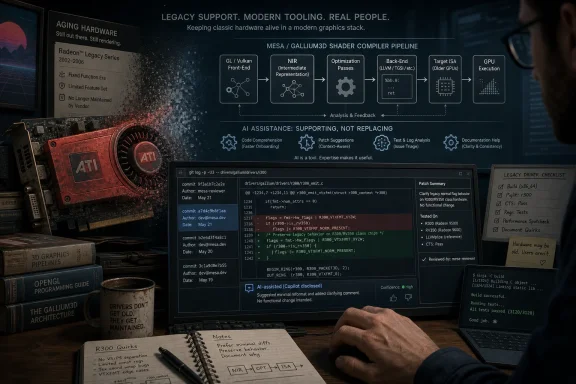 The Old Radeon Driver Becomes an AI Test Case
The R600 driver is not a consumer product launch, a Windows driver package, or a dramatic reversal from AMD. It is part of Mesa, the open-source graphics stack that underpins much of Linux’s 3D acceleration, and it serves a family of Radeon GPUs that began life when Windows Vista was new and ATI’s brand still had cultural weight among PC builders.That distinction matters because this is not AMD reviving 2007 hardware out of corporate benevolence. These GPUs are far outside the normal commercial support window. Their continued usefulness depends on volunteer developers, distribution maintainers, and the slow, sometimes thankless work of keeping old code compatible with modern toolchains and graphics infrastructure.
The Copilot angle makes the story irresistible, but it also risks distorting it. The merge was not a chatbot shipping a driver in the way a marketing department might describe an “AI-coded” product. It was a human developer using an AI assistant during refactoring work, with that assistance declared in the public record.
That disclosure is the part worth dwelling on. In a software culture increasingly split between AI boosters and AI skeptics, the Mesa change offers a more grounded model: use the tool, document the tool, and leave the work where other humans can inspect it.
This Is Maintenance Work, Not Magic
Shader compiler refactoring is exactly the kind of labor that makes old drivers age gracefully, and exactly the kind of labor that rarely produces a headline. A driver can continue to “work” for years while its internals become harder to maintain, test, and modify. Cleaning that code is not glamorous, but it reduces the cost of every future fix.That is why the phrase “new lease of life” should be read carefully. The change does not turn a Radeon HD 4870 into a modern gaming card, and it does not erase the hardware limits of pre-GCN AMD GPUs. These cards remain bound by their era: old APIs, old display capabilities, old power efficiency, and a performance envelope that modern integrated graphics often surpass.
But there is a difference between obsolete and abandoned. Mesa’s value to retro systems, lightweight desktops, lab machines, and hobbyist hardware collections lies in that middle ground. A card can be irrelevant to current AAA gaming and still useful for display output, compositing, old games, educational systems, or simply keeping a working PC out of the scrap pile.
The R600 driver lives in that world. It is not strategic silicon for AMD. It is not a growth market. It is a piece of shared infrastructure maintained because open-source graphics has a longer memory than most corporate support matrices.
AI Enters Through the Side Door
The most interesting thing about this episode is where AI showed up. It did not arrive as a sweeping rewrite, a new compiler architecture, or a promised productivity revolution. It appeared in cleanup work on a legacy driver few people outside the Linux graphics community think about.That is probably where AI coding tools will be most useful in mature infrastructure. Not as autonomous engineers, but as accelerants for repetitive edits, mechanical reshaping, and tedious refactors that a competent maintainer understands but may not have time to perform by hand at scale. The danger is not that the machine helps with the boring parts; the danger is pretending the boring parts no longer require judgment.
The merge request’s assistance declaration is therefore more important than the phrase “AI-assisted” itself. It says that the provenance of the work matters. It gives reviewers, downstream maintainers, and skeptical users a signal about how the patches were produced.
That signal does not automatically make the work better or worse. Copilot can suggest useful transformations, and it can also produce nonsense with great confidence. The question is whether the human maintainer remains accountable for the result, and whether the project’s review culture treats AI-generated or AI-assisted changes as code to be tested rather than vibes to be trusted.
Open Source Has Always Been the Afterlife of Hardware
For Windows users, the story may feel distant at first. The R600 Gallium3D driver is Linux graphics plumbing, not something that arrives through Windows Update or AMD Adrenalin. But WindowsForum readers know the pattern: hardware often outlives the vendor’s interest in supporting it.PC history is full of devices that remain electrically healthy long after their official software channel closes. Printers, scanners, sound cards, Wi-Fi adapters, capture cards, and GPUs all become casualties of shifting driver models and shrinking support teams. Sometimes the hardware is genuinely too old to justify modern support. Sometimes it is merely inconvenient.
Open source changes the economics by moving part of the maintenance burden away from the original vendor. That does not make support free. It transfers the cost to volunteers, distributions, testers, and users willing to tolerate rough edges. But it also prevents a perfectly functional device from becoming useless solely because a download page stopped receiving updates.
That is the quiet triumph in the R600 update. The work exists because Mesa’s architecture and licensing make it possible for outsiders to care after the original commercial moment has passed. AI did not create that possibility; it merely entered an ecosystem already built around long-term, communal maintenance.
The ATI Ghost Still Haunts Modern Radeon
There is also a nostalgia current running through this story because the hardware involved comes from a strange transitional period in GPU history. The Radeon HD 2000 series arrived in 2007, after AMD’s acquisition of ATI, and the ATI name lingered for a while before AMD retired it from consumer branding. For a generation of PC builders, “ATI Radeon” still evokes red PCBs, Catalyst drivers, and the bruising competition with Nvidia’s GeForce line.Those memories are not just sentimental. They reflect an era when the GPU market was becoming the modern GPU market: programmable shaders were central, driver quality could make or break performance, and operating systems were changing underneath everyone. Vista’s driver model had reset expectations on Windows, while Linux graphics was still evolving toward the Mesa and Gallium ecosystem we now take for granted.
The R600 family sits at that crossroads. It is old enough to feel antique, but modern enough that its software stack still resembles the architecture of today’s graphics drivers. It is not a museum piece in the way a 3dfx Voodoo card is a museum piece. It is a bridge from the old ATI world into the AMD graphics lineage that eventually produced GCN, RDNA, and today’s Radeon products.
That makes its continued maintenance oddly poignant. The ATI logo may be gone, but the driver code still receives patches. The brand died; the stack lives.
The Risk Is Not “Vibe Coding” Alone
The phrase vibe coding has become a convenient insult for software produced by prompting a model and hoping the output works. It captures a real anxiety: that code can now be generated faster than it can be understood, reviewed, or tested. In infrastructure projects, that is a recipe for subtle breakage.But not every use of an AI coding assistant is vibe coding. A maintainer who understands the subsystem, reviews the output, breaks the work into commits, and submits it through the normal review process is doing something different from a novice pasting a prompt into a chatbot and shipping whatever comes back. The tool may be the same; the engineering context is not.
That distinction should matter to open-source communities. Blanket hostility to AI assistance may discourage disclosure, pushing the practice underground. Blind enthusiasm may flood maintainers with plausible-looking patches that consume more review time than they save. The sustainable middle is transparency plus accountability.
The R600 case points toward that middle. The assistance was declared. The work landed as a series of commits. The human developer’s name remains attached. That is not a guarantee of correctness, but it is the right shape of process.
Legacy Drivers Are Where Review Culture Gets Tested
Old drivers expose a difficult asymmetry in open source. The fewer users a hardware path has, the fewer testers it attracts. The fewer testers it attracts, the riskier each change becomes. Yet the less often it changes, the more likely it is to rot against the rest of the stack.That is why refactoring legacy code is both valuable and uncomfortable. Cleanup can reduce long-term maintenance cost, but it can also introduce regressions in configurations that almost nobody is running. A change that looks safe on paper may fail on a card sitting in someone’s drawer, a retro build, or a decade-old workstation pressed into light duty.
AI assistance intensifies that tension because it can make broad mechanical edits easier. That is useful when the changes are genuinely mechanical. It is dangerous when mechanical-looking code encodes hardware-specific assumptions, undocumented quirks, or historical workarounds that only make sense to people who remember the bugs they fixed.
Graphics drivers are especially hostile territory for casual automation. They sit between compilers, kernels, firmware, APIs, and unpredictable application behavior. A harmless cleanup in one path can surface as a rendering bug in an old game, a compositor glitch, or a crash that only appears with a specific shader pattern.
Windows Users Should Read This as a Support Story
This is a Linux graphics story, but the broader lesson belongs to every Windows user who has watched support timelines shrink around otherwise usable machines. Microsoft, AMD, Nvidia, Intel, and OEMs all make rational business decisions about where to spend engineering resources. Those decisions often leave users with hardware that still works but no longer fits the official support story.Windows 10’s lifecycle, Windows 11’s hardware requirements, and the broader industry push toward security baselines have made that tension more visible. TPM requirements, driver signing, WDDM changes, and vendor support policies are not abstract when they decide whether a machine remains convenient to use. Sometimes the security and reliability case is strong. Sometimes the user experience is simply that a working PC has been nudged toward retirement.
Open-source driver work is not a universal answer to that problem. It will not bring first-class Windows support back to old Radeon HD cards, and it will not make unsupported hardware a good fit for sensitive production environments. But it does show that software support is not a law of physics. It is a set of institutional choices.
The community can make different choices when the code is available, the build system is accessible, and enough people care. That is the part Windows users should notice. The strongest preservation tool in computing is not nostalgia; it is source availability.
AI Could Help the Long Tail, If Maintainers Stay in Charge
The long tail of hardware support is where AI tools could earn a legitimate place in software development. There are not enough expert maintainers for every old driver, every obscure device, and every compatibility layer. If AI assistants can reduce the toil around repetitive refactoring, test scaffolding, documentation updates, and codebase navigation, they may help keep marginal projects alive.The catch is that AI does not create domain expertise. It compresses patterns from existing code and text. That can be powerful in a mature codebase with consistent conventions, but it is not the same as understanding why a register write must be ordered a certain way or why a workaround exists for a GPU released before many current developers entered the field.
For Mesa, the human layer is still the asset. Developers like Wollny bring context that a model cannot reliably infer. They know where the driver is fragile, where cleanup is safe, and where hardware history lurks behind ugly code. AI can assist that judgment; it cannot replace it.
The best version of this future looks boring. A maintainer uses an assistant, reviews the diff, runs the tests, declares the assistance, and submits the patches. The worst version looks exciting right up until users become the test suite.
Disclosure Is the New Signed-Off-By
Open-source development already has rituals for accountability. Commit authorship, review tags, sign-offs, mailing list discussion, merge requests, CI results, and issue trackers all create a paper trail. AI assistance now needs to fit into that culture rather than float outside it.A declared Copilot-assisted refactor is not a confession. It is metadata. It tells the community something about the production of the patch, just as a generated file header or a co-authored commit tells reviewers how to interpret a change.
Over time, projects will likely develop sharper norms. Some may require AI assistance declarations. Some may restrict generated code in sensitive areas. Some may treat AI tools like any other editor feature unless the output is substantial. The important thing is that the norms be explicit enough that contributors know what honesty looks like.
The worst outcome would be a culture in which developers use AI quietly because disclosure attracts drama. That would satisfy nobody. Skeptics would lose visibility, maintainers would lose trust, and users would have less information about the code they depend on.
The Practical Win Is Modest, Which Is Why It Matters
Nobody should oversell what happened here. A set of cleanup commits to an old Gallium3D driver will not transform the daily life of most PC users. It will not make vintage Radeon hardware competitive, and it will not alter the balance of power in modern graphics.The modesty is exactly why the story matters. Most software maintenance is modest. Most preservation happens through small patches, not grand rescues. Most old hardware survives because someone fixes a warning, removes dead code, updates an interface, or keeps a compiler path understandable for the next person.
AI’s role in software may ultimately be judged less by headline-grabbing demos than by whether it helps with this kind of upkeep. The industry is saturated with promises about agents building applications from scratch. The more credible story may be assistants helping experienced developers sustain the infrastructure everyone else has forgotten.
That is not as marketable as “AI writes driver.” It is also far more believable.
The R600 Patch Is a Small Signal From a Larger Future
The concrete lessons from this episode are less dramatic than the headlines, but more useful for anyone who cares about long-lived PCs.- The R600 Gallium3D work benefits old Radeon HD 2000 through HD 6000-era hardware in Mesa, not modern Windows Radeon driver packages.
- The reported Copilot involvement appears to be assistance with refactoring and cleanup, not an autonomous AI rewrite of a graphics driver.
- The public assistance declaration is a meaningful precedent because it keeps AI use visible to reviewers and downstream users.
- The value of the work depends on human maintainership, review, and testing, not on the mere fact that an AI tool was involved.
- The episode reinforces how open-source graphics stacks can preserve hardware usefulness long after official vendor support has ended.
References
- Primary source: Club386
Published: 2026-06-10T11:50:08.152707
Vintage AMD Radeon GPUs now have AI to thank for new drivers | Club386
Open-source developers are using GitHub Copilot in support of their efforts to maintain support for ATi Radeon HD 2000-series GPUs. www.club386.com
- Related coverage: tomshardware.com
Linux developers are using AI vibe coding to keep vintage AMD GPUs alive — R600 driver cleaned up with GitHub Copilot gives HD 2000 to HD 6000 series a new lease of life | Tom's Hardware
AI is now being used to help maintain Linux kernel driverswww.tomshardware.com - Related coverage: portaltela.com
IA entra no kernel Linux; Copilot ajuda a modernizar driver da Radeon HD – Portal Tela
O GitHub Copilot ajudou a limpar o compilador de shaders do driver R600, usado por GPUs AMD entre 2007 e 2010, em uma atualização da Mesa 26.2. Foram quarent...www.portaltela.com - Related coverage: ametropolesorocabana.com.br
GitHub Copilot revive o AMD R600 driver e mantém GPUs HD 2000–6000 funcionando - A Metrópole Sorocabana
O AMD R600 driver ganhou uma segunda vida graças a uma combinação improvável: décadas de hardware vintage e inteligência artificial de última geração. O GitHub Copilot foi utilizado para realizar uma limpeza técnica no driver Gallium3D R600 do kernel Linux, cobrindo as placas das séries...ametropolesorocabana.com.br - Related coverage: theoutpost.ai
AI Coding Keeps Vintage AMD GPUs Alive on Linux
Linux developers use GitHub Copilot to revive vintage AMD GPUs. Gert Wollny made 59 commits to R600 driver, extending life of Radeon HD 2000-6000 cards from 2007.theoutpost.ai - Related coverage: tomshw.it
- Related coverage: adrenaline.com.br
IA entra no kernel Linux: GitHub Copilot ajuda a modernizar driver das antigas Radeon HD - Adrenaline
Ferramenta limpou o compilador de placas de 2007 e mantém vivas GPUs com quase 20 anos; veja como o processo aconteceu.www.adrenaline.com.br - Related coverage: pcworld.com
Radeon 6000 GPUs were brand new 3 years ago. AMD's already dropping support | PCWorld
Graphics cards and integrated graphics in the Radeon 5000 and 6000 series, some just two or three years old, are now in "maintenance mode" for new drivers.www.pcworld.com
