

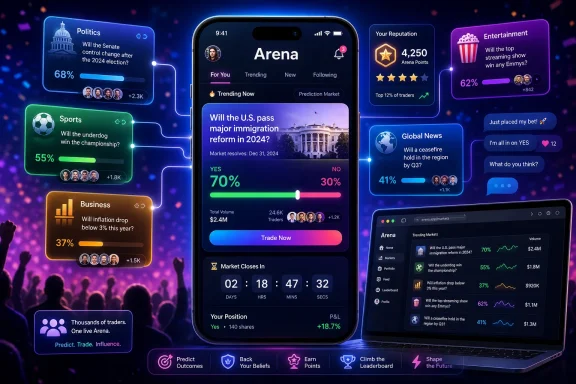
Meta is reportedly developing a standalone prediction-market smartphone app called Arena, under direction from CEO Mark Zuckerberg, that would let users forecast future events in areas such as politics, sports, business, entertainment, and news, initially using points rather than real-money wagers. The story is not just that Facebook’s parent wants a Polymarket clone. It is that Meta appears to be testing whether the social feed can be rebuilt around odds, not posts. If Arena ships, it could turn prediction from a niche trader habit into another mass-market engagement loop.
The old social network asked users what they were doing. The algorithmic social network asked what they would watch next. A prediction-market app asks something more combustible: what do you think will happen, and are you willing to be publicly measured against everyone else?
That is why Arena matters even if it begins as a points-based experiment. Meta does not need users to place cash wagers on elections or Super Bowls on day one for the product to be strategically important. It needs them to come back, argue, rank themselves, share outcomes, and create a durable habit around forecasting.
That is a familiar Meta move. The company has repeatedly entered fast-growing behavior categories once they proved sticky elsewhere: Stories after Snapchat, Reels after TikTok, Threads after Twitter’s instability, and standalone AI experiences after ChatGPT normalized conversational assistants. Arena, if the reports are accurate, fits that pattern almost too neatly.
Prediction markets are especially tempting because they combine several things Meta already understands: social status, viral controversy, real-time news, creator commentary, and engagement loops. A user who predicts the outcome of a court case, an earnings report, a transfer rumor, or an election is not merely consuming content. They are attaching identity to an outcome.
Kalshi and Polymarket have grown because real stakes sharpen the signal. Money forces participants to reveal conviction, and that is the feature prediction-market advocates prize. But money is also what turns a prediction product into a legal minefield.
Meta appears to understand that distinction. A points-based Arena can be framed as a game, reputation system, or forecasting community rather than a betting exchange. That would let Meta test demand, moderation systems, market creation, resolution mechanics, and user behavior without immediately crossing into the more heavily regulated terrain of real-money event contracts.
Still, the line will not be easy to hold. Points can become prestige. Prestige can become influencer economics. Leaderboards can become monetizable status. Once a market-like system produces rankings, badges, creator followings, and social proof, users may treat it as consequential even without cash.
This is where Meta’s history cuts both ways. The company is very good at turning lightweight participation into large-scale behavioral infrastructure. It is also very familiar with the backlash that follows when engagement mechanics amplify conflict, misinformation, or addictive use.
The product logic is simple. Users buy or trade positions tied to future outcomes, and market prices become a rough probability estimate. If a contract tied to an event trades near 70 cents, participants read that as the crowd assigning roughly a 70 percent chance to that outcome, with all the caveats that liquidity, incentives, and market structure require.
That framing has proved powerful during elections, sports seasons, crypto cycles, legal dramas, and corporate news events. It gives users a number to argue with, not just a headline to react to. For a social platform, that is gold: numbers are shareable, disputable, and easy to refresh.
The danger is that markets can look authoritative even when they are thin, manipulated, or driven by fandom. A liquid market may aggregate information. A shallow one may aggregate noise. A social product that treats both as equally engaging could turn uncertainty into content without giving users enough context to understand the difference.
That scale matters even if Arena remains separate from Facebook and Instagram. Meta can cross-promote, recommend, authenticate, notify, and eventually integrate prediction activity into its broader social graph. A standalone app does not mean a standalone ecosystem.
Imagine a sports creator on Instagram pushing followers into an Arena market before a championship game. Imagine a business-news account embedding prediction prompts around earnings calls. Imagine Threads arguments ending not in quote-post wars, but in “put points on it” challenges. The product practically writes its own engagement strategy.
This is also why existing players should take the experiment seriously. Polymarket and Kalshi have brand recognition among prediction-market users. Meta has the ability to teach everyone else the behavior.
Sports outcomes are familiar territory, but they blur quickly into gambling-like behavior. Political outcomes invite manipulation, brigading, and accusations that markets are influencing the events they track. Business predictions can collide with insider information. Entertainment markets can become harassment engines around artists, actors, and creators. Global news markets can become grotesque if users are rewarded for wagering on crises, violence, or disasters.
Meta would need to decide not only what users can predict, but what users should not be invited to gamify. That is harder than it sounds. Prediction markets have a way of converting everything into a tradable proposition, and the internet has a way of testing every boundary a platform leaves open.
The company’s moderation burden would therefore be structural, not incidental. It would need rules for market creation, rules for market wording, rules for resolution, rules for disputed outcomes, rules for manipulated activity, and rules for events where forecasting itself becomes ethically questionable.
The most difficult cases would not be the obviously unacceptable ones. They would be the markets that are legal, popular, and awful for public trust.
That could solve a real product problem. Prediction markets need a steady supply of well-formed questions. They also need clarity: precise deadlines, measurable outcomes, and unambiguous resolution criteria. Badly written markets create disputes, and disputes poison trust.
But AI-generated markets introduce their own failure modes. A model can hallucinate premises, frame questions irresponsibly, overproduce sensational topics, or recommend markets optimized for outrage rather than usefulness. If Arena becomes a machine for generating endless “will X happen by Y date” prompts, Meta may find itself industrializing speculation.
The deeper issue is incentives. AI can make prediction markets easier to scale, but scale is not the same as judgment. A system that can automatically generate thousands of markets still needs a human policy architecture deciding which futures deserve to become games.
That opens a very Meta-shaped possibility. Arena could become a reputation graph for forecasting, with users building public identities around accuracy. The best forecasters might gain followers. Creators might specialize in categories. Communities might form around competing interpretations of the same future.
This is more interesting than a simple betting app because it gives Meta a route around the cold-start problem. A real-money market needs counterparties and liquidity. A points market needs participation and social feedback. Meta is better at the latter than almost anyone.
A good Arena would make being right feel rewarding. A bad Arena would make being loudly confident feel rewarding. The distinction is everything.
Social platforms have spent the last decade proving that engagement does not automatically select for truth. Prediction markets at least contain a corrective mechanism: eventually, reality resolves the question. But the period before resolution may still reward misinformation, tribal certainty, and viral nonsense.
IT pros should watch the enterprise angle. Prediction platforms can become distractions, gambling-adjacent services, or data-leakage risks depending on how they are designed. If users begin making forecasts about companies, product launches, layoffs, earnings, or internal events, employers will care very quickly.
There is also the identity layer. Meta accounts are widely used, and any new app that ties user behavior to public prediction history creates a fresh privacy surface. Forecasting sounds harmless until it reveals political views, financial expectations, health anxieties, workplace knowledge, or patterns of attention.
Administrators already manage access to social media, messaging apps, trading platforms, and gaming services. Arena could sit awkwardly across all four categories. A points-only app may not trigger the same compliance alarms as a brokerage or sportsbook, but it could still deserve policy attention on managed devices.
The security concern is not that Arena itself would be malware or uniquely dangerous. It is that a large-scale prediction platform would create another high-value target for scams, impersonation, influence campaigns, and phishing built around breaking news.
Real-money prediction markets already occupy contested ground. In the United States, Kalshi’s regulated event contracts sit in a different posture from crypto-native or offshore-style platforms, while state-level gambling authorities continue to challenge the boundaries of sports and event betting. The category is expanding faster than the legal consensus around it.
Meta’s entry would intensify that debate. A niche platform can argue that it serves traders, forecasters, or information markets. Meta would be bringing the format to the mass public, potentially including younger users depending on age rules, regional availability, and app-store restrictions.
The political category is especially sensitive. Markets on elections can be defended as information aggregation, but critics argue they risk incentivizing manipulation, distorting media narratives, or turning civic life into a casino-like spectacle. Meta, given its past controversies around political content, would not get the benefit of the doubt.
If Arena ever adds real-money features, the scrutiny would multiply. But even without cash, a points economy with rankings, rewards, creators, and public influence could draw attention if it meaningfully shapes behavior.
A Meta-scale version could make forecasting more accessible. Users who would never open a trading account might participate in a points-based market about product launches, sports outcomes, or policy decisions. Communities could learn to distinguish confidence from evidence, and accuracy histories could discipline bad punditry.
That is the optimistic case. It is not fantasy. Prediction systems can expose overconfidence and reward calibration. A user who is wrong repeatedly has a record. A commentator who beats the crowd has evidence of skill.
But Meta’s business is not public epistemology. It is engagement funded overwhelmingly by advertising. If Arena’s most accurate markets are boring and its most inflammatory markets are sticky, the company will face the same old platform dilemma in a new format.
The best version of Arena would slow people down. It would force users to define terms, set deadlines, compare probabilities, and revisit outcomes. The worst version would speed everything up, transforming every headline into a contest before facts settle.
Posts ask for reactions. Videos ask for watch time. Stories ask for taps. Predictions ask for commitment. That is a powerful shift because it changes passive opinion into a measurable act.
In a mature Arena, the content unit might not be a photo, a thread, or a reel. It might be a market card: a proposition, a probability, a countdown, a comment stream, and a public record of who got it right. That format is compact, viral, and endlessly renewable.
It also pairs naturally with live events. Elections, earnings, matches, product launches, court rulings, central-bank decisions, award shows, and breaking news all become recurring engagement hooks. Meta has spent years optimizing feeds around what people might want to see. Arena would optimize around what people think happens next.
That is why the app could matter even if it never becomes a serious rival to Kalshi or Polymarket as a financial venue. Its real competition may be the comment section, the poll, the quote post, and the group chat.
 Meta Has Found a New Way to Make the Feed Competitive Again
The old social network asked users what they were doing. The algorithmic social network asked what they would watch next. A prediction-market app asks something more combustible: what do you think will happen, and are you willing to be publicly measured against everyone else?That is why Arena matters even if it begins as a points-based experiment. Meta does not need users to place cash wagers on elections or Super Bowls on day one for the product to be strategically important. It needs them to come back, argue, rank themselves, share outcomes, and create a durable habit around forecasting.
That is a familiar Meta move. The company has repeatedly entered fast-growing behavior categories once they proved sticky elsewhere: Stories after Snapchat, Reels after TikTok, Threads after Twitter’s instability, and standalone AI experiences after ChatGPT normalized conversational assistants. Arena, if the reports are accurate, fits that pattern almost too neatly.
Prediction markets are especially tempting because they combine several things Meta already understands: social status, viral controversy, real-time news, creator commentary, and engagement loops. A user who predicts the outcome of a court case, an earnings report, a transfer rumor, or an election is not merely consuming content. They are attaching identity to an outcome.
The Points System Is a Regulatory Hedge, Not a Small Detail
The reported plan to launch Arena with points instead of real money is not cosmetic. It is the difference between a social app and a product that could immediately invite gambling regulators, commodities regulators, state attorneys general, election watchdogs, and platform-safety critics into the room.Kalshi and Polymarket have grown because real stakes sharpen the signal. Money forces participants to reveal conviction, and that is the feature prediction-market advocates prize. But money is also what turns a prediction product into a legal minefield.
Meta appears to understand that distinction. A points-based Arena can be framed as a game, reputation system, or forecasting community rather than a betting exchange. That would let Meta test demand, moderation systems, market creation, resolution mechanics, and user behavior without immediately crossing into the more heavily regulated terrain of real-money event contracts.
Still, the line will not be easy to hold. Points can become prestige. Prestige can become influencer economics. Leaderboards can become monetizable status. Once a market-like system produces rankings, badges, creator followings, and social proof, users may treat it as consequential even without cash.
This is where Meta’s history cuts both ways. The company is very good at turning lightweight participation into large-scale behavioral infrastructure. It is also very familiar with the backlash that follows when engagement mechanics amplify conflict, misinformation, or addictive use.
Prediction Markets Are Having Their Mainstream Moment
Prediction markets have existed in academic, political, and financial circles for decades, but the current wave feels different because it is native to the internet’s attention economy. Platforms such as Polymarket and Kalshi have made event forecasting feel less like a spreadsheet and more like a live scoreboard for public belief.The product logic is simple. Users buy or trade positions tied to future outcomes, and market prices become a rough probability estimate. If a contract tied to an event trades near 70 cents, participants read that as the crowd assigning roughly a 70 percent chance to that outcome, with all the caveats that liquidity, incentives, and market structure require.
That framing has proved powerful during elections, sports seasons, crypto cycles, legal dramas, and corporate news events. It gives users a number to argue with, not just a headline to react to. For a social platform, that is gold: numbers are shareable, disputable, and easy to refresh.
The danger is that markets can look authoritative even when they are thin, manipulated, or driven by fandom. A liquid market may aggregate information. A shallow one may aggregate noise. A social product that treats both as equally engaging could turn uncertainty into content without giving users enough context to understand the difference.
Meta’s Scale Changes the Category Before Arena Even Launches
The most important competitor Arena would bring to prediction markets is not Meta’s engineering team. It is distribution. Meta’s family of apps still reaches billions of people daily, giving the company a launchpad that specialist prediction-market platforms cannot replicate.That scale matters even if Arena remains separate from Facebook and Instagram. Meta can cross-promote, recommend, authenticate, notify, and eventually integrate prediction activity into its broader social graph. A standalone app does not mean a standalone ecosystem.
Imagine a sports creator on Instagram pushing followers into an Arena market before a championship game. Imagine a business-news account embedding prediction prompts around earnings calls. Imagine Threads arguments ending not in quote-post wars, but in “put points on it” challenges. The product practically writes its own engagement strategy.
This is also why existing players should take the experiment seriously. Polymarket and Kalshi have brand recognition among prediction-market users. Meta has the ability to teach everyone else the behavior.
The App Store Version of a Betting Exchange Is Still a Moderation Problem
Arena’s reported scope—politics, sports, business, entertainment, and global news—sounds broad enough to be interesting and broad enough to be dangerous. Every category introduces a different kind of risk.Sports outcomes are familiar territory, but they blur quickly into gambling-like behavior. Political outcomes invite manipulation, brigading, and accusations that markets are influencing the events they track. Business predictions can collide with insider information. Entertainment markets can become harassment engines around artists, actors, and creators. Global news markets can become grotesque if users are rewarded for wagering on crises, violence, or disasters.
Meta would need to decide not only what users can predict, but what users should not be invited to gamify. That is harder than it sounds. Prediction markets have a way of converting everything into a tradable proposition, and the internet has a way of testing every boundary a platform leaves open.
The company’s moderation burden would therefore be structural, not incidental. It would need rules for market creation, rules for market wording, rules for resolution, rules for disputed outcomes, rules for manipulated activity, and rules for events where forecasting itself becomes ethically questionable.
The most difficult cases would not be the obviously unacceptable ones. They would be the markets that are legal, popular, and awful for public trust.
AI Could Make Arena Work — Or Make It Weird Faster
Meta’s current product strategy is inseparable from AI, and a prediction app would be an obvious place to deploy it. AI systems could suggest markets, summarize arguments, detect duplicate questions, flag manipulation, recommend relevant forecasts, and help resolve outcomes from trusted sources.That could solve a real product problem. Prediction markets need a steady supply of well-formed questions. They also need clarity: precise deadlines, measurable outcomes, and unambiguous resolution criteria. Badly written markets create disputes, and disputes poison trust.
But AI-generated markets introduce their own failure modes. A model can hallucinate premises, frame questions irresponsibly, overproduce sensational topics, or recommend markets optimized for outrage rather than usefulness. If Arena becomes a machine for generating endless “will X happen by Y date” prompts, Meta may find itself industrializing speculation.
The deeper issue is incentives. AI can make prediction markets easier to scale, but scale is not the same as judgment. A system that can automatically generate thousands of markets still needs a human policy architecture deciding which futures deserve to become games.
The Real Product Is Reputation
If Arena starts with points, the core asset will not be liquidity. It will be reputation. Users will want to know who is good at predicting elections, who understands semiconductor earnings, who always overestimates their favorite team, and who quietly beats the crowd on geopolitical developments.That opens a very Meta-shaped possibility. Arena could become a reputation graph for forecasting, with users building public identities around accuracy. The best forecasters might gain followers. Creators might specialize in categories. Communities might form around competing interpretations of the same future.
This is more interesting than a simple betting app because it gives Meta a route around the cold-start problem. A real-money market needs counterparties and liquidity. A points market needs participation and social feedback. Meta is better at the latter than almost anyone.
A good Arena would make being right feel rewarding. A bad Arena would make being loudly confident feel rewarding. The distinction is everything.
Social platforms have spent the last decade proving that engagement does not automatically select for truth. Prediction markets at least contain a corrective mechanism: eventually, reality resolves the question. But the period before resolution may still reward misinformation, tribal certainty, and viral nonsense.
Windows Users Will See This Through the Browser Before the App
For WindowsForum readers, this may sound like a mobile-social story at first glance. But prediction markets rarely stay confined to the phone. If Arena works, expect it to become a web experience, a notification layer, a creator tool, and eventually a data source that bleeds into desktop workflows.IT pros should watch the enterprise angle. Prediction platforms can become distractions, gambling-adjacent services, or data-leakage risks depending on how they are designed. If users begin making forecasts about companies, product launches, layoffs, earnings, or internal events, employers will care very quickly.
There is also the identity layer. Meta accounts are widely used, and any new app that ties user behavior to public prediction history creates a fresh privacy surface. Forecasting sounds harmless until it reveals political views, financial expectations, health anxieties, workplace knowledge, or patterns of attention.
Administrators already manage access to social media, messaging apps, trading platforms, and gaming services. Arena could sit awkwardly across all four categories. A points-only app may not trigger the same compliance alarms as a brokerage or sportsbook, but it could still deserve policy attention on managed devices.
The security concern is not that Arena itself would be malware or uniquely dangerous. It is that a large-scale prediction platform would create another high-value target for scams, impersonation, influence campaigns, and phishing built around breaking news.
Regulators Will Not Wait for Cash Forever
Meta may hope that points create breathing room. Regulators may not be so patient if Arena becomes large enough to influence public discourse or resembles gambling in practice. The history of consumer internet regulation is full of products that began as playful engagement and later became policy problems.Real-money prediction markets already occupy contested ground. In the United States, Kalshi’s regulated event contracts sit in a different posture from crypto-native or offshore-style platforms, while state-level gambling authorities continue to challenge the boundaries of sports and event betting. The category is expanding faster than the legal consensus around it.
Meta’s entry would intensify that debate. A niche platform can argue that it serves traders, forecasters, or information markets. Meta would be bringing the format to the mass public, potentially including younger users depending on age rules, regional availability, and app-store restrictions.
The political category is especially sensitive. Markets on elections can be defended as information aggregation, but critics argue they risk incentivizing manipulation, distorting media narratives, or turning civic life into a casino-like spectacle. Meta, given its past controversies around political content, would not get the benefit of the doubt.
If Arena ever adds real-money features, the scrutiny would multiply. But even without cash, a points economy with rankings, rewards, creators, and public influence could draw attention if it meaningfully shapes behavior.
Meta Is Chasing Engagement, but It May Accidentally Build an Information Product
The most generous interpretation of prediction markets is that they make public belief measurable. Instead of asking pundits what they think, a market asks participants to express conviction in a structured way. That can be useful when the alternative is vibes.A Meta-scale version could make forecasting more accessible. Users who would never open a trading account might participate in a points-based market about product launches, sports outcomes, or policy decisions. Communities could learn to distinguish confidence from evidence, and accuracy histories could discipline bad punditry.
That is the optimistic case. It is not fantasy. Prediction systems can expose overconfidence and reward calibration. A user who is wrong repeatedly has a record. A commentator who beats the crowd has evidence of skill.
But Meta’s business is not public epistemology. It is engagement funded overwhelmingly by advertising. If Arena’s most accurate markets are boring and its most inflammatory markets are sticky, the company will face the same old platform dilemma in a new format.
The best version of Arena would slow people down. It would force users to define terms, set deadlines, compare probabilities, and revisit outcomes. The worst version would speed everything up, transforming every headline into a contest before facts settle.
The Future Becomes a Feed
The phrase “prediction market” can make Arena sound more financial than social. That may be misleading. Meta is not merely looking at an exchange; it is reportedly looking at a new feed primitive.Posts ask for reactions. Videos ask for watch time. Stories ask for taps. Predictions ask for commitment. That is a powerful shift because it changes passive opinion into a measurable act.
In a mature Arena, the content unit might not be a photo, a thread, or a reel. It might be a market card: a proposition, a probability, a countdown, a comment stream, and a public record of who got it right. That format is compact, viral, and endlessly renewable.
It also pairs naturally with live events. Elections, earnings, matches, product launches, court rulings, central-bank decisions, award shows, and breaking news all become recurring engagement hooks. Meta has spent years optimizing feeds around what people might want to see. Arena would optimize around what people think happens next.
That is why the app could matter even if it never becomes a serious rival to Kalshi or Polymarket as a financial venue. Its real competition may be the comment section, the poll, the quote post, and the group chat.
The Arena Bet Has Only a Few Outcomes That Matter
Arena is still reportedly experimental, and Meta has not publicly laid out a launch date, market list, regional plan, or monetization model. But the shape of the idea is clear enough to separate the signal from the hype. This is not simply Facebook discovering betting; it is Meta testing whether forecasts can become social content at global scale.- Meta is reportedly building Arena as a standalone prediction-market app rather than a feature bolted onto Facebook or Instagram.
- The app is expected to start with a points-based system, which would let Meta test engagement while avoiding the immediate complexity of real-money wagering.
- Prediction markets are attractive because they turn news, sports, politics, business, and entertainment into repeatable participation loops.
- Meta’s distribution advantage could bring prediction behavior to mainstream users faster than specialist platforms could manage on their own.
- The biggest risks are not technical but institutional: regulation, manipulation, privacy, moderation, and the ethics of gamifying real-world events.
- For Windows users and IT administrators, Arena could become another social-financial hybrid to watch on managed devices, workplace networks, and browser environments.
References
- Primary source: trak.in
Published: 2026-06-28T04:42:11.609012
Facebook Making App Which Will Predict The Future Events - Trak.in - Indian Business of Tech, Mobile & Startups
Meta, the parent company of Facebook, Instagram, WhatsApp, and Messenger, is reportedly exploring a new frontier in digital engagement: prediction markets. According to multiple reports, CEO Mark Zuckerberg has directed a small team within the company to develop a standalone smartphone app that... trak.in
