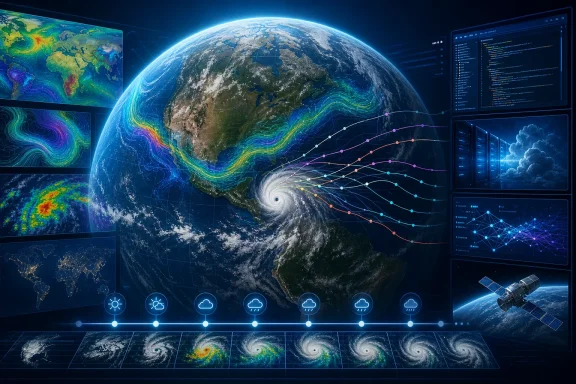
Microsoft has launched Aurora 1.5, an open-access update to its Earth-system foundation model that adds 22 weather variables, produces hourly forecasts, and introduces probabilistic ensemble forecasting. Microsoft reports that the ensemble median reduced tropical-cyclone track error by one-third compared with the previous Aurora version and says the model outperformed its comparison baseline on 88.9% of evaluated targets.
The two-sentence takeaway: Aurora 1.5’s reported one-third lower median track error is promising, but it does not mean individual users or emergency managers should replace official hurricane forecasts or warnings. Consumer weather products may improve situational awareness, while official emergency agencies must remain the authoritative source for protective actions and operational triggers.
Source attribution: The specifications, evaluation figures, open-access status, intended coupling with the European Centre for Medium-Range Weather Forecasts, and planned Microsoft Weather integration discussed in this article come from Microsoft’s Aurora 1.5 announcement as summarized in Neowin’s report. Performance figures remain Microsoft-reported results unless otherwise stated.
Microsoft describes Aurora as an Earth-system foundation model: an AI system designed to learn from varied geophysical data and then support multiple environmental forecasting tasks.
That description distinguishes Aurora from a model developed for only one variable or narrowly defined prediction problem. The foundation-model approach is intended to provide a reusable base that can be adapted to different forecasting tasks, although the quality of each adaptation must still be evaluated separately.
Aurora 1.5 pushes the project toward practical forecasting use. According to Microsoft, the update adds 22 weather variables, increases the output frequency to hourly forecasts, and introduces probabilistic ensemble forecasting.
Source attribution: Microsoft supplied the description of Aurora as an Earth-system foundation model and the Aurora 1.5 specifications; Neowin reported those details in its coverage of the release.
The additional variables could make the model relevant to more specialized analysis, but Microsoft’s announcement does not by itself demonstrate performance for every energy, agricultural, transport, insurance, or climate-risk application. Organizations considering those uses would need to establish which variables are available, how they are defined, and whether their accuracy is sufficient for the organization’s locations and thresholds.
Hourly output is potentially useful where conditions and decisions change faster than a daily summary can represent. That does not guarantee that every hourly value will be more accurate or more actionable. It means users receive a finer forecast timeline that can be evaluated against time-sensitive requirements.
Probabilistic ensemble forecasting is the most consequential structural change. Instead of returning only one predicted future, an ensemble represents multiple plausible outcomes. That can help qualified users examine whether scenarios remain concentrated around a similar result or spread across substantially different possibilities.
Aurora 1.5 is therefore not simply another accuracy update. Microsoft is changing the scope, frequency, and form of its model’s output in ways that could make the system more useful as one input to forecasting and decision-support workflows.
The median is the middle result after ensemble outcomes are ordered. Microsoft’s reported one-third reduction concerns that ensemble median, not every individual ensemble member and not the full range of possible storm tracks.
That distinction should carry most of the uncertainty explanation needed here: a better median is encouraging, but it does not prove that every scenario improved or that dangerous alternatives disappeared from the distribution.
Source attribution: Microsoft reported the one-third reduction in median tropical-cyclone track error relative to the prior Aurora version; Neowin relayed that comparison. The explanation of how to interpret a median versus a distribution is editorial analysis.
This matters because operational decisions do not always follow the most likely outcome. A utility, hospital, port, logistics provider, or local government may need to consider a less likely scenario if the consequences of being unprepared would be severe.
Aurora 1.5’s ensemble output may support that kind of assessment, but the release information leaves important evaluation questions unanswered. The reported summary does not establish how performance changes across every ocean basin, storm type, lead time, season, or initialization source. It also does not show whether the central-track improvement is accompanied by equally useful calibration of the wider ensemble.
Calibration is particularly important for probabilistic output. If an event presented as having a given likelihood occurs much more or less often than expected, the probabilities may be difficult to use for thresholds and automated decisions. Microsoft’s reported median improvement does not, on its own, establish the calibration, reliability, or sharpness of the ensemble.
Those are verifiable evaluation limits rather than reasons to dismiss the model. Aurora 1.5 may prove valuable, but users should distinguish the result Microsoft has reported from the broader evidence that would be needed for operational adoption.
Source attribution: Microsoft provided the feature comparison and tropical-cyclone result summarized in the table; Neowin reported the update. The practical-consequence column is WindowsForum analysis and should not be read as a Microsoft product guarantee.
The table shows why Aurora 1.5 is more than a routine version bump. Microsoft has altered what the model predicts, how often it produces results, and whether it represents one outcome or a set of possible outcomes. What remains to be established is how consistently those changes improve decisions outside Microsoft’s evaluation.
Source attribution: The Hurricane Helene example and the one-third median-track-error improvement are attributed to Microsoft’s evaluation as reported by Neowin.
A reduction of that size deserves attention because track differences can influence where organizations stage personnel, equipment, supplies, and communications. It should not, however, be converted into a claim that every affected community would receive a forecast that is one-third “better” in every meaningful respect.
Track error measures only part of hurricane risk. A tropical cyclone’s effects can extend far from the center, and a track metric does not by itself evaluate rainfall, wind impacts, storm surge, tornadoes, inland flooding, or the timing and duration of local hazards.
The verified result is narrower: Microsoft reports that the Aurora 1.5 ensemble median had lower track error than the previous Aurora version in its testing. The available information does not establish an equivalent improvement for every storm, region, forecast horizon, or hazard.
Hurricane Helene helps make the evaluation easier to understand, but one named storm cannot establish universal superiority. A stronger assessment would include a clearly defined sample of storms, multiple basins and seasons, a range of lead times, difficult or unusual tracks, and cases involving changes in storm organization.
Independent evaluation would also need to disclose the comparison protocol. Relevant details include the datasets used for initialization and verification, the number of ensemble members, the treatment of missing or dissipating systems, the geographic domain, and whether any post-processing affected the final tracks.
Those limitations do not erase the reported gain. They define what Microsoft’s result can responsibly support today: Aurora 1.5 appears to have produced a meaningfully better central track estimate than its predecessor in the company’s evaluation, while broader operational claims require more evidence.
Source attribution: The 88.9% figure is Microsoft’s reported evaluation result, repeated by Neowin. Neither the percentage nor this article should be interpreted as a universal accuracy rate.
The percentage is striking, but “evaluated targets” is a benchmark category, not a promise covering every user’s weather question. Its significance depends on which variables, forecast horizons, locations, metrics, and cases were included.
A model can perform better on a large majority of targets while still underperforming on a smaller set that matters greatly to a particular organization. A utility may care about a specific combination of temperature, wind, and timing. An agricultural operator may prioritize precipitation and temperature extremes. A transport organization may focus on localized disruption thresholds rather than broad average performance.
The figure also does not show the magnitude of each win or loss. Many narrow improvements could produce a high win percentage, while a smaller number of substantial failures could remain important. Alternatively, modest but consistent gains across many targets could be valuable when forecasts are generated repeatedly at scale.
Without the complete evaluation matrix, the safest interpretation is that Microsoft reports broad improvement across the targets it selected. The number is not a service-level commitment, an emergency-warning accuracy rate, or proof that Aurora 1.5 is superior for every geography and workload.
The verified facts also do not support saying that Neowin declared Aurora 1.5 competitive with ECMWF-associated systems. What is supported is more limited: Microsoft wants to couple Aurora 1.5 with the European Centre for Medium-Range Weather Forecasts.
That planned relationship should not be rewritten as a head-to-head performance victory. Coupling can describe technical or operational collaboration between systems without proving that one independently outperforms the other.
For IT departments, the lesson is familiar: a vendor benchmark is a reason to test, not a reason to skip testing. Organizations should reproduce relevant comparisons using their own locations, variables, lead times, thresholds, and consequences.
Source attribution: The stated intention to couple Aurora 1.5 with ECMWF comes from Microsoft and was reported by Neowin. Any discussion of the possible value of combining systems is WindowsForum analysis.
That is a more measured posture than framing the release as “AI versus physics.” Different forecasting approaches can produce different signals and different failure modes. In principle, using more than one independently developed source can expose disagreement that would remain hidden if users followed a single output.
The available announcement does not document exactly how Microsoft and ECMWF systems will be coupled. It does not specify weighting, calibration, data exchange, production responsibilities, or how disagreements will be resolved. Until those details are published, readers should not assume that the systems will simply be averaged or that Aurora will control the final forecast.
For operational users, a combined system would still require verification and provenance. Teams would need to know which components contributed to a forecast, which versions were active, when each input was generated, and whether post-processing changed the outputs.
Human review remains important wherever forecasts inform high-consequence decisions. That conclusion is an editorial recommendation, not a claim that Microsoft has documented a particular review workflow for Aurora 1.5.
The credible near-term role for Aurora 1.5 is as an additional probabilistic signal that can be tested alongside other forecast sources—not as an automatic replacement for official forecasts, warnings, or professional judgment.
Source attribution: Aurora 1.5’s open-access status is attributed to Microsoft and was included in Neowin’s report.
The verified information does not establish that Microsoft’s public release infrastructure lists Aurora 1.5 support, nor does it establish that Neowin linked readers to a specific GitHub repository. Those distribution details should not be asserted without direct documentation.
Open access can still improve scrutiny. External teams may be able to evaluate the model on different regions, events, variables, and lead times. They can investigate where the reported gains transfer and where performance weakens.
Availability should not be confused with operational readiness. Access to a model does not automatically provide a maintained forecasting service, validated input pipeline, monitoring system, support agreement, or governance framework.
Organizations would still need to manage data availability, execution, dependencies, output formats, version control, security, monitoring, and failure recovery. They would also need to determine whether the access terms permit their intended research, commercial, or public-sector use.
Forecast provenance should be treated as a core control. A production user should be able to identify the model version, input data, initialization time, forecast horizon, ensemble configuration, and any transformations applied after generation.
Without that record, a forecast can be difficult to reproduce or audit. If a later model revision changes behavior, teams may be unable to determine which version informed an earlier decision.
Open access therefore makes Microsoft’s claims more testable, but it also shifts responsibility toward adopters. Microsoft can provide access to a model; an organization choosing to rely on it must establish the controls appropriate to its own risk.
Source attribution: The planned Aurora 1.5 integration into Microsoft Weather is a Microsoft statement reported by Neowin.
Microsoft has not yet documented enough product detail to say precisely how Aurora 1.5 will behave inside Microsoft Weather. The company has not established in the verified material whether Aurora will generate the primary forecast, supplement another forecast system, influence only certain variables, or contribute to a larger blended pipeline.
It is therefore premature to claim that users will receive new confidence indicators, scenario-aware notifications, or a particular presentation of ensemble uncertainty. Those are possible design directions, not announced features.
Hourly forecasts could support more frequent or granular information within Microsoft Weather, and the expanded variable set could give the service more inputs to work with. Whether those capabilities become visible to users will depend on Microsoft’s implementation.
The product challenge is straightforward even if the solution is not: probabilistic information must be communicated without creating false precision or unnecessary confusion. Microsoft will need to decide what the interface presents, what it simplifies, and what remains internal to the forecasting pipeline.
WindowsForum’s policy recommendation is unambiguous: Microsoft Weather and other consumer weather apps may inform situational awareness, but official emergency agencies remain the authoritative source for warnings, protective actions, evacuation instructions, closures, and operational triggers.
A commercial forecast can be useful without having public authority. A more capable AI model does not transfer responsibility for emergency instructions from agencies to a software vendor.
Microsoft should also explain material changes to the product’s forecast pipeline. Users and enterprise customers would benefit from knowing whether Aurora supplies an additional signal, generates part of the atmospheric forecast, or contributes to presentation and summarization.
Until Microsoft publishes those details, claims about Aurora’s exact behavior inside Microsoft Weather should remain clearly labeled as possibilities.
That indirect route could give Aurora substantial visibility. Users do not need to install or operate a forecasting model if its output is incorporated into a service they already use.
The trade-off is limited transparency. If Microsoft blends Aurora with other forecast sources, users may not know which component produced a particular value or how the final result was assembled.
That is not necessarily a flaw. Composite systems can be appropriate when they are validated and monitored. But the product should avoid using a generic “AI-powered” label as a substitute for meaningful disclosure.
An AI-generated explanation of a forecast is not the same as an AI-generated atmospheric forecast. An AI model used as one contributor to a broader forecast is not the same as a standalone system. Those distinctions affect how users and organizations should interpret the output.
For Windows administrators, the immediate task is not deploying Aurora to endpoints. It is identifying whether employees or business processes consume Microsoft Weather and whether the planned integration could alter an information source already used informally.
That policy should be written into business-continuity, field-safety, travel, facilities, and emergency-response procedures wherever employees might otherwise treat a familiar weather app as an official instruction channel.
Weather information already enters enterprises through dashboards, apps, reports, third-party feeds, and employee judgment. Aurora 1.5 creates another possible source within that environment, potentially without a formal procurement or deployment event.
A logistics manager may check Microsoft Weather before changing a schedule. A field team may consult an hourly forecast on a Windows device. An incident team may copy information from a commercial app into a broader assessment. Once repeated, those informal actions can become de facto workflow.
The reported performance gains may encourage greater trust, but an organization should not inherit its risk policy from a benchmark headline. It should identify weather-sensitive decisions and classify the consequence of a wrong, late, incomplete, or misunderstood forecast.
Changing a routine outdoor meeting is different from closing a facility, dispatching emergency crews, suspending transportation, or altering critical infrastructure. The required source authority, verification, and approval should increase with the consequence of the decision.
Probabilistic forecasts can support threshold-based planning, but thresholds must be designed and tested. An organization needs to determine what probability or scenario range triggers monitoring, escalation, preparation, or action—and which official warning overrides all other signals.
Automated responses deserve particular caution. Until Aurora 1.5 has been validated for a specific workload, an app forecast should not independently trigger an irreversible high-impact action. Forecast disagreement should route the issue to an accountable person or established incident process.
Source attribution: All figures and release features in this summary are Microsoft-reported claims conveyed in Neowin’s coverage. The limits, governance recommendations, and operational interpretation are WindowsForum analysis.
The next step is verification rather than celebration or dismissal. Researchers need to test more storms, regions, variables, lead times, and atmospheric conditions. Organizations need to evaluate the specific outputs connected to their decisions. Microsoft needs to document how Aurora 1.5 will be incorporated into Microsoft Weather and how material pipeline changes will be communicated.
For Windows users, the rule is simple: use improved commercial forecasts as additional context, not as a substitute for official warnings. For administrators, the work is equally concrete: inventory existing weather dependencies, define authoritative sources, prevent one app from becoming an operational trigger by accident, and test any Aurora-influenced output before expanding its role.
Aurora 1.5’s reported gains are promising. Now Microsoft and adopters must prove where those gains hold, document how the model enters products, and keep official emergency guidance firmly in control when people and infrastructure are at risk.
The two-sentence takeaway: Aurora 1.5’s reported one-third lower median track error is promising, but it does not mean individual users or emergency managers should replace official hurricane forecasts or warnings. Consumer weather products may improve situational awareness, while official emergency agencies must remain the authoritative source for protective actions and operational triggers.
Source attribution: The specifications, evaluation figures, open-access status, intended coupling with the European Centre for Medium-Range Weather Forecasts, and planned Microsoft Weather integration discussed in this article come from Microsoft’s Aurora 1.5 announcement as summarized in Neowin’s report. Performance figures remain Microsoft-reported results unless otherwise stated.
 Microsoft Turns Aurora From a Research Model Into a Forecasting System
Microsoft describes Aurora as an Earth-system foundation model: an AI system designed to learn from varied geophysical data and then support multiple environmental forecasting tasks.That description distinguishes Aurora from a model developed for only one variable or narrowly defined prediction problem. The foundation-model approach is intended to provide a reusable base that can be adapted to different forecasting tasks, although the quality of each adaptation must still be evaluated separately.
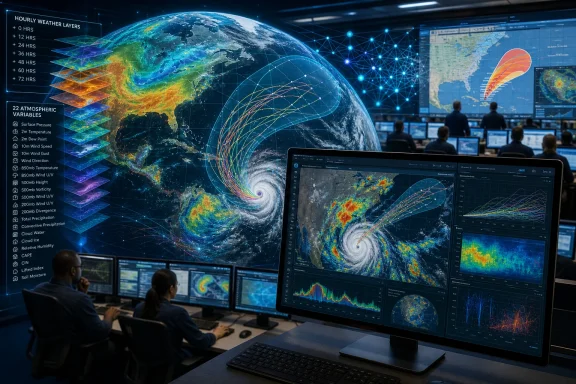
Aurora 1.5 pushes the project toward practical forecasting use. According to Microsoft, the update adds 22 weather variables, increases the output frequency to hourly forecasts, and introduces probabilistic ensemble forecasting.
Source attribution: Microsoft supplied the description of Aurora as an Earth-system foundation model and the Aurora 1.5 specifications; Neowin reported those details in its coverage of the release.
The additional variables could make the model relevant to more specialized analysis, but Microsoft’s announcement does not by itself demonstrate performance for every energy, agricultural, transport, insurance, or climate-risk application. Organizations considering those uses would need to establish which variables are available, how they are defined, and whether their accuracy is sufficient for the organization’s locations and thresholds.
Hourly output is potentially useful where conditions and decisions change faster than a daily summary can represent. That does not guarantee that every hourly value will be more accurate or more actionable. It means users receive a finer forecast timeline that can be evaluated against time-sensitive requirements.
Probabilistic ensemble forecasting is the most consequential structural change. Instead of returning only one predicted future, an ensemble represents multiple plausible outcomes. That can help qualified users examine whether scenarios remain concentrated around a similar result or spread across substantially different possibilities.
Aurora 1.5 is therefore not simply another accuracy update. Microsoft is changing the scope, frequency, and form of its model’s output in ways that could make the system more useful as one input to forecasting and decision-support workflows.
The Real Upgrade Is Uncertainty, Not Another Accuracy Trophy
A single forecast line can appear more certain than the underlying evidence warrants. An ensemble provides several modeled outcomes, making it possible to examine both a central estimate and the variation around it.The median is the middle result after ensemble outcomes are ordered. Microsoft’s reported one-third reduction concerns that ensemble median, not every individual ensemble member and not the full range of possible storm tracks.
That distinction should carry most of the uncertainty explanation needed here: a better median is encouraging, but it does not prove that every scenario improved or that dangerous alternatives disappeared from the distribution.
Source attribution: Microsoft reported the one-third reduction in median tropical-cyclone track error relative to the prior Aurora version; Neowin relayed that comparison. The explanation of how to interpret a median versus a distribution is editorial analysis.
This matters because operational decisions do not always follow the most likely outcome. A utility, hospital, port, logistics provider, or local government may need to consider a less likely scenario if the consequences of being unprepared would be severe.
Aurora 1.5’s ensemble output may support that kind of assessment, but the release information leaves important evaluation questions unanswered. The reported summary does not establish how performance changes across every ocean basin, storm type, lead time, season, or initialization source. It also does not show whether the central-track improvement is accompanied by equally useful calibration of the wider ensemble.
Calibration is particularly important for probabilistic output. If an event presented as having a given likelihood occurs much more or less often than expected, the probabilities may be difficult to use for thresholds and automated decisions. Microsoft’s reported median improvement does not, on its own, establish the calibration, reliability, or sharpness of the ensemble.
Those are verifiable evaluation limits rather than reasons to dismiss the model. Aurora 1.5 may prove valuable, but users should distinguish the result Microsoft has reported from the broader evidence that would be needed for operational adoption.
| Capability | Previous Aurora version | Aurora 1.5 | Practical consequence |
|---|---|---|---|
| Weather-variable coverage | Earlier baseline | Adds 22 variables | Potentially supports a broader range of forecast analysis |
| Temporal resolution | Earlier baseline | Hourly forecasts | Provides a finer timeline for time-sensitive use cases |
| Forecasting approach | Earlier baseline | Probabilistic ensemble forecasting | Represents multiple plausible outcomes rather than only one result |
| Tropical-cyclone tracking | Comparison baseline | Ensemble median showed one-third lower track error | Improves the central track estimate in Microsoft’s reported testing |
The table shows why Aurora 1.5 is more than a routine version bump. Microsoft has altered what the model predicts, how often it produces results, and whether it represents one outcome or a set of possible outcomes. What remains to be established is how consistently those changes improve decisions outside Microsoft’s evaluation.
Hurricane Helene Makes the Improvement Concrete
Neowin’s report cites Hurricane Helene in its discussion of Microsoft’s Aurora 1.5 testing. Microsoft says the model’s ensemble median achieved tropical-cyclone track error one-third lower than the previous Aurora version.Source attribution: The Hurricane Helene example and the one-third median-track-error improvement are attributed to Microsoft’s evaluation as reported by Neowin.
A reduction of that size deserves attention because track differences can influence where organizations stage personnel, equipment, supplies, and communications. It should not, however, be converted into a claim that every affected community would receive a forecast that is one-third “better” in every meaningful respect.
Track error measures only part of hurricane risk. A tropical cyclone’s effects can extend far from the center, and a track metric does not by itself evaluate rainfall, wind impacts, storm surge, tornadoes, inland flooding, or the timing and duration of local hazards.
The verified result is narrower: Microsoft reports that the Aurora 1.5 ensemble median had lower track error than the previous Aurora version in its testing. The available information does not establish an equivalent improvement for every storm, region, forecast horizon, or hazard.
Hurricane Helene helps make the evaluation easier to understand, but one named storm cannot establish universal superiority. A stronger assessment would include a clearly defined sample of storms, multiple basins and seasons, a range of lead times, difficult or unusual tracks, and cases involving changes in storm organization.
Independent evaluation would also need to disclose the comparison protocol. Relevant details include the datasets used for initialization and verification, the number of ensemble members, the treatment of missing or dissipating systems, the geographic domain, and whether any post-processing affected the final tracks.
Those limitations do not erase the reported gain. They define what Microsoft’s result can responsibly support today: Aurora 1.5 appears to have produced a meaningfully better central track estimate than its predecessor in the company’s evaluation, while broader operational claims require more evidence.
The 88.9% Claim Is Impressive—and Incomplete
Microsoft says Aurora 1.5 outperformed its comparison baseline on 88.9% of evaluated targets. Neowin highlighted the figure in its account of the release.Source attribution: The 88.9% figure is Microsoft’s reported evaluation result, repeated by Neowin. Neither the percentage nor this article should be interpreted as a universal accuracy rate.
The percentage is striking, but “evaluated targets” is a benchmark category, not a promise covering every user’s weather question. Its significance depends on which variables, forecast horizons, locations, metrics, and cases were included.
A model can perform better on a large majority of targets while still underperforming on a smaller set that matters greatly to a particular organization. A utility may care about a specific combination of temperature, wind, and timing. An agricultural operator may prioritize precipitation and temperature extremes. A transport organization may focus on localized disruption thresholds rather than broad average performance.
The figure also does not show the magnitude of each win or loss. Many narrow improvements could produce a high win percentage, while a smaller number of substantial failures could remain important. Alternatively, modest but consistent gains across many targets could be valuable when forecasts are generated repeatedly at scale.
Without the complete evaluation matrix, the safest interpretation is that Microsoft reports broad improvement across the targets it selected. The number is not a service-level commitment, an emergency-warning accuracy rate, or proof that Aurora 1.5 is superior for every geography and workload.
The verified facts also do not support saying that Neowin declared Aurora 1.5 competitive with ECMWF-associated systems. What is supported is more limited: Microsoft wants to couple Aurora 1.5 with the European Centre for Medium-Range Weather Forecasts.
That planned relationship should not be rewritten as a head-to-head performance victory. Coupling can describe technical or operational collaboration between systems without proving that one independently outperforms the other.
For IT departments, the lesson is familiar: a vendor benchmark is a reason to test, not a reason to skip testing. Organizations should reproduce relevant comparisons using their own locations, variables, lead times, thresholds, and consequences.
Microsoft Is Choosing Partnership With Physics
According to Microsoft’s announcement as reported by Neowin, the company wants to couple Aurora 1.5 with ECMWF. That positioning suggests integration with established forecasting infrastructure rather than a simple claim that an AI model should replace it.Source attribution: The stated intention to couple Aurora 1.5 with ECMWF comes from Microsoft and was reported by Neowin. Any discussion of the possible value of combining systems is WindowsForum analysis.
That is a more measured posture than framing the release as “AI versus physics.” Different forecasting approaches can produce different signals and different failure modes. In principle, using more than one independently developed source can expose disagreement that would remain hidden if users followed a single output.
The available announcement does not document exactly how Microsoft and ECMWF systems will be coupled. It does not specify weighting, calibration, data exchange, production responsibilities, or how disagreements will be resolved. Until those details are published, readers should not assume that the systems will simply be averaged or that Aurora will control the final forecast.
For operational users, a combined system would still require verification and provenance. Teams would need to know which components contributed to a forecast, which versions were active, when each input was generated, and whether post-processing changed the outputs.
Human review remains important wherever forecasts inform high-consequence decisions. That conclusion is an editorial recommendation, not a claim that Microsoft has documented a particular review workflow for Aurora 1.5.
The credible near-term role for Aurora 1.5 is as an additional probabilistic signal that can be tested alongside other forecast sources—not as an automatic replacement for official forecasts, warnings, or professional judgment.
Open Access Turns Microsoft’s Claim Into a Testable Proposition
Microsoft identifies Aurora 1.5 as open access. That matters because outside researchers and organizations can, subject to the actual access terms and technical requirements, examine the model rather than relying only on promotional descriptions.Source attribution: Aurora 1.5’s open-access status is attributed to Microsoft and was included in Neowin’s report.
The verified information does not establish that Microsoft’s public release infrastructure lists Aurora 1.5 support, nor does it establish that Neowin linked readers to a specific GitHub repository. Those distribution details should not be asserted without direct documentation.
Open access can still improve scrutiny. External teams may be able to evaluate the model on different regions, events, variables, and lead times. They can investigate where the reported gains transfer and where performance weakens.
Availability should not be confused with operational readiness. Access to a model does not automatically provide a maintained forecasting service, validated input pipeline, monitoring system, support agreement, or governance framework.
Organizations would still need to manage data availability, execution, dependencies, output formats, version control, security, monitoring, and failure recovery. They would also need to determine whether the access terms permit their intended research, commercial, or public-sector use.
Forecast provenance should be treated as a core control. A production user should be able to identify the model version, input data, initialization time, forecast horizon, ensemble configuration, and any transformations applied after generation.
Without that record, a forecast can be difficult to reproduce or audit. If a later model revision changes behavior, teams may be unable to determine which version informed an earlier decision.
Open access therefore makes Microsoft’s claims more testable, but it also shifts responsibility toward adopters. Microsoft can provide access to a model; an organization choosing to rely on it must establish the controls appropriate to its own risk.
Microsoft Weather Is Where the Research Meets Ordinary Users
Microsoft plans to bring Aurora 1.5 into Microsoft Weather. For many users, that integration may become their only encounter with the model.Source attribution: The planned Aurora 1.5 integration into Microsoft Weather is a Microsoft statement reported by Neowin.
Microsoft has not yet documented enough product detail to say precisely how Aurora 1.5 will behave inside Microsoft Weather. The company has not established in the verified material whether Aurora will generate the primary forecast, supplement another forecast system, influence only certain variables, or contribute to a larger blended pipeline.
It is therefore premature to claim that users will receive new confidence indicators, scenario-aware notifications, or a particular presentation of ensemble uncertainty. Those are possible design directions, not announced features.
Hourly forecasts could support more frequent or granular information within Microsoft Weather, and the expanded variable set could give the service more inputs to work with. Whether those capabilities become visible to users will depend on Microsoft’s implementation.
The product challenge is straightforward even if the solution is not: probabilistic information must be communicated without creating false precision or unnecessary confusion. Microsoft will need to decide what the interface presents, what it simplifies, and what remains internal to the forecasting pipeline.
WindowsForum’s policy recommendation is unambiguous: Microsoft Weather and other consumer weather apps may inform situational awareness, but official emergency agencies remain the authoritative source for warnings, protective actions, evacuation instructions, closures, and operational triggers.
A commercial forecast can be useful without having public authority. A more capable AI model does not transfer responsibility for emergency instructions from agencies to a software vendor.
Microsoft should also explain material changes to the product’s forecast pipeline. Users and enterprise customers would benefit from knowing whether Aurora supplies an additional signal, generates part of the atmospheric forecast, or contributes to presentation and summarization.
Until Microsoft publishes those details, claims about Aurora’s exact behavior inside Microsoft Weather should remain clearly labeled as possibilities.
Windows Users Will See the Product, Not the Model
Aurora 1.5 is not a Windows operating-system feature in the conventional sense. It does not alter the kernel, hardware requirements, or Windows Update process. Its Windows relevance comes from Microsoft Weather and the broader Microsoft experiences through which weather information may be presented.That indirect route could give Aurora substantial visibility. Users do not need to install or operate a forecasting model if its output is incorporated into a service they already use.
The trade-off is limited transparency. If Microsoft blends Aurora with other forecast sources, users may not know which component produced a particular value or how the final result was assembled.
That is not necessarily a flaw. Composite systems can be appropriate when they are validated and monitored. But the product should avoid using a generic “AI-powered” label as a substitute for meaningful disclosure.
An AI-generated explanation of a forecast is not the same as an AI-generated atmospheric forecast. An AI model used as one contributor to a broader forecast is not the same as a standalone system. Those distinctions affect how users and organizations should interpret the output.
For Windows administrators, the immediate task is not deploying Aurora to endpoints. It is identifying whether employees or business processes consume Microsoft Weather and whether the planned integration could alter an information source already used informally.
Enterprise IT Must Treat Weather AI as Decision Infrastructure
The concrete policy should come first: consumer weather apps may inform situational awareness, while official emergency agencies remain the authoritative source for protective actions and operational triggers.That policy should be written into business-continuity, field-safety, travel, facilities, and emergency-response procedures wherever employees might otherwise treat a familiar weather app as an official instruction channel.
Weather information already enters enterprises through dashboards, apps, reports, third-party feeds, and employee judgment. Aurora 1.5 creates another possible source within that environment, potentially without a formal procurement or deployment event.
A logistics manager may check Microsoft Weather before changing a schedule. A field team may consult an hourly forecast on a Windows device. An incident team may copy information from a commercial app into a broader assessment. Once repeated, those informal actions can become de facto workflow.
The reported performance gains may encourage greater trust, but an organization should not inherit its risk policy from a benchmark headline. It should identify weather-sensitive decisions and classify the consequence of a wrong, late, incomplete, or misunderstood forecast.
Changing a routine outdoor meeting is different from closing a facility, dispatching emergency crews, suspending transportation, or altering critical infrastructure. The required source authority, verification, and approval should increase with the consequence of the decision.
Probabilistic forecasts can support threshold-based planning, but thresholds must be designed and tested. An organization needs to determine what probability or scenario range triggers monitoring, escalation, preparation, or action—and which official warning overrides all other signals.
Automated responses deserve particular caution. Until Aurora 1.5 has been validated for a specific workload, an app forecast should not independently trigger an irreversible high-impact action. Forecast disagreement should route the issue to an accountable person or established incident process.
Action checklist for admins
- Adopt a written rule that consumer weather apps support situational awareness but do not replace official warnings or agency instructions.
- Identify the official agencies whose alerts control protective actions for each operating location.
- Inventory workflows in which employees, dashboards, scripts, or automated systems use Microsoft Weather or another commercial forecast source.
- Classify each weather-sensitive decision by consequence, from routine scheduling to life-safety and critical-infrastructure actions.
- Record the forecast product, retrieval time, forecast horizon, location, and product or model version when that information is available.
- Benchmark Aurora-influenced output against existing sources before using it for operational thresholds.
- Test the variables and lead times that correspond to the organization’s actual decisions rather than relying on the 88.9% headline.
- Keep multiple forecast sources available so that one commercial service does not become a single point of operational failure.
- Route material disagreement between sources to human review or an established incident-management process.
- Confirm that emergency notifications direct employees to authoritative agency instructions.
- Review automated actions and require approval for high-consequence or irreversible responses.
- Revalidate workflows after Microsoft changes the forecast pipeline, interface, model version, or data source.
- Maintain fallback procedures for service outages, stale data, missing runs, or unexplained forecast changes.
- Document who owns the weather-data policy and who has authority to change operational thresholds.
The Next Contest Is Operational Trust
Microsoft has presented three substantive Aurora 1.5 changes: 22 additional weather variables, hourly forecasts, and probabilistic ensemble output. It also reports a one-third reduction in median tropical-cyclone track error and better performance on 88.9% of evaluated targets.Source attribution: All figures and release features in this summary are Microsoft-reported claims conveyed in Neowin’s coverage. The limits, governance recommendations, and operational interpretation are WindowsForum analysis.
The next step is verification rather than celebration or dismissal. Researchers need to test more storms, regions, variables, lead times, and atmospheric conditions. Organizations need to evaluate the specific outputs connected to their decisions. Microsoft needs to document how Aurora 1.5 will be incorporated into Microsoft Weather and how material pipeline changes will be communicated.
For Windows users, the rule is simple: use improved commercial forecasts as additional context, not as a substitute for official warnings. For administrators, the work is equally concrete: inventory existing weather dependencies, define authoritative sources, prevent one app from becoming an operational trigger by accident, and test any Aurora-influenced output before expanding its role.
Aurora 1.5’s reported gains are promising. Now Microsoft and adopters must prove where those gains hold, document how the model enters products, and keep official emergency guidance firmly in control when people and infrastructure are at risk.
References
- Primary source: Neowin
Published: 2026-07-10T02:50:08.935574
Microsoft's Aurora 1.5 weather model could make hurricane predictions a lot better - Neowin
Microsoft has updated its Aurora weather AI model to version 1.5. It won't replace physics-based models, but will help make forecasts better. www.neowin.net
- Official source: github.com
Releases · microsoft/aurora · GitHub
Implementation of the Aurora model for Earth system forecasting - Releases · microsoft/aurora github.com
- Official source: news.microsoft.com
From sea to sky: Microsoft’s Aurora AI foundation model goes beyond weather forecasting - Source
Aurora, an AI foundation model revolutionizes weather and environmental forecasting with accuracy, speed and efficiency.news.microsoft.com - Official source: microsoft.github.io
- Official source: microsoft.com
Introducing Aurora: The first large-scale foundation model of the atmosphere - Microsoft Research
Aurora, a new AI foundation model from Microsoft Research, can transform our ability to predict and mitigate extreme weather events and the effects of climate change by enabling faster and more accurate weather forecasts than ever before.www.microsoft.com - Related coverage: washingtonpost.com
- Official source: build.microsoft.com
Build smarter AI systems in Foundry as models and costs evolve
Discover how to quickly choose, integrate, and validate AI models inside Microsoft Foundry. Learn techniques for navigating thousands of model options, benchmarking performance, and streamlining your workflow with deep IDE support. Build faster, ship smarter, and stay on top of the evolving AI...build.microsoft.com - Related coverage: almanac.com
Long-Range Weather Forecast for Aurora, IN | Almanac.com
Find trusted long-range weather forecasts for Aurora, IN from The Old Farmer’s Almanac. See the 60-day forecast for your region.www.almanac.com
- Official source: community.fabric.microsoft.com
Solved: Conditional Formatting Calculation Error When Usin... - Microsoft Fabric Community
Solved: Having a problem conditionally formatting my pie graph to be a specific color based on a percetnage range. In the example provided, a scorecommunity.fabric.microsoft.com - Related coverage: csem.engin.umich.edu
AuroraTonight
 csem.engin.umich.edu
- Related coverage: pokerstars.com
Today's Featured Sports Betting Odds, Picks, Predictions | FOX Sports
View today's featured sports betting odds, picks and predictions spanning prop bets, futures, game lines, game spreads, moneylines and more on FOX Sports. www.pokerstars.com
- Related coverage: medium.com
AI at the speed of light with LightOn Cloud 2.0 optical computing as a service | by LightOn | Quantonation, Quantum Investors | Medium
AI at the speed of light with LightOn Cloud 2.0 optical computing as a service Today, we are proud to announce a major upgrade to LightOn Cloud service, now available for the AI community worldwide …medium.com - Related coverage: rossum.ai
Rossum Aurora 1.5 AI Engine & Copilot
Rossum Aurora 1.5 and Copilot bring 25% increase in accuracy, Instant Learning for 276 languages, and 4x faster processing of 100+ page documents.rossum.ai - Related coverage: soccerpunter.com
Aurora vs Mictlán in Soccer Tipsters Competition
Predict Aurora vs Mictlán match result in Soccer Tipsters Competition. Predictions can be 1x2, Asian Handicap, Total Goals Over/Under, Half-time/full-time or correct score.www.soccerpunter.com