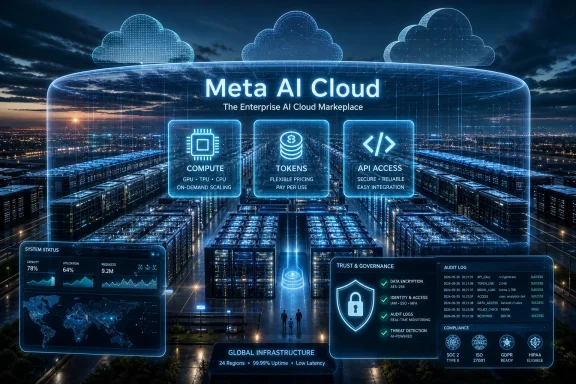
Meta Platforms is reportedly developing a cloud infrastructure business called Meta Compute in July 2026 to sell access to AI computing power and hosted models from its data centers, putting the Facebook parent into direct competition with AWS, Microsoft Azure, Google Cloud, and specialist AI cloud providers. The move is not just a new product idea; it is a defense of one of the largest capital-spending stories in technology. Meta is trying to turn the most uncomfortable question about the AI boom — what happens if you build too much compute? — into a sales pitch. If the plan works, the AI race stops looking like a contest of chatbots and starts looking like a fight over who owns the factories.
The immediate market reaction tells the story. Meta’s shares jumped after the report, while AI infrastructure specialists such as CoreWeave, Nebius, and IREN sold off as investors contemplated a richer, more powerful competitor entering the rental-compute trade. That divergence is the market doing what markets do best: not deciding whether a product will succeed, but repricing the story around it.
For the past two years, Meta’s AI spending has carried a familiar unease. Mark Zuckerberg has insisted that infrastructure is the price of remaining relevant in the next computing platform, but investors have watched the checks grow faster than the visible revenue line. Meta AI, Llama, recommendation systems, advertising tools, smart glasses, and future “superintelligence” work all sit inside the justification, but they do not yet resemble AWS-style standalone economics.
A cloud business gives Meta a cleaner narrative. If the company overbuilds, it can rent the surplus. If demand for AI training and inference keeps outrunning supply, those racks of GPUs become an appreciating strategic asset rather than a depreciating embarrassment. The pitch is elegant because it does not require Meta to admit failure; it reframes optionality as discipline.
That is why the phrase excess compute is doing so much work. In ordinary enterprise IT, excess capacity sounds like waste. In the current AI market, excess capacity can sound like inventory. Meta is betting that Wall Street will accept the second interpretation long enough for the company to build something real around it.
But AWS was not simply “spare servers for rent.” It became AWS because Amazon built primitives that developers loved, wrapped them in APIs, priced them with brutal clarity, and spent years earning trust from startups and enterprises that had no interest in Amazon’s retail business. It solved a broad computing problem at the moment the market was ready to stop buying physical servers.
Meta’s opportunity is narrower and more volatile. AI compute is scarce, expensive, and urgent, but it is also a specialized market shaped by chip availability, power constraints, model architectures, and fast-changing customer economics. Renting clusters for training frontier models is not the same as offering the global menu of databases, networking, storage, identity, security, compliance, observability, and managed services that define a true hyperscale cloud.
That does not mean Meta cannot build a meaningful business. It means the cleanest version of the AWS analogy is probably wrong. The more plausible version is that Meta first becomes a compute wholesaler and model-hosting platform, then decides whether it wants to endure the less glamorous work of becoming a full enterprise cloud vendor.
That is why SpaceX’s recent compute-leasing deals matter to this story. The reported comparison is not accidental. If SpaceX and xAI can turn a giant AI data center into a cash-generating asset by selling capacity to Anthropic, Google, Reflection AI, or other model companies, Meta can argue that its own infrastructure has similar financial optionality.
This is the new circular economy of AI. Companies raise money to buy chips, lease capacity to other AI companies, invest in model startups, sell them cloud credits, and then book the resulting demand as evidence that more infrastructure is needed. It can be a flywheel, but it can also be a mirror maze.
The risk is that compute demand is being treated as infinite because today’s buyers are desperate. That may hold for some time, especially for training and large-scale inference. But GPUs are not timeless assets. They depreciate quickly, the software stack changes, and a cluster that looks scarce in 2026 can look poorly configured a few years later if chip generations, power efficiency, or model techniques move faster than expected.
Meta’s reported plan is therefore both rational and revealing. It is rational because any company building at Meta’s scale should explore resale channels. It is revealing because the best way to reassure investors about AI spending may now be to say: even if our own AI products do not monetize quickly enough, someone else will pay to use the machines.
Azure’s advantage with enterprises comes from decades of Microsoft relationships, Windows Server lineage, Active Directory and Entra ID integration, Microsoft 365 adjacency, compliance programs, hybrid-cloud tooling, procurement familiarity, and a sales machine that knows how to survive a bank’s vendor review. AWS has the deepest cloud catalog and the gravitational pull of modern cloud architecture. Google Cloud has AI credibility, Kubernetes heritage, and a growing enterprise business despite being the smallest of the three hyperscalers.
Meta has none of that in the enterprise cloud market. It has world-class infrastructure engineers, deep AI research talent, a massive consumer platform, and experience operating at planetary scale. Those are formidable assets, but they are not the same as being a trusted vendor for regulated workloads, internal business systems, and production enterprise infrastructure.
That distinction matters for WindowsForum readers because “cloud” is too often treated as a single market. It is not. A sysadmin deciding where to run domain-joined workloads, virtual desktops, SQL Server, identity-dependent applications, backup systems, or regulated business data is making a very different decision from an AI startup renting a GPU cluster for a training run.
Meta’s first real competitive pressure is likely to land on the neoclouds and AI-specialist providers, not on Azure’s entire enterprise estate. If Meta prices aggressively, it can hurt providers whose pitch depends on scarce GPU access and flexible capacity. But it will take more than cheap accelerators to dislodge cloud platforms embedded in corporate IT.
AI infrastructure pricing is unusually exposed to market psychology. When capacity is scarce, providers can command premiums. When capacity loosens, customers quickly become more flexible, especially for training jobs that can be scheduled, moved, or burst across providers. A buyer that would never migrate its identity stack away from Microsoft might happily run a model-training workload wherever the economics are best.
That is where Meta could become disruptive. The company does not need to win the whole cloud market. It only needs to create credible alternative supply in a high-growth segment. Even the perception of new capacity can pressure valuations for neoclouds and force hyperscalers to sharpen pricing for AI customers.
There is also an ecosystem play. If Meta offers hosted access to its models alongside raw compute, it can create a channel for Llama and other Meta-developed models that does not depend entirely on open-source goodwill or third-party clouds. The company has long benefited from making Llama widely available, but distribution through its own infrastructure would give it more control over monetization, performance, and developer relationships.
That said, model hosting is not magic. Developers already have options through AWS Bedrock, Azure AI Foundry, Google Vertex AI, direct API providers, and specialized inference platforms. Meta will need to offer more than the Meta logo on a GPU bill. It will need performance, uptime, predictable pricing, model quality, tooling, and a reason for customers to believe the service will still matter in three years.
Large customers buy cloud services through a matrix of risk. They ask who has access to data, where workloads run, what compliance regimes apply, how incidents are handled, what support looks like at 3 a.m., and whether the vendor’s strategic incentives align with the customer’s business. Meta’s history as a consumer advertising company complicates that conversation.
This is not merely reputational baggage. It affects procurement. A healthcare organization, bank, government contractor, or large manufacturer may see Meta’s infrastructure capability and still hesitate to place sensitive workloads on a platform owned by a company whose core business has long been behavioral advertising and social data. Even if the cloud business is technically isolated, perception becomes part of the product.
Microsoft, Amazon, and Google have their own trust issues, but they have spent years building the contractual, compliance, and support machinery that enterprise buyers expect. Meta would have to assemble that muscle quickly or begin with customers less burdened by traditional IT governance: AI labs, startups, research groups, and companies buying raw capacity rather than a cloud relationship.
That path is plausible. It is also limiting. The easiest customers to win may be the most price-sensitive, the least loyal, and the most likely to move when another provider offers better chips or lower rates.
If Meta’s own models become must-use systems, then Meta Compute can be the preferred place to run them. If Llama remains influential but not directly lucrative enough, hosted inference and enterprise access can become a monetization layer. If Meta falls behind in model quality, raw compute rental still offers a fallback.
That strategic layering is exactly what investors like. It makes the infrastructure spend look less binary. Meta does not have to win every part of the AI stack for the data centers to matter. It can use them internally, sell access externally, host its own models, support open-weight ecosystems, and arbitrage demand during periods of scarcity.
But the flexibility cuts both ways. A company that says it might sell surplus capacity is also implicitly admitting that forecasting AI infrastructure needs is hard. If Meta truly needs every GPU for its own products, there may be little to rent. If it has enough to rent at scale, skeptics will ask whether the original buildout exceeded near-term internal demand.
That tension is not fatal, but it is the heart of the story. Meta wants investors to believe it is both compute-constrained and compute-rich: constrained enough to justify massive investment, rich enough to monetize the overflow.
If Meta adds meaningful AI capacity to the market, it could lower the price of training and inference services over time. That matters for enterprises experimenting with copilots, internal assistants, document-processing systems, code tools, security automation, and custom model deployments. Even organizations that never buy from Meta may benefit if Microsoft, Amazon, Google, and the neoclouds face more pricing pressure.
The move could also accelerate the separation between ordinary cloud workloads and AI workloads. A company might keep identity, productivity, databases, and Windows-heavy systems in Azure while sending batch AI jobs to wherever GPUs are cheapest. That already happens in high-performance computing, but AI may normalize it for a broader class of businesses.
For sysadmins, that means more multi-cloud complexity. Data movement, access control, logging, compliance, cost tracking, and incident response become harder when AI jobs run outside the main enterprise cloud. The cheap GPU quote is only one line in the spreadsheet; the operational burden lives elsewhere.
Security teams should be especially cautious. Sending proprietary data to train or fine-tune models on a new platform raises questions about retention, isolation, auditability, and model leakage. Meta may eventually offer strong answers, but enterprise buyers should demand them before treating low-cost capacity as a shortcut.
AWS, Azure, and Google understand this. Their goal is not merely to sell accelerators; it is to sell managed model platforms, data pipelines, security layers, developer tools, observability, databases, and enterprise integration around those accelerators. The more customers build on those surrounding services, the less GPU price alone determines the relationship.
Meta’s challenge is deciding which game it wants to play. If it sells raw compute, it can move quickly and monetize surplus capacity. But raw compute is vulnerable to price wars, hardware cycles, and customer churn. If it builds a richer platform, it enters a slower, more expensive, more support-heavy business where incumbents have a massive head start.
There is a third route: Meta could become an AI infrastructure specialist with a model ecosystem attached, not a general-purpose cloud. That would make more sense than trying to recreate Azure from scratch. It would also align with Meta’s strengths in AI systems, open-weight models, large-scale inference, and performance optimization.
The danger is strategic drift. Once a company starts selling compute, customers ask for storage. Then networking. Then identity. Then compliance dashboards. Then support plans. The road from “we have extra GPUs” to “we are now a cloud provider” is paved with unglamorous enterprise requirements.
If the AI boom is durable, then Meta is smart to own capacity and sell what it does not use. If the boom cools, then the company may find itself holding expensive infrastructure in a market where everyone else also built for peak demand. The difference between strategic foresight and overcapacity may only be visible in hindsight.
Rapid chip depreciation is the cruel mechanic in this story. A data center is not worthless after a new GPU generation arrives, but the premium attached to cutting-edge capacity can fade quickly. Customers training frontier models want the newest hardware. Customers running inference care intensely about cost and efficiency. Hardware that cannot meet either standard at attractive margins becomes a problem.
Power is another constraint. AI data centers are not just collections of chips; they are enormous electrical and cooling commitments. Communities, utilities, regulators, and grid operators are increasingly part of the AI story. Meta can rent compute, but it cannot rent away the politics of building and powering the underlying infrastructure.
That is why the market’s enthusiasm should be read carefully. Investors did not necessarily conclude that Meta has discovered a guaranteed AWS-scale business. They concluded that Meta has a more credible answer to the return-on-capital question than it had the day before.
Neoclouds thrive when capacity is scarce and buyers need alternatives quickly. A platform company with Meta’s balance sheet can alter that perception even before it ships a mature product. If investors believe more hyperscale-owned capacity will be resold into the market, the scarcity premium narrows.
That does not mean the neocloud model is doomed. Many customers want dedicated clusters, flexible contracting, specific hardware configurations, or support from providers focused entirely on AI infrastructure. Some may prefer a specialist over a giant platform company. Others may be locked into existing contracts or value speed over brand.
But the competitive environment becomes harsher. A neocloud must prove it is not just a temporary arbitrage between Nvidia supply and hyperscaler backlog. It must show operational excellence, customer stickiness, financing discipline, and a path through hardware refresh cycles. Meta’s reported plan raises the bar.
The irony is that Meta itself has reportedly relied on outside capacity providers as part of its AI expansion. That makes the ecosystem more intertwined than the stock-market reaction suggests. Today’s supplier can be tomorrow’s competitor, and tomorrow’s competitor can still be a customer when internal demand spikes.
The speed of execution will determine whether this becomes a genuine business or a financial narrative. If Meta can quickly offer credible access to high-demand accelerators, with transparent pricing and usable developer tooling, it can become relevant to AI startups and model teams. If the effort gets trapped inside organizational complexity, it risks becoming another strategic option that sounds better on earnings calls than in procurement meetings.
Leadership structure will matter. A cloud business needs infrastructure expertise, AI product judgment, enterprise sales leadership, and political authority inside the company. It must also avoid being treated as a dumping ground for whatever capacity internal teams do not want. Customers will not build serious workloads on a platform that feels like a side hustle.
Meta also has to decide how much it wants to expose its infrastructure economics. Selling compute invites comparisons. Customers will benchmark performance, reliability, networking, price, and support against AWS, Azure, Google Cloud, CoreWeave, Lambda, Nebius, and others. A private infrastructure advantage becomes a public scorecard.
That transparency can be powerful if Meta is excellent. It can be punishing if the company discovers that operating infrastructure for itself is easier than operating infrastructure as a product.
That thesis explains why so much capital is flowing into data centers, chips, power contracts, and networking. It also explains why companies that once looked like software businesses increasingly talk like industrial conglomerates. The AI economy is physical in a way the social-web economy was not.
Meta is unusually well suited to this world in some respects. It has spent years running massive systems, optimizing machine-learning workloads, and building custom infrastructure for ranking, recommendations, video, ads, and social graphs. It understands scale not as a marketing slogan but as an operational condition.
Yet Meta’s consumer DNA remains a complication. Cloud customers are not users to be acquired and monetized indirectly. They are buyers with contracts, lawyers, auditors, architects, and exit plans. They do not want surprises, and they do not reward move-fast culture when their production systems are on the line.
That is the gap between infrastructure excellence and cloud-market success. Meta may own the factory. Now it has to learn whether customers want to buy from that factory, and under what terms.
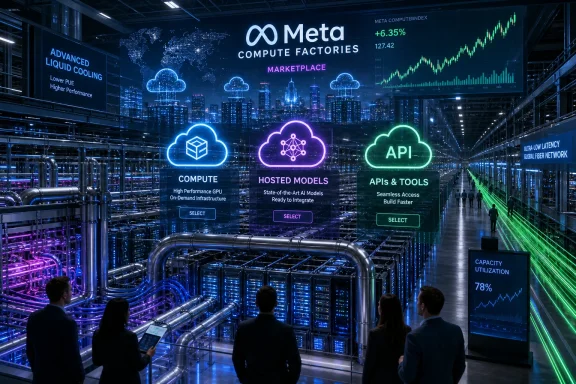 Meta Wants Wall Street to See a Cloud Business, Not an AI Bonfire
The immediate market reaction tells the story. Meta’s shares jumped after the report, while AI infrastructure specialists such as CoreWeave, Nebius, and IREN sold off as investors contemplated a richer, more powerful competitor entering the rental-compute trade. That divergence is the market doing what markets do best: not deciding whether a product will succeed, but repricing the story around it.For the past two years, Meta’s AI spending has carried a familiar unease. Mark Zuckerberg has insisted that infrastructure is the price of remaining relevant in the next computing platform, but investors have watched the checks grow faster than the visible revenue line. Meta AI, Llama, recommendation systems, advertising tools, smart glasses, and future “superintelligence” work all sit inside the justification, but they do not yet resemble AWS-style standalone economics.
A cloud business gives Meta a cleaner narrative. If the company overbuilds, it can rent the surplus. If demand for AI training and inference keeps outrunning supply, those racks of GPUs become an appreciating strategic asset rather than a depreciating embarrassment. The pitch is elegant because it does not require Meta to admit failure; it reframes optionality as discipline.
That is why the phrase excess compute is doing so much work. In ordinary enterprise IT, excess capacity sounds like waste. In the current AI market, excess capacity can sound like inventory. Meta is betting that Wall Street will accept the second interpretation long enough for the company to build something real around it.
The AWS Origin Story Is Tempting, but It Is Also a Trap
The obvious comparison is Amazon Web Services, which grew out of Amazon’s internal infrastructure needs and became one of the most consequential businesses in modern technology. Every large platform company wants its own version of that story: a messy internal capability hardened into an external service, then transformed into a profit engine. Meta’s reported cloud push borrows that mythology almost too neatly.But AWS was not simply “spare servers for rent.” It became AWS because Amazon built primitives that developers loved, wrapped them in APIs, priced them with brutal clarity, and spent years earning trust from startups and enterprises that had no interest in Amazon’s retail business. It solved a broad computing problem at the moment the market was ready to stop buying physical servers.
Meta’s opportunity is narrower and more volatile. AI compute is scarce, expensive, and urgent, but it is also a specialized market shaped by chip availability, power constraints, model architectures, and fast-changing customer economics. Renting clusters for training frontier models is not the same as offering the global menu of databases, networking, storage, identity, security, compliance, observability, and managed services that define a true hyperscale cloud.
That does not mean Meta cannot build a meaningful business. It means the cleanest version of the AWS analogy is probably wrong. The more plausible version is that Meta first becomes a compute wholesaler and model-hosting platform, then decides whether it wants to endure the less glamorous work of becoming a full enterprise cloud vendor.
AI Compute Has Become the New Oil, but Oil Still Needs Refineries
The strongest case for Meta Compute is that the AI economy is increasingly limited by physical infrastructure. Frontier labs, open-model startups, enterprise AI teams, and governments all want access to high-end accelerators. The constraint is no longer simply who has the best research paper or the cleverest product manager; it is who can secure chips, power, land, cooling, networking, and long-term data center capacity.That is why SpaceX’s recent compute-leasing deals matter to this story. The reported comparison is not accidental. If SpaceX and xAI can turn a giant AI data center into a cash-generating asset by selling capacity to Anthropic, Google, Reflection AI, or other model companies, Meta can argue that its own infrastructure has similar financial optionality.
This is the new circular economy of AI. Companies raise money to buy chips, lease capacity to other AI companies, invest in model startups, sell them cloud credits, and then book the resulting demand as evidence that more infrastructure is needed. It can be a flywheel, but it can also be a mirror maze.
The risk is that compute demand is being treated as infinite because today’s buyers are desperate. That may hold for some time, especially for training and large-scale inference. But GPUs are not timeless assets. They depreciate quickly, the software stack changes, and a cluster that looks scarce in 2026 can look poorly configured a few years later if chip generations, power efficiency, or model techniques move faster than expected.
Meta’s reported plan is therefore both rational and revealing. It is rational because any company building at Meta’s scale should explore resale channels. It is revealing because the best way to reassure investors about AI spending may now be to say: even if our own AI products do not monetize quickly enough, someone else will pay to use the machines.
The Real Target Is Not Azure’s Whole Kingdom
The dramatic version of this story says Meta is taking on AWS, Azure, and Google Cloud. That is true in the broadest sense, but it overstates the near-term threat. Microsoft, Amazon, and Google are not merely landlords for GPUs. They are operating systems for corporate computing.Azure’s advantage with enterprises comes from decades of Microsoft relationships, Windows Server lineage, Active Directory and Entra ID integration, Microsoft 365 adjacency, compliance programs, hybrid-cloud tooling, procurement familiarity, and a sales machine that knows how to survive a bank’s vendor review. AWS has the deepest cloud catalog and the gravitational pull of modern cloud architecture. Google Cloud has AI credibility, Kubernetes heritage, and a growing enterprise business despite being the smallest of the three hyperscalers.
Meta has none of that in the enterprise cloud market. It has world-class infrastructure engineers, deep AI research talent, a massive consumer platform, and experience operating at planetary scale. Those are formidable assets, but they are not the same as being a trusted vendor for regulated workloads, internal business systems, and production enterprise infrastructure.
That distinction matters for WindowsForum readers because “cloud” is too often treated as a single market. It is not. A sysadmin deciding where to run domain-joined workloads, virtual desktops, SQL Server, identity-dependent applications, backup systems, or regulated business data is making a very different decision from an AI startup renting a GPU cluster for a training run.
Meta’s first real competitive pressure is likely to land on the neoclouds and AI-specialist providers, not on Azure’s entire enterprise estate. If Meta prices aggressively, it can hurt providers whose pitch depends on scarce GPU access and flexible capacity. But it will take more than cheap accelerators to dislodge cloud platforms embedded in corporate IT.
Cheap GPUs Could Still Hurt the Hyperscalers Where Margins Are Juiciest
The fact that Meta may not become a full Azure rival overnight does not make the move harmless to the incumbents. Hyperscalers are counting on AI workloads to sustain growth and justify enormous infrastructure expansion. If Meta enters with surplus capacity and a willingness to price low, it can compress margins in exactly the area investors currently prize.AI infrastructure pricing is unusually exposed to market psychology. When capacity is scarce, providers can command premiums. When capacity loosens, customers quickly become more flexible, especially for training jobs that can be scheduled, moved, or burst across providers. A buyer that would never migrate its identity stack away from Microsoft might happily run a model-training workload wherever the economics are best.
That is where Meta could become disruptive. The company does not need to win the whole cloud market. It only needs to create credible alternative supply in a high-growth segment. Even the perception of new capacity can pressure valuations for neoclouds and force hyperscalers to sharpen pricing for AI customers.
There is also an ecosystem play. If Meta offers hosted access to its models alongside raw compute, it can create a channel for Llama and other Meta-developed models that does not depend entirely on open-source goodwill or third-party clouds. The company has long benefited from making Llama widely available, but distribution through its own infrastructure would give it more control over monetization, performance, and developer relationships.
That said, model hosting is not magic. Developers already have options through AWS Bedrock, Azure AI Foundry, Google Vertex AI, direct API providers, and specialized inference platforms. Meta will need to offer more than the Meta logo on a GPU bill. It will need performance, uptime, predictable pricing, model quality, tooling, and a reason for customers to believe the service will still matter in three years.
The Enterprise Trust Problem Is Bigger Than the Engineering Problem
Meta can build data centers. Meta can tune infrastructure. Meta can operate enormous distributed systems. None of that automatically answers the enterprise trust problem.Large customers buy cloud services through a matrix of risk. They ask who has access to data, where workloads run, what compliance regimes apply, how incidents are handled, what support looks like at 3 a.m., and whether the vendor’s strategic incentives align with the customer’s business. Meta’s history as a consumer advertising company complicates that conversation.
This is not merely reputational baggage. It affects procurement. A healthcare organization, bank, government contractor, or large manufacturer may see Meta’s infrastructure capability and still hesitate to place sensitive workloads on a platform owned by a company whose core business has long been behavioral advertising and social data. Even if the cloud business is technically isolated, perception becomes part of the product.
Microsoft, Amazon, and Google have their own trust issues, but they have spent years building the contractual, compliance, and support machinery that enterprise buyers expect. Meta would have to assemble that muscle quickly or begin with customers less burdened by traditional IT governance: AI labs, startups, research groups, and companies buying raw capacity rather than a cloud relationship.
That path is plausible. It is also limiting. The easiest customers to win may be the most price-sensitive, the least loyal, and the most likely to move when another provider offers better chips or lower rates.
Meta’s AI Reset Makes Compute Monetization Look Less Optional
The timing of the reported cloud plan matters because Meta’s AI strategy has been in reset mode. The company has reorganized around more ambitious “superintelligence” efforts, brought in high-profile leadership, and faced scrutiny over whether its recent models have matched the momentum of rivals. A compute business would not solve those problems, but it would give Meta another way to extract value from the same infrastructure.If Meta’s own models become must-use systems, then Meta Compute can be the preferred place to run them. If Llama remains influential but not directly lucrative enough, hosted inference and enterprise access can become a monetization layer. If Meta falls behind in model quality, raw compute rental still offers a fallback.
That strategic layering is exactly what investors like. It makes the infrastructure spend look less binary. Meta does not have to win every part of the AI stack for the data centers to matter. It can use them internally, sell access externally, host its own models, support open-weight ecosystems, and arbitrage demand during periods of scarcity.
But the flexibility cuts both ways. A company that says it might sell surplus capacity is also implicitly admitting that forecasting AI infrastructure needs is hard. If Meta truly needs every GPU for its own products, there may be little to rent. If it has enough to rent at scale, skeptics will ask whether the original buildout exceeded near-term internal demand.
That tension is not fatal, but it is the heart of the story. Meta wants investors to believe it is both compute-constrained and compute-rich: constrained enough to justify massive investment, rich enough to monetize the overflow.
Windows Shops Should Watch the Price Signal, Not the Branding
For most Windows administrators and enterprise IT teams, Meta Compute will not be an immediate replacement for Azure. Nobody should expect a sudden wave of Group Policy migrations to a Facebook-branded cloud. The practical consequences are more indirect and potentially more interesting.If Meta adds meaningful AI capacity to the market, it could lower the price of training and inference services over time. That matters for enterprises experimenting with copilots, internal assistants, document-processing systems, code tools, security automation, and custom model deployments. Even organizations that never buy from Meta may benefit if Microsoft, Amazon, Google, and the neoclouds face more pricing pressure.
The move could also accelerate the separation between ordinary cloud workloads and AI workloads. A company might keep identity, productivity, databases, and Windows-heavy systems in Azure while sending batch AI jobs to wherever GPUs are cheapest. That already happens in high-performance computing, but AI may normalize it for a broader class of businesses.
For sysadmins, that means more multi-cloud complexity. Data movement, access control, logging, compliance, cost tracking, and incident response become harder when AI jobs run outside the main enterprise cloud. The cheap GPU quote is only one line in the spreadsheet; the operational burden lives elsewhere.
Security teams should be especially cautious. Sending proprietary data to train or fine-tune models on a new platform raises questions about retention, isolation, auditability, and model leakage. Meta may eventually offer strong answers, but enterprise buyers should demand them before treating low-cost capacity as a shortcut.
The AI Cloud Is Becoming a Commodities Market With Platform Ambitions
There is a useful way to think about Meta’s reported move: AI compute is becoming a commodity market, while AI platforms are trying not to become commodities. Raw GPU hours are closer to oil, electricity, or freight than traditional software. Customers want availability, performance, and price. Loyalty is thin unless the provider wraps the commodity in tools that create switching costs.AWS, Azure, and Google understand this. Their goal is not merely to sell accelerators; it is to sell managed model platforms, data pipelines, security layers, developer tools, observability, databases, and enterprise integration around those accelerators. The more customers build on those surrounding services, the less GPU price alone determines the relationship.
Meta’s challenge is deciding which game it wants to play. If it sells raw compute, it can move quickly and monetize surplus capacity. But raw compute is vulnerable to price wars, hardware cycles, and customer churn. If it builds a richer platform, it enters a slower, more expensive, more support-heavy business where incumbents have a massive head start.
There is a third route: Meta could become an AI infrastructure specialist with a model ecosystem attached, not a general-purpose cloud. That would make more sense than trying to recreate Azure from scratch. It would also align with Meta’s strengths in AI systems, open-weight models, large-scale inference, and performance optimization.
The danger is strategic drift. Once a company starts selling compute, customers ask for storage. Then networking. Then identity. Then compliance dashboards. Then support plans. The road from “we have extra GPUs” to “we are now a cloud provider” is paved with unglamorous enterprise requirements.
The Bubble Argument Gets Harder to Dismiss
Every AI infrastructure story now lives under the shadow of the bubble question. The numbers are too large, the buildouts too aggressive, and the monetization timelines too uncertain for skepticism to be treated as contrarian theater. Meta’s reported cloud plan is partly a rebuttal to that skepticism, but it also reinforces it.If the AI boom is durable, then Meta is smart to own capacity and sell what it does not use. If the boom cools, then the company may find itself holding expensive infrastructure in a market where everyone else also built for peak demand. The difference between strategic foresight and overcapacity may only be visible in hindsight.
Rapid chip depreciation is the cruel mechanic in this story. A data center is not worthless after a new GPU generation arrives, but the premium attached to cutting-edge capacity can fade quickly. Customers training frontier models want the newest hardware. Customers running inference care intensely about cost and efficiency. Hardware that cannot meet either standard at attractive margins becomes a problem.
Power is another constraint. AI data centers are not just collections of chips; they are enormous electrical and cooling commitments. Communities, utilities, regulators, and grid operators are increasingly part of the AI story. Meta can rent compute, but it cannot rent away the politics of building and powering the underlying infrastructure.
That is why the market’s enthusiasm should be read carefully. Investors did not necessarily conclude that Meta has discovered a guaranteed AWS-scale business. They concluded that Meta has a more credible answer to the return-on-capital question than it had the day before.
The Neoclouds Just Learned How Fragile Their Story Can Be
The sharp selloff in specialist AI cloud providers is perhaps the most telling part of the reaction. CoreWeave and its peers have benefited from a simple and powerful thesis: the hyperscalers cannot satisfy all AI demand, so specialized providers with access to GPUs can command premium economics. Meta’s reported entry threatens that thesis not because it destroys demand, but because it changes the supply story.Neoclouds thrive when capacity is scarce and buyers need alternatives quickly. A platform company with Meta’s balance sheet can alter that perception even before it ships a mature product. If investors believe more hyperscale-owned capacity will be resold into the market, the scarcity premium narrows.
That does not mean the neocloud model is doomed. Many customers want dedicated clusters, flexible contracting, specific hardware configurations, or support from providers focused entirely on AI infrastructure. Some may prefer a specialist over a giant platform company. Others may be locked into existing contracts or value speed over brand.
But the competitive environment becomes harsher. A neocloud must prove it is not just a temporary arbitrage between Nvidia supply and hyperscaler backlog. It must show operational excellence, customer stickiness, financing discipline, and a path through hardware refresh cycles. Meta’s reported plan raises the bar.
The irony is that Meta itself has reportedly relied on outside capacity providers as part of its AI expansion. That makes the ecosystem more intertwined than the stock-market reaction suggests. Today’s supplier can be tomorrow’s competitor, and tomorrow’s competitor can still be a customer when internal demand spikes.
The Calendar Now Matters as Much as the Strategy
The biggest unknown is timing. A reported plan is not a product catalog, and an internal initiative is not a cloud region with service-level agreements. Meta can explore, prototype, and recruit without immediately changing the market for enterprise buyers.The speed of execution will determine whether this becomes a genuine business or a financial narrative. If Meta can quickly offer credible access to high-demand accelerators, with transparent pricing and usable developer tooling, it can become relevant to AI startups and model teams. If the effort gets trapped inside organizational complexity, it risks becoming another strategic option that sounds better on earnings calls than in procurement meetings.
Leadership structure will matter. A cloud business needs infrastructure expertise, AI product judgment, enterprise sales leadership, and political authority inside the company. It must also avoid being treated as a dumping ground for whatever capacity internal teams do not want. Customers will not build serious workloads on a platform that feels like a side hustle.
Meta also has to decide how much it wants to expose its infrastructure economics. Selling compute invites comparisons. Customers will benchmark performance, reliability, networking, price, and support against AWS, Azure, Google Cloud, CoreWeave, Lambda, Nebius, and others. A private infrastructure advantage becomes a public scorecard.
That transparency can be powerful if Meta is excellent. It can be punishing if the company discovers that operating infrastructure for itself is easier than operating infrastructure as a product.
The Real Bet Is That Owning the Factory Beats Owning the App
The most important idea behind Meta Compute is not that Meta might rent GPUs. It is that the AI industry may reward infrastructure owners more reliably than application makers. If every company is building AI features, and many model capabilities become widely available, the scarce layer may be compute rather than interface.That thesis explains why so much capital is flowing into data centers, chips, power contracts, and networking. It also explains why companies that once looked like software businesses increasingly talk like industrial conglomerates. The AI economy is physical in a way the social-web economy was not.
Meta is unusually well suited to this world in some respects. It has spent years running massive systems, optimizing machine-learning workloads, and building custom infrastructure for ranking, recommendations, video, ads, and social graphs. It understands scale not as a marketing slogan but as an operational condition.
Yet Meta’s consumer DNA remains a complication. Cloud customers are not users to be acquired and monetized indirectly. They are buyers with contracts, lawyers, auditors, architects, and exit plans. They do not want surprises, and they do not reward move-fast culture when their production systems are on the line.
That is the gap between infrastructure excellence and cloud-market success. Meta may own the factory. Now it has to learn whether customers want to buy from that factory, and under what terms.
The Signal Inside Meta’s Compute Gambit
Meta’s reported cloud plan should be read less as a sudden invasion of enterprise cloud and more as a sign that AI infrastructure has become too expensive to leave as a single-purpose bet. The practical lessons are already visible.- Meta is reportedly exploring a business that would sell AI compute and hosted model access, but a reported plan is not yet the same thing as a mature cloud platform.
- The near-term competitive pressure is likely to hit AI-specialist cloud providers before it threatens the core enterprise franchises of AWS, Azure, and Google Cloud.
- Lower AI compute prices would help enterprises experimenting with model training and inference, but they would also increase multi-cloud governance, security, and cost-management complexity.
- Meta’s biggest obstacle is not whether it can run data centers at scale, but whether it can earn enterprise trust and provide the support, compliance, and reliability customers expect.
- The move gives investors a cleaner story for Meta’s AI capital spending, but it also underscores how uncertain demand forecasting remains in the AI infrastructure boom.
- Windows and Microsoft-heavy shops should watch the pricing and procurement ripple effects rather than assume Meta Compute will become an Azure substitute.
References
- Primary source: finance.biggo.com
Published: 2026-07-01T18:30:10.063329
Meta Plans to Sell Surplus AI Computing Power, Taking on AWS and Azure — BigGo Finance
Meta Platforms shares surged over 8% after Bloomberg reported the company is planning to sell excess AI computing capacity, directly challenging AWS,…finance.biggo.com - Independent coverage: TechCrunch
Published: 2026-07-01T14:30:10.062853
Meta, like SpaceX, looks to turn excess AI compute into cash | TechCrunch
Meta is developing plans for a cloud infrastructure business, selling access to AI compute power and models. The move would pit it against the big cloud providers like Amazon Web Services, Google Cloud, and Microsoft Azure.techcrunch.com - Related coverage: axios.com
Meta stock soars as Mark Zuckerberg explores cloud business
Meta shares soared Wednesday on a report that the company is wading into the business of selling cloud computing services and access to AI models.www.axios.com
- Related coverage: tomsguide.com
Even Google doesn't have enough AI power — and that should worry all of us | Tom's Guide
Google reportedly couldn't meet Meta's demand for Gemini AI compute. It's another reminder that local AI may become one of the biggest trends in personal computing.www.tomsguide.com - Related coverage: bloomberg.com
- Related coverage: investing.com
Meta building cloud business to sell excess AI capacity, Bloomberg News reports By Reuters
Meta building cloud business to sell excess AI capacity, Bloomberg News reportswww.investing.com
- Related coverage: gigazine.net
MetaがAWS・Azure・Google Cloudに対抗するためAIコンピューティングとAIモデルへのアクセスを販売するクラウドインフラストラクチャ事業を計画中との報道 - GIGAZINE
AIコンピューティング能力とAIモデルへのアクセスを販売するクラウドインフラストラクチャ事業、いわゆる「ネオクラウド」事業にMetaが参入する予定だと、Bloombergが事情に詳しい関係者からの話として報じました。gigazine.net - Related coverage: vff.ai
Meta Plans Cloud Business to Monetize AI Compute | VFF - The signal in the noise
Meta Platforms is developing a cloud infrastructure business to monetize excess AI compute capacity, according to Bloomberg reporting. The move puts Meta in dirvff.ai - Related coverage: news.bloomberglaw.com
Meta Is Planning a Cloud Business to Sell AI Computing Power
Meta Platforms Inc. is developing plans for a cloud infrastructure business that will sell access to AI computing power and models, setting up a new vector of competition with industry leaders like Amazon Web Services, Microsoft Azure and Google Cloud.news.bloomberglaw.com
- Related coverage: oquilia.com
Meta plots a cloud business to rent out its vast AI compute | Oquilia
With $182.9bn sunk into data centres, Meta wants to sell spare AI compute to enterprises. The question is whether it can beat AWS, Azure and Google at their own game.www.oquilia.com - Related coverage: drawpie.com
Why Meta Is Selling Its 'Excess' AI Compute — and Why the Stock Jumped · Drawpie
Meta's stock jumped more than 6% after a report it's building a cloud business to sell its 'excess' AI computing power. Here's why Meta has spare compute to sell, why investors cheered, and why some analysts are skeptical. drawpie.com
- Related coverage: livemint.com
Meta Platforms surges 12% on report of AI cloud service plans to rival Amazon, Microsoft | Stock Market News
Meta Platforms' shares rose nearly 12% after reports of launching a cloud computing business aimed at selling AI services. The initiative, part of Meta Compute, could position the company against Amazon and Microsoft in the AI infrastructure market.www.livemint.com - Related coverage: insight.tmcnet.com
Meta Advances Plan to Rent AI Compute Capacity to External Customers | TMC Insight
Meta Advances Plan to Rent AI Compute Capacity to External Customers Key Takeaways: • Meta is organizing a cloud business to commercialize excess AI compute from its expanding data centers • The effort positions Meta against AWS, Microsoft Azure, and Google Cloud in a market generating roughly 300 binsight.tmcnet.com - Related coverage: edgen.tech
- Related coverage: techradar.com
Meta cloud computing business ‘definitely on the table’, Mark Zuckerberg says – excess data center capacity could be used to enter the market | TechRadar
Zuckerberg wouldn't rule out a cloud businesswww.techradar.com - Related coverage: tomshardware.com
Zuckerberg's Meta will beam sunlight from space to power AI data centers, solar-collecting satellites will orbit 22,000 miles above Earth — firm reserves 1 Gigawatt of orbital solar energy and 100 Gigawatt-hours of long-duration storage | Tom's
Sunlight beamed from space could help solve AI’s exploding electricity problem.www.tomshardware.com - Related coverage: androidcentral.com
Meta's Q1 2026 earnings are in, and it looks like Zuckerberg's blank check for AI spending is raising some eyebrows | Android Central
Meta's AI efforts are paying off with record-high growth, but the company is spending more than ever on infrastructure costs.www.androidcentral.com - Related coverage: elpais.com
Meta sigue los pasos de Alphabet: planea una macroampliación de capital para financiar la inversión en IA | Economía | EL PAÍS
Las acciones de la matriz de Facebook sufren un fuerte castigoelpais.com