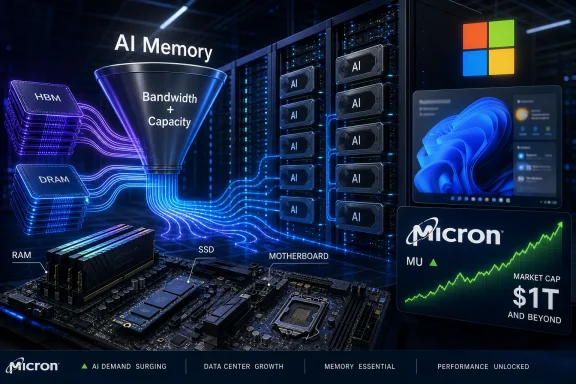
Micron reported fiscal third-quarter 2026 revenue of $41.46 billion and GAAP net income of $28.24 billion for the quarter ended May 28, with record gross margin and multiyear customer agreements driven by the AI memory shortage. That is the plain answer behind the viral question about whether anyone should “believe in the light.” The more important answer is less mystical: AI has not abolished the memory cycle, but it has temporarily given memory makers the pricing power of infrastructure monopolies. For Windows users, PC buyers, OEMs, cloud tenants, and enterprise IT departments, that means the AI boom is no longer something happening only inside Nvidia’s datacenter halo.
For most of its life, Micron has been a brutally cyclical company in a brutally cyclical industry. DRAM and NAND are essential, technically sophisticated, and strategically important, but they have often behaved like commodities: when prices rise, producers expand; when new capacity arrives, prices collapse; when margins vanish, investment freezes; and then the shortage starts again.
That cycle is why memory companies have rarely been valued like platform companies. Microsoft sells software and cloud services with recurring revenue. Nvidia sells scarce accelerators into a market that cannot get enough of them. Memory vendors, by contrast, have historically sold into a market where customers love the product but hate the lack of differentiation.
AI has changed the terms of that bargain. High-bandwidth memory, or HBM, is not just a slightly faster part sitting beside a GPU. It is now a gating factor for AI accelerator performance, packaging capacity, system design, and deployment schedules. If GPUs are the engines of the AI buildout, memory has become the fuel system; without it, the engine idles.
That is why Micron’s numbers look so alien to anyone who remembers the last downturn. A company that once lived with the indignities of commodity pricing has posted margins that resemble a software platform more than a component supplier. The striking part is not merely that Micron earned a huge quarterly profit. It is that the market now appears willing, at least for the moment, to treat memory as a strategic choke point rather than an interchangeable input.
Micron’s non-GAAP gross margin of 84.9 percent is the sort of number investors usually associate with digital distribution, cloud software, or dominant ad platforms. It is not the number one expects from a manufacturer that buys wafers, operates fabs, manages yields, pays for packaging, and ships physical products into a historically volatile market.
That distinction matters because gross margin is where pricing power shows up before the accounting arguments begin. A company can flatter net income through timing, tax treatment, or one-off effects, but an 85 percent gross margin says something simpler: customers are paying far above production cost because the product is scarce, strategically necessary, and hard to replace.
The comparison with Nvidia is provocative but imperfect. Nvidia still owns more of the visible AI narrative because its accelerators define the architecture choices of hyperscalers, AI labs, and enterprise buyers. Micron does not command the same developer ecosystem or software lock-in. Yet at this moment in the supply chain, memory scarcity is powerful enough to make a component maker look like the owner of a platform.
That is the paradox of the AI boom. The public story is about models, GPUs, and cloud services; the financial story keeps drifting down into the plumbing. Advanced packaging, HBM stacks, power delivery, networking, and storage are no longer background details. They are the places where the AI economy either scales or stalls.
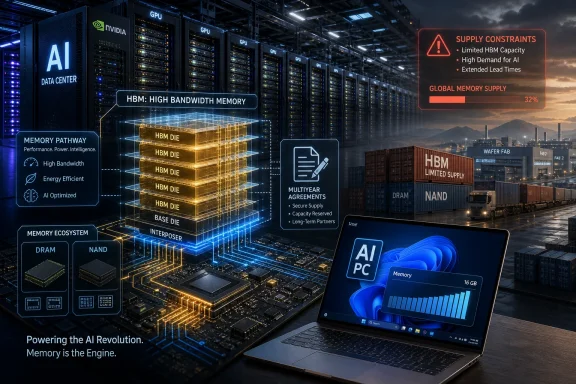
Micron’s long-term strategic customer agreements are the most serious argument that something structural has changed. Multiyear commitments, deposits, and minimum revenue obligations are not the normal language of a spot-driven commodity market. They are the language of customers trying to reserve capacity before someone else takes it.
That matters because the memory industry has usually been punished by uncertainty. If producers build too aggressively, they create the next glut. If they build too cautiously, they miss the next upcycle. Customer prepayments and long-term contracts reduce that uncertainty by turning part of future demand into something closer to an infrastructure reservation.
But contracts do not repeal physics, capital cycles, or competitive behavior. Samsung, SK hynix, and Micron all have strong incentives to expand where margins are extraordinary. Governments also have incentives to subsidize semiconductor capacity. AI customers want guaranteed supply today, but they will want lower prices tomorrow.
The real question, then, is not whether this is still a cycle. It is whether the lows of the next cycle are meaningfully higher than the lows of the last one. If AI keeps absorbing premium memory capacity faster than the industry can add it, memory makers may not escape cyclicality, but they may escape the worst version of it.
HBM attacks that problem by stacking DRAM dies vertically and placing them close to the accelerator through advanced packaging. The result is much higher bandwidth than traditional memory, but at the cost of complexity, yield sensitivity, manufacturing difficulty, and packaging constraints. It is not simply “more DRAM.” It is DRAM turned into a tightly integrated performance component.
That is why AI buyers are willing to sign contracts that would have looked strange in the old market. A delayed HBM supply chain can delay accelerator shipments, datacenter clusters, model training schedules, and cloud revenue. In that context, memory is not a line item to be optimized at the end of procurement. It is part of the product roadmap.
This is where the “light” metaphor becomes less ridiculous than it first sounds. The industry has discovered that memory bandwidth is one of the places where AI progress becomes tangible. Faster models, larger context windows, better inference economics, and more capable local AI systems all depend on moving data efficiently.
But there is a darker side to that light. When the richest buyers in technology reserve the best memory capacity, everyone else competes for what remains. That is where the AI boom leaks out of the datacenter and lands in the price of ordinary devices.
That matters at exactly the wrong moment for the PC market. Windows 11 pushed hardware requirements upward. AI PCs add new expectations around memory capacity, local inference, NPUs, and faster storage. Microsoft’s own Copilot+ PC push has made the personal computer feel newly strategic, but that strategy assumes OEMs can deliver capable hardware at tolerable prices.
Memory inflation complicates that assumption. A mainstream Windows laptop with 16GB of RAM and a modest SSD was already under pressure from thin margins. If memory and storage costs rise sharply, OEMs have only a few choices: raise prices, reduce capacity, cheapen other components, or segment aggressively.
None of those choices is good for users. Raising prices slows refresh cycles. Reducing RAM creates machines that age badly. Cutting display, keyboard, battery, or thermal quality makes the PC worse in ways users feel every day. Segmentation turns adequate configurations into expensive upsells.
This is why memory pricing is not an abstract semiconductor story for WindowsForum readers. It shapes whether the next $699 laptop is a genuinely capable Windows machine or another compromise box with soldered RAM, a small SSD, and no realistic upgrade path.
If memory and NAND costs consume a larger share of the device budget, vendors must either lift prices or retreat from the generous configurations they used as marketing weapons. The era of casually stuffing large RAM and storage packages into midrange devices becomes harder to sustain.
The same dynamic can hit Windows PCs, especially in retail. For years, buyers were told to avoid 8GB machines if they wanted longevity. That advice remains sound, but the economics behind it are getting uglier. If 16GB becomes more expensive for OEMs, the industry may quietly normalize configurations that technically run Windows but do not feel good for long.
Enterprise buyers face a different version of the same problem. A fleet refresh that assumed a certain memory and SSD baseline may suddenly cost more, or procurement teams may be tempted to accept lower specifications to preserve budgets. That is a false economy in a world where browsers, endpoint agents, collaboration apps, virtualization, and local AI features keep demanding more headroom.
The lesson from smartphones is that component inflation does not distribute evenly. Premium products can hide it inside brand margins and higher ASPs. Midrange devices cannot. That is where the squeeze becomes visible first.
If cloud providers and AI labs pay aggressively for memory capacity, the entire electronics stack reprices around that demand. Apple, Android vendors, Windows OEMs, console makers, automotive suppliers, and networking vendors all find themselves downstream from the same constraint. The buyer with the highest willingness to pay sets the tone.
That is especially uncomfortable for companies that sell polished consumer experiences. Apple, for example, has historically used supply-chain discipline as a competitive weapon. If even the strongest procurement machines in consumer electronics face pressure from memory pricing, smaller OEMs have far less room to maneuver.
Windows OEMs are particularly exposed because the PC market is fragmented. Lenovo, HP, Dell, Asus, Acer, Samsung, Microsoft, and dozens of smaller vendors compete across thinly sliced price bands. When component prices rise, the temptation to protect headline prices by cutting configuration quality is intense.
The result may be a more polarized device market. Premium machines get enough RAM, enough storage, and enough thermal design to support AI-era workloads. Budget machines get just enough to satisfy minimum requirements. The middle, as usual, gets squeezed.
The most direct effect will be on AI training and inference, where HBM-heavy accelerators dominate. But the indirect effects may be broader. General-purpose server memory, high-capacity SSDs, and storage systems all sit in the same industry weather pattern. When suppliers can earn extraordinary returns selling into AI, every other customer must justify its place in the allocation queue.
For Windows Server shops, Azure tenants, and hybrid-cloud operators, this changes planning assumptions. Capacity that once felt elastic may become more expensive at the high end. Hardware refreshes may require longer lead times. On-premises deployments that depend on dense memory configurations could face tighter procurement windows.
It also changes the economics of local versus cloud AI. If endpoint memory becomes expensive, pushing workloads to the cloud looks attractive. If cloud AI capacity remains expensive because it is HBM-bound, local inference looks attractive. The industry may oscillate between these models not only because of privacy or latency, but because of whichever memory pool is less painful at the time.
That is not a clean strategic environment. It is a world where architecture decisions increasingly reflect supply-chain constraints.
That is why deposits matter. A nonbinding forecast is optimism. A prepaid commitment is evidence. If customers are willing to put money behind future supply, Micron can invest with more confidence and negotiate from a stronger position.
Still, the agreements cut both ways. Customers may accept higher floors today because shortage risk is terrifying. If supply normalizes and spot prices fall, those same customers will pressure vendors for relief, renegotiation, or preferential treatment elsewhere. The contract is only as strong as the market conditions and relationships around it.
Micron’s challenge is to use this moment without believing its own press clippings. The company must expand enough to satisfy durable AI demand, but not so much that it recreates the oversupply disasters of the past. It must serve HBM demand without abandoning the broader memory market that keeps PCs, phones, cars, and servers moving.
That balancing act is the difference between a transformed business model and a spectacular peak.
This matters because Windows has a long history of suffering at the low end. Machines built to meet a price point rather than a performance target create years of user frustration. They boot slowly, swap too often, age poorly, and become the devices people blame on Windows rather than on bad configuration choices.
The AI PC era could repeat that mistake. If OEMs ship thin-and-light laptops with NPUs but insufficient RAM, users will experience AI features as another resource burden rather than a meaningful improvement. If storage remains cramped, local models, cached data, developer tools, and creative workflows will collide with the same old capacity warnings.
Microsoft has influence here, but not total control. It can set certification requirements, tune Windows, and promote Copilot+ experiences. It cannot repeal memory pricing. If the component market makes adequate configurations more expensive, the Windows ecosystem must decide whether to protect quality or chase entry-level price points.
For enthusiasts and IT pros, the practical advice is blunt: memory headroom is becoming more valuable, not less. Buying barely enough RAM in 2026 is likely to look worse in 2028.
The practical implications are already visible:
Micron’s quarter is a landmark because it shows where the AI boom’s profits are migrating next: away from the visible demo and into the substrate beneath it. The company may not have escaped the cycle forever, and today’s extraordinary margins will invite the usual forces of expansion and competition. But the industry has learned something it will not easily unlearn: in the AI era, memory is no longer the boring part of the computer. It is one of the places where the future either arrives on schedule or gets stuck waiting for bandwidth.
 The Memory Business Has Found Its Nvidia Moment
For most of its life, Micron has been a brutally cyclical company in a brutally cyclical industry. DRAM and NAND are essential, technically sophisticated, and strategically important, but they have often behaved like commodities: when prices rise, producers expand; when new capacity arrives, prices collapse; when margins vanish, investment freezes; and then the shortage starts again.That cycle is why memory companies have rarely been valued like platform companies. Microsoft sells software and cloud services with recurring revenue. Nvidia sells scarce accelerators into a market that cannot get enough of them. Memory vendors, by contrast, have historically sold into a market where customers love the product but hate the lack of differentiation.
AI has changed the terms of that bargain. High-bandwidth memory, or HBM, is not just a slightly faster part sitting beside a GPU. It is now a gating factor for AI accelerator performance, packaging capacity, system design, and deployment schedules. If GPUs are the engines of the AI buildout, memory has become the fuel system; without it, the engine idles.
That is why Micron’s numbers look so alien to anyone who remembers the last downturn. A company that once lived with the indignities of commodity pricing has posted margins that resemble a software platform more than a component supplier. The striking part is not merely that Micron earned a huge quarterly profit. It is that the market now appears willing, at least for the moment, to treat memory as a strategic choke point rather than an interchangeable input.
Gross Margin Is the Signal, Not the Spectacle
The headline number is almost too large to be useful. A quarterly GAAP net income figure of $28.24 billion translates neatly into the “money per second” framing, and that framing is irresistible because it makes the profit boom visceral. But the more revealing figure is the gross margin.Micron’s non-GAAP gross margin of 84.9 percent is the sort of number investors usually associate with digital distribution, cloud software, or dominant ad platforms. It is not the number one expects from a manufacturer that buys wafers, operates fabs, manages yields, pays for packaging, and ships physical products into a historically volatile market.
That distinction matters because gross margin is where pricing power shows up before the accounting arguments begin. A company can flatter net income through timing, tax treatment, or one-off effects, but an 85 percent gross margin says something simpler: customers are paying far above production cost because the product is scarce, strategically necessary, and hard to replace.
The comparison with Nvidia is provocative but imperfect. Nvidia still owns more of the visible AI narrative because its accelerators define the architecture choices of hyperscalers, AI labs, and enterprise buyers. Micron does not command the same developer ecosystem or software lock-in. Yet at this moment in the supply chain, memory scarcity is powerful enough to make a component maker look like the owner of a platform.
That is the paradox of the AI boom. The public story is about models, GPUs, and cloud services; the financial story keeps drifting down into the plumbing. Advanced packaging, HBM stacks, power delivery, networking, and storage are no longer background details. They are the places where the AI economy either scales or stalls.
The Old Pork Cycle Has Not Been Repealed
It is tempting to declare that memory has finally escaped its boom-and-bust history. That would be premature. Cycles do not vanish because one cycle becomes extraordinarily profitable; they vanish only when the structure of supply and demand changes permanently.Micron’s long-term strategic customer agreements are the most serious argument that something structural has changed. Multiyear commitments, deposits, and minimum revenue obligations are not the normal language of a spot-driven commodity market. They are the language of customers trying to reserve capacity before someone else takes it.
That matters because the memory industry has usually been punished by uncertainty. If producers build too aggressively, they create the next glut. If they build too cautiously, they miss the next upcycle. Customer prepayments and long-term contracts reduce that uncertainty by turning part of future demand into something closer to an infrastructure reservation.
But contracts do not repeal physics, capital cycles, or competitive behavior. Samsung, SK hynix, and Micron all have strong incentives to expand where margins are extraordinary. Governments also have incentives to subsidize semiconductor capacity. AI customers want guaranteed supply today, but they will want lower prices tomorrow.
The real question, then, is not whether this is still a cycle. It is whether the lows of the next cycle are meaningfully higher than the lows of the last one. If AI keeps absorbing premium memory capacity faster than the industry can add it, memory makers may not escape cyclicality, but they may escape the worst version of it.
HBM Has Turned Memory Into a System-Level Constraint
The reason HBM commands such pricing power is that it changes the bottleneck. AI accelerators are built to move and process enormous amounts of data. When model parameters and intermediate values cannot move quickly enough between memory and compute units, expensive silicon waits.HBM attacks that problem by stacking DRAM dies vertically and placing them close to the accelerator through advanced packaging. The result is much higher bandwidth than traditional memory, but at the cost of complexity, yield sensitivity, manufacturing difficulty, and packaging constraints. It is not simply “more DRAM.” It is DRAM turned into a tightly integrated performance component.
That is why AI buyers are willing to sign contracts that would have looked strange in the old market. A delayed HBM supply chain can delay accelerator shipments, datacenter clusters, model training schedules, and cloud revenue. In that context, memory is not a line item to be optimized at the end of procurement. It is part of the product roadmap.
This is where the “light” metaphor becomes less ridiculous than it first sounds. The industry has discovered that memory bandwidth is one of the places where AI progress becomes tangible. Faster models, larger context windows, better inference economics, and more capable local AI systems all depend on moving data efficiently.
But there is a darker side to that light. When the richest buyers in technology reserve the best memory capacity, everyone else competes for what remains. That is where the AI boom leaks out of the datacenter and lands in the price of ordinary devices.
The AI Datacenter Is Now Taxing the Consumer PC
Windows users may not care about HBM directly, but they will feel the effects of the capacity shift. DRAM and NAND are everywhere: laptops, desktops, phones, consoles, routers, cameras, cars, and servers. When the industry tilts capital, wafers, packaging attention, and executive urgency toward AI memory, general-purpose memory tightens.That matters at exactly the wrong moment for the PC market. Windows 11 pushed hardware requirements upward. AI PCs add new expectations around memory capacity, local inference, NPUs, and faster storage. Microsoft’s own Copilot+ PC push has made the personal computer feel newly strategic, but that strategy assumes OEMs can deliver capable hardware at tolerable prices.
Memory inflation complicates that assumption. A mainstream Windows laptop with 16GB of RAM and a modest SSD was already under pressure from thin margins. If memory and storage costs rise sharply, OEMs have only a few choices: raise prices, reduce capacity, cheapen other components, or segment aggressively.
None of those choices is good for users. Raising prices slows refresh cycles. Reducing RAM creates machines that age badly. Cutting display, keyboard, battery, or thermal quality makes the PC worse in ways users feel every day. Segmentation turns adequate configurations into expensive upsells.
This is why memory pricing is not an abstract semiconductor story for WindowsForum readers. It shapes whether the next $699 laptop is a genuinely capable Windows machine or another compromise box with soldered RAM, a small SSD, and no realistic upgrade path.
Smartphone Pain Is a Warning for the PC Channel
The smartphone market is already showing what happens when memory costs collide with mature consumer demand. Midrange phones compete fiercely on bill-of-materials discipline, and memory is one of the few specifications consumers understand. A phone with less RAM or storage looks worse on a comparison chart before anyone tests the camera or display.If memory and NAND costs consume a larger share of the device budget, vendors must either lift prices or retreat from the generous configurations they used as marketing weapons. The era of casually stuffing large RAM and storage packages into midrange devices becomes harder to sustain.
The same dynamic can hit Windows PCs, especially in retail. For years, buyers were told to avoid 8GB machines if they wanted longevity. That advice remains sound, but the economics behind it are getting uglier. If 16GB becomes more expensive for OEMs, the industry may quietly normalize configurations that technically run Windows but do not feel good for long.
Enterprise buyers face a different version of the same problem. A fleet refresh that assumed a certain memory and SSD baseline may suddenly cost more, or procurement teams may be tempted to accept lower specifications to preserve budgets. That is a false economy in a world where browsers, endpoint agents, collaboration apps, virtualization, and local AI features keep demanding more headroom.
The lesson from smartphones is that component inflation does not distribute evenly. Premium products can hide it inside brand margins and higher ASPs. Midrange devices cannot. That is where the squeeze becomes visible first.
Apple, Android, and Windows Are Competing for the Same Scarcity
The AI memory boom also blurs the old boundaries between device categories. In the past, a smartphone DRAM shortage, a PC downturn, and a server refresh cycle could be discussed as related but separate markets. Now the same strategic pressure sits above all of them: hyperscale AI demand.If cloud providers and AI labs pay aggressively for memory capacity, the entire electronics stack reprices around that demand. Apple, Android vendors, Windows OEMs, console makers, automotive suppliers, and networking vendors all find themselves downstream from the same constraint. The buyer with the highest willingness to pay sets the tone.
That is especially uncomfortable for companies that sell polished consumer experiences. Apple, for example, has historically used supply-chain discipline as a competitive weapon. If even the strongest procurement machines in consumer electronics face pressure from memory pricing, smaller OEMs have far less room to maneuver.
Windows OEMs are particularly exposed because the PC market is fragmented. Lenovo, HP, Dell, Asus, Acer, Samsung, Microsoft, and dozens of smaller vendors compete across thinly sliced price bands. When component prices rise, the temptation to protect headline prices by cutting configuration quality is intense.
The result may be a more polarized device market. Premium machines get enough RAM, enough storage, and enough thermal design to support AI-era workloads. Budget machines get just enough to satisfy minimum requirements. The middle, as usual, gets squeezed.
Cloud Bills Will Carry the Memory Premium Too
Enterprise IT should not assume this is only a client-device problem. Datacenter memory is now part of the AI infrastructure arms race, and that affects cloud economics. If hyperscalers pay more to secure memory and accelerator capacity, those costs eventually appear in reserved instances, AI service pricing, premium VM tiers, and storage-adjacent offerings.The most direct effect will be on AI training and inference, where HBM-heavy accelerators dominate. But the indirect effects may be broader. General-purpose server memory, high-capacity SSDs, and storage systems all sit in the same industry weather pattern. When suppliers can earn extraordinary returns selling into AI, every other customer must justify its place in the allocation queue.
For Windows Server shops, Azure tenants, and hybrid-cloud operators, this changes planning assumptions. Capacity that once felt elastic may become more expensive at the high end. Hardware refreshes may require longer lead times. On-premises deployments that depend on dense memory configurations could face tighter procurement windows.
It also changes the economics of local versus cloud AI. If endpoint memory becomes expensive, pushing workloads to the cloud looks attractive. If cloud AI capacity remains expensive because it is HBM-bound, local inference looks attractive. The industry may oscillate between these models not only because of privacy or latency, but because of whichever memory pool is less painful at the time.
That is not a clean strategic environment. It is a world where architecture decisions increasingly reflect supply-chain constraints.
Micron’s Contracts Are a Bet Against Amnesia
The most important part of Micron’s story may be the customer agreements, not the quarterly profit. Memory executives have lived through enough cycles to know that today’s shortage can become tomorrow’s inventory problem. Long-term agreements are an attempt to make customers remember their panic after the panic passes.That is why deposits matter. A nonbinding forecast is optimism. A prepaid commitment is evidence. If customers are willing to put money behind future supply, Micron can invest with more confidence and negotiate from a stronger position.
Still, the agreements cut both ways. Customers may accept higher floors today because shortage risk is terrifying. If supply normalizes and spot prices fall, those same customers will pressure vendors for relief, renegotiation, or preferential treatment elsewhere. The contract is only as strong as the market conditions and relationships around it.
Micron’s challenge is to use this moment without believing its own press clippings. The company must expand enough to satisfy durable AI demand, but not so much that it recreates the oversupply disasters of the past. It must serve HBM demand without abandoning the broader memory market that keeps PCs, phones, cars, and servers moving.
That balancing act is the difference between a transformed business model and a spectacular peak.
The Windows Ecosystem Needs More Memory, Not Less
For Microsoft and the Windows hardware ecosystem, the timing is awkward. The industry wants to sell users on AI PCs just as memory becomes more strategically contested. Local AI features need fast memory, adequate capacity, and storage headroom. The best version of the AI PC is not an under-provisioned laptop with a marketing badge.This matters because Windows has a long history of suffering at the low end. Machines built to meet a price point rather than a performance target create years of user frustration. They boot slowly, swap too often, age poorly, and become the devices people blame on Windows rather than on bad configuration choices.
The AI PC era could repeat that mistake. If OEMs ship thin-and-light laptops with NPUs but insufficient RAM, users will experience AI features as another resource burden rather than a meaningful improvement. If storage remains cramped, local models, cached data, developer tools, and creative workflows will collide with the same old capacity warnings.
Microsoft has influence here, but not total control. It can set certification requirements, tune Windows, and promote Copilot+ experiences. It cannot repeal memory pricing. If the component market makes adequate configurations more expensive, the Windows ecosystem must decide whether to protect quality or chase entry-level price points.
For enthusiasts and IT pros, the practical advice is blunt: memory headroom is becoming more valuable, not less. Buying barely enough RAM in 2026 is likely to look worse in 2028.
The New Memory Economy Is Already Writing Procurement Policy
The most concrete lesson from Micron’s quarter is that memory can no longer be treated as a passive commodity line. It is now a strategic input whose price, availability, and form factor can change product plans. That is true whether the buyer is a hyperscaler, a PC OEM, an enterprise IT department, or a consumer waiting for a laptop sale.The practical implications are already visible:
- Organizations planning Windows PC refreshes should treat 16GB of RAM as the practical floor for mainstream productivity machines, not as a premium configuration.
- Buyers with predictable hardware needs should consider earlier procurement windows, because memory-driven price moves can change device economics quickly.
- OEMs that cut RAM or SSD capacity to preserve price points risk damaging the credibility of the AI PC category before it matures.
- Cloud customers should expect memory-heavy AI services and high-end compute instances to remain exposed to supply-chain pricing pressure.
- Investors should remember that long-term agreements reduce volatility, but they do not magically erase the semiconductor capital cycle.
Micron’s quarter is a landmark because it shows where the AI boom’s profits are migrating next: away from the visible demo and into the substrate beneath it. The company may not have escaped the cycle forever, and today’s extraordinary margins will invite the usual forces of expansion and competition. But the industry has learned something it will not easily unlearn: in the AI era, memory is no longer the boring part of the computer. It is one of the places where the future either arrives on schedule or gets stuck waiting for bandwidth.
References
- Primary source: 36 Kr
Published: 2026-06-26T01:22:19.562201
Earning 26,400 Yuan Net per Second: More Profitable than NVIDIA - Do You Believe in "The Light"?
Micron Reaches Full Capacity, Global Phone Makers Face Declineeu.36kr.com