

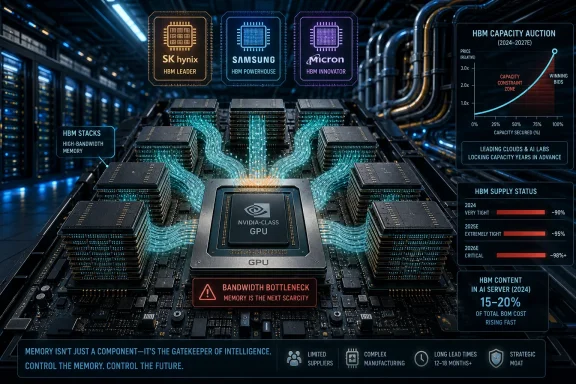
Wall Street is increasingly treating Micron Technology, the Boise-based memory maker, as a major artificial-intelligence infrastructure winner in 2026 because high-bandwidth memory has become a scarce, high-value companion to Nvidia-class GPUs in the data centers powering modern AI systems. The trade is not simply that Micron sells chips into a hot market. It is that the definition of an AI accelerator is expanding from the GPU itself to the memory stack that keeps it fed. If Nvidia taught investors that compute scarcity could become a business model, Micron is testing whether bandwidth scarcity can become one too.
For most of the AI boom, the market’s story was clean enough to fit on a ticker: Nvidia owned the GPU, the GPU owned the data center, and the data center owned the next era of software. That story was not wrong. It was merely incomplete.
A modern AI server is not a box of magical processors floating in isolation. It is a tightly engineered system in which GPUs, high-bandwidth memory, networking, storage, power delivery, and cooling all have to move together. When one part of that stack falls behind, the entire system becomes less useful, no matter how expensive the accelerators inside it may be.
That is why Micron suddenly looks different to Wall Street. For decades, memory was the commodity end of the semiconductor market: brutally cyclical, capital intensive, and prone to price collapses whenever supply outran demand. In the AI cycle, memory is being recast as a strategic component with pricing power, long customer commitments, and fewer suppliers than the market had grown accustomed to caring about.
High-bandwidth memory, or HBM, is not ordinary PC RAM with a better marketing department. It is stacked, advanced memory placed close to the processor package so enormous volumes of data can move quickly and efficiently. AI models are hungry for exactly that movement, because training and inference workloads are constrained not only by arithmetic but by how fast data reaches the compute units.
That distinction matters for anyone watching Windows hardware, enterprise procurement, or cloud economics. The same AI buildout that makes Nvidia GPUs scarce can also make memory more expensive across the stack. The ripple effects do not stop at hyperscale server rooms.
It is also a thesis with some real substance behind it. The global HBM market is effectively controlled by three companies: SK hynix, Samsung, and Micron. SK hynix has been widely regarded as the leader in recent HBM generations, while Samsung has fought to regain momentum and Micron has positioned itself as the U.S.-based challenger with a growing role in advanced AI memory.
That three-player structure is very different from the sprawling supplier landscape that buyers prefer. Hyperscalers want redundancy, leverage, and predictable supply. They do not want the most important memory in an AI system to come from one favored vendor with no credible second or third source.
Micron benefits from that anxiety. Even if it is not the HBM share leader, it is strategically useful simply because the AI infrastructure market cannot comfortably depend on a single memory supplier. In a world where Microsoft, Meta, Google, Amazon, and AI labs are committing enormous capital to data-center expansion, being the credible alternative is not a consolation prize.
The more important shift is that memory is moving from spot-market psychology to allocation psychology. Customers are not merely asking what a chip costs today. They are asking whether they can get enough of it next quarter, next year, and for the next generation of accelerator platforms.
Micron does not have the CUDA equivalent of memory. It does not dictate the AI software stack. It does not sit between developers and deployment in the same way Nvidia does. Its power is upstream and physical: capacity, yield, packaging, qualification, and the ability to ship memory that works inside unforgiving AI systems.
That difference should temper the comparison. Nvidia sells a platform. Micron sells essential components into other companies’ platforms. The economics can still be excellent during a supply crunch, but the strategic control is not the same.
Still, the comparison survives because AI has made components that used to be overlooked feel suddenly irreplaceable. Investors once underestimated how much power Nvidia would gain from being the gating item in AI deployment. Now they are asking whether HBM has become another gate.
There is a better way to put it: Micron does not need to become Nvidia to become much more valuable. It only needs AI memory to remain scarce, technically difficult, and central to the next several years of data-center spending.
HBM changes the rhythm. It is harder to make, consumes more wafer capacity per bit than conventional DRAM, requires advanced stacking and packaging, and must qualify with accelerator vendors whose platforms are themselves moving quickly. That means supply cannot instantly appear just because prices are attractive.
The result is not the death of cyclicality, but a different kind of cycle. Instead of selling mostly interchangeable bits into a broad market, memory makers are selling technically specific products into a narrow set of massive AI customers. Capacity planning becomes more contractual, more strategic, and more entangled with the roadmaps of Nvidia, AMD, custom silicon teams, and hyperscale cloud operators.
That is why investors have become obsessed with allocation. If a supplier’s HBM capacity is effectively spoken for, revenue visibility improves. If future generations such as HBM4 and HBM4E require even more demanding manufacturing, the winners may enjoy longer periods of favorable pricing.
For IT buyers, the important point is not the stock chart. It is that the AI boom has turned memory into a boardroom-level supply-chain issue. The same companies that once treated DRAM as a procurement line item now have to think about whether memory supply constrains cloud capacity, server availability, and AI service pricing.
The most obvious pathway is the data center. Microsoft’s AI ambitions run through Azure, Copilot, GitHub, Windows, Office, and developer services. Those products depend on massive infrastructure investment, and that infrastructure depends on GPUs, memory, networking, storage, and power. If HBM is expensive or constrained, AI capacity is expensive or constrained.
That cost has to go somewhere. It may show up in cloud instance pricing, Copilot licensing, enterprise AI service bundles, longer wait times for specialized compute, or tighter limits on what “included” AI features can actually do. The consumer may never see the Micron part number, but the economics of memory can still shape the experience.
The second pathway is the PC supply chain. When memory manufacturers prioritize HBM and data-center products, they are making choices about wafer starts, equipment, and capital allocation. That does not automatically mean every DIMM or SSD becomes unaffordable, but it does raise the possibility that consumer and enterprise hardware markets feel pressure from the AI buildout.
This is where the AI boom becomes more than a cloud story. If the richest customers in technology are bidding aggressively for advanced memory, everyone else is competing in the shadow of that demand.
That framing is already getting strained. Local AI workloads want more RAM, faster storage, and more efficient memory architectures. A Windows laptop with 8GB of memory now looks increasingly out of place in a market where browser tabs, Teams calls, security agents, and local AI features all compete for headroom.
The irony is sharp. The same AI boom that encourages users to buy more capable PCs may also make memory a more contested resource across the industry. Hyperscalers want HBM. Servers want high-capacity DRAM. AI PCs want more system memory. Storage demand rises as datasets, embeddings, checkpoints, and local caches multiply.
This does not mean consumer PCs will suddenly be priced like AI servers. The memory types are different, and supply chains are not perfectly interchangeable. But capital and wafer capacity are finite, and memory makers will naturally chase the highest-margin demand first.
For Windows users, the practical lesson is old-fashioned but newly relevant: buy enough memory for the life of the system. The AI era is not kind to marginal configurations.
The United States does not want the memory layer of AI systems to be entirely dependent on South Korea and Taiwan-adjacent supply chains, however strong those partners may be. It wants domestic capacity, domestic know-how, and domestic leverage. Micron is the obvious beneficiary of that strategic desire.
This does not make execution easy. Building fabs is slow, expensive, and vulnerable to delays. Advanced memory manufacturing requires equipment, materials, process expertise, and customer qualification cycles that cannot be wished into existence by policy speeches. A subsidy can lower the hurdle; it cannot repeal semiconductor physics.
Still, Micron’s U.S. footprint gives the company a narrative that Samsung and SK hynix cannot copy. In a market increasingly shaped by export controls, supply-chain resilience, and strategic technology competition, location has become part of the product.
That does not guarantee superior returns. But it does explain why investors are willing to imagine Micron as more than the third name in a three-company memory club.
That tension is what makes the stock fascinating. Investors are not buying certainty. They are buying a probability-weighted claim that AI demand will remain strong enough, long enough, to change the economics of Micron’s business.
There are reasons for caution. HBM generations move quickly, and missing a qualification window with a major accelerator platform can matter. Samsung is too large and too technically capable to dismiss. SK hynix has not become the HBM leader by accident. Nvidia, AMD, and hyperscalers will all push suppliers hard on price, performance, and reliability.
There is also the broader AI spending question. If cloud providers eventually discover that AI revenue does not justify their infrastructure buildout, the whole supply chain will feel it. Memory makers are leveraged to the boom, which means they are also leveraged to any disappointment.
But the market’s enthusiasm is not irrational just because it is enthusiastic. The AI buildout has revealed that compute without memory bandwidth is stranded capital. That realization changes the way investors value the companies that provide the bandwidth.
Micron’s opportunity is narrower and more physical. It is about being one of the very few companies that can ship advanced memory at scale into systems where the failure tolerance is low and the demand curve is steep. That is a powerful position, but it is not the same position.
The better analogy may be less glamorous: Micron is becoming a toll collector on AI throughput. The toll is not charged through a software license or a developer platform. It is charged through scarce, validated, high-performance memory attached to the most valuable compute systems ever deployed.
That toll can be lucrative. It can also be cyclical, contested, and exposed to capacity expansion. Investors who forget the second half of that sentence are likely to relearn an old memory-market lesson in a new AI dialect.
For Windows and enterprise readers, the phrase matters because it reveals how capital markets now view the guts of computing. The AI story is moving from visible products to invisible constraints. The winners may be the companies whose components users never think about until supply runs short.
Memory pricing and availability can influence server lead times, cloud region capacity, AI instance pricing, and the economics of running inference at scale. Storage is part of the same story, especially as enterprises move from pilots to production systems that need retrieval-augmented generation, vector databases, logs, monitoring, and compliance retention.
The important shift is that AI infrastructure planning is becoming systems planning again. A model does not run on a press release. It runs on racks full of interdependent components, cooled by real facilities, supplied by real vendors, and paid for through budgets that eventually collide with ordinary business constraints.
That is where Micron’s moment becomes operationally relevant. If HBM remains constrained, cloud AI services may remain expensive. If memory makers prioritize hyperscale contracts, smaller buyers may find advanced systems harder to source. If data-center demand keeps pulling capacity upward, ordinary refresh cycles may face new pricing assumptions.
The lesson for enterprise buyers is not to become semiconductor analysts. It is to stop treating AI capacity as an abstract cloud feature. Behind every Copilot rollout, model endpoint, and GPU-backed VM is a supply chain that can tighten.
Nvidia has captured an extraordinary share of the early infrastructure margin because it owned the hardest-to-replace piece. Micron’s rally suggests investors believe that margin pool is widening. The money may not stop at the GPU.
That is plausible because AI systems are becoming more memory intensive as models grow, context windows expand, and inference workloads scale. Training was the first great demand shock. Inference may be the longer one, because it turns AI from a lab project into a daily workload.
In that world, memory bandwidth and capacity matter constantly. A model that cannot access data quickly enough wastes compute. A service that cannot serve users efficiently burns money. A data center that cannot get enough qualified components misses deployment targets.
Micron’s opportunity is to sit at that junction between ambition and physics. Wall Street loves that kind of junction because it is where scarcity becomes pricing power.
That has consequences for nearly every layer of technology. Cloud providers will keep designing platforms around component availability. PC makers will have to justify memory configurations that no longer look generous. Enterprise IT teams will need to think harder about AI capacity, not merely AI software licenses. Semiconductor investors will keep looking for the next constraint before it becomes obvious.
The concrete takeaways are less breathless than the “next Nvidia” slogan, but more useful:
 The New AI Bottleneck Is Not Just Compute
For most of the AI boom, the market’s story was clean enough to fit on a ticker: Nvidia owned the GPU, the GPU owned the data center, and the data center owned the next era of software. That story was not wrong. It was merely incomplete.A modern AI server is not a box of magical processors floating in isolation. It is a tightly engineered system in which GPUs, high-bandwidth memory, networking, storage, power delivery, and cooling all have to move together. When one part of that stack falls behind, the entire system becomes less useful, no matter how expensive the accelerators inside it may be.
That is why Micron suddenly looks different to Wall Street. For decades, memory was the commodity end of the semiconductor market: brutally cyclical, capital intensive, and prone to price collapses whenever supply outran demand. In the AI cycle, memory is being recast as a strategic component with pricing power, long customer commitments, and fewer suppliers than the market had grown accustomed to caring about.
High-bandwidth memory, or HBM, is not ordinary PC RAM with a better marketing department. It is stacked, advanced memory placed close to the processor package so enormous volumes of data can move quickly and efficiently. AI models are hungry for exactly that movement, because training and inference workloads are constrained not only by arithmetic but by how fast data reaches the compute units.
That distinction matters for anyone watching Windows hardware, enterprise procurement, or cloud economics. The same AI buildout that makes Nvidia GPUs scarce can also make memory more expensive across the stack. The ripple effects do not stop at hyperscale server rooms.
Micron Gets Repriced Because Memory Stopped Looking Disposable
The investor enthusiasm around Micron rests on a deceptively simple premise: if every AI server needs more memory, and if only a few companies can supply the most advanced memory, then Micron deserves a richer valuation than a traditional boom-and-bust DRAM manufacturer. That is the thesis now pushing the stock into the AI spotlight.It is also a thesis with some real substance behind it. The global HBM market is effectively controlled by three companies: SK hynix, Samsung, and Micron. SK hynix has been widely regarded as the leader in recent HBM generations, while Samsung has fought to regain momentum and Micron has positioned itself as the U.S.-based challenger with a growing role in advanced AI memory.
That three-player structure is very different from the sprawling supplier landscape that buyers prefer. Hyperscalers want redundancy, leverage, and predictable supply. They do not want the most important memory in an AI system to come from one favored vendor with no credible second or third source.
Micron benefits from that anxiety. Even if it is not the HBM share leader, it is strategically useful simply because the AI infrastructure market cannot comfortably depend on a single memory supplier. In a world where Microsoft, Meta, Google, Amazon, and AI labs are committing enormous capital to data-center expansion, being the credible alternative is not a consolation prize.
The more important shift is that memory is moving from spot-market psychology to allocation psychology. Customers are not merely asking what a chip costs today. They are asking whether they can get enough of it next quarter, next year, and for the next generation of accelerator platforms.
Nvidia Still Owns the Center of Gravity
The danger in calling Micron “the next Nvidia” is that the phrase flatters more than it explains. Nvidia’s rise was not just about selling into a shortage. It was about owning the software ecosystem, the accelerator roadmap, the developer mindshare, and the reference architecture for AI computing.Micron does not have the CUDA equivalent of memory. It does not dictate the AI software stack. It does not sit between developers and deployment in the same way Nvidia does. Its power is upstream and physical: capacity, yield, packaging, qualification, and the ability to ship memory that works inside unforgiving AI systems.
That difference should temper the comparison. Nvidia sells a platform. Micron sells essential components into other companies’ platforms. The economics can still be excellent during a supply crunch, but the strategic control is not the same.
Still, the comparison survives because AI has made components that used to be overlooked feel suddenly irreplaceable. Investors once underestimated how much power Nvidia would gain from being the gating item in AI deployment. Now they are asking whether HBM has become another gate.
There is a better way to put it: Micron does not need to become Nvidia to become much more valuable. It only needs AI memory to remain scarce, technically difficult, and central to the next several years of data-center spending.
High-Bandwidth Memory Turns a Commodity Cycle Into a Capacity Auction
Traditional DRAM cycles were ugly because supply could overshoot demand. Manufacturers spent heavily on fabs, demand cooled, prices collapsed, and investors rediscovered why memory stocks carried a discount. The industry consolidated over time, but the pattern never fully disappeared.HBM changes the rhythm. It is harder to make, consumes more wafer capacity per bit than conventional DRAM, requires advanced stacking and packaging, and must qualify with accelerator vendors whose platforms are themselves moving quickly. That means supply cannot instantly appear just because prices are attractive.
The result is not the death of cyclicality, but a different kind of cycle. Instead of selling mostly interchangeable bits into a broad market, memory makers are selling technically specific products into a narrow set of massive AI customers. Capacity planning becomes more contractual, more strategic, and more entangled with the roadmaps of Nvidia, AMD, custom silicon teams, and hyperscale cloud operators.
That is why investors have become obsessed with allocation. If a supplier’s HBM capacity is effectively spoken for, revenue visibility improves. If future generations such as HBM4 and HBM4E require even more demanding manufacturing, the winners may enjoy longer periods of favorable pricing.
For IT buyers, the important point is not the stock chart. It is that the AI boom has turned memory into a boardroom-level supply-chain issue. The same companies that once treated DRAM as a procurement line item now have to think about whether memory supply constrains cloud capacity, server availability, and AI service pricing.
The Windows Angle Is Hiding in Plain Sight
A Micron stock rally can sound remote from the daily concerns of WindowsForum readers. Most people are not buying HBM stacks for a home lab, and even many enterprise IT departments consume AI infrastructure through cloud services rather than direct hardware purchases. But the AI memory crunch still matters for Windows users because it shapes the cost and availability of the systems they actually touch.The most obvious pathway is the data center. Microsoft’s AI ambitions run through Azure, Copilot, GitHub, Windows, Office, and developer services. Those products depend on massive infrastructure investment, and that infrastructure depends on GPUs, memory, networking, storage, and power. If HBM is expensive or constrained, AI capacity is expensive or constrained.
That cost has to go somewhere. It may show up in cloud instance pricing, Copilot licensing, enterprise AI service bundles, longer wait times for specialized compute, or tighter limits on what “included” AI features can actually do. The consumer may never see the Micron part number, but the economics of memory can still shape the experience.
The second pathway is the PC supply chain. When memory manufacturers prioritize HBM and data-center products, they are making choices about wafer starts, equipment, and capital allocation. That does not automatically mean every DIMM or SSD becomes unaffordable, but it does raise the possibility that consumer and enterprise hardware markets feel pressure from the AI buildout.
This is where the AI boom becomes more than a cloud story. If the richest customers in technology are bidding aggressively for advanced memory, everyone else is competing in the shadow of that demand.
The PC Market Learns That AI Has an Opportunity Cost
The PC industry spent the past year trying to sell users on the AI PC. That pitch focused on NPUs, local inference, battery life, privacy, and the idea that Windows machines would become more useful when they could run models on-device. Memory was treated as a supporting spec, not the star.That framing is already getting strained. Local AI workloads want more RAM, faster storage, and more efficient memory architectures. A Windows laptop with 8GB of memory now looks increasingly out of place in a market where browser tabs, Teams calls, security agents, and local AI features all compete for headroom.
The irony is sharp. The same AI boom that encourages users to buy more capable PCs may also make memory a more contested resource across the industry. Hyperscalers want HBM. Servers want high-capacity DRAM. AI PCs want more system memory. Storage demand rises as datasets, embeddings, checkpoints, and local caches multiply.
This does not mean consumer PCs will suddenly be priced like AI servers. The memory types are different, and supply chains are not perfectly interchangeable. But capital and wafer capacity are finite, and memory makers will naturally chase the highest-margin demand first.
For Windows users, the practical lesson is old-fashioned but newly relevant: buy enough memory for the life of the system. The AI era is not kind to marginal configurations.
Micron’s U.S. Identity Is More Than Branding
Micron’s appeal also intersects with industrial policy. It is headquartered in Idaho, has announced major U.S. manufacturing ambitions, and sits inside Washington’s broader effort to reduce dependence on overseas semiconductor supply chains. That political context matters because AI infrastructure has become national infrastructure.The United States does not want the memory layer of AI systems to be entirely dependent on South Korea and Taiwan-adjacent supply chains, however strong those partners may be. It wants domestic capacity, domestic know-how, and domestic leverage. Micron is the obvious beneficiary of that strategic desire.
This does not make execution easy. Building fabs is slow, expensive, and vulnerable to delays. Advanced memory manufacturing requires equipment, materials, process expertise, and customer qualification cycles that cannot be wished into existence by policy speeches. A subsidy can lower the hurdle; it cannot repeal semiconductor physics.
Still, Micron’s U.S. footprint gives the company a narrative that Samsung and SK hynix cannot copy. In a market increasingly shaped by export controls, supply-chain resilience, and strategic technology competition, location has become part of the product.
That does not guarantee superior returns. But it does explain why investors are willing to imagine Micron as more than the third name in a three-company memory club.
The Market Is Pricing Scarcity, Not Perfection
The bullish case for Micron has a clean elegance: AI demand is enormous, HBM supply is limited, and Micron is one of the few companies able to meet the need. The bearish case is just as straightforward: memory is still memory, capital spending is still capital spending, and today’s shortage can become tomorrow’s overbuild if everyone extrapolates too far.That tension is what makes the stock fascinating. Investors are not buying certainty. They are buying a probability-weighted claim that AI demand will remain strong enough, long enough, to change the economics of Micron’s business.
There are reasons for caution. HBM generations move quickly, and missing a qualification window with a major accelerator platform can matter. Samsung is too large and too technically capable to dismiss. SK hynix has not become the HBM leader by accident. Nvidia, AMD, and hyperscalers will all push suppliers hard on price, performance, and reliability.
There is also the broader AI spending question. If cloud providers eventually discover that AI revenue does not justify their infrastructure buildout, the whole supply chain will feel it. Memory makers are leveraged to the boom, which means they are also leveraged to any disappointment.
But the market’s enthusiasm is not irrational just because it is enthusiastic. The AI buildout has revealed that compute without memory bandwidth is stranded capital. That realization changes the way investors value the companies that provide the bandwidth.
The “Next Nvidia” Label Is Useful Only If We Retire It Quickly
The phrase “next Nvidia” is a market shortcut, not an analytical conclusion. It signals that investors are hunting for the next company whose role in AI infrastructure is being underestimated. It does not mean the next company will have Nvidia’s margins, monopoly-like software advantages, or cultural position in the developer ecosystem.Micron’s opportunity is narrower and more physical. It is about being one of the very few companies that can ship advanced memory at scale into systems where the failure tolerance is low and the demand curve is steep. That is a powerful position, but it is not the same position.
The better analogy may be less glamorous: Micron is becoming a toll collector on AI throughput. The toll is not charged through a software license or a developer platform. It is charged through scarce, validated, high-performance memory attached to the most valuable compute systems ever deployed.
That toll can be lucrative. It can also be cyclical, contested, and exposed to capacity expansion. Investors who forget the second half of that sentence are likely to relearn an old memory-market lesson in a new AI dialect.
For Windows and enterprise readers, the phrase matters because it reveals how capital markets now view the guts of computing. The AI story is moving from visible products to invisible constraints. The winners may be the companies whose components users never think about until supply runs short.
Enterprise IT Should Watch the Memory Market, Not Just GPU Headlines
IT departments have spent the last several years tracking GPU availability as if it were a weather system. That made sense when AI projects were being delayed by access to Nvidia accelerators. But the next phase requires a broader dashboard.Memory pricing and availability can influence server lead times, cloud region capacity, AI instance pricing, and the economics of running inference at scale. Storage is part of the same story, especially as enterprises move from pilots to production systems that need retrieval-augmented generation, vector databases, logs, monitoring, and compliance retention.
The important shift is that AI infrastructure planning is becoming systems planning again. A model does not run on a press release. It runs on racks full of interdependent components, cooled by real facilities, supplied by real vendors, and paid for through budgets that eventually collide with ordinary business constraints.
That is where Micron’s moment becomes operationally relevant. If HBM remains constrained, cloud AI services may remain expensive. If memory makers prioritize hyperscale contracts, smaller buyers may find advanced systems harder to source. If data-center demand keeps pulling capacity upward, ordinary refresh cycles may face new pricing assumptions.
The lesson for enterprise buyers is not to become semiconductor analysts. It is to stop treating AI capacity as an abstract cloud feature. Behind every Copilot rollout, model endpoint, and GPU-backed VM is a supply chain that can tighten.
The Real Contest Is Over Who Captures AI Infrastructure Margin
The AI boom has created an uncomfortable question for the entire technology sector: who actually gets paid? Application vendors want subscription revenue. Cloud providers want utilization. Chipmakers want margin. Enterprises want productivity gains. Users want tools that justify the hype.Nvidia has captured an extraordinary share of the early infrastructure margin because it owned the hardest-to-replace piece. Micron’s rally suggests investors believe that margin pool is widening. The money may not stop at the GPU.
That is plausible because AI systems are becoming more memory intensive as models grow, context windows expand, and inference workloads scale. Training was the first great demand shock. Inference may be the longer one, because it turns AI from a lab project into a daily workload.
In that world, memory bandwidth and capacity matter constantly. A model that cannot access data quickly enough wastes compute. A service that cannot serve users efficiently burns money. A data center that cannot get enough qualified components misses deployment targets.
Micron’s opportunity is to sit at that junction between ambition and physics. Wall Street loves that kind of junction because it is where scarcity becomes pricing power.
The Micron Trade Says the AI Stack Is Getting Rewritten
The most useful way to read Micron’s rise is not as a stock-market parlor game but as a map of where AI pressure is moving next. The GPU shortage taught the industry that compute supply could define strategy. The HBM scramble teaches the next lesson: compute is only as useful as the memory system around it.That has consequences for nearly every layer of technology. Cloud providers will keep designing platforms around component availability. PC makers will have to justify memory configurations that no longer look generous. Enterprise IT teams will need to think harder about AI capacity, not merely AI software licenses. Semiconductor investors will keep looking for the next constraint before it becomes obvious.
The concrete takeaways are less breathless than the “next Nvidia” slogan, but more useful:
- Micron is benefiting because high-bandwidth memory has become a critical constraint in AI server design, not because ordinary memory suddenly stopped being cyclical.
- The HBM market’s concentration among SK hynix, Samsung, and Micron gives all three suppliers strategic importance, even though their current positions are not equal.
- Nvidia remains the center of the AI hardware ecosystem, but memory suppliers are capturing more investor attention as bandwidth becomes a deployment bottleneck.
- Windows users and enterprise buyers may feel the AI memory boom indirectly through cloud AI pricing, server availability, PC memory configurations, and broader component costs.
- The bullish Micron case depends on sustained AI infrastructure spending, successful execution across HBM generations, and disciplined capacity expansion.
References
- Primary source: The Tech Buzz
Published: 2026-06-28T16:30:20.824437
Wall Street Bets Micron Is the Next Nvidia AI Winner | The Tech Buzz
Investors eye memory chip maker as AI infrastructure gold rush spreads beyond GPUswww.techbuzz.ai - Related coverage: tomshardware.com
SK hynix passes Samsung as South Korea's most valuable company — memory company surpasses valuation milestone on the back of HBM | Tom's Hardware
It's the first time since 2000 that Samsung hasn't topped the Korean market.www.tomshardware.com - Related coverage: axios.com
Micron earnings expectations have gone vertical
Micron shares are up over 250% so far this year, and more than 750% over the last 12 months.www.axios.com
- Related coverage: presenc.ai
HBM Market Share 2026: SK hynix 62%, Micron Overtakes Samsung, HBM4 Battle | Presenc AI
HBM market share 2026: SK hynix 50-62%, Samsung 25-40%, Micron 5-20%. HBM3E dominates shipments, HBM4 ramping. Snapshot for 2026-05-15.presenc.ai - Related coverage: spglobal.com
- Related coverage: patsnap.com
Chiplet interconnect tech 2026: UCIe, HBM4 & packaging | PatSnap
UCIe, HBM4, and advanced packaging are reshaping AI chip design in 2026. Explore competitive dynamics, patent trends, and supply chain risks in this deep-dive. www.patsnap.com
- Related coverage: andrew.ooo
Micron Q3 FY2026 Earnings: $41B Revenue, HBM4 Sold Out — andrew.ooo
Micron posted Q3 FY2026 revenue of $41B (4x YoY) and 81% gross margins on June 24, 2026. HBM4 sold out, $100B+ in signed contracts. What it means. andrew.ooo
- Related coverage: micron.com
- Related coverage: lionhq.ghost.io
Memory Semiconductor Cycle: Micron (MU), Samsung, SK Hynix
Disclaimer: These reports include AI-generated summaries, often explicitly arguing one side as strongly as possible (positive or negative) and should not be relied on. They're designed to test theses and foster polite debate and scrutiny, so please comment if you see an error! Date...lionhq.ghost.io - Related coverage: techradar.com
Micron just packed 256GB of LPDDR5x into one module, and hyperscalers can stack eight for staggering 2TB AI servers | TechRadar
Total capacity exceeds the previous module generation by a thirdwww.techradar.com - Related coverage: investors.micron.com
- Related coverage: files-scs.pstatic.net
Micron Technology, Inc. Reports Record Results for the Third Quarter of Fiscal 2026
PDF documentfiles-scs.pstatic.net
