Microslop Discord Backlash: Moderation Limits and Brand Trust

  • Thread Author
Microsoft’s official Copilot Discord briefly became the sort of live, unscripted case study that every community manager and corporate comms team dreads: a one‑word moderation rule intended to quiet a meme instead amplified it, users circled the wagons with evasion tactics, and the company’s attempt to contain the flare‑up ended with channel lockdowns and embarrassed damage control.

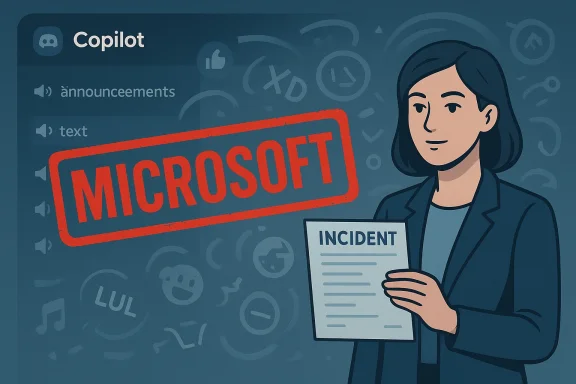
A person holds an incident report beneath a red MICROSOFT stamp on a Copilot interface.Background / Overview​

The flashpoint was the nine‑letter epithet “Microslop,” a derisive portmanteau used by some members of the wider Windows and AI communities to mock what they view as low‑quality or overhyped outputs from Microsoft’s Copilot family of AI assistants. The term rose into broader attention after a set of public comments about “slop vs. sophistication” from Microsoft’s leadership late last year; critics seized on the language and the company’s rapid Copilot rollout, and “Microslop” stuck as shorthand for those grievances.
On or around March 1–2, 2026, moderators in the official Microsoft Copilot Discord implemented an automated keyword filter that blocked the word “Microslop,” producing an automatic “your message contains a phrase that is inappropriate” notice for users attempting to post it. Within hours, community members discovered simple bypasses — leetspeak substitutions like “Microsl0p,” spacing tricks, and other variants — and began deliberately testing or amplifying the filter as protest. Moderators responded by restricting posting permissions in affected channels and, for a time, locking portions of the server and hiding parts of message history while they tried to regain control.
Microsoft told reporters that the intervention was part of a response to targeted spam and disruptive activity and that temporary filters were deployed to slow the activity while stronger safeguards were stood up. That explanation aligns with the company’s claim that the action was not a political suppression of criticism but a short‑term anti‑spam measure; critics see that as insufficient and tone‑deaf amid legitimate product feedback.

How a One‑Word Rule Became a Serverwide Problem​

The mechanics: why keyword filters trip over culture​

Discord’s AutoMod and similar moderation tools work by matching exact phrases, configured trigger patterns, and spam heuristics. They can block, hide, or log messages automatically and are commonly used to remove profanity, link spam, and invite hoses. But keyword filters are brittle: motivated communities can easily avoid them with substitutions like zeros for O, alternate spacing, unicode characters, or by posting the term as an image. The platform documentation explicitly warns that keyword matching is exact and recommends wildcards carefully; it’s powerful for blunt threats and invite spam, less effective for controlling memetic culture.
When moderators add a high‑salience term to an automated blocklist, they send a visible signal to the community: the company noticed the insult, and now it’s trying to suppress it. That signal can be interpreted as censorship or as an admission that the term stings — either reading fuels further attention. The result is a classic Streisand Effect in miniature: the moderation act itself raises the profile of the insult and turns it into a rallying point. Multiple contemporaneous reports show how quickly “Microslop” spread in the wake of the filter, with users deliberately posting variants and sharing screenshots on other platforms.

The social dynamics: testing, evasion, and escalation​

Online communities rarely passively accept rules imposed from above, especially when a term is comedic, catchy, or tied to broader grievances. The Copilot Discord episode followed a predictable social arc:
  • A moderation action is quietly implemented (keyword blocked).
  • Some users notice the block and share the discovery publicly.
  • Other users treat the block as a game: can the filter be evaded?
  • Evasion techniques spread (leetspeak, spacing, images), which increases raw volume.
  • Moderators escalate defensive measures (channel lockdowns, posting restrictions, account bans).
  • The escalation is reported externally, amplifying the attention and leaving the company on the defensive.
This progression is well known to community operators, and it played out in the Copilot server with speed and visibility. Reports indicate that attempts to expand the banned‑words list weren’t sustainable in the face of manual and automated evasion, and that moderators resorted to structural controls to stop the flood rather than selective intervention alone.

Why the Copilot Discord Choice Was Especially Risky​

A first‑party brand channel is porous optics​

An official product Discord is a first‑party, public channel where the brand's voice and behavior are highly visible. Unlike private, invite‑only community spaces, actions taken in a public server are easily observed and shared outside the venue, increasing reputational exposure.
For Microsoft, already engaged in a sensitive phase of broad Copilot deployment across Windows, Office, and other products, the optics of banning a single meme term — especially one that captures a complaint about product quality — are costly. The company appears to have underestimated how quickly the move could be interpreted as tone policing, or worse, as a refusal to accept valid criticism during a period of rising public skepticism about generative AI. Several outlets linked the moderation decision to broader frustrations about Copilot’s quality and the pace of its rollouts.

Memes scale faster than moderation rosters​

Memes are lightweight and highly sharable; even a small nucleus of active users can amplify a joke into trending discourse. Moderation operations — staffing, escalation paths, and tooling — are often slower to scale. When moderators face a sudden spike in volume that overwhelms AutoMod, their options are blunt: expand blocked lists (which increases false positives), shut channels (which appears heavy‑handed), or temporarily lock the server (which looks like a suppression tactic). Microsoft’s measured choice — to deploy a keyword filter and then tighten channel permissions — is defensible as triage, but it is also the exact sequence that escalates attention and inflames critics. Independent reporting suggests Microsoft did exactly that, then backtracked when the noise and press coverage mounted.

What This Reveals About Moderation Tools and Limits​

AutoMod is a blunt instrument, not a conversation starter​

Discord’s AutoMod works best against low‑effort spam, invite links, and slurs — categories with low ambiguity. It is not a replacement for normative community design and does not address root causes of discontent. Documentation explicitly notes that keyword matches are exact, and that wildcards can broaden the match at the cost of false positives. The Copilot incident demonstrates that keyword blocking without a broader engagement strategy can be counterproductive.

Moderation must be layered and contextual​

Best practice for large communities emphasizes layered defenses:
  • Behavioral controls — rate limits, slowmode, and mention caps to blunt flood tactics.
  • Role design — verified or trusted roles that can bypass conservative filters to allow constructive contributors to speak.
  • Human review — triage queues and visible moderation logs to avoid opaque, unilateral decisions.
  • Communication — timely public moderation notes explaining why actions were taken and how members can appeal.
When moderation appears to be automated and secretive, it tends to delegitimize itself. The Copilot Discord episode shows the practical cost: the community tested the system because the action was visible and the why wasn’t. Every credible technology community requires a mix of automated gates and human‑led dialog.

Brand Safety vs. Product Critique: A Strategic Tension​

Why Microsoft faced a twin reputational risk​

For a company positioning Copilot as an integrated AI companion across productivity suites and Windows itself, two reputational vectors mattered:
  • Immediate optics: locking a public community and hiding message history looks like censorship, which can feed headlines and social media criticism.
  • Long‑term credibility: appearing unwilling to accept critique undermines trust among developers, enterprise customers, and independent reviewers at a moment when Microsoft is asking organizations to adopt AI into core workflows.
The mix of those two risks is what made the episode far more than a fleeting moderation snafu. It turned into a symbolic test of whether Microsoft’s public communities are spaces for genuine feedback or curated PR channels. Multiple outlets covered the sequence and noted that Microsoft later relaxed enforcement and argued the moves were anti‑spam triage rather than political suppression — an explanation that some reporters accepted and others questioned.

The underlying grievance: quality, not just tone​

“Microslop” is not merely a joke; it captures a larger sentiment: some users believe that generative AI features are being shipped prematurely or without adequate opt‑out options, producing sloppy outputs or noisy distractions across products. That grievance is substantive and evidence‑driven in many cases (bugs, incorrect suggestions, intrusion into workflows), and top‑down censorship of the shorthand term will not make those problems go away. Moderation can hide the symptom, but until the root causes are addressed — product quality, transparency, and opt‑outs — the meme will persist. Several community reports and commentaries connected the moderation flap to these deeper worries.

Practical Recommendations for Microsoft (and Any Brand Running Public Channels)​

The Copilot Discord incident provides a compact set of lessons for how brands should balance community order, free critique, and brand safety. These recommendations are operational and tactical — not rhetorical.

Short term (triage)​

  • Shift to behavior‑based controls first. Use rate limits, slowmode, mention caps, and anti‑raid lockdowns to blunt volume rather than banning specific cultural words that will only attract attention. Discord’s spam and mention filters are meant precisely for that.
  • Open a transparent incident notice. When locking channels or restricting posting, publish a clear, short moderation note explaining the reason (e.g., coordinated spam waves), what’s being done, how long it will last, and what users can expect when the server reopens. Transparency reduces rumor and rage.
  • Create a dedicated escalation channel. Route frustrated users into a verified feedback or bug‑report pipeline where posts are triaged by product staff rather than mass‑moderated. This converts frustration into telemetry.

Medium term (stabilize)​

  • Pair automated defenses with human review. AutoMod should be configured to flag, not silently delete, when the context is ambiguous, with human moderators empowered to decide whether to remove or post an explanatory message.
  • Implement role‑based exceptions and trusted lists. Allow verified community contributors to bypass some filters so that legitimate users aren’t silenced while trolls get suppressed.
  • Run scheduled, moderated AMAs. Host regular ask‑me‑anything sessions with Copilot product leads, with pre‑defined scope and visible moderation rules to surface and publicly address concerns.

Long term (rebuild trust)​

  • Document fixes and cadence. If community complaints are about quality, publish a public cadence of improvements and how they will be measured (e.g., accuracy metrics, regression counts, customer‑reported issues resolved). Nothing kills a meme faster than demonstrable improvement.
  • Design product opt‑outs and controls. Install clear, discoverable toggles so users who do not want Copilot features can disable them without fear of partial functionality loss. Opt‑outs reduce the political salience of product complaints.
  • Invest in community governance. Empower a community advisory board for major product decisions that affect user experience; this distributes responsibility and signals genuine engagement.
Each of these steps reduces the chance that a single moderation action will become the headline narrative and shifts the conversation back to product performance and accountability. Many of them are documented best practices for large communities and are reflected in the way other brands operate their official channels.

What Microsoft (and Observers) Should Watch Going Forward​

  • Memetic stickiness: Catchy epithets like “Microslop” don’t disappear because they’re censored; they disappear when the reasons people use them no longer exist. Track sentiment metrics to see whether the root causes — product quality, forced features — are improving.
  • Moderation optics: Any future moderation work must be accompanied by plain‑language explanations and appeal routes. Without those, even perfectly justified actions will be treated as secrecy.
  • Tool limits: Automated matching, even with regex and wildcards, will always lose to determined evasion or coordinated meme‑driving. Prepare human escalation paths and limit the reliance on keyword blocks for cultural disputes.
  • Community health signals: Consider broader community metrics — active daily users, bug escalation rates, percentage of posts flagged for moderator attention — as primary KPIs for community health, not just brand safety metrics.

Critical Analysis: Strengths, Weaknesses, and Risk Assessment​

Strengths of Microsoft’s immediate response​

  • Speed: Automatic filters and lockdowns act fast; they can blunt a raid or spam wave within minutes, which is important for protecting users.
  • Defensive clarity: The company’s explanation that the measures were anti‑spam triage rather than censorship is plausible and consistent with the need to protect a public community from disruption. Forbes quoted an official Microsoft spokesperson indicating spam was a key driver for the temporary filters.

Weaknesses and missteps​

  • Opaque action: Deploying a sensitive filter without a visible public explanation invites speculation and conspiracy. That opacity appears to be what converted a moderation problem into a PR incident.
  • Misplaced emphasis on vocabulary: Banning a label that embodies product critique treats the symptom rather than the cause. It’s a well‑documented governance error: remove the needle and a swarm of new needles appears elsewhere.
  • Operational brittleness: Keyword blocks are easy to evade. In an era dominated by memes and rapid character substitutions, a lexical blacklist is low leverage. Discord docs explicitly highlight both the power and limits of AutoMod keyword filters.

Risks that remain​

  • Reputational: The episode feeds narratives about corporate tone policing and unwillingness to accept criticism during an era of real user apprehension about generative AI.
  • Operational: Overreliance on automated filters may produce collateral moderation damage — false positives that alienate constructive community members.
  • Strategic: If communities feel unheard, their grievances will migrate to other venues (social platforms, press outlets) where they do more reputational damage and less product feedback is captured productively.
Where possible, these risks can be quantified via sentiment analytics, retention metrics on official channels, and the ratio of constructive feedback to disruptive posts. At present, public reporting suggests the episode caused an immediate spike in attention but not a systemic community collapse — yet; reputational losses are cumulative and not easily reversed without demonstrable product improvements.

Conclusion: The Best Defense Is Better Product and Clear Community Design​

The Copilot Discord “Microslop” incident is a compact, almost archetypal lesson: in fast, memetic online cultures, suppression is often the fuel for virality. Keyword filters and automatic deletions can stop a spam wave in its tracks, but when those measures are applied to shorthand critiques about product quality, they can validate and amplify the critique instead of containing it.
Microsoft had defensible operational reasons to slow disruptive activity in a public server. But the company’s approach leaned too heavily on lexical suppression while underestimating the cultural dynamics at play. The better long‑term defense is not a larger banned‑word list; it is an improved product experience that leaves the joke with nowhere to land, paired with transparent, layered moderation that treats community trust as a technical metric to be measured and improved.
For brands running large, public communities in 2026, the takeaway is blunt and practical: culture moves faster than filters. If the goal is to preserve constructive dialogue and brand trust, prioritize behavioral controls, transparent communication, and product fixes over lexical blacklists — and prepare to explain your actions when you act.

Source: findarticles.com Microsoft Copilot Discord Microslop Ban Backfires
 

Microsoft’s attempt to silence a cheeky one‑word criticism in its official Copilot Discord didn’t bury the joke; it detonated it, turning a private moderation decision into a public relations headache that crystallizes deep, ongoing tensions over Microsoft’s AI strategy and how big tech manages community dissent.

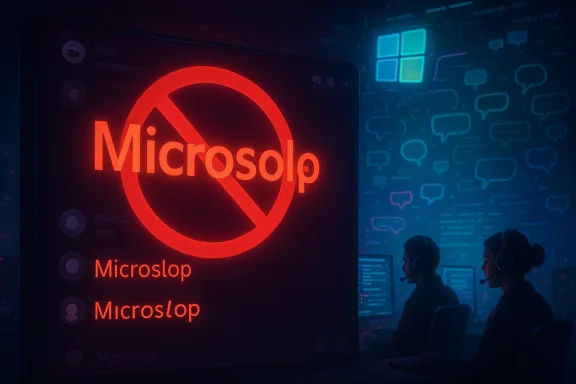
A neon red 'Microslop' sign with a prohibition circle in a blue, high-tech control room.Background: how a nickname became a flashpoint​

The epithet “Microslop” — a portmanteau of Microsoft and the slang “slop” for low‑quality output — emerged last year as a succinct expression of user frustration with Microsoft’s Copilot family of assistants and the increasingly AI‑centric direction of Windows. What began as offhand mockery across forums, subreddits, and product comment threads migrated into official community spaces where Microsoft maintains active channels for product discussion.
In late February and early March 2026, moderators for the official Microsoft Copilot Discord added the literal string “Microslop” to the server’s automated word filter. Users trying to post that exact string received an automated moderation notice stating their message contained an inappropriate phrase; the messages did not appear publicly. That simple action set off a predictable internet reflex: people treated the block as a challenge and immediately began testing and evading the filter.
Shortly after the ban became visible, participants weaponized character substitution and Unicode homoglyphs — think “Microsl0p” (zero for O) or Greek‑letter mixes such as “ΜιcrοsΙορ” — to bypass the filter. The volume and creativity of the workarounds overwhelmed moderation, and Microsoft temporarily restricted posting rights, hid message history in affected channels, and locked significant portions of the server while it implemented broader safeguards. The episode played out publicly via screenshots and re‑posts, producing the very amplification the filter likely sought to prevent.

What actually happened — the timeline in plain terms​

Discovery and the first filter​

  • Late February / March 1, 2026: Community members noticed that attempts to post “Microslop” on the Copilot Discord triggered an automated deletion and a notice that the phrase was inappropriate. This behavior appeared to come from a server‑level keyword filter rather than manual post removals.

Rapid escalation and evasion​

  • Within hours, users began posting variations and homoglyphs, turning the filter into a puzzle and a performance. Because keyword filters are often literal or pattern‑based, simple substitutions frequently bypassed the block. Moderators then escalated containment strategies as message volume rose.

Lockdown and messaging​

  • Microsoft moderators restricted channels and temporarily locked the server to stem the tide, while company spokespeople later described the measures as temporary anti‑spam protections rather than a policy to silence criticism. Screenshots of the filter, account suspensions for repeat offenders, and the server lock went viral across X, Reddit, and news sites, spawning wider discussion about moderation, corporate transparency, and product quality.

Why this matters: community moderation meets corporate messaging​

The incident is a compact case study in three linked problems tech companies now face:
  • Automated moderation is brittle. Simple word filters are easy to implement but are trivially defeated by human ingenuity (or bots designed to mimic it). When the goal is preserving signal in a busy channel, keyword blocks can reduce noise — but when the community perceives the block as censorship, the filter becomes the story itself.
  • Perception matters more than intent. Microsoft framed the move as an anti‑spam measure; many users read it as an attempt to suppress legitimate criticism. In tightly networked online communities, how a decision is communicated often determines whether it escalates or cools off. The absence of transparent, on‑record moderation rationale compounded the problem.
  • The Streisand effect is alive and well. Attempts to suppress a meme nearly always amplify it. What might have been a short, private moderation clean‑up became a viral example of overreach because screenshots shared across platforms turned the filter into a badge of ridicule.

The tactics users used — and what they reveal about modern communities​

When a toxic or derisive term is blocked, modern communities use a toolbox of easy techniques to protest or evade:
  • Character substitution (l33t): replacing characters with numerals or symbols (e.g., “Microsl0p”).
  • Unicode homoglyphs: swapping Latin letters for visually identical glyphs from Greek, Cyrillic, or other scripts (e.g., “ΜιcrοsΙορ”).
  • Spacing, punctuation, and zero‑width characters: inserting invisible or cosmetic characters to defeat naive substring matches.
  • Flooding and context collapse: posting the term en masse to drown out conversation or provoke an administrative response.
These techniques are not new, but the speed and scale with which a community deploys them against an enforced ban are striking. The incident turned the Copilot Discord into a masterclass in digital civil disobedience, and moderators were left trying to select the least‑worst containment tools under public scrutiny.

What Microsoft said — and what remains unclear​

Public reporting and statements around the event are consistent on a few narrow points: moderators activated filters that blocked “Microslop,” users discovered and evaded the filter, the server was temporarily restricted, and Microsoft described the step as an anti‑spam measure. Major outlets picked up Microsoft’s framing while also documenting the subsequent fallout.
What is less clear — and important to note — is intent behind the initial filter: was it a narrow defensive move against coordinated spam, a reactive manual decision by a moderation team, or an overbroad attempt to curtail negative commentary? Public statements stress spam mitigation, but community evidence and the speed of escalation made the action read as heavy‑handed censorship to many participants. Because internal moderation logs and decision threads are private, the full, auditable record is not available to outsiders; therefore any definitive claim about the original intent should be qualified.

The broader context: why “Microslop” sticks​

The nickname endures because it condenses several grievances into a single, memetic word:
  • Users complain Copilot outputs are sometimes inaccurate, hallucinate facts, or feel like rushed feature baggage rather than genuinely helpful assistants. These are recurring community criticisms across multiple Copilot surfaces.
  • Many users feel Microsoft has pushed AI into Windows and other products before fixing basic stability and usability problems, creating a perception of feature bloat and misplaced priorities. The result is an audience primed to amplify a derisive label.
  • Corporate communications missteps — from confusing opt‑outs to aggressive defaults in the OS and promoted AI features — have eroded goodwill, giving memes like “Microslop” traction beyond the original complainants.
Taken together, the nickname functions as shorthand: it’s an identity claim about Microsoft’s perceived direction, not simply a literal critique of one product component. That’s why a moderation move that goes after the label becomes symbolic — it’s policing a symptom, not addressing the underlying patient.

Lessons for community and product teams — a practical checklist​

Companies that operate public communities and product support forums should treat incidents like this as predictable and design governance accordingly. Key lessons:
  • Don’t treat keyword filters as a primary defense. They are brittle and easy to game. Use behavioral signals, rate limiting, CAPTCHAs, bot detection, and human triage for high‑value spaces first.
  • Be transparent and swift with messaging. If a moderation change is necessary, state the reason, the scope, and the expected timeline for reopening or reversing actions. Silence breeds suspicion; clarity reduces escalation.
  • Engage community moderators as partners. Volunteer and community moderators are often cultural intermediaries; involve them in policy design and incident response rather than issuing unilateral actions.
  • Measure upstream product issues, not only downstream chatter. A spike in negative memes may be an early warning of real product pain; allocate resources to triage root causes rather than solely focusing on tone control.
  • Prepare a graduated response plan. Escalation should go from polite nudges to rate limiting to temporary locks — and always accompanied by public status updates if the incident affects large swaths of users.

Risk analysis: reputation, trust, and the AI narrative​

The Copilot Discord incident is small in absolute terms — a keyword filter, some evasion, and a temporary lockdown — but it is disproportionate in reputational risk for several reasons.
  • Trust is sticky and asymmetric. Recovering from perceived censorship requires more effort than the original restraint would have. An overbroad moderation action corrodes trust among power users and amplifies existing narratives of heavy‑handed design.
  • Memes scale faster than explanations. Once a meme like “Microslop” escapes to broader platforms, it becomes part of the public record. Attempts to scrub it inside closed channels cannot unring the bell.
  • The AI prism magnifies everything. Because AI is a charged topic — tied to ethics, jobs, privacy, and UX promises — any misstep is interpreted as evidence of deeper management or engineering failures. The moderation misstep therefore feeds into the larger debate about whether Microsoft is balancing ambition with attention to core reliability.

What this reveals about Microsoft’s product posture (and what’s unverified)​

Multiple outlets and community threads argue that Microsoft has recently shifted focus to address Windows performance and reliability concerns, led by executives in the Windows organization. Pavan Davuluri, who took on expanded Windows responsibilities in 2024, has been publicly associated with efforts to balance ambitious AI features with platform stability. Some reports describe an internal reallocation of engineering resources toward reliability work in early 2026. Those reports are consistent with a visible pivot, but the degree and permanence of any strategic shift are still matters of reporting and interpretation. Readers should treat narratives about company pivots as indicative rather than definitive unless supported by explicit, time‑stamped corporate disclosures.
Another recurring claim in some coverage is that CEO Satya Nadella or other executives privately described some Copilot integrations as “almost unusable.” This phrase circulates in forums and secondary reporting but lacks a verifiable, attributable public quote from an on‑the‑record Microsoft executive. I could not find a primary source with that specific phrasing in a confirmed Microsoft communication; therefore the claim should be considered unverified hearsay until authenticated by a direct source. Treat such attributions cautiously.

Short‑term fallout and likely next steps​

  • Microsoft will likely document the incident internally and update moderation playbooks for branded community spaces. Expect more nuanced tooling that blends pattern matching with behavioral signals and manual oversight.
  • The company will continue messaging that the filter was an anti‑spam measure; expect spokespeople to avoid acknowledging censorship or heavy‑handed enforcement even as they refine moderation practices. That messaging strategy is defensible but fragile — without visible changes, skepticism will persist.
  • On product strategy, if Microsoft is already reallocating resources to address Windows reliability and Copilot usability concerns, this incident could be used internally as evidence to accelerate that work. But public perception may require more than internal shifts: measurable improvements and transparent roadmaps will be necessary to rebuild trust.

Broader implications for the industry​

This micro‑crisis is a reminder that companies building and shipping AI at scale must do three things well simultaneously:
  • Ship features that demonstrably solve user problems rather than add noise.
  • Maintain the foundational quality, stability, and performance of existing platforms.
  • Manage communities with humility and explicit, traceable processes.
When any one of those strands frays, the others must pick up the slack — and often they don’t. Companies that want to position AI as a net benefit will need to treat community feedback not as an annoyance to be filtered, but as an input signal for product triage. The best path out of a meme is demonstrable improvement.

Final verdict: a small misstep with outsized lessons​

Microsoft’s Copilot Discord filter decision was, in isolation, a manageable moderation tactic. The real mistake was underestimating how that action would be perceived in a climate already primed with skepticism about aggressive AI integration and questionable UX trade‑offs. The result was a textbook Streisand effect: the attempt to suppress amplified the criticism and made the label stick.
For community managers, product teams, and executives, the episode is a timely reminder: moderation is a product feature, and product features leak into public reputation. If the goal is to regain trust, companies must respond with clarity, concrete product fixes, and an ethic of partnership with their users — not keyword filters that look like censorship.

Practical takeaways for users and administrators​

  • If you run a public community: plan for meme‑driven escalation. Use layered defenses and communicate openly.
  • If you’re a Microsoft Copilot user who’s skeptical: document reproducible issues and report them through official channels — systemic fixes require telemetry and repeatable reports more than slogans.
  • If you’re evaluating Copilot or AI features for deployment: trial them under realistic conditions, measure impact on performance and workflows, and insist on rollback plans.
The “Microslop” incident will be remembered less for the word itself and more for what it revealed: a company juggling enormous technical ambition with the delicate craft of community stewardship. How Microsoft responds in the coming months — with fixes, transparency, and humility — will decide whether the nickname becomes an enduring brand scar or an embarrassing footnote.

Source: National Today Microsoft Bans 'Microslop' on Discord, Sparking Backlash - Los Angeles Today
 

Microsoft’s attempt to scrub a nine‑letter insult from its official Copilot Discord turned into a textbook Streisand‑effect meltdown: moderators added “Microslop” to automated filters, users immediately found evasions and variants, and the server was briefly locked while Microsoft scrambled to stem a self‑inflicted PR leak.

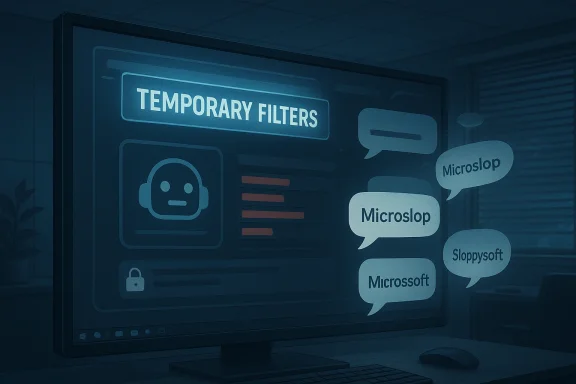
A computer monitor shows a “Temporary Filters” dashboard with chat bubbles labeled Microslop and Sloppysoft.Background​

The nickname “Microslop” has become shorthand across social media and tech forums for a specific frustration: the perception that Microsoft is aggressively stuffing low‑value or poorly integrated AI features into existing products, often at the expense of performance, clarity, or user choice. The meme accelerated after public-facing Microsoft commentary urging people to “move past” broad dismissals of AI as “slop,” which many interpreted as tone‑deaf given the visible quality problems users report with some recent Copilot and Edge integrations.
That cultural context is important. This wasn’t a word invented inside the Copilot community—it was a meme that had already crossed into browser extensions, image macros, and mainstream headlines. When moderators on the official Copilot Discord added “Microslop” to an automated keyword filter in response to what they characterized as a spam campaign, they accidentally turned a moderation action into a viral protest.

What happened, step by step​

The initial moderation move​

On or around March 1–2, 2026, Microsoft’s Copilot Discord moderators implemented temporary filters that blocked some terms described as associated with a spam campaign. Moderators configured the server so messages containing those phrases were flagged as “inappropriate,” preventing them from appearing publicly and prompting private moderation notices to the senders. Windows Latest first reported the filter’s presence; PC Gamer, Kotaku, and other outlets quickly confirmed it.

User workaround and escalation​

Users rapidly responded with simple obfuscation: swapping a zero for the letter O (“Microsl0p”), using spacing and punctuation, or adopting new epithets such as “Sloppysoft.” Those variants initially slipped past the server’s filters, and community members began posting them as an act of collective mockery and protest. That, in turn, changed the incident from a few blocked messages into a torrent of repeated, irrelevant posts—precisely the sort of activity moderators said they were trying to prevent.

Lockdown and the official statement​

Faced with the flood of evasion attempts and non‑Copilot spam, Microsoft temporarily restricted posting permissions, hid message history in affected channels, and paused invites while it implemented “stronger safeguards.” A spokesperson told reporters: “The Copilot Discord channel has recently been targeted by spammers attempting to disrupt and overwhelm the space with harmful content not related to Copilot. Initially, this spam consisted of walls of text, so we added temporary filters for select terms to slow this activity. We have since made the decision to temporarily lock down the server while we work to implement stronger safeguards to protect users from this harmful spam and help ensure the server remains a safe, usable space for the community.” Microsoft framed the move as defensive, not a content ban designed to suppress criticism.

Why the reaction was predictable​

This episode hits several predictable human and technical dynamics at once:
  • People love to mock power and authority online; attempts to silence a joke or nickname tend to amplify it rather than erase it. The Streisand effect is the simplest lens for what followed: censoring or filtering a meme often gives the meme a new boost. Media coverage immediately turned the moderation move into more clicks and more shares.
  • Keyword filters are brittle. When moderators rely on exact‑match blocks without comprehensive pattern rules (regex, wildcards, or careful exemptions), users find easy evasions—character substitutions, spacing, or alternative synonyms. The initial evasion strategy—“Microsl0p”—is the classic response to fragile word filters.
  • Community norms matter. A public corporate server tends to attract critics as much as supporters. Attempting heavy‑handed moderation in a populated public space without transparent communication is a fast track to distrust and performative backlash. The Copilot server’s move looked, to many observers, like a corporate attempt to suppress a grassroots critique rather than a narrowly tailored anti‑spam measure. Coverage and forum discussion reflected that perception.

Technical anatomy: how Discord moderation works (and why this failed)​

Discord’s native AutoMod and common bot ecosystems offer multiple ways to filter content, each with tradeoffs moderators must manage.
  • Exact keyword filters: AutoMod can block exact words or phrases; matches are generally case‑insensitive but depend on whitespace and punctuation. Exact matches are easy to set up but trivial to evade with simple substitutions.
  • Wildcards and partial matches: AutoMod supports wildcard patterns (e.g., word), which can catch word parts and reduce evasion, but they raise the risk of false positives by catching benign terms unintentionally.
  • Regular expressions (regex): For advanced moderation, AutoMod supports regex patterns that can detect many obfuscation patterns with a single rule. Regex is powerful but error‑prone; poorly tested regex can either under‑match (miss evasion) or over‑match (block legitimate discussion). Discord’s guidance explicitly warns that regex filtering “is advanced and not for the faint of heart.”
  • Spam detection vs. content moderation: Discord also offers spam content filters that detect high‑frequency posting and “walls of text.” Those systems are designed to throttle disruptive behavior but can require tuning to avoid penalizing passionate discussion or legitimate rapid threads. Microsoft’s spokesperson said "walls of text" were part of the initial spam profile.
In short: the tools exist to block “Microslop” and clever variants, but they require judicious configuration, testing, and transparent moderation policies to avoid collateral damage.

PR and trust: why wording and context mattered​

Microsoft’s statement framed the action as an anti‑spam intervention, yet the optics were poor for several reasons:
  • The affected term was not a private insult directed at staff but a public meme used across platforms to criticize product strategy. That made the filter look like opinion suppression rather than spam control.
  • The filter’s discovery by vigilant community members before Microsoft publicly acknowledged the action magnified the impression of secretive censorship. The initial reporting came from server members and Windows Latest screenshots rather than a preemptive corporate explanation.
  • Timing mattered. The meme gained traction after high‑profile Microsoft public comments (and product moves) that had already angered parts of the Windows community. A moderation action that seemed to favor company image over user feedback ran against the prevailing sentiment.
This isn't an abstract reputational risk. Public Discord servers are, for many companies, an official consumer touchpoint. Heavy‑handed moderation there damages the perception of openness—and when the moderated term is a critique that people already feel viscerally, the penalty for mistakes is public humiliation rather than quiet correction.

The broader cultural context: why “Microslop” sticks​

The Microslop meme reveals a set of recurring user complaints about modern software platforms, particularly where AI is concerned:
  • Feature bloat: Users complain that AI features are being layered on top of existing apps without sufficient useability testing or clear opt‑out paths.
  • Telemetry and control: Concerns about how deeply AI assistants integrate with local files, telemetry, and cloud services fuel suspicion.
  • Performance tradeoffs: AI features, especially when tightly integrated across many apps, can have measurable performance impacts or increase system complexity.
  • Perception of prioritization: When product updates emphasize AI branding or copilotification at the expense of basic UI polish or backward compatibility, users push back. The Microslop term succinctly encapsulates those grievances.
Because the term is short, catchy, and freighted with meaning, it functions as an organizing slogan for disparate complaints. Attempting to remove it by fiat is therefore doomed to be noisy.

Moderation best practices Microsoft and others ignored (or under‑applied)​

This episode is a useful case study in how large organizations should not handle sensitive moderation in public developer or product communities:
  • Be transparent about intent before large policy changes. Issue a short, clear explanation when enforcing new filters that could be interpreted as opinion suppression. Explain whether the filter is temporary, which channels are affected, and what the remediation steps are. Microsoft's public statement came after the filters were deployed and after media attention; an earlier, proactive explanation would have helped.
  • Prefer behavior‑based controls over content bans. Filtering based on posting rates, repeated identical messages, or automated bot patterns targets disruptive behavior directly and avoids squashing legitimate critical speech—especially satire. Discord’s spam filters and AutoMod patterns can be tuned to throttle repetition without banning specific words.
  • Use advanced pattern matching carefully and transparently. If you must block a meme, adopt regex or wildcard rules that minimize evasions and minimize false positives, and publish a redacted rule set for community review when appropriate. Debug and test in closed channels before rolling out to a public server.
  • Create clear appeals and remediation paths. When users are told a message is “inappropriate,” they need an obvious, quick way to contest or learn why. Without that, moderation messages feel arbitrary and fuel resistance. Discord’s AutoMod supports custom block messages—use them to be helpful rather than cryptic.
  • Treat public communities as strategic communications channels. Corporate communities should be staffed by moderators trained in both community norms and corporate policy. Rapid escalation pathways to communications teams are essential when PR risk is high.
These steps reduce the chance that a moderation action explodes into a viral reputation incident.

Legal and ethical considerations​

Moderation decisions on private platforms are legally permissible in most jurisdictions: platform owners generally have the right to set rules for their channels. But legal permissibility is not the same as wise stewardship.
  • Free speech optics: While Discord is private and legal free‑speech protections do not apply the same way they do to government actors, there's a strong cultural expectation among users that corporate communities will tolerate criticism, even barbed satire. Ignoring that norm is costly.
  • Consumer trust: Repeated attempts to curtail criticism undermine users’ willingness to engage in official channels—a subtle but real form of reputational erosion that can affect product feedback loops and bug reporting.
  • Regulatory scrutiny: If moderation is used to suppress whistleblowing, safety concerns, or consumer complaint reporting, companies can attract regulator interest in some jurisdictions. While that wasn’t the case here, poor moderation policies can raise red flags. Cite: general regulatory trend and public conversation. (This is a caution: there’s no public regulatory action tied to this particular incident as of this writing.)

What Microsoft could (and should) do now​

If the goal is to restore trust in the Copilot community, Microsoft has several concrete options:
  • Publicly publish the exact reasons for the temporary filters and an audit of which rules were active and why. Transparency would shift the narrative from “secret censorship” to “targeted, explained anti‑spam work.”
  • Reconfigure moderation to emphasize behavioural heuristics (rate limits, identical message blocks, bot detection) before resorting to content‑based keyword blocks. This preserves critical speech while stopping disruption.
  • Offer a moderation FAQ and appeal process inside the Copilot Discord so users understand how Automatic Moderation works, what triggers blocks, and how to contest them. Discord’s own guidance supports custom block messages and alerts to moderator channels—use that functionality to educate rather than obscure.
  • Use this as an opportunity to listen: host an open “office hours” conversation with moderators and product leads to surface genuine product complaints hidden behind memes. Memes are not just jokes—they’re a form of product feedback and an early warning system for user pain points.

Why the episode matters beyond a single Discord server​

This isn’t simply a giggle about a banned word. It’s a microcosm of a larger tension that will define corporate‑consumer relations in the AI era: companies that are aggressively integrating AI across products will face persistent cultural backlash when users feel features are added for brand or investor signaling rather than genuine user benefit.
The Copilot Discord incident shows how vulnerable public relations and community trust are when moderation is applied without clear communication. It also underscores a perennial truth about the internet: trying to bury an idea often makes it stronger. The word “Microslop” will be harder to kill now than it was a week ago; the attempted suppression made the term more visible to people who had never heard it before.

Final analysis: a modest playbook for avoiding the next Microslop​

If you work inside product or community moderation at a large company, take note:
  • Focus on behavior, not opinion. Stop the spam, not the joke.
  • Communicate early and honestly. A short note explaining policy intent cuts off speculation.
  • Test moderation rules in private before applying them publicly. Regex and wildcard traps can be subtle.
  • Remember that community spaces are for engagement; heavy enforcement that feels like censorship drives conversation to more hostile platforms.
Microsoft’s Copilot Discord fiasco is, in the end, a cautionary tale about how automation, corporate sensitivity, and meme culture collide. It’s also an object lesson in humility: in public communities, the quickest way to make a joke permanent is to attempt to delete it.
The good news for community managers everywhere: the tools exist to manage spam without clamping down on criticism. The harder work is cultural—choosing to treat user anger as feedback rather than as something to silence. Microsoft has the technical means to do that; whether it will change the way it listens is a different question altogether.

Conclusion
A keyword filter, a quick community revolt, and a temporary lockdown—this sequence repeats across the internet because people respond to perceived censorship the same way: loudly and creatively. Microsoft’s statement framed the action as an anti‑spam defense, and technically that defense was reasonable; operationally and culturally, it was clumsy. The lesson is straightforward: when moderating official public channels, especially in an era of heightened sensitivity about AI, transparency, behavior‑based controls, and rapid communication matter far more than any single blocked word.

Source: TheGamer Microsoft Bans The Word "Microslop" In Copilot's Discord Server, Which Goes Predictably Poorly
 

Back
Top