

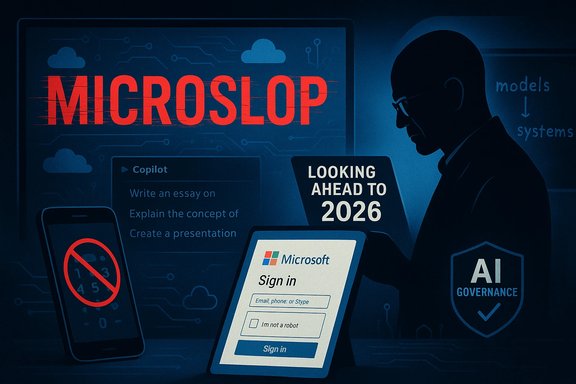
Satya Nadella’s offhand instruction to “get beyond the arguments of slop vs sophistication” has become a corporate optics crisis for Microsoft — spawning the viral “Microslop” meme, intensifying scrutiny of Windows 11’s ongoing reliability problems, and arriving the same week users discovered Microsoft has effectively ended decades‑old phone‑based product activation in favor of an online, account‑based portal.
Satya Nadella published a concise year‑end reflection titled “Looking Ahead to 2026” on his personal sn scratchpad site, urging the industry to move from model showmanship to systems engineering — and to “get beyond the arguments of slop vs sophistication.” The essay framed 2026 as a turning point where AI must demonstrate measurable, real‑world impact rather than just dazzling demos. That rhetorical turn collided with a cultural moment. “Slop” had already entered mainstream vocabulary after Merriam‑Webster named it its 2025 Word of the Year, defining it as “digital content of low quality that is produced usually in quantity by means of artificial intelligence.” The association made Nadella’s plea sound, to many readers, like a plea to stop criticizing legitimate product failures — and the one‑word mockery “Microslop” spread quickly across social platforms. The result: a reputational flashpoint in which executive rhetoric about long‑term engineering discipline collided with a wave of user complaints about immediate, tangible product regressions.
Benefits of that posture:
The Microslop moment isn’t merely viral mockery. It’s a concise, socially amplified signal of a credibility gap. Microsoft can close that gap by turning high‑level commitments into auditable product promises: verifiable reliability metrics, restored offline options for mission‑critical deployments, conservative marketing that matches delivered capabilities, and defaults that respect user agency. Until those steps are visible and measurable, the company’s aggressive AI timetable will continue to be weighed against whether core Windows experiences — activation, stability, and predictable behavior — remain intact for the millions that still rely on them.
Source: Technobezz Satya Nadella's Slop Remark Sparks Viral Backlash Against Microsoft
 Background: how a short blog post ignited a reputational storm
Satya Nadella published a concise year‑end reflection titled “Looking Ahead to 2026” on his personal sn scratchpad site, urging the industry to move from model showmanship to systems engineering — and to “get beyond the arguments of slop vs sophistication.” The essay framed 2026 as a turning point where AI must demonstrate measurable, real‑world impact rather than just dazzling demos. That rhetorical turn collided with a cultural moment. “Slop” had already entered mainstream vocabulary after Merriam‑Webster named it its 2025 Word of the Year, defining it as “digital content of low quality that is produced usually in quantity by means of artificial intelligence.” The association made Nadella’s plea sound, to many readers, like a plea to stop criticizing legitimate product failures — and the one‑word mockery “Microslop” spread quickly across social platforms. The result: a reputational flashpoint in which executive rhetoric about long‑term engineering discipline collided with a wave of user complaints about immediate, tangible product regressions.The facts on the table
Nadella’s thesis: models → systems and the “theory of the mind”
Nadella’s short post lays out three interlinked priorities: treat AI as a scaffold that amplifies human ability, move from isolated models to orchestration layers (memory, entitlements, provenance), and make deliberate choices about where AI should be diffused so it earns “societal permission.” Those are defensible, engineering‑oriented prescriptions — but the post offers little in the way of concrete timelines, independent validation mechanisms, or immediate product commitments.The social reaction: “Microslop” and what it signals
Within hours of coverage amplifying Nadella’s post, social channels compressed a diffuse set of grievances — flaky Copilot outputs, intrusive UI placements, defaults that favor telemetry and account linking, and performance regressions — into a single meme: “Microslop.” That meme functions as a coordination device: it organizes disparate complaints into a repeatable signal that enterprise buyers and regulators pay attention to. Independent hands‑on tests and community threads corroborate many of these operational complaints rather than showing them to be pure trolling.A major UX change: phone activation disappears in practice
Multiple outlets and user reports documented that the traditional method of activating Windows and Office by phone — a process dating back decades — now appears to be defunct in practice. Callers to well‑known activation numbers report hearing automated messages that redirect them to an online activation portal (aka.ms/aoh) which requires signing in with a Microsoft or business account and often completing CAPTCHA flows. Independent testing and multiple news outlets reported the change; Microsoft’s support pages initially continued to list phone activation options even as the hotline redirected callers, creating a disconnect between documentation and user experience.Why the timing is combustible
Microsoft’s corporate posture at the moment combines three combustible elements:- A highly public, aggressive pivot to AI across Windows, Microsoft 365, Edge and device partners — Copilot is everywhere.
- Concrete, reproducible user complaints about reliability, hallucinations, intrusive defaults and performance regressions in AI‑driven features.
- Visible friction around long‑standing, user‑facing mechanisms (offline activation, local account options) that signal a tightening of cloud‑first, identity‑first flows.
Product reality checks (what independent testing shows)
Copilot features often fail to match marketing demos
Independent retests of the scenarios shown in Microsoft’s Copilot holiday advertising found multiple gaps. The Verge’s investigation reproduced several ad prompts and observed hallucinated interface elements, incomplete automations, and outcomes that didn’t align with the commercial’s presentation. Microsoft acknowledged some creative assets in the advert were fabricated or edited for brevity, which further strained credibility. These ad‑to‑reality gaps amplify the “slop” perception.Windows 11 quality and adoption friction
Longstanding compatibility and design complaints about Windows 11 remain in market discourse: design regressions, driver and app compatibility issues, and perceived slowness to address regressions on diverse hardware. The OS’s TPM 2.0 and CPU eligibility gate further constrained broad in‑place upgrades from Windows 10, contributing to an enduring base of users who prefer the known stability of Windows 10. Large pools of devices still run Windows 10 because hardware or procurement realities make an upgrade painful or impossible; that contributes to market friction when Microsoft aggressively bakes Copilot into the OS experience.Activation and offline workflows: a practical barrier
The phone activation route served as a critical offline method for air‑gapped systems, devices in remote locations, legacy installations, and institutions that avoid cloud‑bound Microsoft accounts. Replacing that path with a portal that requires network access, CAPTCHA, and account credentials creates concrete operational pain for multiple constituencies: field technicians, governments with air‑gap requirements, and users in low‑connectivity regions. The documentation vs reality mismatch — support pages still listing phone activation even as the hotline redirects callers — adds to the confusion.The strategic tradeoffs Microsoft appears to be making
Microsoft’s leadership is visibly willing to accept short‑term user dissatisfaction in return for building an AI foundation across its products. Nadella’s note mentions AI repeatedly and offers a roadmap focused on systems engineering and diffusion, while not addressing specific Windows quality concerns, Surface hardware, or Xbox pricing in the same breath. That prioritization signals a classic platform pivot: invest heavily in future platform primitives (agents, NPUs, Copilot+ PCs) at the cost of near‑term product polish for legacy anchors.Benefits of that posture:
- Scale advantage in cloud, models, and enterprise contracts if execution succeeds.
- Early positioning for on‑device acceleration (Copilot+ PC guidance, NPU targets), which can become a differentiator.
- Potential to capture AI dependency as a moat if customers accept integrated agentic experiences.
- Erosion of goodwill among core Windows users and IT admins, who care about reliability and control.
- Procurement and regulatory risk as enterprises demand auditable, monitored AI flows and clear SLAs.
- Alienation of niche use cases (air‑gapped systems, strict local‑account environments), which can create operational and political pushback particularly in public sector deployments.
Financial and historical perspective: Windows’ commercial weight
Historical reference points matter for assessing risk. In fiscal 2015 Microsoft’s annual report shows the line item “Windows PC operating system” brought in roughly $14.8 billion of $93.6 billion total revenue — about 15–16% of overall revenue that year. Framing Windows as “one‑fifth” of Microsoft’s 2015 revenue slightly overstates the share; the accurate figure from Microsoft’s filings is closer to the mid‑teens percentage range. That matters because it shows that while Windows has long been a meaningful cash engine, Microsoft’s revenue mix has shifted materially toward cloud and commercial services in subsequent years — which changes the calculus for leadership investing heavily in Azure and AI.The enterprise and public‑sector impact: beyond consumer frustration
Phone activation removal and policy shifts toward mandatory online accounts are not purely consumer pains: they materially affect enterprise, government, and educational deployments.- Air‑gapped systems and restricted networks lose a durable offline activation path, creating compliance and deployment friction for critical infrastructure.
- Government procurement and regulated sectors frequently require local account models or documented offline activation for auditability and sovereignty reasons; the portal‑only approach raises procurement questions.
- Schools that adopted Windows 11 SE and low‑cost hardware now face an OS SKU sunset that compresses migration timelines and forces procurement choices — Windows 11 SE’s final feature release is 24H2 and support is scheduled to end in October 2026 for that SKU, leaving districts to plan transitions.
Credibility and communications: why tone matters as much as technical fixes
Two communication errors amplify the technical issues:- Rhetoric perceived as dismissive. Senior leaders framing user grievances as mere fixation on “slop” or as an overreaction to demos can be read as dismissive of legitimate operational pain. When product leaders react to criticism with expressions of incredulity, it risks hardening a negative narrative into enduring reputational damage.
- Marketing that outpaces reality. Ads that depict capabilities not reliably available in shipping products — for example, holiday commercials showing Copilot smoothly orchestrating smart home tasks that real tests found flaky — deepen skepticism. When marketing demonstrates features that many users cannot reproduce, trust erodes faster than product teams can fix bugs.
Practical, testable recommendations for Microsoft
- Publish reproducible reliability metrics for core Copilot flows (email summarization, schedule automation, vision→action tasks) and commit to quarterly transparency updates.
- Make provenance and confidence visible by default in Copilot responses, and add a single‑click “human review / undo” for any automated action.
- Restore or provide an audited offline activation fallback (or a supported, documented migration path for air‑gapped systems) to remove the operational risk for regulated customers.
- Reintroduce explicit opt‑in defaults for persistent memory or background agents, and require enterprise admin enablement for agentic defaults in corporate images.
- Fund independent third‑party benchmarks for on‑device NPU performance claims (e.g., the “40+ TOPS” Copilot+ guidance) and publish redacted audit findings where feasible.
What users and IT teams should do now
- Treat December 2025–January 2026 as a product‑assurance audit window: validate Copilot flows used in production with repeatable test cases before rolling into critical workflows.
- For offline or low‑connectivity deployments, inventory activation and account requirements and plan migration or alternative licensing strategies; do not assume the phone route remains functional.
- For schools with Windows 11 SE fleets, treat October 2026 as a hard deadline for migration planning: inventory devices, evaluate hardware feasibility for upgrades, and prepare budgets and timelines.
Strengths worth acknowledging
Microsoft still holds structural advantages for delivering durable AI systems: massive cloud footprint, enterprise relationships, identity and compliance tooling, and deep integration across productivity suites. Nadella’s high‑level framing — move from spectacle to meaningful systems engineering and governance — is the correct strategic posture for long‑term industry stability and policy compliance. If executed honestly and visibly, it could restore trust.Risks if Microsoft fails to align words with verifiable action
- A durable brand penalty: once customers adopt a shorthand like “Microslop,” it becomes a procurement talking point that can be amplified in buying committees and by regulators.
- Enterprise pullback: procurement teams could decouple or delay Copilot deployments pending verifiable metrics, independent audits, and stronger SLAs.
- Regulatory heat: product misrepresentations and forced cloud‑only experiences invite scrutiny in privacy and competition frameworks, especially for public sector contracts.
- Channel friction: OEMs and education partners may resist costly hardware or SKU changes if Microsoft’s product work does not materially reduce the operational burden on end customers.
Conclusion — the narrow path forward
Satya Nadella’s call to move “beyond slop” is both a strategy and a test. The strategy — pivot from model demos to system engineering, stronger governance, and selective diffusion — is sound in principle. The test is execution: the public will judge Microsoft not by manifestos but by measured improvements in everyday product quality, clearer communications, and tangible accommodations for users who need offline and local‑account workflows.The Microslop moment isn’t merely viral mockery. It’s a concise, socially amplified signal of a credibility gap. Microsoft can close that gap by turning high‑level commitments into auditable product promises: verifiable reliability metrics, restored offline options for mission‑critical deployments, conservative marketing that matches delivered capabilities, and defaults that respect user agency. Until those steps are visible and measurable, the company’s aggressive AI timetable will continue to be weighed against whether core Windows experiences — activation, stability, and predictable behavior — remain intact for the millions that still rely on them.
Source: Technobezz Satya Nadella's Slop Remark Sparks Viral Backlash Against Microsoft
