

Microsoft is using the 2026 Microsoft 365 Community Conference to tell a bigger story about where its workplace AI strategy is headed: from Copilot as a productivity helper to agents as operational teammates. The company’s Microsoft Digital IT organization is positioning itself as Customer Zero, showing how it deployed Copilot at enterprise scale, hardened governance, and is now moving into agent adoption across the business. That shift is not just a product story; it is an argument about how modern IT organizations should balance innovation, safety, and measurable business value. oft’s own framing makes clear that this year’s conference is less about a single feature announcement and more about a staged transition in workplace computing. The company says it has already reached a level of maturity with Copilot that allows it to move from individual productivity toward systems that can reason and collaborate on employees’ behalf, and it explicitly identifies agents as the next focus. That language matters because it reframes AI from a drafting assistant into a workflow layer, which is a much larger operational ambition.
The conference itsepril 21–23, 2026 in Orlando, and Microsoft is using it to showcase how it manages adoption, controls risk, and operationalizes AI internally. That aligns with the broader 2026 conference narrative that centers on intelligent work, Copilot, and agentic AI across Microsoft 365. The message is clear: Microsoft wants attendees to see not just what is possible, but what is already working inside one of the world’s largest IT organizations.
This is a particularly important moment because Microsoft has spent the last two years turning Copilot into an enterprise platform rather than a single assistant. Internal stories from Microsoft Digital now emphasize Copilot adoption at scale, governance controls, and the use of the Copilot Control System and related admin tooling to manage health, satisfaction, and risk. That internal maturity gives Microsoft a strong narrative advantage: it can speak about AI governance from a position of lived experience rather than theory.
The result is a conference agenda that looks unusually practical. Instead of asking whether AI should be adopted, Microsoft is asking how organizations can deploy it responsibly, where it creates measurable value, and how administrators can keep control as agents become more capable. That is a more serious conversation, and it reflects where enterprise AI is heading in 2026.
The conference matters because Microsoft is effectively using its own workforce as a proving ground. By treating Microsoft Digital as Customer Zero, the company can present lessons from a real, large-scale rollout rather than a pilot lab. That gives its sessions a credibility many vendor presentations lack.
It also matters because the market has moved past novelty. Most enterprises now understand what Copilot is in broad terms, but they want to know whether it can be governed, whether it improves work, and whether agents can be trusted to act inside real business processes. Microsoft’s conference sessions are designed to answer those questions.
That matters for rivals too. If Microsoft can make agents feel safe, useful, and native to the workplace, it strengthens the argument that the best AI platform is the one already closest to email, meetings, documents, identities, and compliance. In other words, Microsoft is trying to convert ubiquity into trust.
The company’s internal deployment history is also notable for its scale. Microsoft has publicly discussed deploying Copilot to hundreds of thousands of employees and vendors worldwide, which makes its operating environment one of the most demanding test beds in enterprise software. When Microsoft talkss not speaking hypothetically; it is talking about a massive, heterogeneous workforce with real security and compliance constraints.
That scale has pushed Microsoft to think differently about governance. Instead of treating governance as a post-launch concern, the company now presents it as a prerequisite for innovation. Internal sessions at the conference emphasize identity, permissions, data boundaries, and misuse prevention, which signals that the organization sees governance not as red tape but as the condition that makes experimentation possible. That is a subtle but important shift in enterprise AI thinking.
Another part of the background is Copilot’s evolution from a single assistant into a broader platform. Microsoft has steadily expanded the product story to include app integration, agent orchestration, admin controls, and security tooling. The company’s messaging now spans Microsoft 365, Copilot Studio, Agent 365, Defender, Purview, Entra, and other compo an operating model rather than a standalone chatbot.
This is why the move to agents is such a logical next step. If Copilot can already summarize, draft, and organize, then adding agentic behavior lets Microsoft claim it can also coordinate work across systems. That is a much bigger promise, and it creates a much larger governance burden.
The lesson is simple: AI adoption is no longer just about user enthusiasm. It depends on whether IT can give people confidence to experiment without creating operational chaos. Microsoft appears to have internalized that lesson and is now packaging it as a core part of its public story.
One of the clearest signals is the session on managing and governing agents, which brings together Microsoft Agent 365, Microsoft Defender, and Microsoft Purview. That combination tells you exactly how Microsoft wants enterprises to think about agents: as manageable assets that need identity, security, and compliance controls from day one.
Another important session focuses on reclaiming engineering time with AI in Azure DevOps. This is significant because it shows Microsoft applying the same logic to software engineering that it is applying to pr The company is arguing that AI should disappear into the tools people already use, reducing manual overhead rather than adding another layer of work.
There is also a governance lightning talk and a session on Copilot controls, both of which reinforce the same message: organizations need visibility into what AI is doing, who can use it, and how it is governed. Microsoft is clearly betting that trust will be a major purchasing criterion in the agent era.
That approach also helps Microsoft avoid overpromising. If attendees see practical demos and administration patterns, they are more likely to believe the platform can scale. The company is effectively converting AI into an IT discipline, not just a product pitch.
That transition is important because it reflects how the AI market is evolving. The first wave of workplace AI was about speeding up individual tasks. The next wave is about delegating sequences of work, coordinating across apps, and using AI as a bridge between intent and execution. Microsoft is betting that Copilot is the platform on which that transition will happen inside the enterprise.
From a technical standpoint, Copilabout context. It lives close to documents, meetings, email, chat, and identity, which means it can infer work patterns more effectively than isolated tools. That is why Microsoft keeps describing Copilot as a layer across the Microsoft 365 estate rather than a single standalone application.
From a business standpoint, Copilot also creates a new kind of stickiness. If employees increasingly begin tasks in Copilot, the platform becomes a habit, and habits are hard to replace. That is why the move from “assistant” to “operating layer” is so strategically important.
Microsoft’s internal and public messaging now reflect that maturity. The company has moved from asking whether AI belongs in work software to asking how much of the workflow AI should handle. That is a sign of real platform evolution.
That is also why Microsoft is pairing Copilot with governance, identity, and compliance controls rather than treating them as separate concerns. The company knows that the future of Copilot depends on whether IT can say yes more often without sacrificing safety.
In practical terms, that means Microsoft wants agents to handle routine or semi-routine work that currently requires human coordination. Think of status updates, triage, task delegation, knowledge lookup, and cross-app transitions. Those are precisely the kinds of tasks that create friction in large organizations, which is why the promise is so appealing.
But there is a real distinction between “help me work” and “do the work.” The more an agent can act, the more the platform has to prove it will act correctly, transparently, and within policy. That is where Microsoft’s governance-first story becomes essential rather than optional.
It also changes the way users evaluate value. A good draft is nice. A trustworthy agent that saves a recurring hour every week is transformative. Microsoft’s conference messaging strongly suggests it wants customers to start measuring AI by process compression, not just content generation.
This is also why guardrails are now a product story. In the agent era, safety is not just a compliance requirement; it is a usability feature. If users feel confident that the system is bounded, they will use it more often. If they do not, they will revert to manual work.
At the same time, organizations will need new operating norms. Approvals, auditability, scope control, and user education become more important when software can take action. Microsoft’s internal experience suggests the company knows that adoption without discipline is not sustainable.
This matters because here AI initiatives fail. Organizations can get excited about what a tool can do, only to discover that they cannot monitor it, constrain it, or explain it to risk teams. Microsoft is trying to preempt that failure by making governance central to the product narrative.
Sessions focused on Microsoft Agent 365, Defender, and Purview are evidence of that strategy. These are not decorative add-ons; they are the mechanisms by which Microsoft wants enterprises to classify, manage, and secure agents at scale. If that story holds up in practice, it could become a major differentiator.
The company’s approach also recognizes a hard truth: unmanaged AI is a liability. As more agents appear across organizations, the risk of sprawl, over-permissioning, and invisible automation grows quickly. Microsoft is betting that customers will prefer a governed ecosystem over a chaotic one.
The company’s internal speakers reinforce that idea. Microsoft Digital leaders responsible for architecture, compAI operations are positioned as people who manage the real mechanics of safe adoption. That makes the conference’s governance content more credible than a generic product pitch.
That argument is especially persuasive in large enterprises, where the cost of a bad AI deployment is high. Microsoft’s own posture suggests it wants to be the vendor that can say yes responsibly, rather than the one that merely ships the newest feature first.
That makes governance the real differentiator, not just for Microsoft but for the broader AI market. The vendors that can prove safe operationalization will win the right to handle the most valuable workflows. Microsoft clearly wants to be in that group.
The session suggests Microsoft is embedding AI directly into existing development workflows rather than forcing teams into a separate AI tool. That design choice is critical. Engineers generally do not want another platform to manage; they want useful assistance where they already work.
Microsoft is also tying the Azure DevOps story to downstream effectiveness in GitHub Enterprise and Copilot, which hints at a broader workflow chain. The message is that AI should improve the quality of work upstream so the rest of the system benefits downstream. That is a systems-thinking approach, and it is exactly how enterprise IT should think about productivity.
It also matters because software delivery teams often become the earliest power users of AI tools. If Microsoft can show that its own engineers benefit from embedded AI without extra cognitive load, it strengthens the broader claim that Copilot-style experiences belong inside core business systems.
That is also a subtle competitive move. If the best AI capabilities are nvity stack, standalone point tools have a harder time justifying their existence. Microsoft’s strategy here is not just to add features; it is to collapse the distance between work and automation.
The deeper lesson is that Microsoft is not only trying to speed up content creation. It is trying to make the software deveelf more efficient, which is a much more credible enterprise AI story.
The session on driving adoption across Microsoft is especially revealing because it emphasizes how Microsoft rolled out Copilot to more than 300,000 employees and vendors worldwide, then used change management strategies to encourage people to thread Copilot into daily work. That is a classic enterpge, only at unusually large scale.
Microsoft also highlights community-driven enablement, such as the Copilot Champs community lead and internal advocacy approaches. This suggests the company understands that adoption is social as much as technical. People often adopt tools because peers show them how the tools make wpany’s framing is especially useful because it avoids the trap of assuming employees will naturally gravitate toward AI. In reality, many users need proof, examples, coaching, and permission to change established habits. Microsoft seems to be building all of those layers.
That also explains why the company talks so much about satisfaction signals, health . If you cannot measure adoption quality, you cannot improve it. Microsoft appears to be treating adoption as an instrumented process, not a vague change campaign.
That is why the company keeps tying AI The faster employees see AI as a support system rather than an imposed mandate, the more likely the adoption curve will hold.
That is a powerful position. It means Microsoft can iterate on AI not only as a vendor, but as a very large user of its own stack. In the age of agents, that may matter as much as model quality.
This also raises the stakes for app partners. If Copilot becomes the default starting point for more tasks, then third-party tools may need to prove they add enough value to justify leaving the Microsoft 365 surface. That is a subtle but real platform power shiftegy is not to replace every application. It is to become the layer above them, where work begins and is increasingly completed. If that works, the company gains leverage across licensing, ecosystem participation, and user habit formation.
That is a tall order. Microsoft’s installed base and operational footprint give it a head start that competitors will struggle to match unless they can offer a distinctly better experience or a clearer niche.
But gravity cuts both ways. If Microsoft makes Coor too hard to govern, it could damage the very trust that makes the platform valuable. The company must keep the experience coherent as it grows.
The opportunity is not simply to sell more AI features. It is to turn Copilot into the default interface for business intent, where employees start tasks, agents carry out routine work, and IT keeps control through central policy. If Microsoft can deliver that consistently, it will strengthen both customer retention and platform relevance.
Another concern is agent sprawl. Once organizations can create or deploy agents more easily, the number of managed objects grows quickly, and so does the burden on IT and compliance teams. Without strong lifecycle controls, the platform could become harder to understand rather than easier.
The other thing to watch is whether Microsoft continues to blur the line between Copilot, apps, and agents. That blurring can be powerful if it makes the experience simpler. It can also be dangerous if it confuses users about what is happening, what is governed, and who is responsible. The company’s success will depend on making the future feel unified rather than messy.
Source: Microsoft Unfolding our AI in IT story: What to expect at the 2026 Microsoft 365 Community Conference - Inside Track Blog
The conference itsepril 21–23, 2026 in Orlando, and Microsoft is using it to showcase how it manages adoption, controls risk, and operationalizes AI internally. That aligns with the broader 2026 conference narrative that centers on intelligent work, Copilot, and agentic AI across Microsoft 365. The message is clear: Microsoft wants attendees to see not just what is possible, but what is already working inside one of the world’s largest IT organizations.
This is a particularly important moment because Microsoft has spent the last two years turning Copilot into an enterprise platform rather than a single assistant. Internal stories from Microsoft Digital now emphasize Copilot adoption at scale, governance controls, and the use of the Copilot Control System and related admin tooling to manage health, satisfaction, and risk. That internal maturity gives Microsoft a strong narrative advantage: it can speak about AI governance from a position of lived experience rather than theory.
The result is a conference agenda that looks unusually practical. Instead of asking whether AI should be adopted, Microsoft is asking how organizations can deploy it responsibly, where it creates measurable value, and how administrators can keep control as agents become more capable. That is a more serious conversation, and it reflects where enterprise AI is heading in 2026.
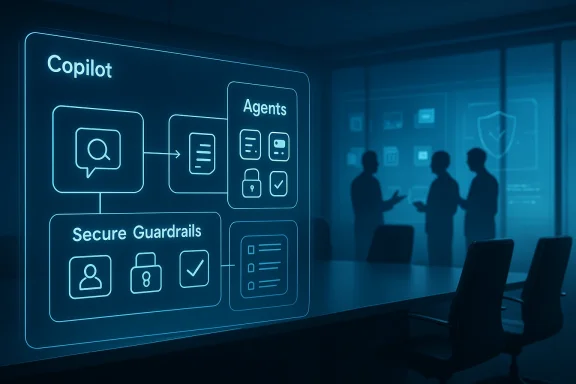 Why this conference matters
The conference matters because Microsoft is effectively using its own workforce as a proving ground. By treating Microsoft Digital as Customer Zero, the company can present lessons from a real, large-scale rollout rather than a pilot lab. That gives its sessions a credibility many vendor presentations lack.It also matters because the market has moved past novelty. Most enterprises now understand what Copilot is in broad terms, but they want to know whether it can be governed, whether it improves work, and whether agents can be trusted to act inside real business processes. Microsoft’s conference sessions are designed to answer those questions.
- Copilot is shifting from drafting to delegated work.
- Governance is now positioned as a growth enabler, not a brake.
- Microsoft Digital is using internal deployment lessons as proof points.
- Agents are becoming the center of the company’s AI story.
The strategic backdrop
The strategic backdrop is a broader industry movement toward agentic AI, where software does not just respond to prompts but performs multi-step work. Microsoft has already been laying the groundwork across Microsoft 365, Copilot Studio, security, and admin tooling. The conference is likely to reinforce that the company sees this as the next phase of office productivity.That matters for rivals too. If Microsoft can make agents feel safe, useful, and native to the workplace, it strengthens the argument that the best AI platform is the one already closest to email, meetings, documents, identities, and compliance. In other words, Microsoft is trying to convert ubiquity into trust.
Background
Microsoft’s “Customer Zero” approach has long been part of its product culture, but Copilot has given it a new level of importance. The company says Microsoft Digital embedded Microsoft 365 Copilot into employees’ daily workflows and carefully monitored the results, then used those learnings to guide broader adoption. That internal loop is powerful because it lets Microsoft test change management, measure behavior, and refine governance before it asks customers to do the same.The company’s internal deployment history is also notable for its scale. Microsoft has publicly discussed deploying Copilot to hundreds of thousands of employees and vendors worldwide, which makes its operating environment one of the most demanding test beds in enterprise software. When Microsoft talkss not speaking hypothetically; it is talking about a massive, heterogeneous workforce with real security and compliance constraints.
That scale has pushed Microsoft to think differently about governance. Instead of treating governance as a post-launch concern, the company now presents it as a prerequisite for innovation. Internal sessions at the conference emphasize identity, permissions, data boundaries, and misuse prevention, which signals that the organization sees governance not as red tape but as the condition that makes experimentation possible. That is a subtle but important shift in enterprise AI thinking.
Another part of the background is Copilot’s evolution from a single assistant into a broader platform. Microsoft has steadily expanded the product story to include app integration, agent orchestration, admin controls, and security tooling. The company’s messaging now spans Microsoft 365, Copilot Studio, Agent 365, Defender, Purview, Entra, and other compo an operating model rather than a standalone chatbot.
From assistant to operating layer
The most important conceptual change is that Copilot is no longer being described merely as an assistant that helps you write faster. It is increasingly presented as a layer that can connect actions, content, and approvals across Microsoft 365. That means the value proposition shifts from convenience to continuity.This is why the move to agents is such a logical next step. If Copilot can already summarize, draft, and organize, then adding agentic behavior lets Microsoft claim it can also coordinate work across systems. That is a much bigger promise, and it creates a much larger governance burden.
The governance lesson
Microsoft’s own governance language is unusually mature for a company still in a relatively early phase of agentic rollout. The company keeps stressing guardrails, tenant configuration, and secure adoption because it understands that unsafe AI will not scale in the enterprise. That is especially true in environments where a single bad permission decision can expose data or trigger unintended actions.The lesson is simple: AI adoption is no longer just about user enthusiasm. It depends on whether IT can give people confidence to experiment without creating operational chaos. Microsoft appears to have internalized that lesson and is now packaging it as a core part of its public story.
The Conference Agenda
Microsoft’s conference sessions are built around a very specific set of themes: change management, AI adoption, governance, and practical deployment. The company is not merely showcasing features; it is showing how those features fit into enterprise operations. That makes the agenda especially relevant to IT leaders who need more than a demo.One of the clearest signals is the session on managing and governing agents, which brings together Microsoft Agent 365, Microsoft Defender, and Microsoft Purview. That combination tells you exactly how Microsoft wants enterprises to think about agents: as manageable assets that need identity, security, and compliance controls from day one.
Another important session focuses on reclaiming engineering time with AI in Azure DevOps. This is significant because it shows Microsoft applying the same logic to software engineering that it is applying to pr The company is arguing that AI should disappear into the tools people already use, reducing manual overhead rather than adding another layer of work.
There is also a governance lightning talk and a session on Copilot controls, both of which reinforce the same message: organizations need visibility into what AI is doing, who can use it, and how it is governed. Microsoft is clearly betting that trust will be a major purchasing criterion in the agent era.
Session highlights
- Managing and governing agents with Agent 365, Defender, and Purview.
- Reclaiming engineering time with Azure DevOps AI.
- Governance for Copilot and agents in Microsoft 365.
- Adoption lessons from Microsoft Digital’s own Copilot rollout.
- A fireside chat focuseperience and business outcomes.
Why the session design is smart
The session design is smart because it mirrors the real buying journey. Enterprises rarely start with “How do we deploy agents?” They start with “How do we keep this safe, useful, and manageable?” By structuring the conference around governance, adoption, and operational value, Microsoft is meeting the audience where it is.That approach also helps Microsoft avoid overpromising. If attendees see practical demos and administration patterns, they are more likely to believe the platform can scale. The company is effectively converting AI into an IT discipline, not just a product pitch.
The enterprise message beneath the m conference marketing is a serious enterprise message: AI adoption succeeds when it is tied to known workflows, governed centrally, and measured against real outcomes. Microsoft is using its own IT organization to show that employee confidence and operational discipline can coexist. That is a stronger story than raw capability claims alone.
The emphasis on customer experience also matters. Microsoft is bringing in a customer fireside chat specifically to translate internal lessons into external value, which suggests it wants attendees to leave with deployable ideas, not just inspiration. That kind of practical framing is exactly what enterprise buyers now demand.Copilot as the Foundation
Microsoft’s Copilot story has matured from experimentation to operational dependence. The company’s internal deployments show that Copilot can be embedded into day-to-day work, but the conference is asking a more advanced question: what happens after Copilot becomes normal? The answer, according to Microsoft, is agents.That transition is important because it reflects how the AI market is evolving. The first wave of workplace AI was about speeding up individual tasks. The next wave is about delegating sequences of work, coordinating across apps, and using AI as a bridge between intent and execution. Microsoft is betting that Copilot is the platform on which that transition will happen inside the enterprise.
From a technical standpoint, Copilabout context. It lives close to documents, meetings, email, chat, and identity, which means it can infer work patterns more effectively than isolated tools. That is why Microsoft keeps describing Copilot as a layer across the Microsoft 365 estate rather than a single standalone application.
From a business standpoint, Copilot also creates a new kind of stickiness. If employees increasingly begin tasks in Copilot, the platform becomes a habit, and habits are hard to replace. That is why the move from “assistant” to “operating layer” is so strategically important.
What changed since the first Copilot wave
The first Copilot wave was about proving that generative AI could be useful in mainstream productivity tools. The current wave is about proving that those tools can support delegated work without losing control. That is a much higher bar, but it is also where the market is heading.Microsoft’s internal and public messaging now reflect that maturity. The company has moved from asking whether AI belongs in work software to asking how much of the workflow AI should handle. That is a sign of real platform evolution.
Why the foundation matters more than the flash
The foundation matters more than the flash because enterprise AI is not won by the most impressive demo alone. It is won by the system that can be trusted every day, across thousands of users, under real governance constraints. Microsoft’s conference content suggests it understands that distinction very well.That is also why Microsoft is pairing Copilot with governance, identity, and compliance controls rather than treating them as separate concerns. The company knows that the future of Copilot depends on whether IT can say yes more often without sacrificing safety.
Agents and the New Work Model
Agents are the centerpiece of Microsoft’s 2026 AI story because they extend Copilot from suggestion to action. The company’s language is careful, but the underlying ambition is clear: agents should be able to collaborate on behalf of employees, provided the right guardrails exist. That is a huge shift in how software works.In practical terms, that means Microsoft wants agents to handle routine or semi-routine work that currently requires human coordination. Think of status updates, triage, task delegation, knowledge lookup, and cross-app transitions. Those are precisely the kinds of tasks that create friction in large organizations, which is why the promise is so appealing.
But there is a real distinction between “help me work” and “do the work.” The more an agent can act, the more the platform has to prove it will act correctly, transparently, and within policy. That is where Microsoft’s governance-first story becomes essential rather than optional.
From prompts to delegated execution
The shift from prompts to delegated execution is probably the single most important change in enterprise AI this year. Microsoft’s own framing suggests that employees no longer need only an answer or a draft; they need systems that can move work forward. That is a much richer and riskier model.It also changes the way users evaluate value. A good draft is nice. A trustworthy agent that saves a recurring hour every week is transformative. Microsoft’s conference messaging strongly suggests it wants customers to start measuring AI by process compression, not just content generation.
Why agents create both momentum and anxiety
Agents create momentum because they reduce manual overhead, but they also create anxiety because they introduce uncertainty about what the system can access or change. Microsoft’s sessions on governance, controls, and misuse prevention are a direct response to that concern. The company knows that adoption will stall if people do not trust the boundaries.This is also why guardrails are now a product story. In the agent era, safety is not just a compliance requirement; it is a usability feature. If users feel confident that the system is bounded, they will use it more often. If they do not, they will revert to manual work.
- Agents are about execution, not just explanation.
- Delegated work raises the value of governance.
- Trust will determine whether users adopt or avoid agents.
- Microsoft is building control into the story from the start.
The organizational impact
The organizational impact could be substantial. If agents reduce repetitive coordination work, then teams may reclaim time for higher-value tasks such as analysis, planning, and problem solving. That is why Microsoft frames the shift as moving from individual productivity to system-level collaboration.At the same time, organizations will need new operating norms. Approvals, auditability, scope control, and user education become more important when software can take action. Microsoft’s internal experience suggests the company knows that adoption without discipline is not sustainable.
Governance as the Real Differentiator
Microsoft’s strongest message at the conference may not be about AI capability at all. It may be about governance. The company repeatedly emphasizes that innovation and safety must advance together, and that governance should give people confidence rather than slow them down. That is a mature view of enterprise AI and a potentially decisive one.This matters because here AI initiatives fail. Organizations can get excited about what a tool can do, only to discover that they cannot monitor it, constrain it, or explain it to risk teams. Microsoft is trying to preempt that failure by making governance central to the product narrative.
Sessions focused on Microsoft Agent 365, Defender, and Purview are evidence of that strategy. These are not decorative add-ons; they are the mechanisms by which Microsoft wants enterprises to classify, manage, and secure agents at scale. If that story holds up in practice, it could become a major differentiator.
The company’s approach also recognizes a hard truth: unmanaged AI is a liability. As more agents appear across organizations, the risk of sprawl, over-permissioning, and invisible automation grows quickly. Microsoft is betting that customers will prefer a governed ecosystem over a chaotic one.
The governance stack
Microsoft’s governance stack appears to rest on several layers: identity, permissions, data boundaries, security monitoring, and lifecycle controls. That breadth is important because agent risks are not confined to one domain. They cut across access management, compliance, endpoint security, and tenant administration.The company’s internal speakers reinforce that idea. Microsoft Digital leaders responsible for architecture, compAI operations are positioned as people who manage the real mechanics of safe adoption. That makes the conference’s governance content more credible than a generic product pitch.
Why governance is a growth engine
Governance is a growth engine because it lowers the friction of adoption. When IT trusts the controls, it can approve broader use cases. When employees trust the environment, they are more likely to experiment. Microsoft is essentially arguing that guardrails accelerate scale.That argument is especially persuasive in large enterprises, where the cost of a bad AI deployment is high. Microsoft’s own posture suggests it wants to be the vendor that can say yes responsibly, rather than the one that merely ships the newest feature first.
The trust equation
Trust in this context is not abstract. It depends on whether users understand what the agent can access, what it can change, and how administrators can intervene. Microsoft seems to understand that explainability and control are not optional in a system that acts on behalf of people.That makes governance the real differentiator, not just for Microsoft but for the broader AI market. The vendors that can prove safe operationalization will win the right to handle the most valuable workflows. Microsoft clearly wants to be in that group.
Azure DevOps and Engineering Time
One of the more interesting sessions in the lineup focuses on Azure DevOps and reclaiming engineering time through AI. That may sound narrower than the Copilot and governance sessions, but it is strategically important because engineering efficiency compounds across product delivery. Small time savings in backlog quality, sprint hygiene, and task handlinful organizational gains.The session suggests Microsoft is embedding AI directly into existing development workflows rather than forcing teams into a separate AI tool. That design choice is critical. Engineers generally do not want another platform to manage; they want useful assistance where they already work.
Microsoft is also tying the Azure DevOps story to downstream effectiveness in GitHub Enterprise and Copilot, which hints at a broader workflow chain. The message is that AI should improve the quality of work upstream so the rest of the system benefits downstream. That is a systems-thinking approach, and it is exactly how enterprise IT should think about productivity.
Why engineering workflows matter
Engineering workflows matter because they are among the most measurable in the enterprise. If AI can reduce busywork in planning, issue tracking, or documentation, the impact can be tracked in throughput and quality. That makes the case for AI much easier to evaluate than vague productivity claims.It also matters because software delivery teams often become the earliest power users of AI tools. If Microsoft can show that its own engineers benefit from embedded AI without extra cognitive load, it strengthens the broader claim that Copilot-style experiences belong inside core business systems.
Embedded AI versus tool sprawl
The session’s emphasis on avoiding separate tools is more important than it may first appear. Tool sprawl creates adoption drag, training overhead, and shadow workflows. By embedding AI where work already happens, Microsoft reduces friction and improves the odds of sustained usage.That is also a subtle competitive move. If the best AI capabilities are nvity stack, standalone point tools have a harder time justifying their existence. Microsoft’s strategy here is not just to add features; it is to collapse the distance between work and automation.
Practical outcomes
The practical outcomes here are likely to be modest at first but meetter backlog hygiene, fewer manual updates, and cleaner sprint planning may not sound glamorous, but these are exactly the kinds of improvements that accumulate into real organizational advantage. That is how AI becomes operationally relevant.The deeper lesson is that Microsoft is not only trying to speed up content creation. It is trying to make the software deveelf more efficient, which is a much more credible enterprise AI story.
Change Management and Adoption
Microsoft’s conference narrative gives change management almost the same weight as technology. That is a telling choice. The company knows that technical capability does not guarantee adoption, and adoption does not happen withThe session on driving adoption across Microsoft is especially revealing because it emphasizes how Microsoft rolled out Copilot to more than 300,000 employees and vendors worldwide, then used change management strategies to encourage people to thread Copilot into daily work. That is a classic enterpge, only at unusually large scale.
Microsoft also highlights community-driven enablement, such as the Copilot Champs community lead and internal advocacy approaches. This suggests the company understands that adoption is social as much as technical. People often adopt tools because peers show them how the tools make wpany’s framing is especially useful because it avoids the trap of assuming employees will naturally gravitate toward AI. In reality, many users need proof, examples, coaching, and permission to change established habits. Microsoft seems to be building all of those layers.
What adoption really requires
Adoption really requires confidence. Employees need to know the tool is useful, the output is trustworthy, and the organization supports its use. Microsoft’s internal narrative repeatedly returns to those themes because they are the difference between a pilot and a lasting transformation.That also explains why the company talks so much about satisfaction signals, health . If you cannot measure adoption quality, you cannot improve it. Microsoft appears to be treating adoption as an instrumented process, not a vague change campaign.
The human side of AI rollout
The human side ofunderestimated. Employees need to understand not just how to prompt a tool, but when to trust it, when to review it, and how it fits into their responsibilities. Microsoft’s focus on practical, daily value is a sign that it understands this nuance.That is why the company keeps tying AI The faster employees see AI as a support system rather than an imposed mandate, the more likely the adoption curve will hold.
Adoption as competitive advantage
Adoption itself becomes a competitive advantage when the organization can learn faster than rivals. Microsoft’s internal scale gives it a feedback loop most companies do not have. Every lesson from its own rollout can be turned into a customer message, product improvement, or governance recommendation.That is a powerful position. It means Microsoft can iterate on AI not only as a vendor, but as a very large user of its own stack. In the age of agents, that may matter as much as model quality.
Competitiveoft’s conference story has implications far beyond Microsoft 365. The company is effectively defining the competitive frame for workplace AI: the best AI platform is the one that can sit inside the flow of work, integrate across systems, and be governed centrally. That creates pressure on every major productivity and enterprise software vendor.
For rivals, the challenge is not only to match capabilities but to match the trust story. Many vendors can demo an AI assistant. Fewer can demonstrate a credible enterprise governance model at scale. Microsoft’s advantage is that it can bundle identity, security, compliance, and productivitytory.This also raises the stakes for app partners. If Copilot becomes the default starting point for more tasks, then third-party tools may need to prove they add enough value to justify leaving the Microsoft 365 surface. That is a subtle but real platform power shiftegy is not to replace every application. It is to become the layer above them, where work begins and is increasingly completed. If that works, the company gains leverage across licensing, ecosystem participation, and user habit formation.
Pressure on productivity rivals
Productivity rivals now have to answer a hardre. It is no longer enough to offer a chat assistant or an isolated automation feature. They must show how AI helps users complete meaningful work without breaking governance or requiring ge.That is a tall order. Microsoft’s installed base and operational footprint give it a head start that competitors will struggle to match unless they can offer a distinctly better experience or a clearer niche.
The platform gravity effect
Platform gravity is one of the most important dynamics here. When an organization standardizes on Microsoft 365, Copilot naturally inherits access to the daily rhythms of office work. That makes Microsoft hard to dislodge and gives it a strong position in the agent market.But gravity cuts both ways. If Microsoft makes Coor too hard to govern, it could damage the very trust that makes the platform valuable. The company must keep the experience coherent as it grows.
The bigger market signal
The bigger market signal is that enterprise AI is becoming infrastructure, not novelty. Microsoft is pushing that idea hard, and the conference is one more step in normalizing it. In that sense, the company is not just responding to market demand; it is helping define what “good” looks like in 2026.Strengths and Opportunities
Microsoft’s approach has several clear strengths. It pairs a real enterprise deployment story with a practical governance model, and it does so from the inside out. That gives the company a rare combination of credibility, scale, and product depth.The opportunity is not simply to sell more AI features. It is to turn Copilot into the default interface for business intent, where employees start tasks, agents carry out routine work, and IT keeps control through central policy. If Microsoft can deliver that consistently, it will strengthen both customer retention and platform relevance.
- Microsoft has a large, real-world Copilot deployment to learn from.
- Governance is integrated into the story from the beginning.
- Agents can reduce context switching and repetitive work.
- The company’s installed base gives it strong distribution leverage.
- Embedded AI in existing tools lowers adoption friction.
- Partner integrations expand Copilot’s usefulness beyond drafting.
- Change management is treated as a first-class product concern.
Risks and Concerns
The main risk is that agents outpace trust. The more capable the system becomes, the more damage a permission error, a misconfiguration, or a misunderstood action could cause. Microsoft is right to stress governance, but governance complexity is real and can slow adoption if it feels burdensome.Another concern is agent sprawl. Once organizations can create or deploy agents more easily, the number of managed objects grows quickly, and so does the burden on IT and compliance teams. Without strong lifecycle controls, the platform could become harder to understand rather than easier.
- Permission errors could expose data or enable unintended actions.
- Agent sprawl may create governance overload.
- Users may not always understand what an agent can access.
- Overly cautious controls could reduce usefulness.
- Third-party integrations add security and compliance complexity.
- Expectation gaps could emerge if agents do less than the marketing suggests.
- Fragmented experiences could undermine trust in Copilot overall.
Looking Ahead
The next phase of this story will be measured less by keynote language and more by operational evidence. Attendees will want to know whether Microsoft can make agents feel predictable, whether the admin experience is manageable, and whether the productivity gains are real enough to justify broader rollout. Those are practical questions, and they will shape the market’s response.The other thing to watch is whether Microsoft continues to blur the line between Copilot, apps, and agents. That blurring can be powerful if it makes the experience simpler. It can also be dangerous if it confuses users about what is happening, what is governed, and who is responsible. The company’s success will depend on making the future feel unified rather than messy.
What to watch next
- New demonstrations of delegated work inside Microsoft 365.
- More detail on Agent 365 and its control model.
- Expanded guidance for IT on permissions and compliance.
- Additional customer evidence showing measurable productivity gains.
- Further clarification of how Microsoft links Copilot, agents, and admin governance.
Source: Microsoft Unfolding our AI in IT story: What to expect at the 2026 Microsoft 365 Community Conference - Inside Track Blog
