
 Finance AI Leaves the Sandbox
For the last two years, enterprise AI strategy has often sounded like a corporate theater production: executives promising transformation, vendors promising copilots, and administrators quietly asking who owns the logs when the model invents a number. Finance has been one of the least forgiving places for that tension to play out. A hallucinated marketing tagline is embarrassing; a hallucinated forecast variance can become a boardroom problem.
OneStream’s new push lands directly in that gap. The company already had native AI agents inside its own platform, including finance analyst and deep analysis capabilities. The new move is to let those governed finance functions surface through third-party AI environments where employees may already be working.
That distinction matters. The question is no longer whether the CFO’s office will use AI. The question is whether AI will be forced into the finance platform, or whether finance controls will be projected outward into ChatGPT, Claude, Copilot, and whatever interface wins the user’s day.
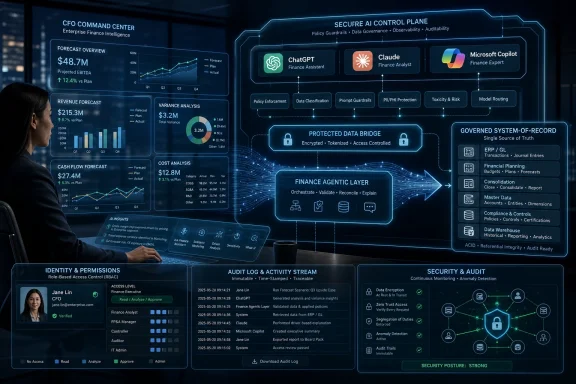
OneStream’s answer is the latter. Its Finance Agentic Layer is meant to provide secure access to OneStream data and logic through open standards such as Model Context Protocol, while preserving the role-based permissions and auditability that finance teams expect from systems of record. In plain English: use the AI assistant you like, but the numbers still come from the finance platform.
That is a pragmatic concession to how enterprise software actually gets adopted. Users do not wait for procurement to standardize on the perfect interface. They bring their own habits, their own copilots, and increasingly their own preferred frontier model. The platform vendor that pretends otherwise risks becoming the database behind someone else’s user experience.
The Real Product Is Not the Agent, but the Control Plane
The most interesting part of OneStream’s announcement is not the new forecast agent, even though forecasting is an obvious and valuable target for AI. The more consequential piece is the layer that governs how outside AI tools reach into OneStream. That layer is where the market is moving.
Enterprise AI is beginning to separate into two products. One is the model or assistant users talk to. The other is the control plane that decides what the assistant can see, what it can do, and how its work is recorded. Finance, healthcare, legal, and security buyers are going to care much more about the second product than the first.
That is why OneStream’s language around authentication and role-based permissions is not boilerplate. If ChatGPT asks OneStream for a dashboard showing trends, variances, and forecast projections, the decisive question is not whether the interface can produce a polished executive summary. The decisive question is whether the employee asking for that summary is allowed to see the underlying entities, accounts, forecasts, and workflow states in the first place.
This is where agentic AI becomes more like enterprise middleware than consumer software. An agent that can only summarize public text is a productivity feature. An agent that can call finance systems, retrieve forecast assumptions, compare actuals, and generate management-ready output is a participant in business operations. That raises the standard for logging, segregation of duties, data lineage, and incident response.
OneStream appears to understand that distinction. The company is not pitching a world where the model becomes the source of truth. It is pitching a world where the model becomes a conversational access layer over a controlled financial substrate. That is a much more credible message for CFOs, and a much more complicated engineering challenge.
MCP Becomes the Enterprise AI Plug, With All the Usual Enterprise Caveats
Model Context Protocol has quickly become one of the most important pieces of plumbing in the agentic AI conversation. The simplest way to describe MCP is as a standard way for AI systems to discover and use tools, data sources, and business systems. The more honest way to describe it is as a new integration surface that will inherit every security and governance problem that came before it.
OneStream’s Andrew Shea reportedly described MCP as a kind of USB plug for AI systems. The analogy works because it captures the appeal: a common connector reduces bespoke integrations and lets organizations link agents to business systems without reinventing the wheel each time. But anyone who has managed endpoints knows that universal plugs also expand the attack surface.
For WindowsForum readers, the familiar comparison is not hard to find. The Windows ecosystem became powerful because it supported broad hardware, software, drivers, extensions, and management layers. It also became difficult to secure for exactly the same reason. Interoperability creates value, then administrators spend the next decade controlling the consequences.
Agent interoperability will follow the same arc. MCP and related protocols promise to make agents portable across systems, but the existence of a protocol does not guarantee good authorization models, clean logging, predictable failure states, or sane defaults. Those are implementation details, and in enterprise IT, implementation details are where breaches and audit findings live.
That does not mean OneStream is wrong to embrace MCP. Quite the opposite. Finance AI that cannot connect to outside systems will be too isolated to matter. The issue is that MCP should be treated less like a convenience feature and more like a privileged integration framework. The protocol can make agents useful; governance determines whether they remain trustworthy.
SAP’s “Autonomous Enterprise” Shows This Is Becoming Table Stakes
OneStream is not moving in isolation. SAP used its Sapphire event this month to push the idea of the “Autonomous Enterprise,” including agent-to-agent interoperability across external applications and partner ecosystems. That matters because SAP remains one of the gravity wells of enterprise process architecture. When SAP says agents must interoperate, it is not merely chasing a buzzword; it is signaling where large customers will expect the market to standardize.
Constellation Research reportedly characterized SAP’s move as “table stakes,” and that framing is blunt but fair. A closed agent inside a single application may be useful for demos and narrow workflows, but business processes rarely respect application boundaries. Finance depends on ERP, planning, HR, procurement, supply chain, CRM, data warehouses, collaboration tools, and spreadsheets that refuse to die.
The autonomous enterprise pitch is grandiose, as enterprise software branding usually is. But beneath the slogan is a reasonable observation: AI agents will not deliver much operational leverage if each one is trapped inside its vendor’s walled garden. A planning agent needs actuals. A procurement agent needs budget context. A finance agent needs consolidation status and forecast assumptions. A compliance agent needs logs.
That is why the race is shifting from “we have an AI assistant” to “our assistant can participate in governed workflows across systems.” It is also why the vendors are suddenly talking so much about protocols, identity, runtime environments, and auditability. The chatbot wrapper phase is ending. The integration phase has begun.
OneStream’s announcement fits that pattern neatly. Its competitive posture is not simply that it has finance agents. It is that those agents can be exposed through the AI ecosystems customers are already choosing while retaining OneStream’s financial logic and controls. In a market where Microsoft, SAP, Anthropic, OpenAI, and others are all trying to define the agent layer, that is a necessary survival move.
The CFO’s Office Wants Answers, Not Another Place to Log In
Corporate finance teams are a strange target for AI hype because their work is both deeply analytical and deeply procedural. They ask questions that sound natural-language friendly: Why did margin move? What changed in the forecast? Which region drove variance? But the acceptable answer is not a plausible paragraph. It is a traceable explanation tied to controlled numbers.
That is why OneStream’s new forecast agent is a sensible addition. Forecasting is full of repetitive diagnostic work: comparing scenarios, explaining deviations, reviewing assumptions, and translating model output into executive narrative. A conversational agent that can sit on top of governed forecast data could save real time if it reduces the hunt through reports and spreadsheets.
The danger is that finance users may confuse fluency with correctness. A polished C-level output generated in minutes is useful only if the underlying retrieval, calculations, and permissions are sound. The assistant’s tone should not be mistaken for verification. In finance, the “last mile” is not formatting the slide; it is proving the numbers deserve to be on the slide.
OneStream’s emphasis on trusted source-of-truth data is therefore more than marketing. It is the core of the use case. If the model is free to improvise outside the governed finance layer, trust collapses quickly. If it is constrained to retrieve and reason over approved data, it becomes a faster interface to institutional knowledge.
There is a Windows admin lesson hiding here too. The best enterprise user experiences often succeed because the boring controls are invisible when they work. Single sign-on, conditional access, group policy, endpoint management, and audit logs are not what users celebrate. They are what allow users to move quickly without turning the environment into a liability.
Interoperability Is Also a Vendor Power Struggle
The word “interoperability” sounds neutral, almost benevolent. In enterprise software, it is usually a battlefield. Everyone wants open standards when they are trying to reach someone else’s customer; everyone discovers the virtues of platform differentiation when the customer is already inside their own estate.
OneStream’s move should be read in that light. If customers are standardizing on ChatGPT Enterprise, Claude, or Microsoft Copilot as their preferred AI interface, OneStream has a choice. It can insist that finance users come back to the OneStream interface for AI-powered analysis, or it can make OneStream’s governed intelligence available where the user already is. The second option is more realistic, but it also risks pushing OneStream deeper into the role of trusted backend.
That is not necessarily a bad business. The system of record has power. The platform that owns financial logic, workflow state, consolidation rules, permissions, and audit history is not easily replaced by a prettier assistant. But user experience gravity matters, and Microsoft in particular understands how to use productivity surfaces as distribution channels.
This is why the expanded OneStream-Microsoft partnership is strategically relevant. OneStream’s AI solutions being available through Microsoft’s marketplace and aligned with Microsoft adoption pathways gives it a route into enterprises already leaning into Copilot and Azure. But it also reinforces the broader trend: finance application vendors increasingly have to meet customers inside hyperscaler and AI-assistant ecosystems.
The uncomfortable future for many SaaS vendors is that users may not care which application generated the answer. They will care whether the answer is accurate, authorized, fast, and available in the tool they already use. That shifts differentiation away from interface ownership and toward data quality, process depth, governance, and trust.
Security Teams Will See the Blast Radius Before Users Do
The phrase agentic AI often implies autonomy, but in enterprise deployments the more important concept is delegated authority. An agent becomes powerful when it can act using a user’s permissions, call tools, retrieve data, and potentially trigger downstream workflow. That is also when it becomes dangerous.
OneStream says interactions through its Finance Agentic Layer are authenticated against the user’s OneStream identity and enforced against existing role-based permissions. That is the right baseline. It means an external AI tool should not become a backdoor around finance access controls. If a user cannot see a forecast entity in OneStream, they should not be able to coax it out through Claude or Copilot.
But identity enforcement is only the beginning. Security teams will want to know how prompts are logged, what data leaves the OneStream environment, how external model providers process retrieved content, whether outputs are retained, how connectors are approved, and how abnormal agent behavior is detected. They will also want revocation to be immediate and comprehensible. If an employee changes roles, the agent’s effective access must change with them.
There is also the problem of prompt injection and tool misuse. Once an AI assistant can retrieve governed finance data, malicious or simply malformed content in connected systems can attempt to influence the agent’s behavior. A finance agent that reads notes, documents, comments, or external inputs needs guardrails against instructions hidden inside the data it processes.
This is not unique to OneStream. It is the entire enterprise agent problem in miniature. The more useful the agent, the closer it gets to sensitive systems. The closer it gets to sensitive systems, the less acceptable it is to manage it like a chat feature.
Auditability Is the Difference Between a Demo and a Deployment
Audit trails are not glamorous, but they are where enterprise AI either matures or stalls. A CFO can tolerate experimentation when AI drafts a memo. A controller will not tolerate a black box that changes the interpretation of forecast data without a defensible trail. External auditors will be even less sentimental.
OneStream’s promise that administrators retain visibility into system usage and activity is therefore crucial. Finance teams need to know who asked what, what data the system accessed, what answer was produced, and whether that answer influenced a workflow. Without that chain, the agent becomes an ungoverned analyst whose work cannot be reliably reviewed.
This is especially important because AI output often compresses many steps into a single answer. A human analyst might pull reports, build a workbook, check formulas, write commentary, and circulate a draft. Each step leaves artifacts. An agent can collapse the same process into a conversational exchange, which is convenient but potentially opaque.
The answer is not to ban agents from finance. The answer is to make the agent’s work reconstructable. If the AI says revenue variance was driven by a region, a product line, and a late-booked adjustment, finance users should be able to inspect the data path behind that claim. The burden of proof does not disappear because the interface got friendlier.
This is where native finance platforms have an advantage over generic AI tools. They already understand workflow state, dimensional models, consolidation structures, approvals, and reporting hierarchies. A general-purpose model can write convincingly about finance. A governed finance platform can tell it which numbers it is allowed to reason over.
Windows Shops Should Recognize the Pattern
For Windows-heavy enterprises, the OneStream announcement is part of a broader shift that will feel familiar: AI is becoming another managed access layer. It will sit across productivity software, line-of-business systems, identity providers, security tools, and data platforms. The job of IT will be to make it useful without letting it become an uncontrolled super-user.
Microsoft’s Copilot strategy already points in this direction. Copilot is not merely a chat assistant; it is a distribution mechanism across Microsoft 365, Windows, Edge, Dynamics, Power Platform, and Azure. When third-party systems expose governed data to Copilot-compatible workflows, the Microsoft estate becomes even more central to daily work.
That creates opportunity and risk for Windows administrators. On the opportunity side, AI assistants connected to governed enterprise data could reduce the swivel-chair work that still dominates office life. On the risk side, every connector becomes a new place where permissions, data classification, retention, and monitoring must be correct.
The old rule still applies: users experience convenience immediately, while administrators experience complexity cumulatively. A finance user sees a faster dashboard. IT sees identity federation, connector approval, data egress, logging, endpoint policy, browser controls, model-provider terms, and incident response playbooks.
The successful shops will not treat this as a pure finance project or a pure AI project. It is an identity, governance, security, and data architecture project with a finance user interface. That is the framing that keeps agentic AI from becoming shadow IT with better branding.
The Spreadsheet Is Not Dead, but Its Role Is Changing
No discussion of finance software is complete without acknowledging the spreadsheet, the undead king of corporate analysis. AI agents will not kill Excel. They may, however, change which parts of finance work belong in spreadsheets and which parts should be pulled back into governed platforms.
For decades, finance teams have used spreadsheets as both interface and escape hatch. When the enterprise system was too rigid, too slow, or too difficult to query, users exported data and built their own models. That flexibility was productive, but it also created version-control nightmares, brittle formulas, and local truths that drifted away from official numbers.
Agentic finance systems are a direct response to that history. If a user can ask natural-language questions against governed data, generate variance analysis, and produce forecast commentary without exporting everything into a private workbook, the platform becomes more usable. The spreadsheet remains useful for ad hoc modeling, but it no longer has to be the only humane interface.
The challenge is cultural as much as technical. Finance professionals trust spreadsheets because they can see the cells. They can audit the formula, however ugly it may be. AI systems must earn a similar kind of trust through explainability, lineage, and reviewability. “The model said so” will not survive contact with a close process.
OneStream’s emphasis on financial logic and audit trails suggests it understands this trust gap. The company is not asking finance teams to abandon controls in exchange for speed. It is arguing that speed can be delivered through the controls. That is the only version of the pitch likely to survive beyond pilot projects.
The Agent Layer Will Force Hard Procurement Questions
The more interoperable AI becomes, the harder procurement gets. Enterprises will have to decide not only which finance platform to buy, but which AI assistants are allowed to connect, which model providers can process sensitive prompts, which protocols are approved, and which vendors are responsible when something goes wrong.
This will complicate vendor risk management. A finance answer generated in ChatGPT using governed OneStream data may involve OneStream controls, OpenAI infrastructure, enterprise identity providers, network policy, logging tools, and whatever device or browser the user is operating from. Responsibility will not map cleanly to the interface the user sees.
Legal and compliance teams will ask about data residency, model training, retention, contractual indemnity, and audit access. Security teams will ask about least privilege, connector scopes, vulnerability management, and monitoring. Finance teams will ask whether the numbers reconcile. Users will ask why it cannot simply work.
That tension is unavoidable. Agentic AI collapses workflows across systems, but enterprises still buy, secure, and audit those systems separately. The market’s language of “seamless” interoperability will run into the enterprise reality of policy boundaries and accountability.
The vendors that win will be those that make these boundaries explicit rather than pretending they do not exist. OneStream’s finance-specific governance pitch is a good start. The next phase will require even more transparency around what happens when external agents query internal data, how decisions are logged, and how organizations can prove compliance after the fact.
The OneStream Announcement Is Smaller Than the Shift It Represents
It would be easy to overstate this news as if OneStream had solved enterprise AI interoperability for finance. It has not. No single vendor announcement can do that. Standards are still evolving, customer architectures vary wildly, and the operational lessons from large-scale agent deployments are still being written in real time.
But it would also be a mistake to dismiss the announcement as ordinary AI marketing. The move from native-only agents to interoperable, governed access through external AI tools is exactly the kind of shift that separates serious enterprise adoption from demo-room enthusiasm. It acknowledges that customers will live in mixed AI environments and that finance platforms must participate without surrendering control.
The most important phrase in the announcement is not “agentic.” It is “trusted source of truth.” That is the line between useful automation and expensive nonsense. If agents are going to summarize, forecast, explain, and eventually act inside business processes, they need a governed foundation that is more reliable than the model’s next token.
For IT pros, the lesson is to start mapping where these foundations are today. Which systems own truth? Which permissions matter? Which workflows require human approval? Which logs would prove what happened? Those questions are less exciting than agent demos, but they are the questions that determine whether AI becomes infrastructure or remains theater.
The CFO’s AI Stack Now Has a Shape
OneStream’s rollout gives finance leaders and administrators a clearer picture of what the practical AI stack is becoming. It is not a single all-knowing assistant, and it is not a pile of disconnected bots. It is a layered architecture where models, agents, governed data, identity, workflow, and audit controls all have to cooperate.
The near-term implications are concrete:
- Finance teams should expect AI assistants to become front ends for governed systems rather than replacements for those systems.
- Administrators should treat MCP and similar protocols as privileged integration surfaces that require security review, monitoring, and lifecycle management.
- CFO organizations should demand that agent outputs remain traceable to approved financial data, business logic, and user permissions.
- Enterprises standardizing on ChatGPT, Claude, or Copilot should still avoid letting the assistant become the de facto source of truth.
- Vendors that cannot interoperate with external AI ecosystems will look increasingly isolated, especially in complex Microsoft- and SAP-heavy environments.
- The most successful deployments will keep humans in the approval loop for material financial judgments while using agents to reduce retrieval, analysis, and reporting friction.
OneStream’s announcement is a reminder that the enterprise AI race is not really about who has the cleverest bot. It is about who can make AI useful inside the systems where mistakes are expensive, permissions are political, and trust is earned one reconciled number at a time. The next wave of finance AI will be won not by the vendor that makes the boldest autonomy claim, but by the one that lets organizations connect agents broadly while proving, in the logs and in the close process, that the numbers still add up.
