

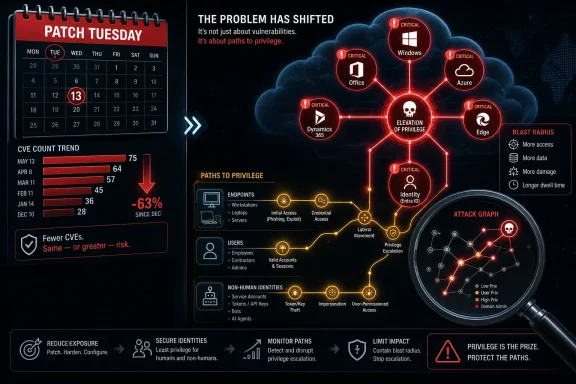
BeyondTrust’s 13th annual Microsoft Vulnerabilities Report, released April 21, 2026, says Microsoft disclosed 1,273 vulnerabilities across its software ecosystem in 2025, down 6 percent from 2024, while critical flaws doubled from 78 to 157 across Windows, Office, Azure, Dynamics 365, Edge, and related platforms. That is the kind of statistic that looks contradictory only if security is still being measured by volume alone. The more useful reading is harsher: Microsoft’s bug count may be stabilizing, but the bugs that matter most are clustering around the places enterprises can least afford to lose control. In 2026, the Microsoft security story is no longer just about patching Windows; it is about containing privilege across an estate that now includes cloud tenants, productivity suites, machine identities, and AI-driven workflows.
For years, vulnerability reporting has encouraged a comforting kind of arithmetic. Fewer CVEs meant less danger, more CVEs meant more danger, and Patch Tuesday could be treated as a monthly bookkeeping exercise with occasional alarms. BeyondTrust’s latest analysis breaks that mental model, because the top-line decline in Microsoft vulnerabilities arrives alongside a steep rise in critical severity.
The report’s headline numbers are easy to summarize and harder to operationalize. Microsoft’s total reported vulnerabilities fell from 1,360 in 2024 to 1,273 in 2025, which would normally be read as a modest improvement. But critical vulnerabilities rose from 78 to 157, meaning defenders are facing fewer entries on the spreadsheet and more entries that demand immediate judgment.
That distinction matters because the enterprise cost of a vulnerability is not evenly distributed. A low-severity information disclosure bug in a narrow component does not carry the same operational consequence as a critical remote code execution flaw in a widely deployed service or an elevation-of-privilege bug that turns a foothold into domain influence. Security teams do not live in averages; they live in blast radius.
This is why the report’s real message is not that Microsoft suddenly became less secure. It is that the shape of Microsoft risk is changing. The attack surface has moved upward and outward, from local operating-system defects toward identity, privilege, cloud configuration, productivity platforms, and the seams between them.
It is also dangerous for the same reason. The more Microsoft becomes the connective tissue of enterprise IT, the more a flaw in one layer can become leverage in another. An Office document is no longer just a file, a Teams identity is no longer just a chat account, and an Azure permission is no longer just an administrative convenience. They are routes through an organization.
BeyondTrust’s numbers on Azure and Dynamics 365 are therefore more than a product-specific warning. Critical vulnerabilities in those platforms reportedly rose from four to 37, a ninefold increase. Even if some of that movement reflects reporting methodology, product growth, or deeper scrutiny rather than a pure degradation in engineering quality, the practical message is the same: cloud business platforms are now high-value exploitation terrain.
The significance of Azure and Dynamics is not merely that they are cloud services. It is that they often hold the logic of the business itself. Azure carries infrastructure and identity dependencies; Dynamics carries customer, finance, sales, and operations workflows. A critical flaw in such an environment is not simply a technical event. It can become a business-continuity event.
Office has always been attractive to attackers because it blends technical reach with human behavior. Documents, spreadsheets, presentations, and templates pass through organizations with a social legitimacy that executables rarely enjoy. Even after years of macro hardening, attachment filtering, sandboxing, and endpoint detection, productivity software remains one of the few places where strangers can persuade employees to open complex content in the course of normal work.
The newer risk is that Office is no longer just a desktop application suite. It is also a cloud collaboration environment tied into SharePoint, OneDrive, Teams, Exchange Online, sensitivity labels, compliance tooling, automation, and identity controls. The same document can now be a file, a workflow trigger, a shared object, a permission boundary, and a data-loss-prevention event.
That complexity makes the Office trend harder to dismiss. A vulnerability in productivity software is not automatically catastrophic, but productivity platforms sit at the crossroads of people, data, and privilege. If attackers can turn everyday collaboration into a route toward elevated access, then the old advice to “be careful with attachments” is laughably insufficient.
That improvement should not be minimized. Browsers remain exposed to hostile content all day, every day, and any meaningful reduction in browser vulnerability volume is good news for users and administrators. Edge also benefits from Microsoft’s alignment with Chromium, which means the security burden is shared across a broader ecosystem rather than carried entirely by one vendor.
But Edge’s improvement also highlights the asymmetry of the broader problem. A hardened browser reduces one class of entry point, yet it does not solve identity sprawl, excessive permissions, stale service accounts, misconfigured cloud resources, or weak governance over automation. In other words, Microsoft can make one door much stronger while enterprises keep adding more doors.
That is the uncomfortable lesson for defenders. Product hardening matters, and Microsoft deserves credit where the numbers improve. But the enterprise security problem is no longer reducible to whether a single application family is better engineered this year than last year.
That figure should focus administrators because modern intrusions are rarely a single leap from outside the firewall to total compromise. They are chains. An attacker gets a foothold through phishing, credential theft, exposed services, stolen session tokens, a vulnerable application, or a misused remote-access tool. The campaign then depends on turning that foothold into more access.
Elevation-of-privilege vulnerabilities are valuable because they compress that middle stage. They help attackers move from user to admin, from local to domain, from workload to tenant, or from one identity boundary to another. They do not always start the fire, but they often determine how far it spreads.
This is where vulnerability management and identity security collide. A company can patch aggressively and still suffer if ordinary users have too much local privilege, service principals have excessive cloud permissions, administrators use standing access, and machine credentials live forever. The flaw and the permission model become part of the same exploit chain.
The key change is tempo. Patch diffing and exploit development were never manual arts reserved for a tiny priesthood, but AI-assisted workflows lower the cost of turning public information into operational capability. When a vendor ships a fix, attackers can increasingly treat that fix as a clue, not a closing chapter.
This puts pressure on the old rhythm of enterprise patching. Monthly change windows, staged deployment rings, emergency exceptions, and compatibility testing remain necessary, especially in regulated or mission-critical environments. But the window between disclosure and exploitation is shrinking in enough cases that organizations cannot pretend a 30-day patch target is automatically prudent.
The answer is not reckless patching. Breaking authentication, business applications, or endpoint fleets with an untested update is its own security incident. The answer is risk-tiered velocity: faster movement for exposed, critical, and privilege-relevant flaws; better rollback planning; more realistic asset inventory; and controls that assume some patches will arrive after attackers have already begun probing.
Some of the most dangerous conditions in a Microsoft estate may never show up as a conventional software vulnerability. A long-lived service account with broad permissions is not a CVE. An over-privileged automation identity is not a CVE. A misconfigured conditional access policy is not a CVE. A dormant administrator account without strong authentication is not a CVE.
This is why security teams that celebrate a declining vulnerability backlog can still be exposed in ways that matter. The backlog may be shrinking while privilege pathways multiply. The dashboard may look greener while the environment becomes easier to traverse after initial compromise.
The gap is especially important as AI agents and automation become more deeply integrated into enterprise workflows. A human user with excessive access is already a problem; a non-human identity with excessive access, no fatigue, broad API reach, and weak monitoring can become a silent control plane for abuse. Traditional vulnerability management was not designed for that world.
These identities are essential to modern IT. They keep systems integrated, reduce toil, and make cloud-native operations possible. But they also tend to accumulate privileges because teams are rewarded for making automation work and punished when it breaks. Least privilege is easy to endorse and hard to maintain when every dependency failure becomes an urgent ticket.
Microsoft environments are particularly sensitive to this trend because identity is the hinge between endpoint, cloud, productivity, and management layers. Entra ID, Azure role-based access control, Microsoft Graph permissions, Exchange permissions, SharePoint access, Teams app grants, and Defender integrations can create legitimate but sprawling pathways. Attackers do not need to invent those pathways; they need to find and abuse them.
The risk is not simply that non-human identities exist. It is that many organizations still govern them with less rigor than employee accounts. They may lack clear owners, rotation schedules, conditional controls, behavioral monitoring, and decommissioning processes. In a privilege-centric attack, that neglect is not an administrative detail. It is an opportunity.
But patching is a control, not a strategy. If every conversation about Microsoft security begins and ends with update deployment, defenders will miss the systems that decide whether a vulnerability becomes a breach. Privilege, segmentation, identity governance, monitoring, backup resilience, and incident response determine the blast radius.
This is particularly true for elevation-of-privilege flaws. The best mitigation is not only to remove the bug but to reduce what an attacker gains before and after exploiting it. Local admin rights, standing global administrator roles, broad application consent, legacy protocols, weak device compliance rules, and unmanaged endpoints all make EoP more valuable.
Patch management also depends on asset truth. Many organizations do not have a reliable answer to which systems run which Microsoft components, which Office versions are exposed to risky content, which servers host critical workloads, or which cloud resources map to business processes. Without that inventory, prioritization becomes guesswork dressed up as governance.
This does not make Microsoft uniquely negligent. Large, complex software ecosystems produce defects, and Microsoft has invested heavily in secure development, telemetry, automatic updating, threat intelligence, and security tooling. The company also faces a level of scrutiny and targeting that few vendors experience.
But ubiquity changes the stakes. A flaw in a niche application may threaten a department. A flaw in a Microsoft component can threaten the operating assumptions of an entire enterprise. Even when Microsoft fixes quickly, administrators must absorb the operational burden of testing, deployment, exception handling, and post-patch verification across sprawling estates.
The BeyondTrust report should therefore be read less as an indictment of one vendor and more as a measurement of dependency. Organizations built their productivity, identity, cloud, and endpoint strategies around Microsoft because the integration works. The security bill is that the same integration gives attackers a coherent map.
Yet the cloud also shifts responsibility rather than eliminating it. Customers still configure identities, access policies, application permissions, data sharing, device trust, logging, retention, and administrative roles. A secure cloud platform can still host an insecure tenant.
The reported rise in critical Azure and Dynamics vulnerabilities lands in this shared-responsibility reality. Microsoft must secure the services, but customers must understand how those services are exposed inside their own environments. A flaw in the platform is dangerous; a flaw combined with permissive identity design is worse.
This is why cloud security cannot be delegated entirely to the cloud provider. The provider may fix the underlying issue, but only the customer can decide which identities have standing access, which apps can request sensitive permissions, which logs are retained, and which alerts trigger action. In the Microsoft world, that customer-side discipline is now central to vulnerability impact.
A medium-severity issue on a heavily privileged workstation may matter more than a critical issue on an isolated lab system. A service principal with broad Graph permissions may be more dangerous than a missing patch on a rarely used endpoint. A stale admin account may turn a contained incident into a tenant-wide compromise.
This path-based view changes how defenders prioritize. Instead of asking only which CVEs have the highest scores, teams should ask which systems connect to privilege, which identities can modify security controls, which devices are used by administrators, which applications can read sensitive data, and which automation accounts can deploy or change infrastructure.
That approach is harder than sorting by severity. It requires identity telemetry, endpoint context, cloud posture management, attack-path analysis, and cooperation between teams that often operate separately. But it is closer to how intrusions actually unfold.
That caveat does not invalidate the data. The emphasis on elevation of privilege, non-human identities, cloud permissions, and least privilege matches what incident responders, red teams, and administrators have observed for years. Attackers gravitate toward privilege because privilege turns access into control.
The better criticism is that the industry sometimes packages old truths in new branding. Least privilege, segmentation, identity governance, and rapid patching are not new ideas. What has changed is the operating environment. Cloud platforms, SaaS collaboration, hybrid identity, and AI automation have made old failures scale faster.
So the report should be read with both skepticism and seriousness. Skepticism for the marketing gloss; seriousness for the underlying direction of travel. If critical vulnerabilities are rising while identity complexity expands, administrators do not need vendor slogans to understand the risk.
That expansion is not merely a career-path issue. It affects how organizations staff and fund defensive work. A team responsible for patching Windows clients may not have authority over cloud app consent. A cloud team may not own endpoint privilege. A security operations center may see alerts without understanding the business impact of the identity involved.
Attackers benefit from those seams. They do not care whether a permission lives under the endpoint team, the cloud team, the messaging team, or the application owner. They care whether it helps them move.
A mature Microsoft security program therefore needs governance that matches the platform’s integration. Endpoint, identity, cloud, productivity, and application teams must share a common view of privilege. Otherwise, each group optimizes its own lane while attackers drive across all of them.
The first move is to separate internet-exposed, privilege-adjacent, and business-critical assets from the rest of the estate. Not every vulnerability deserves the same emergency process, but vulnerabilities affecting identity infrastructure, administrative workstations, remote access, Office content handling, Azure control planes, and server workloads should move through a faster lane.
The second move is to reduce standing privilege. Just-in-time administration, privileged access workstations, role reviews, local admin removal, service account ownership, and application permission hygiene are tedious controls. They are also the difference between a contained endpoint compromise and a broad enterprise incident.
The third move is to treat non-human identities as first-class security subjects. Every automation account, app registration, service principal, managed identity, and AI agent should have an owner, a purpose, scoped permissions, monitoring, and a retirement path. If an organization cannot explain what a machine identity can do, it cannot claim to manage its Microsoft risk.
The fourth move is to build patch operations around exploitation likelihood and blast radius. CVSS matters, but it is not enough. Exploit availability, active exploitation, exposure, asset criticality, privilege relevance, and compensating controls should all influence urgency.
 The Smaller Number Is Not the Safer Number
For years, vulnerability reporting has encouraged a comforting kind of arithmetic. Fewer CVEs meant less danger, more CVEs meant more danger, and Patch Tuesday could be treated as a monthly bookkeeping exercise with occasional alarms. BeyondTrust’s latest analysis breaks that mental model, because the top-line decline in Microsoft vulnerabilities arrives alongside a steep rise in critical severity.The report’s headline numbers are easy to summarize and harder to operationalize. Microsoft’s total reported vulnerabilities fell from 1,360 in 2024 to 1,273 in 2025, which would normally be read as a modest improvement. But critical vulnerabilities rose from 78 to 157, meaning defenders are facing fewer entries on the spreadsheet and more entries that demand immediate judgment.
That distinction matters because the enterprise cost of a vulnerability is not evenly distributed. A low-severity information disclosure bug in a narrow component does not carry the same operational consequence as a critical remote code execution flaw in a widely deployed service or an elevation-of-privilege bug that turns a foothold into domain influence. Security teams do not live in averages; they live in blast radius.
This is why the report’s real message is not that Microsoft suddenly became less secure. It is that the shape of Microsoft risk is changing. The attack surface has moved upward and outward, from local operating-system defects toward identity, privilege, cloud configuration, productivity platforms, and the seams between them.
Microsoft’s Attack Surface Now Looks Like the Enterprise It Serves
Microsoft’s modern footprint is not one product line; it is an operating environment. Windows endpoints still matter, but they now sit inside a mesh of Entra ID identities, Azure resources, Microsoft 365 applications, Defender telemetry, SharePoint sites, Teams workflows, Dynamics 365 business processes, and third-party integrations. That mesh is powerful precisely because everything can talk to everything else.It is also dangerous for the same reason. The more Microsoft becomes the connective tissue of enterprise IT, the more a flaw in one layer can become leverage in another. An Office document is no longer just a file, a Teams identity is no longer just a chat account, and an Azure permission is no longer just an administrative convenience. They are routes through an organization.
BeyondTrust’s numbers on Azure and Dynamics 365 are therefore more than a product-specific warning. Critical vulnerabilities in those platforms reportedly rose from four to 37, a ninefold increase. Even if some of that movement reflects reporting methodology, product growth, or deeper scrutiny rather than a pure degradation in engineering quality, the practical message is the same: cloud business platforms are now high-value exploitation terrain.
The significance of Azure and Dynamics is not merely that they are cloud services. It is that they often hold the logic of the business itself. Azure carries infrastructure and identity dependencies; Dynamics carries customer, finance, sales, and operations workflows. A critical flaw in such an environment is not simply a technical event. It can become a business-continuity event.
Office Is Still the Front Door, Even When the Network Has No Perimeter
Microsoft Office’s reported vulnerability surge is a reminder that old attack paths do not disappear just because new ones arrive. BeyondTrust says Office vulnerabilities climbed to 157 in 2025, more than tripling year over year, while critical Office vulnerabilities increased tenfold. That is an uncomfortable data point for a suite that remains embedded in almost every corporate routine.Office has always been attractive to attackers because it blends technical reach with human behavior. Documents, spreadsheets, presentations, and templates pass through organizations with a social legitimacy that executables rarely enjoy. Even after years of macro hardening, attachment filtering, sandboxing, and endpoint detection, productivity software remains one of the few places where strangers can persuade employees to open complex content in the course of normal work.
The newer risk is that Office is no longer just a desktop application suite. It is also a cloud collaboration environment tied into SharePoint, OneDrive, Teams, Exchange Online, sensitivity labels, compliance tooling, automation, and identity controls. The same document can now be a file, a workflow trigger, a shared object, a permission boundary, and a data-loss-prevention event.
That complexity makes the Office trend harder to dismiss. A vulnerability in productivity software is not automatically catastrophic, but productivity platforms sit at the crossroads of people, data, and privilege. If attackers can turn everyday collaboration into a route toward elevated access, then the old advice to “be careful with attachments” is laughably insufficient.
Edge Shows That Hardening Can Work, but It Also Shows Its Limits
The report’s most encouraging product trend is Microsoft Edge. BeyondTrust says Edge vulnerabilities fell 83 percent to 50 in 2025, after rising in the prior report cycle. Browser security has been one of the more disciplined areas of modern software engineering, partly because browsers are constantly attacked and partly because the industry has learned to invest in sandboxing, memory safety work, rapid updates, and exploit mitigation.That improvement should not be minimized. Browsers remain exposed to hostile content all day, every day, and any meaningful reduction in browser vulnerability volume is good news for users and administrators. Edge also benefits from Microsoft’s alignment with Chromium, which means the security burden is shared across a broader ecosystem rather than carried entirely by one vendor.
But Edge’s improvement also highlights the asymmetry of the broader problem. A hardened browser reduces one class of entry point, yet it does not solve identity sprawl, excessive permissions, stale service accounts, misconfigured cloud resources, or weak governance over automation. In other words, Microsoft can make one door much stronger while enterprises keep adding more doors.
That is the uncomfortable lesson for defenders. Product hardening matters, and Microsoft deserves credit where the numbers improve. But the enterprise security problem is no longer reducible to whether a single application family is better engineered this year than last year.
Elevation of Privilege Is the Statistic That Explains the Rest
The report’s most important category is not remote code execution, even though RCE remains the vulnerability class that tends to attract the loudest headlines. It is elevation of privilege. BeyondTrust says EoP accounted for 40 percent of Microsoft vulnerabilities in 2025, or 509 cases.That figure should focus administrators because modern intrusions are rarely a single leap from outside the firewall to total compromise. They are chains. An attacker gets a foothold through phishing, credential theft, exposed services, stolen session tokens, a vulnerable application, or a misused remote-access tool. The campaign then depends on turning that foothold into more access.
Elevation-of-privilege vulnerabilities are valuable because they compress that middle stage. They help attackers move from user to admin, from local to domain, from workload to tenant, or from one identity boundary to another. They do not always start the fire, but they often determine how far it spreads.
This is where vulnerability management and identity security collide. A company can patch aggressively and still suffer if ordinary users have too much local privilege, service principals have excessive cloud permissions, administrators use standing access, and machine credentials live forever. The flaw and the permission model become part of the same exploit chain.
AI Is Speeding Up Both Sides of the Patch Race
BeyondTrust’s report frames artificial intelligence as a double-edged force, which is the least surprising and most accurate way to describe its current role in security. Defenders can use AI to triage alerts, inspect code, summarize advisories, correlate telemetry, and search for risky configurations. Attackers can use the same class of tooling to analyze patches, generate exploit hypotheses, automate reconnaissance, and scale social engineering.The key change is tempo. Patch diffing and exploit development were never manual arts reserved for a tiny priesthood, but AI-assisted workflows lower the cost of turning public information into operational capability. When a vendor ships a fix, attackers can increasingly treat that fix as a clue, not a closing chapter.
This puts pressure on the old rhythm of enterprise patching. Monthly change windows, staged deployment rings, emergency exceptions, and compatibility testing remain necessary, especially in regulated or mission-critical environments. But the window between disclosure and exploitation is shrinking in enough cases that organizations cannot pretend a 30-day patch target is automatically prudent.
The answer is not reckless patching. Breaking authentication, business applications, or endpoint fleets with an untested update is its own security incident. The answer is risk-tiered velocity: faster movement for exposed, critical, and privilege-relevant flaws; better rollback planning; more realistic asset inventory; and controls that assume some patches will arrive after attackers have already begun probing.
CVE Counting Is Becoming a Bad Proxy for Risk
The report is also right to challenge the industry’s dependence on CVE counts. CVEs are useful. They create a common language for defects, help vendors coordinate disclosure, and give security tools something structured to track. But they are not a complete map of enterprise exposure.Some of the most dangerous conditions in a Microsoft estate may never show up as a conventional software vulnerability. A long-lived service account with broad permissions is not a CVE. An over-privileged automation identity is not a CVE. A misconfigured conditional access policy is not a CVE. A dormant administrator account without strong authentication is not a CVE.
This is why security teams that celebrate a declining vulnerability backlog can still be exposed in ways that matter. The backlog may be shrinking while privilege pathways multiply. The dashboard may look greener while the environment becomes easier to traverse after initial compromise.
The gap is especially important as AI agents and automation become more deeply integrated into enterprise workflows. A human user with excessive access is already a problem; a non-human identity with excessive access, no fatigue, broad API reach, and weak monitoring can become a silent control plane for abuse. Traditional vulnerability management was not designed for that world.
Non-Human Identities Are the New Shadow Admins
The phrase non-human identity sounds like analyst jargon until it describes the thing that just moved money, copied data, deployed code, or changed infrastructure without a person directly touching the keyboard. Service accounts, application registrations, managed identities, automation scripts, CI/CD tokens, bots, and AI agents increasingly perform the work that humans used to initiate manually.These identities are essential to modern IT. They keep systems integrated, reduce toil, and make cloud-native operations possible. But they also tend to accumulate privileges because teams are rewarded for making automation work and punished when it breaks. Least privilege is easy to endorse and hard to maintain when every dependency failure becomes an urgent ticket.
Microsoft environments are particularly sensitive to this trend because identity is the hinge between endpoint, cloud, productivity, and management layers. Entra ID, Azure role-based access control, Microsoft Graph permissions, Exchange permissions, SharePoint access, Teams app grants, and Defender integrations can create legitimate but sprawling pathways. Attackers do not need to invent those pathways; they need to find and abuse them.
The risk is not simply that non-human identities exist. It is that many organizations still govern them with less rigor than employee accounts. They may lack clear owners, rotation schedules, conditional controls, behavioral monitoring, and decommissioning processes. In a privilege-centric attack, that neglect is not an administrative detail. It is an opportunity.
Patch Tuesday Still Matters, but It Is No Longer the Center of Gravity
There is a temptation in every vulnerability discussion to turn the conclusion into a sermon about patching faster. That is not wrong, exactly. Unpatched critical vulnerabilities remain one of the least defensible causes of compromise, and Microsoft’s monthly security updates are still a core operational discipline for Windows administrators.But patching is a control, not a strategy. If every conversation about Microsoft security begins and ends with update deployment, defenders will miss the systems that decide whether a vulnerability becomes a breach. Privilege, segmentation, identity governance, monitoring, backup resilience, and incident response determine the blast radius.
This is particularly true for elevation-of-privilege flaws. The best mitigation is not only to remove the bug but to reduce what an attacker gains before and after exploiting it. Local admin rights, standing global administrator roles, broad application consent, legacy protocols, weak device compliance rules, and unmanaged endpoints all make EoP more valuable.
Patch management also depends on asset truth. Many organizations do not have a reliable answer to which systems run which Microsoft components, which Office versions are exposed to risky content, which servers host critical workloads, or which cloud resources map to business processes. Without that inventory, prioritization becomes guesswork dressed up as governance.
Microsoft’s Security Burden Is Also Its Market Power
Microsoft occupies an unusual position in enterprise security because it is simultaneously platform vendor, productivity provider, cloud operator, identity broker, endpoint security vendor, and management tooling supplier. That integration gives customers enormous operational convenience. It also means Microsoft’s vulnerabilities and architectural decisions cascade through a vast portion of global business infrastructure.This does not make Microsoft uniquely negligent. Large, complex software ecosystems produce defects, and Microsoft has invested heavily in secure development, telemetry, automatic updating, threat intelligence, and security tooling. The company also faces a level of scrutiny and targeting that few vendors experience.
But ubiquity changes the stakes. A flaw in a niche application may threaten a department. A flaw in a Microsoft component can threaten the operating assumptions of an entire enterprise. Even when Microsoft fixes quickly, administrators must absorb the operational burden of testing, deployment, exception handling, and post-patch verification across sprawling estates.
The BeyondTrust report should therefore be read less as an indictment of one vendor and more as a measurement of dependency. Organizations built their productivity, identity, cloud, and endpoint strategies around Microsoft because the integration works. The security bill is that the same integration gives attackers a coherent map.
The Cloud Made Security More Centralized and Less Simple
Cloud adoption was supposed to reduce some classic infrastructure pain, and in many ways it has. Organizations no longer need to manage every server, storage device, or network appliance directly. Microsoft can patch and secure large portions of Azure and Microsoft 365 at a scale customers could not match individually.Yet the cloud also shifts responsibility rather than eliminating it. Customers still configure identities, access policies, application permissions, data sharing, device trust, logging, retention, and administrative roles. A secure cloud platform can still host an insecure tenant.
The reported rise in critical Azure and Dynamics vulnerabilities lands in this shared-responsibility reality. Microsoft must secure the services, but customers must understand how those services are exposed inside their own environments. A flaw in the platform is dangerous; a flaw combined with permissive identity design is worse.
This is why cloud security cannot be delegated entirely to the cloud provider. The provider may fix the underlying issue, but only the customer can decide which identities have standing access, which apps can request sensitive permissions, which logs are retained, and which alerts trigger action. In the Microsoft world, that customer-side discipline is now central to vulnerability impact.
Administrators Need to Think in Paths, Not Patches
One of the more useful phrases in BeyondTrust’s framing is “paths to privilege.” It captures something that traditional vulnerability scoring often misses: attackers do not experience an enterprise as a list of isolated defects. They experience it as a graph of accounts, devices, permissions, sessions, applications, tokens, and trust relationships.A medium-severity issue on a heavily privileged workstation may matter more than a critical issue on an isolated lab system. A service principal with broad Graph permissions may be more dangerous than a missing patch on a rarely used endpoint. A stale admin account may turn a contained incident into a tenant-wide compromise.
This path-based view changes how defenders prioritize. Instead of asking only which CVEs have the highest scores, teams should ask which systems connect to privilege, which identities can modify security controls, which devices are used by administrators, which applications can read sensitive data, and which automation accounts can deploy or change infrastructure.
That approach is harder than sorting by severity. It requires identity telemetry, endpoint context, cloud posture management, attack-path analysis, and cooperation between teams that often operate separately. But it is closer to how intrusions actually unfold.
The Report’s Vendor Lens Should Not Be Ignored, but Neither Should Its Warning
BeyondTrust is not a neutral academic institution; it sells identity and privilege security products. Readers should keep that commercial context in mind when a report emphasizes privilege as the center of gravity. Security vendors tend to diagnose the world in terms that align with what they sell.That caveat does not invalidate the data. The emphasis on elevation of privilege, non-human identities, cloud permissions, and least privilege matches what incident responders, red teams, and administrators have observed for years. Attackers gravitate toward privilege because privilege turns access into control.
The better criticism is that the industry sometimes packages old truths in new branding. Least privilege, segmentation, identity governance, and rapid patching are not new ideas. What has changed is the operating environment. Cloud platforms, SaaS collaboration, hybrid identity, and AI automation have made old failures scale faster.
So the report should be read with both skepticism and seriousness. Skepticism for the marketing gloss; seriousness for the underlying direction of travel. If critical vulnerabilities are rising while identity complexity expands, administrators do not need vendor slogans to understand the risk.
The Windows Admin’s Job Keeps Expanding
For WindowsForum readers, the practical frustration is obvious: the Windows admin role has become a Microsoft estate security role. Managing endpoints is still part of the job, but so is understanding Intune policy, Defender signals, Entra ID roles, Microsoft 365 app permissions, Azure resource access, conditional access, and device compliance. The boundary between sysadmin and security engineer keeps thinning.That expansion is not merely a career-path issue. It affects how organizations staff and fund defensive work. A team responsible for patching Windows clients may not have authority over cloud app consent. A cloud team may not own endpoint privilege. A security operations center may see alerts without understanding the business impact of the identity involved.
Attackers benefit from those seams. They do not care whether a permission lives under the endpoint team, the cloud team, the messaging team, or the application owner. They care whether it helps them move.
A mature Microsoft security program therefore needs governance that matches the platform’s integration. Endpoint, identity, cloud, productivity, and application teams must share a common view of privilege. Otherwise, each group optimizes its own lane while attackers drive across all of them.
The Practical Reading for 2026 Is Ruthlessly Operational
The most useful response to the report is not panic. It is a more disciplined operating model. Organizations should still patch quickly, but they should stop pretending that patch speed alone is a proxy for security maturity.The first move is to separate internet-exposed, privilege-adjacent, and business-critical assets from the rest of the estate. Not every vulnerability deserves the same emergency process, but vulnerabilities affecting identity infrastructure, administrative workstations, remote access, Office content handling, Azure control planes, and server workloads should move through a faster lane.
The second move is to reduce standing privilege. Just-in-time administration, privileged access workstations, role reviews, local admin removal, service account ownership, and application permission hygiene are tedious controls. They are also the difference between a contained endpoint compromise and a broad enterprise incident.
The third move is to treat non-human identities as first-class security subjects. Every automation account, app registration, service principal, managed identity, and AI agent should have an owner, a purpose, scoped permissions, monitoring, and a retirement path. If an organization cannot explain what a machine identity can do, it cannot claim to manage its Microsoft risk.
The fourth move is to build patch operations around exploitation likelihood and blast radius. CVSS matters, but it is not enough. Exploit availability, active exploitation, exposure, asset criticality, privilege relevance, and compensating controls should all influence urgency.
The Numbers Point to a Different Kind of Microsoft Hardening
The concrete lesson from BeyondTrust’s 2025 Microsoft vulnerability data is not that every organization should chase every advisory with equal urgency. It is that the most damaging Microsoft risks increasingly live where software defects intersect with privilege. That calls for a different hardening agenda than the one many enterprises still use.- Microsoft disclosed fewer total vulnerabilities in 2025 than in 2024, but the number of critical vulnerabilities roughly doubled.
- Elevation-of-privilege flaws remained the dominant category, accounting for about 40 percent of the reported Microsoft vulnerability portfolio.
- Azure and Dynamics 365 saw a sharp rise in critical vulnerabilities, underscoring how cloud and business platforms have become central security terrain.
- Office’s vulnerability growth matters because productivity software now connects users, files, cloud permissions, collaboration, and sensitive data.
- Edge’s improvement shows targeted product hardening can work, but browser progress does not solve identity sprawl or excessive privilege elsewhere.
- Security teams should prioritize exploitability, exposure, and privilege pathways rather than relying on raw CVE counts as their main risk signal.
References
- Primary source: SecurityBrief Australia
Published: 2026-06-05T02:30:18.232260
Microsoft security landscape shifts as critical vulnerabilities surge: report
Critical flaws in Microsoft software have nearly doubled, leaving enterprises facing a sharper risk profile despite fewer total vulnerabilities. securitybrief.com.au
- Related coverage: beyondtrust.com
BeyondTrust’s 13th Annual Microsoft Vulnerabilities Report Reveals Drop in Total Volume, But Surge in Critical Risk | BeyondTrust
Critical vulnerabilities doubled year-over-year, signaling rising risk severity as AI-driven discovery and expanding attack surfaces reshape the Microsoft security landscapewww.beyondtrust.com - Related coverage: assets.beyondtrust.com
- Related coverage: cyberriskleaders.com
BeyondTrust report finds fewer Microsoft vulnerabilities in 2025, but critical issues doubled
A new report from BeyondTrust says the total number of Microsoft vulnerabilities disclosed in 2025 fell compared with 2024, but the number classed as critical rose sharply, pointing to a shift in risk from volume to severity.cyberriskleaders.com - Related coverage: scworld.com
Critical Microsoft vulnerabilities surge as total flaw prevalence declines | brief | SC Media
A BeyondTrust report found a twofold increase in critical flaws in Microsoft software despite a 6% drop in total vulnerabilities to 1,273 this year, indicating that fewer but more severe security issues are being discovered, reports HackRead.www.scworld.com - Related coverage: itwire.com
BeyondTrust’s 13th Annual Microsoft Vulnerabilities Report Reveals Drop in Total Volume, But Surge in Critical Risk | iTWire
GUEST RESEARCH: Critical vulnerabilities doubled year-over-year, signalling rising risk severity as AI-driven discovery and expanding attack surfaces reshape the Microsoft... itwire.com
- Related coverage: techitupme.com
BeyondTrust’s 2026 Microsoft Vulnerabilities Report
Microsoft Vulnerabilities Report 2026 highlights a 6% drop in total vulnerabilities, 83% drop in Microsoft Edge vulnerabilities, 2x increasetechitupme.com - Related coverage: kbi.media
- Related coverage: tech-channels.com

Microsoft Vulnerabilities Report 2025
Discover a wealth of resources on cloud modernization, cybersecurity, data management, and more. Stay informed with insightful white papers, webinars, and guides for business success.
www.tech-channels.com
