

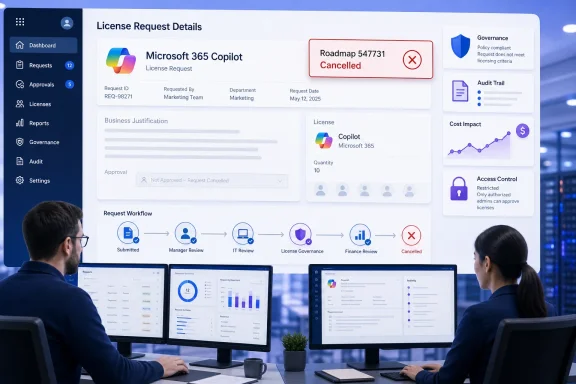
Microsoft has cancelled a planned Microsoft 365 Copilot licensing feature that would have allowed employees to include a business justification when requesting a Copilot license. Roadmap item 547731 had been positioned as a straightforward way to give administrators more context, shorten approval cycles, and strengthen governance, but Microsoft updated the entry on July 20, 2026, to say that it had decided to roll back the change and would not move forward with it “at this time.” The reversal leaves organizations with the existing license-request experience—and with the broader challenge of deciding who genuinely needs paid Copilot access, how those decisions should be documented, and whether Microsoft’s built-in workflow is sufficient for enterprise governance.
Microsoft 365 Copilot licensing has always involved more than flipping a switch. The service brings generative AI into applications and services such as Word, Excel, PowerPoint, Outlook, Teams, and Microsoft 365 Copilot, using Microsoft Graph and organizational data to produce work-grounded responses.
That integration makes Copilot potentially valuable, but it also makes license allocation a financial, security, and organizational decision. A Copilot license is not simply another application entitlement. It can alter how employees search for information, draft documents, summarize communications, analyze data, and interact with content to which they already have access.
As demand expanded, manual selection became difficult to sustain. Employees heard about Copilot from colleagues, saw it appear across Microsoft 365, or encountered prompts inviting them to explore AI-assisted features. Organizations consequently needed a repeatable way to receive, evaluate, and approve requests.
Microsoft 365 already supports self-service license request processes for certain products. When self-service purchasing is blocked, users can submit requests that administrators review in the Microsoft 365 admin center. Depending on the organization’s configuration, administrators can approve or reject requests, assign licenses through groups, share a request with another decision-maker, or direct employees to an internal request system.
That text would then have appeared to administrators during review. Microsoft said the field would help admins make faster, more informed decisions, reduce follow-up work, and support governance and audit requirements.
The feature was initially expected to reach general availability in 2026, with rollout timing later associated with the end of May. It targeted the worldwide standard multi-tenant cloud and the desktop, Mac, and web experiences. The roadmap entry is now marked Cancelled, and Microsoft’s July 20 update says the company is not proceeding with the change at this time.
This does not mean Microsoft is eliminating Copilot license requests. It means that one specific contextual field—the requester’s explanation of need—is no longer moving forward according to the published roadmap.
Organizations can also connect users to their own request process. That option is important because many larger businesses already use service management platforms, access-governance systems, procurement portals, or customized Power Platform applications for software access requests.
The cancellation therefore does not remove the ability to govern licenses. It removes a potentially useful piece of context from Microsoft’s native path.
The concept could return in a redesigned form, become part of a broader Copilot administration experience, or be replaced by deeper integration with organizational workflows. Microsoft could also decide that structured approvals belong in an identity-governance or service-management product rather than a lightweight licensing screen.
Administrators should nevertheless treat the feature as cancelled, not delayed. A roadmap item marked cancelled should not influence current architecture or procurement decisions unless Microsoft publishes a replacement commitment.
That creates friction at scale. A tenant receiving dozens or hundreds of requests may require managers, cost-center owners, data stewards, and IT administrators to exchange messages before anyone can decide whether a license is justified.
That distinction matters because desire is not the same as suitability. A user may be curious about AI without having enough repetitive, document-heavy, communication-heavy, or analytical work to support a paid assignment.
A justification also gives the employee an opportunity to articulate the expected value before receiving access. That simple exercise can improve adoption by encouraging requesters to identify specific workflows rather than treating Copilot as a general-purpose perk.
If the original request says that a user needs Copilot for a six-month proposal project, the organization has a natural review point. If it says that an analyst will use Copilot daily to summarize research and prepare client material, usage data can be compared with the stated expectation.
The cancellation removes that native contextual anchor. Organizations that want it will need to collect and preserve the information elsewhere.
The rollback may therefore be disappointing without being catastrophic. Mature organizations should already have controls extending beyond the Microsoft 365 admin center.
For audit purposes, organizations may need to establish:
Those fields can be scored, reported, and routed. A paragraph such as “I need Copilot to be more productive” is harder to evaluate and almost impossible to compare systematically against hundreds of similar requests.
The cancelled feature could have been a useful starting point. It would not have replaced the need for a formal entitlement model in larger environments.
That gap is especially visible when license ownership is split across teams. The Microsoft 365 administrator may have technical authority to assign a license without having the business authority to approve the expense.
The Microsoft 365 request workflow does allow requests to be shared with other people in the organization. That can help when the administrator needs input from a manager or product owner, but it is not equivalent to a fully structured, multi-stage approval process.
The person making the financial decision may not be the person performing the technical assignment. An effective process must connect those responsibilities while preserving evidence of both.
In that environment, administrators need more than a first-come, first-served queue. They need criteria that prioritize roles and use cases likely to deliver meaningful value.
A missing justification field makes that prioritization less efficient. It does not make it impossible, but it shifts more work to internal systems and human reviewers.
Clear internal communications can reduce that burden. The request instructions should tell users what information they must provide, who owns the decision, how long approval normally takes, and what happens if no license is currently available.
Managers, meanwhile, may receive requests without enough detail to judge expected benefits. They may approve access because an employee asks confidently or reject it because the business case arrives too late.
A formal justification process can reduce that inequity by requiring everyone to answer the same questions. It does not guarantee fairness, but it gives the organization a common decision framework.
Without a native field, companies should reproduce that consistency in their own process. Otherwise, Copilot access risks becoming a status symbol rather than a governed productivity investment.
Useful criteria may include:
The cancelled feature would have improved the intake side of that lifecycle. It would not, by itself, have solved optimization after assignment.
Copilot licenses are better managed as reviewable entitlements. The organization can approve a license for an initial period, examine adoption and usage indicators, and then renew, reclaim, or reassign it.
A practical lifecycle includes:
The group should not become an uncontrolled dumping ground. Membership needs a documented owner, an approval method, periodic review, and a process for removing users whose roles change.
Dynamic eligibility can work for clearly defined populations, but many Copilot decisions remain use-case dependent. Two employees with the same title may have very different work patterns, data access, or adoption readiness.
An internal form can collect the budget owner, cost center, requested term, and approval authority. That information allows IT to distinguish technical provisioning from financial accountability and prevents the Microsoft 365 team from becoming the default owner of every AI expense.
If an employee can access overshared files, broad SharePoint sites, legacy Teams content, or improperly permissioned documents, Copilot can make that information easier to discover and synthesize. The AI may expose an access-governance weakness that already existed rather than creating the underlying permission.
The most effective approval process can include a readiness check for the user’s department. That does not require perfect data governance before anyone receives Copilot, but it does require awareness of where sensitive or broadly shared content resides.
Microsoft’s wider Copilot governance tools, Microsoft Purview capabilities, audit features, sensitivity labels, data loss prevention policies, and identity controls remain relevant regardless of whether a justification field exists.
An audit log might show that an administrator assigned access or that a user interacted with Copilot. It may not explain why the organization authorized the expense or considered the employee an appropriate candidate.
Businesses therefore need to preserve both technical events and decision context. The cancelled feature would have contributed to the second category, not replaced the first.
Separating approval, assignment, and review duties can also reduce conflicts. A manager may approve the business need, a license administrator may provision access, and a governance owner may later review utilization and policy compliance.
The right implementation depends on scale. A small company may need only a standardized form and manager approval, while a multinational enterprise may require routing by geography, legal entity, cost center, role, and data classification.
A suitable platform should preserve timestamps, requester identity, approval identity, comments, status, and retention. It should also support reporting and make it possible to export evidence for internal audit.
When possible, the workflow should trigger or guide assignment rather than creating another disconnected queue. Manual re-entry increases delay and the risk that approved requests are never provisioned—or that rejected requests are assigned accidentally.
This approach may provide a better result than the cancelled field would have delivered. The tradeoff is ownership: the organization must build, secure, maintain, and support the process itself.
Microsoft’s advantage is its position inside the productivity stack and its access to established identity, compliance, collaboration, and management systems. Customers therefore expect Copilot governance to feel integrated rather than assembled from disconnected portals and workarounds.
A missing justification field will not determine the outcome of a major AI platform evaluation. Repeated gaps in administrative workflow, however, can increase the total cost of deployment and weaken confidence in large-scale adoption.
Microsoft has been building broader Copilot and agent governance capabilities across the Microsoft 365 admin center, Power Platform, Microsoft Purview, and related services. The challenge is ensuring that those controls form a coherent operational system.
Smaller organizations, by contrast, benefit from sensible defaults because they may lack service management and identity governance infrastructure. The cancelled feature appeared likely to help that group most.
Microsoft must balance native simplicity with extensibility. The strongest future design would let organizations configure required fields, route approvals, connect external systems, and preserve records without forcing every customer into the same workflow.
The implementation may have encountered usability, privacy, data-retention, integration, or workflow concerns. Alternatively, Microsoft may be consolidating the capability into a broader licensing or Copilot administration redesign. Without further disclosure, those possibilities remain speculative.
Integration with groups would allow an approved request to result in controlled membership rather than a one-off direct assignment. Integration with external workflow systems would prevent duplicate records and let customers retain their established approval authority.
Microsoft should avoid reducing value measurement to raw prompt counts. Frequent activity does not automatically produce good outcomes, while some high-value use cases may occur less often.
The better model combines usage indicators with business outcomes, user feedback, manager assessment, and workflow-specific measures. A justification captured at request time would make those later comparisons more meaningful.
Future governance needs to answer several related questions: who can use an AI capability, who can build or publish an agent, which data sources it can access, how consumption is funded, and who reviews its continued operation.
A unified request and approval layer would be more valuable than separate queues for every product. Microsoft’s long-term opportunity is to connect licensing, identity, data security, agent governance, cost control, and audit evidence into one coherent control plane.
 Background
Microsoft 365 Copilot licensing has always involved more than flipping a switch. The service brings generative AI into applications and services such as Word, Excel, PowerPoint, Outlook, Teams, and Microsoft 365 Copilot, using Microsoft Graph and organizational data to produce work-grounded responses.That integration makes Copilot potentially valuable, but it also makes license allocation a financial, security, and organizational decision. A Copilot license is not simply another application entitlement. It can alter how employees search for information, draft documents, summarize communications, analyze data, and interact with content to which they already have access.
The shift from broad pilots to controlled allocation
Early enterprise Copilot deployments often began as tightly managed pilots. IT departments selected a limited group of executives, knowledge workers, technology staff, or business champions and assigned licenses directly.As demand expanded, manual selection became difficult to sustain. Employees heard about Copilot from colleagues, saw it appear across Microsoft 365, or encountered prompts inviting them to explore AI-assisted features. Organizations consequently needed a repeatable way to receive, evaluate, and approve requests.
Microsoft 365 already supports self-service license request processes for certain products. When self-service purchasing is blocked, users can submit requests that administrators review in the Microsoft 365 admin center. Depending on the organization’s configuration, administrators can approve or reject requests, assign licenses through groups, share a request with another decision-maker, or direct employees to an internal request system.
What Roadmap ID 547731 was supposed to add
The cancelled feature was relatively narrow. It would have added a field through which a user requesting a Microsoft 365 Copilot license could explain the business reason for needing it.That text would then have appeared to administrators during review. Microsoft said the field would help admins make faster, more informed decisions, reduce follow-up work, and support governance and audit requirements.
The feature was initially expected to reach general availability in 2026, with rollout timing later associated with the end of May. It targeted the worldwide standard multi-tenant cloud and the desktop, Mac, and web experiences. The roadmap entry is now marked Cancelled, and Microsoft’s July 20 update says the company is not proceeding with the change at this time.
What Microsoft Has Cancelled
The immediate consequence is simple: organizations should not plan around a Microsoft-provided business-justification field appearing in the standard Copilot license-request workflow. Any deployment documentation, administrator training, or approval policy that assumed the field would become available now needs to be reviewed.This does not mean Microsoft is eliminating Copilot license requests. It means that one specific contextual field—the requester’s explanation of need—is no longer moving forward according to the published roadmap.
The existing request process remains
Microsoft’s broader self-service license request machinery continues to exist. Administrators can review requests through the licensing area of the Microsoft 365 admin center, see information such as the requested product, requester, date, and status, and decide whether to approve or reject an entitlement.Organizations can also connect users to their own request process. That option is important because many larger businesses already use service management platforms, access-governance systems, procurement portals, or customized Power Platform applications for software access requests.
The cancellation therefore does not remove the ability to govern licenses. It removes a potentially useful piece of context from Microsoft’s native path.
“At this time” leaves the door open
Microsoft’s wording matters. Saying that it will not move forward “at this time” is not the same as declaring that a business-justification capability will never appear.The concept could return in a redesigned form, become part of a broader Copilot administration experience, or be replaced by deeper integration with organizational workflows. Microsoft could also decide that structured approvals belong in an identity-governance or service-management product rather than a lightweight licensing screen.
Administrators should nevertheless treat the feature as cancelled, not delayed. A roadmap item marked cancelled should not influence current architecture or procurement decisions unless Microsoft publishes a replacement commitment.
Why a Justification Field Mattered
A free-text box may sound like a minor interface enhancement, but it would have addressed a real operational gap. A request that says only “User A wants Microsoft 365 Copilot” forces the reviewer to obtain context elsewhere.That creates friction at scale. A tenant receiving dozens or hundreds of requests may require managers, cost-center owners, data stewards, and IT administrators to exchange messages before anyone can decide whether a license is justified.
Turning demand into a business case
A useful justification could tell an approver what the employee intends to do, how frequently the capability will be used, and which measurable outcome the organization expects. For example, a salesperson might need Copilot to prepare account summaries, while a project manager might use it to synthesize meetings, risks, and status reports.That distinction matters because desire is not the same as suitability. A user may be curious about AI without having enough repetitive, document-heavy, communication-heavy, or analytical work to support a paid assignment.
A justification also gives the employee an opportunity to articulate the expected value before receiving access. That simple exercise can improve adoption by encouraging requesters to identify specific workflows rather than treating Copilot as a general-purpose perk.
Reducing administrative follow-up
Without contextual information, administrators commonly need to perform a sequence like this:- The employee submits a license request.
- IT asks the employee why the license is needed.
- The employee provides a broad or incomplete answer.
- IT contacts the employee’s manager or budget owner.
- The decision-maker asks for expected usage or value.
- IT records the outcome in a separate ticket, spreadsheet, or email thread.
- An administrator finally assigns or rejects the license.
Supporting later reviews
Justification is also useful after assignment. Organizations increasingly want to reclaim underused cloud subscriptions, particularly optional add-ons that are not required for an employee’s basic role.If the original request says that a user needs Copilot for a six-month proposal project, the organization has a natural review point. If it says that an analyst will use Copilot daily to summarize research and prepare client material, usage data can be compared with the stated expectation.
The cancellation removes that native contextual anchor. Organizations that want it will need to collect and preserve the information elsewhere.
Governance Is More Than a Text Box
Microsoft associated the planned feature with governance and audit needs, but a business-justification field would never have been a complete governance system by itself. Free-form text can inform a decision, yet it does not automatically establish approval authority, retention requirements, segregation of duties, or periodic recertification.The rollback may therefore be disappointing without being catastrophic. Mature organizations should already have controls extending beyond the Microsoft 365 admin center.
Approval context versus audit evidence
An administrator seeing a justification can make a better decision. That does not necessarily mean the text becomes a durable, immutable audit record that satisfies internal control or regulatory requirements.For audit purposes, organizations may need to establish:
- Who requested the license and when the request was submitted.
- What business purpose was stated at the time of the request.
- Which manager, budget owner, or system owner approved it.
- Which administrator performed the assignment.
- Which policy criteria applied to the decision.
- Whether the entitlement was reviewed or removed later.
Structured data is often more valuable
Free text is flexible, but structured questions produce more consistent decisions. An organization may need to know the requester’s department, cost center, manager, job function, intended use cases, data sensitivity, expected frequency of use, and requested duration.Those fields can be scored, reported, and routed. A paragraph such as “I need Copilot to be more productive” is harder to evaluate and almost impossible to compare systematically against hundreds of similar requests.
The cancelled feature could have been a useful starting point. It would not have replaced the need for a formal entitlement model in larger environments.
Impact on Microsoft 365 Administrators
For administrators, the most immediate impact is the persistence of an information gap. The native request queue can tell IT that someone wants a license, but it may not explain whether the employee’s role, workload, or business objective warrants one.That gap is especially visible when license ownership is split across teams. The Microsoft 365 administrator may have technical authority to assign a license without having the business authority to approve the expense.
More work outside the admin center
Organizations may continue relying on email, Teams messages, ticketing systems, or spreadsheets to collect explanations. This fragments the decision record and can make it difficult to reconstruct why a particular user received a license.The Microsoft 365 request workflow does allow requests to be shared with other people in the organization. That can help when the administrator needs input from a manager or product owner, but it is not equivalent to a fully structured, multi-stage approval process.
The person making the financial decision may not be the person performing the technical assignment. An effective process must connect those responsibilities while preserving evidence of both.
Pressure on scarce license pools
The problem becomes sharper when all purchased licenses are already assigned. Every new approval may require a purchase, a reassignment, or the removal of access from an inactive user.In that environment, administrators need more than a first-come, first-served queue. They need criteria that prioritize roles and use cases likely to deliver meaningful value.
A missing justification field makes that prioritization less efficient. It does not make it impossible, but it shifts more work to internal systems and human reviewers.
Help-desk implications
The rollback may also increase support traffic. Users who believe they submitted a valid request may not understand why it remains pending, while administrators may need to ask repetitive questions before acting.Clear internal communications can reduce that burden. The request instructions should tell users what information they must provide, who owns the decision, how long approval normally takes, and what happens if no license is currently available.
Impact on Employees and Managers
Employees lose a convenient way to explain their need at the point of request. That may be particularly frustrating for users whose job title does not make the value obvious but whose actual work includes intensive document analysis, meeting synthesis, writing, or information retrieval.Managers, meanwhile, may receive requests without enough detail to judge expected benefits. They may approve access because an employee asks confidently or reject it because the business case arrives too late.
Unequal access can become a hidden problem
When allocation depends on informal conversations, employees who know the right administrator or manager may receive licenses more quickly. Less-connected workers may wait longer even when they have stronger use cases.A formal justification process can reduce that inequity by requiring everyone to answer the same questions. It does not guarantee fairness, but it gives the organization a common decision framework.
Without a native field, companies should reproduce that consistency in their own process. Otherwise, Copilot access risks becoming a status symbol rather than a governed productivity investment.
Managers need clearer criteria
Managers should not have to become AI licensing experts. They do, however, need enough guidance to distinguish a concrete workflow from a vague aspiration.Useful criteria may include:
- The employee regularly works in Microsoft 365 applications where Copilot can assist.
- The role involves substantial writing, synthesis, research, meeting follow-up, or data interpretation.
- The employee can identify recurring tasks rather than a one-time experiment.
- The department has an adoption plan, training resources, or internal champions.
- The expected value can be reviewed after a defined period.
- The user’s existing access to organizational data has been checked for oversharing risks.
Enterprise Licensing and Cost Control
Copilot governance is closely tied to software asset management. Organizations need to know not only how many licenses they own, but whether assigned users are active, trained, properly targeted, and producing enough value to justify continued access.The cancelled feature would have improved the intake side of that lifecycle. It would not, by itself, have solved optimization after assignment.
Assignment should not be permanent by default
Many businesses still treat cloud licenses as permanent once assigned. That model creates subscription sprawl because users change jobs, complete projects, take leave, or stop using optional tools.Copilot licenses are better managed as reviewable entitlements. The organization can approve a license for an initial period, examine adoption and usage indicators, and then renew, reclaim, or reassign it.
A practical lifecycle includes:
- Request: The employee identifies specific workflows and expected benefits.
- Validation: A manager confirms that the use case supports business priorities.
- Readiness: IT checks prerequisites, data access, training, and policy coverage.
- Assignment: The license is granted directly or through a governed group.
- Adoption: The user receives training and role-specific examples.
- Measurement: The organization evaluates activity, outcomes, and support needs.
- Recertification: The manager or service owner confirms continued need.
- Reclamation: Unused or unjustified licenses return to the available pool.
Group-based licensing can reduce operational effort
Microsoft 365 supports assigning product licenses through groups. For organizations with well-defined eligibility rules, group-based assignment can reduce manual administration and produce a more consistent entitlement model.The group should not become an uncontrolled dumping ground. Membership needs a documented owner, an approval method, periodic review, and a process for removing users whose roles change.
Dynamic eligibility can work for clearly defined populations, but many Copilot decisions remain use-case dependent. Two employees with the same title may have very different work patterns, data access, or adoption readiness.
Cost centers and chargeback
Some enterprises allocate Copilot costs centrally, while others charge licenses to departments. A justification field would have helped explain demand, but it would not have captured all the financial data needed for chargeback.An internal form can collect the budget owner, cost center, requested term, and approval authority. That information allows IT to distinguish technical provisioning from financial accountability and prevents the Microsoft 365 team from becoming the default owner of every AI expense.
Security, Compliance, and Data Readiness
License approval should not be treated as a security clearance. Microsoft 365 Copilot generally works within the user’s existing permissions, which means the quality of the organization’s access controls directly affects the experience.If an employee can access overshared files, broad SharePoint sites, legacy Teams content, or improperly permissioned documents, Copilot can make that information easier to discover and synthesize. The AI may expose an access-governance weakness that already existed rather than creating the underlying permission.
Justification does not replace data remediation
A convincing business case should not override poor data hygiene. Before expanding licensed access, organizations should assess high-risk repositories, sharing links, inactive teams, excessive group membership, and sensitive content.The most effective approval process can include a readiness check for the user’s department. That does not require perfect data governance before anyone receives Copilot, but it does require awareness of where sensitive or broadly shared content resides.
Microsoft’s wider Copilot governance tools, Microsoft Purview capabilities, audit features, sensitivity labels, data loss prevention policies, and identity controls remain relevant regardless of whether a justification field exists.
Audit logging remains separate
Copilot and related administrative activity can generate audit information, depending on the service, licensing, and configuration involved. That operational logging is distinct from the business reason for assigning a license.An audit log might show that an administrator assigned access or that a user interacted with Copilot. It may not explain why the organization authorized the expense or considered the employee an appropriate candidate.
Businesses therefore need to preserve both technical events and decision context. The cancelled feature would have contributed to the second category, not replaced the first.
Least privilege still applies
Administrators reviewing and assigning licenses should use the least-privileged role that supports their responsibilities. Global Administrator access should not be the default merely because a licensing process involves Microsoft 365.Separating approval, assignment, and review duties can also reduce conflicts. A manager may approve the business need, a license administrator may provision access, and a governance owner may later review utilization and policy compliance.
Building an Internal Alternative
Organizations that considered the Microsoft field important should not wait for it to return. A modest internal workflow can collect better information than a single free-text box while integrating with existing governance systems.The right implementation depends on scale. A small company may need only a standardized form and manager approval, while a multinational enterprise may require routing by geography, legal entity, cost center, role, and data classification.
Questions worth asking
A Copilot request form should be short enough that employees complete it accurately, but specific enough to support a decision. Suitable questions include:- Which recurring work activities will Copilot support?
- Which Microsoft 365 applications are central to those activities?
- How often does the employee expect to use Copilot?
- What measurable outcome is expected, such as reduced drafting time or faster meeting follow-up?
- Is the request permanent, project-based, or part of a pilot?
- Has the employee completed required AI, privacy, and security training?
- Who owns the budget for the license?
- Does the employee regularly handle sensitive, regulated, or confidential information?
- When should the entitlement be reviewed?
Choosing a workflow platform
Organizations can use their existing IT service management system, identity governance tooling, Power Apps, Microsoft Forms combined with Power Automate, or another approved business process platform. The decisive requirement is not the brand of the tool but the integrity of the workflow.A suitable platform should preserve timestamps, requester identity, approval identity, comments, status, and retention. It should also support reporting and make it possible to export evidence for internal audit.
When possible, the workflow should trigger or guide assignment rather than creating another disconnected queue. Manual re-entry increases delay and the risk that approved requests are never provisioned—or that rejected requests are assigned accidentally.
Connecting users to the custom process
Microsoft 365 administrators can direct users toward an organization-specific license request process rather than relying exclusively on the built-in queue. The instructions should clearly identify the internal portal and explain that Copilot access requires a documented business case.This approach may provide a better result than the cancelled field would have delivered. The tradeoff is ownership: the organization must build, secure, maintain, and support the process itself.
Competitive and Strategic Implications
The cancellation is small in product scope but revealing in strategic terms. Enterprise AI adoption increasingly depends on administration, allocation, measurement, and governance—not merely model capability.Microsoft’s advantage is its position inside the productivity stack and its access to established identity, compliance, collaboration, and management systems. Customers therefore expect Copilot governance to feel integrated rather than assembled from disconnected portals and workarounds.
Administrative polish is part of the product
Generative AI vendors often compete on model quality, response speed, context windows, agents, and integrations. Enterprise buyers also care about mundane but essential capabilities such as approvals, delegated administration, reporting, access reviews, and cost allocation.A missing justification field will not determine the outcome of a major AI platform evaluation. Repeated gaps in administrative workflow, however, can increase the total cost of deployment and weaken confidence in large-scale adoption.
Microsoft has been building broader Copilot and agent governance capabilities across the Microsoft 365 admin center, Power Platform, Microsoft Purview, and related services. The challenge is ensuring that those controls form a coherent operational system.
Native integration versus customer flexibility
There is also a reasonable argument against adding a simplistic built-in field. Large organizations already have established request processes, and a Microsoft-specific text box could create duplicate records or encourage administrators to approve requests without proper managerial authority.Smaller organizations, by contrast, benefit from sensible defaults because they may lack service management and identity governance infrastructure. The cancelled feature appeared likely to help that group most.
Microsoft must balance native simplicity with extensibility. The strongest future design would let organizations configure required fields, route approvals, connect external systems, and preserve records without forcing every customer into the same workflow.
Strengths and Opportunities
The cancellation does not erase the progress Microsoft has made around self-service requests, group-based assignment, Copilot administration, auditing, and broader AI governance. It also creates an opportunity for customers to design a more rigorous process than a single optional text field could provide.- Existing request capabilities remain available. Administrators can continue receiving and acting on supported license requests through the Microsoft 365 admin center.
- Organizations can use their own workflows. Businesses with established approval platforms can direct users to a process that includes managerial, financial, security, and compliance checks.
- Structured forms can produce better data. Required categories, expected outcomes, duration, cost-center ownership, and review dates are more useful than unrestricted prose alone.
- The rollback creates time for a stronger Microsoft design. A future implementation could support configurable fields, policy-based routing, delegated approvals, application programming interfaces, and entitlement recertification.
- License reviews can improve return on investment. Connecting requests to training, adoption measurement, and reclamation can prevent expensive assignments from becoming permanent by inertia.
- Copilot demand can reveal workflow opportunities. Justifications can show where employees spend time on repetitive writing, meeting administration, document review, or information synthesis, helping leaders identify broader process improvements.
Risks and Concerns
The largest risk is not that one roadmap item disappeared. It is that organizations may continue assigning Copilot licenses without consistent evidence, ownership, or review.- Informal approvals can create inequity. Employees with stronger internal networks may receive licenses faster than workers with more valuable use cases.
- Fragmented records weaken accountability. Email, chats, tickets, and spreadsheets may contain different pieces of the decision without forming a reliable audit trail.
- License sprawl can increase costs. Users may retain access after projects end, roles change, or adoption stalls.
- A business case can create false confidence. A well-written justification does not prove that the employee is ready, that data permissions are appropriate, or that measurable value will follow.
- Free text can collect sensitive information. Employees may disclose confidential business details, personal data, or customer information unless the request form provides clear limits.
- Roadmap dependence creates planning risk. Features listed for future release can be delayed, redesigned, or cancelled, so organizations should avoid building control frameworks around unshipped functionality.
- Governance may become inconsistent across AI services. Separate processes for Microsoft 365 Copilot, agents, Power Platform capabilities, developer tools, and third-party AI products can confuse users and administrators.
What to Watch Next
The first item to watch is whether Microsoft publishes a replacement for Roadmap ID 547731 or explains the reason for the rollback. No detailed explanation accompanied the July 20 cancellation notice beyond the decision not to proceed at this time.The implementation may have encountered usability, privacy, data-retention, integration, or workflow concerns. Alternatively, Microsoft may be consolidating the capability into a broader licensing or Copilot administration redesign. Without further disclosure, those possibilities remain speculative.
A redesigned request experience
A stronger successor would make justification configurable rather than merely optional. Administrators could define required questions, character limits, acceptable data guidance, approval stages, review periods, and routing rules.Integration with groups would allow an approved request to result in controlled membership rather than a one-off direct assignment. Integration with external workflow systems would prevent duplicate records and let customers retain their established approval authority.
Better usage and value reporting
Request context becomes more useful when paired with post-assignment evidence. Organizations need privacy-respecting ways to understand whether licenses are active, which workloads are being adopted, and whether training or process changes are required.Microsoft should avoid reducing value measurement to raw prompt counts. Frequent activity does not automatically produce good outcomes, while some high-value use cases may occur less often.
The better model combines usage indicators with business outcomes, user feedback, manager assessment, and workflow-specific measures. A justification captured at request time would make those later comparisons more meaningful.
Broader entitlement governance
Copilot is becoming part of a larger ecosystem involving agents, Copilot Studio, Microsoft 365 Copilot Chat, usage-based capabilities, connectors, plugins, and organization-specific AI solutions. A conventional per-user license request is only one type of entitlement in that environment.Future governance needs to answer several related questions: who can use an AI capability, who can build or publish an agent, which data sources it can access, how consumption is funded, and who reviews its continued operation.
A unified request and approval layer would be more valuable than separate queues for every product. Microsoft’s long-term opportunity is to connect licensing, identity, data security, agent governance, cost control, and audit evidence into one coherent control plane.
Guidance for administrators now
Until Microsoft announces another approach, administrators should take four practical actions:- Remove Roadmap ID 547731 from active deployment plans. Treat the business-justification field as cancelled rather than delayed.
- Review the current Copilot request path. Determine whether requests arrive with enough information to support consistent decisions.
- Implement a documented internal business case where necessary. Use structured questions, named approvers, retention rules, and a defined review period.
- Connect approval to the full license lifecycle. Include training, adoption measurement, periodic recertification, and reclamation rather than focusing only on initial assignment.
References
- Primary source: Microsoft 365 Roadmap
Published: 2026-07-20T22:37:15.9046041Z
Microsoft 365 Roadmap | Microsoft 365
The Microsoft 365 Roadmap lists updates that are currently planned for applicable subscribers. Check here for more information on the status of new features and updates.www.microsoft.com
- Official source: learn.microsoft.com
Manage Self-Service License Requests | Microsoft Learn
License requests management lets admins control self-service purchases. Discover how to approve, deny, or share license requests in the Microsoft 365 admin center.learn.microsoft.com - Related coverage: windowscentral.com
Microsoft 365 is paywalling most of Copilot in its Office apps | Windows Central
Commercial customers will soon need a Microsoft 365 Copilot license to use Copilot Chat in Word, Excel, PowerPoint, and OneNote.www.windowscentral.com
