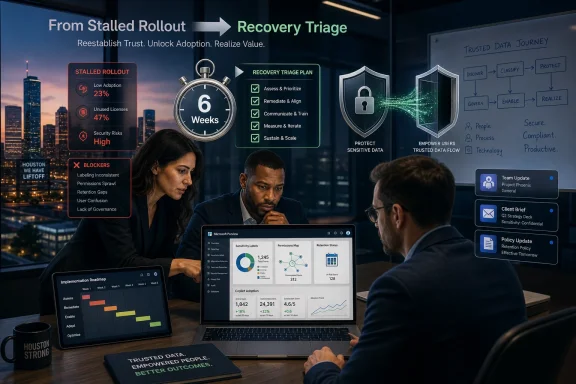
EPC Group announced on June 29, 2026, from Houston, Texas, a fixed-fee six-week Microsoft 365 Copilot Rescue Engagement for enterprises whose paid Copilot rollouts have stalled below expected usage and return-on-investment targets. The announcement is not really about one consultancy adding another SKU to its services catalog. It is a marker for where the Copilot market has arrived: past the launch excitement, deep into the accountability phase, and increasingly uncomfortable with the difference between buying AI and operationalizing it.
Microsoft’s enterprise AI pitch has always depended on proximity. Copilot sits inside Outlook, Teams, Word, Excel, SharePoint, OneDrive, and the Microsoft Graph, which means it is already near the work and near the data. But that same proximity makes the product unusually dependent on the condition of the tenant underneath it. If your permissions are messy, your content estate is stale, your labels are half-applied, and your users are unsure what a good Copilot workflow looks like, the AI does not magically fix the enterprise. It reflects the enterprise back at you.
The first year of Microsoft 365 Copilot was sold in the language of acceleration. Summarize the meeting, draft the document, find the insight, unblock the worker. That pitch was powerful because it attached generative AI to a familiar productivity stack rather than asking enterprises to build everything from scratch.
The second wave is less romantic. It is about license utilization, access reviews, sensitivity labels, stale SharePoint sites, executive dashboards, and whether a finance chief can see enough measurable value to keep paying the per-user premium. That is a very different conversation from the one that surrounded the first wave of generative AI rollouts.
EPC Group’s new engagement lands exactly in that second wave. The firm is not positioning the service as a greenfield Copilot deployment or a generic security audit. It is aiming at organizations that already bought licenses, enabled the technology, and then watched adoption stall before the deployment became part of everyday work.
That distinction matters. A rescue engagement implies that the initial assumption was wrong: that turning on Copilot would be enough to create a durable productivity habit. The emerging enterprise lesson is harsher. Copilot does not fail only when the model is weak; it fails when the organization around it is unprepared.
Copilot operates inside that terrain. Microsoft’s own documentation emphasizes that Copilot respects existing user permissions and works with controls such as sensitivity labels, encryption, auditing, retention, data loss prevention, and Microsoft Purview. That is reassuring, but it is not the same thing as saying the tenant is ready.
If a user can already access too much, Copilot can make that excess easier to discover. If the best version of a policy lives in a forgotten folder while an outdated draft is more visible, Copilot may amplify confusion rather than reduce it. If sensitive material is unlabeled or inconsistently governed, administrators may respond by restricting Copilot to a small pilot group, which protects the organization but also suppresses the adoption needed to justify the spend.
This is the uncomfortable middle ground for IT leaders. Microsoft can plausibly say Copilot honors the security model. Customers can plausibly say the security model was never designed for AI-assisted retrieval across a sprawling corporate knowledge base. Both can be true, and that is precisely why governance has become the Copilot battleground.
The diagnostic phase covers four areas: Purview sensitivity labeling and data security posture, Copilot usage and adoption telemetry, semantic model and data-estate readiness, and prompt and response governance. In plain English, EPC Group is looking at whether the tenant is safe enough, whether people are actually using the tool, whether the data estate can support trustworthy answers, and whether security teams know the boundaries of acceptable AI behavior.
The remediation phase then focuses on expanding safe access, building a champion network, tuning data and semantic models, and defining governed prompt and completion boundaries. That combination is telling. EPC Group is not treating adoption as a training problem alone, nor governance as a security-only exercise. It is presenting Copilot value as a dependency chain.
The measurement phase may be the most important part of the offer. Many enterprise AI projects are still defended through anecdotes: a manager saved two hours, a sales team drafted proposals faster, an analyst summarized meetings more efficiently. Those stories help, but they do not survive budget scrutiny forever. A rollout that cannot connect usage telemetry to business outcomes becomes vulnerable the moment the next renewal or expansion decision arrives.
Even if those numbers vary by customer, the broader pattern is credible. Microsoft’s public messaging has emphasized rapid Copilot momentum, expanding agent capabilities, and growing enterprise interest. But IT departments live in a more granular world. They see who received a license, who used it last week, which app they used it in, whether usage repeated, and whether any of that activity changed a process that matters.
A weekly active rate of 20 to 30 percent is not automatically failure. Some expensive enterprise tools produce value for narrower populations. The problem is that Microsoft 365 Copilot has often been discussed as a broad productivity layer, not a niche specialist utility. If a company bought licenses on the assumption that Copilot would become a daily habit for a large share of knowledge workers, sporadic usage creates a budget problem.
That is where rescue services become attractive. They offer executives a way to avoid two politically awkward conclusions: that the organization overbought licenses, or that the AI strategy was mostly theater. A six-week intervention says there is still a path to value, but it also says the path runs through operational discipline rather than executive enthusiasm.
That strategy is logical. Microsoft’s advantage is not simply that it has access to strong models. It owns the productivity surface, the identity layer, the collaboration fabric, the admin consoles, and much of the compliance tooling that large organizations already use. If enterprise AI becomes a governance-heavy discipline, Microsoft has every reason to believe it can win.
But that same strategy creates a dependency on customer readiness. Microsoft can ship controls, but customers must configure them. Microsoft can provide reports, but someone must interpret them. Microsoft can point to Purview, SharePoint Advanced Management, Entra, audit logs, sensitivity labels, and retention policies, but many organizations still struggle with basic information architecture.
The result is a paradox. Copilot is sold as a way to make work simpler, yet making Copilot work well may require enterprises to confront years of accumulated complexity. That does not make the product bad. It makes the product revealing.
But adoption is rarely just a matter of enthusiasm. If users try Copilot and receive bland summaries, irrelevant answers, or responses grounded in questionable content, they will not build a habit. Trust is a usage multiplier. Once users decide that a tool is unreliable, winning them back is harder than training them the first time.
This is why EPC Group’s emphasis on data readiness is important. A Copilot rollout can have an excellent communications plan and still fail if the underlying content is poor. AI adoption is not separate from records management, knowledge management, search quality, and business process design. It is downstream from all of them.
Champion networks can help, but only if champions have something credible to demonstrate. The best internal advocates are not people who repeat vendor talking points. They are people who can show colleagues how Copilot shortens a real workflow without creating new risk or cleanup work.
Those teams are not irrationally blocking innovation. They are responding to a product category that changes the economics of discovery. Information that technically existed before may become easier to surface, summarize, and combine. That matters in environments with sensitive HR files, legal documents, merger discussions, regulated customer data, intellectual property, and executive communications.
Microsoft’s position is that Copilot respects existing permissions and can be governed through the Microsoft 365 and Purview control plane. That is a strong architectural answer, but it does not eliminate the customer’s obligation to clean up oversharing. In many organizations, permissions are correct only in the narrow sense that they reflect years of unreviewed decisions.
This is where the phrase permission hygiene stops being boring. In the pre-AI era, sloppy access control might have been mitigated by obscurity, bad search, or simple inconvenience. In the Copilot era, obscurity is not a control. If the assistant can quickly find and summarize what a user is allowed to see, then “allowed to see” has to mean what the business actually intends.
A user who saves 15 minutes summarizing a meeting may simply spend those 15 minutes in another meeting. A worker who drafts an email faster may not improve customer satisfaction, shorten a sales cycle, or reduce operational cost. Productivity tools often create local efficiency without changing the system around them.
That is why measurement frameworks matter. A serious Copilot program should define which workflows are being targeted, what baseline exists today, what improvement is expected, and how the organization will know whether the change occurred. Usage telemetry is necessary, but it is not sufficient. A high prompt count can indicate value, curiosity, confusion, or busywork.
EPC Group’s promise to tie adoption telemetry to business outcomes is therefore the right ambition. The challenge is execution. Measuring AI value in knowledge work is notoriously difficult because the outputs are often qualitative, collaborative, and indirect. Still, imperfect measurement beats vibes, especially when licensing costs scale across thousands of users.
But the six-week framing also risks oversimplifying the depth of the problem. Governance is not a one-time cleanup. Adoption is not permanently solved by a champion network kickoff. Data quality does not stay fixed after a consulting team leaves. AI operating models decay unless someone owns them.
To EPC Group’s credit, the release frames the rescue as an entry point to a sustained operating model through an AI Center of Excellence and virtual Chief AI Officer service. That is commercially convenient, but it is also substantively accurate. Enterprises do not need a one-off Copilot ceremony. They need a way to continuously decide which use cases are worth scaling, which controls must evolve, and which licenses should be reassigned or retired.
The danger for customers is confusing remediation with maturity. A rescue engagement can create momentum, but it cannot substitute for internal ownership. If an organization exits six weeks of cleanup and then returns to the same habits that created the mess, Copilot will drift back toward underuse or unmanaged risk.
That shift favors firms that can speak both Microsoft architecture and organizational change. Copilot is not only an AI deployment. It touches SharePoint administration, Purview configuration, Entra identity practices, data governance, Power BI and Fabric models, records policies, user training, and executive measurement. Few internal teams own that entire chain cleanly.
EPC Group is positioning itself as one of those cross-domain operators. The firm points to its Microsoft consulting history, Microsoft Solutions Partner designations, business intelligence consulting recognition, and experience across regulated and large enterprise environments. Some of that is standard services marketing, but the underlying market need is real.
The question for buyers is whether a consultancy can move beyond generic Copilot readiness language and confront the specific dysfunctions inside a tenant. The value is not in producing a polished slide deck that says “improve governance.” The value is in identifying which sites are overshared, which labels are missing, which users should get licenses next, which workflows justify expansion, and which controls are blocking adoption for good reasons.
In practice, partner-led rescue offerings may help Microsoft more than they hurt it. They give customers a way to stay in the Copilot ecosystem rather than abandoning or shrinking deployments. They also shift the narrative from “Copilot does not work” to “Copilot requires readiness.” That is a much more manageable story for Redmond.
Microsoft has long relied on partners to turn platform capability into customer outcomes. Azure migrations, SharePoint intranets, Teams voice projects, Dynamics deployments, Power BI governance programs, and security hardening efforts have all depended on consulting ecosystems. Copilot is following the same path, only faster and with more executive scrutiny.
The difference is that AI disappointment is more visible. Boards and CEOs have heard the pitch. Employees have experimented with consumer AI tools. CFOs can see the license line. If Copilot does not become useful, the gap between promise and reality is not buried in an infrastructure project. It is discussed in the language of corporate strategy.
The same issues will appear with other assistants and agents. Poor permissions, low-quality data, unclear ownership, weak change management, and vague ROI models will undermine any AI system that depends on internal knowledge. The model can be better, the interface can be slicker, and the vendor can be different, but the organizational prerequisites remain.
This is why the current wave of AI governance is not just compliance theater. Done badly, governance becomes a brake: committees, forms, and vague policies that slow every experiment. Done well, governance becomes the mechanism that lets enterprises scale AI safely because it clarifies what data can be used, who can use it, how output should be checked, and how value will be measured.
Copilot is forcing that conversation because it is embedded where work already happens. It does not wait for a pristine data lake or a bespoke AI application. It reaches into the messy center of the company. That is its strength, and that is why stalled rollouts are so instructive.
The practical lessons are becoming clearer for organizations that have already licensed Microsoft 365 Copilot or are preparing to scale it:
Microsoft 365 Copilot is entering its accountability era, and EPC Group’s rescue engagement is one more sign that the market has moved from curiosity to operational consequence. The next phase will not be decided by whether executives believe in AI, because most already do. It will be decided by whether organizations can clean up their data estates, govern access without freezing innovation, train users around real work, and measure enough value to justify the next renewal. In that world, the rescue is not an admission that Copilot failed; it is an admission that enterprise AI has finally become serious.
Microsoft’s enterprise AI pitch has always depended on proximity. Copilot sits inside Outlook, Teams, Word, Excel, SharePoint, OneDrive, and the Microsoft Graph, which means it is already near the work and near the data. But that same proximity makes the product unusually dependent on the condition of the tenant underneath it. If your permissions are messy, your content estate is stale, your labels are half-applied, and your users are unsure what a good Copilot workflow looks like, the AI does not magically fix the enterprise. It reflects the enterprise back at you.
 The Copilot Hangover Was Always Going to Be a Governance Story
The first year of Microsoft 365 Copilot was sold in the language of acceleration. Summarize the meeting, draft the document, find the insight, unblock the worker. That pitch was powerful because it attached generative AI to a familiar productivity stack rather than asking enterprises to build everything from scratch.The second wave is less romantic. It is about license utilization, access reviews, sensitivity labels, stale SharePoint sites, executive dashboards, and whether a finance chief can see enough measurable value to keep paying the per-user premium. That is a very different conversation from the one that surrounded the first wave of generative AI rollouts.
EPC Group’s new engagement lands exactly in that second wave. The firm is not positioning the service as a greenfield Copilot deployment or a generic security audit. It is aiming at organizations that already bought licenses, enabled the technology, and then watched adoption stall before the deployment became part of everyday work.
That distinction matters. A rescue engagement implies that the initial assumption was wrong: that turning on Copilot would be enough to create a durable productivity habit. The emerging enterprise lesson is harsher. Copilot does not fail only when the model is weak; it fails when the organization around it is unprepared.
The Button Was Easy; the Tenant Was Not
The phrase “turning on Copilot” has always understated the real work. Microsoft 365 is not a clean room. It is years of Teams sprawl, inherited SharePoint permissions, abandoned project sites, overbroad sharing links, duplicate files, hidden departmental processes, and content that may be business-critical, obsolete, confidential, or all three.Copilot operates inside that terrain. Microsoft’s own documentation emphasizes that Copilot respects existing user permissions and works with controls such as sensitivity labels, encryption, auditing, retention, data loss prevention, and Microsoft Purview. That is reassuring, but it is not the same thing as saying the tenant is ready.
If a user can already access too much, Copilot can make that excess easier to discover. If the best version of a policy lives in a forgotten folder while an outdated draft is more visible, Copilot may amplify confusion rather than reduce it. If sensitive material is unlabeled or inconsistently governed, administrators may respond by restricting Copilot to a small pilot group, which protects the organization but also suppresses the adoption needed to justify the spend.
This is the uncomfortable middle ground for IT leaders. Microsoft can plausibly say Copilot honors the security model. Customers can plausibly say the security model was never designed for AI-assisted retrieval across a sprawling corporate knowledge base. Both can be true, and that is precisely why governance has become the Copilot battleground.
EPC Group Sells the Missing Middle
EPC Group’s six-week structure is built around a familiar consulting promise: diagnose, remediate, measure. The notable part is not that the phases exist. It is that the firm is packaging them as a fixed-fee recovery motion for organizations that are already disappointed.The diagnostic phase covers four areas: Purview sensitivity labeling and data security posture, Copilot usage and adoption telemetry, semantic model and data-estate readiness, and prompt and response governance. In plain English, EPC Group is looking at whether the tenant is safe enough, whether people are actually using the tool, whether the data estate can support trustworthy answers, and whether security teams know the boundaries of acceptable AI behavior.
The remediation phase then focuses on expanding safe access, building a champion network, tuning data and semantic models, and defining governed prompt and completion boundaries. That combination is telling. EPC Group is not treating adoption as a training problem alone, nor governance as a security-only exercise. It is presenting Copilot value as a dependency chain.
The measurement phase may be the most important part of the offer. Many enterprise AI projects are still defended through anecdotes: a manager saved two hours, a sales team drafted proposals faster, an analyst summarized meetings more efficiently. Those stories help, but they do not survive budget scrutiny forever. A rollout that cannot connect usage telemetry to business outcomes becomes vulnerable the moment the next renewal or expansion decision arrives.
The Gartner Shadow Over Copilot ROI
The press release leans on Gartner’s reported view that weekly active usage of licensed Microsoft 365 Copilot seats remains in the 20-to-30 percent range across many organizations. It also references a Gartner analyst describing ROI justification for full-scale Copilot deployment as “quite challenging,” with many organizations pausing rollouts to determine where the technology actually fits.Even if those numbers vary by customer, the broader pattern is credible. Microsoft’s public messaging has emphasized rapid Copilot momentum, expanding agent capabilities, and growing enterprise interest. But IT departments live in a more granular world. They see who received a license, who used it last week, which app they used it in, whether usage repeated, and whether any of that activity changed a process that matters.
A weekly active rate of 20 to 30 percent is not automatically failure. Some expensive enterprise tools produce value for narrower populations. The problem is that Microsoft 365 Copilot has often been discussed as a broad productivity layer, not a niche specialist utility. If a company bought licenses on the assumption that Copilot would become a daily habit for a large share of knowledge workers, sporadic usage creates a budget problem.
That is where rescue services become attractive. They offer executives a way to avoid two politically awkward conclusions: that the organization overbought licenses, or that the AI strategy was mostly theater. A six-week intervention says there is still a path to value, but it also says the path runs through operational discipline rather than executive enthusiasm.
Microsoft’s AI Ambition Depends on Customer Plumbing
Microsoft has been racing to turn Copilot from a feature family into an operating layer for work. The company has pushed Microsoft 365 Copilot, Copilot Chat, agents, Copilot Studio, Purview integrations, SharePoint Advanced Management hooks, and broader governance controls under the idea that AI must be both useful and manageable at enterprise scale.That strategy is logical. Microsoft’s advantage is not simply that it has access to strong models. It owns the productivity surface, the identity layer, the collaboration fabric, the admin consoles, and much of the compliance tooling that large organizations already use. If enterprise AI becomes a governance-heavy discipline, Microsoft has every reason to believe it can win.
But that same strategy creates a dependency on customer readiness. Microsoft can ship controls, but customers must configure them. Microsoft can provide reports, but someone must interpret them. Microsoft can point to Purview, SharePoint Advanced Management, Entra, audit logs, sensitivity labels, and retention policies, but many organizations still struggle with basic information architecture.
The result is a paradox. Copilot is sold as a way to make work simpler, yet making Copilot work well may require enterprises to confront years of accumulated complexity. That does not make the product bad. It makes the product revealing.
Stalled Adoption Is Not Just a User Problem
It is tempting to blame weak Copilot adoption on employees who are too busy, too skeptical, or too comfortable with old workflows. There is some truth there. Generative AI tools require behavioral change, and many workers still do not know when to use them, how to prompt them, or how to judge their output.But adoption is rarely just a matter of enthusiasm. If users try Copilot and receive bland summaries, irrelevant answers, or responses grounded in questionable content, they will not build a habit. Trust is a usage multiplier. Once users decide that a tool is unreliable, winning them back is harder than training them the first time.
This is why EPC Group’s emphasis on data readiness is important. A Copilot rollout can have an excellent communications plan and still fail if the underlying content is poor. AI adoption is not separate from records management, knowledge management, search quality, and business process design. It is downstream from all of them.
Champion networks can help, but only if champions have something credible to demonstrate. The best internal advocates are not people who repeat vendor talking points. They are people who can show colleagues how Copilot shortens a real workflow without creating new risk or cleanup work.
Security Teams Are Becoming the Real Gatekeepers
The most consequential audience for Copilot expansion may not be the end user. It may be the security, compliance, and legal teams that decide whether the deployment can safely move beyond a controlled pilot.Those teams are not irrationally blocking innovation. They are responding to a product category that changes the economics of discovery. Information that technically existed before may become easier to surface, summarize, and combine. That matters in environments with sensitive HR files, legal documents, merger discussions, regulated customer data, intellectual property, and executive communications.
Microsoft’s position is that Copilot respects existing permissions and can be governed through the Microsoft 365 and Purview control plane. That is a strong architectural answer, but it does not eliminate the customer’s obligation to clean up oversharing. In many organizations, permissions are correct only in the narrow sense that they reflect years of unreviewed decisions.
This is where the phrase permission hygiene stops being boring. In the pre-AI era, sloppy access control might have been mitigated by obscurity, bad search, or simple inconvenience. In the Copilot era, obscurity is not a control. If the assistant can quickly find and summarize what a user is allowed to see, then “allowed to see” has to mean what the business actually intends.
The ROI Debate Is Really a Workflow Debate
The hardest Copilot question is not whether the product can save time. In many cases, it can. The harder question is whether those time savings accumulate into measurable business value.A user who saves 15 minutes summarizing a meeting may simply spend those 15 minutes in another meeting. A worker who drafts an email faster may not improve customer satisfaction, shorten a sales cycle, or reduce operational cost. Productivity tools often create local efficiency without changing the system around them.
That is why measurement frameworks matter. A serious Copilot program should define which workflows are being targeted, what baseline exists today, what improvement is expected, and how the organization will know whether the change occurred. Usage telemetry is necessary, but it is not sufficient. A high prompt count can indicate value, curiosity, confusion, or busywork.
EPC Group’s promise to tie adoption telemetry to business outcomes is therefore the right ambition. The challenge is execution. Measuring AI value in knowledge work is notoriously difficult because the outputs are often qualitative, collaborative, and indirect. Still, imperfect measurement beats vibes, especially when licensing costs scale across thousands of users.
The Six-Week Promise Is Both Practical and Dangerous
A six-week fixed-fee rescue engagement is attractive because it gives leaders a defined intervention rather than an open-ended transformation program. It suggests urgency, containment, and a visible path out of rollout limbo. For enterprises tired of abstract AI roadmaps, that packaging has obvious appeal.But the six-week framing also risks oversimplifying the depth of the problem. Governance is not a one-time cleanup. Adoption is not permanently solved by a champion network kickoff. Data quality does not stay fixed after a consulting team leaves. AI operating models decay unless someone owns them.
To EPC Group’s credit, the release frames the rescue as an entry point to a sustained operating model through an AI Center of Excellence and virtual Chief AI Officer service. That is commercially convenient, but it is also substantively accurate. Enterprises do not need a one-off Copilot ceremony. They need a way to continuously decide which use cases are worth scaling, which controls must evolve, and which licenses should be reassigned or retired.
The danger for customers is confusing remediation with maturity. A rescue engagement can create momentum, but it cannot substitute for internal ownership. If an organization exits six weeks of cleanup and then returns to the same habits that created the mess, Copilot will drift back toward underuse or unmanaged risk.
Consulting Firms Are Turning AI Disappointment Into a Market
There is a broader industry pattern here. The first phase of generative AI created demand for pilots, workshops, and executive briefings. The next phase is creating demand for recovery, governance, cost control, and operating discipline.That shift favors firms that can speak both Microsoft architecture and organizational change. Copilot is not only an AI deployment. It touches SharePoint administration, Purview configuration, Entra identity practices, data governance, Power BI and Fabric models, records policies, user training, and executive measurement. Few internal teams own that entire chain cleanly.
EPC Group is positioning itself as one of those cross-domain operators. The firm points to its Microsoft consulting history, Microsoft Solutions Partner designations, business intelligence consulting recognition, and experience across regulated and large enterprise environments. Some of that is standard services marketing, but the underlying market need is real.
The question for buyers is whether a consultancy can move beyond generic Copilot readiness language and confront the specific dysfunctions inside a tenant. The value is not in producing a polished slide deck that says “improve governance.” The value is in identifying which sites are overshared, which labels are missing, which users should get licenses next, which workflows justify expansion, and which controls are blocking adoption for good reasons.
Microsoft Benefits When Partners Admit the Hard Part
On the surface, a “Copilot Rescue Engagement” might sound like bad news for Microsoft. Rescue implies trouble. Stalled rollouts imply disappointed customers. Governance gaps imply that the product did not deliver immediate value out of the box.In practice, partner-led rescue offerings may help Microsoft more than they hurt it. They give customers a way to stay in the Copilot ecosystem rather than abandoning or shrinking deployments. They also shift the narrative from “Copilot does not work” to “Copilot requires readiness.” That is a much more manageable story for Redmond.
Microsoft has long relied on partners to turn platform capability into customer outcomes. Azure migrations, SharePoint intranets, Teams voice projects, Dynamics deployments, Power BI governance programs, and security hardening efforts have all depended on consulting ecosystems. Copilot is following the same path, only faster and with more executive scrutiny.
The difference is that AI disappointment is more visible. Boards and CEOs have heard the pitch. Employees have experimented with consumer AI tools. CFOs can see the license line. If Copilot does not become useful, the gap between promise and reality is not buried in an infrastructure project. It is discussed in the language of corporate strategy.
The Enterprise Lesson Is Bigger Than Copilot
The most useful reading of EPC Group’s announcement is not that Microsoft 365 Copilot is uniquely troubled. It is that enterprise AI is exposing the weak points in enterprise operations.The same issues will appear with other assistants and agents. Poor permissions, low-quality data, unclear ownership, weak change management, and vague ROI models will undermine any AI system that depends on internal knowledge. The model can be better, the interface can be slicker, and the vendor can be different, but the organizational prerequisites remain.
This is why the current wave of AI governance is not just compliance theater. Done badly, governance becomes a brake: committees, forms, and vague policies that slow every experiment. Done well, governance becomes the mechanism that lets enterprises scale AI safely because it clarifies what data can be used, who can use it, how output should be checked, and how value will be measured.
Copilot is forcing that conversation because it is embedded where work already happens. It does not wait for a pristine data lake or a bespoke AI application. It reaches into the messy center of the company. That is its strength, and that is why stalled rollouts are so instructive.
The Rescue Playbook Says the Quiet Part Out Loud
EPC Group’s announcement is useful because it says something many IT leaders already know but vendors often soften: Copilot value is not automatic.The practical lessons are becoming clearer for organizations that have already licensed Microsoft 365 Copilot or are preparing to scale it:
- Enterprises should treat Copilot readiness as a tenant, data, security, and adoption program rather than a feature enablement task.
- Weekly active usage is a starting metric, but it does not prove ROI unless it is connected to specific workflows and measurable business outcomes.
- Oversharing remediation and sensitivity-label coverage are not optional hygiene projects when AI can rapidly surface and synthesize accessible content.
- Champion networks work best when they are tied to real business scenarios, not generic prompt training.
- A stalled rollout should trigger license reassessment, governance cleanup, and workflow redesign before the organization simply buys more seats.
- A six-week rescue can create momentum, but durable Copilot value requires an operating model that continues after the consultants leave.
Microsoft 365 Copilot is entering its accountability era, and EPC Group’s rescue engagement is one more sign that the market has moved from curiosity to operational consequence. The next phase will not be decided by whether executives believe in AI, because most already do. It will be decided by whether organizations can clean up their data estates, govern access without freezing innovation, train users around real work, and measure enough value to justify the next renewal. In that world, the rescue is not an admission that Copilot failed; it is an admission that enterprise AI has finally become serious.
References
- Primary source: EIN Presswire
Published: Mon, 29 Jun 2026 16:11:00 GMT
EPC Group Launches Microsoft 365 Copilot Rescue Engagement for Stalled Enterprise Rollouts
EPC Group launches a fixed-fee, six-week Microsoft 365 Copilot Rescue Engagement that diagnoses and remediates the governance, data-readiness, and adoption gapswww.einpresswire.com
- Official source: microsoft.com
Copilot Cowork is now generally available | Microsoft 365 Blog
Copilot Cowork is now generally available worldwide, bringing secure, AI-powered automation for complex enterprise tasks in Microsoft 365.www.microsoft.com - Related coverage: natlawreview.com
- Related coverage: world.einnews.com
EPC Group Launches Governed AI on Microsoft Framework - World News Report - EIN Presswire
Houston-based EPC Group introduces a seven-layer governance framework unifying Microsoft Purview, Fabric, Power BI, M365, Entra ID, Copilot and Defender.world.einnews.com
- Related coverage: epcgroup.net
EPC Group Surpasses 70 Fortune 500 Microsoft...
EPC Group has crossed 70 Fortune 500 Microsoft enterprise engagements — NASA, FBI, Federal Reserve Bank of New York, Pentagon, United Airlines, PepsiCo,.www.epcgroup.net - Related coverage: einnews.com
EPC Group Marks Federal Reserve eDiscovery Role During TARP as Governance Discipline Powers 2026 Copilot - EIN Presswire
Houston-based Microsoft Gold Partner and four-time G2 Leader extends federal-grade governance discipline behind TARP-era work to 2026 Copilot and Fabricwww.einnews.com
- Related coverage: oilandgas.einnews.com
EPC Group Publishes 7-Phase Engagement Operating Model for Microsoft Enterprise Project Management - Oil & Gas Industry Today - EIN Presswire
Seven-phase Microsoft enterprise project management methodology with senior-architect bench, named artifacts at every phase, and fixed-fee predictability.oilandgas.einnews.com
- Official source: learn.microsoft.com
Microsoft 365 Copilot Usage Report - Microsoft 365 admin | Microsoft Learn
The Microsoft 365 Copilot usage report helps admins measure user adoption, prompt activity, and agent engagement. Explore key metrics and insights today.learn.microsoft.com - Related coverage: kpmg.com
- Related coverage: techradar.com
Microsoft spent billions on Copilot, but only 3.3% of users are actually paying for the AI tools | TechRadar
Microsoft spent $37.5 billion on AI tools, with limited returns so farwww.techradar.com - Related coverage: 0e190a550a8c4c8c4b93-fcd009c875a5577fd4fe2f5b7e3bf4eb.ssl.cf2.rackcdn.com
EINPresswire 858122180 epc group hits 625 google to microsoft 365 cloud migrations 3x g2 power bi winner announced 2
PDF document0e190a550a8c4c8c4b93-fcd009c875a5577fd4fe2f5b7e3bf4eb.ssl.cf2.rackcdn.com
- Related coverage: press.spglobal.com
S&P Global Launches AI-Ready Commodities Data Integrated With Microsoft 365 Copilot - Apr 21, 2025
PDF documentpress.spglobal.com
- Related coverage: dashboard.adoptify.ai
- Official source: news.microsoft.com