

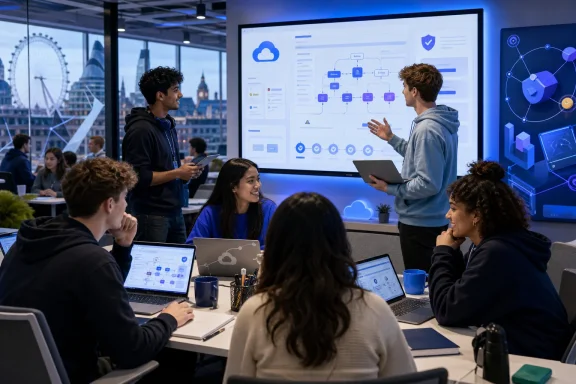
A LinkedIn post about Accenture’s enormous Microsoft 365 Copilot rollout has inspired an unusually practical experiment in bottom-up AI adoption: a cross-company hackathon designed and led by early-career employees. Microsoft UK degree apprentice Kasheef McLennon turned a question about how young workers would learn to use workplace AI into a London event where roughly 40 people aged 18 to 25 built agents, developed presentations, and pitched solutions to specialists from Microsoft, Accenture, and Avanade. The result is more than an encouraging career story. It offers a compact case study in how enterprises can move beyond merely assigning Copilot licenses and start building the skills, confidence, governance habits, and peer networks required to make those licenses useful.
McLennon works as an Account Technology Strategist at Microsoft UK, where Copilot forms part of his everyday work with customers. The catalyst for the hackathon came while he was browsing his chief executive’s LinkedIn page and found a post about Accenture rolling out Microsoft 365 Copilot to approximately 740,000 employees.
That figure naturally suggested a story about enterprise scale, licensing, infrastructure, and change management. McLennon viewed it through a different lens: What would such a deployment mean for apprentices, graduates, and other people taking their first steps into corporate life?
The idea became the first early-career crossover event of its kind between Microsoft and Accenture. Avanade, the long-standing Microsoft and Accenture joint venture, contributed customer examples and practical Copilot expertise.
The participants then moved from listening to building. They created AI agents intended to reduce friction, improve access to business information, support decision-making, and produce better outcomes from familiar workplace processes.
A hackathon reverses the emphasis. Participants start with a problem, decide whether AI is appropriate, construct a possible solution, and defend the result in front of others. That experience exposes technical limitations and business questions that a polished demonstration can easily hide.
Accenture did not arrive at that position in one step. Its deployment began in 2023 with selected employees and senior leaders, expanded to approximately 20,000 users, and continued through larger phases as the company refined governance, training, communications, and adoption practices.
Accenture has reported strong usage in large deployment groups, alongside employees saying they would miss Copilot if access disappeared. The company has also presented internal findings suggesting that many users complete routine tasks more quickly and report improvements in productivity.
Those figures should still be interpreted with care. Self-reported time savings do not automatically equal audited financial returns, while a task completed faster may require additional review if AI introduces an error. Even so, sustained voluntary use across hundreds of thousands of employees is a stronger signal than a successful executive demonstration.
That explains why smaller, audience-specific events can complement a global deployment. Central programs provide governance and consistency, while local communities translate the technology into the language of particular roles.
The hackathon’s importance lies in that translation layer. It asked young workers to discover how AI could help them rather than assuming that a generic adoption campaign would answer the question.
The organizers also discussed attention, cognitive overload, and the learning preferences of their generation. While sweeping claims about generational attention spans deserve skepticism, their underlying design principle was sensible: participants should spend the day applying ideas rather than trying to retain an uninterrupted stream of product information.
This is an important distinction between awareness and capability. An employee may understand that generative AI can summarize meetings or draft text without being able to decide:
Peer-led education can also give adoption campaigns greater credibility. A prompt demonstrated by an apprentice who uses it during real project work may feel more relevant than a generic example delivered by an external trainer.
However, peer credibility must not replace technical validation. The ideal model pairs enthusiastic employee communities with specialists who can test assumptions, identify security issues, and distinguish a promising prototype from a production-ready system.
Participants created agents, generated presentations, and pitched their concepts to technical judges from the three participating organizations. Two projects highlighted in Microsoft UK’s account are particularly instructive.
A well-designed RFP agent could:
The strongest implementation would therefore treat AI as an orchestration and drafting layer, not an autonomous bidder. Legal, commercial, security, and delivery owners would still need to approve relevant sections before submission.
Automating that process could save time while reducing formatting inconsistencies and transcription errors. It could also help new team members begin work without first learning where every piece of account information is stored.
Yet the design would depend heavily on data quality. If account records are outdated, duplicated, or contradictory, the agent may fill a polished template with the wrong information. The apparent simplicity of the use case therefore leads directly to a larger lesson: AI readiness is often data readiness in disguise.
A participant does not always need to build a full application from scratch. Agent-building tools can combine instructions, approved knowledge sources, connectors, actions, and conversational interaction into a prototype that colleagues can test quickly.
That shift can make AI more reliable because the designer specifies the agent’s purpose, boundaries, data sources, and expected output. It can also make the system more consequential if the agent is allowed to create records, send messages, update files, or trigger business actions.
Organizations should therefore think in terms of an authority ladder:
Hackathons are most useful when they make this distinction explicit. The winning idea should not necessarily be the most autonomous agent or the flashiest presentation. It should be the concept with a credible path from experiment to governed operation.
That trust matters because centralized AI programs cannot identify every valuable workflow. Employees closest to a process often know where time is wasted, which documents are repeatedly recreated, and where customers encounter avoidable delays.
The enterprise challenge is to capture that insight without creating uncontrolled “shadow AI.” If every enthusiastic employee publishes an agent connected to business data, organizations can accumulate duplicate tools, unclear ownership, inconsistent instructions, and unreviewed access paths.
A sustainable model needs both freedom and boundaries:
That protection does not eliminate oversharing. If a SharePoint site, Teams workspace, or OneDrive file already has an excessively broad audience, Copilot may make that accessible information easier to find and synthesize.
Before expanding AI use, organizations need to examine site ownership, sharing links, group membership, sensitivity labels, retention policies, and legacy repositories. AI can expose weak information governance not by breaking the rules, but by applying existing rules more efficiently than a person searching manually.
This reflects a wider change in early-career technology roles. Apprentices are not merely being prepared to operate established systems; they are entering organizations while those organizations are still deciding how AI should reshape work.
Generative AI strengthens this role because experimentation has become more accessible. A young employee can now move from an observed problem to a rough interactive prototype without waiting for a full development project.
That does not make experience obsolete. Senior colleagues understand customer commitments, regulations, failure modes, and organizational history that a newcomer may miss. The greatest value appears when early-career experimentation and experienced judgment operate together.
The event therefore developed skills beyond prompting and agent construction:
Copilot touches content, identity, permissions, compliance, workflows, and business decisions. Productive adoption therefore requires cooperation among technical teams, business owners, human resources, learning specialists, legal departments, and security professionals.
Useful measures could include:
An effective funnel might proceed as follows:
An employee might begin with an email request in Outlook, retrieve supporting documents through Microsoft 365, analyze figures in Excel, draft a response in Word, and generate a presentation in PowerPoint. Agents can potentially coordinate parts of that chain.
A well-managed Windows device remains essential for endpoint security, authentication, data protection, and application control. However, preparing for Copilot also requires work inside Entra ID, SharePoint, OneDrive, Teams, Purview, the Microsoft 365 admin center, and potentially the Power Platform.
A fully patched PC does not compensate for an ownerless SharePoint site with broad access. Likewise, a strong sensitivity-labeling policy will not help if employees ignore it or lack confidence in applying it.
Users need to understand which account they are using, what data protections apply, whether prompts are retained, which repositories can ground responses, and whether an agent has permission to take actions. The visual similarity between consumer chat and enterprise Copilot can conceal substantial differences in governance.
Training should therefore explain not just how to prompt, but how identity, tenancy, permissions, citations, and data classification affect the result.
As enterprises adopt Copilot and agents, that relationship serves multiple purposes. Microsoft supplies the platforms, Accenture brings business transformation and industry expertise, and Avanade specializes in applying Microsoft technology within customer environments.
Those relationships may later improve collaboration on customer projects. Employees who understand the roles and working styles of partner organizations can navigate joint engagements more effectively.
There is also a recruitment dimension. Young professionals gain visibility into possible career paths spanning strategy, engineering, consulting, sales, adoption, security, and change management.
Enterprise customers also evaluate integration with existing software, the availability of trained partners, identity and compliance controls, deployment support, data connectivity, and the ability to move experiments into production. Programs that develop communities of capable users can therefore become a competitive advantage.
The hackathon may have involved only 40 attendees, but the model supports a broader ecosystem strategy: create practitioners who can identify use cases, explain the technology, and carry adoption into customer-facing work.
The design should begin with a business purpose and an honest assessment of what participants can accomplish in the available time.
A better challenge identifies a domain and measurable outcome without prescribing the solution. Examples include reducing the time required to prepare a customer meeting, improving access to approved policy information, or decreasing rework in a document-heavy process.
The organizers should also define prohibited areas. Certain personal data, live customer records, privileged legal material, source code, and security information may be inappropriate for a rapid experiment.
A balanced scoring model should consider:
A second question is how many prototypes progress beyond presentations. The RFP and Client Template concepts address recognizable business problems, but their lasting significance will depend on whether they gain owners, pass governance reviews, and produce measurable improvements.
Cross-generational participation may also improve the model. Early-career employees could lead ideation and prototyping while experienced specialists contribute process knowledge, risk awareness, and customer context.
The strongest program would not treat one group as the teacher and the other as the student. It would recognize that both hold knowledge the other lacks.
They need employees who can identify useful workflows, evaluate outputs, manage knowledge sources, understand permissions, and know when automation is inappropriate. Events like McLennon’s hackathon test whether those skills can be developed through practical, peer-led activity.
They also test whether large organizations can give junior employees meaningful autonomy without abandoning operational discipline. That balance may determine whether enterprise AI becomes an empowering layer across the workforce or another centrally purchased platform that only a minority uses well.
McLennon’s journey from a casual LinkedIn discovery to a three-company AI event captures an important truth about workplace technology: transformation rarely happens through licensing alone. It happens when someone notices a practical question, finds collaborators, works through unglamorous details, and creates a space where other people can experiment. If Microsoft, Accenture, and Avanade can turn that energy into a repeatable path from idea to governed deployment, this modest London hackathon may prove more instructive than its size suggests—especially for a generation that will inherit not only AI-powered tools, but responsibility for deciding how those tools should work.
 Overview
McLennon works as an Account Technology Strategist at Microsoft UK, where Copilot forms part of his everyday work with customers. The catalyst for the hackathon came while he was browsing his chief executive’s LinkedIn page and found a post about Accenture rolling out Microsoft 365 Copilot to approximately 740,000 employees.That figure naturally suggested a story about enterprise scale, licensing, infrastructure, and change management. McLennon viewed it through a different lens: What would such a deployment mean for apprentices, graduates, and other people taking their first steps into corporate life?
From passive interest to a real event
Rather than leaving the question in the comments section, McLennon connected with Chidinma Iroegbu, a technology apprentice at Accenture. Together, they explored the possibility of an event built specifically for early-in-career colleagues rather than adapting an executive workshop or conventional technical conference.The idea became the first early-career crossover event of its kind between Microsoft and Accenture. Avanade, the long-standing Microsoft and Accenture joint venture, contributed customer examples and practical Copilot expertise.
The participants then moved from listening to building. They created AI agents intended to reduce friction, improve access to business information, support decision-making, and produce better outcomes from familiar workplace processes.
Why the format matters
Corporate AI training often begins with centrally produced videos, compliance modules, prompt libraries, and product demonstrations. Those materials have a role, but they do not necessarily help an employee understand where AI belongs in a real workflow.A hackathon reverses the emphasis. Participants start with a problem, decide whether AI is appropriate, construct a possible solution, and defend the result in front of others. That experience exposes technical limitations and business questions that a polished demonstration can easily hide.
The Significance of Accenture’s Copilot Rollout
Accenture’s deployment provides the scale behind McLennon’s idea. Microsoft has described the expansion to more than 740,000 seats as its largest Microsoft 365 Copilot enterprise agreement to date, illustrating how quickly generative AI has moved from limited pilots to near-workforce-wide availability.Accenture did not arrive at that position in one step. Its deployment began in 2023 with selected employees and senior leaders, expanded to approximately 20,000 users, and continued through larger phases as the company refined governance, training, communications, and adoption practices.
A deployment measured in human behavior
Enterprise software rollouts are commonly described through license counts, but a purchased license is not the same as productive use. The more meaningful measures include monthly active usage, repeat behavior, output quality, time saved, and whether employees continue using the tool after the novelty fades.Accenture has reported strong usage in large deployment groups, alongside employees saying they would miss Copilot if access disappeared. The company has also presented internal findings suggesting that many users complete routine tasks more quickly and report improvements in productivity.
Those figures should still be interpreted with care. Self-reported time savings do not automatically equal audited financial returns, while a task completed faster may require additional review if AI introduces an error. Even so, sustained voluntary use across hundreds of thousands of employees is a stronger signal than a successful executive demonstration.
The challenge hidden inside the headline
Putting Copilot in front of 740,000 people creates a second problem: there is no single “Copilot user.” A new apprentice, a marketing director, a security analyst, a consultant, and a finance specialist have different data, responsibilities, risks, and definitions of value.That explains why smaller, audience-specific events can complement a global deployment. Central programs provide governance and consistency, while local communities translate the technology into the language of particular roles.
The hackathon’s importance lies in that translation layer. It asked young workers to discover how AI could help them rather than assuming that a generic adoption campaign would answer the question.
Designing AI Training for Early-Career Workers
McLennon and Iroegbu deliberately avoided turning the event into a long sequence of presentations. Sessions were kept short, pre-event study requirements were limited, and practical construction took priority over passive instruction.The organizers also discussed attention, cognitive overload, and the learning preferences of their generation. While sweeping claims about generational attention spans deserve skepticism, their underlying design principle was sensible: participants should spend the day applying ideas rather than trying to retain an uninterrupted stream of product information.
Practical outputs instead of abstract awareness
The event aimed to ensure that every attendee left with something reusable. That could be a prompt, an agent concept, a workflow improvement, or simply enough confidence to demonstrate Copilot to a manager.This is an important distinction between awareness and capability. An employee may understand that generative AI can summarize meetings or draft text without being able to decide:
- Which business task is suitable for automation.
- What source material should ground a response.
- How to write an instruction that produces a useful result.
- How to check the output for unsupported claims.
- When human approval must remain mandatory.
- How to share a successful workflow without exposing sensitive data.
Learning through peer credibility
Early-career employees may be more willing to admit confusion, test unfinished ideas, and ask basic questions among peers than in a session dominated by senior leaders. That psychological safety is not a trivial benefit.Peer-led education can also give adoption campaigns greater credibility. A prompt demonstrated by an apprentice who uses it during real project work may feel more relevant than a generic example delivered by an external trainer.
However, peer credibility must not replace technical validation. The ideal model pairs enthusiastic employee communities with specialists who can test assumptions, identify security issues, and distinguish a promising prototype from a production-ready system.
What the Teams Actually Built
The challenge focused on reducing friction, improving access to information, supporting decisions, and achieving meaningful business impact. Those broad themes reflect the places where Microsoft 365 Copilot and task-specific agents are most likely to gain traction: repetitive knowledge work spread across documents, messages, meetings, and templates.Participants created agents, generated presentations, and pitched their concepts to technical judges from the three participating organizations. Two projects highlighted in Microsoft UK’s account are particularly instructive.
The RFP agent
One team proposed an agent capable of producing a Request for Proposal response or pitch document from beginning to end. RFP work is a natural target for AI because it frequently involves finding approved material, matching customer requirements to capabilities, drafting structured answers, and maintaining consistent terminology.A well-designed RFP agent could:
- Extract individual requirements from a customer document.
- Classify questions by subject, owner, and urgency.
- Locate approved evidence in a controlled repository.
- Draft answers in the required tone and format.
- Flag missing information or uncertain statements.
- Assemble sections into a consistent first draft.
- Record the sources used for later human verification.
The strongest implementation would therefore treat AI as an orchestration and drafting layer, not an autonomous bidder. Legal, commercial, security, and delivery owners would still need to approve relevant sections before submission.
The Client Template Agent
Another group designed a Client Template Agent that would pre-populate documents with known information about a customer. This addresses a common but easily overlooked source of workplace friction: repeatedly copying names, organizational details, account history, team structures, objectives, and approved descriptions into new documents.Automating that process could save time while reducing formatting inconsistencies and transcription errors. It could also help new team members begin work without first learning where every piece of account information is stored.
Yet the design would depend heavily on data quality. If account records are outdated, duplicated, or contradictory, the agent may fill a polished template with the wrong information. The apparent simplicity of the use case therefore leads directly to a larger lesson: AI readiness is often data readiness in disguise.
Why Agents Are Becoming the New Hackathon Default
Earlier corporate hackathons often revolved around mobile applications, dashboards, bots, or Power Automate flows. In 2026, agents increasingly occupy that central position because they offer an approachable interface to complex workflows and organizational data.A participant does not always need to build a full application from scratch. Agent-building tools can combine instructions, approved knowledge sources, connectors, actions, and conversational interaction into a prototype that colleagues can test quickly.
From chat to task execution
Basic Copilot use involves asking questions, drafting content, or summarizing information. An agent narrows that general capability around a task, domain, or process.That shift can make AI more reliable because the designer specifies the agent’s purpose, boundaries, data sources, and expected output. It can also make the system more consequential if the agent is allowed to create records, send messages, update files, or trigger business actions.
Organizations should therefore think in terms of an authority ladder:
- The assistant retrieves or summarizes information.
- The assistant drafts an artifact for review.
- The agent recommends an action and waits for approval.
- The agent executes a limited, reversible action.
- The agent coordinates a longer workflow across systems.
- The agent operates with persistent identity or delegated authority.
Prototyping is not deployment
The speed of agent creation can encourage teams to underestimate the distance between a compelling demonstration and a dependable business service. A prototype needs only to work under known conditions for a short presentation. Production software must survive changing data, incomplete inputs, malicious content, permission changes, staff turnover, outages, and audits.Hackathons are most useful when they make this distinction explicit. The winning idea should not necessarily be the most autonomous agent or the flashiest presentation. It should be the concept with a credible path from experiment to governed operation.
Bottom-Up Adoption Meets Enterprise Governance
McLennon’s initiative highlights the energy available when employees are trusted to experiment. Microsoft’s support, including backing from his managers and the company’s MOSAIC early-career inclusion group, gave a junior employee budgetary responsibility and freedom to coordinate stakeholders.That trust matters because centralized AI programs cannot identify every valuable workflow. Employees closest to a process often know where time is wasted, which documents are repeatedly recreated, and where customers encounter avoidable delays.
Innovation at the edge
Bottom-up adoption can surface highly specific opportunities that senior leadership might never see. An apprentice who spends hours consolidating project information may recognize an automation candidate long before a digital transformation committee does.The enterprise challenge is to capture that insight without creating uncontrolled “shadow AI.” If every enthusiastic employee publishes an agent connected to business data, organizations can accumulate duplicate tools, unclear ownership, inconsistent instructions, and unreviewed access paths.
A sustainable model needs both freedom and boundaries:
- Employees should have approved spaces in which to experiment.
- Prototypes should use appropriately classified or synthetic data.
- Agent-sharing permissions should be limited during development.
- Owners should document the intended purpose and knowledge sources.
- Security and compliance reviews should match the agent’s level of authority.
- Successful prototypes should enter a managed production pipeline.
- Abandoned agents should be identified and retired.
Existing permissions remain critical
Microsoft 365 Copilot generally operates within the access rights of the signed-in user. It does not grant a user permission to information that the user could not otherwise access.That protection does not eliminate oversharing. If a SharePoint site, Teams workspace, or OneDrive file already has an excessively broad audience, Copilot may make that accessible information easier to find and synthesize.
Before expanding AI use, organizations need to examine site ownership, sharing links, group membership, sensitivity labels, retention policies, and legacy repositories. AI can expose weak information governance not by breaking the rules, but by applying existing rules more efficiently than a person searching manually.
The Changing Role of the Apprentice
The most striking element of the story is not that an apprentice attended an AI workshop. It is that an apprentice conceived the event, coordinated senior stakeholders, secured support, managed logistics, hosted proceedings, and helped define the learning model.This reflects a wider change in early-career technology roles. Apprentices are not merely being prepared to operate established systems; they are entering organizations while those organizations are still deciding how AI should reshape work.
Young employees as workflow investigators
Early-career staff may lack institutional authority, but they often possess a useful combination of curiosity and proximity to inefficient processes. They are still learning why work is done in a particular way, making them more likely to question steps that experienced colleagues have normalized.Generative AI strengthens this role because experimentation has become more accessible. A young employee can now move from an observed problem to a rough interactive prototype without waiting for a full development project.
That does not make experience obsolete. Senior colleagues understand customer commitments, regulations, failure modes, and organizational history that a newcomer may miss. The greatest value appears when early-career experimentation and experienced judgment operate together.
Leadership skills hidden inside a technical event
McLennon’s account describes late nights, room-booking difficulties, communications, catering, certificates, judges, budgets, and the pressure of keeping the event moving. None of these tasks is glamorous, but together they turn an idea into an organizational outcome.The event therefore developed skills beyond prompting and agent construction:
- Stakeholder management required alignment across three companies.
- Budget management converted ambition into practical constraints.
- Event design required decisions about attention, pacing, and learning.
- Communication work helped recruit participants and specialists.
- Hosting required confidence and rapid adaptation.
- Feedback collection created evidence for improving a future event.
Implications for Enterprise IT Leaders
The hackathon offers several lessons for CIOs, Microsoft 365 administrators, adoption teams, and business leaders. The first is that AI adoption cannot be delegated entirely to IT, even though IT must govern the platform.Copilot touches content, identity, permissions, compliance, workflows, and business decisions. Productive adoption therefore requires cooperation among technical teams, business owners, human resources, learning specialists, legal departments, and security professionals.
Measure outcomes, not attendance
A successful event should produce more than positive survey comments. Enterprise programs need a path for measuring whether participants applied what they learned after returning to work.Useful measures could include:
- The number of reusable prompts or agents that enter a reviewed catalog.
- The percentage of participants who remain active after 30 or 90 days.
- Reductions in cycle time for targeted processes.
- Improvements in output completeness or consistency.
- The frequency and severity of AI-related corrections.
- The number of colleagues subsequently trained by participants.
- The proportion of prototypes that receive formal business sponsorship.
Create an innovation funnel
Organizations seeking to reproduce the model need a clear route for ideas after the final presentation. Without one, even strong prototypes disappear once participants return to billable work and normal deadlines.An effective funnel might proceed as follows:
- Participants submit a short problem statement before the event.
- Organizers screen proposals for data sensitivity and feasibility.
- Teams build with approved tools and controlled information.
- Judges assess value, usability, risk, and technical viability.
- Selected projects receive a business owner and technical mentor.
- Security, privacy, and compliance teams review the proposed design.
- A limited pilot tests the workflow with measurable success criteria.
- Proven solutions move into a managed catalog or production service.
Implications for Windows and Microsoft 365 Users
For WindowsForum readers, the story illustrates how the familiar Microsoft desktop is evolving into an AI workbench. Word, Excel, PowerPoint, Outlook, Teams, SharePoint, OneDrive, and Copilot increasingly operate as connected surfaces rather than separate applications.An employee might begin with an email request in Outlook, retrieve supporting documents through Microsoft 365, analyze figures in Excel, draft a response in Word, and generate a presentation in PowerPoint. Agents can potentially coordinate parts of that chain.
The operating system is only one layer
Windows remains the endpoint through which many employees access these tools, but much of the intelligence, grounding, identity, and policy enforcement resides in Microsoft 365 cloud services. This changes how administrators should think about readiness.A well-managed Windows device remains essential for endpoint security, authentication, data protection, and application control. However, preparing for Copilot also requires work inside Entra ID, SharePoint, OneDrive, Teams, Purview, the Microsoft 365 admin center, and potentially the Power Platform.
A fully patched PC does not compensate for an ownerless SharePoint site with broad access. Likewise, a strong sensitivity-labeling policy will not help if employees ignore it or lack confidence in applying it.
Consumer habits can create workplace confusion
Young employees may arrive with extensive experience using consumer AI services. That familiarity can accelerate experimentation, but it can also create incorrect assumptions about enterprise tools.Users need to understand which account they are using, what data protections apply, whether prompts are retained, which repositories can ground responses, and whether an agent has permission to take actions. The visual similarity between consumer chat and enterprise Copilot can conceal substantial differences in governance.
Training should therefore explain not just how to prompt, but how identity, tenancy, permissions, citations, and data classification affect the result.
The Microsoft-Accenture-Avanade Relationship
The event also reflects the unusual closeness of the three participating organizations. Avanade was established by Microsoft and Accenture and has spent decades delivering Microsoft-focused consulting and technology services.As enterprises adopt Copilot and agents, that relationship serves multiple purposes. Microsoft supplies the platforms, Accenture brings business transformation and industry expertise, and Avanade specializes in applying Microsoft technology within customer environments.
A strategic talent pipeline
A joint early-career hackathon can strengthen this commercial ecosystem. Participants learn how the same technology appears from a product company, a broad professional services firm, and a Microsoft-centered implementation partner.Those relationships may later improve collaboration on customer projects. Employees who understand the roles and working styles of partner organizations can navigate joint engagements more effectively.
There is also a recruitment dimension. Young professionals gain visibility into possible career paths spanning strategy, engineering, consulting, sales, adoption, security, and change management.
Competition beyond individual products
Microsoft competes in workplace AI against platforms and models from Google, OpenAI, Anthropic, Salesforce, ServiceNow, and others. The contest is not decided solely by model quality.Enterprise customers also evaluate integration with existing software, the availability of trained partners, identity and compliance controls, deployment support, data connectivity, and the ability to move experiments into production. Programs that develop communities of capable users can therefore become a competitive advantage.
The hackathon may have involved only 40 attendees, but the model supports a broader ecosystem strategy: create practitioners who can identify use cases, explain the technology, and carry adoption into customer-facing work.
Building a Better Corporate AI Hackathon
Organizations inspired by McLennon’s example should resist the temptation to copy only the visible parts of the event. Pizza, prizes, and agent demonstrations do not automatically create valuable innovation.The design should begin with a business purpose and an honest assessment of what participants can accomplish in the available time.
Keep the challenge broad but bounded
A prompt such as “use AI to improve the company” is too vague. Teams may spend most of the event choosing a subject or produce concepts with no realistic owner.A better challenge identifies a domain and measurable outcome without prescribing the solution. Examples include reducing the time required to prepare a customer meeting, improving access to approved policy information, or decreasing rework in a document-heavy process.
The organizers should also define prohibited areas. Certain personal data, live customer records, privileged legal material, source code, and security information may be inappropriate for a rapid experiment.
Design judging criteria before the event
Technical polish can dominate judging if criteria are unclear. A carefully animated pitch may defeat a less glamorous idea with greater operational value.A balanced scoring model should consider:
- Problem clarity: The team demonstrates a genuine and specific source of friction.
- User value: The proposed solution improves an identifiable outcome.
- Data readiness: The team understands where reliable information will come from.
- Human oversight: The design identifies decisions that require review.
- Security and compliance: The concept respects permissions and sensitive data.
- Feasibility: The prototype could realistically progress into a pilot.
- Scalability: The solution can serve more than one person or isolated scenario.
- Originality: AI contributes something more useful than conventional automation alone.
Strengths and Opportunities
McLennon’s initiative combines technical learning, career development, and organizational change in a format that is relatively inexpensive compared with a large transformation program. Its strengths extend beyond the prototypes produced during one day.- It gives early-career employees genuine ownership. Participants and organizers become contributors to AI strategy rather than passive recipients of executive decisions.
- It converts product access into practical capability. Building an agent or reusable prompt requires more engagement than watching a feature demonstration.
- It connects users across corporate boundaries. Microsoft, Accenture, and Avanade employees can compare how technology is developed, deployed, and applied for customers.
- It reveals grassroots use cases. Employees close to repetitive work can identify opportunities that centralized teams may overlook.
- It develops non-technical skills. Organizing and pitching solutions exercises communication, budgeting, facilitation, stakeholder management, and leadership.
- It can seed internal communities. Participants may become local champions who support colleagues after the formal event ends.
- It strengthens the partner ecosystem. Shared training creates a common vocabulary around Copilot, agents, governance, and customer outcomes.
- It provides a low-risk testing environment. With controlled data and clear boundaries, teams can examine ideas before committing to formal projects.
Risks and Concerns
The positive story should not obscure the problems that can emerge when hackathon enthusiasm meets enterprise data and autonomous tooling. Every successful AI experimentation program needs controls proportionate to the consequences of failure.- Prototype confidence can exceed prototype reliability. A smooth demonstration may depend on carefully selected inputs and fail under normal operating conditions.
- AI can amplify existing oversharing. Copilot respects permissions, but poorly governed permissions may already expose information too broadly.
- Agents can create unclear accountability. Organizations must know who owns an agent, approves changes, reviews incidents, and retires it when the original creator moves roles.
- Generated content can contain errors. RFPs, client documents, summaries, and recommendations require verification against authoritative sources.
- Young employees may feel pressure to overstate results. Competitive judging should reward transparent limitations rather than encouraging teams to hide weaknesses.
- Too many local agents can fragment the workplace. Duplicate tools with conflicting instructions can create confusion and unnecessary maintenance.
- Productivity claims may be difficult to validate. Time saved on drafting can be lost through review, correction, or low-value output generation.
- Automation can shift rather than remove work. A faster first draft may create additional responsibilities for reviewers, data owners, and compliance teams.
- Skills may become platform-specific. Training should teach durable concepts such as workflow analysis, evaluation, data quality, and responsible automation—not only today’s Copilot interface.
What to Watch Next
The first question is whether the Microsoft-Accenture-Avanade event becomes a repeatable program. Participant demand for additional time points toward longer sessions, multi-day formats, or a staged process in which teams develop ideas before an in-person final.A second question is how many prototypes progress beyond presentations. The RFP and Client Template concepts address recognizable business problems, but their lasting significance will depend on whether they gain owners, pass governance reviews, and produce measurable improvements.
From one cohort to a wider community
Future events could connect apprentices and graduates across more countries, industries, and business functions. A finance-focused cohort would encounter different controls from a marketing group, while healthcare, government, and legal teams would bring stricter requirements around evidence and data handling.Cross-generational participation may also improve the model. Early-career employees could lead ideation and prototyping while experienced specialists contribute process knowledge, risk awareness, and customer context.
The strongest program would not treat one group as the teacher and the other as the student. It would recognize that both hold knowledge the other lacks.
A test of Microsoft’s AI adoption thesis
Microsoft increasingly presents Copilot as an interface through which employees access organizational knowledge and task-specific agents. For that vision to succeed, businesses need people who can do more than open the Copilot pane.They need employees who can identify useful workflows, evaluate outputs, manage knowledge sources, understand permissions, and know when automation is inappropriate. Events like McLennon’s hackathon test whether those skills can be developed through practical, peer-led activity.
They also test whether large organizations can give junior employees meaningful autonomy without abandoning operational discipline. That balance may determine whether enterprise AI becomes an empowering layer across the workforce or another centrally purchased platform that only a minority uses well.
McLennon’s journey from a casual LinkedIn discovery to a three-company AI event captures an important truth about workplace technology: transformation rarely happens through licensing alone. It happens when someone notices a practical question, finds collaborators, works through unglamorous details, and creates a space where other people can experiment. If Microsoft, Accenture, and Avanade can turn that energy into a repeatable path from idea to governed deployment, this modest London hackathon may prove more instructive than its size suggests—especially for a generation that will inherit not only AI-powered tools, but responsibility for deciding how those tools should work.
References
- Primary source: Microsoft UK Stories
Published: 2026-07-22T00:00:00+00:00
How I turned an idea into a corporate AI hackathon for young people
For Kasheef McLennon, a young degree apprentice at Microsoft UK, what started as a random scroll through LinkedIn ended up morphing into a Copilot hackathon that brought early-in-career employees at Microsoft, Accenture and Avanade together to learn and share ideas.ukstories.microsoft.com
