Microsoft is pitching an integrated “agentic enterprise” platform that ties GitHub, Microsoft Foundry, Microsoft IQ, Agent 365, Entra, Purview, Defender, Fabric, Teams, and Microsoft 365 into a governed system for building, running, securing, and improving AI agents across business operations. The message is not subtle: the chatbot era was the demo; the platform era is where Microsoft wants the budget. For Windows shops, Microsoft 365 tenants, Azure customers, and enterprise developers, this is less a new product announcement than a redrawing of the enterprise software stack around agents. The bet is that AI will not become operational because the model got smarter, but because the organization around the model became manageable.
For the last two years, enterprise AI has been sold through moments: a draft email appears, a spreadsheet formula writes itself, a meeting gets summarized before the coffee cools. Those demos mattered because they changed expectations. They also hid the hard part.
The hard part is not whether a language model can answer a question. It is whether an organization can safely let software take action across systems, data, approvals, identities, and obligations that were never designed for probabilistic automation. Microsoft’s agentic platform vision is an attempt to make that shift explicit: agents are not just smarter prompts; they are operational actors that need lifecycle management.
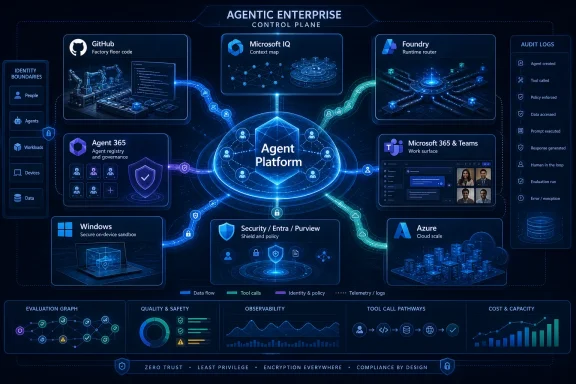
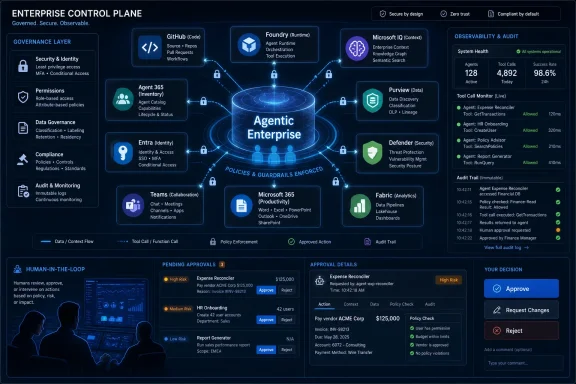
That is why Microsoft’s framing keeps circling back to systems. GitHub is where agents are built. Microsoft IQ and its related intelligence layers are where they get business context. Foundry is where they run. Agent 365 is where IT sees, governs, and restrains them. Entra, Purview, Defender, and the broader Microsoft security stack become the guardrails that turn an agent from a clever script into something an enterprise might actually allow near production data.
This is classic Microsoft platform strategy, but aimed at a new class of workload. The company is not merely saying, “Use our AI.” It is saying, “Use our identity, compliance, developer, productivity, data, security, and cloud estate as the substrate on which AI becomes useful.” That is a much bigger claim, and a much more consequential one.
Microsoft’s answer is that the agent needs to be treated less like a feature and more like enterprise software. That means versioning, testing, access control, observability, deployment policy, runtime controls, and auditability. It also means acknowledging that a useful agent is rarely self-contained. It needs to read documents, query structured data, call tools, trigger workflows, and collaborate with humans and other agents.
That is the gap between AI as an impressive interface and AI as infrastructure. A chatbot can be tolerated as a companion, especially if it is clearly bounded. An agent that can modify customer records, open tickets, draft purchase orders, update code, or respond to security incidents enters a different category of risk. It becomes part of the control surface of the enterprise.
Microsoft’s platform vision is compelling because it understands that distinction. It is also self-serving because Microsoft already owns many of the control surfaces in question. Windows identity, Microsoft 365 collaboration, Azure compute, GitHub development, Defender telemetry, Purview compliance, Fabric analytics, and Teams workflows all become more valuable if agents are the new connective tissue.
That sprawl is not hypothetical. It is the natural consequence of making agent creation easier. The same democratization that makes AI useful to business teams also makes it hard to govern. If every department can produce semi-autonomous software workers, the enterprise needs a registry, a policy engine, and a security model that does not depend on everyone behaving perfectly.
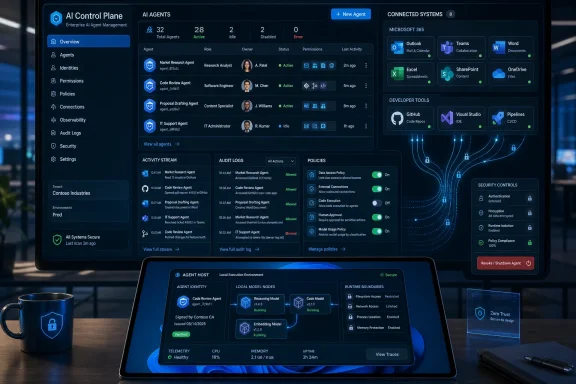
Microsoft positions Agent 365 as the place where those agents become visible. The language of “control plane” is important. In cloud computing, a control plane is where resources are organized, governed, observed, and constrained. By applying that concept to agents, Microsoft is telling IT leaders to stop thinking about agents as isolated chat windows and start thinking about them as managed enterprise resources.
The comparison Microsoft likes to make is that agents should be managed the way people are managed. That sounds neat until you think about it for more than ten seconds. People have jobs, managers, identities, permissions, compliance obligations, and termination procedures. If an agent is going to operate inside an enterprise, it needs analogues for all of those things.
That is why Agent 365’s emphasis on registry, access control, visualization, interoperability, and security is more than checklist marketing. Those are the categories that decide whether agents scale beyond novelty. If a company cannot answer which agents exist, what they can access, what they have done, who is responsible for them, and whether they are behaving normally, then “agentic transformation” becomes a governance accident waiting to happen.
Microsoft’s argument is that agents need a shared understanding of the organization: documents, meetings, charts, workflows, relationships, business data, operational processes, and institutional memory. Microsoft 365 has the work graph. Fabric has business data. Foundry has model and agent infrastructure. Azure has compute. Microsoft IQ is the conceptual layer meant to make all of that usable by agents without turning every deployment into a bespoke data engineering project.
This is where the company’s platform advantage becomes obvious. A startup can build a brilliant agent. A model provider can ship astonishing reasoning capability. But Microsoft can say that the agent should already understand the tenant, the permissions, the documents, the meetings, the organizational structure, and the compliance posture because those signals are already in the Microsoft stack.
For customers, that is both attractive and dangerous. It is attractive because context is the difference between an AI assistant that produces generic output and an agent that actually knows how the business works. It is dangerous because the more context is mediated through Microsoft’s platform, the harder it becomes to treat AI infrastructure as modular.
Microsoft is careful to emphasize model choice, partner ecosystems, open-source frameworks, and interoperability. That matters. But in enterprise software, control often comes less from owning the model and more from owning the workflow, the permissions, the data plane, and the administrative console. Microsoft does not need to make every model proprietary if it can make every useful agent pass through its trust fabric.
That means source control, dependencies, code review, testing, evaluation, issue tracking, and deployment workflows. It also means that agent behavior becomes something developers can inspect, improve, and ship with a degree of repeatability. The agent is not just a prompt in a web form. It is an artifact with code, tools, skills, policies, evaluations, telemetry, and owners.
This framing is essential for IT pros and developers who have watched “AI initiatives” become a parade of disconnected experiments. If agents are going to handle software delivery, incident response, business operations, or customer support, they need to be built with the same seriousness as the systems they touch. GitHub gives Microsoft a natural place to normalize that discipline.
There is also a subtler move here. GitHub Copilot began as an assistant for developers. In this vision, GitHub becomes part of the production line for agents themselves. Developers are not merely using AI to write code; they are building and maintaining AI workers that participate in the business. That is a meaningful change in the shape of enterprise development.
That production focus is important because agents fail differently than traditional applications. A normal application usually fails through exceptions, downtime, latency, broken dependencies, or incorrect deterministic logic. An agent can fail by pursuing the wrong goal, misreading context, calling the wrong tool, leaking sensitive information, looping through an unproductive workflow, or confidently producing a plausible but damaging action.
That makes observability more complicated. Logs and metrics are still necessary, but they are not enough. Enterprises need traces of agent reasoning paths, tool calls, context retrieval, policy enforcement, human interventions, and outcome quality. They need evaluations that test not just whether a model responds, but whether an agent behaves within acceptable operational boundaries.
Foundry’s significance is that it gives Microsoft a place to package those needs into developer-facing infrastructure. The more agents become multi-step systems, the more their reliability depends on orchestration, evaluation, and controlled access to tools. In that world, the runtime is not an implementation detail. It is where trust is either earned or lost.
This is where Entra, Purview, and Defender become more than supporting products. They are the rationale for Microsoft’s platform claim. Entra can give agents identity and enforce access policy. Purview can help classify, govern, and protect data the agent touches. Defender can monitor threats and risky behavior. Intune and Microsoft 365 admin tooling can give administrators familiar operating surfaces.
The pitch will resonate with security teams because the alternative is ugly. Without native governance, enterprises will face a mixture of unmanaged browser agents, vendor agents, internal scripts, SaaS automations, and experimental copilots with inconsistent permissions. That is not digital transformation. That is a shadow IT renaissance with better autocomplete.
But Microsoft also has to overcome its own trust burden. The company is asking customers to give agents deeper access to their operational estate at the same time that Microsoft’s own ecosystem has become a massive target for attackers. Security-minded readers should separate the logic of the architecture from the assumption that any vendor can make it foolproof. Agent governance is necessary; it is not magic.
Microsoft’s continuous improvement loop depends on signals from agent actions, outcomes, feedback, and observed behavior. In theory, that loop improves prompts, tools, skills, routing, context retrieval, and eventually model specialization. In practice, it creates a new management challenge: deciding which feedback matters, who can change agent behavior, and how to prevent small optimizations from creating large governance problems.
The human supervisor of an agent may not be a developer. It may be a finance manager, support lead, HR operations owner, or security analyst. That means agent oversight must be understandable outside the AI team. If business owners cannot see what an agent did and why, they will either overtrust it or abandon it.
This is why Microsoft’s operational framing is stronger than a pure autonomy pitch. The near-term enterprise win is not replacing departments with swarms of unsupervised bots. It is turning repeatable business processes into monitored, improvable workflows where agents do more of the execution and humans retain accountability. That is less glamorous than science fiction, but far closer to how enterprises buy and deploy software.
Windows endpoints still matter because agents will surface in the flow of work: Teams, Outlook, Excel, Edge, custom line-of-business apps, and potentially managed cloud PCs or virtualized environments. But the more important Windows-adjacent issue is administrative consistency. If agents are going to interact with enterprise apps and users, IT will want them governed through familiar policy, identity, and compliance models.
This is where Microsoft’s strategy lines up with the habits of enterprise IT. Admins do not want yet another console if they can avoid it. They do not want agent permissions managed in five vendor dashboards. They do not want compliance evidence reconstructed manually after an incident. They want agents to appear in the same operational universe as users, devices, apps, and data.
That does not mean deployment will be simple. Microsoft licensing is already complex, and the agentic stack adds another layer of products, bundles, and capability boundaries. The more Microsoft ties governance, Copilot, Agent 365, and premium Microsoft 365 suites together, the more customers will need to scrutinize what is included, what costs extra, and which features are generally available rather than still emerging through preview programs.
Model choice is especially important for agents because cost, latency, reasoning depth, tool use, privacy requirements, and domain specialization vary by task. A procurement summarizer, a code migration agent, a customer support workflow, and a security triage agent may not need the same model. A serious platform has to route intelligently rather than pretend one model fits all.
Still, openness does not erase platform gravity. If the agent is registered in Agent 365, gets context through Microsoft IQ, runs in Foundry, authenticates through Entra, stores telemetry in Microsoft’s observability systems, and surfaces through Teams or Microsoft 365, then Microsoft is still the center of mass. The model may be swappable while the operational system is not.
That is not necessarily bad for customers. Standardization can reduce chaos. But it should be understood as a strategic trade. Enterprises may gain governance and integration while accepting deeper dependence on Microsoft’s administrative and data layers. The question is not whether that trade is avoidable; for many Microsoft-heavy organizations, it may be entirely rational. The question is whether IT leaders make it deliberately.
That is why the “teams of agents” idea should be treated carefully. In a demo, a group of agents collaborating across software delivery, support, finance, and operations sounds like productivity heaven. In production, it raises awkward questions. If one agent retrieves the wrong context, another agent makes a bad recommendation, a third agent executes an action, and a human approves under time pressure, where does responsibility sit?
Traditional software has owners, change management, and incident processes. Human employees have managers and policies. Agents will need a hybrid of both. Microsoft’s vision gestures toward that by treating agents as governed entities with identities, permissions, telemetry, and lifecycle controls. But enterprises will have to define the organizational operating model themselves.
That may be the hardest part. The technology can expose which agent accessed which resource. It can record a tool call. It can flag suspicious behavior. It can enforce policy. But it cannot automatically settle whether a department should automate a decision, whether a workflow should require human approval, or whether an agent’s optimization target conflicts with a broader business obligation.
These are not trivial jobs. They are the glue work of the enterprise. They are also where AI has a better chance of producing measurable value because the work is repetitive, document-heavy, process-bound, and often bottlenecked by human attention. An agent that reliably shortens those workflows without creating governance debt is more valuable than a theatrical autonomous assistant.
Microsoft is leaning into that reality by emphasizing continuous improvement. The first version of an enterprise agent may be mediocre. The tenth version may be useful. The hundredth may become part of how the business operates. That compounding effect only happens if the organization can measure outcomes, collect feedback, adjust behavior, and do so without losing control.
This is where Microsoft’s platform thesis is strongest. The model supplies intelligence, but the system supplies memory, policy, telemetry, deployment, security, and iteration. In production, those surrounding pieces are not secondary. They are the difference between a clever prototype and an operational capability.
Agent 365, Microsoft 365 Copilot, Foundry, Copilot Studio, Fabric, Purview, Defender, Entra, GitHub, and the Frontier branding all make sense individually. Together, they can become a procurement and architecture maze. Microsoft must make the platform not only powerful but legible. If customers need a consultant just to understand which SKU governs which agent in which runtime, the governance pitch starts to undercut itself.
There is also the issue of maturity. Agentic systems are young. Many organizations are still learning how to evaluate AI outputs, secure retrieval pipelines, manage prompt injection risk, and prevent oversharing through poorly governed data. Microsoft can provide tooling, but it cannot compress every enterprise’s operational learning curve.
That is why early adopters should resist both cynicism and hype. The vision is coherent. The need is real. The platform pieces are plausible. But enterprises should treat agent deployment as a staged operational transformation, not as a switch that gets flipped because a vendor bundled the right nouns together.
That bridge will matter most to organizations that already live in Microsoft’s ecosystem. If Entra is the identity backbone, Purview is the compliance layer, Defender is the security console, GitHub is the developer home, and Teams is where collaboration happens, Microsoft’s agentic platform will look like an extension of existing gravity rather than a new planet.
 Microsoft Moves the AI Argument From Models to Machinery
For the last two years, enterprise AI has been sold through moments: a draft email appears, a spreadsheet formula writes itself, a meeting gets summarized before the coffee cools. Those demos mattered because they changed expectations. They also hid the hard part.The hard part is not whether a language model can answer a question. It is whether an organization can safely let software take action across systems, data, approvals, identities, and obligations that were never designed for probabilistic automation. Microsoft’s agentic platform vision is an attempt to make that shift explicit: agents are not just smarter prompts; they are operational actors that need lifecycle management.
That is why Microsoft’s framing keeps circling back to systems. GitHub is where agents are built. Microsoft IQ and its related intelligence layers are where they get business context. Foundry is where they run. Agent 365 is where IT sees, governs, and restrains them. Entra, Purview, Defender, and the broader Microsoft security stack become the guardrails that turn an agent from a clever script into something an enterprise might actually allow near production data.
This is classic Microsoft platform strategy, but aimed at a new class of workload. The company is not merely saying, “Use our AI.” It is saying, “Use our identity, compliance, developer, productivity, data, security, and cloud estate as the substrate on which AI becomes useful.” That is a much bigger claim, and a much more consequential one.
The Demo Was Never the Destination
Enterprise AI pilots have often succeeded just enough to become politically dangerous. A sales team likes a Copilot workflow. A support group prototypes a triage agent. A finance analyst wires a model into reporting. Then the CIO asks the obvious questions: who owns it, what data can it see, how is it monitored, what happens when it is wrong, and how do we shut it off?Microsoft’s answer is that the agent needs to be treated less like a feature and more like enterprise software. That means versioning, testing, access control, observability, deployment policy, runtime controls, and auditability. It also means acknowledging that a useful agent is rarely self-contained. It needs to read documents, query structured data, call tools, trigger workflows, and collaborate with humans and other agents.
That is the gap between AI as an impressive interface and AI as infrastructure. A chatbot can be tolerated as a companion, especially if it is clearly bounded. An agent that can modify customer records, open tickets, draft purchase orders, update code, or respond to security incidents enters a different category of risk. It becomes part of the control surface of the enterprise.
Microsoft’s platform vision is compelling because it understands that distinction. It is also self-serving because Microsoft already owns many of the control surfaces in question. Windows identity, Microsoft 365 collaboration, Azure compute, GitHub development, Defender telemetry, Purview compliance, Fabric analytics, and Teams workflows all become more valuable if agents are the new connective tissue.
Agent 365 Is the Control Plane Microsoft Needed to Invent
Agent 365 is the most revealing piece of the strategy because it admits the uncomfortable truth behind agentic AI: organizations are going to end up with too many agents. Some will be created in Copilot Studio. Some will be built by developers in Foundry. Some will come from vendors. Some will be open-source projects. Some will appear as shadow AI experiments long before IT has a neat procurement record.That sprawl is not hypothetical. It is the natural consequence of making agent creation easier. The same democratization that makes AI useful to business teams also makes it hard to govern. If every department can produce semi-autonomous software workers, the enterprise needs a registry, a policy engine, and a security model that does not depend on everyone behaving perfectly.
Microsoft positions Agent 365 as the place where those agents become visible. The language of “control plane” is important. In cloud computing, a control plane is where resources are organized, governed, observed, and constrained. By applying that concept to agents, Microsoft is telling IT leaders to stop thinking about agents as isolated chat windows and start thinking about them as managed enterprise resources.
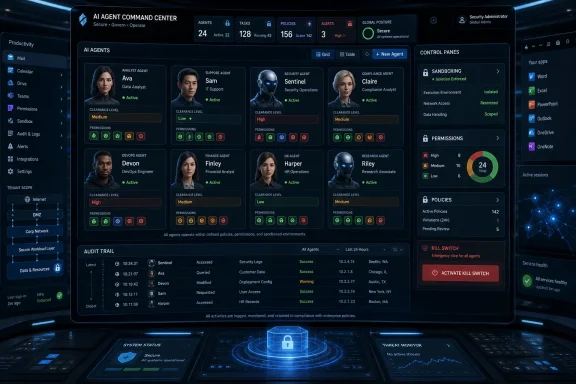
The comparison Microsoft likes to make is that agents should be managed the way people are managed. That sounds neat until you think about it for more than ten seconds. People have jobs, managers, identities, permissions, compliance obligations, and termination procedures. If an agent is going to operate inside an enterprise, it needs analogues for all of those things.
That is why Agent 365’s emphasis on registry, access control, visualization, interoperability, and security is more than checklist marketing. Those are the categories that decide whether agents scale beyond novelty. If a company cannot answer which agents exist, what they can access, what they have done, who is responsible for them, and whether they are behaving normally, then “agentic transformation” becomes a governance accident waiting to happen.
Microsoft IQ Turns Context Into the New Lock-In
The phrase “Microsoft IQ” may sound like branding mist, but the underlying idea is strategically sharp. Models are increasingly interchangeable at the surface level. Enterprise context is not. The company that organizes, secures, and feeds that context to agents controls much of the value chain.Microsoft’s argument is that agents need a shared understanding of the organization: documents, meetings, charts, workflows, relationships, business data, operational processes, and institutional memory. Microsoft 365 has the work graph. Fabric has business data. Foundry has model and agent infrastructure. Azure has compute. Microsoft IQ is the conceptual layer meant to make all of that usable by agents without turning every deployment into a bespoke data engineering project.
This is where the company’s platform advantage becomes obvious. A startup can build a brilliant agent. A model provider can ship astonishing reasoning capability. But Microsoft can say that the agent should already understand the tenant, the permissions, the documents, the meetings, the organizational structure, and the compliance posture because those signals are already in the Microsoft stack.
For customers, that is both attractive and dangerous. It is attractive because context is the difference between an AI assistant that produces generic output and an agent that actually knows how the business works. It is dangerous because the more context is mediated through Microsoft’s platform, the harder it becomes to treat AI infrastructure as modular.
Microsoft is careful to emphasize model choice, partner ecosystems, open-source frameworks, and interoperability. That matters. But in enterprise software, control often comes less from owning the model and more from owning the workflow, the permissions, the data plane, and the administrative console. Microsoft does not need to make every model proprietary if it can make every useful agent pass through its trust fabric.
GitHub Becomes the Factory Floor for Software Agents
The developer story matters because agents cannot become operational if they remain a low-code novelty. Business users will build plenty of agents, but production-grade automation still needs engineering discipline. Microsoft’s decision to place GitHub near the front of the lifecycle is a signal that agents are being pulled into the same practices that govern modern software delivery.That means source control, dependencies, code review, testing, evaluation, issue tracking, and deployment workflows. It also means that agent behavior becomes something developers can inspect, improve, and ship with a degree of repeatability. The agent is not just a prompt in a web form. It is an artifact with code, tools, skills, policies, evaluations, telemetry, and owners.
This framing is essential for IT pros and developers who have watched “AI initiatives” become a parade of disconnected experiments. If agents are going to handle software delivery, incident response, business operations, or customer support, they need to be built with the same seriousness as the systems they touch. GitHub gives Microsoft a natural place to normalize that discipline.
There is also a subtler move here. GitHub Copilot began as an assistant for developers. In this vision, GitHub becomes part of the production line for agents themselves. Developers are not merely using AI to write code; they are building and maintaining AI workers that participate in the business. That is a meaningful change in the shape of enterprise development.
Foundry Is Where the Agent Stops Being a Prototype
If GitHub is the factory floor, Microsoft Foundry is the runtime and tooling environment where agents are expected to become production systems. Foundry’s role is to support model choice, inference, agent frameworks, observability, evaluation, tracing, and deployment. In plain English, it is where Microsoft wants developers to bring AI projects when the demo has to survive contact with real users.That production focus is important because agents fail differently than traditional applications. A normal application usually fails through exceptions, downtime, latency, broken dependencies, or incorrect deterministic logic. An agent can fail by pursuing the wrong goal, misreading context, calling the wrong tool, leaking sensitive information, looping through an unproductive workflow, or confidently producing a plausible but damaging action.
That makes observability more complicated. Logs and metrics are still necessary, but they are not enough. Enterprises need traces of agent reasoning paths, tool calls, context retrieval, policy enforcement, human interventions, and outcome quality. They need evaluations that test not just whether a model responds, but whether an agent behaves within acceptable operational boundaries.
Foundry’s significance is that it gives Microsoft a place to package those needs into developer-facing infrastructure. The more agents become multi-step systems, the more their reliability depends on orchestration, evaluation, and controlled access to tools. In that world, the runtime is not an implementation detail. It is where trust is either earned or lost.
Security by Design Is the Sales Pitch and the Survival Requirement
Microsoft’s strongest argument is that agents cannot be bolted onto enterprise security after the fact. An agent that can act across systems needs identity. It needs least-privilege access. It needs conditional access policies. It needs data loss prevention. It needs audit trails. It needs threat detection. It needs a way to be suspended, reviewed, or retired.This is where Entra, Purview, and Defender become more than supporting products. They are the rationale for Microsoft’s platform claim. Entra can give agents identity and enforce access policy. Purview can help classify, govern, and protect data the agent touches. Defender can monitor threats and risky behavior. Intune and Microsoft 365 admin tooling can give administrators familiar operating surfaces.
The pitch will resonate with security teams because the alternative is ugly. Without native governance, enterprises will face a mixture of unmanaged browser agents, vendor agents, internal scripts, SaaS automations, and experimental copilots with inconsistent permissions. That is not digital transformation. That is a shadow IT renaissance with better autocomplete.
But Microsoft also has to overcome its own trust burden. The company is asking customers to give agents deeper access to their operational estate at the same time that Microsoft’s own ecosystem has become a massive target for attackers. Security-minded readers should separate the logic of the architecture from the assumption that any vendor can make it foolproof. Agent governance is necessary; it is not magic.
The Human-in-the-Loop Becomes a Management Problem
Agentic AI is often described as autonomous, but the enterprise version is more likely to be supervised autonomy. Humans will approve actions, review exceptions, tune workflows, interpret results, and intervene when confidence drops. The interesting question is not whether humans remain involved. It is how that involvement is structured.Microsoft’s continuous improvement loop depends on signals from agent actions, outcomes, feedback, and observed behavior. In theory, that loop improves prompts, tools, skills, routing, context retrieval, and eventually model specialization. In practice, it creates a new management challenge: deciding which feedback matters, who can change agent behavior, and how to prevent small optimizations from creating large governance problems.
The human supervisor of an agent may not be a developer. It may be a finance manager, support lead, HR operations owner, or security analyst. That means agent oversight must be understandable outside the AI team. If business owners cannot see what an agent did and why, they will either overtrust it or abandon it.
This is why Microsoft’s operational framing is stronger than a pure autonomy pitch. The near-term enterprise win is not replacing departments with swarms of unsupervised bots. It is turning repeatable business processes into monitored, improvable workflows where agents do more of the execution and humans retain accountability. That is less glamorous than science fiction, but far closer to how enterprises buy and deploy software.
The Windows Angle Is Not the Desktop, It Is the Managed Environment
For WindowsForum readers, the immediate temptation is to ask what this means for Windows itself. The answer is that the agentic platform is not primarily a Start menu story. It is a management, identity, security, and productivity story that happens to sit on top of the Microsoft estate many Windows organizations already run.Windows endpoints still matter because agents will surface in the flow of work: Teams, Outlook, Excel, Edge, custom line-of-business apps, and potentially managed cloud PCs or virtualized environments. But the more important Windows-adjacent issue is administrative consistency. If agents are going to interact with enterprise apps and users, IT will want them governed through familiar policy, identity, and compliance models.
This is where Microsoft’s strategy lines up with the habits of enterprise IT. Admins do not want yet another console if they can avoid it. They do not want agent permissions managed in five vendor dashboards. They do not want compliance evidence reconstructed manually after an incident. They want agents to appear in the same operational universe as users, devices, apps, and data.
That does not mean deployment will be simple. Microsoft licensing is already complex, and the agentic stack adds another layer of products, bundles, and capability boundaries. The more Microsoft ties governance, Copilot, Agent 365, and premium Microsoft 365 suites together, the more customers will need to scrutinize what is included, what costs extra, and which features are generally available rather than still emerging through preview programs.
Openness Is Real, but Gravity Still Points to Microsoft
Microsoft knows enterprise customers do not want a one-model future. The company’s agentic platform messaging therefore stresses support for Microsoft models, partner models, open-source models, and third-party frameworks. That is the right posture in a market where model leadership shifts quickly and where many organizations will want different models for different workloads.Model choice is especially important for agents because cost, latency, reasoning depth, tool use, privacy requirements, and domain specialization vary by task. A procurement summarizer, a code migration agent, a customer support workflow, and a security triage agent may not need the same model. A serious platform has to route intelligently rather than pretend one model fits all.
Still, openness does not erase platform gravity. If the agent is registered in Agent 365, gets context through Microsoft IQ, runs in Foundry, authenticates through Entra, stores telemetry in Microsoft’s observability systems, and surfaces through Teams or Microsoft 365, then Microsoft is still the center of mass. The model may be swappable while the operational system is not.
That is not necessarily bad for customers. Standardization can reduce chaos. But it should be understood as a strategic trade. Enterprises may gain governance and integration while accepting deeper dependence on Microsoft’s administrative and data layers. The question is not whether that trade is avoidable; for many Microsoft-heavy organizations, it may be entirely rational. The question is whether IT leaders make it deliberately.
The First Real Agentic Platform Battle Is Over Accountability
The industry’s agentic rhetoric often drifts toward capability: what agents can do, how many steps they can take, how many systems they can touch. Microsoft’s more grounded insight is that accountability will decide adoption. A company does not merely need agents that can act. It needs agents whose actions can be assigned, inspected, justified, reversed, and improved.That is why the “teams of agents” idea should be treated carefully. In a demo, a group of agents collaborating across software delivery, support, finance, and operations sounds like productivity heaven. In production, it raises awkward questions. If one agent retrieves the wrong context, another agent makes a bad recommendation, a third agent executes an action, and a human approves under time pressure, where does responsibility sit?
Traditional software has owners, change management, and incident processes. Human employees have managers and policies. Agents will need a hybrid of both. Microsoft’s vision gestures toward that by treating agents as governed entities with identities, permissions, telemetry, and lifecycle controls. But enterprises will have to define the organizational operating model themselves.
That may be the hardest part. The technology can expose which agent accessed which resource. It can record a tool call. It can flag suspicious behavior. It can enforce policy. But it cannot automatically settle whether a department should automate a decision, whether a workflow should require human approval, or whether an agent’s optimization target conflicts with a broader business obligation.
The Platform Wins If It Makes Boring Workflows Dependable
The real proof of Microsoft’s agentic platform will not be a keynote scenario in which a virtual team builds a product plan while everyone smiles at a dashboard. It will be the duller cases: invoice reconciliation, ticket routing, compliance evidence gathering, release note generation, access review preparation, knowledge base updates, customer onboarding, service desk triage, and data cleanup.These are not trivial jobs. They are the glue work of the enterprise. They are also where AI has a better chance of producing measurable value because the work is repetitive, document-heavy, process-bound, and often bottlenecked by human attention. An agent that reliably shortens those workflows without creating governance debt is more valuable than a theatrical autonomous assistant.
Microsoft is leaning into that reality by emphasizing continuous improvement. The first version of an enterprise agent may be mediocre. The tenth version may be useful. The hundredth may become part of how the business operates. That compounding effect only happens if the organization can measure outcomes, collect feedback, adjust behavior, and do so without losing control.
This is where Microsoft’s platform thesis is strongest. The model supplies intelligence, but the system supplies memory, policy, telemetry, deployment, security, and iteration. In production, those surrounding pieces are not secondary. They are the difference between a clever prototype and an operational capability.
The Fine Print Will Decide Whether the Vision Feels Like Freedom or Rent
The main risk in Microsoft’s strategy is that it becomes another expensive layer in an already expensive stack. Enterprises have heard the platform story before. They have also lived through license creep, admin-center sprawl, overlapping product names, and features that look unified in diagrams but fragmented in deployment.Agent 365, Microsoft 365 Copilot, Foundry, Copilot Studio, Fabric, Purview, Defender, Entra, GitHub, and the Frontier branding all make sense individually. Together, they can become a procurement and architecture maze. Microsoft must make the platform not only powerful but legible. If customers need a consultant just to understand which SKU governs which agent in which runtime, the governance pitch starts to undercut itself.
There is also the issue of maturity. Agentic systems are young. Many organizations are still learning how to evaluate AI outputs, secure retrieval pipelines, manage prompt injection risk, and prevent oversharing through poorly governed data. Microsoft can provide tooling, but it cannot compress every enterprise’s operational learning curve.
That is why early adopters should resist both cynicism and hype. The vision is coherent. The need is real. The platform pieces are plausible. But enterprises should treat agent deployment as a staged operational transformation, not as a switch that gets flipped because a vendor bundled the right nouns together.
The Practical Reading for Microsoft Shops
The most important takeaway is that Microsoft is trying to make agentic AI feel administratively familiar. That may not sound revolutionary, but it is exactly what enterprise adoption requires. The company is building a bridge from today’s Microsoft 365 and Azure management practices to a future where agents behave like a new class of digital worker.That bridge will matter most to organizations that already live in Microsoft’s ecosystem. If Entra is the identity backbone, Purview is the compliance layer, Defender is the security console, GitHub is the developer home, and Teams is where collaboration happens, Microsoft’s agentic platform will look like an extension of existing gravity rather than a new planet.
- Microsoft’s agentic vision is less about individual chatbots and more about governing AI agents as production software with identities, permissions, telemetry, and lifecycle controls.
- Agent 365 is the strategic centerpiece because it gives IT a control plane for agent inventory, access, behavior, interoperability, and security.
- Microsoft IQ and related context layers may become the real source of platform power because enterprise agents need trusted organizational context more than they need generic fluency.
- GitHub and Foundry signal that Microsoft expects serious agents to be built, tested, deployed, observed, and improved like software systems rather than prompt experiments.
- Security teams should welcome native governance while remaining skeptical of any implication that agent risk disappears simply because it runs inside a familiar vendor stack.
- The organizations most likely to benefit first are those with disciplined data governance, mature identity practices, and business processes clear enough to be safely delegated in stages.
References
- Primary source: startuphub.ai
Published: 2026-06-02T19:30:11.118787
Microsoft's Agentic Platform Vision | StartupHub.ai
Microsoft unveils its vision for an integrated agentic enterprise platform, moving AI from demos to operational reality by focusing on systems, governance, andwww.startuphub.ai - Official source: microsoft.com
Microsoft IQ | Unified Enterprise Intelligence for AI
Microsoft IQ unifies enterprise data, context, and knowledge to power AI agents and Copilot with consistent, secure intelligence at scale.www.microsoft.com
- Related coverage: techtarget.com
Microsoft Foundry ties in with Agent 365 | TechTarget
Microsoft Foundry updates flesh out AI agent data context, security and MCP tools access under the Agent 365 control plane umbrella.www.techtarget.com - Official source: adoption.microsoft.com
Microsoft Foundry – Microsoft Adoption
AI agents are changing the way we work. From simple prompt-and-response agents to fully autonomous agents able to execute entire workflows from start to finish, there’s an agent for every need. Create, deploy, and scale agents across your organization. Design and build agents with Copilot Studio...adoption.microsoft.com - Official source: devblogs.microsoft.com
Foundry IQ in Microsoft Agent Framework | Microsoft Foundry Blog
Build enterprise-grade RAG agents with Foundry IQ Knowledge Bases in ~20 lines of Python. Learn how the Azure AI Search Context Provider brings intelligent, multi-hop retrieval to the Microsoft Agent Framework—no fragmented pipelines, just plug in the knowledge your agent needs. devblogs.microsoft.com
- Official source: news.microsoft.com

- Official source: learn.microsoft.com
在 Microsoft Agent 365 中發佈自動駕駛程式 - Microsoft Foundry | Microsoft Learn
學習如何在 Microsoft Agent 365 中以自動駕駛方式發佈 Foundry Hosted 代理,提交審核,並在 Teams 中驗證。learn.microsoft.com - Official source: techcommunity.microsoft.com
Foundry Agent Service, Observability, and Foundry Portal Now Generally Available | Microsoft Foundry
Foundry Agent Service, Observability in Foundry Control Plane, and the Microsoft Foundry portal are now generally available. Build and operate secure,... techcommunity.microsoft.com
- Related coverage: windowscentral.com
Microsoft doubles down on agentic AI — Agent 365 prepares for a future with over 1 billion agents | Windows Central
Microsoft kicked off Ignite with a major push into agentic AI, unveiling Agent 365 as its newest tool for automating workflows.www.windowscentral.com - Related coverage: tech.co
Microsoft Launches 'Agent 365' for AI Agent Management - Tech.co
The new dashboard can help businesses manage a broad range of AI agents - even from third party platforms. Here's how it all works.tech.co - Related coverage: techradar.com
Microsoft is working on a "new class” of AI agents that could change everything in your workforce | TechRadar
Microsoft wants humans to work closer with AI colleagueswww.techradar.com - Related coverage: itpro.com
Satya Nadella talks up Microsoft's sovereign cloud credentials as firm announces general availability for Azure Local Disconnected, new capabilities for Foundry Local | IT Pro
Microsoft has expanded its Sovereign Cloud for AI and regulated environments, as CEO Satya Nadella hypes up the full extent of AI support the firm now offers.www.itpro.com - Related coverage: salesforce.com
futurum signal agentic ai platforms for enterprise fsraape202510 licensed 202512 salesforce
PDF documentwww.salesforce.com
- Related coverage: isg.sitefinity.cloud
MSFT Blueprint 2026
Business people join puzzle pieces in office. Concept of teamwork and partnership. double exposure with light effectsisg.sitefinity.cloud
- Official source: cdn-dynmedia-1.microsoft.com
- Official source: blogs.microsoft.com
Accelerating Frontier Transformation with Microsoft partners - The Official Microsoft Blog
AI has moved quickly from experimentation to production. Customers want measurable business outcomes, along with security, governance and responsible AI built in from day one. Microsoft partners are a meaningful differentiator to deliver these objectives. They turn ideas into deployable...blogs.microsoft.com