

Satya Nadella’s announcement that Microsoft will "grow our headcount" again — but only with far more leverage thanks to AI — signals a deliberate shift in how the company plans to rebuild after a year of widespread cost-cutting and reorganisation. The comment, made on investor Brad Gerstner’s BG2 podcast on October 31, 2025, was short on hard numbers but heavy on strategic intent: hiring will return, but staffing decisions will be driven by AI-first workflows, higher individual productivity, and investments in AI infrastructure rather than a simple headcount rebound. This is a pivotal moment for Microsoft’s workforce strategy, one that blends massive capital spending on cloud and models with a new approach to labour, skills and organisational design.
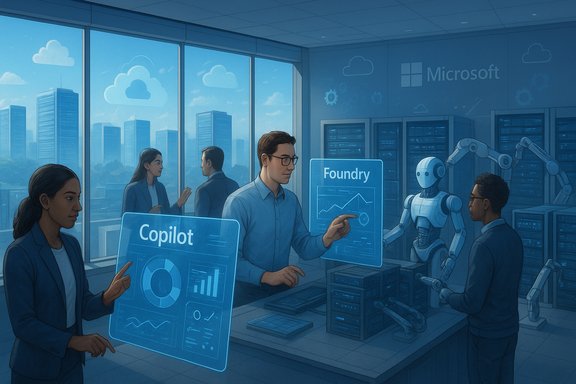
Microsoft closed its fiscal year on June 30, 2025 with roughly 228,000 employees, a level that reflects multiple rounds of layoffs earlier in the year. The company cut several thousand roles in May and a further large tranche in July as it streamlined management layers, reshuffled teams and reallocated resources into AI infrastructure and product lines. Those reductions — combined with Microsoft’s large, public investments in AI infrastructure, new cloud services like Azure AI Foundry, and the rapid roll-out of Copilot across Microsoft 365 and GitHub — set the stage for Nadella’s new framing of hiring as targeted scaling rather than broad-based expansion.
Nadella’s phrase — that future headcount growth will have "a lot more leverage than the headcount we had pre-AI" — encapsulates a core premise driving Microsoft’s plans: fewer people, or at least a more modest increase in people, can deliver much greater output when work is redesigned around AI agents, automation and model-powered assistive tools. Internally that means integrating AI into planning, research, execution and collaboration; externally it means selling AI-enabled cloud services and tools that make customers more productive.
But the strategy is not without trade-offs. The transition risks deepening employee anxiety after mass layoffs, raising regulatory scrutiny, and concentrating operational risk around power and infrastructure readiness. Execution will require transparent targeting, substantial reskilling investments, and robust trust-and-safety engineering — or the company risks hollow productivity claims that mercilessly exacerbate workforce churn.
In the immediate term, Nadella’s message is best read as a recalibration: Microsoft will hire, but differently. The real narrative to follow is whether the company’s next hires are additive — building the platform and product capabilities customers will pay for — or primarily redistributive, shifting work from one team to another while reducing the absolute number of roles. The answer will determine whether Microsoft’s “AI-first” hiring becomes a model for large-scale workforce transformation — or a cautionary tale about the human costs of automation dressed up as efficiency.
Source: Business Chief Why Satya Nadella’s Microsoft Hiring Plans Focus on AI
 Background
Microsoft closed its fiscal year on June 30, 2025 with roughly 228,000 employees, a level that reflects multiple rounds of layoffs earlier in the year. The company cut several thousand roles in May and a further large tranche in July as it streamlined management layers, reshuffled teams and reallocated resources into AI infrastructure and product lines. Those reductions — combined with Microsoft’s large, public investments in AI infrastructure, new cloud services like Azure AI Foundry, and the rapid roll-out of Copilot across Microsoft 365 and GitHub — set the stage for Nadella’s new framing of hiring as targeted scaling rather than broad-based expansion.Nadella’s phrase — that future headcount growth will have "a lot more leverage than the headcount we had pre-AI" — encapsulates a core premise driving Microsoft’s plans: fewer people, or at least a more modest increase in people, can deliver much greater output when work is redesigned around AI agents, automation and model-powered assistive tools. Internally that means integrating AI into planning, research, execution and collaboration; externally it means selling AI-enabled cloud services and tools that make customers more productive.
Overview: What Nadella actually said — and what he didn’t
- What was explicit: Microsoft will increase headcount again; the company expects new roles to be amplified by AI so staff will produce higher output per person; Microsoft intends to equip employees with AI tools such as Microsoft 365 Copilot and GitHub Copilot and make AI part of everyday workflows.
- What was implicit: The shift from earlier growth-by-hiring to AI-augmented hiring is deliberate and structural. Nadella indicated the company is in a period of “unlearning and learning” as teams adopt new agentic workflows and productivity models.
- What was missing: No concrete hiring targets, no timeline for numbers, and no detail about which business units will get increased headcount or where new roles will be geographically located.
Why Microsoft is framing hiring as “AI-first”
Microsoft’s public strategy since the AI surge of 2022 has been consistent: invest heavily in cloud infrastructure, embed models into core productivity products, and partner aggressively with leading model builders. Several forces explain the AI-first hiring framing:- Infrastructure-led growth: Microsoft has expanded Azure and launched services like Azure AI Foundry and Copilot Studio to help enterprises build, host and operate AI applications at scale. Those services scale revenue and usage rapidly, but they require specialised engineering, data, security, and customer-success teams trained around ML ops, model governance, and agent orchestration.
- Product-led leverage: Microsoft 365 Copilot, GitHub Copilot and other AI features act as force multipliers for user productivity. The company’s strategy is to sell platform-level AI features that increase customer consumption of Azure compute, creating a flywheel where AI drives cloud revenue growth without linear increases in traditional headcount.
- Skill transformation: Nadella emphasised an “unlearning and learning” process — signalling that the company expects sizable internal reskilling. Roles will tilt toward model engineers, agent architects, data engineers, prompt engineers, trust & safety specialists and product managers who can design AI workflows rather than traditional task-based jobs that AI can automate.
- Capital intensity, not people intensity: Microsoft’s ramp of data center, power and networking capacity is capital-intensive. The near-term bottleneck the company cites is often power and facility readiness rather than raw compute availability — a factor that shapes where and how new teams can be deployed.
What the numbers tell us
- Microsoft’s workforce stood at roughly 228,000 employees at the end of fiscal 2025. That figure represents the post-layoff baseline from which any future growth will be measured.
- The company reported record revenue and net income for fiscal 2025, with Microsoft Cloud and Azure growing substantially. That financial strength is the engine for both AI capex and selective hiring.
- Platform metrics shared publicly (Copilot adoption, Foundry agent customers and token volumes) show explosive usage — and importantly, these are the leading indicators Microsoft will point to when justifying hiring to build, operate and sell AI services.
Strategic strengths of an AI-guided hiring plan
- Productivity leverage: AI can allow one worker to achieve what previously required several. If Microsoft executes, it will place employees where AI amplifies impact rather than where tasks can be automated end-to-end by models.
- Faster time-to-value for customers: More AI-centric hires in product, trust, security, and customer engineering accelerate enterprise onboarding of Copilot and Foundry solutions — increasing Azure consumption and stickiness.
- Attracting new talent: A clear, front-and-centre AI mission helps recruit engineers, researchers and product leaders who want to work at the intersection of cloud-scale systems and generative AI.
- Operational efficiency: Concentrating hires on higher-value AI work can compress organisational layers and reduce duplication, improving margins while preserving strategic capacity.
- Platform defensibility: Investing in AI operations, tooling, and governance builds switching costs — customers who build agents and pipelines on Foundry are more likely to continue consuming Azure services.
Significant risks and downsides
- Ambiguity on job volumes increases uncertainty: Without public commitments to hiring numbers or timelines, employees and markets face claim-versus-outcome risk. Promises to hire “with more leverage” could translate to fewer net hires if productivity gains are used to permanently replace roles.
- Employee morale and retention: After multiple, painful rounds of layoffs, the messaging that AI will enable hiring but require “unlearning” can be perceived as a signal that many current roles could be reshaped or eliminated. That dynamic can accelerate attrition among talent wary of reskilling requirements or of long-term stability.
- Talent competition and wage inflation: Specialized AI talent remains scarce. Competing with cloud hyperscalers, startups and model labs for top engineers drives wage pressure and could impair the economics of hiring if not carefully balanced.
- Power and footprint constraints: Microsoft executives have publicly noted that power availability and data center readiness are real constraints. Buying GPUs is only one part of capacity building; electricity, grid upgrades and permitted data center shells matter. Those constraints can limit hiring in locations where compute is needed.
- Regulatory and reputational exposure: Rapid expansion of AI features and agent services brings scrutiny on safety, bias, privacy and corporate governance. Scaling teams without robust trust, safety and compliance investments could create legal, operational and reputational liabilities.
- Vendor and partner concentration risk: Heavy reliance on third-party model providers — including deep partnerships with certain model-makers — concentrates strategic risk. Changes in partner economics, licensing, or technology could force pivots and impact hiring plans.
- Macro and market sensitivity: A capital-intensive AI build requires continued customer adoption. If enterprise AI budgets slow, Microsoft could be left with elevated infrastructure and a mismatch between headcount and demand.
What targeted hiring will likely look like at Microsoft
Microsoft’s next hiring surge — if it follows the CEO’s stated intent — is likely to prioritise several categories of roles:- AI engineering and platform roles
- Model engineers, inference optimisation specialists, and ML systems engineers.
- MLOps, observability, and platform reliability staff for Azure AI Foundry and Copilot Studio.
- Agent and automation architects
- Designers and engineers who build production-ready agents that automate complex business workflows.
- Trust & safety, compliance and governance
- Policy, legal, and technical staff focused on model auditing, red-teaming, explainability, and regulatory compliance.
- Customer engineering and solutions
- Vertical-facing cloud sales engineers and solution architects who help enterprises deploy AI safely and at scale.
- Data and prompt engineering
- Teams that curate context, knowledge bases, retrieval layers, and prompt templates for high-value applications.
- Product and UX
- Designers and PMs who convert model capabilities into product experiences that fuel adoption.
- Energy, facilities, and infrastructure
- Data center engineers, power planning specialists and site operations staff to ensure compute capacity can be connected and scaled.
Change management: the human challenge
Microsoft’s internal pivot will demand the kind of large-scale change management rarely successful without deliberate investment:- Reskilling at scale: The company must design aggressive training programs that move existing employees from task-based roles to AI-augmented roles. That means curriculum, hands-on labs, apprenticeship models and career-path transparency.
- Clear role mapping: Workers need transparent frameworks showing which roles are at risk, which will be augmented, and what skill pathways are required.
- Incentives and measurement: Compensation, performance metrics and organisational incentives must reward adoption and responsible deployment of AI, rather than merely output or cost-cutting.
- Cultural reset: Moving from "headcount growth" to "AI leverage" requires a cultural shift: product teams must prioritise learning, experimentation and cross-disciplinary collaboration between engineers, privacy, legal and customer-facing teams.
Competitive implications and industry ripple effects
Microsoft’s hiring posture is both a signal and a competitive move:- Signal to the market: Hiring with AI leverage suggests Microsoft believes the best way to scale is to combine capital (data centers) and human capital focused on AI productisation.
- Impact on rivals: Competitors will watch whether Microsoft’s approach accelerates enterprise adoption of Copilot and Foundry — a wider moat could follow if customers tightly integrate their business data, pipelines and agents into Azure.
- Ecosystem growth: Partner ecosystems (ISVs, systems integrators, consultancies) will need to expand their AI talent pools to deploy enterprise-grade agents, creating secondary hiring demand across the industry.
- Location dynamics: Regions that can deliver power and data center readiness may attract more hires, shifting where AI jobs concentrate geographically.
Short-term indicators to watch
- Job postings by function and geography: A surge in postings for AI platform, Foundry, and Copilot engineering roles would be the clearest sign hiring is moving from intent to execution.
- Headcount disclosures: Quarterly filings will reveal whether headcount grows and which segments see increases.
- Capex and data center investments: Continued large capital expenditures in cloud regions and power capacity suggest Microsoft is preparing to host more compute- and human-driven operations.
- Customer adoption metrics: Growth in Copilot seats, Foundry customers, and agent deployments signals demand that will justify hiring.
- Training and apprenticeship programmes: Roll-out of large-scale internal reskilling initiatives indicates a commitment to internal talent transformation versus external hiring.
A measured verdict
Microsoft’s pivot toward AI-centric hiring is logical given its product trajectory, balance sheet and platform strategy. The concept of hiring "with more leverage" is attractive: every company wants more output per dollar of compensation and less human toil. Microsoft aspires to be the platform where organisations build, govern and operate AI agents — and that role requires specialists who think in models, agents and signals rather than in repetitive task buckets.But the strategy is not without trade-offs. The transition risks deepening employee anxiety after mass layoffs, raising regulatory scrutiny, and concentrating operational risk around power and infrastructure readiness. Execution will require transparent targeting, substantial reskilling investments, and robust trust-and-safety engineering — or the company risks hollow productivity claims that mercilessly exacerbate workforce churn.
In the immediate term, Nadella’s message is best read as a recalibration: Microsoft will hire, but differently. The real narrative to follow is whether the company’s next hires are additive — building the platform and product capabilities customers will pay for — or primarily redistributive, shifting work from one team to another while reducing the absolute number of roles. The answer will determine whether Microsoft’s “AI-first” hiring becomes a model for large-scale workforce transformation — or a cautionary tale about the human costs of automation dressed up as efficiency.
Key takeaways
- Microsoft plans to expand headcount again, but with AI-driven leverage rather than a return to pre-AI hiring patterns.
- The company has the capital and product momentum to support selective hiring, especially in AI engineering, agent development, trust & safety, and customer engineering.
- Critical risks include employee morale, talent competition, power and data center constraints, regulatory exposure and execution of large-scale reskilling.
- Short-term signals to monitor are job postings, quarterly headcount disclosures, capex patterns, and customer adoption metrics for Copilot and Azure AI services.
Source: Business Chief Why Satya Nadella’s Microsoft Hiring Plans Focus on AI
