

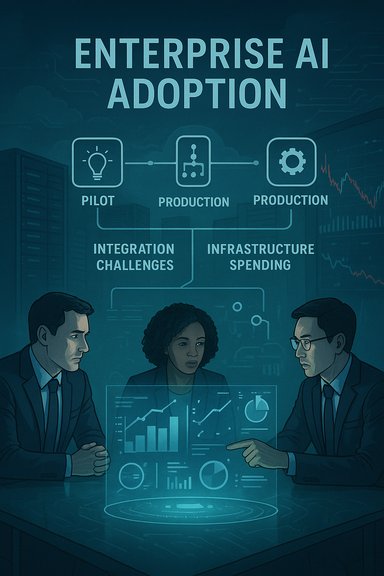
Microsoft’s share price wobble this morning was not the result of a single headline but the market’s reaction to a constellation of signals: a report that parts of Microsoft had reduced product-level sales growth targets for certain AI offerings, investor anxiety about the company’s heavy AI infrastructure spending, and renewed questions about the pace at which enterprises are converting AI pilots into production systems. The market response was quick and visible — shares dropped in early trading on December 3 after the report first surfaced and later pared some losses after Microsoft pushed back on the characterization of the story — a sequence that underscores how sensitive investors are to early signs that AI monetization might take longer than expected.
Background
Microsoft’s corporate pivot to AI has been aggressive and expensive. Over the past two years the company has embedded “Copilot” features across Microsoft 365, expanded GitHub Copilot, introduced agent-style products (Foundry, Copilot Studio), and funneled enormous capital into Azure capacity and GPUs to support inference and model hosting. That strategy made Microsoft one of the largest beneficiaries of the generative-AI narrative, lifting both revenue and market valuation. But it also created a new set of execution risks: converting pilot interest into long-term, high-margin software revenue requires reliable integrations, predictable billing, and demonstrable ROI — all of which are proving harder and slower to deliver at enterprise scale than some investors anticipated. Azure’s growth remains robust but faces headwinds: capacity constraints and very large capital expenditures have raised questions about near-term margin pressure even as AI workloads drive cloud consumption. Microsoft reported record capital spending in recent quarters to buy data-center capacity and GPUs, a line item that analysts and investors watch closely because it reflects the company’s willingness to front-load hardware costs in hopes that enterprise spend will follow. The scale of that spending — roughly in the tens of billions for recent quarters — is central to why the market reacts strongly to any signal that revenue conversion is lagging.What happened, step by step
The original report
A report in The Information described an internal change: several Microsoft sales teams had relaxed growth targets for specific AI products after many salespeople failed to meet aggressive goals set for the prior fiscal year. The piece suggested that product-level quotas for certain AI offerings — particularly agent-style tools intended to automate multi-step workflows — had been dialed back in some divisions. That detail was framed as significant because it implied slower adoption of pricier, next‑generation AI features than some in the market had expected.The market response
The report triggered a drop in Microsoft’s stock price during premarket and early trading — intraday moves in the 1.5–3% range were widely reported — as traders digested the implication that Microsoft’s near-term AI revenue ramp might not be as steep as forecasts priced into the shares. The reaction was amplified by the fact that Microsoft’s recent earnings had shown a huge uptick in capital expenditure tied to AI capacity, making any sign of slower monetization particularly salient to investors. Several outlets confirmed the linkage between the report and the sell-off, and then covered Microsoft’s public denial that the company had lowered aggregate sales quotas across the firm.Microsoft’s response
Microsoft pushed back on the broad characterization. The company stated that aggregate sales quotas for AI products have not been lowered, and criticized the reporting as conflating internal growth expectations with firmwide quota policy. That denial did not dispute the existence of product-level adjustments reported by salespeople in some units, but it sought to stop the story being read as a company-wide retreat from AI monetization. The nuance mattered: product-level recalibrations for new offerings can be routine in sales organizations, but investors treated the signal as larger because of the stakes associated with Microsoft’s multi‑billion-dollar AI investments.Why did demand look weaker for some AI tools? — Four practical explanations
The story is not one of broad “AI failure.” Rather, it highlights friction points that commonly slow enterprise adoption of technically promising but operationally demanding products.1) Integration and data plumbing are real-world showstoppers
Enterprise AI often requires connecting models to live corporate systems — CRM, ERP, document stores, and identity providers. Those integrations are rarely plug‑and‑play. When automations must reliably ingest, normalize, and act on heterogeneous data, the engineering and governance work multiplies. The Carlyle anecdote cited in reporting — an asset manager that reduced Copilot Studio spend because it struggled to make the tool reliably pull data from Salesforce and other applications — is emblematic; it illustrates that if the AI cannot be trusted to access the right data consistently, the economics collapse. This is a structural adoption barrier, not a product-market-fit blip.2) Pilot-to-production conversion remains the industry’s largest bottleneck
Multiple industry studies and reporting note that a small fraction of AI pilots progress to large-scale production deployments. That pilot-to-scale gap means many promising projects demonstrate value in constrained settings but stumble on governance, monitoring, retraining, or legal/compliance reviews when organizations try to scale. Enterprises therefore lengthen procurement cycles, require more robust SLAs, and demand measurable KPIs tied to cost savings or revenue improvements — all factors that slow sales velocity. Analysts have repeatedly flagged that this dynamic undercuts the assumption that pilot success will automatically convert into rapid recurring revenue.3) Pricing and billing visibility create buyer friction
AI features often translate into additional compute consumption and more complex licensing models. Customers are increasingly wary of open-ended bills for inference and prompt consumption, and they want clear TCO modeling and caps on spend. When vendors’ commercial terms are perceived to shift costs onto customers — for example, by adding expensive inference consumption on top of existing subscription fees — buyers pause and demand clearer outcome-based pricing or pilot-to-production discounts. That commercial uncertainty slows adoption, especially at larger enterprises where procurement controls are strict.4) Organizational readiness, privacy, and compliance concerns
Many companies lack the internal data engineering, identity, and governance foundations required to operationalize advanced AI safely. Privacy and compliance worries — plus some high-profile product rollbacks and feature reworks around data capture — make procurement teams risk-averse. Buyers frequently ask for on-device processing options, stronger audit trails, and deterministic behaviors from agents before scaling them widely. Those requirements increase implementation timelines and the cost of customer success programs that vendors must run to close deals.Structural context: Microsoft’s spending and the investor calculus
One of the most consequential undercurrents to the headlines is Microsoft’s scale of investment in AI‑capable infrastructure. Recent quarters showed record capital expenditure as Microsoft raced to expand data-center capacity and buy GPUs to serve AI workloads. That spending is defensible if revenue growth follows, but it becomes a liability if monetization slips.- Microsoft reported capital spending in the range of nearly $35 billion in a recent fiscal quarter as it expanded AI infrastructure; the magnitude of that number has been flagged by multiple outlets and analysts because it materially affects margins and free cash flow dynamics.
Assessing the reporting: what’s solid and what’s unverified
Journalism in this story relies on a mix of named corporate statements and anonymous internal sources. That mix is common for reporting on internal quotas and sales tactics, but it requires careful interpretation.- Corroborated facts: Multiple reputable outlets confirmed that The Information published a story describing product-level quota adjustments and that Microsoft publicly denied an across-the-board quota reduction. These confirmations come from independent news organizations that relied on their own reporting and Microsoft’s statements.
- Less certain items: Specific internal targets (for example, an initial 50% growth target lowered to ~25% for one unit), the exact scope of quota adjustments across divisions, and customer anecdotes (like the Carlyle example) are either sourced to unnamed insiders or to secondary reporting. Those details are plausible and widely reported, but because they rely on anonymous internal sources, they should be treated with caution until Microsoft or the named customers publicly confirm them. The record shows product-level adjustments are real; the scale and precise mechanics are not independently verifiable from public filings.
- Broader data on AI adoption (e.g., the oft-cited figure that only ~5% of AI projects move beyond pilots) is repeatedly quoted across coverage but is itself an aggregation of different studies. That figure is useful as an indicator of the pilot-to-production problem, but readers should treat it as a directional metric rather than a precise law of adoption.
What this means for Microsoft, customers, and the market
For Microsoft
Short term, a modest share pullback and heightened scrutiny of near-term AI revenue are probable. The company still has exceptional strengths: a massive installed base, deep partner channels, control of the endpoint OS (Windows), and a strategic commercial relationship with OpenAI that funnels significant model-hosting demand to Azure. Those advantages reduce existential risk but do not eliminate near-term execution pressure. Microsoft’s appropriate responses include product hardening (better connectors and governance), clearer commercial offerings (pilot-to-production pricing or outcome-based deals), and more hands-on partner enablement for scaled deployments.For enterprise buyers and IT leaders
This moment is an opportunity to negotiate from strength. Enterprises should demand transparent TCO models, staged rollouts, outcome-based commercial terms, and committed partner resources for integration and operations. Where vendors offer opaque consumption billing, buyers should press for spend caps or predictable tiers. Investing in internal data engineering and governance will accelerate deployments and reduce reliance on vendor-managed custom integrations that increase cost and time to value.For investors and the wider market
A single report about product-level quota changes does not invalidate Microsoft’s multi-year AI strategy, but it does highlight the importance of leading indicators. Investors will likely pay closer attention to sales attainment data, commercial bookings for AI products, partner-led managed services revenue, and the pace at which pilot customers sign multi-year production contracts. The market will reward proof of durable monetization; absent that evidence, valuations may remain volatile as the narrative shifts from “AI tailwind” to “AI execution.”Risks and potential second‑order effects
- Valuation compression risk: If AI revenue growth lags while capex remains elevated, margin pressure could compress multiples on the stock. Microsoft’s strong balance sheet mitigates near-term solvency risk, but multiples are sensitive to execution timing.
- Competitive margin pressure: Open-source and low-cost model entrants (including efficient models out of China and nimble open-source stacks) can drive down inference costs and force hyperscalers to compete on price or add higher-value services to justify premiums.
- Reputation and commercial backlash: Aggressive upsell strategies without clear ROI risk customer churn or slower renewals; customers forced into higher tiers without demonstrable value could become politically resistant inside their organizations.
- Execution risk in partner channel: Microsoft’s partner ecosystem will be crucial to scale AI projects; if partners cannot operationalize pilots at scale, product adoption will lag. That creates an opening for niche integrators and cloud competitors.
Short checklist for IT decision makers evaluating vendor AI offerings
- Define measurable outcomes before buying (e.g., FTE reduction, cycle time improvement).
- Require staged rollouts with clear acceptance criteria and cost transparency.
- Insist on pilot-to-production pricing or outcome-based contracts when possible.
- Verify connectors and data flows in a sandbox that mirrors production systems.
- Budget for partner or in-house engineering time — pilots rarely become production without it.
Conclusion
The trading blip following reports of lowered product-level AI growth targets for some Microsoft teams is a meaningful market signal but not a definitive verdict on Microsoft’s AI strategy. It highlights a central truth of enterprise AI: technical capability is necessary but not sufficient. For vendors and buyers alike, the hard work now is operational — building connectors, governance, predictable commercial models, and managed services that turn promising pilots into reliable, auditable production systems.Microsoft’s balance sheet, platform reach, and OpenAI ties give it durable advantages; the company can and almost certainly will iterate on product, pricing, and partner strategies to accelerate adoption. At the same time, investors and enterprise customers have legitimate reasons to ask for clearer evidence of conversion of massive capital spending into recurring, scalable software revenue. The next several quarters will be telling: real‑world contract signings, sales attainment across AI product lines, and improvements in pilot-to-production ratios are the metrics to watch.
Source: Bloomberg.com https://www.bloomberg.com/news/arti...lide-on-report-of-low-demand-for-ai-software/
