

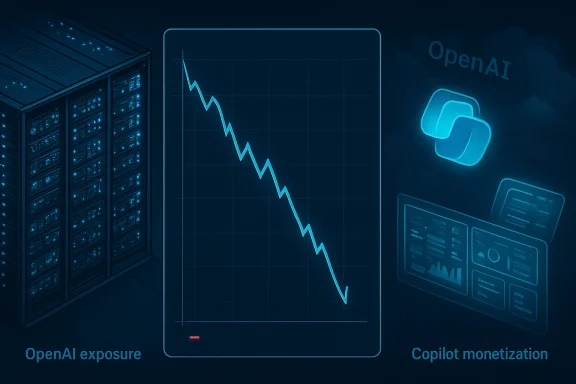
Microsoft’s stock was knocked lower this week after two sell‑side firms publicly trimmed their ratings within days of each other, with Melius Research’s note explicitly warning that Microsoft’s massive AI push has created near‑term execution and margin risks investors can no longer ignore.
Background
Microsoft reported a strong fiscal quarter—top‑line beats and healthy adjusted earnings—yet the market fixated on the balance sheet and footnotes: an unprecedented surge in capital expenditures, possible Azure capacity bottlenecks, and growing questions about how quickly AI products such as the Copilot family will convert heavy usage into durable, high‑margin revenue.Two analyst actions crystallized investor concern. First, Stifel moved from Buy to Hold and sharply cut its price target, pointing to elevated capex assumptions and rising competition as drivers of a slower, costlier path to returns. Days later, Melius Research issued a second downgrade, explicitly connecting the case to capital allocation, Copilot monetization uncertainty, and the operational challenge of converting pre‑contracted AI demand into recognized revenue. The clustering of these downgrades amplified market nervousness and prompted the move in Microsoft shares.
What happened, in plain terms
- Microsoft reported a quarter with solid revenues (around $81.3 billion) and adjusted EPS that beat expectations, but the company disclosed extraordinarily large capital spending—a one‑quarter capex figure reported in the tens of billions. Analysts zeroed in on the composition of that spending: a large share dedicated to short‑lived, GPU‑dense compute for generative AI workloads rather than traditional long‑lived cloud assets.
- The company’s Azure (Intelligent Cloud) growth remained robust but showed marginal deceleration, a detail investors treated as material given extremely high expectations for AI‑driven acceleration.
- Analysts warned that Microsoft’s resource allocation dilemma—deciding whether scarce GPU capacity should run internal projects, strategic partners, or commercial Azure customers—creates timing mismatches between costs and revenue recognition. That mismatch is central to Melius’s caution.
Why the downgrades happened: the core drivers
1) Capital intensity and the economics of GPUs
Microsoft disclosed an extraordinary capex step‑up for the quarter, with industry summaries pointing to roughly $37.5 billion in spend in that reporting period—a number notable not only for its size, but for the fact that much of it went to short‑lived accelerators (GPUs, AI accelerators) with faster replacement cycles and different depreciation timing than legacy cloud hardware. This changes the cash‑flow math and raises near‑term margin pressure.Analyst models that previously assumed a continuation of high gross margins now face a new reality: when a larger portion of costs is compute consumption and accelerated asset depreciation, the denominator in margin calculations shifts. If utilization and monetization lag the deployment of those assets, free cash flow and gross margins can compress materially. Stifel modeled larger multi‑year capex trajectories and took down margin assumptions accordingly—an explicit quantitative action that changed price targets.
2) Capacity constraints and timing risk
Investors aren’t merely worried about the amount Microsoft is spending—they’re worried about when that spending turns into revenue. The market learned that Microsoft has contracted for or committed to workloads that currently exceed available GPU capacity; bringing power, racks, and specialized hardware online takes quarters. That creates a timing mismatch: costs are being incurred now while some contracted or expected revenue arrives later. Analysts fear that if capacity ramps slower than expected, near‑term revenue growth will disappoint relative to the company’s investment pace.3) Copilot monetization uncertainty
Copilot—a family that spans Microsoft 365 Copilot, GitHub Copilot, verticalized agents and enterprise integration—is central to Microsoft’s AI monetization story. Management reported large seat adds and strong engagement, but seat growth plus engagement does not automatically equal sustainable, high‑margin recurring revenue at the enterprise scale analysts expect. Key unknowns include long‑run ARPU per seat, renewal/retention curves, and willingness of enterprise buyers to accept per‑seat or consumption pricing at scale without negotiating discounts that erode margin. Melius named this monetization risk explicitly as a reason for downgrading the stock.4) Concentration risk (OpenAI exposure)
Microsoft’s earnings disclosures and investor commentary flagged a sizable portion of its commercial RPO (remaining performance obligations) as tied to OpenAI‑related commitments—figures cited around 45% of a roughly $625 billion commercial RPO. That level of concentration introduces a counterparty and concentration risk: renegotiations, operational changes at OpenAI, or shifts in the economics of the partnership could ripple materially through Microsoft’s near‑term bookings and revenue recognition. Analysts factor that into uncertainty about quality and predictability of future cash flows.5) Rising competition and potential pricing pressure
The market backdrop matters. Google Cloud’s push with Gemini and Anthropic’s rapid enterprise traction were named by analysts as credible competitive threats that could blunt Microsoft’s AI pricing power or force Microsoft into concessions to win large enterprise deals. In a race where multiple players vie for enterprise AI workloads, the winner isn’t guaranteed to extract premium pricing at scale—especially if model parity, tooling, or pricing models overlap across vendors.How the market mechanics amplified the reaction
Two elements made the downgrades sting more than a routine note:- Clustering effect: One downgrade is noteworthy; two within days on the same theme signals a shift in the consensus probability assigned to downside outcomes. That clustering makes passive flows and quant funds re‑weight portfolios, magnifying price moves.
- Narrative vs. numbers: Microsoft delivered strong headline revenue and EPS, but the story shifted from "growth" to "when and how those investments pay off." In high‑valuation markets, timing matters—investors price companies on expected returns over defined windows. When the expected timeline stretches, required returns rise and multiples compress. Analysts adjusted models to reflect longer payback horizons and lower near‑term margins.
What the analysts specifically modeled and why it matters
Stifel’s public change was more than tone—it adjusted concrete model inputs: a materially higher fiscal‑2027 capex estimate (the firm raised its capex view meaningfully) and trimmed gross margin assumptions to reflect the margin drag from GPU‑heavy investments. That led Stifel to cut its price target substantially—moves that signal a belief that Microsoft’s margin and EPS trajectory for the next 12–24 months will be less favorable than prior consensus. Melius mirrored these concerns from a different angle, emphasizing monetization and allocation risk (Copilot traction and internal compute demands).Why that matters for investors: when analysts lower growth or expand capex assumptions in models, the present value of future cash flows declines—directly reducing justified share price. The firms didn’t accuse Microsoft of mismanagement; they recalibrated the probability distribution of outcomes and priced in a longer, bumpier ramp to profitable AI monetization.
The operational tradeoffs Microsoft faces
Microsoft’s senior management is confronting a series of interlocking operational tradeoffs:- Prioritize internal research, strategic partners and OpenAI commitments (which may accelerate long‑term differentiation) or prioritize external Azure customers (which supports more immediate revenue recognition).
- Accept depressed near‑term gross margins from expensive GPUs and rapid replacement cycles, hoping utilization and seat ARPU catch up over time; or slow the infrastructure build and risk losing a competitive foothold in hosted model capacity.
- Maintain generous allocations to strategic partners to secure long‑term advantages, while defending against investors’ impatience for predictable cash returns.
Scenarios going forward — what to watch (practical checklist)
- Management guidance and capex cadence: look for quarterly updates on capex trajectory and a clearer breakdown of GPU vs. long‑lived infrastructure spending. Better granularity will reduce timing uncertainty.
- Azure growth cadence: sequential changes, particularly whether Azure accelerates once a portion of capacity comes online or continues showing deceleration.
- Copilot economics: public disclosure of ARPU per Copilot seat, renewal rates, retention cohorts, and enterprise deal structures would materially improve investors’ ability to model long‑term margins.
- Physical capacity milestones: announcements of new data centers, chip deliveries, and usable GPU fleet size (not just commitments) will be critical.
- Competitive pricing and bundling moves by Google Cloud, Anthropic, and other AI providers that might force margin concessions.
For enterprise IT leaders and Windows users: what this means operationally
- Negotiate explicit capacity and SLA terms if you’re locking mission‑critical AI workloads to a cloud provider. Given capacity allocation tensions, contractual clarity about priority and delivery timelines matters.
- Treat Copilot and generative features as production software: test, version, monitor, and govern—don’t assume pilot usage scales without governance and cost controls. Consumption‑based inference pricing can escalate if not tracked.
- Build multi‑cloud escape routes for critical workloads that can tolerate some portability to mitigate vendor allocation risk. Microsoft’s scale advantage is real, but so are supply constraints and geopolitical/supply‑chain exposures that can delay capacity.
- Include model safety, privacy and auditability in procurement. As AI features spread across productivity stacks, legal and compliance teams must negotiate data‑handling clauses and audit rights.
Strengths in Microsoft’s position — why the downgrades aren’t a death knell
- Microsoft’s distribution footprint—Microsoft 365, Windows, Azure and GitHub—creates durable channels to monetize AI. The installed base and enterprise integrations provide a clear path to embed AI into workflows at scale. That structural advantage is a genuine moat.
- A strong balance sheet and high credit quality give Microsoft the ability to underwrite sustained capex and wait for utilization curves to improve—this optionality is nontrivial in a capital‑intensive transition.
- Large RPO/backlog figures provide multi‑year visibility if realized as expected; the problem is not presence of demand but the pacing and concentration of that demand.
Key risks and blind spots analysts emphasized
- Overcapacity/underutilization: If data center build cycles or GPU supply delays result in idle, expensive assets, margins will suffer. Analysts flagged this as a material operational hazard for hyperscalers.
- Commodity inference pricing: If models and inference commoditize, raw compute becomes a lower‑margin business and Microsoft’s ability to convert compute into premium seat revenue becomes the core value test.
- Contract concentration: Large exposure to a single partner (OpenAI) raises questions about earnings quality and potential renegotiation risk.
- Regulatory and supply‑chain shocks: Export controls, geopolitical tensions, and energy/power constraints at data‑center build sites can slow deployment or change economics.
Balanced assessment: verdict without polemics
The downgrades reflect a recalibration, not a condemnation. Analysts and markets are reacting to measurable, near‑term variables—capex magnitude and mix, capacity ramp timing, Copilot monetization clarity, and concentration exposures—that materially alter how investors model Microsoft’s short‑to‑medium term returns. The company’s long‑term strategic thesis—owning the AI stack from silicon to productivity hooks—remains logically coherent and defensible. What has changed is the market’s confidence in the timing and economics of that thesis.If Microsoft can show steady capacity ramp milestones, transparent monetization metrics for Copilot, and controlled capex inflation relative to revenue conversion, the downgrades will look conservative. If capacity or monetization disappoint, analysts’ warnings will prove prescient and the market will continue to press for valuation repricing.
Practical next‑steps for different audiences
- Investors (long‑term): Reassess your horizon. Do you have patience for a multi‑quarter conversion of capex to profit? If yes, monitor operational disclosures rather than daily price moves. If no, reduce exposure or hedge until clearer cadence is visible.
- Traders/short‑term: Watch analyst model changes, passive‑flow rebalancing events, and headline capacity announcements—these are the likely volatility triggers.
- IT buyers: Renegotiate capacity and delivery guarantees; pilot Copilot features under production governance; design escape routes for critical AI workloads with multi‑cloud strategies.
- Microsoft watchers and partners: Demand and expect clearer, more granular disclosure—ARPU per Copilot seat, GPU fleet operational size, and a tile‑by‑tile timeline for when booked capacity becomes billable capacity. These disclosures would materially reduce the uncertainty feeding analyst downgrades.
Final thoughts
This episode is a reminder that in the AI era, scale creates both opportunity and novel operational risks. Building the infrastructure to host generative models at enterprise scale is expensive, physically constrained, and dependent on supply chains and allocation decisions that did not dominate traditional SaaS economics. Microsoft’s leadership position gives it advantages others lack, but the company now sits at the operational crossroads: justify the capital-intensive build with clear monetization and capacity timelines, or accept the likelihood of continued market skepticism until those proofs appear. Investors and enterprise customers should treat the current downgrades as a call for transparency and a prompt to stress‑test plans against a realistic timeline for the return on AI infrastructure spending.Source: Bloomberg.com https://www.bloomberg.com/news/arti...elius-warns-on-ai-risks/?srnd=homepage-europe
