

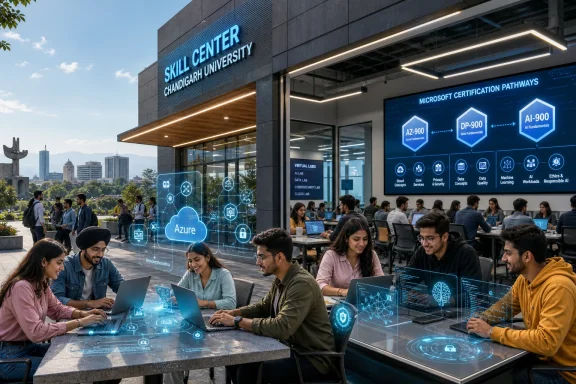
Microsoft and Chandigarh University inaugurated a Microsoft Skill Center in Artificial Intelligence at CU’s Punjab campus on April 2, 2026, with training planned in AI, machine learning, cloud computing, data science, cybersecurity, Azure labs, and Microsoft certification pathways. The announcement is easy to file under campus public relations, but that would miss the larger signal. Microsoft is not merely donating brand equity to another lab; it is pushing its credential stack deeper into the university pipeline. For students, administrators, and employers, the real question is whether “AI for All” becomes a durable skills bridge or another badge economy with a shiny signboard.
The most important part of the Chandigarh University announcement is not the ribbon-cutting. It is the decision to embed Microsoft-aligned learning into the structure of university education rather than treating it as an optional extra students chase after graduation.
The Skill Center is described as a hub for hands-on training, virtual labs, and Microsoft certifications in areas such as Azure fundamentals, data fundamentals, AI fundamentals, GitHub Foundation, Power BI data analysis, and cloud computing. Chandigarh University officials said the center will initially focus on engineering students before expanding across the wider university under an “AI for All” framing.
That matters because universities have historically moved slowly, while cloud platforms move on quarterly roadmaps. A conventional computer science syllabus can teach operating systems, databases, networks, and algorithms, but it often struggles to keep pace with the tooling employers actually use. Microsoft’s answer is to bring its own modular learning and certification machinery closer to the degree itself.
There is an obvious upside. Students get access to lab-based work, structured cloud environments, and recognizable credentials before they enter the job market. But there is also a strategic logic for Microsoft: the earlier students learn Azure, Power BI, GitHub, and Microsoft’s AI services, the more likely they are to carry that familiarity into internships, startups, corporate IT teams, and government projects.
This is the old developer-platform play, updated for the AI era. Microsoft does not need every student to become an Azure architect. It needs enough of them to think of Azure, GitHub, Power Platform, and Microsoft’s AI stack as the default vocabulary of modern computing.
Sanjay Dhingra, Microsoft’s Director for Public Sector, framed the collaboration as something that would reach beyond B.Tech students into other university programs. That is the more revealing claim. AI is no longer being sold only to computer science departments; it is being sold to business schools, media programs, law students, commerce students, pharmacy students, and anyone whose future job may involve data, automation, or software-mediated workflows.
That shift reflects a broader change in how AI is being operationalized. The first wave of AI education was about model builders. The current wave is about model users, workflow designers, data interpreters, prompt-literate analysts, and employees who understand enough about AI systems to supervise, question, and apply them.
For Chandigarh University, the Microsoft Skill Center offers a way to market employability across disciplines. For Microsoft, it expands the addressable audience from future developers to future professionals. That is why courses such as Power BI and Azure AI Fundamentals sit alongside more technical cloud modules. The center is not simply trying to produce machine learning engineers; it is trying to normalize Microsoft-flavored digital literacy as a baseline professional skill.
There is nothing inherently wrong with that. Most graduates will not train foundation models, and most enterprises do not need them to. They need people who can work with cloud dashboards, understand data pipelines, use AI-assisted tools responsibly, and translate business problems into technical workflows.
The danger is that “AI for All” can become an elastic slogan. If it means serious lab access, assessed work, real projects, and transparent certification outcomes, it can help students. If it means a thin layer of generic AI awareness wrapped around marketing language, it risks becoming another item in the placement brochure.
Cloud labs change what a university can realistically teach. Instead of relying only on local machines, uneven lab hardware, or simulated environments, students can work inside cloud-hosted systems that resemble the infrastructure used in industry. That allows courses to cover deployment, identity, data services, analytics, AI APIs, and security concepts in a way that feels less abstract.
For WindowsForum readers, this is where the announcement connects to the broader Microsoft ecosystem. Azure is not just a cloud provider in this context; it is the training ground. GitHub is not just a code host; it is the workflow layer. Power BI is not just a dashboard tool; it is an entry point into Microsoft’s enterprise data story.
The Skill Center therefore acts as a funnel into Microsoft’s commercial universe. Students may begin with AZ-900, DP-900, or AI-900, but the path can extend toward role-based credentials, applied skills, internships, and eventually enterprise procurement decisions. In that sense, a campus center is also long-horizon customer acquisition.
That may sound cynical, but it is how platform ecosystems work. AWS, Google Cloud, Cisco, Red Hat, Oracle, and others have all treated education as a strategic market. The difference now is the urgency around AI. Vendors are racing not just to win workloads, but to shape the workforce that will recommend, implement, and maintain those workloads.
Microsoft’s advantage is that it can tie together education, productivity software, developer tooling, cloud infrastructure, analytics, security, and AI services under one umbrella. A university adopting that package is not merely adding a course; it is importing a worldview about how modern IT should be built.
The university said the center will provide access to Microsoft’s large library of learning modules, Microsoft Fundamentals certification curriculum, teaching materials, advanced role-based curriculum, workshops, expert sessions, real-world project exposure, and career-oriented development. It also said it is launching a specialized Bachelor of Engineering program in Computer Science Engineering with a specialization in AI in collaboration with Microsoft.
That is powerful admissions language. Indian universities compete intensely on placements, industry tie-ups, international rankings, and claims of future-ready education. A Microsoft-branded center gives Chandigarh University a recognizable signal to students and parents who may not be able to assess curriculum depth but understand the value of a global technology brand.
The involvement of byteXL adds another layer. The company has positioned itself around industry-aligned engineering education, including AI, ML, and GenAI-focused programs. Its presence suggests that this is not simply Microsoft handing over course links; it is part of a delivery ecosystem involving curriculum support, platform access, and training design.
Still, branding is not the same as outcomes. The center’s credibility will depend on mundane details: how many students complete certifications, how much lab time they receive, whether faculty are trained deeply enough, whether projects go beyond tutorials, and whether employers actually reward the credentials during hiring.
The announcement says the center will begin with engineering students and later expand across the university. That phased rollout is sensible. It also creates a measurable test. If the first cohorts produce strong completion rates and placement outcomes, the model will be easier to defend. If the expansion outruns teaching capacity, the Microsoft name could end up covering a shallow experience.
Microsoft Fundamentals exams such as AZ-900, DP-900, and AI-900 are designed as entry-level credentials. They can introduce students to cloud concepts, data services, AI workloads, governance, and basic platform terminology. For a first- or second-year student, that structure can be genuinely valuable.
But the industry has seen this pattern before. When a credential becomes a mass-market signal, the market eventually discounts it unless it is paired with demonstrated ability. A student who can explain Azure regions, responsible AI principles, or relational versus non-relational data services has a head start. A student who can deploy a working app, secure it, document it, and troubleshoot it under constraints has a much stronger claim.
That is why the lab-based component is the part to watch. If the Skill Center treats certification as the finish line, it will produce badge holders. If it treats certification as scaffolding for projects, internships, and problem-solving, it can produce employable graduates.
The university’s language about real-world project exposure and hands-on learning is encouraging, but those phrases are common in education marketing. The proof will be in assessment design. Are students building things that survive outside a guided lab? Are they working with messy data? Are they learning cost management, access control, deployment failures, documentation, and security trade-offs? Are non-engineering students learning how to apply AI without pretending to be software engineers?
A mature program would separate foundational literacy from professional readiness. Everyone can benefit from AI literacy. Not everyone needs the same technical depth. The best version of “AI for All” recognizes that difference instead of forcing every discipline through the same cloud-certification tunnel.
India is an obvious focal point. It has a massive student population, a large IT services industry, a fast-growing developer base, and a government agenda that increasingly treats digital capability as national infrastructure. For Microsoft, skilling initiatives in India are both social investment and market development.
This is why the public-sector angle matters. Dhingra’s presence at the inauguration signals that Microsoft sees education partnerships not only as campus relationships but as part of broader public and institutional transformation. Training students in Azure, AI, GitHub, and analytics tools helps build the human layer needed for cloud adoption across enterprises and government-adjacent sectors.
The company is also responding to competitive pressure. Google has its developer groups and cloud training. AWS has academy programs and cloud certifications. NVIDIA has pushed AI and accelerated computing education. Indian edtech and training providers are trying to package GenAI skills for students at scale. Microsoft cannot afford to sit outside that pipeline.
The Chandigarh University center is therefore less an isolated first than a template. A private university with an employability focus, an industry partner, a cloud curriculum, certification paths, and an AI-for-everyone slogan is a replicable model. If it works, expect to see similar centers, labs, and embedded credential programs elsewhere.
That replication will raise a policy question for Indian higher education. How much of the curriculum should be shaped by platform vendors? Industry alignment is necessary, but universities also have a duty to teach durable concepts that outlast any single vendor’s product cycle. A good cloud course should make Azure intelligible without making Azure inevitable.
The future Windows administrator is increasingly a cloud administrator, identity administrator, endpoint security operator, automation builder, data analyst, and AI policy interpreter. Microsoft’s ecosystem has been pulling those roles together for years through Entra ID, Intune, Defender, Azure, Microsoft 365, Power Platform, GitHub, and now Copilot-era AI services.
A university student trained only on desktop computing is not prepared for that world. A student trained only on abstract AI theory is not prepared either. The real workplace sits between them: hybrid identity, cloud storage, endpoint compliance, app deployment, data governance, security alerts, low-code workflows, and AI features embedded into everyday productivity software.
This is where Microsoft’s education strategy becomes practical for sysadmins and IT managers. If graduates arrive with basic Azure literacy, GitHub familiarity, Power BI exposure, and a conceptual grasp of AI services, employers spend less time teaching the vocabulary of modern Microsoft IT. That does not make them senior engineers. It makes them less foreign to the environment they are entering.
There is also a security dimension. AI and cloud tools can expand capability, but they can also expand risk when users do not understand permissions, data boundaries, compliance, and model limitations. A serious Skill Center should teach not only how to consume AI services, but how to ask whether data should be used, how access should be limited, and how outputs should be validated.
That is especially important for non-engineering students. The next wave of AI risk will not come only from developers writing insecure code. It will come from analysts uploading sensitive spreadsheets, managers automating workflows without governance, and departments adopting AI tools faster than IT can evaluate them.
The Skill Center’s success should be judged by observable outcomes rather than institutional adjectives. How many students enroll? How many complete courses? How many pass certifications? How many build projects that employers can inspect? How many faculty members are trained to deliver the material rather than simply supervise online modules? How many students outside engineering actually benefit?
There is also the question of affordability. Microsoft certifications can be valuable, but exams, preparation, and retakes can impose costs. If the university absorbs those costs or provides structured support, the center becomes more inclusive. If certification becomes a paid add-on that advantages students who can afford repeated attempts, the “AI for All” slogan becomes weaker.
Another test is curriculum independence. Universities should not outsource judgment to vendors. Microsoft can provide tools, labs, modules, and credentials, but faculty still need to contextualize them. Students should learn why a cloud architecture works, not merely which Azure service to click. They should understand AI limitations, not merely pass an AI fundamentals quiz.
The best industry-academia partnerships are not advertisements. They are translation layers between theory and practice. They preserve academic depth while exposing students to real tools. They invite vendor expertise without surrendering the curriculum.
Chandigarh University now has an opportunity to show that this model can work. The center’s promise lies in its combination of lab access, certification pathways, and broad disciplinary reach. Its risk lies in the same combination becoming too broad, too branded, and too thin.
 Microsoft Moves the Certification Layer Into the Degree
The most important part of the Chandigarh University announcement is not the ribbon-cutting. It is the decision to embed Microsoft-aligned learning into the structure of university education rather than treating it as an optional extra students chase after graduation.The Skill Center is described as a hub for hands-on training, virtual labs, and Microsoft certifications in areas such as Azure fundamentals, data fundamentals, AI fundamentals, GitHub Foundation, Power BI data analysis, and cloud computing. Chandigarh University officials said the center will initially focus on engineering students before expanding across the wider university under an “AI for All” framing.
That matters because universities have historically moved slowly, while cloud platforms move on quarterly roadmaps. A conventional computer science syllabus can teach operating systems, databases, networks, and algorithms, but it often struggles to keep pace with the tooling employers actually use. Microsoft’s answer is to bring its own modular learning and certification machinery closer to the degree itself.
There is an obvious upside. Students get access to lab-based work, structured cloud environments, and recognizable credentials before they enter the job market. But there is also a strategic logic for Microsoft: the earlier students learn Azure, Power BI, GitHub, and Microsoft’s AI services, the more likely they are to carry that familiarity into internships, startups, corporate IT teams, and government projects.
This is the old developer-platform play, updated for the AI era. Microsoft does not need every student to become an Azure architect. It needs enough of them to think of Azure, GitHub, Power Platform, and Microsoft’s AI stack as the default vocabulary of modern computing.
The “AI for All” Pitch Is Really About Labor-Market Scale
The phrase “AI for All” sounds inclusive, almost civic-minded. In practice, it is also a labor-market strategy.Sanjay Dhingra, Microsoft’s Director for Public Sector, framed the collaboration as something that would reach beyond B.Tech students into other university programs. That is the more revealing claim. AI is no longer being sold only to computer science departments; it is being sold to business schools, media programs, law students, commerce students, pharmacy students, and anyone whose future job may involve data, automation, or software-mediated workflows.
That shift reflects a broader change in how AI is being operationalized. The first wave of AI education was about model builders. The current wave is about model users, workflow designers, data interpreters, prompt-literate analysts, and employees who understand enough about AI systems to supervise, question, and apply them.
For Chandigarh University, the Microsoft Skill Center offers a way to market employability across disciplines. For Microsoft, it expands the addressable audience from future developers to future professionals. That is why courses such as Power BI and Azure AI Fundamentals sit alongside more technical cloud modules. The center is not simply trying to produce machine learning engineers; it is trying to normalize Microsoft-flavored digital literacy as a baseline professional skill.
There is nothing inherently wrong with that. Most graduates will not train foundation models, and most enterprises do not need them to. They need people who can work with cloud dashboards, understand data pipelines, use AI-assisted tools responsibly, and translate business problems into technical workflows.
The danger is that “AI for All” can become an elastic slogan. If it means serious lab access, assessed work, real projects, and transparent certification outcomes, it can help students. If it means a thin layer of generic AI awareness wrapped around marketing language, it risks becoming another item in the placement brochure.
Azure Labs Turn the Campus Into a Platform On-Ramp
The announcement’s reference to virtual labs running on Microsoft Azure is more than a technical footnote. It is the operational core of the center.Cloud labs change what a university can realistically teach. Instead of relying only on local machines, uneven lab hardware, or simulated environments, students can work inside cloud-hosted systems that resemble the infrastructure used in industry. That allows courses to cover deployment, identity, data services, analytics, AI APIs, and security concepts in a way that feels less abstract.
For WindowsForum readers, this is where the announcement connects to the broader Microsoft ecosystem. Azure is not just a cloud provider in this context; it is the training ground. GitHub is not just a code host; it is the workflow layer. Power BI is not just a dashboard tool; it is an entry point into Microsoft’s enterprise data story.
The Skill Center therefore acts as a funnel into Microsoft’s commercial universe. Students may begin with AZ-900, DP-900, or AI-900, but the path can extend toward role-based credentials, applied skills, internships, and eventually enterprise procurement decisions. In that sense, a campus center is also long-horizon customer acquisition.
That may sound cynical, but it is how platform ecosystems work. AWS, Google Cloud, Cisco, Red Hat, Oracle, and others have all treated education as a strategic market. The difference now is the urgency around AI. Vendors are racing not just to win workloads, but to shape the workforce that will recommend, implement, and maintain those workloads.
Microsoft’s advantage is that it can tie together education, productivity software, developer tooling, cloud infrastructure, analytics, security, and AI services under one umbrella. A university adopting that package is not merely adding a course; it is importing a worldview about how modern IT should be built.
Chandigarh University Gets a Placement Story With Global Branding
Chandigarh University’s side of the bargain is straightforward. The institution gets a high-profile industry partnership, a new center of excellence, and a stronger employability narrative in a competitive Indian higher-education market.The university said the center will provide access to Microsoft’s large library of learning modules, Microsoft Fundamentals certification curriculum, teaching materials, advanced role-based curriculum, workshops, expert sessions, real-world project exposure, and career-oriented development. It also said it is launching a specialized Bachelor of Engineering program in Computer Science Engineering with a specialization in AI in collaboration with Microsoft.
That is powerful admissions language. Indian universities compete intensely on placements, industry tie-ups, international rankings, and claims of future-ready education. A Microsoft-branded center gives Chandigarh University a recognizable signal to students and parents who may not be able to assess curriculum depth but understand the value of a global technology brand.
The involvement of byteXL adds another layer. The company has positioned itself around industry-aligned engineering education, including AI, ML, and GenAI-focused programs. Its presence suggests that this is not simply Microsoft handing over course links; it is part of a delivery ecosystem involving curriculum support, platform access, and training design.
Still, branding is not the same as outcomes. The center’s credibility will depend on mundane details: how many students complete certifications, how much lab time they receive, whether faculty are trained deeply enough, whether projects go beyond tutorials, and whether employers actually reward the credentials during hiring.
The announcement says the center will begin with engineering students and later expand across the university. That phased rollout is sensible. It also creates a measurable test. If the first cohorts produce strong completion rates and placement outcomes, the model will be easier to defend. If the expansion outruns teaching capacity, the Microsoft name could end up covering a shallow experience.
The Certification Economy Has Promise, but It Also Has Gravity
Certifications occupy an awkward place in technology hiring. They are useful signals, but they are not substitutes for skill.Microsoft Fundamentals exams such as AZ-900, DP-900, and AI-900 are designed as entry-level credentials. They can introduce students to cloud concepts, data services, AI workloads, governance, and basic platform terminology. For a first- or second-year student, that structure can be genuinely valuable.
But the industry has seen this pattern before. When a credential becomes a mass-market signal, the market eventually discounts it unless it is paired with demonstrated ability. A student who can explain Azure regions, responsible AI principles, or relational versus non-relational data services has a head start. A student who can deploy a working app, secure it, document it, and troubleshoot it under constraints has a much stronger claim.
That is why the lab-based component is the part to watch. If the Skill Center treats certification as the finish line, it will produce badge holders. If it treats certification as scaffolding for projects, internships, and problem-solving, it can produce employable graduates.
The university’s language about real-world project exposure and hands-on learning is encouraging, but those phrases are common in education marketing. The proof will be in assessment design. Are students building things that survive outside a guided lab? Are they working with messy data? Are they learning cost management, access control, deployment failures, documentation, and security trade-offs? Are non-engineering students learning how to apply AI without pretending to be software engineers?
A mature program would separate foundational literacy from professional readiness. Everyone can benefit from AI literacy. Not everyone needs the same technical depth. The best version of “AI for All” recognizes that difference instead of forcing every discipline through the same cloud-certification tunnel.
Microsoft’s India Strategy Is Bigger Than One Campus
The Chandigarh University center fits a wider Microsoft pattern in India: large-scale skilling, public-sector partnerships, education initiatives, AI literacy campaigns, and cloud ecosystem development.India is an obvious focal point. It has a massive student population, a large IT services industry, a fast-growing developer base, and a government agenda that increasingly treats digital capability as national infrastructure. For Microsoft, skilling initiatives in India are both social investment and market development.
This is why the public-sector angle matters. Dhingra’s presence at the inauguration signals that Microsoft sees education partnerships not only as campus relationships but as part of broader public and institutional transformation. Training students in Azure, AI, GitHub, and analytics tools helps build the human layer needed for cloud adoption across enterprises and government-adjacent sectors.
The company is also responding to competitive pressure. Google has its developer groups and cloud training. AWS has academy programs and cloud certifications. NVIDIA has pushed AI and accelerated computing education. Indian edtech and training providers are trying to package GenAI skills for students at scale. Microsoft cannot afford to sit outside that pipeline.
The Chandigarh University center is therefore less an isolated first than a template. A private university with an employability focus, an industry partner, a cloud curriculum, certification paths, and an AI-for-everyone slogan is a replicable model. If it works, expect to see similar centers, labs, and embedded credential programs elsewhere.
That replication will raise a policy question for Indian higher education. How much of the curriculum should be shaped by platform vendors? Industry alignment is necessary, but universities also have a duty to teach durable concepts that outlast any single vendor’s product cycle. A good cloud course should make Azure intelligible without making Azure inevitable.
The Windows Angle Is the Enterprise Skills Pipeline
At first glance, this is not a Windows story. There is no new build, no Patch Tuesday regression, no Copilot setting hiding in Group Policy. But for IT pros, it is absolutely part of the Windows and Microsoft ecosystem story.The future Windows administrator is increasingly a cloud administrator, identity administrator, endpoint security operator, automation builder, data analyst, and AI policy interpreter. Microsoft’s ecosystem has been pulling those roles together for years through Entra ID, Intune, Defender, Azure, Microsoft 365, Power Platform, GitHub, and now Copilot-era AI services.
A university student trained only on desktop computing is not prepared for that world. A student trained only on abstract AI theory is not prepared either. The real workplace sits between them: hybrid identity, cloud storage, endpoint compliance, app deployment, data governance, security alerts, low-code workflows, and AI features embedded into everyday productivity software.
This is where Microsoft’s education strategy becomes practical for sysadmins and IT managers. If graduates arrive with basic Azure literacy, GitHub familiarity, Power BI exposure, and a conceptual grasp of AI services, employers spend less time teaching the vocabulary of modern Microsoft IT. That does not make them senior engineers. It makes them less foreign to the environment they are entering.
There is also a security dimension. AI and cloud tools can expand capability, but they can also expand risk when users do not understand permissions, data boundaries, compliance, and model limitations. A serious Skill Center should teach not only how to consume AI services, but how to ask whether data should be used, how access should be limited, and how outputs should be validated.
That is especially important for non-engineering students. The next wave of AI risk will not come only from developers writing insecure code. It will come from analysts uploading sensitive spreadsheets, managers automating workflows without governance, and departments adopting AI tools faster than IT can evaluate them.
The Center’s Success Will Be Measured After the Press Release Fades
Every education partnership sounds transformative on launch day. The harder story begins in semester two.The Skill Center’s success should be judged by observable outcomes rather than institutional adjectives. How many students enroll? How many complete courses? How many pass certifications? How many build projects that employers can inspect? How many faculty members are trained to deliver the material rather than simply supervise online modules? How many students outside engineering actually benefit?
There is also the question of affordability. Microsoft certifications can be valuable, but exams, preparation, and retakes can impose costs. If the university absorbs those costs or provides structured support, the center becomes more inclusive. If certification becomes a paid add-on that advantages students who can afford repeated attempts, the “AI for All” slogan becomes weaker.
Another test is curriculum independence. Universities should not outsource judgment to vendors. Microsoft can provide tools, labs, modules, and credentials, but faculty still need to contextualize them. Students should learn why a cloud architecture works, not merely which Azure service to click. They should understand AI limitations, not merely pass an AI fundamentals quiz.
The best industry-academia partnerships are not advertisements. They are translation layers between theory and practice. They preserve academic depth while exposing students to real tools. They invite vendor expertise without surrendering the curriculum.
Chandigarh University now has an opportunity to show that this model can work. The center’s promise lies in its combination of lab access, certification pathways, and broad disciplinary reach. Its risk lies in the same combination becoming too broad, too branded, and too thin.
The Credential Race Comes to Campus
The concrete takeaways are less about one building than about where Microsoft wants the next generation of IT workers to begin. Chandigarh University gets a headline partnership, but Microsoft gets something just as valuable: a structured place in the student journey before career habits harden.- The Microsoft Skill Center at Chandigarh University was inaugurated on April 2, 2026, with a focus on AI, cloud computing, data science, cybersecurity, machine learning, and Microsoft certification pathways.
- The center is expected to begin with engineering students before expanding to learners across other university programs under the “AI for All” initiative.
- Chandigarh University has identified AZ-900, DP-900, and AI-900 as initial core certification courses, with additional Microsoft-aligned training expected later.
- The collaboration includes virtual labs running on Microsoft Azure, which makes the center a practical on-ramp into Microsoft’s cloud and developer ecosystem.
- The long-term value will depend on whether students produce real projects and job-ready skills, not merely entry-level certification badges.
References
- Primary source: irishsun.com
Published: Tue, 26 May 2026 10:40:00 GMT
Microsoft Establishes 'Skill Center' at Chandigarh University
In collaboration with US-based global tech giant Microsoft, Chandigarh University (CU) has established a state-of-the-art Microsoft Skill Center in Artificial Intelligence (AI) to boost employability of CU students with Microsoft certifications in AI, ML, Cloud Computing and emerging...www.irishsun.com - Related coverage: tribuneindia.com
Microsoft Establishes 'Skill Center' at Chandigarh University - The Tribune
Chandigarh [India], April 2: In collaboration with US-based global tech giant Microsoft, Chandigarh University (CU) has established a state-of-the-art Microsoft Skill Center in Artificial Intelligence (AI) to boost employability of CU students with Microsoft certifications in AI, ML, Cloud...www.tribuneindia.com
- Related coverage: helm.news

Microsoft opens first AI skill center at Chandigarh University. | Helm
Microsoft has partnered with Chandigarh University in India to launch the first-of-its-kind Microsoft Skill Center, dedicated to Artificial Intelligence.
helm.news
- Related coverage: edinbox.com
- Related coverage: booklace.com

Microsoft set up an AI Skill Center at Chandigarh University
<p>Microsoft launched AI Skill Center at Chandigarh University<strong>.</strong> I
www.booklace.com
- Related coverage: windowsforum.com
Chandigarh University Microsoft Skill Center: AI, Cloud & Certifications for Jobs | Windows Forum
Microsoft’s new Skill Center at Chandigarh University is more than a ribbon-cutting. It is a clear signal that the company sees higher education as a...windowsforum.com
- Related coverage: newsvoir.com

Chandigarh University in Collaboration with Microsoft & FITT Organises One -Day Workshop ‘Unnati AI’ for First Batch of Students
Microsoft conducted its first AI Bootcamp at the newly established campus of Chandigarh University, Uttar Pradesh, with an objective to impart industry-oriented skills.
www.newsvoir.com
- Related coverage: devdiscourse.com
Chandigarh University Collaborates with Microsoft to Launch Online MCA Program with Industry-Ready Certifications | Education
Chandigarh University has partnered with Microsoft to launch an Online MCA Degree program featuring Microsoft Certifications, starting July 2026. The program aims to enhance career readiness by integrating six Microsoft Certifications, providing students with industry-relevant skills in AI...www.devdiscourse.com - Related coverage: gdg.community.dev
See BUILD WITH AI – Mohali Edition at Google Developer Groups GDG on Campus Chandigarh Group of Colleges (COE campus) - Landran, India
Google Developer Groups GDG on Campus Chandigarh Group of Colleges (COE campus) - Landran, India presents BUILD WITH AI – Mohali Edition | Apr 2, 2026. Find event and ticket information.gdg.community.dev - Related coverage: linkedin.com
Chandigarh University Launches Microsoft AI Skill Center | Brands Pe Charcha posted on the topic | LinkedIn
Microsoft Establishes &apos;Skill Center&apos; at Chandigarh University In collaboration with US-based global tech giant Microsoft, Chandigarh University (CU) has established a state-of-the-art Microsoft Skill Center in Artificial Intelligence (AI) to boost employability of CU students...www.linkedin.com
- Official source: pulse.microsoft.com
- Official source: cdn-dynmedia-1.microsoft.com
- Related coverage: kcskasinadarcollege.in
- Related coverage: thefinancialworld.com
- Related coverage: accenterp.com
