

Microsoft has quietly moved from single-site, ultra-dense GPU farms to a deliberately networked approach — connecting purpose-built datacenters into what it calls an AI superfactory capable of training and deploying frontier models across states, with Atlanta now operating as the second Fairwater-class site joined to the company’s Wisconsin installation.
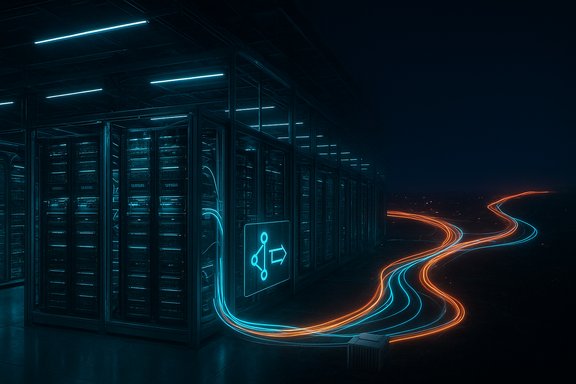
Microsoft’s Fairwater program marks a shift in hyperscale thinking: design buildings not as separate multi-tenant halls but as tightly engineered compute modules that can be federated into one distributed compute fabric. The idea is to run very large, single jobs — large‑model pretraining, fine‑tuning, reinforcement learning loops — across many racks and multiple geographic sites in near real time. The Atlanta Fairwater came online in October and mirrors the architectural choices first revealed at the Wisconsin campus: two‑story halls for higher GPU density, advanced closed‑loop liquid cooling, rack-scale NVIDIA systems, and a dedicated wide‑area AI network designed to minimize cross‑site latency. Microsoft frames Fairwater as an integrated stack: silicon (NVIDIA Blackwell/GB‑class GPUs), rack and building design for density, a specialized internal fabric, storage tuned to feed GPUs at line rate, and a new AI WAN linking sites to operate as a single, virtual supercomputer. This is not just scale by adding boxes — it’s scale by changing the whole topology of how compute, cooling and networking are designed and operated.
Source: Microsoft Source Microsoft AI superfactory
 Background
Microsoft’s Fairwater program marks a shift in hyperscale thinking: design buildings not as separate multi-tenant halls but as tightly engineered compute modules that can be federated into one distributed compute fabric. The idea is to run very large, single jobs — large‑model pretraining, fine‑tuning, reinforcement learning loops — across many racks and multiple geographic sites in near real time. The Atlanta Fairwater came online in October and mirrors the architectural choices first revealed at the Wisconsin campus: two‑story halls for higher GPU density, advanced closed‑loop liquid cooling, rack-scale NVIDIA systems, and a dedicated wide‑area AI network designed to minimize cross‑site latency. Microsoft frames Fairwater as an integrated stack: silicon (NVIDIA Blackwell/GB‑class GPUs), rack and building design for density, a specialized internal fabric, storage tuned to feed GPUs at line rate, and a new AI WAN linking sites to operate as a single, virtual supercomputer. This is not just scale by adding boxes — it’s scale by changing the whole topology of how compute, cooling and networking are designed and operated. What Microsoft built in Atlanta — the technical snapshot
The physical design and density
- A two‑story GPU hall that packs compute vertically to reduce intra‑site latency and increase GPU density. This two‑level approach permits shorter interconnect paths and higher rack counts per square foot, but it requires novel structural and mechanical engineering — heavier floors, reworked cable and coolant routing, and building‑level thermal management.
- Purpose‑built liquid cooling in a closed‑loop configuration that Microsoft says consumes almost zero operational water (only an initial fill and chemistry‑driven make‑up). The system circulates hot liquid out of the building to external heat exchangers and returns chilled fluid, reducing evaporative water loss compared with older evaporative tower systems. Microsoft describes a massive chilled loop with external fan arrays for heat rejection.
The compute building block: rack-scale NVIDIA systems
- Atlanta’s Fairwater uses rack‑scale NVL72-style systems built around NVIDIA’s Blackwell‑class designs (vendors market these as GB‑family systems). That means tightly coupled domains of dozens of GPUs per rack with very high intra‑rack NVLink/NVSwitch bandwidth and pooled fast memory intended to present a rack as a single accelerator. This is the same rack topology Microsoft has used in earlier NVL72 disclosures and in its GB300/GB200 descriptions.
- Microsoft has said these racks can be aggregated into clusters containing thousands of GPUs and that Fairwater clusters will scale to hundreds of thousands of GPUs across multiple sites as the program rolls out. That phrasing is strategic: it describes a long‑term capacity target rather than a snapshot of today’s installed inventory. The practical unit of compute remains the rack as an accelerator.
Networking: a purposeful AI WAN
- The most striking non‑hardware claim is the dedicated AI WAN: Microsoft has built or repurposed fiber to create a congestion‑free backbone to link Fairwater sites. Public statements reference roughly 120,000 miles of dedicated fiber in its network, an increase of more than 25% over the previous year, used to stitch Fairwater sites together and to Azure’s broader global footprint. The company emphasizes both physical fiber and optimized network protocols to reduce bottlenecks and minimize end‑to‑end latency for synchronized training workloads.
- Inside each site, GPUs are connected via very high‑throughput fabrics (InfiniBand/800G‑class interconnects and NVLink inside racks). The software stack — orchestration, RDMA/TCP tuning, and model‑parallel algorithms — is tailored so that GPUs constantly exchange gradients, activations and checkpoints with minimal idle time. Microsoft says the combination keeps GPUs busy rather than waiting on stragglers, a key efficiency gain for large synchronized training jobs.
Why networked sites matter: the AI superfactory concept
Creating one enormous rack farm in a single building still limits you to local constraints: land, power, cooling, and grid impacts. Microsoft’s answer is to federate many such halls into a single logical compute plane.- Distributed training across regions allows additional power and land resources to be leveraged while maintaining a synchronized compute job via the AI WAN. This design spreads risk (a grid outage, for example), increases overall capacity, and permits scale that is physically impossible on a single campus.
- The AI WAN approach recognizes that training a frontier model is fundamentally different from running millions of independent cloud workloads. Training requires repeated all‑reduce and collective operations where every GPU must see and share parameter updates quickly. Bottlenecks anywhere slow the whole job; the WAN’s job is to make remote GPUs behave like local ones as much as physics and economics allow.
- By combining exabytes of storage, millions of CPU cores for orchestration and hundreds of thousands of GPUs in a single fabric, Microsoft is treating the datacenter fleet as a single product offering to customers (OpenAI, Microsoft’s own model teams, and enterprise customers using ND/ML SKUs). The result is a commercialized shared supercomputer — a superfactory — sold as Azure capacity.
The advantages Microsoft claims — and the engineering realities
Strengths and practical benefits
- Throughput and cycle time: Microsoft argues the superfactory model cuts training cycles from months to weeks for large models by eliminating IO and communication bottlenecks and by enabling much larger parallelism. For enterprises and model developers, shorter iteration cycles translate directly to faster productization.
- Rack‑as‑accelerator economics: Treating the rack as the atomic unit of acceleration simplifies scheduling and model placement, improving utilization and reducing the inefficiencies of sharded training across loosely coupled hosts. This is especially valuable for models where activation exchanges happen every training step.
- Co‑engineering with NVIDIA and software tuning: Close hardware–software co‑design (NVIDIA NVLink, InfiniBand fabric, Microsoft’s storage rework) reduces integration risk and improves end‑to‑end throughput for typical AI workloads. Vendors provide rack‑level performance primitives that Microsoft integrates to present validated capacity to customers.
- Resource fungibility across lifecycle: Microsoft positions Fairwater as usable for the entire model lifecycle — pretraining, fine‑tuning, RLHF, evaluation and large‑scale inference — enabling customers to reserve parts of the factory as needed rather than building isolated infrastructure.
Engineering tradeoffs and costs
- Capital and operational intensity: Fairwater‑class builds require multibillion‑dollar up‑front capital, long lead times for racks and chips, and recurrent energy costs for chillers and pumps. Microsoft has signalled very large capex envelopes to underwrite this strategy. The ROI depends on sustained, growing demand for cloud AI compute.
- Complex orchestration: Synchronously training across hundreds of thousands of GPUs demands not just fiber and switches but algorithmic adaptations: communication compression, pipeline parallelism, and clever scheduling to counter speed‑of‑light limits when sites are far apart. These are nontrivial software engineering challenges with real performance ceilings.
- Resource concentration risks: Relying heavily on one accelerator vendor (NVIDIA Blackwell family) and specialized rack topologies concentrates supply‑chain and vendor risks. Any disruption in GPU supply or changes in vendor direction have outsized impact when architectures are tightly coupled to a single hardware family.
Environmental and community considerations
Microsoft emphasizes closed‑loop liquid cooling and reduced operational water use, claiming only the initial fill (equivalent, in one public description, to about what 20 homes consume in a year) with makeup only as chemistry requires. That minimizes evaporative water loss but does not remove the energy cost of chilling and pumps; the net carbon footprint depends on local grid generation and renewable procurement. Microsoft’s public materials and third‑party coverage stress on‑site grid planning and renewable purchases to mitigate local impacts, while also noting that firming capacity (storage or dispatchable generation) may be required to maintain 24/7 availability during peaks. Local economic benefits are real at the construction and high‑skill operations phase: billions in investment, thousands of construction jobs, and several hundred to a few thousand permanent high‑tech roles per campus depending on the scale of operations — but those long‑term headcounts are small relative to the capital committed. Community engagement, co‑innovation labs, and datacenter academies are being used to translate construction dollars into local workforce pipelines.Who gets access and how it fits into Microsoft’s product strategy
Fairwater is not purely an internal research toy. It’s explicitly integrated into Azure and positioned to serve:- OpenAI and other large model partners as priority tenants.
- Microsoft’s own model teams (for Copilot, Bing and internal AI product features).
- Enterprise customers who need frontier training and inference capacity via Azure ND/AI SKUs and managed services.
Risks, open questions and claims that need scrutiny
- Bold performance claims need benchmarks. Microsoft’s marketing sometimes cites orders‑of‑magnitude improvements (e.g., comparisons to the “world’s fastest supercomputer” on selected AI workloads). These statements are workload‑specific and not directly comparable to HPC benchmarks like LINPACK; independent, reproducible benchmarks on representative model training runs are necessary to validate headline claims. Treat throughput comparisons as metric‑dependent.
- Exact GPU counts and timelines can be ambiguous. Public statements range from “more than 4,600” GPUs for early GB300 NVL72 clusters to “hundreds of thousands” of GPUs across Fairwater campuses. The former is a verifiable rack math point for a specific deployment; the latter is a program‑level target. Readers should distinguish between deployed inventory and planned capacity.
- Distributed synchronous training is bounded by physics. Speed‑of‑light latency between geographically dispersed sites imposes hard limits on synchronous training efficiency. Microsoft’s AI WAN reduces practical network bottlenecks but cannot change physics; algorithmic strategies (asynchronous updates, reduced precision, compression) will be necessary to achieve meaningful cross‑region scale. Claims of near‑real‑time cross‑state synchronization should be understood in that context.
- Supply‑chain and vendor concentration create strategic exposure. Relying predominantly on a single GPU family and specialized rack architectures creates execution risk if those product lines encounter shortages, delays or technological shifts. Microsoft’s scale and purchasing power mitigate but do not eliminate that risk.
- Environmental accounting needs independent audits. Closed‑loop liquid cooling reduces operational water evaporation, but full lifecycle analyses (construction, embodied carbon, grid generation mix, firming power) are required for credible sustainability claims. Local concerns about grid impacts, noise and land use will persist even with mitigation steps.
How this changes the competitive landscape
The Fairwater strategy is a clear signal: hyperscalers are moving from incremental capacity growth to specialized, distributed supercomputing fabrics. Competitors are responding in different ways:- Some providers emphasize custom silicon (AWS with Trainium/Inferentia, Google with TPUs) to reduce reliance on general GPU vendors.
- Others are building similar hyper-dense clusters and delivering them as single‑tenant superclusters or managed superPODs.
- A parallel market of dedicated infrastructure providers and partnerships (including deals between hyperscalers and networking vendors) is emerging to lower integration friction for enterprise customers.
Practical takeaways for IT and cloud architects
- For organizations that need frontier training at scale today, the Fairwater model provides a path to access that capacity without the capital and operational complexity of building bespoke facilities.
- For those focused on inference‑heavy workloads or hybrid/edge models, the advantages are more nuanced: latency, data residency, and cost per inference will determine whether centralized Fairwater capacity or distributed inference points make more sense.
- Architectures should be designed for model portability: trainable models should be shippable between GPU types and cloud vendors where possible to avoid excessive lock‑in risk. Prepare for increasing complexity in data governance as datasets scale to petabyte/exabyte levels and are fed into these systems.
Conclusion
Microsoft’s Atlanta Fairwater site — joined to the Wisconsin Fairwater and connected with a dedicated AI WAN — is the clearest public example to date of hyperscale providers reimagining datacenters as networked factories for AI. The engineering decisions are coherent: densify compute, liquid cool efficiently, treat a rack as an accelerator, and stitch sites together with fiber and protocol work so that large training jobs can run more quickly and at a previously impractical scale. Those decisions bring powerful advantages: shortened model iteration cycles, commercialized access to frontier compute, and a productized integration into Microsoft’s software ecosystem. They also bring substantial tradeoffs: heavy capital outlay, supply‑chain concentration, environmental accounting complexity, and algorithmic limits imposed by physics. The superfactory model will matter most where speed to capability and scale are mission‑critical — for large model builders, high‑throughput enterprise AI users, and partners that require guaranteed frontier compute. For everyone else, the new class of datacenter is an important signpost of where cloud economics and product capabilities are headed — and an invitation to scrutinize benchmark claims, governance promises and long‑term sustainability commitments as these superfactories scale.Source: Microsoft Source Microsoft AI superfactory
