

Microsoft is facing renewed pressure over GitHub Copilot in May 2026 as rival AI coding tools including Cursor, Claude Code, and OpenAI Codex reshape developer workflows around autonomous agents rather than autocomplete. That is the factual story; the strategic one is sharper. GitHub gave Microsoft the first credible mass-market AI coding product, but the market has moved from “help me finish this line” to “help me own this task,” and that shift threatens to turn GitHub from the center of developer gravity into plumbing for someone else’s agent.
It is easy, in hindsight, to flatten GitHub Copilot into just another Microsoft-branded assistant. That undersells what Microsoft and GitHub actually achieved. Copilot arrived before ChatGPT made generative AI a household phrase, and it gave developers one of the first widely deployed examples of AI that did something useful inside a real professional workflow.
That timing mattered. Developers are skeptical users, but they are also unusually tolerant of tools that make them faster. Copilot did not need to explain artificial intelligence to the world; it needed to complete code in a way that felt useful often enough to become habit-forming. For a while, that was enough.
The problem is that an early lead in developer tooling is not the same as permanent ownership of the developer workflow. The history of software is full of tools that won the first interface and lost the second. Microsoft knows this better than most companies, because its own developer empire was built on controlling the place where applications were written, shipped, deployed, and monetized.
GitHub Copilot’s early advantage was that it lived beside the code. The new AI coding race is about tools that increasingly want to live around the code, the repository, the issue tracker, the terminal, the pull request, and the deployment pipeline. That is a much more ambitious battlefield.
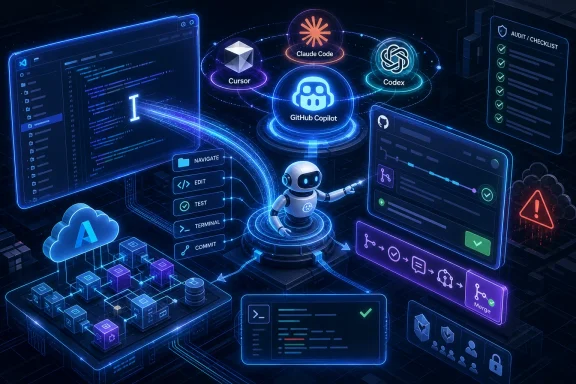
But the most aggressive AI coding products now sell a different promise. Cursor, Claude Code, and Codex-style agents are not merely trying to accelerate keystrokes. They are trying to absorb more of the task itself: inspect a codebase, reason across files, edit several components, run commands, explain failures, and iterate toward a working change.
That is why the competitive anxiety around GitHub is more serious than a normal feature race. If developers move their daily attention into an AI-native editor or command-line agent, GitHub risks becoming the place where the finished artifact is pushed after the real work has happened elsewhere. In software platforms, attention usually precedes control.
Microsoft’s challenge is therefore not just to make Copilot “better.” It has to decide whether Copilot is a feature attached to GitHub, a multi-surface agent across Microsoft’s developer stack, or a new operating layer for software creation. Those are not the same product, and they do not imply the same business model.
The uncomfortable truth is that Copilot’s original success may have made the transition harder. A product with millions of paying users, enterprise contracts, and familiar pricing cannot pivot as casually as a startup tool chasing power users. The incumbent has revenue to protect, reliability expectations to meet, and procurement departments to appease.
That kind of gravity is powerful, but it is not magic. If the AI coding layer becomes the place where developers plan work, modify code, review changes, and coordinate agents, then the repository becomes one component in a larger system. That does not make GitHub irrelevant overnight, but it does change what GitHub must defend.
The reported concern inside Microsoft — that tools like Cursor or Claude Code could displace not only Copilot but eventually weaken GitHub’s repository role — sounds dramatic only if one assumes repositories are immune to workflow shifts. They are not. Developers have changed source control systems before, changed editors before, changed CI/CD systems before, and changed hosting defaults before.
The switching costs are real, especially for enterprises with compliance controls, audit trails, integrations, and institutional memory tied to GitHub. But AI agents create a new kind of switching pressure. If an AI coding environment becomes dramatically more productive when it controls more of the workspace, developers will push organizations to move the center of work toward the agent.
That is where Microsoft’s risk becomes platform-level rather than product-level. GitHub is not just a revenue line. It is an identity system, a social graph, a code corpus, a collaboration surface, and a developer relationship engine. If Microsoft loses the daily developer interface, it loses leverage far beyond Copilot subscriptions.
But the same arrangement now exposes a tension. If GitHub Copilot depends heavily on models from OpenAI and Anthropic, then Microsoft does not fully control the cost curve, the product differentiation, or the pace of specialization. In a market where inference costs can define margins, model dependency becomes a business-model problem.
That is why reported efforts to build stronger Microsoft-controlled coding models make strategic sense. A coding assistant used by millions of developers is not just an application; it is a training loop, a distribution channel, and a cost center. The company that owns the models, the data pipeline, and the interface has more room to tune quality, price, latency, and margin.
There is also a competitive awkwardness in relying on partners that may be building directly adjacent products. OpenAI’s Codex ambitions and Anthropic’s Claude Code momentum make the old division of labor harder to sustain. Microsoft can still benefit from partner models, but it cannot afford to have GitHub Copilot perceived as a wrapper around someone else’s best work.
The classic Microsoft move would be to integrate, bundle, and outlast. But AI coding is moving quickly enough that distribution alone may not be decisive. Developers will tolerate some enterprise friction for a tool that materially improves their output, especially if the alternative feels like an aging assistant with a better procurement story.
This is not unique to GitHub. Every serious AI software company is wrestling with the same mismatch between user expectations formed by SaaS subscriptions and infrastructure costs driven by tokens, context windows, tool calls, and long-running agents. The more useful the agent becomes, the more expensive it may be to serve.
For Microsoft, however, the optics are especially delicate. Copilot’s enterprise pitch has leaned on predictability, integration, and trust. Usage-based pricing introduces a variable-cost anxiety that IT departments have spent years trying to tame in cloud infrastructure. Developers may like autonomy; finance teams like forecasts.
The danger is that price changes arrive just as competitors are arguing that Copilot is no longer the most capable coding environment. If customers feel they are being asked to pay more for a tool that is catching up rather than leading, Microsoft has a messaging problem. If they believe the new pricing reflects a more capable agentic system, the conversation is easier.
The deeper issue is that AI coding may not support the clean per-seat economics that made enterprise software so lucrative. Seats are easy to sell. Agents consume resources unevenly. Heavy users can be both the strongest advocates and the least profitable customers.
That is why reports of customer frustration over outages land differently in the AI era. More traffic from AI tools, more automated repository interactions, and more agent-generated activity all increase the stress on systems originally built around human-paced collaboration. The repository is becoming a machine-to-machine surface as much as a developer-to-developer one.
For enterprises, outages also reframe the AI coding conversation. A CIO may be willing to experiment with multiple AI assistants, but the core code platform is a different matter. If GitHub is both more expensive and less reliable under AI-driven load, alternatives such as GitLab become easier to discuss, even if migration remains painful.
Microsoft can fix reliability problems, and GitHub has engineering depth few rivals can match. But reliability failures during a platform transition have symbolic weight. They suggest that the old system is being asked to carry a new workload before the new architecture is fully ready.
That is the “refitting the plane while flying” problem. Microsoft must improve Copilot, protect GitHub, revise pricing, manage model costs, and preserve enterprise trust at the same time. None of those tasks is optional.
Companies often standardize internal tools for security, cost, and governance reasons, so a shift away from third-party AI coding tools does not automatically mean panic. But timing matters. When a company is trying to prove its own coding agent can compete, forcing internal adoption can look like confidence or like an intervention.
The best version of this strategy is straightforward. Microsoft can use its enormous internal engineering base to stress-test Copilot CLI, generate feedback, improve coding models, and build an agent that handles real-world enterprise code at Microsoft scale. Few companies have that kind of internal laboratory.
The risky version is equally clear. If engineers feel pushed from a more capable tool into a less capable corporate standard, adoption becomes performative. The telemetry may improve, but the culture may sour. Developers are unusually good at detecting when a mandated tool exists to serve a strategy deck rather than their workflow.
This is where Microsoft’s history cuts both ways. The company has repeatedly succeeded by dogfooding its own platforms until they became enterprise-ready. It has also, at times, confused distribution power with product love. In AI coding, developers will notice the difference quickly.
GitHub was supposed to refresh that relationship for a cloud and open-source world that had moved beyond Windows as the default center of gravity. The 2018 acquisition was not just a purchase of repositories; it was a purchase of relevance. Microsoft bought its way back into the daily life of developers who might otherwise have associated the company with legacy enterprise software.
Copilot extended that bet. If GitHub was the place developers stored and collaborated on code, Copilot could become the assistant that helped write it. Together, they formed a credible answer to the question of how Microsoft would remain central in a world where the operating system mattered less than the development workflow.
Now the question is whether Microsoft can keep that centrality as AI agents abstract away more of the mechanics. If an agent can navigate a codebase, open files, create branches, write tests, and submit changes, the developer’s loyalty may shift from the repository host to the agent that understands the work. That is a profound change.
WindowsForum readers will recognize the pattern. Platform control often moves upward. The kernel gives way to the runtime, the runtime to the browser, the browser to the cloud service, and now perhaps the cloud service to the agent. Microsoft does not need to lose GitHub for GitHub to become less strategically commanding.
Microsoft 365 Copilot has real traction by enterprise software standards. Paid seats in the tens of millions are not trivial, and the revenue implied by those seats is meaningful even for a company of Microsoft’s size. But the adoption debate is not only about seat counts. It is about whether users experience Copilot as the natural interface for work or as another pane bolted onto Office.
The GitHub comparison is useful because developers are often early indicators of broader computing shifts. If developers prefer autonomous coding agents over integrated assistants, knowledge workers may follow a similar path in their own tools. They may not care whether the agent is “inside” Word or Excel if a more capable assistant can operate across the workflow from outside.
Microsoft’s advantage is distribution. Its disadvantage is that distribution can mask weak engagement until a better interface appears. The company has to make Copilot feel inevitable without making it feel imposed.
That tension explains why investors are watching the AI application layer so closely. Cloud AI revenue is impressive, but infrastructure margins and application margins are not the same. If AI mostly drives Azure consumption for others while eroding the pricing power of Microsoft’s own apps, the market will eventually distinguish between gross AI momentum and durable software profit.
Cursor’s rise matters because it made the editor itself feel like the AI-native surface. Claude Code matters because it pushed the terminal agent into the mainstream developer conversation. Codex matters because OpenAI can connect coding agents to a broader ecosystem of models, chat interfaces, and developer APIs.
These products are not identical, and their relative strengths will shift. But collectively they have changed user expectations. The baseline is no longer “Can the assistant suggest a decent next line?” It is “Can the agent understand enough of my project to move the work forward?”
That expectation is both thrilling and dangerous. AI agents can produce impressive progress and subtle errors. They can accelerate development and multiply review burden. They can make senior engineers faster and junior engineers overconfident. The winner in this market will not simply be the product that writes the most code; it will be the product that fits into professional accountability.
That should be GitHub’s home turf. Pull requests, code review, security scanning, issue tracking, and repository permissions are exactly the places where AI-generated work needs governance. Microsoft’s opportunity is to make GitHub the system of record for agentic development, not merely the place where agentic output lands.
Microsoft’s enterprise credibility still matters here. Many organizations will prefer a tool integrated with Entra ID, GitHub Enterprise, Microsoft Defender, Azure, and existing compliance workflows. Procurement departments do not love chaos, and Microsoft is very good at selling reduced chaos.
But enterprise standardization only works if the standardized tool is good enough. If developers believe a rival agent is materially better, shadow AI usage will grow. The history of enterprise IT is the history of users routing around official tools when the productivity gap becomes too large.
That creates a narrow path for Microsoft. It must make Copilot competitive for developers while making it governable for enterprises. Too much control, and developers drift. Too little control, and CISOs push back.
The winning product may not be the most magical demo. It may be the assistant that produces auditable changes, respects repository policy, integrates with review workflows, and gives organizations confidence that AI-generated code is not bypassing the controls humans spent years building. GitHub has the ingredients for that product, but ingredients are not execution.
Traditional developer tools scale beautifully when software is downloaded, licensed, or hosted with predictable workloads. AI agents are different. A developer who asks an agent to grind through a large codebase, run tests, inspect logs, and revise multiple times is consuming significant compute. At scale, enthusiasm becomes a bill.
That reality explains why usage-based pricing keeps surfacing across the sector. It also explains why companies want their own models. Owning the model stack can reduce dependency costs, enable specialization, and make the product roadmap less hostage to external pricing.
But pricing sophistication can collide with user psychology. Developers like powerful tools, but they dislike meters that make them hesitate mid-flow. The ideal coding assistant feels abundant. The infrastructure behind it is anything but.
Microsoft has to square that circle in front of customers that are already trained by Azure to fear surprise bills. If Copilot becomes more agentic and more metered at the same time, the administrative experience will matter almost as much as the coding experience.
The question is whether those assets reinforce one another or become a maze of overlapping Copilots. Developers do not want an org chart. They want a tool that follows the work. If Copilot means one thing in GitHub, another in VS Code, another in the terminal, another in Azure, and another in Office, Microsoft risks diluting a brand it has spent billions pushing.
A coherent Microsoft answer would make the developer workflow feel continuous. The agent would understand local code, repository history, issues, pull requests, CI failures, security alerts, cloud deployment targets, and documentation. It would know when to suggest, when to act, when to ask, and when to stop.
That is hard, but it is exactly the kind of hard problem an incumbent platform company should be able to solve. Microsoft does not need to mimic every startup interface. It needs to integrate the parts of software development that startups cannot easily own end to end.
The danger is that integration becomes an excuse for slower product feel. Developers will forgive rough edges in a tool that feels powerful. They are less forgiving of a polished tool that feels behind.
A loop starts with intent, gathers context, changes code, validates the change, reports what happened, and hands control back to the developer. The company that owns that loop gets the data, the habit, the trust, and eventually the monetization. GitHub Copilot owned part of the old loop. Rivals are fighting to own more of the new one.
For Microsoft, the repository is both an advantage and a constraint. GitHub has the collaboration context that agents need, but developer work often begins in the editor or terminal. If Microsoft cannot make Copilot feel native at the moment of intent, GitHub’s downstream context may not be enough.
This is why Copilot CLI and deeper agent features matter. They are not add-ons; they are attempts to move Copilot closer to where the new loop begins. The company cannot defend a developer platform from the pull request page alone.
The strategic endpoint is obvious. AI coding tools will not remain separate assistants forever. They will become orchestration layers for software work, with permissions, budgets, model choices, review gates, and deployment hooks. Whoever defines that layer will shape how software teams operate for the next decade.
The practical question is not which assistant has the loudest momentum. It is which assistant fits your codebase, risk model, budget, and review culture. A solo developer can optimize for speed. A regulated enterprise must optimize for traceability. An open-source maintainer may care most about community workflow and cost.
Microsoft’s position remains strong, but no longer unchallenged. That is the important distinction. GitHub is not collapsing, Copilot is not irrelevant, and Microsoft is not suddenly a bystander. But the assumption that GitHub’s repository dominance automatically guarantees AI coding dominance now looks too comfortable.
The AI code wars are entering the phase where product quality, infrastructure cost, and platform governance collide. Microsoft has advantages in all three areas, but it also has exposure in all three. That makes the next year unusually consequential.
 GitHub’s Lead Was Real, and That Is Why the Slippage Matters
It is easy, in hindsight, to flatten GitHub Copilot into just another Microsoft-branded assistant. That undersells what Microsoft and GitHub actually achieved. Copilot arrived before ChatGPT made generative AI a household phrase, and it gave developers one of the first widely deployed examples of AI that did something useful inside a real professional workflow.That timing mattered. Developers are skeptical users, but they are also unusually tolerant of tools that make them faster. Copilot did not need to explain artificial intelligence to the world; it needed to complete code in a way that felt useful often enough to become habit-forming. For a while, that was enough.
The problem is that an early lead in developer tooling is not the same as permanent ownership of the developer workflow. The history of software is full of tools that won the first interface and lost the second. Microsoft knows this better than most companies, because its own developer empire was built on controlling the place where applications were written, shipped, deployed, and monetized.
GitHub Copilot’s early advantage was that it lived beside the code. The new AI coding race is about tools that increasingly want to live around the code, the repository, the issue tracker, the terminal, the pull request, and the deployment pipeline. That is a much more ambitious battlefield.
Autocomplete Was the Opening Move, Not the Endgame
The first Copilot era was defined by inline suggestions. It helped finish functions, draft boilerplate, translate intent into syntax, and reduce the small frictions that accumulate across a working day. That model was valuable because it respected the shape of software work as developers already understood it.But the most aggressive AI coding products now sell a different promise. Cursor, Claude Code, and Codex-style agents are not merely trying to accelerate keystrokes. They are trying to absorb more of the task itself: inspect a codebase, reason across files, edit several components, run commands, explain failures, and iterate toward a working change.
That is why the competitive anxiety around GitHub is more serious than a normal feature race. If developers move their daily attention into an AI-native editor or command-line agent, GitHub risks becoming the place where the finished artifact is pushed after the real work has happened elsewhere. In software platforms, attention usually precedes control.
Microsoft’s challenge is therefore not just to make Copilot “better.” It has to decide whether Copilot is a feature attached to GitHub, a multi-surface agent across Microsoft’s developer stack, or a new operating layer for software creation. Those are not the same product, and they do not imply the same business model.
The uncomfortable truth is that Copilot’s original success may have made the transition harder. A product with millions of paying users, enterprise contracts, and familiar pricing cannot pivot as casually as a startup tool chasing power users. The incumbent has revenue to protect, reliability expectations to meet, and procurement departments to appease.
The Repository Is No Longer Untouchable
GitHub’s core advantage has always been network gravity. Developers put code there because other developers put code there. Employers standardized on it because candidates already knew it. Open source projects gathered there because the defaults of modern software collaboration gathered there first.That kind of gravity is powerful, but it is not magic. If the AI coding layer becomes the place where developers plan work, modify code, review changes, and coordinate agents, then the repository becomes one component in a larger system. That does not make GitHub irrelevant overnight, but it does change what GitHub must defend.
The reported concern inside Microsoft — that tools like Cursor or Claude Code could displace not only Copilot but eventually weaken GitHub’s repository role — sounds dramatic only if one assumes repositories are immune to workflow shifts. They are not. Developers have changed source control systems before, changed editors before, changed CI/CD systems before, and changed hosting defaults before.
The switching costs are real, especially for enterprises with compliance controls, audit trails, integrations, and institutional memory tied to GitHub. But AI agents create a new kind of switching pressure. If an AI coding environment becomes dramatically more productive when it controls more of the workspace, developers will push organizations to move the center of work toward the agent.
That is where Microsoft’s risk becomes platform-level rather than product-level. GitHub is not just a revenue line. It is an identity system, a social graph, a code corpus, a collaboration surface, and a developer relationship engine. If Microsoft loses the daily developer interface, it loses leverage far beyond Copilot subscriptions.
Microsoft’s OpenAI Advantage Is Becoming a Dependency Problem
Microsoft’s OpenAI partnership was one of the defining strategic moves of the current AI cycle. It gave Microsoft access to frontier models, turned Azure into the infrastructure backbone for a generational AI company, and helped Microsoft move faster than nearly every other incumbent software vendor. GitHub Copilot was one of the clearest early proofs that the partnership could become product.But the same arrangement now exposes a tension. If GitHub Copilot depends heavily on models from OpenAI and Anthropic, then Microsoft does not fully control the cost curve, the product differentiation, or the pace of specialization. In a market where inference costs can define margins, model dependency becomes a business-model problem.
That is why reported efforts to build stronger Microsoft-controlled coding models make strategic sense. A coding assistant used by millions of developers is not just an application; it is a training loop, a distribution channel, and a cost center. The company that owns the models, the data pipeline, and the interface has more room to tune quality, price, latency, and margin.
There is also a competitive awkwardness in relying on partners that may be building directly adjacent products. OpenAI’s Codex ambitions and Anthropic’s Claude Code momentum make the old division of labor harder to sustain. Microsoft can still benefit from partner models, but it cannot afford to have GitHub Copilot perceived as a wrapper around someone else’s best work.
The classic Microsoft move would be to integrate, bundle, and outlast. But AI coding is moving quickly enough that distribution alone may not be decisive. Developers will tolerate some enterprise friction for a tool that materially improves their output, especially if the alternative feels like an aging assistant with a better procurement story.
Usage-Based Pricing Is the Moment the Subsidy Gets a Bill
The move toward usage-based Copilot pricing is not merely a billing update. It is an admission that the economics of AI coding have changed. A lightweight autocomplete suggestion and a multi-step agentic coding session do not cost the same thing, and a flat subscription model becomes strained when power users discover how much work they can push through the machine.This is not unique to GitHub. Every serious AI software company is wrestling with the same mismatch between user expectations formed by SaaS subscriptions and infrastructure costs driven by tokens, context windows, tool calls, and long-running agents. The more useful the agent becomes, the more expensive it may be to serve.
For Microsoft, however, the optics are especially delicate. Copilot’s enterprise pitch has leaned on predictability, integration, and trust. Usage-based pricing introduces a variable-cost anxiety that IT departments have spent years trying to tame in cloud infrastructure. Developers may like autonomy; finance teams like forecasts.
The danger is that price changes arrive just as competitors are arguing that Copilot is no longer the most capable coding environment. If customers feel they are being asked to pay more for a tool that is catching up rather than leading, Microsoft has a messaging problem. If they believe the new pricing reflects a more capable agentic system, the conversation is easier.
The deeper issue is that AI coding may not support the clean per-seat economics that made enterprise software so lucrative. Seats are easy to sell. Agents consume resources unevenly. Heavy users can be both the strongest advocates and the least profitable customers.
Outages Turn Platform Anxiety Into Procurement Risk
GitHub’s reliability matters because it sits inside the bloodstream of modern software development. When GitHub stumbles, development teams do not merely lose access to a website. They lose coordination, deployment flow, issue context, dependency visibility, and sometimes the ability to move production work forward.That is why reports of customer frustration over outages land differently in the AI era. More traffic from AI tools, more automated repository interactions, and more agent-generated activity all increase the stress on systems originally built around human-paced collaboration. The repository is becoming a machine-to-machine surface as much as a developer-to-developer one.
For enterprises, outages also reframe the AI coding conversation. A CIO may be willing to experiment with multiple AI assistants, but the core code platform is a different matter. If GitHub is both more expensive and less reliable under AI-driven load, alternatives such as GitLab become easier to discuss, even if migration remains painful.
Microsoft can fix reliability problems, and GitHub has engineering depth few rivals can match. But reliability failures during a platform transition have symbolic weight. They suggest that the old system is being asked to carry a new workload before the new architecture is fully ready.
That is the “refitting the plane while flying” problem. Microsoft must improve Copilot, protect GitHub, revise pricing, manage model costs, and preserve enterprise trust at the same time. None of those tasks is optional.
The Internal Claude Code Shift Says the Quiet Part Out Loud
The reported move to steer Microsoft engineers away from Claude Code and toward GitHub Copilot CLI is telling because internal tool choices are rarely just symbolic. Microsoft’s own developers are among the most important proving grounds for its coding tools. If they prefer a rival’s agent for day-to-day work, that is not a branding issue; it is product evidence.Companies often standardize internal tools for security, cost, and governance reasons, so a shift away from third-party AI coding tools does not automatically mean panic. But timing matters. When a company is trying to prove its own coding agent can compete, forcing internal adoption can look like confidence or like an intervention.
The best version of this strategy is straightforward. Microsoft can use its enormous internal engineering base to stress-test Copilot CLI, generate feedback, improve coding models, and build an agent that handles real-world enterprise code at Microsoft scale. Few companies have that kind of internal laboratory.
The risky version is equally clear. If engineers feel pushed from a more capable tool into a less capable corporate standard, adoption becomes performative. The telemetry may improve, but the culture may sour. Developers are unusually good at detecting when a mandated tool exists to serve a strategy deck rather than their workflow.
This is where Microsoft’s history cuts both ways. The company has repeatedly succeeded by dogfooding its own platforms until they became enterprise-ready. It has also, at times, confused distribution power with product love. In AI coding, developers will notice the difference quickly.
The Ballmer Chant Still Explains the Stakes
“Developers, developers, developers” became a meme because it was loud, repetitive, and impossible to forget. But underneath the theatrics was a serious strategic truth. Microsoft’s power came from making developers believe that building for its platforms was the rational path to users, revenue, and career leverage.GitHub was supposed to refresh that relationship for a cloud and open-source world that had moved beyond Windows as the default center of gravity. The 2018 acquisition was not just a purchase of repositories; it was a purchase of relevance. Microsoft bought its way back into the daily life of developers who might otherwise have associated the company with legacy enterprise software.
Copilot extended that bet. If GitHub was the place developers stored and collaborated on code, Copilot could become the assistant that helped write it. Together, they formed a credible answer to the question of how Microsoft would remain central in a world where the operating system mattered less than the development workflow.
Now the question is whether Microsoft can keep that centrality as AI agents abstract away more of the mechanics. If an agent can navigate a codebase, open files, create branches, write tests, and submit changes, the developer’s loyalty may shift from the repository host to the agent that understands the work. That is a profound change.
WindowsForum readers will recognize the pattern. Platform control often moves upward. The kernel gives way to the runtime, the runtime to the browser, the browser to the cloud service, and now perhaps the cloud service to the agent. Microsoft does not need to lose GitHub for GitHub to become less strategically commanding.
Office Copilot Is the Same War in Different Clothes
The GitHub fight also previews Microsoft’s broader Copilot challenge. The company is trying to defend its most valuable productivity surfaces at the same time that frontier AI labs are building agents that can operate across documents, spreadsheets, email, browsers, and collaboration tools. That puts Microsoft in the strange position of being both an AI infrastructure winner and an application incumbent under attack.Microsoft 365 Copilot has real traction by enterprise software standards. Paid seats in the tens of millions are not trivial, and the revenue implied by those seats is meaningful even for a company of Microsoft’s size. But the adoption debate is not only about seat counts. It is about whether users experience Copilot as the natural interface for work or as another pane bolted onto Office.
The GitHub comparison is useful because developers are often early indicators of broader computing shifts. If developers prefer autonomous coding agents over integrated assistants, knowledge workers may follow a similar path in their own tools. They may not care whether the agent is “inside” Word or Excel if a more capable assistant can operate across the workflow from outside.
Microsoft’s advantage is distribution. Its disadvantage is that distribution can mask weak engagement until a better interface appears. The company has to make Copilot feel inevitable without making it feel imposed.
That tension explains why investors are watching the AI application layer so closely. Cloud AI revenue is impressive, but infrastructure margins and application margins are not the same. If AI mostly drives Azure consumption for others while eroding the pricing power of Microsoft’s own apps, the market will eventually distinguish between gross AI momentum and durable software profit.
Cursor and Claude Code Are Selling Momentum, Not Just Features
Startups and AI labs have one advantage incumbents struggle to manufacture: momentum that feels like discovery. Developers try a tool, share clips, post workflows, complain about pricing, switch editors, and argue about model quality in public. That chaotic conversation can move faster than enterprise roadmap cycles.Cursor’s rise matters because it made the editor itself feel like the AI-native surface. Claude Code matters because it pushed the terminal agent into the mainstream developer conversation. Codex matters because OpenAI can connect coding agents to a broader ecosystem of models, chat interfaces, and developer APIs.
These products are not identical, and their relative strengths will shift. But collectively they have changed user expectations. The baseline is no longer “Can the assistant suggest a decent next line?” It is “Can the agent understand enough of my project to move the work forward?”
That expectation is both thrilling and dangerous. AI agents can produce impressive progress and subtle errors. They can accelerate development and multiply review burden. They can make senior engineers faster and junior engineers overconfident. The winner in this market will not simply be the product that writes the most code; it will be the product that fits into professional accountability.
That should be GitHub’s home turf. Pull requests, code review, security scanning, issue tracking, and repository permissions are exactly the places where AI-generated work needs governance. Microsoft’s opportunity is to make GitHub the system of record for agentic development, not merely the place where agentic output lands.
Enterprise IT Will Choose the Least Unmanageable Revolution
For sysadmins and IT leaders, the AI coding race is not a fandom contest. It is a governance problem wrapped in a productivity promise. Every AI coding assistant raises questions about source-code exposure, model training, auditability, license compliance, secrets handling, and developer accountability.Microsoft’s enterprise credibility still matters here. Many organizations will prefer a tool integrated with Entra ID, GitHub Enterprise, Microsoft Defender, Azure, and existing compliance workflows. Procurement departments do not love chaos, and Microsoft is very good at selling reduced chaos.
But enterprise standardization only works if the standardized tool is good enough. If developers believe a rival agent is materially better, shadow AI usage will grow. The history of enterprise IT is the history of users routing around official tools when the productivity gap becomes too large.
That creates a narrow path for Microsoft. It must make Copilot competitive for developers while making it governable for enterprises. Too much control, and developers drift. Too little control, and CISOs push back.
The winning product may not be the most magical demo. It may be the assistant that produces auditable changes, respects repository policy, integrates with review workflows, and gives organizations confidence that AI-generated code is not bypassing the controls humans spent years building. GitHub has the ingredients for that product, but ingredients are not execution.
The Economics of AI Coding Are Still Unsettled
The AI coding market is described as white hot for a reason. Developers are willing to pay, enterprises are experimenting aggressively, and the productivity claims are large enough to command executive attention. But the business model remains unsettled because the cost of serving the product rises with the intensity of use.Traditional developer tools scale beautifully when software is downloaded, licensed, or hosted with predictable workloads. AI agents are different. A developer who asks an agent to grind through a large codebase, run tests, inspect logs, and revise multiple times is consuming significant compute. At scale, enthusiasm becomes a bill.
That reality explains why usage-based pricing keeps surfacing across the sector. It also explains why companies want their own models. Owning the model stack can reduce dependency costs, enable specialization, and make the product roadmap less hostage to external pricing.
But pricing sophistication can collide with user psychology. Developers like powerful tools, but they dislike meters that make them hesitate mid-flow. The ideal coding assistant feels abundant. The infrastructure behind it is anything but.
Microsoft has to square that circle in front of customers that are already trained by Azure to fear surprise bills. If Copilot becomes more agentic and more metered at the same time, the administrative experience will matter almost as much as the coding experience.
Microsoft’s Real Advantage Is the Whole Stack, If It Can Make the Stack Feel Coherent
Microsoft still has formidable strengths. It owns GitHub, Visual Studio Code, Visual Studio, Azure, Windows, Microsoft 365, TypeScript stewardship, enterprise identity relationships, security products, and one of the largest internal engineering organizations in the world. No AI coding startup can casually replicate that footprint.The question is whether those assets reinforce one another or become a maze of overlapping Copilots. Developers do not want an org chart. They want a tool that follows the work. If Copilot means one thing in GitHub, another in VS Code, another in the terminal, another in Azure, and another in Office, Microsoft risks diluting a brand it has spent billions pushing.
A coherent Microsoft answer would make the developer workflow feel continuous. The agent would understand local code, repository history, issues, pull requests, CI failures, security alerts, cloud deployment targets, and documentation. It would know when to suggest, when to act, when to ask, and when to stop.
That is hard, but it is exactly the kind of hard problem an incumbent platform company should be able to solve. Microsoft does not need to mimic every startup interface. It needs to integrate the parts of software development that startups cannot easily own end to end.
The danger is that integration becomes an excuse for slower product feel. Developers will forgive rough edges in a tool that feels powerful. They are less forgiving of a polished tool that feels behind.
The Fight Is Now About Who Owns the Agentic Development Loop
The phrase agentic coding can sound like marketing fog, but the underlying shift is concrete. The assistant is moving from suggestion to action. That means the competitive unit is no longer a completion; it is a loop.A loop starts with intent, gathers context, changes code, validates the change, reports what happened, and hands control back to the developer. The company that owns that loop gets the data, the habit, the trust, and eventually the monetization. GitHub Copilot owned part of the old loop. Rivals are fighting to own more of the new one.
For Microsoft, the repository is both an advantage and a constraint. GitHub has the collaboration context that agents need, but developer work often begins in the editor or terminal. If Microsoft cannot make Copilot feel native at the moment of intent, GitHub’s downstream context may not be enough.
This is why Copilot CLI and deeper agent features matter. They are not add-ons; they are attempts to move Copilot closer to where the new loop begins. The company cannot defend a developer platform from the pull request page alone.
The strategic endpoint is obvious. AI coding tools will not remain separate assistants forever. They will become orchestration layers for software work, with permissions, budgets, model choices, review gates, and deployment hooks. Whoever defines that layer will shape how software teams operate for the next decade.
The Lesson for WindowsForum Readers Is Not to Bet on Brand Names Alone
For enthusiasts, developers, and administrators, the immediate temptation is to pick a champion: Microsoft, Anthropic, OpenAI, Cursor, GitLab, or whichever tool feels most impressive this month. That is understandable, but the market is too fluid for brand loyalty to substitute for evaluation.The practical question is not which assistant has the loudest momentum. It is which assistant fits your codebase, risk model, budget, and review culture. A solo developer can optimize for speed. A regulated enterprise must optimize for traceability. An open-source maintainer may care most about community workflow and cost.
Microsoft’s position remains strong, but no longer unchallenged. That is the important distinction. GitHub is not collapsing, Copilot is not irrelevant, and Microsoft is not suddenly a bystander. But the assumption that GitHub’s repository dominance automatically guarantees AI coding dominance now looks too comfortable.
The AI code wars are entering the phase where product quality, infrastructure cost, and platform governance collide. Microsoft has advantages in all three areas, but it also has exposure in all three. That makes the next year unusually consequential.
The Developer Platform Microsoft Bought Is Now the Platform It Must Defend
The clearest reading of the moment is that Microsoft’s GitHub bet was right, but the job has become harder than expected.- GitHub Copilot’s early lead was meaningful, but the market has moved from autocomplete toward agents that can plan, edit, run, and revise across a codebase.
- Cursor, Claude Code, and Codex are dangerous because they compete for the developer’s daily workflow, not merely for a feature checkbox.
- Usage-based Copilot pricing reflects real AI infrastructure costs, but it also risks making customers more sensitive to whether Copilot still feels best in class.
- GitHub reliability has become strategically important because AI tools increase traffic and make the repository more central to automated workflows.
- Microsoft’s push toward its own coding models is a logical attempt to improve margins, differentiation, and control over the product roadmap.
- Enterprise buyers will reward governance and integration, but developers will keep pressure on Microsoft if rival tools remain visibly more capable.
References
- Primary source: AI: Reset to Zero
Published: 2026-05-25T05:03:07.930152
AI: Microsoft slipping in AI Coding with Github Copilot. AI-RTZ #1097
...a gap in the white hot AI coding segment of enterprise AI marketmichaelparekh.substack.com - Related coverage: windowscentral.com
Microsoft admits forcing the floating Copilot button on Office users was a mistake—but engagement went up anyway | Windows Central
After a wave of user backlash over "intrusive" design, Microsoft is rolling out a fix that allows Word and Excel users to move the AI assistant back to the ribbon.www.windowscentral.com - Related coverage: techcrunch.com
Microsoft says it has over 20M paid Copilot users, and they really are using it | TechCrunch
Despite the lingering perception that no one really uses Copilot, Microsoft said on Wednesday that the number of users and engagement is growing.techcrunch.com - Related coverage: theinformation.com
Microsoft Executives Sound the Alarm Over GitHub’s Eroding AI Lead — The Information
No part of Microsoft better illustrates its predicament in AI than GitHub. The AI boom has boosted usage and revenue of the code repository as well as GitHub Copilot, an AI coding assistant. But GitHub has struggled to respond to new AI coding competitors that have since overtaken it. And the ...www.theinformation.com - Official source: docs.github.com
GitHub Copilot licenses - GitHub Docs
Learn how licenses for Copilot work, including usage measurement and managing your budget. docs.github.com
- Related coverage: kodiq.ai
KODiQ News — vibe coding & AI tools
Breakdowns, guides and fresh news on building apps with words — from the team behind the KODiQ learning app.kodiq.ai
- Related coverage: theplanettools.ai
Microsoft Copilot: 20M Paid Seats, $37B AI ARR (Q3 FY26) | ThePlanetTools.ai
Microsoft Q3 FY26: 20M paid Copilot seats, $37B AI ARR up 123%, Accenture at 740K seats. Why enterprise AI just crossed from pilot to default deployment.theplanettools.ai - Related coverage: techsifted.com
GitHub Copilot Pricing 2026: Pro Tier Paused — What You Need to Know | TechSifted
Microsoft has paused new GitHub Copilot Pro, Pro+, and Student signups and removed Opus models from the Pro tier. Here is what each plan costs now and which tier actually makes sense. techsifted.com
- Related coverage: awesomeagents.ai
Microsoft AI Revenue Hits $37B as Copilot Tops 20M Seats | Awesome Agents
Microsoft's Q3 FY2026 earnings show its AI business running at $37 billion annually - up 123 percent - while Copilot enterprise seats hit 20 million, demolishing the low-adoption narrative.awesomeagents.ai - Related coverage: perplexityaimagazine.com
Microsoft AI Revenue $37 Billion ARR Copilot 20M Seats M365 E7 2026
Microsoft AI Revenue hits $37 billion ARR growing 123% with 20 million Copilot 2026 — the M365 E7 Frontier Suite at $99 changes economics.perplexityaimagazine.com - Related coverage: github.blog
GitHub Copilot is moving to usage-based billing - The GitHub Blog
Starting June 1, your Copilot usage will consume GitHub AI Credits.github.blog
- Related coverage: advancedai.com
Microsoft Drops Claude Code. Who Chooses Your AI Tools? | Advanced AI
Microsoft canceled internal Claude Code licenses with a June 30 deadline, routing engineers to GitHub Copilot CLI — while PwC simultaneously went all-in on Claude. The AI coding tool you rely on may not be yours to keep. www.advancedai.com
- Related coverage: bighatgroup.com
Copilot Weekly: Usage-Based Billing Lands June 1, 2026 | Big Hat Group Inc.
GitHub Copilot moves to usage-based billing on June 1 with AI Credits replacing premium request units. Plus GPT-5.5 GA, BYOK in VS Code, Visual Studio 18.5 Debugger Agent, faster cloud agent, and a 30× capacity plan.www.bighatgroup.com - Related coverage: techradar.com
Microsoft may discontinue Claude Code internally as it looks to push users towards GitHub Copilot | TechRadar
Microsoft wants developers to use GitHub, not Claudewww.techradar.com - Related coverage: itpro.com
Everything you need to know about the GitHub Copilot pricing changes | IT Pro
GitHub Copilot pricing changes mean users will be charged based on consumption, rather than a set number of credits.www.itpro.com - Related coverage: tomshardware.com
OpenAI building GitHub alternative after frequent platform outages and disruptions — a public OpenAI code repository would directly compete with one of its biggest investors | Tom's Hardware
The project could eventually be sold to customers and would put OpenAI in direct competition with one of its biggest investors.www.tomshardware.com
