
Microsoft and Google have unveiled continent‑shaping investments — Microsoft committing roughly $10 billion (about €8.6 billion) to build an AI and cloud hub at Start Campus in Sines, Portugal, while Google has pledged about €5.5 billion for German infrastructure, new data centres and office expansion through 2029.
The announcements arrive at a moment of intense competition among hyperscalers to secure local compute capacity for large language models (LLMs), generative AI training and enterprise AI workloads across the European Union. Both packages pair hyper‑scale hardware plans with commitments to local renewable energy, heat‑recovery initiatives and workforce development — moves intended to reassure regulators and customers that sensitive data and compute will remain geographically and legally proximate. These investments are not isolated PR stunts: they reflect a strategic pivot by cloud providers to balance scale with sovereignty, responding to the EU’s tightening regulatory environment (notably the AI Act and the Data Act) and the escalating demand from European enterprises for low‑latency, compliant AI services. The scale of capital and hardware committed also underscores how critical access to cutting‑edge accelerators — principally NVIDIA GPUs — has become to cloud competitiveness.
If European policymakers wish to retain authentic long‑term sovereignty, the private investments must be balanced with industrial policy that supports diverse hardware suppliers, regional cloud alternatives, open‑stack research and local skills development. Absent that balance, Europe’s compute capacity may be ample but still skewed toward a small set of external firms controlling the hardware and software ecosystems.
For European enterprises and policymakers, the opportunities are real: greater local access to training‑scale compute, new supplier ecosystems and sizable economic activity. The risks are also clear: dependence on a narrow set of vendors, contested local politics (as Sines demonstrates), and the heavy engineering task of integrating AI megaclusters with real‑world grids and communities.
What matters next is execution: whether ships of capital become functioning, responsibly governed, and resilient compute nodes that serve both European digital ambitions and local communities — or whether they remain impressive announcements that face delay, legal friction and disappointing local outcomes. The coming 12–36 months, as GPU deployments begin and district‑heating and energy contracts are tested in practice, will tell that story.
Source: Mobile Europe Microsoft pledges €8.6bn on AI hub in Portugal and Google €5.5bn in Germany - Mobile Europe
 Background
The announcements arrive at a moment of intense competition among hyperscalers to secure local compute capacity for large language models (LLMs), generative AI training and enterprise AI workloads across the European Union. Both packages pair hyper‑scale hardware plans with commitments to local renewable energy, heat‑recovery initiatives and workforce development — moves intended to reassure regulators and customers that sensitive data and compute will remain geographically and legally proximate. These investments are not isolated PR stunts: they reflect a strategic pivot by cloud providers to balance scale with sovereignty, responding to the EU’s tightening regulatory environment (notably the AI Act and the Data Act) and the escalating demand from European enterprises for low‑latency, compliant AI services. The scale of capital and hardware committed also underscores how critical access to cutting‑edge accelerators — principally NVIDIA GPUs — has become to cloud competitiveness. Microsoft in Sines: what the pledge actually is
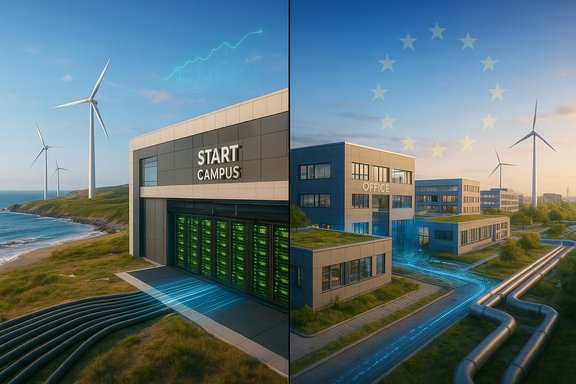
Microsoft’s stated commitment is to invest approximately $10 billion in a new AI and cloud hub at Sines, located on Portugal’s Atlantic coast. The project will anchor Microsoft Azure’s regional compute and AI capacity and has been announced in collaboration with Start Campus, the AI infrastructure company Nscale, and NVIDIA as the key silicon partner. Microsoft has framed the Sines hub as a node for LLM training, fine‑tuning and enterprise AI workloads. Key details announced or corroborated in public statements:- The Sines site is intended to host more than 12,000 next‑generation NVIDIA GB300‑class GPUs, with initial deployments slated to begin in early 2026.
- The investment is described as part of a broader Start Campus development that, in public filings and prior announcements, targets a multi‑building campus powered by renewable energy and sited adjacent to subsea cable landings.
Why Sines?
Sines offers several logistical advantages that explain the choice beyond headline numbers:- Subsea cable landings that link Europe to the Atlantic, Africa and the Americas, reducing latency for some intercontinental workloads.
- Large parcels of industrial land and proximity to port infrastructure that simplify both construction and heavy equipment logistics.
- Planned access to significant renewable power and potential grid stability mechanisms that are attractive to hyperscalers trying to meet ambitious carbon‑free targets.
Google in Germany: the €5.5bn roadmap
Google’s package covers 2026–2029 and combines new data‑centre construction (Dietzenbach near Frankfurt), expansion at the Hanau campus, and large office build‑outs and upgrades in Berlin, Frankfurt and Munich. The company says the plan will add approximately €1 billion per year to German GDP and support roughly 9,000 jobs annually as an economic multiplier — figures Google presented at its announcement. Highlights:- New data centre in Dietzenbach to strengthen Google Cloud regions serving Germany.
- Expansion of the Hanau campus and investments in local office real estate, including converting historic urban buildings into development hubs.
- Environmental measures including an expanded 24/7 carbon‑free energy partnership with Engie and the launch of a heat‑recovery system to feed district heating networks (the Dietzenbach facility is expected to warm thousands of homes via recovered waste heat).
The technical reality: GPUs, regions and sovereign AI
At the core of both moves is the same technical equation: large models require large clusters of high‑end accelerators, and hyperscalers compete on both quantity of GPUs and the sovereign packaging of compute.- GPU scale matters. The Sines announcements center on tens of thousands of NVIDIA GB300‑class GPUs — a class of accelerator designed for high‑throughput training of LLMs. Nscale has publicly stated phased deliveries of 12,600 GPUs into Sines beginning in Q1 2026, alongside other multi‑site supply deals.
- Cloud regions are legal and operational boundaries. Google’s German expansions strengthen its regional cloud footprint for low‑latency and jurisdictional assurance (data residency, local audits and contractual sovereignty). Microsoft’s Sines campus is presented as an Azure node that can serve European customers with local compute for sensitive workloads. Both approaches respond to procurement rules, customer risk profiles and regulators that increasingly insist that certain data and processing remain in the EU.
- Vendor ecosystems are consolidating around NVIDIA. Both Microsoft‑Nscale and other hyperscaler GPU purchases reinforce NVIDIA’s dominant role in current AI training infrastructure. That creates both operational advantages (ecosystem maturity, software stacks like CUDA) and systemic concentration risks for supply chain resilience and market competition.
Local impacts: energy, jobs and community
The hyperscalers are pairing compute investments with promises around energy sourcing, heat recovery and local employment. Those promises serve multiple purposes: meeting corporate sustainability goals, mollifying local communities, and addressing regulatory scrutiny over the environmental footprint of AI‑scale data centres.- Energy and decarbonisation: Google is expanding a 24/7 carbon‑free energy partnership with Engie in Germany and intends to source new wind, solar, storage and hydro capacity to serve its facilities and improve grid stability. Microsoft and partners similarly emphasise green energy access for Sines, leveraging Portugal’s renewable ambitions.
- Heat reuse and district heating: Google’s Dietzenbach plan explicitly includes heat‑recovery infrastructure that will feed local district heating, potentially warming thousands of homes and improving the sustainability profile of the data centre. Microsoft and other operators have pursued similar projects elsewhere, but the feasibility and economics are site‑specific.
- Jobs and supply chains: Hyperscalers project thousands of jobs from construction and operations and estimate significant GDP uplift. These figures are usually company estimates and include indirect multiplier effects; independent verification often lags economic reporting cycles. Local suppliers, electricians, civil contractors and logistics firms stand to benefit, as do regional academic and skills initiatives.
Regulatory context: Data Act, AI Act and the sovereignty imperative
The EU’s regulatory framework is now a primary driver for on‑shoring cloud and AI capacity.- The EU Data Act — which entered into force in January 2024 and applies from September 2025 — focuses on fair access and use of data, imposing obligations that increase the appeal of local infrastructure and contractual clarity for data controllers and processors. This makes in‑region compute and storage an attractive risk‑management strategy for enterprises handling regulated or sensitive datasets.
- The EU AI Act — the world’s first comprehensive AI regulation — establishes staged obligations for general‑purpose AI providers and higher‑risk systems, with major compliance milestones in 2025–2026 and fuller applicability by 2027. These rules incentivize cloud vendors to provide verifiably compliant, localised services and strong governance frameworks for model provenance, logging and transparency. Hyperscaler investments are framed as measures to align infrastructure with these legal requirements.
Strategic analysis: strengths, motivations and immediate benefits
- Speed to market: The cloud leaders are racing to put real training capacity in Europe before compliance dates tighten and demand peaks. Deploying tens of thousands of GPUs in region reduces latency for European enterprises and avoids legal ambiguity around cross‑border data flows.
- Commercial differentiation: Offering sovereign or compliant AI services bundled with local energy and heat‑reuse narratives helps hyperscalers win contracts with governments, regulated industries (finance, health, automotive) and large manufacturers that require demonstrable data‑residency and auditability.
- Ecosystem and supply‑chain control: By locking in large GPU allocations via partners such as Nscale and NVIDIA, Microsoft secures a hardware runway for Azure AI services, while Google consolidates its regional cloud presence to support Vertex AI and enterprise offerings. That operational depth is a competitive moat.
- Political and PR gains: Investments that promise jobs, skills programmes and climate benefits generate strong political support, smoothing permitting and local approvals in markets that value industrial investment.
Risks and open questions
Large headline investments mask nuanced risks — some technical, some political, and some environmental.- Concentration risk in accelerator supply: Heavy reliance on a single accelerator vendor (NVIDIA) increases geopolitical and commercial concentration. Supply bottlenecks or export controls on advanced silicon could materially slow model training capacity across these new hubs.
- Grid and energy constraints: Even with carbon‑free energy commitments, integrating multi‑MW AI clusters into local grids is complex. The reliance on contracted renewable supply and storage is real but often contingent on new generation and long lead times. Grid upgrades and firming capacity are practical bottlenecks that could delay full operation.
- Regulatory and geopolitical friction: While investments address EU sovereignty concerns, they also consolidate US cloud dominance inside the EU. European policymakers aiming for a diversified vendor landscape may view these moves ambivalently; a future policy shift (for example stronger national procurement rules) could alter commercial dynamics.
- Local opposition and legal risk: Projects like Start Campus face residual political and judicial scrutiny that could complicate project delivery, raise costs or delay timelines. Community concerns about biodiversity, water use and industrialisation of coastal lands are tangible political risks.
- Over‑reliance on job and GDP claims: Company projections on jobs and GDP uplift are often optimistic and include indirect effects. Independent economic assessments typically show that long‑term operational employment remains a small fraction of total investment. Those projections should be read as indicative, not definitive.
How to read the hyperscalers’ playbook
These investments reflect a repeatable playbook:- Acquire or partner for large, strategically sited land parcels (port access, subsea cable proximity, industrial power connections).
- Secure long‑term GPU supply agreements with infrastructure specialists like Nscale and chip vendors such as NVIDIA.
- Layer in decarbonisation and heat‑reuse commitments to gain political and social license.
- Emphasise sovereign cloud features and compliance to win regulated business.
- Close with local skills and community programmes to buttress public narratives.
What this means for European digital sovereignty
The investments are double‑edged for EU sovereignty ambitions. On the one hand, they localise compute and support the emergence of European AI value chains that are physically and legally inside the EU. On the other hand, they do so under the stewardship of US cloud providers and NVIDIA‑centric infrastructure, reinforcing dependence on non‑European commercial actors for critical AI primitives.If European policymakers wish to retain authentic long‑term sovereignty, the private investments must be balanced with industrial policy that supports diverse hardware suppliers, regional cloud alternatives, open‑stack research and local skills development. Absent that balance, Europe’s compute capacity may be ample but still skewed toward a small set of external firms controlling the hardware and software ecosystems.
Short‑term outlook and likely next moves
- Expect competing announcements: other hyperscalers, chipmakers and regional players will accelerate complementary investments, interconnection services and green‑power deals to secure customers and grid capacity.
- Regulatory guardrails will matter: the AI Act and Data Act milestones make localised compute attractive now; enforcement activity and guidance (for GPAI and high‑risk AI) through 2026–2027 will shape contractual and product designs. Firms will continue to promote sovereign cloud offerings to win regulated customers.
- Practical timelines will be uneven: hardware deliveries, grid upgrades and permitting will create differences between announced investment sizes and when full operational capacity is realised. Watch the first GPU deliveries in Q1‑Q2 2026 and the corresponding ramp in customer offerings for signs of real progress.
Conclusion
The Microsoft and Google commitments are watershed moments in Europe’s AI infrastructure story: massive capital, large accelerator counts, and explicit commitments to local energy and social programmes. They answer the immediate imperatives of companies and governments — compute close to data, auditable governance and decarbonisation — while exposing deeper structural questions about vendor concentration, supply‑chain resilience and how genuine sovereignty is achieved.For European enterprises and policymakers, the opportunities are real: greater local access to training‑scale compute, new supplier ecosystems and sizable economic activity. The risks are also clear: dependence on a narrow set of vendors, contested local politics (as Sines demonstrates), and the heavy engineering task of integrating AI megaclusters with real‑world grids and communities.
What matters next is execution: whether ships of capital become functioning, responsibly governed, and resilient compute nodes that serve both European digital ambitions and local communities — or whether they remain impressive announcements that face delay, legal friction and disappointing local outcomes. The coming 12–36 months, as GPU deployments begin and district‑heating and energy contracts are tested in practice, will tell that story.
Source: Mobile Europe Microsoft pledges €8.6bn on AI hub in Portugal and Google €5.5bn in Germany - Mobile Europe
