

On April 27, 2026, Microsoft and OpenAI amended their partnership so Microsoft remains OpenAI’s primary cloud partner, OpenAI products ship first on Azure in most cases, and Microsoft’s license to OpenAI model and product IP runs through 2032 but is no longer exclusive. The polite corporate phrasing hides a hard strategic turn: the most important AI alliance in enterprise technology is becoming less like a marriage and more like a treaty. Microsoft keeps privileged access, equity exposure, and deep product integration; OpenAI gets room to sell, compute, and negotiate beyond Redmond. For Windows users and IT departments, the change is less about a dramatic breakup than the end of a useful illusion: Copilot was never going to remain a single-vendor story forever.
The first temptation is to call this the end of Microsoft’s exclusive hold over OpenAI. That is true, but incomplete. Microsoft did not wake up one morning and lose OpenAI; it traded a cleaner, narrower set of rights for a partnership that is easier to defend, easier to finance, and harder to accuse of bottling up the AI market.
The revised terms preserve the centerpiece that matters most to Microsoft’s enterprise strategy. Azure remains OpenAI’s primary cloud partner, and OpenAI products are still supposed to arrive first on Azure unless Microsoft cannot or chooses not to support the necessary capabilities. In cloud-platform terms, that is not a demotion to “just another provider.” It is a priority lane with escape hatches.
Those escape hatches are the story. OpenAI can now serve its products to customers across any cloud provider, while Microsoft’s license to OpenAI intellectual property for models and products becomes non-exclusive through 2032. The language matters because exclusivity was the cleanest expression of Microsoft’s leverage. Non-exclusivity turns that leverage into a competition that Microsoft must keep winning.
The old arrangement fit the first phase of the generative AI boom. OpenAI needed cash, infrastructure, enterprise distribution, and political cover. Microsoft needed a leapfrog moment after years of watching consumer AI brands form outside its walls. The partnership turned Azure into the default enterprise route to OpenAI models and turned Copilot into the most visible expression of Microsoft’s AI future.
But what was elegant in 2019 became awkward by 2026. AI demand is no longer a promising workload category; it is a capacity crisis, a regulatory headache, and a board-level procurement fight. A single-cloud funnel may help one vendor, but it also creates friction for customers whose estates already span Azure, AWS, Google Cloud, private infrastructure, and sovereign environments. The revised deal acknowledges the market that already exists.
This is not just about raw compute. It is about optionality. OpenAI wants to be able to meet customers where they already are, especially when those customers have governance, latency, compliance, or commercial reasons to avoid moving workloads into Azure. If an enterprise has built its AI controls around another cloud, telling it that OpenAI means Azure is no longer a sales advantage. It is a procurement obstacle.
Microsoft, meanwhile, has its own reasons to accept a looser structure. The company has spent the last several years integrating AI into Microsoft 365, GitHub, Windows, Edge, Defender, Dynamics, and Azure. But that integration increasingly depends on Microsoft being able to optimize cost, performance, safety, and margins across a portfolio of models. The deeper AI moves into everyday software, the less comfortable Microsoft should be with any arrangement that makes one supplier both indispensable and expensive.
The amendment also ends Microsoft’s revenue-share payments to OpenAI while preserving OpenAI’s revenue-share payments to Microsoft through 2030, at the same percentage but subject to a total cap. That is not the language of a breakup; it is the language of financial engineering after the initial land grab. Both companies are trying to reduce future disputes by specifying what continues, what ends, and what gets capped.
For OpenAI, the calculation is straightforward. A non-exclusive Microsoft license lets it build a broader market without fully alienating the partner that helped turn it from research lab into platform company. For Microsoft, the calculation is subtler. It can continue to benefit from OpenAI’s growth as a major shareholder while also positioning Azure, Copilot, and its own AI stack as competitive products rather than mere wrappers around another company’s models.
That is why exclusivity became a liability. A cloud platform with privileged rights to the leading AI lab’s models invites obvious questions from antitrust authorities. Can rivals compete for workloads? Can customers choose where to deploy? Are model makers effectively tied to infrastructure gatekeepers? Does the arrangement make the AI stack more open, or does it quietly re-create the old platform monopolies with GPUs instead of operating systems?
Microsoft and OpenAI have been careful to frame the amendment as flexibility for customers and clarity for both companies. That is plausible, and it is also convenient. A non-exclusive license is easier to defend than an exclusive one. A primary cloud relationship with exceptions is easier to defend than a locked gate. A capped revenue-sharing structure is easier to explain than an open-ended toll on the future.
None of this means regulators forced the change directly. The more likely explanation is that regulatory pressure, infrastructure reality, customer demand, and OpenAI’s capital needs all pointed in the same direction. Exclusive control over the hottest AI platform was strategically valuable, but it carried rising costs. Microsoft appears to have decided that retaining first position was more important than retaining absolute position.
This is a familiar pattern in tech. Platform companies often begin by insisting on tight integration, then loosen their grip once the market grows large enough that tight control becomes a drag on adoption. The trick is to give up enough control to look open without giving up enough advantage to become ordinary. Microsoft’s revised OpenAI deal is an attempt to thread that needle.
The strategic meaning is different. Copilot’s advantage can no longer be described simply as “Microsoft has OpenAI and others do not.” That line was always too crude, but it was useful. It gave Microsoft a clean story for investors, customers, developers, and PC makers: the company had secured the AI crown jewels and was embedding them across the Windows ecosystem.
Non-exclusivity weakens that story. If OpenAI models become more broadly available across cloud providers and enterprise platforms, Copilot has to win on product design, integration, identity, security, admin controls, price, and workflow depth. That is not bad news for Microsoft, because those are the areas where Microsoft is strongest. But it changes the burden of proof.
The future of Copilot may therefore look less like a single OpenAI-powered assistant and more like a Microsoft orchestration layer. Some tasks may use OpenAI models. Some may use Microsoft’s own models. Some may use smaller local models on AI PCs. Some may use domain-specific models from partners. The user sees one Copilot surface; the administrator sees policy, logging, data boundaries, and cost controls; the infrastructure layer becomes a competitive marketplace.
That is the direction enterprise AI was heading anyway. No serious CIO wants a one-model future. Models age quickly, pricing changes, latency matters, and compliance teams want options. Microsoft’s challenge is to make model choice invisible to end users while keeping enough control that Copilot still feels like a Microsoft product rather than a thin client for whatever model vendor is fashionable this quarter.
But choice is not the same as simplicity. Enterprises already struggle to govern generative AI across shadow tools, SaaS integrations, APIs, browser extensions, and internal pilots. If OpenAI products become more widely available across clouds, the governance problem becomes both better and worse. Better, because official channels can replace workarounds. Worse, because the same model family may appear in multiple administrative contexts with different logging, retention, security, and billing models.
Microsoft’s advantage remains strongest where the enterprise stack is already Microsoft-heavy. Entra ID, Purview, Defender, Microsoft 365, Windows, Intune, and Azure give Redmond a credible governance story that rivals cannot easily clone. If an organization wants AI assistance inside Outlook, Teams, Word, Excel, SharePoint, and Windows management workflows, Microsoft remains the natural route.
The new opening matters more for organizations whose center of gravity is elsewhere. A retailer running analytics and AI pipelines on Google Cloud, a startup built on AWS, or a regulated enterprise with region-specific infrastructure constraints may now have a cleaner path to OpenAI products without reorienting around Azure. That does not automatically reduce Microsoft’s influence, but it prevents Azure from being the unavoidable tollbooth.
For sysadmins, the practical advice is to assume fragmentation. AI procurement will not be a single Microsoft licensing conversation. It will involve cloud contracts, SaaS terms, data-processing agreements, model-routing policies, endpoint controls, and user education. The Microsoft-OpenAI amendment gives enterprises more room to design their own architecture, but it also removes the comforting fiction that one vendor’s AI stack can settle the matter.
Microsoft has been moving Windows toward a model where AI is not merely an app but part of the operating environment. Search, settings, accessibility, productivity shortcuts, developer tools, and endpoint support can all be touched by AI. The deeper that integration goes, the more important it becomes to know which models are being used, where data travels, what can be disabled, and how much administrators can inspect.
A non-exclusive OpenAI market does not solve those concerns. If anything, it shifts the conversation from “Is Microsoft too dependent on OpenAI?” to “How will Microsoft manage a world where OpenAI is both partner and supplier to competitors?” The answer will shape Windows AI features more than any single branding change.
Microsoft has powerful incentives to build abstraction layers. If Copilot can route tasks among different models without breaking the user experience, Microsoft reduces supplier risk and improves margins. If AI PCs can run more local inference, Microsoft can offer privacy and responsiveness that cloud-only assistants cannot. If enterprise administrators can set model and data policies centrally, Microsoft can turn AI sprawl into another management problem Windows is designed to solve.
That is the optimistic scenario. The pessimistic one is that users get more AI surfaces, more settings, more subscriptions, and less clarity. Microsoft has a long history of turning strategic priorities into Windows prompts before the underlying user value is fully obvious. The OpenAI deal gives Microsoft more reason to make Copilot a durable platform, but Windows users will judge it by whether it reduces work or merely adds another layer of branded automation.
Microsoft has already been investing in smaller models, domain-specific models, and infrastructure designed to support a range of AI workloads. The company does not need to abandon OpenAI to reduce dependence on it. It only needs to make sure Copilot, Azure AI, GitHub, and Windows can use the best model for the job.
This is where non-exclusivity cuts both ways. OpenAI can now more easily pursue distribution beyond Azure, but Microsoft can also treat OpenAI as one important supplier among several. The official amendment says Microsoft’s license remains in place through 2032. That gives Microsoft years of access, product planning runway, and investor reassurance. But the license being non-exclusive means Microsoft must assume that OpenAI’s best work may also appear in rival ecosystems.
That prospect will sharpen Microsoft’s internal AI efforts. It is one thing to integrate an exclusive partner’s models into your products. It is another to compete on execution when the same underlying model capability may be available elsewhere. Microsoft’s differentiation will have to come from data context, workflow integration, admin trust, and infrastructure economics.
That is not a small advantage. Microsoft owns the productivity graph for hundreds of millions of commercial users. It controls the dominant desktop operating system. It has one of the strongest developer ecosystems in GitHub and Visual Studio. If AI becomes a context game rather than a model leaderboard, Microsoft still has formidable terrain.
But freedom creates new complications. The more OpenAI sells across clouds, the more it becomes a platform company managing conflicting channel relationships. AWS, Google Cloud, Oracle, Microsoft, and others do not merely provide neutral plumbing. They compete for the same enterprise AI budgets. OpenAI will need to convince each partner that supporting OpenAI helps more than it hurts.
There is also the support problem. Enterprise customers do not buy frontier models in the abstract. They buy uptime, integration, indemnity, observability, compliance commitments, roadmap confidence, and someone to call when a deployment breaks. Microsoft has spent decades building that machinery. OpenAI has been building it fast, but broad multi-cloud distribution will test whether the company can operate like an enterprise platform rather than a fast-moving AI lab with a famous chatbot.
The amended agreement also keeps Microsoft close. Microsoft remains a major shareholder and primary cloud partner, and the companies say they will continue working on data center capacity, silicon, cybersecurity, and large-scale AI infrastructure. OpenAI’s freedom is therefore not independence in the pure sense. It is managed autonomy within a relationship too financially and technically important for either side to casually unwind.
That nuance matters. The market may want a simple narrative: OpenAI broke free, Microsoft lost exclusivity, Amazon and Google get an opening. The more accurate story is that OpenAI has become important enough to require a multi-partner posture, while Microsoft has become experienced enough in AI to prefer enforceable advantages over brittle control.
Tying business rights to the arrival of AGI creates obvious problems. Who decides AGI has been achieved? What evidence counts? What happens if one party has financial incentives to declare it, deny it, or litigate it? How does a customer plan a five-year AI deployment when a metaphysical trigger might change who controls the underlying technology?
The amended structure appears designed to replace that ambiguity with dates, caps, and commercial terms. Microsoft’s license runs through 2032. OpenAI’s revenue-share obligations to Microsoft continue through 2030, subject to a cap. Azure remains primary, but OpenAI can serve customers across clouds. These are not poetic commitments. They are operational commitments.
That shift is healthy for enterprise buyers. Most organizations do not want their AI roadmap governed by a debate over whether a lab has crossed an AGI threshold. They want predictable licensing, support, compliance, and continuity. Removing mystical tripwires from commercial agreements is what happens when a research frontier becomes enterprise infrastructure.
It is also a sign that the AI industry is maturing faster than its mythology. The public conversation may still orbit AGI, superintelligence, and existential stakes. The contracts increasingly orbit data centers, chips, cloud rights, revenue shares, and customer access. That is not a contradiction. It is what commercialization looks like.
Azure still has a first-shipment advantage for OpenAI products, and Microsoft still has deep integration rights. But competitors do not need parity on day one to benefit. They need enough access to keep customers from standardizing on Azure purely to reach OpenAI. Once that happens, the battle shifts to surrounding services: vector databases, agent frameworks, observability, governance, data pipelines, custom silicon, and managed deployment platforms.
This is where Microsoft faces a more subtle threat. The value of OpenAI access declines if every major cloud can offer it in some form. The value of Azure must then come from everything around the model. That is a more demanding contest, but it is also a contest Microsoft knows how to fight.
The cloud providers are not selling compute anymore. They are selling AI operating environments. Customers want to build agents, connect private data, monitor outputs, enforce policy, manage costs, and avoid regulatory disaster. The best model is necessary but insufficient. The platform that makes the model usable at scale captures the durable margin.
That is why this deal does not make Azure irrelevant. It makes Azure’s job harder and more interesting. Microsoft has to prove that first access plus enterprise integration beats multi-cloud availability plus rival tooling. The answer will vary by customer, which is exactly why OpenAI wanted more flexibility.
For Windows and Microsoft 365 customers, the near-term result is continuity. Copilot and Azure OpenAI Service remain central to Microsoft’s AI pitch. The deeper consequence is that Microsoft must increasingly compete on implementation rather than access. That should be good for customers, at least if procurement teams use the added leverage rather than sleepwalk into more fragmented contracts.
OpenAI gains the ability to act more like an independent platform company. Microsoft gains a clearer financial and legal structure while keeping enough rights to remain a central beneficiary. Rivals gain an opening. Regulators gain a cleaner story to examine. Customers gain choices that will require stronger governance.
This is the shape of the next AI cycle. The first wave was about who had the model. The second is about who controls distribution, cost, trust, and context. Microsoft and OpenAI are not ending their partnership; they are adapting it to a market in which exclusivity is too blunt an instrument for infrastructure this strategic.
Source: صوت الإمارات Microsoft-OpenAI Restructuring: A Shift Toward a Non-Exclusive Licensing Model
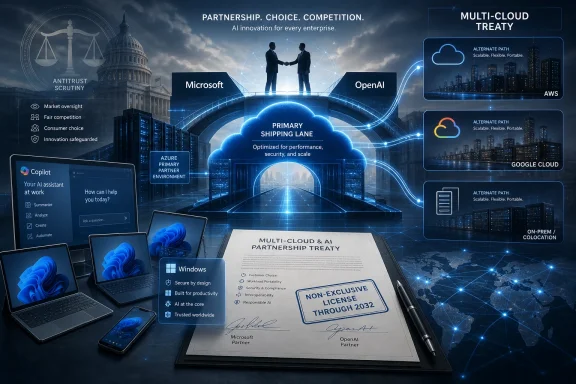 The Azure Moat Is Still There, but the Drawbridge Now Moves
The first temptation is to call this the end of Microsoft’s exclusive hold over OpenAI. That is true, but incomplete. Microsoft did not wake up one morning and lose OpenAI; it traded a cleaner, narrower set of rights for a partnership that is easier to defend, easier to finance, and harder to accuse of bottling up the AI market.The revised terms preserve the centerpiece that matters most to Microsoft’s enterprise strategy. Azure remains OpenAI’s primary cloud partner, and OpenAI products are still supposed to arrive first on Azure unless Microsoft cannot or chooses not to support the necessary capabilities. In cloud-platform terms, that is not a demotion to “just another provider.” It is a priority lane with escape hatches.
Those escape hatches are the story. OpenAI can now serve its products to customers across any cloud provider, while Microsoft’s license to OpenAI intellectual property for models and products becomes non-exclusive through 2032. The language matters because exclusivity was the cleanest expression of Microsoft’s leverage. Non-exclusivity turns that leverage into a competition that Microsoft must keep winning.
The old arrangement fit the first phase of the generative AI boom. OpenAI needed cash, infrastructure, enterprise distribution, and political cover. Microsoft needed a leapfrog moment after years of watching consumer AI brands form outside its walls. The partnership turned Azure into the default enterprise route to OpenAI models and turned Copilot into the most visible expression of Microsoft’s AI future.
But what was elegant in 2019 became awkward by 2026. AI demand is no longer a promising workload category; it is a capacity crisis, a regulatory headache, and a board-level procurement fight. A single-cloud funnel may help one vendor, but it also creates friction for customers whose estates already span Azure, AWS, Google Cloud, private infrastructure, and sovereign environments. The revised deal acknowledges the market that already exists.
OpenAI Needed More Than Microsoft Could Sensibly Promise
The most generous reading of the amendment is that both sides are being realistic. OpenAI’s ambitions have grown beyond any one partner’s willingness or ability to satisfy them on exclusive terms. Training and serving frontier models now require enormous power, data center capacity, specialized chips, networking, and long-term capital planning. Even Microsoft, with one of the world’s largest cloud businesses, has incentives not to become the sole shock absorber for OpenAI’s infrastructure appetite.This is not just about raw compute. It is about optionality. OpenAI wants to be able to meet customers where they already are, especially when those customers have governance, latency, compliance, or commercial reasons to avoid moving workloads into Azure. If an enterprise has built its AI controls around another cloud, telling it that OpenAI means Azure is no longer a sales advantage. It is a procurement obstacle.
Microsoft, meanwhile, has its own reasons to accept a looser structure. The company has spent the last several years integrating AI into Microsoft 365, GitHub, Windows, Edge, Defender, Dynamics, and Azure. But that integration increasingly depends on Microsoft being able to optimize cost, performance, safety, and margins across a portfolio of models. The deeper AI moves into everyday software, the less comfortable Microsoft should be with any arrangement that makes one supplier both indispensable and expensive.
The amendment also ends Microsoft’s revenue-share payments to OpenAI while preserving OpenAI’s revenue-share payments to Microsoft through 2030, at the same percentage but subject to a total cap. That is not the language of a breakup; it is the language of financial engineering after the initial land grab. Both companies are trying to reduce future disputes by specifying what continues, what ends, and what gets capped.
For OpenAI, the calculation is straightforward. A non-exclusive Microsoft license lets it build a broader market without fully alienating the partner that helped turn it from research lab into platform company. For Microsoft, the calculation is subtler. It can continue to benefit from OpenAI’s growth as a major shareholder while also positioning Azure, Copilot, and its own AI stack as competitive products rather than mere wrappers around another company’s models.
The Regulatory Weather Changed Faster Than the Contract
The revised deal arrives in a world where regulators have learned to look past acquisition paperwork. The major AI partnerships of the last several years have been scrutinized precisely because they often avoided the clean lines of traditional mergers. Cloud credits, exclusive licenses, model distribution rights, equity stakes, and board-level influence can shape markets without one company technically buying another.That is why exclusivity became a liability. A cloud platform with privileged rights to the leading AI lab’s models invites obvious questions from antitrust authorities. Can rivals compete for workloads? Can customers choose where to deploy? Are model makers effectively tied to infrastructure gatekeepers? Does the arrangement make the AI stack more open, or does it quietly re-create the old platform monopolies with GPUs instead of operating systems?
Microsoft and OpenAI have been careful to frame the amendment as flexibility for customers and clarity for both companies. That is plausible, and it is also convenient. A non-exclusive license is easier to defend than an exclusive one. A primary cloud relationship with exceptions is easier to defend than a locked gate. A capped revenue-sharing structure is easier to explain than an open-ended toll on the future.
None of this means regulators forced the change directly. The more likely explanation is that regulatory pressure, infrastructure reality, customer demand, and OpenAI’s capital needs all pointed in the same direction. Exclusive control over the hottest AI platform was strategically valuable, but it carried rising costs. Microsoft appears to have decided that retaining first position was more important than retaining absolute position.
This is a familiar pattern in tech. Platform companies often begin by insisting on tight integration, then loosen their grip once the market grows large enough that tight control becomes a drag on adoption. The trick is to give up enough control to look open without giving up enough advantage to become ordinary. Microsoft’s revised OpenAI deal is an attempt to thread that needle.
Copilot Becomes a Product Strategy, Not a Birthright
For Windows users, the immediate effect is probably underwhelming. Copilot will not suddenly stop working. Microsoft 365 Copilot will not lose its model backend overnight. Windows will not become an AI-neutral operating system because OpenAI can now work more freely with other cloud providers. The visible consumer experience is likely to change slowly, if at all.The strategic meaning is different. Copilot’s advantage can no longer be described simply as “Microsoft has OpenAI and others do not.” That line was always too crude, but it was useful. It gave Microsoft a clean story for investors, customers, developers, and PC makers: the company had secured the AI crown jewels and was embedding them across the Windows ecosystem.
Non-exclusivity weakens that story. If OpenAI models become more broadly available across cloud providers and enterprise platforms, Copilot has to win on product design, integration, identity, security, admin controls, price, and workflow depth. That is not bad news for Microsoft, because those are the areas where Microsoft is strongest. But it changes the burden of proof.
The future of Copilot may therefore look less like a single OpenAI-powered assistant and more like a Microsoft orchestration layer. Some tasks may use OpenAI models. Some may use Microsoft’s own models. Some may use smaller local models on AI PCs. Some may use domain-specific models from partners. The user sees one Copilot surface; the administrator sees policy, logging, data boundaries, and cost controls; the infrastructure layer becomes a competitive marketplace.
That is the direction enterprise AI was heading anyway. No serious CIO wants a one-model future. Models age quickly, pricing changes, latency matters, and compliance teams want options. Microsoft’s challenge is to make model choice invisible to end users while keeping enough control that Copilot still feels like a Microsoft product rather than a thin client for whatever model vendor is fashionable this quarter.
The Enterprise Buyer Gets Leverage, but Not Simplicity
The biggest winners from non-exclusivity may be large enterprise customers, though “winner” is doing some work here. More cloud choice gives buyers leverage. It lets organizations ask whether OpenAI workloads should run through Azure, another hyperscaler, a regionally constrained cloud, or a hybrid architecture. It gives procurement teams another axis on which to negotiate.But choice is not the same as simplicity. Enterprises already struggle to govern generative AI across shadow tools, SaaS integrations, APIs, browser extensions, and internal pilots. If OpenAI products become more widely available across clouds, the governance problem becomes both better and worse. Better, because official channels can replace workarounds. Worse, because the same model family may appear in multiple administrative contexts with different logging, retention, security, and billing models.
Microsoft’s advantage remains strongest where the enterprise stack is already Microsoft-heavy. Entra ID, Purview, Defender, Microsoft 365, Windows, Intune, and Azure give Redmond a credible governance story that rivals cannot easily clone. If an organization wants AI assistance inside Outlook, Teams, Word, Excel, SharePoint, and Windows management workflows, Microsoft remains the natural route.
The new opening matters more for organizations whose center of gravity is elsewhere. A retailer running analytics and AI pipelines on Google Cloud, a startup built on AWS, or a regulated enterprise with region-specific infrastructure constraints may now have a cleaner path to OpenAI products without reorienting around Azure. That does not automatically reduce Microsoft’s influence, but it prevents Azure from being the unavoidable tollbooth.
For sysadmins, the practical advice is to assume fragmentation. AI procurement will not be a single Microsoft licensing conversation. It will involve cloud contracts, SaaS terms, data-processing agreements, model-routing policies, endpoint controls, and user education. The Microsoft-OpenAI amendment gives enterprises more room to design their own architecture, but it also removes the comforting fiction that one vendor’s AI stack can settle the matter.
The Windows Angle Is About Control, Not Chatbots
WindowsForum readers know the difference between a feature and a dependency. Copilot in Windows is a feature; the model supply chain behind it is a dependency. The revised Microsoft-OpenAI arrangement matters because it makes that dependency more visible.Microsoft has been moving Windows toward a model where AI is not merely an app but part of the operating environment. Search, settings, accessibility, productivity shortcuts, developer tools, and endpoint support can all be touched by AI. The deeper that integration goes, the more important it becomes to know which models are being used, where data travels, what can be disabled, and how much administrators can inspect.
A non-exclusive OpenAI market does not solve those concerns. If anything, it shifts the conversation from “Is Microsoft too dependent on OpenAI?” to “How will Microsoft manage a world where OpenAI is both partner and supplier to competitors?” The answer will shape Windows AI features more than any single branding change.
Microsoft has powerful incentives to build abstraction layers. If Copilot can route tasks among different models without breaking the user experience, Microsoft reduces supplier risk and improves margins. If AI PCs can run more local inference, Microsoft can offer privacy and responsiveness that cloud-only assistants cannot. If enterprise administrators can set model and data policies centrally, Microsoft can turn AI sprawl into another management problem Windows is designed to solve.
That is the optimistic scenario. The pessimistic one is that users get more AI surfaces, more settings, more subscriptions, and less clarity. Microsoft has a long history of turning strategic priorities into Windows prompts before the underlying user value is fully obvious. The OpenAI deal gives Microsoft more reason to make Copilot a durable platform, but Windows users will judge it by whether it reduces work or merely adds another layer of branded automation.
Microsoft’s Real Hedge Is Its Own Model Portfolio
The amended agreement should also be read as a signal that Microsoft does not want to be trapped in the role of OpenAI reseller. That role was useful when the world wanted the fastest route to GPT-powered software. It becomes less attractive when every major cloud provider is building model marketplaces, every large customer wants bargaining power, and every frontier lab is hunting for compute.Microsoft has already been investing in smaller models, domain-specific models, and infrastructure designed to support a range of AI workloads. The company does not need to abandon OpenAI to reduce dependence on it. It only needs to make sure Copilot, Azure AI, GitHub, and Windows can use the best model for the job.
This is where non-exclusivity cuts both ways. OpenAI can now more easily pursue distribution beyond Azure, but Microsoft can also treat OpenAI as one important supplier among several. The official amendment says Microsoft’s license remains in place through 2032. That gives Microsoft years of access, product planning runway, and investor reassurance. But the license being non-exclusive means Microsoft must assume that OpenAI’s best work may also appear in rival ecosystems.
That prospect will sharpen Microsoft’s internal AI efforts. It is one thing to integrate an exclusive partner’s models into your products. It is another to compete on execution when the same underlying model capability may be available elsewhere. Microsoft’s differentiation will have to come from data context, workflow integration, admin trust, and infrastructure economics.
That is not a small advantage. Microsoft owns the productivity graph for hundreds of millions of commercial users. It controls the dominant desktop operating system. It has one of the strongest developer ecosystems in GitHub and Visual Studio. If AI becomes a context game rather than a model leaderboard, Microsoft still has formidable terrain.
OpenAI Gets Distribution Freedom at the Price of Platform Politics
OpenAI’s side of the deal looks cleaner on paper. It gets the ability to serve products across clouds, escape a rigid exclusivity structure, and continue benefiting from Microsoft’s cloud scale and commercial reach. It can court customers and partners that might have hesitated under an Azure-centered arrangement. It can also reduce the strategic risk of depending too heavily on one infrastructure provider.But freedom creates new complications. The more OpenAI sells across clouds, the more it becomes a platform company managing conflicting channel relationships. AWS, Google Cloud, Oracle, Microsoft, and others do not merely provide neutral plumbing. They compete for the same enterprise AI budgets. OpenAI will need to convince each partner that supporting OpenAI helps more than it hurts.
There is also the support problem. Enterprise customers do not buy frontier models in the abstract. They buy uptime, integration, indemnity, observability, compliance commitments, roadmap confidence, and someone to call when a deployment breaks. Microsoft has spent decades building that machinery. OpenAI has been building it fast, but broad multi-cloud distribution will test whether the company can operate like an enterprise platform rather than a fast-moving AI lab with a famous chatbot.
The amended agreement also keeps Microsoft close. Microsoft remains a major shareholder and primary cloud partner, and the companies say they will continue working on data center capacity, silicon, cybersecurity, and large-scale AI infrastructure. OpenAI’s freedom is therefore not independence in the pure sense. It is managed autonomy within a relationship too financially and technically important for either side to casually unwind.
That nuance matters. The market may want a simple narrative: OpenAI broke free, Microsoft lost exclusivity, Amazon and Google get an opening. The more accurate story is that OpenAI has become important enough to require a multi-partner posture, while Microsoft has become experienced enough in AI to prefer enforceable advantages over brittle control.
The AGI Clause Was Always a Governance Time Bomb
One of the most interesting reported elements of the revised pact is the removal or neutralization of provisions tied to artificial general intelligence, the hypothetical point at which systems match or exceed human-level capability across broad domains. Earlier versions of the Microsoft-OpenAI relationship were famous for treating AGI as a boundary condition that could alter commercial rights. That may have made philosophical sense inside OpenAI’s original nonprofit mission. It made less sense as the foundation for a trillion-dollar enterprise technology stack.Tying business rights to the arrival of AGI creates obvious problems. Who decides AGI has been achieved? What evidence counts? What happens if one party has financial incentives to declare it, deny it, or litigate it? How does a customer plan a five-year AI deployment when a metaphysical trigger might change who controls the underlying technology?
The amended structure appears designed to replace that ambiguity with dates, caps, and commercial terms. Microsoft’s license runs through 2032. OpenAI’s revenue-share obligations to Microsoft continue through 2030, subject to a cap. Azure remains primary, but OpenAI can serve customers across clouds. These are not poetic commitments. They are operational commitments.
That shift is healthy for enterprise buyers. Most organizations do not want their AI roadmap governed by a debate over whether a lab has crossed an AGI threshold. They want predictable licensing, support, compliance, and continuity. Removing mystical tripwires from commercial agreements is what happens when a research frontier becomes enterprise infrastructure.
It is also a sign that the AI industry is maturing faster than its mythology. The public conversation may still orbit AGI, superintelligence, and existential stakes. The contracts increasingly orbit data centers, chips, cloud rights, revenue shares, and customer access. That is not a contradiction. It is what commercialization looks like.
The Cloud War Moves From Capacity to Channel Control
The revised Microsoft-OpenAI deal will be read by cloud competitors as an opening. AWS and Google Cloud have long argued, implicitly or explicitly, that enterprise AI should not be routed through one Microsoft-shaped door. If OpenAI products can now reach customers across clouds, the cloud war gains a new front: who can provide the best combination of model access, deployment tooling, security posture, and price?Azure still has a first-shipment advantage for OpenAI products, and Microsoft still has deep integration rights. But competitors do not need parity on day one to benefit. They need enough access to keep customers from standardizing on Azure purely to reach OpenAI. Once that happens, the battle shifts to surrounding services: vector databases, agent frameworks, observability, governance, data pipelines, custom silicon, and managed deployment platforms.
This is where Microsoft faces a more subtle threat. The value of OpenAI access declines if every major cloud can offer it in some form. The value of Azure must then come from everything around the model. That is a more demanding contest, but it is also a contest Microsoft knows how to fight.
The cloud providers are not selling compute anymore. They are selling AI operating environments. Customers want to build agents, connect private data, monitor outputs, enforce policy, manage costs, and avoid regulatory disaster. The best model is necessary but insufficient. The platform that makes the model usable at scale captures the durable margin.
That is why this deal does not make Azure irrelevant. It makes Azure’s job harder and more interesting. Microsoft has to prove that first access plus enterprise integration beats multi-cloud availability plus rival tooling. The answer will vary by customer, which is exactly why OpenAI wanted more flexibility.
The Deal Makes AI Less Exclusive and More Complicated
The amendment is easy to overstate and easy to understate. It is not a divorce, and it is not a cosmetic tweak. It is the recalibration of a partnership that became too important, too expensive, and too politically exposed to remain in its original form.For Windows and Microsoft 365 customers, the near-term result is continuity. Copilot and Azure OpenAI Service remain central to Microsoft’s AI pitch. The deeper consequence is that Microsoft must increasingly compete on implementation rather than access. That should be good for customers, at least if procurement teams use the added leverage rather than sleepwalk into more fragmented contracts.
OpenAI gains the ability to act more like an independent platform company. Microsoft gains a clearer financial and legal structure while keeping enough rights to remain a central beneficiary. Rivals gain an opening. Regulators gain a cleaner story to examine. Customers gain choices that will require stronger governance.
This is the shape of the next AI cycle. The first wave was about who had the model. The second is about who controls distribution, cost, trust, and context. Microsoft and OpenAI are not ending their partnership; they are adapting it to a market in which exclusivity is too blunt an instrument for infrastructure this strategic.
The Practical Read for WindowsForum Readers Is a Split Verdict
The forum-level takeaway is not that Microsoft lost OpenAI or that OpenAI escaped Microsoft. It is that both companies are preparing for a multi-cloud, multi-model, more heavily regulated AI market where exclusive rights are less useful than durable leverage.- Microsoft remains OpenAI’s primary cloud partner, so Azure and Copilot should continue to receive privileged treatment even though exclusivity has ended.
- OpenAI can now serve products across any cloud provider, which gives enterprise customers more deployment options and gives rival clouds a stronger opening.
- Microsoft’s OpenAI model and product IP license continues through 2032, but the license is now non-exclusive rather than a unique commercial moat.
- Revenue-sharing terms have been simplified, with Microsoft no longer paying a revenue share to OpenAI and OpenAI’s payments to Microsoft continuing through 2030 under a capped structure.
- Windows users should expect Copilot to remain central, but its long-term value will depend more on integration, management, privacy, and price than on exclusive access to OpenAI models.
- IT administrators should plan for AI governance across multiple clouds and model providers rather than assuming Microsoft licensing alone will define the enterprise AI boundary.
Source: صوت الإمارات Microsoft-OpenAI Restructuring: A Shift Toward a Non-Exclusive Licensing Model
