
 The Alliance That Built the AI Boom Has Outgrown Its Original Contract
For years, the Microsoft-OpenAI partnership was the cleanest story in enterprise AI. OpenAI supplied the magic, Microsoft supplied the money, cloud capacity, enterprise distribution, and an aura of institutional seriousness. That bargain helped turn ChatGPT from a consumer shockwave into the foundation for Copilot, Azure AI, and a generation of boardroom presentations about productivity transformation.
But the bargain was also built for an earlier phase of the market. In 2019, OpenAI needed a strategic backer with hyperscale infrastructure and Microsoft needed a technological leapfrog. By 2026, OpenAI is no longer a research lab with a breakout chatbot; it is a global platform company trying to serve customers, developers, governments, and possibly every major cloud ecosystem at once.
That shift matters because exclusivity is most useful when one side needs shelter. Once a company becomes the prize everyone wants, exclusivity starts to look like a toll booth. OpenAI’s problem is no longer whether it can get access to enough enterprise customers; it is whether it can get enough compute, enough distribution, and enough political room to operate without letting any one partner become its ceiling.
Microsoft, meanwhile, has a different problem. It has wrapped enormous parts of its commercial strategy around OpenAI-derived capabilities, from Microsoft 365 Copilot to GitHub Copilot to Azure AI services. The company cannot afford to lose OpenAI, but it also cannot afford to be seen as holding OpenAI hostage if customers, regulators, and investors are all asking whether the AI stack is becoming too concentrated.
The amended deal is an answer to both pressures. It loosens the knot without cutting the rope.
Azure Keeps the Front Door, but the House Is No Longer Locked
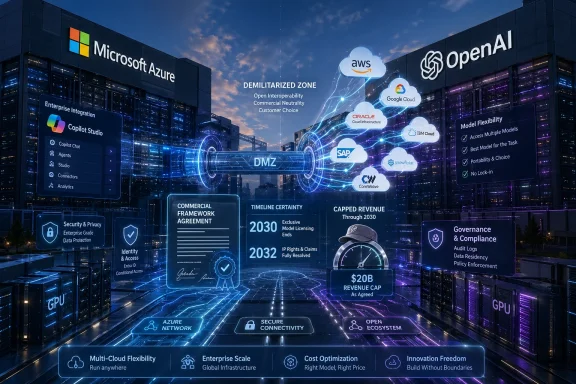
The most visible change is cloud access. OpenAI can now make its products and services available across any cloud provider, while Microsoft remains OpenAI’s primary cloud partner and OpenAI products continue to ship first on Azure unless Microsoft cannot or chooses not to support the necessary capabilities.
That wording is doing a lot of work. It preserves Microsoft’s public claim that Azure is still the main OpenAI home, while giving OpenAI the operational flexibility to go elsewhere when the business requires it. This is not a symbolic tweak; in AI, the cloud is not merely a hosting venue. It is the factory floor.
Training and serving frontier models require massive GPU clusters, specialized networking, power availability, datacenter geography, inference optimization, and procurement muscle. If OpenAI is going to keep scaling products like ChatGPT, developer APIs, enterprise tools, and future agentic systems, it cannot be limited by the capacity curve of a single provider, even one as large as Microsoft.
That is the hard infrastructure reality behind the legal language. The AI industry talks about models as if they are pure software, but the business is increasingly constrained by steel, silicon, substations, cooling systems, and delivery schedules. A company chasing global demand cannot tell a customer, “We would serve you, but our exclusive cloud partner is waiting on power approvals in the right region.”
For Microsoft, conceding this point is painful but rational. The company would rather remain OpenAI’s primary partner in a larger market than be the exclusive partner blamed for throttling growth. Azure-first is still valuable. Azure-only had become dangerous.
The Non-Exclusive License Is Microsoft’s Insurance Policy
The second major change is Microsoft’s license to OpenAI models and products. Microsoft keeps rights through 2032, but those rights are now non-exclusive. In plain English, Microsoft still gets the technology runway it needs for Copilot and Azure AI, but OpenAI is no longer prevented from licensing or distributing comparable technology through other channels.
This is the kind of compromise that looks weaker than it is. Microsoft loses the strategic luxury of uniqueness, but it preserves continuity. That matters because the company has embedded OpenAI capabilities deeply into its product roadmap and customer pitch. Enterprises buying Microsoft 365 Copilot, Azure OpenAI Service, Dynamics automation, security tooling, and developer products need confidence that Microsoft’s access will not vanish because of a governance fight or a technical milestone.
A non-exclusive license through 2032 gives Microsoft that confidence. It also gives investors a fixed horizon rather than an ambiguous dependency on whether some committee has declared that artificial general intelligence has arrived. For a public company with trillion-dollar market expectations, boring legal certainty is not boring at all.
But the price of that certainty is a more open competitive field. If OpenAI can make its models available through other clouds, Microsoft must compete more directly on integration, reliability, enterprise trust, compliance, price, and tooling. In other words, Microsoft must prove that Azure is the best place to consume OpenAI technology, not merely the only place.
That is good for customers. It is also good for Microsoft in the long run, if the company is as confident in its enterprise advantage as it says it is. The end of exclusivity turns Azure OpenAI from a protected franchise into a product that has to win on merit.
The AGI Clause Was Always Too Strange to Govern a Real Business
The most culturally fascinating part of the old arrangement was the so-called AGI clause. In earlier versions of the Microsoft-OpenAI relationship, certain rights and revenue arrangements were tied to artificial general intelligence, with independent verification involved in determining whether that threshold had been reached. That might have made sense inside a research-charter worldview. It made far less sense as the control switch for one of the most commercially important technology partnerships on Earth.
AGI is not like the delivery date of a server rack or the closing date of an acquisition. It is a contested concept, a moving benchmark, and a phrase that carries different meanings depending on whether it is being used by researchers, executives, investors, philosophers, or marketers. Building a giant commercial contract around it was almost guaranteed to create future conflict.
That conflict was not hypothetical. If declaring AGI could change who controls access to technology, who receives revenue, or how long exclusivity lasts, then the definition of AGI becomes a financial weapon. Every technical argument becomes a commercial argument. Every benchmark becomes evidence in a boardroom dispute.
The amended agreement replaces that uncertainty with fixed dates: Microsoft’s model and product license runs through 2032, and OpenAI’s revenue share to Microsoft continues through 2030 at the same percentage but subject to a cap and independent of OpenAI’s technology progress. This does not settle the philosophical debate over AGI. It does something more useful: it removes the debate from the payment mechanism.
That is the adult move. Companies can still pursue extraordinary technology while admitting that “we will know it when an expert panel says it has happened” is a poor foundation for enterprise procurement, capital planning, and platform strategy.
The Money Now Looks More Like a Cap Table Than a Fairy Tale
The financial changes are just as revealing as the cloud and IP terms. Microsoft will no longer pay a revenue share to OpenAI. OpenAI will continue paying Microsoft revenue share through 2030 at the same percentage, but those payments are now subject to a total cap. Microsoft also remains a major stakeholder in OpenAI’s growth.
This is a cleaner arrangement. The earlier partnership was a hybrid of investment, cloud resale, commercial licensing, strategic dependence, and speculative future rights. That complexity was tolerable when both companies were racing to commercialize a breakthrough. It becomes harder to sustain when OpenAI is negotiating with other infrastructure providers, serving regulated customers, and trying to behave like a platform rather than a Microsoft-adjacent lab.
A capped revenue share also changes the tone of the relationship. Microsoft still participates in OpenAI’s upside, but OpenAI has more visibility into its long-term economics. That matters if OpenAI is planning infrastructure commitments, enterprise pricing, international expansion, and future model development at a scale that would make even traditional cloud spending look modest.
The arrangement also helps Microsoft defend the partnership politically. A perpetual or milestone-dependent claim on OpenAI’s revenue could invite more scrutiny as AI becomes central to the economy. A defined payment period, a cap, and non-exclusive rights are easier to explain to regulators and customers who worry that a handful of companies are dividing the future among themselves.
The money is still enormous. The strategic entanglement is still deep. But the relationship is now less mystical and more legible.
OpenAI Gets Freedom, but Not Independence
It would be easy to read the announcement as OpenAI breaking free. That is only partly true. OpenAI gains freedom of movement, but it does not gain freedom from the physics and economics that made Microsoft indispensable in the first place.
OpenAI still needs vast compute capacity. It still needs enterprise distribution. It still needs credible compliance infrastructure. It still needs partners who can build datacenters, negotiate power contracts, serve government customers, and support global businesses that do not want to stitch together experimental AI systems from scratch.
Microsoft remains unusually strong in those areas. Its enterprise relationships are deep, its security and identity stack is embedded across corporate IT, and its productivity software gives it a distribution surface no rival cloud provider can easily replicate. If OpenAI wants to be everywhere, Microsoft is still one of the most valuable places to be.
The difference is that OpenAI can now avoid becoming only a Microsoft story. That distinction matters for developers and customers who prefer AWS, Google Cloud, Oracle, or other environments. It matters for governments that may want sovereign or specialized deployments. It matters for enterprises that have already standardized on non-Microsoft cloud architectures but still want access to leading OpenAI systems.
OpenAI’s freedom is therefore practical rather than ideological. It is not walking away from Microsoft. It is building enough doors that Microsoft is no longer the only entrance.
Microsoft’s Real Risk Is Not Losing OpenAI, but Losing the Default
For Microsoft, the strategic danger is subtle. The company has not lost OpenAI, and it has not lost access to the technology it needs. What it risks losing is default status.
Default status is incredibly powerful in enterprise technology. The default identity provider, the default productivity suite, the default cloud region, the default developer toolchain — these choices shape procurement before a formal comparison ever begins. Microsoft’s OpenAI exclusivity made Azure feel like the natural place to consume frontier AI. That halo now becomes less automatic.
If OpenAI models show up across other clouds in serious, first-class ways, CIOs will start asking different questions. They will ask whether they need Azure OpenAI Service specifically, or whether they can consume OpenAI capabilities closer to existing workloads. They will ask whether latency, data residency, cost, procurement relationships, and operational familiarity favor another provider. They will ask whether Microsoft’s Copilot layer is a productivity advantage or a bundling strategy.
That does not mean Microsoft loses. In many organizations, the answer will still be Microsoft. The company’s ability to integrate AI into Office, Teams, Windows, GitHub, Defender, Power Platform, and Azure remains formidable. No other vendor can place AI assistants so directly into the daily flow of corporate work.
But the contest changes. Microsoft must now win the AI platform argument at multiple layers: user experience, developer experience, cloud economics, governance, and model quality. The old contract reduced the number of fronts. The new one expands them.
AWS and Google Cloud Just Got a More Interesting Opening
The amended partnership is a gift to Microsoft’s cloud rivals, but not a guarantee. AWS and Google Cloud can now plausibly pursue deeper OpenAI integrations, but they still need to show why OpenAI should allocate scarce capacity, engineering attention, and go-to-market energy to them.
AWS has the biggest cloud footprint and a massive enterprise base. It also has its own AI strategy, including custom silicon, model marketplaces, and partnerships across the model ecosystem. If OpenAI becomes more available on AWS, the result could be powerful: customers could bring OpenAI closer to workloads that already live in Amazon’s cloud.
Google Cloud has a different advantage. Google is one of the few companies with deep AI research history, frontier infrastructure, custom TPU experience, and an increasingly serious enterprise AI platform. OpenAI on Google Cloud would be strategically awkward but commercially logical if customers want model choice and if OpenAI wants more high-end capacity.
Yet neither rival should confuse permission with partnership. Microsoft has years of integration work, commercial alignment, and organizational muscle invested in OpenAI. A newly open door does not erase that installed base. It merely makes the next phase contestable.
The bigger point is that the AI cloud market is becoming less like an exclusive content deal and more like a distribution war. Models will travel where customers, capacity, compliance, and economics demand. The cloud provider that wins will be the one that makes advanced AI easiest to deploy responsibly at scale, not the one that negotiated the tightest lockup in an earlier era.
Enterprise IT Finally Gets the Multi-Cloud AI Conversation It Wanted
For sysadmins and IT decision-makers, the immediate implications are less glamorous than the Silicon Valley chessboard, but more important. Enterprises have spent years being told that AI transformation is inevitable, only to find that many leading capabilities were tied to specific clouds, commercial bundles, or opaque platform relationships. This amendment points toward a more flexible future.
Multi-cloud AI is not automatically simple. Moving model access across clouds raises hard questions about data governance, logging, identity, latency, egress costs, regional compliance, and support boundaries. A model available “everywhere” can still behave differently depending on the surrounding platform.
But choice changes procurement leverage. If OpenAI services become viable across multiple providers, customers can press vendors harder on price, uptime, region availability, data handling, and tooling. They can align AI deployment with existing cloud investments rather than restructuring around one vendor’s strategic alliance.
This also creates pressure on Microsoft to make Azure OpenAI Service better, not merely exclusive. Expect sharper emphasis on enterprise controls, private networking, model management, safety tooling, observability, and integration with Microsoft’s security and compliance stack. If Microsoft cannot rely on lock-in, it will lean harder into operational trust.
That is where WindowsForum readers should pay attention. The headline is about corporate deal terms. The real IT story is that AI procurement is moving from novelty adoption to platform discipline.
The Governance Story Is Hiding in Plain Sight
The removal of AGI-linked commercial uncertainty is also a governance story. OpenAI’s original structure and mission created a tension that fascinated the tech world: a nonprofit-rooted organization pursuing technology of potentially civilization-scale consequence while relying on massive commercial partnerships to fund the work. Microsoft’s role was always both enabling and complicating.
By moving away from ambiguous superintelligence triggers and toward fixed commercial terms, the companies are acknowledging that governance cannot depend on theatrical thresholds. If OpenAI builds more capable systems, the hard questions will not disappear in 2030 or 2032. They will intensify around deployment, misuse, labor effects, national security, competition, and concentration of power.
The old AGI clause made for compelling drama because it implied a moment when everything changes. The real world is less tidy. Capabilities will likely arrive unevenly, across domains, with some systems exceeding human performance in specific areas while still failing in others. Regulation, safety evaluation, and commercial responsibility need to work in that messy continuum.
That makes fixed licensing terms more credible than AGI tripwires. It does not make them morally sufficient. It simply means the commercial machinery no longer pretends that one definitional event can resolve the future of access and control.
For Microsoft, this reduces the risk that OpenAI’s governance decisions suddenly disrupt its product empire. For OpenAI, it reduces the risk that its mission language becomes a contractual battlefield. For everyone else, it is a reminder that AI governance is moving out of manifestos and into deal architecture.
The End of Exclusivity Is Also the End of a Convenient Narrative
The Microsoft-OpenAI alliance gave the market a simple map: OpenAI was the model leader, Microsoft was the enterprise vehicle, Azure was the platform, and Copilot was the product expression. That map was never complete, but it was useful. Investors liked it. Customers understood it. Competitors could define themselves against it.
The new arrangement makes the map messier. OpenAI can be Microsoft’s frontier model partner and also a supplier to Microsoft’s cloud rivals. Microsoft can be OpenAI’s primary cloud partner and also one of several distribution paths. Customers can use OpenAI through Microsoft products while potentially consuming OpenAI services elsewhere.
This messiness is not a bug. It is what happens when a technology moves from breakthrough phase to infrastructure phase. The early market rewards tight alliances and dramatic exclusivity. The mature market rewards reach, interoperability, capacity, and bargaining power.
The shift also exposes how quickly AI has become too big for single-channel distribution. If OpenAI’s systems are to become general-purpose infrastructure, they cannot be treated like a console exclusive. They need to show up where the workloads are, where the regulators permit them, and where the economics make sense.
That is the real game change. The amended deal does not make OpenAI independent of Microsoft. It makes OpenAI too strategically important to remain contained by Microsoft.
The New Contract Tells IT Buyers Where the AI Market Is Heading
The practical lesson from the amended agreement is that the AI stack is becoming more modular, more negotiated, and more multi-cloud. That does not mean lock-in disappears. It means lock-in moves upward into workflows, agents, data pipelines, governance systems, and user habits.
- Microsoft remains deeply tied to OpenAI, but its license is now non-exclusive and must compete through product integration rather than contractual scarcity.
- OpenAI gains the ability to serve customers across clouds, which should increase pressure on cloud providers to compete on capacity, compliance, and operational quality.
- Azure still gets first-position treatment, but “Azure-first” is materially different from “Azure-only.”
- The AGI clause’s commercial role has effectively been replaced by fixed timelines, making the partnership easier for enterprises and investors to understand.
- OpenAI’s revenue share to Microsoft continues through 2030 at the same percentage but with a cap, while Microsoft’s model and product license runs through 2032.
- The biggest customer benefit is not immediate price disruption, but greater leverage as AI deployments become part of normal cloud architecture.
The Microsoft-OpenAI honeymoon is not over; it has simply become a marriage with separate bank accounts, negotiated boundaries, and permission to attend different business dinners. That is less romantic than the original alliance, but it is more durable for the next stage of AI. If the first phase of generative AI was defined by who could secure the breakthrough model, the next one will be defined by who can deliver it everywhere customers need it, without making the future depend on a single cloud, a single contract, or a single science-fiction clause.
