

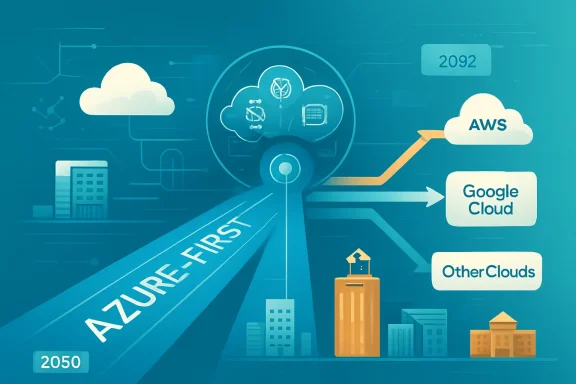
Microsoft and OpenAI have rewritten the rules of the AI era’s most important commercial alliance, ending Microsoft’s exclusive license to OpenAI products while preserving Azure’s privileged place at the front of the line. The amended agreement keeps Microsoft as OpenAI’s primary cloud partner, but it also gives OpenAI the right to serve all of its products across any cloud provider through 2032. For enterprises, developers, schools, universities, and EdTech vendors, the practical result is a new multi-cloud AI market in which OpenAI is no longer effectively routed through Azure alone.
Microsoft and OpenAI began their modern partnership in 2019, when Microsoft invested heavily in the research lab and became the infrastructure backbone for its increasingly expensive AI ambitions. What started as a research and compute alliance became a defining pillar of Microsoft’s strategy across Azure, GitHub, Windows, Microsoft 365, Bing, and Copilot. By the time ChatGPT reshaped public awareness of generative AI, Microsoft had positioned itself not merely as a cloud vendor, but as the enterprise channel for OpenAI’s most important capabilities.
The relationship always carried an unusual tension. OpenAI needed enormous amounts of compute to train and serve frontier models, while Microsoft needed privileged access to the models that would differentiate Azure and Copilot. That bargain worked while OpenAI’s infrastructure needs and Microsoft’s platform strategy were aligned, but it became harder to sustain as OpenAI grew into a platform company with its own enterprise ambitions.
The previous structure gave Microsoft powerful exclusive rights around OpenAI intellectual property and Azure-based API access. It also included revenue-sharing arrangements and complex provisions linked to technological milestones such as artificial general intelligence. Those terms made sense in an earlier phase, when OpenAI was dependent on a narrower set of cloud and capital channels, but they became increasingly awkward as the AI market globalized and model deployment moved closer to customer data.
By late 2025 and early 2026, the partnership had already begun shifting from exclusivity toward managed flexibility. OpenAI secured permission to pursue more third-party development, Microsoft deepened its own multi-model posture by embracing Anthropic’s Claude models, and cloud customers began demanding access to AI systems through the infrastructure they already used. The newly amended agreement formalizes that shift and turns a once-exclusive alliance into something more like a strategic, but non-exclusive, operating framework.
Azure still gets preferential treatment. OpenAI products are expected to ship first on Azure unless Microsoft cannot support the necessary capabilities or elects not to do so. That preserves Microsoft’s launch advantage while reducing the hard lock-in that frustrated OpenAI’s broader cloud ambitions.
The revenue mechanics also change. Microsoft will no longer pay a revenue share to OpenAI, while OpenAI will continue paying Microsoft through 2030, at the same percentage but subject to a total cap. That cap matters because it gives OpenAI clearer long-term economics as it scales across multiple clouds.
Key changes include:
The dispute turned on a technical distinction that will matter across the AI industry: stateless API calls versus stateful agent runtimes. A stateless API call sends a request to a model and receives a response without the provider maintaining persistent memory or workflow context. A stateful agent system, by contrast, may manage files, tools, memory, sandboxed execution, business context, and multi-step task coordination over time.
That difference is not just legal hair-splitting. The future of enterprise AI is moving from chat prompts toward agentic systems that operate across applications and data stores. If the contract treated all API-like interactions as Azure-exclusive, AWS-hosted agent products could have been blocked or forced through awkward architectural compromises.
The amended agreement removes the conflict by allowing OpenAI to serve all products across any cloud. That clears the way for AWS to offer OpenAI models and agent tooling inside Bedrock while Microsoft continues to host first launches and core OpenAI integrations across Azure.
The AWS flashpoint exposed several industry realities:
The real reset is strategic posture. Microsoft is moving from being the exclusive commercial gatekeeper for OpenAI to being the most important enterprise integrator of OpenAI technology. That is a narrower claim, but also a more durable one if customers increasingly demand multi-model and multi-cloud AI architectures.
Microsoft has also hedged intelligently. Its expanded support for Anthropic’s Claude models in Microsoft Foundry and Microsoft 365 Copilot shows that Redmond no longer wants its AI future to depend entirely on one model provider. This is a classic platform move: make Azure and Copilot the place where customers can govern multiple frontier models, not merely the place where they consume OpenAI.
That approach may reduce some short-term exclusivity premium, but it strengthens Microsoft’s enterprise story. CIOs increasingly want choice, auditability, policy enforcement, identity integration, and cost controls across providers. Microsoft can argue that its value lies in trust, governance, productivity integration, and orchestration, not just in preferential access to one lab’s models.
Microsoft’s new position offers several advantages:
OpenAI’s growth has made single-cloud dependency increasingly impractical. Training frontier models, serving consumer-scale products, powering developer APIs, supporting enterprise agents, and experimenting with custom silicon all require more capacity than one partner can always guarantee. Multi-cloud access gives OpenAI negotiating leverage and operational resilience.
The change also improves OpenAI’s distribution. Many enterprises already have committed cloud spend with AWS or Google Cloud, and many education institutions have existing procurement frameworks tied to one provider. If OpenAI can be purchased through those channels, adoption becomes easier because customers can use familiar billing, identity, security, and data controls.
There is also a product benefit. Stateful agents work best when they operate near the data, tools, and applications they need to use. By allowing OpenAI products to run inside different cloud ecosystems, OpenAI can reduce latency, simplify data governance, and make its tools feel more native to enterprise workflows.
For OpenAI, the key wins are:
This matters especially in education, where budgets, compliance reviews, and procurement cycles can move slowly. If an EdTech vendor already hosts student-facing applications on AWS, bringing OpenAI models closer to that environment could reduce integration friction. It may also help institutions avoid duplicating cloud governance across separate platforms.
The change does not eliminate compliance work. Schools and universities still need to evaluate privacy, data retention, accessibility, audit logging, age-appropriate safeguards, and contractual terms. But it gives them more room to align AI procurement with existing infrastructure instead of reshaping infrastructure around a single model provider.
For businesses, the same logic applies at larger scale. Enterprises want to deploy AI near databases, internal applications, document repositories, call center platforms, and software development pipelines. OpenAI’s new flexibility makes that easier, particularly for organizations already committed to AWS Bedrock or other cloud-native AI services.
Education and enterprise buyers should watch:
That shift rewards platforms such as Azure AI Foundry, Amazon Bedrock, and Google Vertex AI because they offer model access alongside orchestration, monitoring, secrets management, storage, and enterprise controls. OpenAI’s ability to appear inside multiple cloud environments means developers can choose the runtime that best matches their application architecture.
The arrival of OpenAI models and Codex-style tooling in AWS environments is especially significant for software teams. Many engineering organizations already build, test, deploy, and monitor software inside AWS. If coding agents can run closer to repositories, build systems, containers, and observability tools, they may become more useful and easier to govern.
Developers should not assume feature parity on day one. Limited previews, region restrictions, model-version differences, and provider-specific management layers can create inconsistencies. The practical path is to design applications with abstraction, observability, and fallback options from the start.
A sensible developer evaluation sequence is:
Google Cloud also benefits indirectly. Even if AWS moves first, the end of Microsoft exclusivity changes customer expectations across the industry. If OpenAI can serve products through any cloud, customers will ask when and how those products will appear in Google Cloud environments, especially where BigQuery, Vertex AI, Workspace, or TPU-backed infrastructure already anchors AI projects.
Anthropic faces a more complicated picture. On one hand, Microsoft’s non-exclusive OpenAI relationship validates Anthropic’s strategy of being available across major enterprise platforms. On the other hand, OpenAI’s broader cloud reach increases pressure on Claude by removing one of OpenAI’s biggest distribution bottlenecks.
The broader market signal is unmistakable: multi-model AI is now the enterprise default. No serious cloud wants to depend on a single model family, and no serious AI lab wants to depend on a single cloud. The winners will be the platforms that make model choice manageable rather than chaotic.
Competitive implications include:
The more subtle change is that Microsoft’s offerings must now justify themselves against OpenAI availability elsewhere. If an enterprise can access similar OpenAI capabilities through AWS, Microsoft must win with better integration into Microsoft 365, security tooling, identity, compliance, Windows management, and developer workflows. That is a strong position, but it is no longer protected by exclusivity.
For Windows users, the immediate impact is indirect. Copilot experiences in Windows and Microsoft 365 will continue to evolve, but Microsoft may increasingly combine OpenAI models with Anthropic, smaller in-house models, and specialized local models. That could improve reliability and cost efficiency, especially for tasks that do not require the largest frontier systems.
Azure OpenAI customers should pay attention to service-level commitments, model-release timing, and pricing. Azure-first language suggests Microsoft may still receive early product availability, but competing clouds could narrow the gap quickly. Procurement teams should compare not only model access, but the surrounding governance and support stack.
The important point for Microsoft customers is stability with more competition. They do not need to abandon Azure, but they now have more leverage in architecture and pricing discussions. Microsoft’s challenge is to make staying on Azure feel like the best technical decision, not merely the inherited default.
Microsoft also remains a major shareholder in OpenAI’s for-profit structure, with its stake previously described at roughly 27 percent on a diluted basis after recapitalization. That means Microsoft can benefit economically from OpenAI’s expansion even when deployments occur on non-Azure clouds. In effect, Microsoft loses some exclusivity but keeps meaningful upside.
For OpenAI, the capped revenue share is valuable because uncapped economics can become burdensome at scale. A company serving millions of consumers, developers, enterprises, and agents across multiple clouds needs predictable margins. The cap helps OpenAI plan around infrastructure commitments, product expansion, and potential future public-market scrutiny.
The agreement also reduces the importance of ambiguous technology triggers. Revenue payments continuing through 2030 independent of technology progress helps avoid disputes over whether a milestone such as AGI has been reached. That may sound abstract, but it is crucial when billions of dollars could hinge on definitions that remain scientifically and commercially contested.
The financial signals are clear:
The second issue is whether Google Cloud secures comparable OpenAI availability. Google has strong AI infrastructure, data analytics, and model capabilities of its own, but many enterprises still want access to OpenAI models alongside Gemini and third-party systems. A Google-OpenAI deployment path would confirm that the market has fully moved beyond Azure-centered access.
The third issue is Microsoft’s response inside Copilot and Azure. Expect Microsoft to emphasize governance, productivity integration, security, and model choice. The company’s strongest argument will be that enterprise AI is not just about where a model runs, but how safely and usefully it is embedded into daily work.
Watch these milestones closely:
Source: EdTech Innovation Hub Microsoft and OpenAI rewrite partnership ending cloud exclusivity through 2032 | ETIH EdTech News — EdTech Innovation Hub
 Background
Microsoft and OpenAI began their modern partnership in 2019, when Microsoft invested heavily in the research lab and became the infrastructure backbone for its increasingly expensive AI ambitions. What started as a research and compute alliance became a defining pillar of Microsoft’s strategy across Azure, GitHub, Windows, Microsoft 365, Bing, and Copilot. By the time ChatGPT reshaped public awareness of generative AI, Microsoft had positioned itself not merely as a cloud vendor, but as the enterprise channel for OpenAI’s most important capabilities.The relationship always carried an unusual tension. OpenAI needed enormous amounts of compute to train and serve frontier models, while Microsoft needed privileged access to the models that would differentiate Azure and Copilot. That bargain worked while OpenAI’s infrastructure needs and Microsoft’s platform strategy were aligned, but it became harder to sustain as OpenAI grew into a platform company with its own enterprise ambitions.
The previous structure gave Microsoft powerful exclusive rights around OpenAI intellectual property and Azure-based API access. It also included revenue-sharing arrangements and complex provisions linked to technological milestones such as artificial general intelligence. Those terms made sense in an earlier phase, when OpenAI was dependent on a narrower set of cloud and capital channels, but they became increasingly awkward as the AI market globalized and model deployment moved closer to customer data.
By late 2025 and early 2026, the partnership had already begun shifting from exclusivity toward managed flexibility. OpenAI secured permission to pursue more third-party development, Microsoft deepened its own multi-model posture by embracing Anthropic’s Claude models, and cloud customers began demanding access to AI systems through the infrastructure they already used. The newly amended agreement formalizes that shift and turns a once-exclusive alliance into something more like a strategic, but non-exclusive, operating framework.
What Changed in the Contract
From exclusivity to priority
The centerpiece of the amended agreement is the removal of Microsoft’s exclusive license to OpenAI models and products. Microsoft keeps a license to OpenAI intellectual property through 2032, but that license is now non-exclusive. That means Microsoft remains deeply tied to OpenAI’s technology, but OpenAI is free to make the same products available through other cloud providers.Azure still gets preferential treatment. OpenAI products are expected to ship first on Azure unless Microsoft cannot support the necessary capabilities or elects not to do so. That preserves Microsoft’s launch advantage while reducing the hard lock-in that frustrated OpenAI’s broader cloud ambitions.
The revenue mechanics also change. Microsoft will no longer pay a revenue share to OpenAI, while OpenAI will continue paying Microsoft through 2030, at the same percentage but subject to a total cap. That cap matters because it gives OpenAI clearer long-term economics as it scales across multiple clouds.
Key changes include:
- Microsoft remains OpenAI’s primary cloud partner, but not its exclusive cloud route.
- OpenAI can serve all products across any cloud provider, including AWS and potentially Google Cloud.
- Microsoft’s OpenAI IP license continues through 2032, but becomes non-exclusive.
- Microsoft stops paying revenue share to OpenAI, simplifying one side of the financial relationship.
- OpenAI continues paying Microsoft through 2030, but with a total cap.
- Azure remains first in line, preserving Microsoft’s strategic advantage without blocking competitors.
Why AWS Became the Flashpoint
Stateless APIs vs. stateful agents
The immediate trigger for the rewrite was OpenAI’s separate arrangement with Amazon Web Services. OpenAI’s Amazon deal reportedly included a major cloud and investment commitment, along with plans to bring OpenAI models, Codex, and managed agent technology into Amazon Bedrock. That created a contractual clash because Microsoft believed its existing rights still covered critical categories of OpenAI API and product access.The dispute turned on a technical distinction that will matter across the AI industry: stateless API calls versus stateful agent runtimes. A stateless API call sends a request to a model and receives a response without the provider maintaining persistent memory or workflow context. A stateful agent system, by contrast, may manage files, tools, memory, sandboxed execution, business context, and multi-step task coordination over time.
That difference is not just legal hair-splitting. The future of enterprise AI is moving from chat prompts toward agentic systems that operate across applications and data stores. If the contract treated all API-like interactions as Azure-exclusive, AWS-hosted agent products could have been blocked or forced through awkward architectural compromises.
The amended agreement removes the conflict by allowing OpenAI to serve all products across any cloud. That clears the way for AWS to offer OpenAI models and agent tooling inside Bedrock while Microsoft continues to host first launches and core OpenAI integrations across Azure.
The AWS flashpoint exposed several industry realities:
- AI agents are not just model calls; they require runtime, memory, tools, and governance.
- Cloud proximity matters because enterprise data often already lives in AWS, Azure, or Google Cloud.
- Contract language written for APIs can break down when products become long-running agent systems.
- Customers dislike forced cloud detours when compliance, procurement, and data architecture are already settled.
- OpenAI needed more deployment surfaces to support its enterprise and developer growth ambitions.
Microsoft’s Strategic Reset
Azure first, but no longer Azure only
For Microsoft, losing exclusivity is not the same as losing relevance. The company keeps a license to OpenAI technology, keeps Azure-first positioning, keeps major shareholder exposure, and keeps OpenAI deeply integrated into Microsoft’s product stack. Those are formidable advantages, especially in enterprise accounts already standardized on Microsoft 365, Entra ID, Defender, GitHub, Windows, and Azure.The real reset is strategic posture. Microsoft is moving from being the exclusive commercial gatekeeper for OpenAI to being the most important enterprise integrator of OpenAI technology. That is a narrower claim, but also a more durable one if customers increasingly demand multi-model and multi-cloud AI architectures.
Microsoft has also hedged intelligently. Its expanded support for Anthropic’s Claude models in Microsoft Foundry and Microsoft 365 Copilot shows that Redmond no longer wants its AI future to depend entirely on one model provider. This is a classic platform move: make Azure and Copilot the place where customers can govern multiple frontier models, not merely the place where they consume OpenAI.
That approach may reduce some short-term exclusivity premium, but it strengthens Microsoft’s enterprise story. CIOs increasingly want choice, auditability, policy enforcement, identity integration, and cost controls across providers. Microsoft can argue that its value lies in trust, governance, productivity integration, and orchestration, not just in preferential access to one lab’s models.
Microsoft’s new position offers several advantages:
- Azure remains the default first-launch platform for OpenAI products.
- Copilot keeps benefiting from OpenAI IP access through the 2032 horizon.
- Microsoft can pursue independent AI development, including with third-party model providers.
- Foundry becomes more credible as a multi-model platform, not just an OpenAI wrapper.
- Enterprise governance becomes Microsoft’s differentiator, especially for regulated industries.
OpenAI’s New Cloud Leverage
Compute as distribution
For OpenAI, the amended agreement is a major expansion of strategic freedom. The company can now meet customers on AWS, Azure, Google Cloud, Oracle, and other infrastructure partners without forcing every major deployment through Microsoft’s cloud. In a market where compute availability can determine product velocity, that flexibility is existential.OpenAI’s growth has made single-cloud dependency increasingly impractical. Training frontier models, serving consumer-scale products, powering developer APIs, supporting enterprise agents, and experimenting with custom silicon all require more capacity than one partner can always guarantee. Multi-cloud access gives OpenAI negotiating leverage and operational resilience.
The change also improves OpenAI’s distribution. Many enterprises already have committed cloud spend with AWS or Google Cloud, and many education institutions have existing procurement frameworks tied to one provider. If OpenAI can be purchased through those channels, adoption becomes easier because customers can use familiar billing, identity, security, and data controls.
There is also a product benefit. Stateful agents work best when they operate near the data, tools, and applications they need to use. By allowing OpenAI products to run inside different cloud ecosystems, OpenAI can reduce latency, simplify data governance, and make its tools feel more native to enterprise workflows.
For OpenAI, the key wins are:
- Broader customer access across established cloud marketplaces.
- More compute flexibility during periods of extreme demand.
- Better leverage in infrastructure negotiations with multiple providers.
- Stronger enterprise adoption among AWS-heavy and multi-cloud organizations.
- A cleaner path for agent products that need persistent runtime environments.
Enterprise and Education Impact
Procurement, governance, and EdTech
For enterprise and education customers, the most immediate impact is choice. A university standardized on AWS can explore OpenAI services without building a separate Azure procurement path solely for AI. A school district using Microsoft 365 can still benefit from Azure-first OpenAI integration through Copilot and Azure OpenAI services.This matters especially in education, where budgets, compliance reviews, and procurement cycles can move slowly. If an EdTech vendor already hosts student-facing applications on AWS, bringing OpenAI models closer to that environment could reduce integration friction. It may also help institutions avoid duplicating cloud governance across separate platforms.
The change does not eliminate compliance work. Schools and universities still need to evaluate privacy, data retention, accessibility, audit logging, age-appropriate safeguards, and contractual terms. But it gives them more room to align AI procurement with existing infrastructure instead of reshaping infrastructure around a single model provider.
For businesses, the same logic applies at larger scale. Enterprises want to deploy AI near databases, internal applications, document repositories, call center platforms, and software development pipelines. OpenAI’s new flexibility makes that easier, particularly for organizations already committed to AWS Bedrock or other cloud-native AI services.
Education and enterprise buyers should watch:
- Data residency and retention terms across each cloud implementation.
- Identity integration with Microsoft Entra ID, AWS IAM, Google Cloud IAM, and campus directories.
- Model availability by region, since launches often begin in limited preview.
- Pricing differences between direct OpenAI access, Azure, AWS, and marketplace channels.
- Admin controls and audit logs, especially for student data and regulated workloads.
- Accessibility and safety tooling, which remain critical for classroom deployment.
Developer and Platform Implications
The agent runtime moves closer to the data
Developers should read this agreement as a sign that AI platform architecture is decentralizing. The old pattern was simple: send prompts to a remote model endpoint and receive completions. The new pattern involves agents that use tools, inspect files, call APIs, execute code, remember context, and interact with cloud-native services.That shift rewards platforms such as Azure AI Foundry, Amazon Bedrock, and Google Vertex AI because they offer model access alongside orchestration, monitoring, secrets management, storage, and enterprise controls. OpenAI’s ability to appear inside multiple cloud environments means developers can choose the runtime that best matches their application architecture.
The arrival of OpenAI models and Codex-style tooling in AWS environments is especially significant for software teams. Many engineering organizations already build, test, deploy, and monitor software inside AWS. If coding agents can run closer to repositories, build systems, containers, and observability tools, they may become more useful and easier to govern.
Developers should not assume feature parity on day one. Limited previews, region restrictions, model-version differences, and provider-specific management layers can create inconsistencies. The practical path is to design applications with abstraction, observability, and fallback options from the start.
A sensible developer evaluation sequence is:
- Identify the workload that needs OpenAI capability, such as coding, tutoring, search, support, or document analysis.
- Map the data location and determine whether Azure, AWS, or another cloud is closest to the relevant systems.
- Compare governance controls including logging, encryption, access policy, and retention settings.
- Test model behavior across providers because wrappers, tools, and runtime limits may differ.
- Build portability into orchestration so applications can shift models or clouds if cost, latency, or availability changes.
Competitive Fallout for AWS, Google Cloud, and Anthropic
Multi-model becomes mainstream
AWS is the clearest near-term beneficiary. Amazon Bedrock was designed as a model marketplace and orchestration layer, offering customers access to models from multiple providers under AWS governance. Adding OpenAI frontier models, Codex, and managed agent capabilities gives AWS a stronger answer to Azure OpenAI and Microsoft Foundry.Google Cloud also benefits indirectly. Even if AWS moves first, the end of Microsoft exclusivity changes customer expectations across the industry. If OpenAI can serve products through any cloud, customers will ask when and how those products will appear in Google Cloud environments, especially where BigQuery, Vertex AI, Workspace, or TPU-backed infrastructure already anchors AI projects.
Anthropic faces a more complicated picture. On one hand, Microsoft’s non-exclusive OpenAI relationship validates Anthropic’s strategy of being available across major enterprise platforms. On the other hand, OpenAI’s broader cloud reach increases pressure on Claude by removing one of OpenAI’s biggest distribution bottlenecks.
The broader market signal is unmistakable: multi-model AI is now the enterprise default. No serious cloud wants to depend on a single model family, and no serious AI lab wants to depend on a single cloud. The winners will be the platforms that make model choice manageable rather than chaotic.
Competitive implications include:
- AWS strengthens Bedrock by adding the model provider most associated with ChatGPT.
- Azure must compete on integration and trust, not just exclusivity.
- Google Cloud gains an opening to pursue OpenAI availability for data-heavy customers.
- Anthropic remains strategically important as enterprises avoid single-model dependency.
- Cloud marketplaces become AI distribution battlegrounds for procurement and committed spend.
- Agent frameworks become differentiators, because orchestration matters as much as raw model access.
Windows, Copilot, and Azure OpenAI Users
What changes for Microsoft customers
For existing Microsoft customers, nothing breaks overnight. Azure OpenAI deployments, Microsoft 365 Copilot, GitHub Copilot, Windows AI features, and Microsoft Foundry remain central to Redmond’s AI strategy. The agreement ensures Microsoft keeps access to OpenAI models and products through 2032, which gives enterprise customers continuity.The more subtle change is that Microsoft’s offerings must now justify themselves against OpenAI availability elsewhere. If an enterprise can access similar OpenAI capabilities through AWS, Microsoft must win with better integration into Microsoft 365, security tooling, identity, compliance, Windows management, and developer workflows. That is a strong position, but it is no longer protected by exclusivity.
For Windows users, the immediate impact is indirect. Copilot experiences in Windows and Microsoft 365 will continue to evolve, but Microsoft may increasingly combine OpenAI models with Anthropic, smaller in-house models, and specialized local models. That could improve reliability and cost efficiency, especially for tasks that do not require the largest frontier systems.
Azure OpenAI customers should pay attention to service-level commitments, model-release timing, and pricing. Azure-first language suggests Microsoft may still receive early product availability, but competing clouds could narrow the gap quickly. Procurement teams should compare not only model access, but the surrounding governance and support stack.
The important point for Microsoft customers is stability with more competition. They do not need to abandon Azure, but they now have more leverage in architecture and pricing discussions. Microsoft’s challenge is to make staying on Azure feel like the best technical decision, not merely the inherited default.
Financial Architecture and Investor Signals
Revenue share, ownership, and incentives
The financial restructuring is as important as the cloud language. Microsoft no longer pays revenue share to OpenAI, while OpenAI continues paying Microsoft through 2030 with a cap. That gives Microsoft continued participation in OpenAI’s growth while helping OpenAI forecast its long-term cost structure more clearly.Microsoft also remains a major shareholder in OpenAI’s for-profit structure, with its stake previously described at roughly 27 percent on a diluted basis after recapitalization. That means Microsoft can benefit economically from OpenAI’s expansion even when deployments occur on non-Azure clouds. In effect, Microsoft loses some exclusivity but keeps meaningful upside.
For OpenAI, the capped revenue share is valuable because uncapped economics can become burdensome at scale. A company serving millions of consumers, developers, enterprises, and agents across multiple clouds needs predictable margins. The cap helps OpenAI plan around infrastructure commitments, product expansion, and potential future public-market scrutiny.
The agreement also reduces the importance of ambiguous technology triggers. Revenue payments continuing through 2030 independent of technology progress helps avoid disputes over whether a milestone such as AGI has been reached. That may sound abstract, but it is crucial when billions of dollars could hinge on definitions that remain scientifically and commercially contested.
The financial signals are clear:
- Microsoft trades exclusivity for durability, equity upside, and continued revenue share.
- OpenAI gains margin predictability as its cloud footprint expands.
- Investors get clearer timelines, including 2030 for revenue share and 2032 for Microsoft IP licensing.
- Cloud providers gain more room to compete for OpenAI workloads.
- Customers gain negotiating leverage as OpenAI products become less tied to one infrastructure path.
Strengths and Opportunities
Where the upside concentrates
The amended Microsoft-OpenAI agreement creates a more open market while preserving enough continuity to avoid chaos. Its biggest strength is that it matches the reality of modern AI deployment: customers want powerful models, but they also want those models inside the cloud, compliance framework, and workflow environment they already trust.- More customer choice across Azure, AWS, and potentially other major clouds.
- Stronger enterprise adoption because procurement can align with existing cloud commitments.
- Better infrastructure resilience for OpenAI as demand for frontier AI grows.
- More competitive pressure on cloud providers, which should improve tooling and pricing discipline.
- A healthier multi-model ecosystem where Microsoft, AWS, Google, Anthropic, and OpenAI all compete on execution.
- Improved agent deployment options for developers building stateful, tool-using AI systems.
- Clearer long-term commercial timelines through the 2030 and 2032 milestones.
Risks and Concerns
The hard parts now move to execution
The risks are equally real. Multi-cloud AI can increase flexibility, but it can also fragment governance, pricing, support, and model behavior. If OpenAI products behave differently across providers, customers may face confusion over which version is authoritative, compliant, or best supported.- Fragmented availability could leave customers waiting for specific models or regions.
- Inconsistent governance controls may complicate compliance for schools, healthcare, finance, and government.
- Pricing opacity could worsen if each cloud packages OpenAI services differently.
- Support accountability may blur when OpenAI, Microsoft, AWS, and third-party vendors all touch the stack.
- Data protection concerns remain serious, especially for student records and sensitive enterprise files.
- Microsoft could lose some Azure differentiation if competitors rapidly match OpenAI access.
- OpenAI could overextend operationally by supporting too many infrastructure paths too quickly.
What to Watch Next
The next test is execution
The first thing to watch is how quickly AWS moves OpenAI services from limited preview into broad enterprise availability. Early announcements matter, but production adoption depends on region support, pricing, reliability, security documentation, and integration with existing AWS services. If Bedrock makes OpenAI deployment feel native, AWS will have turned a legal opening into a real platform win.The second issue is whether Google Cloud secures comparable OpenAI availability. Google has strong AI infrastructure, data analytics, and model capabilities of its own, but many enterprises still want access to OpenAI models alongside Gemini and third-party systems. A Google-OpenAI deployment path would confirm that the market has fully moved beyond Azure-centered access.
The third issue is Microsoft’s response inside Copilot and Azure. Expect Microsoft to emphasize governance, productivity integration, security, and model choice. The company’s strongest argument will be that enterprise AI is not just about where a model runs, but how safely and usefully it is embedded into daily work.
Watch these milestones closely:
- AWS Bedrock general availability for OpenAI models, Codex, and managed agents.
- Azure-first launch timing compared with AWS and other clouds.
- Google Cloud negotiations or availability signals for OpenAI products.
- Microsoft Foundry’s multi-model roadmap, especially around OpenAI and Anthropic.
- Education-sector procurement guidance from districts, universities, and EdTech platforms.
Source: EdTech Innovation Hub Microsoft and OpenAI rewrite partnership ending cloud exclusivity through 2032 | ETIH EdTech News — EdTech Innovation Hub
