

Microsoft and OpenAI have revised their partnership in April 2026, ending Microsoft’s exclusive rights to OpenAI model IP, allowing OpenAI to serve products across multiple clouds, and replacing the old AGI-linked contract structure with a non-exclusive license running through 2032. The popular shorthand is that the two companies have “parted ways,” but that misses the larger shift. This is not a clean breakup so much as a migration from romantic exclusivity to infrastructure dependency. The AI market has stopped asking who owns the best model and started asking who owns the power, chips, land, network capacity, and balance sheet to run it.
The revised Microsoft-OpenAI agreement looks, at first glance, like a liberation story. OpenAI can now reach customers through more than Azure, while Microsoft keeps access to OpenAI technology without being its sole commercial gatekeeper. The old bargain — Microsoft provides capital and cloud, OpenAI provides frontier models — has been softened into something less possessive and more transactional.
That matters because Microsoft’s early bet on OpenAI was one of the defining platform moves of the generative AI era. In 2019, when the rest of the industry still treated large language models as research curiosities, Microsoft bought itself privileged access to what became the most famous AI product line in the world. Azure was not just a cloud provider in that arrangement. It was the toll road to GPT.
But the economics of the sector have changed faster than the legal documents. The old model assumed frontier AI would be scarce, that one or two labs would have the only systems worth buying, and that cloud exclusivity could function like console exclusivity in gaming. If you wanted the model, you came to the platform.
That world is gone. Anthropic has Claude, Google has Gemini, Meta has pushed Llama into the open ecosystem, and enterprise buyers increasingly treat model selection as a portfolio decision rather than a marriage vow. The CIO’s question is no longer “Which model is smartest?” It is “Which models can I use, where, at what cost, under what governance regime, and with what escape hatch?”
That is a very Microsoft move. The company’s modern strength has not been purity of control; it has been the ability to sit inside enterprise workflows until customers cannot easily extract it. Office became Microsoft 365. Windows became an endpoint in a cloud-management fabric. Azure became the commercial substrate for everything from identity to databases to AI.
In that context, OpenAI’s reported $250 billion Azure commitment is more important than the symbolic loss of exclusivity. A non-exclusive license may be less glamorous than an exclusive one, but a large, durable cloud-spend commitment is the kind of thing Wall Street understands. It turns AI drama into revenue visibility.
There is also a risk-transfer story here. Under the old mythology, Microsoft was the patron carrying OpenAI toward artificial general intelligence. Under the new structure, Microsoft can still benefit from OpenAI’s success while reducing the sense that it alone must finance the endless build-out. That matters in an industry where every new model generation seems to require more GPUs, more power, more data centers, and more patience from investors.
Yet freedom from one exclusive arrangement is not the same thing as freedom. OpenAI’s new position looks less like independence than refinancing. The company is spreading itself across Azure, Oracle, and AWS-scale infrastructure commitments because frontier AI is no longer primarily a software business. It is a capital-intensive industrial business with a chat interface on top.
That is the uncomfortable part. The more OpenAI diversifies its cloud access, the more it binds itself to long-duration infrastructure obligations. Each giant compute deal is marketed as capacity, but it is also a claim on future revenue. The assumption baked into these commitments is that demand for AI will grow fast enough, at high enough margins, to justify the physical build-out now underway.
That assumption may prove right. ChatGPT has become one of the most important consumer and enterprise software products of the decade, and OpenAI remains the company most closely associated with the generative AI boom. But the gap between today’s revenue and tomorrow’s compute commitments is the central tension of the business.
But scarcity is what has changed. In 2023, GPT-4 felt like a lonely summit. By 2026, the frontier has become a range of peaks. Some models are better at coding, others at writing, others at long-context analysis, others at cost-efficient deployment. For many businesses, the practical difference between the best model and the second-best model is less important than availability, data controls, integration, and price.
That is why the end of exclusivity is bigger than the Microsoft-OpenAI relationship. It signals that frontier models are becoming components in a broader stack. They are still valuable components, but they are increasingly swapped, routed, benchmarked, blended, and abstracted behind application layers.
The winners in that environment are not necessarily the labs with the most elegant demos. They may be the companies that control distribution, developer tools, enterprise procurement, and the infrastructure beneath it all. In other words, the AI race is starting to look less like a beauty contest among models and more like a war over logistics.
That is why Oracle, Amazon, Microsoft, Google, Nvidia, Broadcom, and data-center operators matter so much in the current phase. They are not side characters supplying back-office capacity. They are the industrial base of the AI economy.
This is also where the old software margins start to look fragile. A classic software company writes code once and sells it many times. A frontier AI company serves inference every time a user asks a question and spends enormous sums training the next system before the current one has fully paid for itself. Scale helps, but scale also consumes capital.
For sysadmins and enterprise architects, this is not an abstract financial distinction. It determines pricing, service reliability, regional availability, latency, compliance options, and vendor lock-in. A model that looks portable in an API brochure may be deeply shaped by the hardware, networking, and optimization stack beneath it.
Amazon’s position is especially interesting because it does not need any single lab to win outright. It has backed Anthropic, built its own AI infrastructure story, and pursued OpenAI-related capacity. That is the platform owner’s dream: if the model war remains unsettled, the infrastructure provider sells to all sides.
This is the old picks-and-shovels story, but with a cloud-era twist. The seller of shovels in the gold rush did not have to correctly predict which miner would strike gold. The seller needed miners to keep digging. In AI, the miners are frontier labs, app developers, enterprises, and governments; the shovels are GPUs, custom accelerators, cloud instances, power contracts, and data-center leases.
The more expensive the race becomes, the better this position can look. Model companies must prove that intelligence can be sold profitably at planetary scale. Cloud companies need only prove that customers will keep renting the machinery.
Microsoft and OpenAI’s earlier arrangement reportedly treated AGI as a milestone that could change access rights and economics. That made sense in a world where the partnership was framed almost as a joint expedition toward a singular breakthrough. But commercial AI has become messier, more incremental, and more distributed than that.
No board declaration can cleanly settle whether a model has crossed some metaphysical threshold into general intelligence. Customers care about whether it can automate workflows, write code, summarize documents, pass audits, reduce support costs, or generate new risks. Regulators care about safety, competition, privacy, and accountability. Investors care about revenue and margins.
By replacing AGI ambiguity with fixed dates, caps, and non-exclusive rights, the companies are moving from prophecy to accounting. That is healthy, even if it is less exciting. The AI industry needs fewer mystical escape hatches and more contracts that can survive contact with ordinary business reality.
In the first stage of cloud adoption, lock-in meant choosing Azure SQL over a portable database, or building too heavily around AWS-specific services. In the AI era, lock-in may mean tuning workflows around one model family, storing embeddings in one vendor’s format, building agents around one orchestration layer, or depending on inference capacity that only exists in certain regions.
That makes the end of OpenAI exclusivity both good and insufficient. More cloud availability gives enterprises leverage. It does not automatically give them portability. A model endpoint that appears in multiple clouds can still behave differently depending on networking, data residency, throughput limits, security controls, and integration with native services.
The smartest IT teams will treat model access the way they learned to treat cloud services: useful, powerful, and never free of architectural consequences. The procurement conversation should not stop at token price. It should include exit costs, model substitution plans, logging, auditability, latency, compliance boundaries, and whether the vendor can actually deliver capacity when demand spikes.
That is already the direction of travel. Copilot’s advantage is not only the underlying model; it is its position inside Microsoft 365, Windows, GitHub, Defender, Azure, Power Platform, and the identity fabric of corporate IT. If Microsoft can make AI useful inside the workflows people already inhabit, it does not need exclusive model rights to maintain leverage.
This is where the loss of exclusivity may even help Microsoft. A non-exclusive world gives the company more room to mix models, build its own, use smaller specialized systems, and optimize for cost. The best enterprise AI product in 2026 may not be the one that always calls the most powerful frontier model. It may be the one that knows when not to.
That distinction will matter as AI budgets face scrutiny. Boards that rushed into generative AI pilots now want measurable productivity, not benchmark theater. If Microsoft can turn AI into an operating layer across enterprise software, it can survive a world where OpenAI also sells through rival clouds.
But brand dominance is not the same as economic inevitability. The company’s challenge is to convert usage into revenue at a scale that matches its infrastructure appetite. That is a harder problem than producing impressive demos or launching faster models.
The consumer subscription business is meaningful but not enough on its own. Enterprise adoption can be lucrative but comes with security reviews, discounts, support obligations, integration costs, and competition from Microsoft, Google, Anthropic, and open-source alternatives. API usage can grow quickly but is price-sensitive and increasingly subject to routing engines that choose the cheapest adequate model.
This is why the infrastructure commitments matter so much. If demand keeps compounding, OpenAI looks visionary for securing capacity early. If growth slows, competition compresses prices, or enterprises become more selective, those same commitments begin to look like a burden.
The United States wants to remain the center of frontier AI. That requires more than clever researchers in San Francisco and Seattle. It requires transmission lines, permitting reform, chip supply, export controls, clean power, backup generation, and communities willing to host enormous facilities.
This is where AI starts to resemble earlier strategic industries. Railroads, telecom networks, oil refining, cloud computing, and semiconductor fabrication all eventually became questions of national capacity. AI is moving along the same path, only faster and with more speculative capital.
The irony is that the most futuristic industry on earth is being constrained by some of the oldest bottlenecks: electricity, concrete, copper, land, and time. No model can prompt-engineer its way around a grid connection that will not be ready for three years.
Those questions are less glamorous than model benchmarks, but they are increasingly where power resides. A benchmark can change in a quarter. A data-center lease can last longer than a product cycle, a CEO tenure, or a hardware generation.
That is why the “parting ways” narrative is too simple. Microsoft and OpenAI are not separating so much as redefining the terms of mutual dependence. Microsoft wants upside without bearing every risk. OpenAI wants distribution without being trapped inside one cloud. Both want enough flexibility to survive a market that is changing under their feet.
The result is not the end of partnership. It is the end of innocence. The AI boom has entered the phase where contracts, capacity, and cash flow matter as much as research prestige.
Source: TechFlow Post 微软与 OpenAI「分手」:模型独家的时代终结了
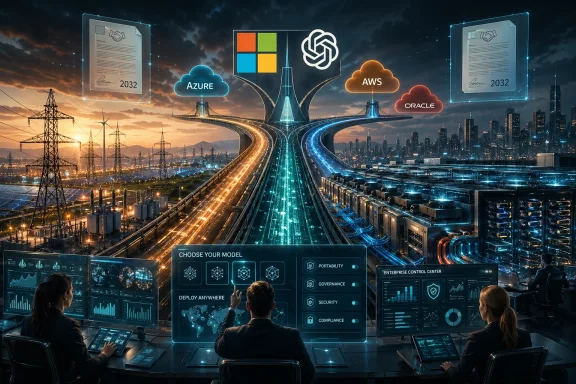 The End of Exclusivity Is Not the End of Dependence
The revised Microsoft-OpenAI agreement looks, at first glance, like a liberation story. OpenAI can now reach customers through more than Azure, while Microsoft keeps access to OpenAI technology without being its sole commercial gatekeeper. The old bargain — Microsoft provides capital and cloud, OpenAI provides frontier models — has been softened into something less possessive and more transactional.That matters because Microsoft’s early bet on OpenAI was one of the defining platform moves of the generative AI era. In 2019, when the rest of the industry still treated large language models as research curiosities, Microsoft bought itself privileged access to what became the most famous AI product line in the world. Azure was not just a cloud provider in that arrangement. It was the toll road to GPT.
But the economics of the sector have changed faster than the legal documents. The old model assumed frontier AI would be scarce, that one or two labs would have the only systems worth buying, and that cloud exclusivity could function like console exclusivity in gaming. If you wanted the model, you came to the platform.
That world is gone. Anthropic has Claude, Google has Gemini, Meta has pushed Llama into the open ecosystem, and enterprise buyers increasingly treat model selection as a portfolio decision rather than a marriage vow. The CIO’s question is no longer “Which model is smartest?” It is “Which models can I use, where, at what cost, under what governance regime, and with what escape hatch?”
Microsoft Traded a Crown Jewel for a Utility Bill
For Microsoft, losing exclusivity sounds dramatic only if exclusivity was still the asset it once appeared to be. In practice, the company has retained what may be more valuable: long-term OpenAI dependency on Azure, a major equity position, and a model license that continues through 2032. Microsoft gave up being the only door and preserved its place as one of the largest pipes.That is a very Microsoft move. The company’s modern strength has not been purity of control; it has been the ability to sit inside enterprise workflows until customers cannot easily extract it. Office became Microsoft 365. Windows became an endpoint in a cloud-management fabric. Azure became the commercial substrate for everything from identity to databases to AI.
In that context, OpenAI’s reported $250 billion Azure commitment is more important than the symbolic loss of exclusivity. A non-exclusive license may be less glamorous than an exclusive one, but a large, durable cloud-spend commitment is the kind of thing Wall Street understands. It turns AI drama into revenue visibility.
There is also a risk-transfer story here. Under the old mythology, Microsoft was the patron carrying OpenAI toward artificial general intelligence. Under the new structure, Microsoft can still benefit from OpenAI’s success while reducing the sense that it alone must finance the endless build-out. That matters in an industry where every new model generation seems to require more GPUs, more power, more data centers, and more patience from investors.
OpenAI Won Freedom and Inherited Three Landlords
OpenAI, meanwhile, gets what it has plainly needed: room to sell beyond Azure. Enterprise customers do not want to be forced into a single hyperscaler because one AI vendor signed a historic contract years earlier. Multi-cloud is not always elegant, but it is how large organizations manage risk, procurement politics, latency, compliance, and leverage.Yet freedom from one exclusive arrangement is not the same thing as freedom. OpenAI’s new position looks less like independence than refinancing. The company is spreading itself across Azure, Oracle, and AWS-scale infrastructure commitments because frontier AI is no longer primarily a software business. It is a capital-intensive industrial business with a chat interface on top.
That is the uncomfortable part. The more OpenAI diversifies its cloud access, the more it binds itself to long-duration infrastructure obligations. Each giant compute deal is marketed as capacity, but it is also a claim on future revenue. The assumption baked into these commitments is that demand for AI will grow fast enough, at high enough margins, to justify the physical build-out now underway.
That assumption may prove right. ChatGPT has become one of the most important consumer and enterprise software products of the decade, and OpenAI remains the company most closely associated with the generative AI boom. But the gap between today’s revenue and tomorrow’s compute commitments is the central tension of the business.
The Model Layer Is Becoming Crowded, Not Irrelevant
It would be a mistake to say models no longer matter. Better reasoning, lower hallucination rates, stronger coding ability, multimodal fluency, and agentic reliability all still shape buying decisions. The companies that build better models can still command attention, developer mindshare, and premium enterprise relationships.But scarcity is what has changed. In 2023, GPT-4 felt like a lonely summit. By 2026, the frontier has become a range of peaks. Some models are better at coding, others at writing, others at long-context analysis, others at cost-efficient deployment. For many businesses, the practical difference between the best model and the second-best model is less important than availability, data controls, integration, and price.
That is why the end of exclusivity is bigger than the Microsoft-OpenAI relationship. It signals that frontier models are becoming components in a broader stack. They are still valuable components, but they are increasingly swapped, routed, benchmarked, blended, and abstracted behind application layers.
The winners in that environment are not necessarily the labs with the most elegant demos. They may be the companies that control distribution, developer tools, enterprise procurement, and the infrastructure beneath it all. In other words, the AI race is starting to look less like a beauty contest among models and more like a war over logistics.
The New Oil Was Never Data. It Is Electricity.
The phrase “data is the new oil” was always too neat, and “models are the new oil” may have an even shorter shelf life. The more useful analogy in 2026 is electricity. AI companies do not merely need insight; they need megawatts, substations, cooling systems, fiber routes, accelerators, and years of construction discipline.That is why Oracle, Amazon, Microsoft, Google, Nvidia, Broadcom, and data-center operators matter so much in the current phase. They are not side characters supplying back-office capacity. They are the industrial base of the AI economy.
This is also where the old software margins start to look fragile. A classic software company writes code once and sells it many times. A frontier AI company serves inference every time a user asks a question and spends enormous sums training the next system before the current one has fully paid for itself. Scale helps, but scale also consumes capital.
For sysadmins and enterprise architects, this is not an abstract financial distinction. It determines pricing, service reliability, regional availability, latency, compliance options, and vendor lock-in. A model that looks portable in an API brochure may be deeply shaped by the hardware, networking, and optimization stack beneath it.
Amazon May Be the Quiet Winner of Everyone Else’s Drama
The most revealing figure in this story may not be Satya Nadella or Sam Altman. It may be Amazon Web Services, which has spent years watching Microsoft convert the OpenAI relationship into Azure momentum. If OpenAI becomes meaningfully available beyond Azure, AWS suddenly has a stronger answer for customers who want OpenAI access without redesigning their cloud estate around Microsoft.Amazon’s position is especially interesting because it does not need any single lab to win outright. It has backed Anthropic, built its own AI infrastructure story, and pursued OpenAI-related capacity. That is the platform owner’s dream: if the model war remains unsettled, the infrastructure provider sells to all sides.
This is the old picks-and-shovels story, but with a cloud-era twist. The seller of shovels in the gold rush did not have to correctly predict which miner would strike gold. The seller needed miners to keep digging. In AI, the miners are frontier labs, app developers, enterprises, and governments; the shovels are GPUs, custom accelerators, cloud instances, power contracts, and data-center leases.
The more expensive the race becomes, the better this position can look. Model companies must prove that intelligence can be sold profitably at planetary scale. Cloud companies need only prove that customers will keep renting the machinery.
The AGI Clause Was a Warning From the Future
The removal of the AGI-linked structure is not just legal housekeeping. It is an admission that “AGI” is too unstable a concept to bear the weight of a trillion-dollar industry. As a scientific aspiration, it remains powerful. As a contract trigger, it was always a litigation machine waiting to happen.Microsoft and OpenAI’s earlier arrangement reportedly treated AGI as a milestone that could change access rights and economics. That made sense in a world where the partnership was framed almost as a joint expedition toward a singular breakthrough. But commercial AI has become messier, more incremental, and more distributed than that.
No board declaration can cleanly settle whether a model has crossed some metaphysical threshold into general intelligence. Customers care about whether it can automate workflows, write code, summarize documents, pass audits, reduce support costs, or generate new risks. Regulators care about safety, competition, privacy, and accountability. Investors care about revenue and margins.
By replacing AGI ambiguity with fixed dates, caps, and non-exclusive rights, the companies are moving from prophecy to accounting. That is healthy, even if it is less exciting. The AI industry needs fewer mystical escape hatches and more contracts that can survive contact with ordinary business reality.
Enterprise IT Should Read This as a Lock-In Story
For WindowsForum readers, the practical lesson is not that OpenAI has escaped Microsoft or that Microsoft has lost the AI race. The lesson is that lock-in is moving down the stack. It is becoming less visible to end users and more embedded in infrastructure, data gravity, model routing, identity systems, and procurement commitments.In the first stage of cloud adoption, lock-in meant choosing Azure SQL over a portable database, or building too heavily around AWS-specific services. In the AI era, lock-in may mean tuning workflows around one model family, storing embeddings in one vendor’s format, building agents around one orchestration layer, or depending on inference capacity that only exists in certain regions.
That makes the end of OpenAI exclusivity both good and insufficient. More cloud availability gives enterprises leverage. It does not automatically give them portability. A model endpoint that appears in multiple clouds can still behave differently depending on networking, data residency, throughput limits, security controls, and integration with native services.
The smartest IT teams will treat model access the way they learned to treat cloud services: useful, powerful, and never free of architectural consequences. The procurement conversation should not stop at token price. It should include exit costs, model substitution plans, logging, auditability, latency, compliance boundaries, and whether the vendor can actually deliver capacity when demand spikes.
Copilot Is Now More Than a Reseller Strategy
Microsoft’s own AI strategy also becomes clearer after the revision. The company cannot rely forever on being the privileged reseller of OpenAI intelligence. It has to make Copilot valuable as a Microsoft product, not merely as a GPT wrapper with enterprise branding.That is already the direction of travel. Copilot’s advantage is not only the underlying model; it is its position inside Microsoft 365, Windows, GitHub, Defender, Azure, Power Platform, and the identity fabric of corporate IT. If Microsoft can make AI useful inside the workflows people already inhabit, it does not need exclusive model rights to maintain leverage.
This is where the loss of exclusivity may even help Microsoft. A non-exclusive world gives the company more room to mix models, build its own, use smaller specialized systems, and optimize for cost. The best enterprise AI product in 2026 may not be the one that always calls the most powerful frontier model. It may be the one that knows when not to.
That distinction will matter as AI budgets face scrutiny. Boards that rushed into generative AI pilots now want measurable productivity, not benchmark theater. If Microsoft can turn AI into an operating layer across enterprise software, it can survive a world where OpenAI also sells through rival clouds.
OpenAI’s Brand Is Huge, but Brand Does Not Pay the Power Bill
OpenAI still has extraordinary advantages. It has the ChatGPT brand, a massive user base, developer attention, enterprise momentum, and a cultural position no rival has fully matched. When ordinary people talk about AI, they often mean ChatGPT in the same way people once said Google when they meant search.But brand dominance is not the same as economic inevitability. The company’s challenge is to convert usage into revenue at a scale that matches its infrastructure appetite. That is a harder problem than producing impressive demos or launching faster models.
The consumer subscription business is meaningful but not enough on its own. Enterprise adoption can be lucrative but comes with security reviews, discounts, support obligations, integration costs, and competition from Microsoft, Google, Anthropic, and open-source alternatives. API usage can grow quickly but is price-sensitive and increasingly subject to routing engines that choose the cheapest adequate model.
This is why the infrastructure commitments matter so much. If demand keeps compounding, OpenAI looks visionary for securing capacity early. If growth slows, competition compresses prices, or enterprises become more selective, those same commitments begin to look like a burden.
The AI Race Is Becoming an Industrial Policy Question
There is another layer beneath the corporate drama: national infrastructure. Gigawatt-scale AI data centers are not just procurement exercises. They are energy, water, land-use, grid-planning, semiconductor-supply, and geopolitical questions.The United States wants to remain the center of frontier AI. That requires more than clever researchers in San Francisco and Seattle. It requires transmission lines, permitting reform, chip supply, export controls, clean power, backup generation, and communities willing to host enormous facilities.
This is where AI starts to resemble earlier strategic industries. Railroads, telecom networks, oil refining, cloud computing, and semiconductor fabrication all eventually became questions of national capacity. AI is moving along the same path, only faster and with more speculative capital.
The irony is that the most futuristic industry on earth is being constrained by some of the oldest bottlenecks: electricity, concrete, copper, land, and time. No model can prompt-engineer its way around a grid connection that will not be ready for three years.
The Contract Is the Product Now
The Microsoft-OpenAI revision should be read as part of a broader normalization of AI. The industry is still moving quickly, but its center of gravity is shifting from research announcements to contract architecture. Who has access to which models? For how long? On what clouds? Under what revenue share? With what capacity guarantees? At what capital cost?Those questions are less glamorous than model benchmarks, but they are increasingly where power resides. A benchmark can change in a quarter. A data-center lease can last longer than a product cycle, a CEO tenure, or a hardware generation.
That is why the “parting ways” narrative is too simple. Microsoft and OpenAI are not separating so much as redefining the terms of mutual dependence. Microsoft wants upside without bearing every risk. OpenAI wants distribution without being trapped inside one cloud. Both want enough flexibility to survive a market that is changing under their feet.
The result is not the end of partnership. It is the end of innocence. The AI boom has entered the phase where contracts, capacity, and cash flow matter as much as research prestige.
The Cloud Bill Tells the Story Better Than the Press Release
The most concrete lesson from the Microsoft-OpenAI reset is that the industry’s scarce resource has moved. Model quality still matters, but it no longer explains the whole competitive landscape. The companies best positioned for the next phase are those that can turn intelligence into a dependable utility without being crushed by the cost of producing it.- Microsoft has lost OpenAI exclusivity, but it has preserved long-term access, equity upside, and a major Azure spending commitment.
- OpenAI has gained multi-cloud freedom, but that freedom is paired with enormous infrastructure obligations across the hyperscaler ecosystem.
- Enterprise customers are likely to benefit from broader access to OpenAI products, but true portability will still require careful architecture.
- The removal of AGI-linked contract terms suggests the industry is replacing vague futurism with more conventional commercial guardrails.
- The biggest beneficiaries may be infrastructure providers that profit whether OpenAI, Anthropic, Google, Meta, or another lab wins a given model cycle.
- The AI market is shifting from model exclusivity to capacity control, and that shift favors companies with power, chips, data centers, and patient capital.
Source: TechFlow Post 微软与 OpenAI「分手」:模型独家的时代终结了
