

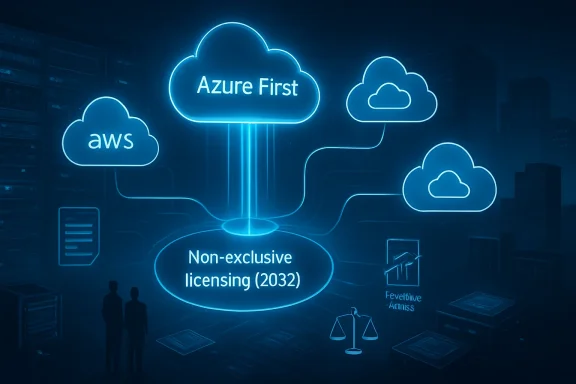
OpenAI and Microsoft have rewritten the terms of one of the most important partnerships in modern technology, preserving a deep alliance while loosening the exclusivity that helped define the first wave of commercial generative AI. Under the amended agreement announced on April 27, 2026, Microsoft remains OpenAI’s primary cloud partner, and OpenAI products will still debut first on Azure when Azure can support the required capabilities. But the deal now gives OpenAI more freedom to offer products across other clouds, turns Microsoft’s OpenAI license into a non-exclusive arrangement through 2032, and reshapes the revenue-sharing mechanics that tied the two companies together during the AI boom.
The Microsoft-OpenAI relationship began as a high-conviction bet before generative AI became a boardroom priority. Microsoft’s early investment gave OpenAI the cloud infrastructure it needed to train frontier models, while Microsoft gained a privileged position in what became the most consequential AI platform shift since mobile computing. That arrangement helped propel ChatGPT, Microsoft Copilot, Azure AI services, and a broader wave of enterprise AI adoption.
The original partnership structure made strategic sense when training frontier models required enormous capital, scarce GPU capacity, and a cloud partner willing to absorb risk. Microsoft had the infrastructure, enterprise distribution, and developer ecosystem; OpenAI had the research velocity and cultural momentum. Together, they turned large language models from experimental systems into mainstream productivity tools.
But the AI market of 2026 is not the AI market of 2019 or 2023. Demand for inference capacity has exploded, enterprises increasingly want multi-cloud AI deployment, and every major cloud provider is racing to host, optimize, and monetize leading models. A partnership built around exclusivity could become a bottleneck if OpenAI wants broader distribution and Microsoft wants clearer commercial predictability.
The revised agreement should be understood as a maturation of the relationship rather than a simple breakup. Microsoft keeps privileged access, shareholder exposure, and first-launch advantages. OpenAI gains operational room to scale beyond one infrastructure lane, even as it continues to rely heavily on Microsoft’s cloud and enterprise reach.
Microsoft remains central to OpenAI’s product pipeline. OpenAI products are still expected to launch first on Azure, unless Microsoft cannot support the necessary capabilities and chooses not to do so. That clause gives Azure a privileged position while acknowledging a practical reality: no single cloud provider can indefinitely satisfy every frontier AI capacity requirement.
Key terms now appear to include:
Azure remains the first stop for OpenAI products, which means Microsoft can still integrate new capabilities rapidly into Copilot, Azure AI Foundry, developer tools, security products, and enterprise software. That advantage is meaningful because first access often determines which platform gets early developer experimentation, early reference architectures, and early customer migration plans.
The updated model creates several consequences for cloud infrastructure:
The difference between exclusive and non-exclusive licensing is not academic. An exclusive license can function like a strategic moat, limiting how rivals access or package similar capabilities. A non-exclusive license still provides valuable access, but it reduces the degree to which one partner can dictate the commercial shape of the entire market.
The practical implications include:
This is not simply a financial footnote. Revenue-sharing models can influence product packaging, sales incentives, cloud routing, and partner negotiations. A capped structure gives OpenAI more certainty about future obligations, while Microsoft retains a path to benefit from OpenAI’s commercial expansion.
The new revenue model appears to create:
But not every enterprise is Azure-centered. Some run major workloads on AWS, Google Cloud, Oracle Cloud, private infrastructure, or industry-specific platforms. The amended agreement allows OpenAI to reach those customers more directly without forcing every AI adoption plan through a Microsoft-shaped doorway.
Enterprise benefits may include:
If OpenAI can scale across multiple infrastructure partners, consumers may see better availability, faster feature rollout, and more localized services. If competition among cloud providers lowers cost or increases capacity, consumer-facing AI products could become more capable without dramatic price increases. That outcome is not guaranteed, but the incentive structure points in that direction.
The consumer-facing effects to watch include:
AWS and Google have their own AI strategies, including in-house models, partner models, custom chips, and developer platforms. Access to OpenAI products does not replace those efforts, but it could strengthen their marketplaces and reduce the perception that Azure is the only practical enterprise route to OpenAI-grade capabilities.
Competitive implications include:
Microsoft has invested heavily in AI data center buildout and custom silicon. OpenAI, meanwhile, needs enough compute to train larger models, run inference for global users, and support enterprise-grade service levels. The amended deal appears designed to avoid a future in which business demand outstrips contractual flexibility.
The industry will increasingly focus on:
However, more distribution channels can also create confusion. Developers will need to understand which features are available where, how pricing differs, what compliance guarantees apply, and whether model behavior is consistent across providers. Choice is powerful only when the differences are transparent.
A sensible evaluation process would look like this:
Regulators will examine whether major AI partnerships concentrate power in subtle ways. Even without exclusivity, a cloud provider can gain advantage through technical integration, pricing, preferential launch timing, or bundled enterprise contracts. The new deal may look more open, but openness must be tested in practice.
Governance concerns include:
Microsoft’s execution will also matter. The company must prove that Azure is the best operational home for OpenAI workloads, not simply the historic one. That means delivering superior reliability, governance, developer tooling, security integration, and total cost of ownership for enterprises already invested in Microsoft’s ecosystem.
Watch these signals closely:
Source: Exchange4Media https://www.exchange4media.com/digi...d-partnership-terms-amid-ai-surge-154197.html
 Background
The Microsoft-OpenAI relationship began as a high-conviction bet before generative AI became a boardroom priority. Microsoft’s early investment gave OpenAI the cloud infrastructure it needed to train frontier models, while Microsoft gained a privileged position in what became the most consequential AI platform shift since mobile computing. That arrangement helped propel ChatGPT, Microsoft Copilot, Azure AI services, and a broader wave of enterprise AI adoption.The original partnership structure made strategic sense when training frontier models required enormous capital, scarce GPU capacity, and a cloud partner willing to absorb risk. Microsoft had the infrastructure, enterprise distribution, and developer ecosystem; OpenAI had the research velocity and cultural momentum. Together, they turned large language models from experimental systems into mainstream productivity tools.
But the AI market of 2026 is not the AI market of 2019 or 2023. Demand for inference capacity has exploded, enterprises increasingly want multi-cloud AI deployment, and every major cloud provider is racing to host, optimize, and monetize leading models. A partnership built around exclusivity could become a bottleneck if OpenAI wants broader distribution and Microsoft wants clearer commercial predictability.
The revised agreement should be understood as a maturation of the relationship rather than a simple breakup. Microsoft keeps privileged access, shareholder exposure, and first-launch advantages. OpenAI gains operational room to scale beyond one infrastructure lane, even as it continues to rely heavily on Microsoft’s cloud and enterprise reach.
The New Deal Rebalances Power Without Ending the Alliance
The most important takeaway is that Microsoft and OpenAI are not separating. They are converting a tightly coupled arrangement into a more flexible commercial framework better suited to the next phase of AI adoption. That distinction matters because the market often treats any reduction in exclusivity as a sign of conflict, when it can also be a sign of institutional maturity.Microsoft remains central to OpenAI’s product pipeline. OpenAI products are still expected to launch first on Azure, unless Microsoft cannot support the necessary capabilities and chooses not to do so. That clause gives Azure a privileged position while acknowledging a practical reality: no single cloud provider can indefinitely satisfy every frontier AI capacity requirement.
From exclusive dependency to structured flexibility
The revised agreement shifts the partnership from exclusive control toward structured preference. Microsoft is still first in line, but OpenAI is no longer boxed into a single distribution path. That gives OpenAI more leverage, while giving Microsoft a cleaner contract that defines what it keeps and what it no longer controls.Key terms now appear to include:
- Azure-first product launches for OpenAI services when Microsoft can support them.
- OpenAI availability across other cloud platforms, giving customers more deployment choice.
- Microsoft model and product access through 2032, preserving long-term integration potential.
- Non-exclusive intellectual property licensing, reducing Microsoft’s sole-control advantage.
Azure Keeps Its Crown, But Not Its Walls
For WindowsForum readers, the Azure angle is the most immediate technical story. Microsoft built much of its AI credibility around the idea that Azure was not just another cloud, but the preferred home for OpenAI workloads. The amended agreement preserves that branding advantage while removing the harder edge of exclusivity.Azure remains the first stop for OpenAI products, which means Microsoft can still integrate new capabilities rapidly into Copilot, Azure AI Foundry, developer tools, security products, and enterprise software. That advantage is meaningful because first access often determines which platform gets early developer experimentation, early reference architectures, and early customer migration plans.
Capacity is now the strategic battlefield
The change also reflects the harsh economics of AI infrastructure. Training frontier models and serving global inference traffic require data centers, accelerators, networking, power, cooling, and orchestration at a scale that challenges even the largest cloud providers. If OpenAI needs more capacity than Azure can deliver at a given moment, flexibility becomes essential rather than optional.The updated model creates several consequences for cloud infrastructure:
- Azure remains a preferred AI launchpad, especially for Microsoft-native enterprises.
- Other clouds gain a path to OpenAI workloads, increasing competitive pressure.
- Capacity planning becomes more distributed, reducing single-provider bottlenecks.
- Customers gain leverage, because OpenAI services can meet them where their workloads already live.
Intellectual Property Terms Signal a More Open Commercial Era
The revised intellectual property terms may prove more important than the cloud language. Microsoft will continue to have access to OpenAI models and products through 2032, but the license is now non-exclusive. That keeps Microsoft inside OpenAI’s innovation stream while allowing OpenAI to commercialize more broadly.The difference between exclusive and non-exclusive licensing is not academic. An exclusive license can function like a strategic moat, limiting how rivals access or package similar capabilities. A non-exclusive license still provides valuable access, but it reduces the degree to which one partner can dictate the commercial shape of the entire market.
Why non-exclusive access matters
Microsoft’s continued access through 2032 gives it runway for long-term AI roadmaps. Windows, Office, Teams, GitHub, Dynamics, Defender, and Azure services can still be built around OpenAI-derived capabilities. But competitors and customers will now watch whether OpenAI’s models appear in more varied forms across other platforms.The practical implications include:
- Microsoft keeps continuity for Copilot and Azure AI services.
- OpenAI gains distribution freedom beyond Microsoft-controlled channels.
- Enterprise buyers get more architectural options for compliance and procurement.
- Cloud rivals can pursue deeper OpenAI integrations, where commercially permitted.
Revenue Sharing Becomes More Predictable
The amended agreement changes the money flow in ways that reveal both companies’ priorities. Microsoft will no longer pay a revenue share to OpenAI, while OpenAI will continue sharing revenue with Microsoft through 2030 under existing percentage terms, now subject to a total cap. Microsoft also remains a significant shareholder, giving it upside if OpenAI continues to grow.This is not simply a financial footnote. Revenue-sharing models can influence product packaging, sales incentives, cloud routing, and partner negotiations. A capped structure gives OpenAI more certainty about future obligations, while Microsoft retains a path to benefit from OpenAI’s commercial expansion.
A cleaner financial map for a larger market
The end of Microsoft payments to OpenAI suggests the relationship is becoming less like a tightly interlocked operating arrangement and more like a major strategic investment plus licensing partnership. Microsoft has already embedded AI throughout its software portfolio, so its return may increasingly come from enterprise subscriptions and cloud consumption rather than direct revenue pass-through.The new revenue model appears to create:
- Greater financial predictability for OpenAI as it scales.
- Continued Microsoft participation in OpenAI revenue through 2030.
- Reduced circular payments between the two companies.
- Clearer investor narrative if OpenAI moves toward broader capital-market options.
Enterprise Customers Gain More Deployment Choice
The enterprise impact may be the most important near-term effect. Many large organizations have standardized on Microsoft because of Windows, Microsoft 365, Entra ID, Defender, Teams, and Azure. For them, Azure-first OpenAI access remains attractive because it fits procurement, identity, compliance, and security workflows.But not every enterprise is Azure-centered. Some run major workloads on AWS, Google Cloud, Oracle Cloud, private infrastructure, or industry-specific platforms. The amended agreement allows OpenAI to reach those customers more directly without forcing every AI adoption plan through a Microsoft-shaped doorway.
Multi-cloud AI becomes more realistic
This is especially important for regulated industries. Banks, healthcare systems, manufacturers, governments, and telecom providers often split workloads across multiple clouds for resilience, latency, data residency, or vendor-risk reasons. If OpenAI products can be made available across more environments, those organizations can adopt advanced AI with fewer architectural compromises.Enterprise benefits may include:
- Better alignment with existing cloud contracts and procurement rules.
- More flexibility for data residency and sovereignty requirements.
- Reduced dependence on a single AI infrastructure provider.
- Greater bargaining power when negotiating AI platform costs.
Consumer AI Will Feel the Change Indirectly
Most consumers will not notice the legal mechanics of the revised partnership. They will continue to use ChatGPT, Copilot, Windows AI features, Office assistants, and app integrations without thinking about cloud routing or IP rights. But the new structure could influence how quickly AI products improve and how widely they appear.If OpenAI can scale across multiple infrastructure partners, consumers may see better availability, faster feature rollout, and more localized services. If competition among cloud providers lowers cost or increases capacity, consumer-facing AI products could become more capable without dramatic price increases. That outcome is not guaranteed, but the incentive structure points in that direction.
Windows and Copilot remain central
For Microsoft’s consumer ecosystem, Copilot remains the key vehicle. Windows users care less about which company holds which license and more about whether AI features are reliable, useful, private, and fast. Microsoft’s continued OpenAI access through 2032 gives it confidence to keep building AI deeply into Windows and Microsoft 365.The consumer-facing effects to watch include:
- More capable Copilot features across Windows and Microsoft 365.
- Potentially faster ChatGPT availability in non-Microsoft environments.
- More competition among AI assistants, including model choice inside apps.
- Pressure for clearer privacy controls as AI becomes more embedded.
The Competitive Map Changes for AWS, Google, and Others
The loosening of exclusivity gives rival cloud providers a clearer opening. AWS, Google Cloud, Oracle, and specialized AI infrastructure companies have all been competing to host frontier AI workloads. OpenAI’s ability to distribute products beyond Azure makes the market more contestable.AWS and Google have their own AI strategies, including in-house models, partner models, custom chips, and developer platforms. Access to OpenAI products does not replace those efforts, but it could strengthen their marketplaces and reduce the perception that Azure is the only practical enterprise route to OpenAI-grade capabilities.
Rivals get opportunity, not certainty
The revised Microsoft-OpenAI terms do not automatically hand victory to other clouds. Microsoft still has deep product integration, a massive enterprise sales force, and years of operational experience serving OpenAI workloads. Azure-first launch rights may preserve a significant timing advantage.Competitive implications include:
- AWS can pitch broader model choice to existing enterprise customers.
- Google Cloud can compete on AI infrastructure and research credibility.
- Oracle and specialized providers can target capacity-sensitive workloads.
- Microsoft must defend Azure through quality rather than exclusivity alone.
Data Centers and Chips Move to the Center of the Story
The agreement’s emphasis on data center capacity, next-generation chips, and cybersecurity reflects where the AI race is heading. Models matter, but infrastructure increasingly determines who can serve them at scale. The industry is entering a phase where power contracts, accelerator supply chains, networking fabric, and cooling systems are strategic assets.Microsoft has invested heavily in AI data center buildout and custom silicon. OpenAI, meanwhile, needs enough compute to train larger models, run inference for global users, and support enterprise-grade service levels. The amended deal appears designed to avoid a future in which business demand outstrips contractual flexibility.
Compute is the new platform lock-in
In earlier software eras, lock-in came from file formats, operating systems, APIs, and enterprise contracts. In frontier AI, lock-in can come from compute availability, accelerator optimization, proprietary serving stacks, and data pipelines. If a model performs best on one provider’s infrastructure, customers may become dependent even without formal exclusivity.The industry will increasingly focus on:
- GPU and AI accelerator supply, including custom chips.
- High-bandwidth networking, which determines training efficiency.
- Energy availability, especially for large AI campuses.
- Inference optimization, where cost per token becomes decisive.
- Security architecture, because AI workloads process sensitive enterprise data.
Developers Should Expect More Choice, but Also More Complexity
Developers may benefit from the revised agreement because OpenAI services can appear in more cloud-native contexts. A startup built on AWS or a data team standardized on Google Cloud may eventually access OpenAI capabilities without redesigning its architecture around Azure. That reduces friction and can speed experimentation.However, more distribution channels can also create confusion. Developers will need to understand which features are available where, how pricing differs, what compliance guarantees apply, and whether model behavior is consistent across providers. Choice is powerful only when the differences are transparent.
Practical steps for technical teams
Technical leaders should treat this as a reason to revisit AI architecture assumptions. If earlier roadmaps assumed that OpenAI meant Azure by default, that may no longer be the only viable path. But Azure will still be the most integrated route for many Microsoft-centric environments.A sensible evaluation process would look like this:
- Inventory existing AI dependencies, including APIs, model versions, data stores, and identity systems.
- Map workloads to compliance requirements, especially for regulated or confidential data.
- Compare latency and cost across deployment options as multi-cloud access becomes available.
- Test portability strategies, including abstraction layers and model-routing frameworks.
- Update vendor-risk reviews to reflect the new Microsoft-OpenAI commercial structure.
Regulatory and Governance Pressures Will Intensify
The Microsoft-OpenAI partnership has attracted attention because it sits at the intersection of cloud dominance, AI model access, enterprise software distribution, and data infrastructure. Loosening exclusivity may reduce some competition concerns, but it will not remove regulatory scrutiny. If anything, broader AI deployment makes governance more important.Regulators will examine whether major AI partnerships concentrate power in subtle ways. Even without exclusivity, a cloud provider can gain advantage through technical integration, pricing, preferential launch timing, or bundled enterprise contracts. The new deal may look more open, but openness must be tested in practice.
The antitrust question evolves
The old question was whether Microsoft had too much exclusive control over OpenAI’s technology. The new question is whether the AI market remains genuinely contestable when a few companies control models, cloud infrastructure, chips, and distribution. That is a harder issue because it involves ecosystem power rather than a single contract clause.Governance concerns include:
- Preferential access that gives one platform a lasting advantage.
- Bundling pressure inside enterprise productivity suites.
- Opaque pricing for AI services tied to cloud consumption.
- Data handling risks as AI spreads across more infrastructure providers.
- Model accountability gaps when products are distributed through multiple channels.
Strengths and Opportunities
The amended agreement has clear upside for both companies and for the broader AI ecosystem. It preserves the most productive parts of the Microsoft-OpenAI relationship while making room for the market reality that AI demand now exceeds any single partnership model. The strongest opportunity is that flexibility, scale, and competition can coexist if the companies execute well.- OpenAI gains broader distribution without losing Microsoft’s enterprise channel.
- Microsoft keeps strategic access to OpenAI models and products through 2032.
- Azure remains first in line, preserving a meaningful launch advantage.
- Enterprises get more cloud flexibility, especially in multi-cloud environments.
- Revenue terms become more predictable, helping long-term planning.
- Cloud competition should intensify, potentially improving pricing and performance.
- AI infrastructure investment accelerates, especially in data centers, chips, and security.
Risks and Concerns
The same flexibility that creates opportunity also introduces new uncertainty. The amended agreement reduces exclusivity, but it does not automatically produce simplicity for customers, developers, or regulators. The biggest concern is that AI distribution becomes broader while accountability becomes harder to follow.- Product fragmentation could make OpenAI features inconsistent across clouds.
- Azure’s first-launch advantage may still limit practical competition.
- Enterprise pricing may become harder to compare across bundled platforms.
- Security responsibilities may blur when workloads span multiple providers.
- Regulators may remain skeptical of deep AI-cloud partnerships.
- Infrastructure constraints may persist despite broader cloud access.
- Customers could face vendor lock-in through tooling, even without formal exclusivity.
What to Watch Next
The next phase will be measured less by press statements and more by product availability. If OpenAI services begin appearing widely across non-Microsoft clouds with strong performance and enterprise-grade controls, the amended agreement will look like a major market-opening move. If Azure continues to receive the most complete and timely features, the shift may be more symbolic than structural.Microsoft’s execution will also matter. The company must prove that Azure is the best operational home for OpenAI workloads, not simply the historic one. That means delivering superior reliability, governance, developer tooling, security integration, and total cost of ownership for enterprises already invested in Microsoft’s ecosystem.
Watch these signals closely:
- Which OpenAI products launch outside Azure, and how quickly they reach parity.
- How Microsoft packages Copilot upgrades around continued OpenAI access.
- Whether AWS, Google, or others announce deeper OpenAI integrations.
- How regulators respond to the revised non-exclusive structure.
- Whether AI infrastructure costs fall as cloud providers compete for workloads.
Source: Exchange4Media https://www.exchange4media.com/digi...d-partnership-terms-amid-ai-surge-154197.html
