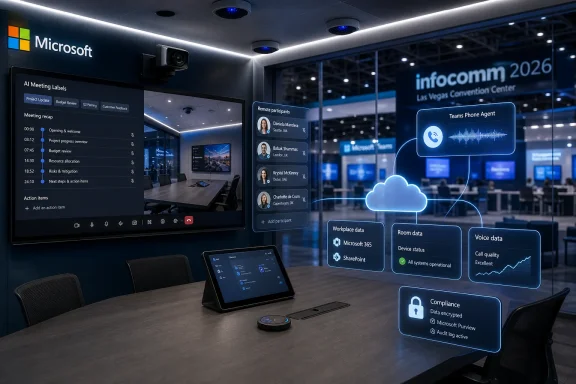
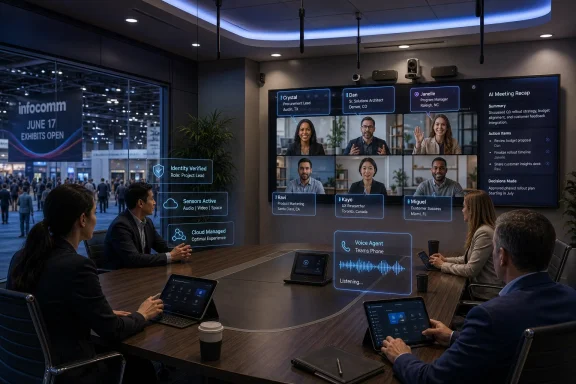
Microsoft used InfoComm 2026’s opening exhibit day in Las Vegas on June 17 to pitch Teams, Copilot Studio, Teams Phone, and Teams Rooms as the operating layer for AI-assisted work across offices, contact centers, and hybrid meeting spaces. The keynote was not just a product tour. It was a signal that the pro AV show floor is being pulled deeper into the same platform fight that has already reshaped enterprise software. If Microsoft is right, the next workplace upgrade cycle will be less about cameras and microphones as isolated devices, and more about whether every room, call, and customer interaction can become an AI-readable workflow.
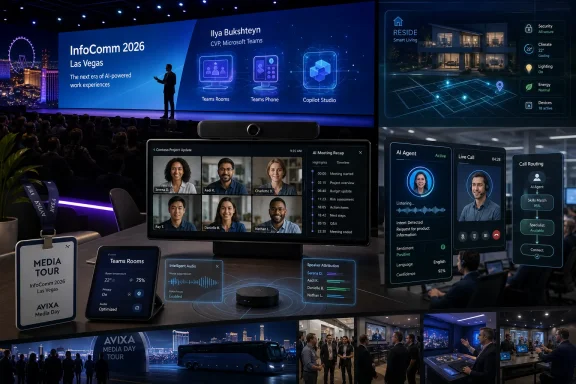
That is a big claim for a trade show whose historical center of gravity has been displays, audio systems, control rooms, projection, signage, and the physical craft of making technology work in real spaces. But InfoComm 2026 opened with a telling juxtaposition: Microsoft on the keynote stage, AVIXA launching its first Media Day, analysts talking about AI and broadcast-grade experience, and the announcement of RESIDE as a bridge between commercial and residential integration. The through-line is clear. AV is no longer a peripheral industry serving the endpoint; it is becoming the interface layer for AI, collaboration, and managed experience.
Microsoft’s keynote, delivered by Ilya Bukshteyn, corporate vice president for Microsoft Teams Calling, Meetings and Devices, framed AI as a practical assistant embedded into the rituals of work. The pitch was familiar in Microsoft language but unusually important in an InfoComm setting: agents should answer routine calls, summarize meetings, help prepare rooms, provide context to remote participants, and push human workers toward higher-value decisions.
That matters because Microsoft was not merely telling customers to buy more Teams licenses. It was telling the AV and IT channel that the room itself is becoming a software surface. Teams Rooms, Teams Phone, Copilot Studio, and Microsoft 365 Copilot are increasingly being described as parts of one system, with the physical environment feeding data and context into software that can act.
The new voice agents for Teams Phone are the clearest example. The Teams Phone Agent is designed to handle routine customer requests, while Copilot Studio allows organizations to build custom voice agents for specialized workflows, including phone-based transactions. For enterprise IT, that shifts phone infrastructure from a static communications utility into something closer to an application platform.
That shift is not theoretical. Contact centers have been moving toward AI-assisted triage and summarization for years, but Microsoft’s advantage is distribution. Teams already sits on the desktops, headsets, room consoles, mobile devices, and calling plans of many organizations. If Microsoft can make voice agents feel like a natural extension of Teams Phone rather than a separate contact-center science project, it could move AI call handling from the pilot pile into the default procurement conversation.
Teams Rooms updates such as IntelliFrame people labels and expanded Facilitator agent capabilities are aimed at the persistent weaknesses of hybrid meetings. Remote participants often lose the room’s social context. In-room participants forget they are being mediated through cameras and microphones. Meeting outcomes vanish into chat threads, partial notes, and calendar artifacts. AI recap, room intelligence, and pre- or post-meeting assistance are Microsoft’s attempt to turn the meeting from a one-hour event into a managed workflow.
The important word is managed. AV professionals have long been judged by whether a room works when a user walks in and presses a button. Microsoft’s AI framing widens that scope. A room that “works” may soon be expected to identify speakers, preserve action items, surface relevant documents, hand off follow-ups, and integrate with customer or operational systems.
That raises the bar for integrators. Installing a camera bar or certified room kit is no longer enough when the customer expects the room to participate in the business process. The trade skill moves from signal flow and acoustics alone toward identity, permissions, data retention, governance, network quality, and application integration. The AV rack is not disappearing, but it is being wrapped in enterprise policy.
The hard part is not making an AI voice sound competent for two minutes on a show floor. The hard part is making it safe, compliant, auditable, and contextually correct across thousands of calls involving frustrated customers, ambiguous requests, account-specific policies, and edge-case exceptions. Phone interactions are messy because people use them when the website, app, or prior process has failed.
Microsoft’s Copilot Studio story gives enterprises a more governed path than a random voice-bot startup can usually promise. It also creates a new burden for administrators. A custom voice agent is not simply a bot; it is a business application with access to knowledge bases, workflows, identity controls, telephony systems, and potentially sensitive customer data.
That is where InfoComm’s AV audience becomes relevant. Voice quality, microphone placement, acoustic treatment, endpoint certification, and network design all affect whether these agents succeed in real deployments. If a human customer cannot be understood clearly, the agent cannot act reliably. AI does not abolish the physics of audio; it makes the cost of bad audio more visible.
Trade shows now compete not only for attendees but for narrative authority. CES owns consumer technology spectacle. NAB owns broadcast transformation. ISE has become a major global stage for systems integration. InfoComm, as North America’s largest pro AV exhibition, needs to explain why its industry matters in the AI era.
Media Day is an answer to that challenge. AVIXA is effectively saying that the innovations on the floor should not be understood as isolated product announcements. They are part of a larger transition toward intelligent experiences, hybrid work infrastructure, immersive environments, and software-defined operations.
That framing helps exhibitors, but it also helps AVIXA. A show organized only around categories such as displays, control, audio, and conferencing risks sounding like a supply chain directory. A show organized around workplace transformation, AI, broadcast convergence, and integrated experience sounds like a strategic destination for CIOs, facilities leaders, customer experience executives, and enterprise architects.
That expectation changes buying behavior. Customers are less likely to fund a project simply because a component is newer. They want measurable outcomes: better meeting equity, faster service resolution, stronger engagement, clearer messaging, improved accessibility, reduced operational cost, or more adaptable spaces.
AI is central to that conversation because it promises to turn AV systems from presentation tools into sensing and response systems. A camera is not merely a camera if it can frame speakers, identify participants, support analytics, and feed meeting intelligence. A microphone array is not merely a microphone if it enables transcription, translation, voice agents, and compliance records. A display is not merely a display if it becomes a dynamic endpoint for personalized content and operational data.
The danger is that “AI” becomes the new “cloud”: a word slapped on everything until it loses meaning. InfoComm’s first day already showed the industry’s tension. Serious vendors are trying to solve real problems in collaboration and experience design, while some marketing departments will inevitably turn machine learning into booth wallpaper. The winners will be the companies that can explain what data they use, what decisions the system makes, what humans can override, and what happens when the model is wrong.
Teams Rooms began as a way to make video meetings less awful. It has become a beachhead into facilities planning, device lifecycle management, meeting intelligence, and hybrid workplace strategy. The addition of AI features accelerates that move because the room is no longer just a place where Teams happens. It becomes a context collector for Copilot-era work.
This should make IT departments both interested and cautious. A standardized meeting-room platform simplifies support, procurement, training, and remote management. But it can also concentrate dependency on one vendor’s roadmap, licensing model, and cloud reliability. The more intelligence Microsoft adds, the harder it becomes to treat the room system as interchangeable commodity hardware.
For AV integrators, this is a double-edged opportunity. Microsoft’s ecosystem creates demand for certified devices, deployment services, acoustic expertise, and managed support. But it also narrows differentiation if customers think of the room primarily as a Microsoft endpoint. The integrator’s value must move upstream into design, governance, workflow integration, and lifecycle services, not merely device installation.
That makes Teams Phone a strategic wedge. Microsoft is not only competing with unified communications vendors; it is edging further into the contact-center and customer-experience stack. Copilot Studio gives business users and IT teams a low-code way to build agents, while Teams Phone provides a familiar channel for deployment.
The risk is that customer experience becomes the proving ground for half-ready automation. Enterprises have incentives to reduce labor costs, and customers have limited patience for systems that pretend to understand more than they do. The difference between a helpful voice agent and a brand-damaging loop is often the quality of escalation, data integration, and human oversight.
Microsoft’s message at InfoComm implicitly recognizes that AI should work “on our behalf,” not replace accountability. But buyers should parse that language carefully. If an agent books a service appointment, changes an order, collects payment details, or gives policy guidance, the organization remains responsible for the outcome. AI may handle the call, but governance owns the consequence.
That convergence is not simply about wealthy homes borrowing commercial gear. It is about shared expectations. People now move between offices, homes, schools, hotels, healthcare spaces, retail environments, and entertainment venues expecting consistent connectivity, high-quality audio and video, intuitive control, and increasingly personalized experiences.
The residential channel has also become a testbed for experience design. Lighting, shading, media, security, networking, wellness, energy management, and voice control are converging in the home just as collaboration, signage, analytics, and automation are converging in commercial spaces. The technical vocabularies differ, but the direction is similar: integrated systems managed as experience platforms.
By placing RESIDE near InfoComm, AVIXA is trying to capture that overlap before someone else does. The move also acknowledges that integrators increasingly operate in hybrid markets. A firm that designs executive briefing centers may also understand luxury residential theaters. A residential integrator that masters lighting, networking, and control may find opportunities in boutique hospitality or small commercial spaces.
The partnership with HTSA and ProSource helps solve that problem by giving RESIDE residential credibility rather than making it look like a commercial show awkwardly bolting on a home-theater pavilion. Together, those groups represent hundreds of residential integration firms, which gives the new event an immediate channel base.
Still, the execution will matter. Residential integration has its own culture, sales model, customer expectations, and training needs. A successful RESIDE cannot simply recycle enterprise AV programming with nicer lighting demos. It will need to speak to custom integrators, builders, architects, designers, and manufacturers in a way that respects the residential market’s economics.
For WindowsForum readers, the relevance is broader than show logistics. The same convergence shaping enterprise collaboration is reshaping the smart home and connected building. Windows endpoints, Teams rooms, Azure services, identity systems, edge devices, and IoT management all sit in the path of that convergence. The old line between “the office network” and “the experience environment” is becoming harder to defend.
Does the system explain what it captured? Does it protect sensitive conversations? Can administrators control retention? Can users correct mistakes? Does it work for accents, soft speakers, crowded rooms, and imperfect acoustics? Does it fail safely? Can it be audited? Can it be turned off without breaking the room?
These questions matter because AI in AV is unusually intimate. It enters meetings, classrooms, clinics, boardrooms, customer calls, and homes. It listens to people, watches rooms, summarizes decisions, labels participants, and may soon take action through agents. That makes trust a product feature, not a legal appendix.
Microsoft has an advantage here because enterprise buyers already understand its compliance story, even if they do not always love its licensing complexity. Smaller AV vendors will need to be equally clear about data handling, model behavior, update policies, and integration boundaries. “Powered by AI” is no longer enough. In many deployments, it may be the beginning of the security questionnaire.
A meeting room with speaker recognition, people labels, recap, agents, and cloud management is an identity-sensitive endpoint. A Teams Phone voice agent connected to business workflows is an application. A digital signage system using audience analytics is a data governance issue. A residential-style experience layer in a corporate hospitality space may cross into privacy, security, and building-management policy.
That does not mean every AV professional must become a cloud architect, or every sysadmin must understand acoustic modeling. It means the handoff model is breaking. The AV team cannot install and walk away; IT cannot treat the room as a dumb peripheral. The most successful deployments will be run by cross-functional teams that understand both user experience and operational risk.
This is where the Windows ecosystem has a quiet but important role. Windows-based management tools, Microsoft 365 administration, Entra identity, Intune device governance, Teams admin policies, Power Platform controls, and Azure services all become part of the collaboration environment. The “room” is increasingly a managed endpoint in the Microsoft estate.
That is why Microsoft may succeed where flashier AI demos fail. The company is not asking enterprises to invent entirely new behaviors. It is embedding AI into existing work patterns: call, meet, summarize, route, follow up, escalate, schedule, decide. The magic trick is to make automation feel like the next version of office plumbing.
But boring does not mean harmless. Office plumbing shapes how organizations work. If Teams agents become the front door for customer calls, if Copilot summaries become the default memory of meetings, and if room intelligence becomes the basis for hybrid participation, Microsoft’s interpretation of work becomes more deeply embedded in enterprise culture.
That is the real platform play. Microsoft is not just adding AI to Teams. It is trying to define the normalized workflow of AI-assisted collaboration, with the AV industry providing the physical interface. InfoComm 2026 made that strategy visible.
That is a big claim for a trade show whose historical center of gravity has been displays, audio systems, control rooms, projection, signage, and the physical craft of making technology work in real spaces. But InfoComm 2026 opened with a telling juxtaposition: Microsoft on the keynote stage, AVIXA launching its first Media Day, analysts talking about AI and broadcast-grade experience, and the announcement of RESIDE as a bridge between commercial and residential integration. The through-line is clear. AV is no longer a peripheral industry serving the endpoint; it is becoming the interface layer for AI, collaboration, and managed experience.
 Microsoft Brings the Platform War to the Meeting Room
Microsoft’s keynote, delivered by Ilya Bukshteyn, corporate vice president for Microsoft Teams Calling, Meetings and Devices, framed AI as a practical assistant embedded into the rituals of work. The pitch was familiar in Microsoft language but unusually important in an InfoComm setting: agents should answer routine calls, summarize meetings, help prepare rooms, provide context to remote participants, and push human workers toward higher-value decisions.That matters because Microsoft was not merely telling customers to buy more Teams licenses. It was telling the AV and IT channel that the room itself is becoming a software surface. Teams Rooms, Teams Phone, Copilot Studio, and Microsoft 365 Copilot are increasingly being described as parts of one system, with the physical environment feeding data and context into software that can act.
The new voice agents for Teams Phone are the clearest example. The Teams Phone Agent is designed to handle routine customer requests, while Copilot Studio allows organizations to build custom voice agents for specialized workflows, including phone-based transactions. For enterprise IT, that shifts phone infrastructure from a static communications utility into something closer to an application platform.
That shift is not theoretical. Contact centers have been moving toward AI-assisted triage and summarization for years, but Microsoft’s advantage is distribution. Teams already sits on the desktops, headsets, room consoles, mobile devices, and calling plans of many organizations. If Microsoft can make voice agents feel like a natural extension of Teams Phone rather than a separate contact-center science project, it could move AI call handling from the pilot pile into the default procurement conversation.
The AV Industry Is Being Rewritten by Software Gravity
InfoComm has always followed the workplace, but the workplace now follows software. The pandemic-era argument for hybrid work has matured into a more operational question: how do organizations make distributed collaboration less brittle, less exclusionary, and less dependent on heroic meeting etiquette? Microsoft’s answer is to make the meeting system more aware.Teams Rooms updates such as IntelliFrame people labels and expanded Facilitator agent capabilities are aimed at the persistent weaknesses of hybrid meetings. Remote participants often lose the room’s social context. In-room participants forget they are being mediated through cameras and microphones. Meeting outcomes vanish into chat threads, partial notes, and calendar artifacts. AI recap, room intelligence, and pre- or post-meeting assistance are Microsoft’s attempt to turn the meeting from a one-hour event into a managed workflow.
The important word is managed. AV professionals have long been judged by whether a room works when a user walks in and presses a button. Microsoft’s AI framing widens that scope. A room that “works” may soon be expected to identify speakers, preserve action items, surface relevant documents, hand off follow-ups, and integrate with customer or operational systems.
That raises the bar for integrators. Installing a camera bar or certified room kit is no longer enough when the customer expects the room to participate in the business process. The trade skill moves from signal flow and acoustics alone toward identity, permissions, data retention, governance, network quality, and application integration. The AV rack is not disappearing, but it is being wrapped in enterprise policy.
Voice Agents Are the Most Tempting—and Most Dangerous—Demo
Microsoft’s Teams Phone Agent is easy to understand because everyone has experienced a bad customer service call. A voice agent that can answer routine questions, collect information, route requests, and complete simple transactions sounds like an obvious productivity gain. It also sounds like the kind of technology that will be oversold before it is fully trusted.The hard part is not making an AI voice sound competent for two minutes on a show floor. The hard part is making it safe, compliant, auditable, and contextually correct across thousands of calls involving frustrated customers, ambiguous requests, account-specific policies, and edge-case exceptions. Phone interactions are messy because people use them when the website, app, or prior process has failed.
Microsoft’s Copilot Studio story gives enterprises a more governed path than a random voice-bot startup can usually promise. It also creates a new burden for administrators. A custom voice agent is not simply a bot; it is a business application with access to knowledge bases, workflows, identity controls, telephony systems, and potentially sensitive customer data.
That is where InfoComm’s AV audience becomes relevant. Voice quality, microphone placement, acoustic treatment, endpoint certification, and network design all affect whether these agents succeed in real deployments. If a human customer cannot be understood clearly, the agent cannot act reliably. AI does not abolish the physics of audio; it makes the cost of bad audio more visible.
Media Day Shows AVIXA Wants to Control the Story, Not Just Host the Show
The debut of InfoComm’s first Media Day was more than a hospitality exercise. AVIXA brought 19 exhibiting companies and 40 journalists into curated tours designed to surface product launches, partnerships, and strategic narratives before the show floor noise took over. That is a sign of an industry trying to present itself as a coherent technology sector rather than a sprawling collection of booths.Trade shows now compete not only for attendees but for narrative authority. CES owns consumer technology spectacle. NAB owns broadcast transformation. ISE has become a major global stage for systems integration. InfoComm, as North America’s largest pro AV exhibition, needs to explain why its industry matters in the AI era.
Media Day is an answer to that challenge. AVIXA is effectively saying that the innovations on the floor should not be understood as isolated product announcements. They are part of a larger transition toward intelligent experiences, hybrid work infrastructure, immersive environments, and software-defined operations.
That framing helps exhibitors, but it also helps AVIXA. A show organized only around categories such as displays, control, audio, and conferencing risks sounding like a supply chain directory. A show organized around workplace transformation, AI, broadcast convergence, and integrated experience sounds like a strategic destination for CIOs, facilities leaders, customer experience executives, and enterprise architects.
Analysts Are Saying the Quiet Part Out Loud
The analyst briefings at InfoComm 2026 reinforced a point many integrators already know: end users are no longer impressed by technology for its own sake. They expect richer, more intelligent experiences with less friction. They expect broadcast-grade polish in corporate spaces, personalization in retail and hospitality, hybrid participation in education and healthcare, and analytics everywhere.That expectation changes buying behavior. Customers are less likely to fund a project simply because a component is newer. They want measurable outcomes: better meeting equity, faster service resolution, stronger engagement, clearer messaging, improved accessibility, reduced operational cost, or more adaptable spaces.
AI is central to that conversation because it promises to turn AV systems from presentation tools into sensing and response systems. A camera is not merely a camera if it can frame speakers, identify participants, support analytics, and feed meeting intelligence. A microphone array is not merely a microphone if it enables transcription, translation, voice agents, and compliance records. A display is not merely a display if it becomes a dynamic endpoint for personalized content and operational data.
The danger is that “AI” becomes the new “cloud”: a word slapped on everything until it loses meaning. InfoComm’s first day already showed the industry’s tension. Serious vendors are trying to solve real problems in collaboration and experience design, while some marketing departments will inevitably turn machine learning into booth wallpaper. The winners will be the companies that can explain what data they use, what decisions the system makes, what humans can override, and what happens when the model is wrong.
Teams Rooms Is Becoming Microsoft’s Trojan Horse for Physical Space
Microsoft’s strongest play at InfoComm is not the voice agent by itself. It is the broader attempt to make Teams Rooms the default abstraction for the modern workplace. Once a room is a Teams Room, it becomes part of a management, identity, update, device certification, and analytics ecosystem. That is where Microsoft’s platform instincts matter.Teams Rooms began as a way to make video meetings less awful. It has become a beachhead into facilities planning, device lifecycle management, meeting intelligence, and hybrid workplace strategy. The addition of AI features accelerates that move because the room is no longer just a place where Teams happens. It becomes a context collector for Copilot-era work.
This should make IT departments both interested and cautious. A standardized meeting-room platform simplifies support, procurement, training, and remote management. But it can also concentrate dependency on one vendor’s roadmap, licensing model, and cloud reliability. The more intelligence Microsoft adds, the harder it becomes to treat the room system as interchangeable commodity hardware.
For AV integrators, this is a double-edged opportunity. Microsoft’s ecosystem creates demand for certified devices, deployment services, acoustic expertise, and managed support. But it also narrows differentiation if customers think of the room primarily as a Microsoft endpoint. The integrator’s value must move upstream into design, governance, workflow integration, and lifecycle services, not merely device installation.
The Future of Work Is Being Sold Through Customer Service
One of the more revealing aspects of Microsoft’s keynote was the emphasis on Teams Phone and customer interactions. Hybrid meetings are important, but customer service provides a cleaner economic argument for AI. If a voice agent can deflect repetitive calls, shorten handle times, or help customers complete transactions without waiting for a human, the return on investment is easier to model.That makes Teams Phone a strategic wedge. Microsoft is not only competing with unified communications vendors; it is edging further into the contact-center and customer-experience stack. Copilot Studio gives business users and IT teams a low-code way to build agents, while Teams Phone provides a familiar channel for deployment.
The risk is that customer experience becomes the proving ground for half-ready automation. Enterprises have incentives to reduce labor costs, and customers have limited patience for systems that pretend to understand more than they do. The difference between a helpful voice agent and a brand-damaging loop is often the quality of escalation, data integration, and human oversight.
Microsoft’s message at InfoComm implicitly recognizes that AI should work “on our behalf,” not replace accountability. But buyers should parse that language carefully. If an agent books a service appointment, changes an order, collects payment details, or gives policy guidance, the organization remains responsible for the outcome. AI may handle the call, but governance owns the consequence.
RESIDE Makes the Home Part of the Same Technology Map
The launch of RESIDE, debuting alongside Lightapalooza at InfoComm 2027 in Orlando, broadens the story beyond the office. Created through a joint venture between AVIXA, HTSA, and ProSource, RESIDE is aimed at the residential integration market and reflects the growing overlap between commercial and home technology.That convergence is not simply about wealthy homes borrowing commercial gear. It is about shared expectations. People now move between offices, homes, schools, hotels, healthcare spaces, retail environments, and entertainment venues expecting consistent connectivity, high-quality audio and video, intuitive control, and increasingly personalized experiences.
The residential channel has also become a testbed for experience design. Lighting, shading, media, security, networking, wellness, energy management, and voice control are converging in the home just as collaboration, signage, analytics, and automation are converging in commercial spaces. The technical vocabularies differ, but the direction is similar: integrated systems managed as experience platforms.
By placing RESIDE near InfoComm, AVIXA is trying to capture that overlap before someone else does. The move also acknowledges that integrators increasingly operate in hybrid markets. A firm that designs executive briefing centers may also understand luxury residential theaters. A residential integrator that masters lighting, networking, and control may find opportunities in boutique hospitality or small commercial spaces.
The Residential Move Also Reveals AVIXA’s Strategic Anxiety
RESIDE is a growth play, but it is also a defensive move. Trade associations and shows have to evolve as their industries blur. If AVIXA defines itself too narrowly around commercial AV, it risks watching adjacent markets form their own centers of gravity. If it expands too broadly, it risks diluting InfoComm’s identity.The partnership with HTSA and ProSource helps solve that problem by giving RESIDE residential credibility rather than making it look like a commercial show awkwardly bolting on a home-theater pavilion. Together, those groups represent hundreds of residential integration firms, which gives the new event an immediate channel base.
Still, the execution will matter. Residential integration has its own culture, sales model, customer expectations, and training needs. A successful RESIDE cannot simply recycle enterprise AV programming with nicer lighting demos. It will need to speak to custom integrators, builders, architects, designers, and manufacturers in a way that respects the residential market’s economics.
For WindowsForum readers, the relevance is broader than show logistics. The same convergence shaping enterprise collaboration is reshaping the smart home and connected building. Windows endpoints, Teams rooms, Azure services, identity systems, edge devices, and IoT management all sit in the path of that convergence. The old line between “the office network” and “the experience environment” is becoming harder to defend.
The Show Floor Is Now a Test of Trust
InfoComm 2026’s central contradiction is that the industry is selling intelligence at a moment when many buyers are still learning how to evaluate it. A display can be judged by brightness, resolution, color, reliability, and price. A microphone can be tested for pickup and noise rejection. An AI-enabled collaboration system requires deeper questions.Does the system explain what it captured? Does it protect sensitive conversations? Can administrators control retention? Can users correct mistakes? Does it work for accents, soft speakers, crowded rooms, and imperfect acoustics? Does it fail safely? Can it be audited? Can it be turned off without breaking the room?
These questions matter because AI in AV is unusually intimate. It enters meetings, classrooms, clinics, boardrooms, customer calls, and homes. It listens to people, watches rooms, summarizes decisions, labels participants, and may soon take action through agents. That makes trust a product feature, not a legal appendix.
Microsoft has an advantage here because enterprise buyers already understand its compliance story, even if they do not always love its licensing complexity. Smaller AV vendors will need to be equally clear about data handling, model behavior, update policies, and integration boundaries. “Powered by AI” is no longer enough. In many deployments, it may be the beginning of the security questionnaire.
IT and AV Can No Longer Pretend They Are Separate Kingdoms
The practical impact of InfoComm’s opening day is that IT and AV teams are being pushed into the same room, whether their org charts are ready or not. Teams Rooms deployments already require coordination among facilities, networking, security, endpoint management, procurement, and user support. AI features intensify that dependency.A meeting room with speaker recognition, people labels, recap, agents, and cloud management is an identity-sensitive endpoint. A Teams Phone voice agent connected to business workflows is an application. A digital signage system using audience analytics is a data governance issue. A residential-style experience layer in a corporate hospitality space may cross into privacy, security, and building-management policy.
That does not mean every AV professional must become a cloud architect, or every sysadmin must understand acoustic modeling. It means the handoff model is breaking. The AV team cannot install and walk away; IT cannot treat the room as a dumb peripheral. The most successful deployments will be run by cross-functional teams that understand both user experience and operational risk.
This is where the Windows ecosystem has a quiet but important role. Windows-based management tools, Microsoft 365 administration, Entra identity, Intune device governance, Teams admin policies, Power Platform controls, and Azure services all become part of the collaboration environment. The “room” is increasingly a managed endpoint in the Microsoft estate.
Microsoft’s AI Pitch Is Powerful Because It Is Boring
The most persuasive part of Microsoft’s InfoComm message is not the futuristic language. It is the boring enterprise logic underneath it. Routine calls should be handled faster. Meetings should produce usable records. Remote participants should know who is speaking. Rooms should be easier to manage. Users should not have to stitch together context from calendar invites, chats, documents, and recordings.That is why Microsoft may succeed where flashier AI demos fail. The company is not asking enterprises to invent entirely new behaviors. It is embedding AI into existing work patterns: call, meet, summarize, route, follow up, escalate, schedule, decide. The magic trick is to make automation feel like the next version of office plumbing.
But boring does not mean harmless. Office plumbing shapes how organizations work. If Teams agents become the front door for customer calls, if Copilot summaries become the default memory of meetings, and if room intelligence becomes the basis for hybrid participation, Microsoft’s interpretation of work becomes more deeply embedded in enterprise culture.
That is the real platform play. Microsoft is not just adding AI to Teams. It is trying to define the normalized workflow of AI-assisted collaboration, with the AV industry providing the physical interface. InfoComm 2026 made that strategy visible.
The Las Vegas Message for Windows Shops Is Practical, Not Futuristic
The immediate lesson from InfoComm 2026 is not that every organization should rush to deploy AI voice agents or rebuild every conference room. It is that collaboration infrastructure is entering a new lifecycle, and the old procurement checklists are no longer enough. The room, the phone system, the agent platform, and the management plane now have to be evaluated together.- Organizations should treat Teams Phone voice agents as business applications, not as telecom features.
- Teams Rooms projects should include security, identity, retention, accessibility, and support requirements from the first design meeting.
- AV integrators that can speak fluently about Microsoft governance, network readiness, and workflow integration will be more valuable than those competing only on hardware margins.
- Buyers should demand clear explanations of what AI systems capture, where data goes, how long it is retained, and how humans can override or audit decisions.
- RESIDE’s launch shows that commercial and residential integration are converging around experience design, which will create new opportunities and new support complexity.
- The strongest AI deployments will be the least theatrical ones: systems that remove routine friction without making users feel trapped inside automation.
References
- Primary source: AVIXA
Published: 2026-06-18T02:42:09.567023
InfoComm 2026 Kicks Off with Microsoft Keynote | AVIXA
Explore AI-powered collaboration at InfoComm 2026 with Microsoft's keynote and industry innovations.www.avixa.org - Official source: microsoft.com
Extend AI voice support with real‑time voice agents in Copilot Studio | Microsoft Copilot Blog
Discover real-time voice agents in Microsoft Copilot Studio built for adaptive, enterprise-ready customer conversations across voice channels.www.microsoft.com - Related coverage: cepro.com
AVIXA, HTSA, ProSource Partner on New Residential Event ‘RESIDE’ - CEPRO
AVIXA, HTSA and ProSource announced RESIDE, a new residential integration event launching alongside InfoComm 2027 in Orlando next June.www.cepro.com - Related coverage: commercialintegrator.com
AVIXA Acquires Lightapalooza, Plans Co-Location with InfoComm in 2027 - Commercial Integrator
AVIXA acquires Lightapalooza from HTSA, bringing the residential lighting event to InfoComm starting in 2027.www.commercialintegrator.com - Related coverage: newrulesrp.pr.co
RESIDE, un nuevo evento para la integración AV residencial, presentado por AVIXA, HTSA y ProSource | New Rules Comunicación y RP Newsroom
La primera edición se llevará a cabo, junto a Lightapalooza, como parte de la feria tecnológica InfoComm 2027 en Orlando, Florida newrulesrp.pr.co
- Related coverage: techtimes.com
InfoComm 2026 Opens Today in Las Vegas: Agentic AI and IPMX Drive 750-Exhibitor Pro AV Show
InfoComm 2026 opened today in Las Vegas as education sessions began at the Las Vegas Convention Center, launching a seven-day pro AV trade show with 750-plus exhibitors, 46 AI sessions, free IPMXwww.techtimes.com
- Official source: learn.microsoft.com
What's new in Copilot Studio - Microsoft Copilot Studio | Microsoft Learn
Find information about new Microsoft Copilot Studio features and features releasing in the next few months.learn.microsoft.com - Related coverage: waboom.ai
Microsoft Copilot Studio voice agents: our take | Waboom AI
Microsoft launched real-time voice agents in Copilot Studio on 27 April. Here is why it validates the category, and where the templates fall flat for NZ and AU.www.waboom.ai - Related coverage: invidis.de
Lightapalooza: Avixa übernimmt Fachmesse | invidis
Avixa erweitert sein Messeportfolio um Lightapalooza: Die Messe für Wohnraumbeleuchtung wird Teil der Infocomm 2027 in Orlando sein, was eine stärkere Verschmelzung von AV, Beleuchtung und Smart Spaces signalisiert. Der Branchenverband Avixa, Owner der Infocomm und Co-Owner der ISE, hat die...invidis.de - Related coverage: pure-ip.com
Voice AI in Microsoft Teams Contact Center | Pure IP
Microsoft launched real-time voice agents for Dynamics 365 Contact Center. Here's what's live, what works in production, and where to start planning. www.pure-ip.com
- Related coverage: adtmag.com
Microsoft Expands Copilot Studio with Agent Automation and Voice Features -- ADTmag
New updates add computer-using agents, workflow enhancements and real-time voice capabilities for enterprise AI automation.adtmag.com - Related coverage: cdn.asp.events
- Related coverage: services.global.ntt
Fact Sheet: NTT DATA AI-DX Agent, powered by Microsoft Copilot Studio
Automate your digital experiences with NTT DATA AI-DX Agentservices.global.ntt
- Official source: adoption.microsoft.com
- Related coverage: reality-tech.com
- Official source: techcommunity.microsoft.com