

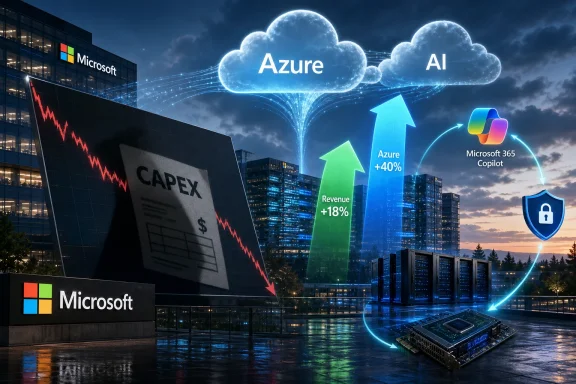
Microsoft’s fiscal third-quarter 2026 results, reported on April 29 in Redmond for the period ended March 31, showed revenue rising 18% to $82.9 billion, EPS rising 23% to $4.27, and Azure and other cloud services growing 40% year over year. The stock’s nearly 4% slide afterward was not a rejection of the quarter so much as a verdict on the bill attached to it. Microsoft has convinced the market that Azure is doing the heavy lifting; it has not yet convinced everyone that the lifting will get cheaper. That distinction is now the whole Microsoft story.
For years, Microsoft’s earnings story had a comforting rhythm. Office subscriptions compounded, Windows threw off cash, server products migrated to the cloud, and Azure grew quickly enough to make the whole machine look younger than it was. The latest quarter changes the emphasis: Azure is no longer merely the growth engine inside Microsoft. It is increasingly the infrastructure layer on which the rest of Microsoft’s growth claims depend.
The headline numbers were difficult to dismiss. Revenue grew 18.3%, Microsoft Cloud revenue reached $54.5 billion and grew 29%, and Intelligent Cloud revenue jumped 30% to $34.7 billion. Azure and other cloud services grew 40%, a rate that would be extraordinary for a smaller company and is almost surreal at Microsoft’s scale.
That strength matters because it answers the simplest bear case against Big Tech’s AI buildout. If generative AI demand were mostly hype, the cloud platform closest to enterprise workloads would be one of the first places to show disappointment. Instead, Azure accelerated against a demanding base, and Microsoft’s AI business reportedly surpassed a $37 billion annual revenue run rate, up 123% year over year.
The counterargument is not that Azure is weak. It is that Azure has become so important that everything else is judged by whether it strengthens, dilutes, or distracts from the cloud-and-AI flywheel. Windows, Xbox, Devices, LinkedIn, GitHub, Dynamics, Security, Copilot, and Office all still matter. But the market increasingly sees them as either feeders into Azure consumption or beneficiaries of Azure-scale AI infrastructure.
That is a remarkable shift for a company once defined by the PC. Microsoft’s old advantage was distribution: Windows on the desk, Office in the workflow, Exchange in the server room. Its new advantage is compute gravity: if a company wants AI close to its identity systems, data estate, developer tools, productivity suite, and compliance model, Microsoft can argue that Azure is where the shortest path begins.
The income statement looked strong almost everywhere investors normally look first. Operating income increased, earnings per share beat consensus, and the company continued to demonstrate operating leverage even while absorbing massive infrastructure spending. This was not a quarter in which Microsoft needed excuses.
But investors have learned to look past the first page of the earnings release. The capex line is now the tell. Microsoft’s capital expenditures were around $31.9 billion for the quarter, and management indicated that spending would rise again as it brings more cloud and AI capacity online. In ordinary software-company terms, those numbers are absurd. In the new AI-cloud race, they are table stakes.
That is why the market reaction was more nuanced than a simple punishment. Investors are not saying Azure is failing; they are asking how much capital must be consumed to keep Azure winning. The concern is not demand. The concern is the conversion rate from demand to durable free cash flow.
This is the inversion at the heart of Microsoft’s current valuation debate. For most of the Satya Nadella era, cloud growth made Microsoft look asset-light compared with older enterprise technology companies. Now the AI phase of cloud is making Microsoft look more like a capital-intensive infrastructure operator, even as its software margins remain enviable.
That does not make the spending painless. Intelligent Cloud gross margin percentage declined as AI infrastructure investment weighed on profitability, even though Azure efficiency gains helped offset some of the pressure. This is the basic bargain Microsoft is offering shareholders: accept lower cloud margin optics today in exchange for a bigger AI platform tomorrow.
The bargain is defensible, but it is not risk-free. AI infrastructure is not like adding another software feature to Microsoft 365. It involves long-lived data center commitments, short-lived accelerators, power availability, supply-chain exposure, and depreciation schedules that can turn yesterday’s strategic urgency into tomorrow’s margin drag.
Microsoft’s challenge is that it must build ahead of demand without building too far ahead of demand. Build too slowly, and Azure cedes workloads to Amazon, Google, Oracle, specialized AI clouds, or private infrastructure. Build too quickly, and the company carries expensive capacity into a pricing environment that could become more competitive as chips improve and inference costs fall.
That balance is especially difficult because AI demand is real but uneven. Training frontier models, running enterprise copilots, serving inference inside productivity tools, powering GitHub Copilot, and supporting third-party model builders are not identical businesses. They have different margin structures, customer behaviors, and hardware profiles. Lumping them together under “AI” may be useful for investor presentations, but the economics will eventually separate.
Yet the same partnership also complicates the story. Microsoft has to persuade investors that its AI growth is not merely rented excitement from OpenAI, but a durable Microsoft platform shift. That is why Azure’s broad growth matters so much. If demand is distributed across Azure AI services, GitHub, Microsoft 365 Copilot, Dynamics, Security, and third-party workloads, the OpenAI relationship becomes an accelerant. If growth is overly concentrated in a narrow set of model workloads, it becomes a dependency.
The accounting impact from OpenAI-related investments was small in the quarter, but the strategic impact is anything but small. Microsoft has embedded OpenAI deeply into its narrative, and enterprise customers have taken notice. The company’s job now is to make the OpenAI layer feel like one part of Azure’s AI portfolio rather than the entire reason Azure is relevant.
That is where Microsoft’s enterprise distribution gives it an advantage that model labs alone do not have. A CIO does not buy “AI” in the abstract. They buy identity integration, audit logs, data residency, procurement comfort, security posture, workflow integration, and someone to call when the rollout breaks. Microsoft’s moat is not only model quality; it is the ability to turn model access into administrable enterprise software.
Still, the OpenAI association keeps a spotlight on Microsoft’s capital intensity. If AI workloads keep scaling, Microsoft must keep feeding the machine. If model economics improve dramatically, customers may expect price reductions. If competitors narrow the perceived quality gap, Microsoft will need to win on integration and trust rather than novelty.
That is why Microsoft 365 Copilot remains so important. The product is not just another SKU; it is Microsoft’s attempt to raise the average revenue per user of the world’s most entrenched productivity suite. If Copilot becomes a standard enterprise add-on, the AI capex story looks far more comfortable. Microsoft would be spending heavily on infrastructure that directly supports high-margin software expansion.
But Copilot adoption is harder to read from the outside than Azure consumption. Microsoft can report usage momentum, customer examples, and annual run-rate figures, but investors still want clearer evidence that Copilot is becoming a must-have rather than a trial license that needs heavy sales motion. In enterprise software, enthusiasm and renewal behavior are not the same thing.
The product also has to overcome a practical threshold: usefulness must be consistent enough to survive the second month of deployment. Summarizing meetings, drafting emails, searching documents, generating spreadsheets, and assisting developers are valuable tasks, but they become budget-protected only when users change habits. The history of enterprise software is littered with tools that impressed in demos and faded in daily work.
Microsoft has one powerful advantage here. It does not need every Copilot experience to be revolutionary. It needs enough of them to become habitual across enough seats that AI becomes part of the Microsoft 365 renewal conversation. Once that happens, Copilot shifts from “AI experiment” to “productivity platform extension,” and the financial model becomes much more familiar.
That does not mean Windows is irrelevant. It means Windows has changed roles. The operating system is now less the profit center around which everything revolves and more an endpoint surface for Microsoft’s cloud, identity, security, and AI services. In that model, Windows matters because it is where work happens, credentials are used, policies are enforced, and Copilot can be placed in front of hundreds of millions of users.
This is why Microsoft keeps trying to make Windows feel like an AI client. Copilot+ PCs, local NPUs, Recall-style features, and tighter integration with Microsoft 365 are all part of the same strategic effort: make the endpoint valuable again without pretending the PC market will return to its 1990s centrality. The future Microsoft wants is not one where Windows alone drives growth. It is one where Windows makes Azure and Microsoft 365 stickier.
That strategy will test user trust. AI features on the desktop invite scrutiny over privacy, telemetry, enterprise controls, and admin defaults. Microsoft’s cloud-first posture can irritate power users who want local control, and Windows administrators have become increasingly wary of consumer-grade nudges appearing in professional environments.
The company can afford that tension only if the value is obvious. If AI features in Windows save time, improve security, and respect policy boundaries, they strengthen the ecosystem. If they feel like promotional surfaces for cloud subscriptions, they will deepen the divide between Microsoft’s platform ambitions and the expectations of its most technical users.
That is exactly why the opportunity is so large. Microsoft can sell AI as an upgrade to tools customers already use, govern it through systems administrators already know, and bill it through contracts finance departments already understand. In a market full of pilots, that procurement advantage is not trivial. It may be the difference between AI as a demo and AI as a deployed service.
But the same convenience creates lock-in anxiety. Every new Copilot integration increases the cost of leaving. Every Azure AI workload that depends on Microsoft’s identity, data, and compliance stack makes the platform more central. For many CIOs, that is acceptable if the productivity gains are real and the governance is strong. For others, it will trigger renewed interest in multi-cloud strategies, open models, and vendor diversification.
The security dimension cuts both ways. Microsoft can credibly argue that AI deployed inside its security and compliance framework is safer than ad hoc tools scattered across departments. At the same time, Microsoft’s own security history ensures that customers will demand proof, not promises. The more AI touches sensitive corporate data, the more every permission model, audit trail, and retention policy matters.
This is the enterprise version of Microsoft’s investor problem. The company has the right assets, but the scale of the bet raises the stakes. If Microsoft executes well, it becomes the default operating layer for enterprise AI. If it stumbles, the backlash will not be confined to one product line.
This is not a metaphorical change. Microsoft’s ability to sell Azure AI capacity depends on physical infrastructure arriving on time. Management has said constraints are expected to persist through 2026, even as the company works to bring GPU, CPU, and storage capacity online faster. That is a very different kind of operating problem from shipping a new Office feature.
It also changes competitive dynamics. Amazon has scale, Google has AI research depth and custom silicon, Oracle has become more relevant in large AI infrastructure deals, and specialized providers can compete on specific workloads or pricing. Microsoft’s advantage is breadth, but breadth must now be backed by enormous capital deployment.
The market’s skepticism is therefore rational. When every major platform company is increasing AI infrastructure spending, investors have to ask whether all of them can earn attractive returns. The answer may be yes for a handful of winners, but not necessarily for every dollar spent. Capacity shortages can support pricing today; overcapacity can pressure margins tomorrow.
Microsoft’s defense is that it is building for known demand, not speculative vanity. The company points to Azure growth, cloud backlog, AI run-rate expansion, and customer commitments as evidence. That defense is stronger than most. But the burden of proof will renew every quarter, because capex is not a press-release metric. It is cash leaving the building.
Where the framing needs sharpening is in the word “heavy.” Azure is lifting revenue, valuation expectations, AI credibility, enterprise relevance, and the rest of Microsoft’s strategic narrative. It is also lifting capital expenditures, depreciation risk, supply-chain exposure, and investor anxiety. The same business line that explains the upside explains the sell-off.
That duality is why a simple bullish or bearish reading misses the point. Microsoft is not a fading incumbent using AI rhetoric to disguise stagnation. Nor is it a riskless compounder immune to infrastructure economics. It is a dominant software company deliberately becoming more capital intensive because the next software platform may require owning more of the physical substrate beneath it.
The right comparison is not old Microsoft versus new Microsoft. It is Microsoft the software toll road versus Microsoft the AI utility. Toll roads are beautiful businesses when traffic rises and maintenance is manageable. Utilities are powerful too, but they require constant investment, regulatory sensitivity, and brutal attention to capacity planning.
Microsoft wants the best of both models. It wants Azure to be the utility and Copilot to be the software toll. The quarter suggests that strategy is working. The stock reaction suggests investors are still debating the price of admission.
Source: Seeking Alpha Microsoft: Azure Doing The Heavylifting (NASDAQ:MSFT)
 Azure Has Become Microsoft’s Operating System for Growth
For years, Microsoft’s earnings story had a comforting rhythm. Office subscriptions compounded, Windows threw off cash, server products migrated to the cloud, and Azure grew quickly enough to make the whole machine look younger than it was. The latest quarter changes the emphasis: Azure is no longer merely the growth engine inside Microsoft. It is increasingly the infrastructure layer on which the rest of Microsoft’s growth claims depend.The headline numbers were difficult to dismiss. Revenue grew 18.3%, Microsoft Cloud revenue reached $54.5 billion and grew 29%, and Intelligent Cloud revenue jumped 30% to $34.7 billion. Azure and other cloud services grew 40%, a rate that would be extraordinary for a smaller company and is almost surreal at Microsoft’s scale.
That strength matters because it answers the simplest bear case against Big Tech’s AI buildout. If generative AI demand were mostly hype, the cloud platform closest to enterprise workloads would be one of the first places to show disappointment. Instead, Azure accelerated against a demanding base, and Microsoft’s AI business reportedly surpassed a $37 billion annual revenue run rate, up 123% year over year.
The counterargument is not that Azure is weak. It is that Azure has become so important that everything else is judged by whether it strengthens, dilutes, or distracts from the cloud-and-AI flywheel. Windows, Xbox, Devices, LinkedIn, GitHub, Dynamics, Security, Copilot, and Office all still matter. But the market increasingly sees them as either feeders into Azure consumption or beneficiaries of Azure-scale AI infrastructure.
That is a remarkable shift for a company once defined by the PC. Microsoft’s old advantage was distribution: Windows on the desk, Office in the workflow, Exchange in the server room. Its new advantage is compute gravity: if a company wants AI close to its identity systems, data estate, developer tools, productivity suite, and compliance model, Microsoft can argue that Azure is where the shortest path begins.
The Quarter Was Excellent, Which Made the Sell-Off More Revealing
A stock can fall after a great quarter for bad reasons. It can also fall for very good ones. Microsoft’s post-earnings decline belongs in the second category, not because the business disappointed, but because the market is now interrogating a more difficult question than “Did revenue beat?”The income statement looked strong almost everywhere investors normally look first. Operating income increased, earnings per share beat consensus, and the company continued to demonstrate operating leverage even while absorbing massive infrastructure spending. This was not a quarter in which Microsoft needed excuses.
But investors have learned to look past the first page of the earnings release. The capex line is now the tell. Microsoft’s capital expenditures were around $31.9 billion for the quarter, and management indicated that spending would rise again as it brings more cloud and AI capacity online. In ordinary software-company terms, those numbers are absurd. In the new AI-cloud race, they are table stakes.
That is why the market reaction was more nuanced than a simple punishment. Investors are not saying Azure is failing; they are asking how much capital must be consumed to keep Azure winning. The concern is not demand. The concern is the conversion rate from demand to durable free cash flow.
This is the inversion at the heart of Microsoft’s current valuation debate. For most of the Satya Nadella era, cloud growth made Microsoft look asset-light compared with older enterprise technology companies. Now the AI phase of cloud is making Microsoft look more like a capital-intensive infrastructure operator, even as its software margins remain enviable.
Microsoft Is Spending From Strength, But Spending From Strength Is Still Spending
The most persuasive defense of Microsoft’s AI capex is that the company is not building blindly. Azure is supply constrained, demand appears broad, and Microsoft has an unusually credible path to monetization across infrastructure, developer tooling, enterprise applications, security, and productivity software. If any company can justify spending tens of billions of dollars on data centers, GPUs, networking, storage, and power commitments, Microsoft is on the short list.That does not make the spending painless. Intelligent Cloud gross margin percentage declined as AI infrastructure investment weighed on profitability, even though Azure efficiency gains helped offset some of the pressure. This is the basic bargain Microsoft is offering shareholders: accept lower cloud margin optics today in exchange for a bigger AI platform tomorrow.
The bargain is defensible, but it is not risk-free. AI infrastructure is not like adding another software feature to Microsoft 365. It involves long-lived data center commitments, short-lived accelerators, power availability, supply-chain exposure, and depreciation schedules that can turn yesterday’s strategic urgency into tomorrow’s margin drag.
Microsoft’s challenge is that it must build ahead of demand without building too far ahead of demand. Build too slowly, and Azure cedes workloads to Amazon, Google, Oracle, specialized AI clouds, or private infrastructure. Build too quickly, and the company carries expensive capacity into a pricing environment that could become more competitive as chips improve and inference costs fall.
That balance is especially difficult because AI demand is real but uneven. Training frontier models, running enterprise copilots, serving inference inside productivity tools, powering GitHub Copilot, and supporting third-party model builders are not identical businesses. They have different margin structures, customer behaviors, and hardware profiles. Lumping them together under “AI” may be useful for investor presentations, but the economics will eventually separate.
The OpenAI Halo Still Casts a Shadow
Microsoft’s partnership with OpenAI remains one of the most important corporate technology bets of the decade. It gave Microsoft early access to the generative AI moment, transformed Azure into a default venue for AI infrastructure conversations, and helped the company reframe its product portfolio around Copilot. Without that move, Microsoft might still be a cloud winner. With it, Microsoft became the enterprise face of AI adoption.Yet the same partnership also complicates the story. Microsoft has to persuade investors that its AI growth is not merely rented excitement from OpenAI, but a durable Microsoft platform shift. That is why Azure’s broad growth matters so much. If demand is distributed across Azure AI services, GitHub, Microsoft 365 Copilot, Dynamics, Security, and third-party workloads, the OpenAI relationship becomes an accelerant. If growth is overly concentrated in a narrow set of model workloads, it becomes a dependency.
The accounting impact from OpenAI-related investments was small in the quarter, but the strategic impact is anything but small. Microsoft has embedded OpenAI deeply into its narrative, and enterprise customers have taken notice. The company’s job now is to make the OpenAI layer feel like one part of Azure’s AI portfolio rather than the entire reason Azure is relevant.
That is where Microsoft’s enterprise distribution gives it an advantage that model labs alone do not have. A CIO does not buy “AI” in the abstract. They buy identity integration, audit logs, data residency, procurement comfort, security posture, workflow integration, and someone to call when the rollout breaks. Microsoft’s moat is not only model quality; it is the ability to turn model access into administrable enterprise software.
Still, the OpenAI association keeps a spotlight on Microsoft’s capital intensity. If AI workloads keep scaling, Microsoft must keep feeding the machine. If model economics improve dramatically, customers may expect price reductions. If competitors narrow the perceived quality gap, Microsoft will need to win on integration and trust rather than novelty.
Copilot Is the Productization Test Wall Street Cares About
Azure explains the quarter. Copilot explains the next phase of investor patience. Infrastructure growth can prove that customers are experimenting and scaling workloads, but Microsoft’s larger ambition is to turn AI into a recurring software layer across work itself.That is why Microsoft 365 Copilot remains so important. The product is not just another SKU; it is Microsoft’s attempt to raise the average revenue per user of the world’s most entrenched productivity suite. If Copilot becomes a standard enterprise add-on, the AI capex story looks far more comfortable. Microsoft would be spending heavily on infrastructure that directly supports high-margin software expansion.
But Copilot adoption is harder to read from the outside than Azure consumption. Microsoft can report usage momentum, customer examples, and annual run-rate figures, but investors still want clearer evidence that Copilot is becoming a must-have rather than a trial license that needs heavy sales motion. In enterprise software, enthusiasm and renewal behavior are not the same thing.
The product also has to overcome a practical threshold: usefulness must be consistent enough to survive the second month of deployment. Summarizing meetings, drafting emails, searching documents, generating spreadsheets, and assisting developers are valuable tasks, but they become budget-protected only when users change habits. The history of enterprise software is littered with tools that impressed in demos and faded in daily work.
Microsoft has one powerful advantage here. It does not need every Copilot experience to be revolutionary. It needs enough of them to become habitual across enough seats that AI becomes part of the Microsoft 365 renewal conversation. Once that happens, Copilot shifts from “AI experiment” to “productivity platform extension,” and the financial model becomes much more familiar.
Windows Is No Longer the Center, But It Still Sets the Edge
For WindowsForum readers, the strange part of Microsoft’s modern earnings is how little the Windows client seems to drive the story. More Personal Computing revenue declined 1% in the quarter, and Windows OEM, Devices, and Xbox content were not the heroes of the report. The PC business is still large, but it is no longer the market’s preferred lens for understanding Microsoft.That does not mean Windows is irrelevant. It means Windows has changed roles. The operating system is now less the profit center around which everything revolves and more an endpoint surface for Microsoft’s cloud, identity, security, and AI services. In that model, Windows matters because it is where work happens, credentials are used, policies are enforced, and Copilot can be placed in front of hundreds of millions of users.
This is why Microsoft keeps trying to make Windows feel like an AI client. Copilot+ PCs, local NPUs, Recall-style features, and tighter integration with Microsoft 365 are all part of the same strategic effort: make the endpoint valuable again without pretending the PC market will return to its 1990s centrality. The future Microsoft wants is not one where Windows alone drives growth. It is one where Windows makes Azure and Microsoft 365 stickier.
That strategy will test user trust. AI features on the desktop invite scrutiny over privacy, telemetry, enterprise controls, and admin defaults. Microsoft’s cloud-first posture can irritate power users who want local control, and Windows administrators have become increasingly wary of consumer-grade nudges appearing in professional environments.
The company can afford that tension only if the value is obvious. If AI features in Windows save time, improve security, and respect policy boundaries, they strengthen the ecosystem. If they feel like promotional surfaces for cloud subscriptions, they will deepen the divide between Microsoft’s platform ambitions and the expectations of its most technical users.
Enterprise IT Sees the Upside and the Lock-In
Microsoft’s strongest argument in enterprise AI is not that it has the flashiest chatbot. It is that it already owns the administrative terrain. Entra ID, Microsoft 365, Teams, SharePoint, Exchange, Defender, Purview, GitHub, Visual Studio, Power Platform, Dynamics, and Azure form a dense mesh of dependencies. AI layered across that mesh is easier to buy than a separate platform that must be stitched into every control plane.That is exactly why the opportunity is so large. Microsoft can sell AI as an upgrade to tools customers already use, govern it through systems administrators already know, and bill it through contracts finance departments already understand. In a market full of pilots, that procurement advantage is not trivial. It may be the difference between AI as a demo and AI as a deployed service.
But the same convenience creates lock-in anxiety. Every new Copilot integration increases the cost of leaving. Every Azure AI workload that depends on Microsoft’s identity, data, and compliance stack makes the platform more central. For many CIOs, that is acceptable if the productivity gains are real and the governance is strong. For others, it will trigger renewed interest in multi-cloud strategies, open models, and vendor diversification.
The security dimension cuts both ways. Microsoft can credibly argue that AI deployed inside its security and compliance framework is safer than ad hoc tools scattered across departments. At the same time, Microsoft’s own security history ensures that customers will demand proof, not promises. The more AI touches sensitive corporate data, the more every permission model, audit trail, and retention policy matters.
This is the enterprise version of Microsoft’s investor problem. The company has the right assets, but the scale of the bet raises the stakes. If Microsoft executes well, it becomes the default operating layer for enterprise AI. If it stumbles, the backlash will not be confined to one product line.
The Cloud War Has Entered Its Industrial Phase
The cloud competition used to be described in software terms: services, APIs, developer ecosystems, managed databases, and migration tooling. Those still matter. But the AI boom has pushed the hyperscaler race into a more industrial phase, where power, land, cooling, chips, supply chains, and data center construction schedules shape who can satisfy demand.This is not a metaphorical change. Microsoft’s ability to sell Azure AI capacity depends on physical infrastructure arriving on time. Management has said constraints are expected to persist through 2026, even as the company works to bring GPU, CPU, and storage capacity online faster. That is a very different kind of operating problem from shipping a new Office feature.
It also changes competitive dynamics. Amazon has scale, Google has AI research depth and custom silicon, Oracle has become more relevant in large AI infrastructure deals, and specialized providers can compete on specific workloads or pricing. Microsoft’s advantage is breadth, but breadth must now be backed by enormous capital deployment.
The market’s skepticism is therefore rational. When every major platform company is increasing AI infrastructure spending, investors have to ask whether all of them can earn attractive returns. The answer may be yes for a handful of winners, but not necessarily for every dollar spent. Capacity shortages can support pricing today; overcapacity can pressure margins tomorrow.
Microsoft’s defense is that it is building for known demand, not speculative vanity. The company points to Azure growth, cloud backlog, AI run-rate expansion, and customer commitments as evidence. That defense is stronger than most. But the burden of proof will renew every quarter, because capex is not a press-release metric. It is cash leaving the building.
The Seeking Alpha Framing Gets the Direction Right
The argument that Azure is doing the heavy lifting captures the essential truth of Microsoft’s current moment. The quarter’s strength was not evenly distributed across a nostalgic map of Microsoft businesses. It was concentrated in the cloud platform and the AI services orbiting it.Where the framing needs sharpening is in the word “heavy.” Azure is lifting revenue, valuation expectations, AI credibility, enterprise relevance, and the rest of Microsoft’s strategic narrative. It is also lifting capital expenditures, depreciation risk, supply-chain exposure, and investor anxiety. The same business line that explains the upside explains the sell-off.
That duality is why a simple bullish or bearish reading misses the point. Microsoft is not a fading incumbent using AI rhetoric to disguise stagnation. Nor is it a riskless compounder immune to infrastructure economics. It is a dominant software company deliberately becoming more capital intensive because the next software platform may require owning more of the physical substrate beneath it.
The right comparison is not old Microsoft versus new Microsoft. It is Microsoft the software toll road versus Microsoft the AI utility. Toll roads are beautiful businesses when traffic rises and maintenance is manageable. Utilities are powerful too, but they require constant investment, regulatory sensitivity, and brutal attention to capacity planning.
Microsoft wants the best of both models. It wants Azure to be the utility and Copilot to be the software toll. The quarter suggests that strategy is working. The stock reaction suggests investors are still debating the price of admission.
The Numbers That Should Stick in Redmond
The cleanest reading of the quarter is not that Microsoft disappointed, but that the market has raised the standard for what counts as success. Growth alone is no longer enough. Investors want growth, capacity discipline, margin resilience, and proof that AI software revenue can scale faster than AI infrastructure costs.- Microsoft reported fiscal third-quarter revenue of $82.9 billion, up 18%, with diluted EPS of $4.27, up 23%.
- Azure and other cloud services grew 40% year over year, making the cloud platform the clearest driver of the quarter’s upside.
- Microsoft Cloud revenue reached $54.5 billion and grew 29%, reinforcing that the company’s AI story is embedded in a much larger commercial cloud base.
- The company’s AI business surpassed a $37 billion annual revenue run rate, but investors are watching how much capital is required to sustain that trajectory.
- Capital expenditures remained enormous and are expected to rise as Microsoft works through cloud and AI capacity constraints.
- The stock’s decline after earnings reflected concern about AI infrastructure economics, not evidence that Azure demand is weakening.
Source: Seeking Alpha Microsoft: Azure Doing The Heavylifting (NASDAQ:MSFT)
