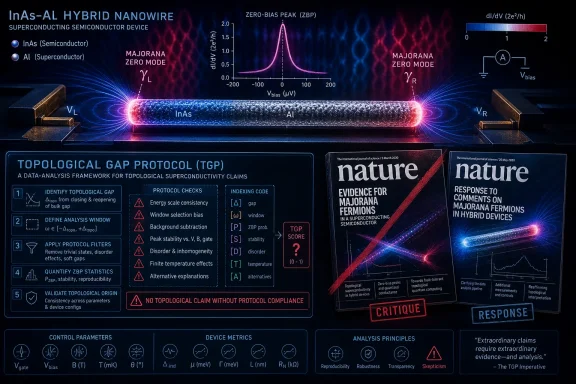
On June 24, 2026, Nature published Henry Legg’s formal critique of Microsoft Azure Quantum’s 2025 Majorana 1 paper, alongside Microsoft’s reply, turning a celebrated quantum-computing claim into a public dispute over code, data selection, and the evidence for a topological phase. The fight is not merely about whether a plotting bug mattered. It is about whether Microsoft has shown the thing its entire hardware strategy requires: a protected Majorana state. The company says the decisive signal is real; its critic says the foundation beneath that signal remains unproven.
Microsoft has spent years arguing that the fastest route to a useful quantum computer is not to build more fragile qubits, but to build a better kind of qubit. Its topological program is meant to store quantum information in a way that is physically protected from local noise, using Majorana zero modes at the ends of engineered semiconductor-superconductor wires. If that works, Microsoft could leapfrog rivals whose machines require heavy software error correction to keep ordinary qubits alive.
That is why the February 2025 Majorana 1 announcement landed with unusual force. Microsoft described a topological chip, a road to a million qubits, and a useful quantum computer in “years, not decades.” Satya Nadella amplified the claim in plain business language: Microsoft had found a path toward scalable quantum hardware.
The June 2026 dispute does not prove that Microsoft is wrong. But it does puncture the cleanest version of the story. A field already haunted by false positives, ambiguous signals, and one previous Microsoft-linked retraction now has a new formal challenge saying that the company’s evidence may not demonstrate the topological phase it needs.
The distinction matters. A quantum company can survive a coding correction. It cannot shrug off uncertainty about whether its claimed hardware platform exists in the necessary physical regime.
The simplified picture is almost too elegant. A single electron-like quantum state is split across two ends of a nanowire, so the information is stored nonlocally rather than at either end. A local disturbance at one end should not be able to read or destroy the state, because the state belongs to the pair.
That nonlocal protection is the prize. Conventional superconducting and trapped-ion qubits store information in fragile local states and then use elaborate error correction to compensate. A topological qubit promises protection from the hardware itself, not as magic but as a consequence of how the state is distributed and manipulated.
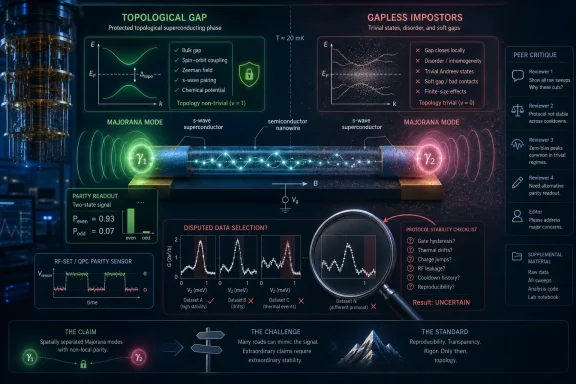
But the promise has a severe condition. The wire must enter a topological superconducting phase with a clean energy gap that separates the protected state from ordinary low-energy excitations. Without that topological gap, the device can mimic parts of the expected behavior while failing to provide the protection that makes the whole architecture attractive.
This is where Majorana physics becomes brutal experimental work. Disorder, accidental quantum dots, poorly controlled interfaces, and mundane subgap states can produce features that look Majorana-like. The field’s central problem is not imagining the topological qubit. It is proving that a real device is not merely impersonating one.
Microsoft’s 2025 paper reported interferometric single-shot parity readout in InAs-Al hybrid devices. In plainer terms, the company said it could read the even-or-odd occupation state associated with a pair of Majorana zero modes. That is an essential operation for Microsoft’s architecture, even if it is not the same as performing arbitrary quantum logic.
The company’s measurement linked the two ends of the wire into a loop and used radio-frequency reflectometry to probe quantum capacitance. Microsoft reported a two-state signal that oscillated with the expected magnetic-flux period. In its interpretation, a disordered gapless wire could not sustain that clean signal, so the signal itself supported the conclusion that the device was in the topological regime.
Before reaching that readout point, Microsoft used an automated tuning method called the Topological Gap Protocol. The protocol was meant to identify promising regions where the device appeared properly gapped and to reject the misleading cases that have dogged the field for more than a decade. It is both a practical tuning tool and, inevitably, part of the evidentiary chain.
That dual role is now the heart of the disagreement. Microsoft says the protocol selected operating points but did not carry the paper’s physics conclusion. Legg says the protocol’s behavior, the raw transport data, and Microsoft’s presentation of those data are inseparable from the claim.
On the software side, Legg argues that the Topological Gap Protocol is unstable under reasonable parameter choices. According to his analysis, regions can shift between “gapped” and “gapless” depending on settings, and in some cases the classification can hinge on a single data point. That is a serious claim because the protocol is supposed to protect the experiment from exactly this kind of interpretive fragility.
Legg also identifies what he describes as errors in the data processing. One allegedly caused the analysis to display only the largest promising region while omitting others. Another allegedly reordered a data array by index rather than by the physical voltage value it represented. In his telling, correcting the issues reveals additional regions and changes how one device’s readout point should be understood.
The dispute becomes especially sharp because Microsoft’s reviewers had asked whether other regions existed where the method did not succeed. Microsoft said the region it used was the only one to pass within the searched range. Legg argues that, after correction, that answer does not hold in the way readers would naturally understand it.
Microsoft’s response is much narrower. The company characterizes the coding issue as essentially an off-by-one-pixel discrepancy that does not materially change the figures, does not move the readout out of a gapped region, and does not undermine the conclusion. In Microsoft’s framing, Legg has elevated a minor implementation issue into a supposed fatal flaw.
That answer may satisfy readers who already accept Microsoft’s hierarchy of evidence. It will not satisfy those who think the device’s topological status must be established independently before the capacitance signal can do interpretive work. The code dispute is therefore not just a code dispute. It is a proxy battle over what counts as proof.
His reading is severe. He describes abundant low-energy states, conductance across the voltage range, poorly defined peaks, and inconsistent behavior between the two ends of the wire. He also points to signatures he associates with quantum dots, including negative local conductance and broken symmetries that a clean gapped device should preserve.
If that interpretation is right, the issue is not whether Microsoft drew a boundary one pixel too far to the left. The issue is whether the experimental platform was full of ordinary low-energy physics capable of contaminating the claimed Majorana signal. That is the nightmare scenario for any Majorana experiment.
Microsoft disputes the interpretation. It argues that conductance inside the apparent gap does not necessarily mean the gap is absent, because a discrete subgap state can broaden under the junction conditions used in the device. It also says negative conductance can arise from several mechanisms and should not be treated as proof of quantum dots.
That is a defensible scientific posture, but it leaves the public reader in a difficult place. Legg says the raw data look disorderly enough to defeat the claim. Microsoft says the raw data are being overread and that the decisive capacitance signal remains unexplained by any alternative model.
The result is not a clean debunking. It is a narrowing of confidence. Microsoft still has a physical signal it believes is hard to fake, but its critic has made the surrounding device characterization look much less settled than the original announcement implied.
This is either a clarification or a retreat, depending on how generously one reads the record. In an experimental paper, the procedure that determines where measurements are taken is not just plumbing. It shapes the result, especially when the field is saturated with false positives and ambiguous regimes.
Microsoft’s strongest argument is that Legg does not provide an alternative physical model that reproduces the flux-periodic two-state capacitance signal. That matters. Criticism of supporting data is more powerful when paired with a plausible account of what produced the headline measurement instead.
Legg’s strongest argument is that Microsoft appears to reason from the signal back to the gap: the signal requires a gapped topological system, the signal was observed, therefore the system was gapped and topological. If the premise is precisely what is under dispute, that loop is not enough.
This is why the exchange feels unresolved even after both sides have had their say in Nature. Microsoft is asking readers to trust the distinctiveness of the capacitance measurement. Legg is asking readers to demand independent proof that the device was in the topological phase before granting the measurement that status.
The deeper disagreement cannot be patched by a corrected script. It requires reproducible, independently persuasive device evidence that shows the gap, rules out mundane impostors, and connects the readout to separated Majorana zero modes rather than to a convenient but ordinary subgap state.
The big materials change is the replacement of aluminium with lead as the superconductor. Microsoft says the lead-based stack improves stability, increases the topological gap, and helps shield fragile states from radiation-related disturbances. The company also says Majorana 2 achieves a mean qubit lifetime of about 20 seconds, with some instances lasting up to a minute.
Those are attention-grabbing numbers. If reproducible and topological, they would represent a major advance over the millisecond-scale behavior associated with the earlier generation. They also fit Microsoft’s strategic claim that the hard part is getting the physics right first, then scaling from a stronger base.
But Majorana 2 does not make the Majorana 1 critique disappear. The new chip is a different device, reportedly using a different tuning method, and its early public record does not yet amount to a full working qubit demonstration. It reports long-lived parity behavior in a limited setting, not universal control, braiding, or a complete logical operation.
That distinction matters because Microsoft’s public messaging keeps sprinting ahead of the scientific record. A company can reasonably say it has made progress. It is more hazardous to let the market, the press, or even internal product culture hear “topological qubit solved” when the peer-reviewed debate is still about whether the earlier topological evidence was adequate.
Majorana 2 may ultimately answer Legg’s criticisms by making them irrelevant. A cleaner materials system, stronger gap, reproducible devices, and fuller measurements could shift the debate from “is this a false positive?” to “how fast can this scale?” But as of late June 2026, the newer chip relocates the uncertainty more than it resolves it.
Microsoft already operates two quantum tracks. One is partner-based and relatively near-term: Azure Quantum provides access to hardware and workflows involving companies such as Quantinuum and Atom Computing. Those machines use trapped ions or neutral atoms, not Microsoft’s own topological chips.
The other track is the Majorana hardware program. That is the bet Microsoft owns most directly and the one that would make its quantum strategy truly distinctive. It is also the track now carrying the heaviest scientific uncertainty.
This distinction is crucial for IT professionals. Microsoft can make real progress in quantum software, error correction, resource estimation, and cloud orchestration without having a validated topological qubit. Those are meaningful platform investments. They just should not be confused with proof that Majorana hardware is ready to scale.
The same caution applies to post-quantum security. Administrators should be planning cryptographic migration because standards and threat models are moving, not because Microsoft’s Majorana roadmap guarantees a commercially useful quantum computer by 2029. The risk of “harvest now, decrypt later” does not depend on one company’s chip announcement.
In that sense, the dispute should make enterprise readers more disciplined rather than more cynical. Quantum computing is not vaporware, and Microsoft’s work is not automatically discredited. But the distance between a promising laboratory signal and a platform that changes enterprise computing remains large enough to measure in years of reproducibility, not keynote slides.
Microsoft knows this better than most. The company’s previous high-profile Majorana work became controversial and was eventually retracted after outside scrutiny challenged whether the data supported the claimed interpretation. That history does not prove the 2025 paper is wrong, but it explains why critics are unusually alert to data selection, protocol definitions, and unexamined alternatives.
This is the scientific process working, but it is not the same as corporate messaging. Peer review can publish a paper, publish a critique, publish a reply, and still leave the central interpretation unresolved. Product announcements, by contrast, prefer a straight line from discovery to roadmap.
That mismatch is becoming a recurring problem in quantum computing. Companies need capital, talent, partnerships, and cloud mindshare, so they describe progress in terms that business readers can understand. The underlying science often speaks in probability, caveat, device dependence, and competing models.
The Majorana dispute is therefore bigger than Microsoft. It is a test of whether the quantum industry can communicate frontier results without laundering uncertainty into inevitability. A responsible claim can be ambitious. It cannot make the unresolved part sound finished.
That middle ground is unsatisfying, but it is where the evidence sits. A topological qubit is an extraordinary claim because it promises hardware-level protection that would reshape the economics of fault-tolerant quantum computing. Extraordinary claims do not require perfect data, but they do require evidence that survives hostile reanalysis.
Microsoft’s next task is therefore not rhetorical. It needs to show reproducible devices, cleaner transport evidence, independent confirmation of the topological gap, and measurements that demonstrate control beyond parity readout. It also needs to separate what its partner-based Azure Quantum work has achieved from what its own topological hardware has not yet proved.
For now, the coding dispute is less important than the epistemic one. Microsoft says the capacitance signal proves the system could not have been gapless. Legg says the gap must be shown independently because the raw data do not support taking it for granted. That is the argument no corrected figure can settle.
 Microsoft’s Quantum Moonshot Now Has a Peer-Reviewed Asterisk
Microsoft has spent years arguing that the fastest route to a useful quantum computer is not to build more fragile qubits, but to build a better kind of qubit. Its topological program is meant to store quantum information in a way that is physically protected from local noise, using Majorana zero modes at the ends of engineered semiconductor-superconductor wires. If that works, Microsoft could leapfrog rivals whose machines require heavy software error correction to keep ordinary qubits alive.That is why the February 2025 Majorana 1 announcement landed with unusual force. Microsoft described a topological chip, a road to a million qubits, and a useful quantum computer in “years, not decades.” Satya Nadella amplified the claim in plain business language: Microsoft had found a path toward scalable quantum hardware.
The June 2026 dispute does not prove that Microsoft is wrong. But it does puncture the cleanest version of the story. A field already haunted by false positives, ambiguous signals, and one previous Microsoft-linked retraction now has a new formal challenge saying that the company’s evidence may not demonstrate the topological phase it needs.
The distinction matters. A quantum company can survive a coding correction. It cannot shrug off uncertainty about whether its claimed hardware platform exists in the necessary physical regime.
The Majorana Claim Lives or Dies on the Gap
The word “Majorana” creates confusion because it carries two histories at once. Ettore Majorana proposed a particle that would be its own antiparticle in 1937, and physicists still look for such behavior in fundamental particles such as neutrinos. Microsoft is chasing something different: a Majorana zero mode, a collective excitation that can emerge in a carefully built condensed-matter system.The simplified picture is almost too elegant. A single electron-like quantum state is split across two ends of a nanowire, so the information is stored nonlocally rather than at either end. A local disturbance at one end should not be able to read or destroy the state, because the state belongs to the pair.
That nonlocal protection is the prize. Conventional superconducting and trapped-ion qubits store information in fragile local states and then use elaborate error correction to compensate. A topological qubit promises protection from the hardware itself, not as magic but as a consequence of how the state is distributed and manipulated.
But the promise has a severe condition. The wire must enter a topological superconducting phase with a clean energy gap that separates the protected state from ordinary low-energy excitations. Without that topological gap, the device can mimic parts of the expected behavior while failing to provide the protection that makes the whole architecture attractive.
This is where Majorana physics becomes brutal experimental work. Disorder, accidental quantum dots, poorly controlled interfaces, and mundane subgap states can produce features that look Majorana-like. The field’s central problem is not imagining the topological qubit. It is proving that a real device is not merely impersonating one.
Microsoft Built a Detector Before It Built the Qubit
The Majorana 1 device was not a universal quantum computer, nor even a complete working topological qubit in the ordinary engineering sense. It was a test platform built around an indium arsenide nanowire coupled to aluminium, cooled to temperatures near absolute zero, and tuned with electrostatic gates.Microsoft’s 2025 paper reported interferometric single-shot parity readout in InAs-Al hybrid devices. In plainer terms, the company said it could read the even-or-odd occupation state associated with a pair of Majorana zero modes. That is an essential operation for Microsoft’s architecture, even if it is not the same as performing arbitrary quantum logic.
The company’s measurement linked the two ends of the wire into a loop and used radio-frequency reflectometry to probe quantum capacitance. Microsoft reported a two-state signal that oscillated with the expected magnetic-flux period. In its interpretation, a disordered gapless wire could not sustain that clean signal, so the signal itself supported the conclusion that the device was in the topological regime.
Before reaching that readout point, Microsoft used an automated tuning method called the Topological Gap Protocol. The protocol was meant to identify promising regions where the device appeared properly gapped and to reject the misleading cases that have dogged the field for more than a decade. It is both a practical tuning tool and, inevitably, part of the evidentiary chain.
That dual role is now the heart of the disagreement. Microsoft says the protocol selected operating points but did not carry the paper’s physics conclusion. Legg says the protocol’s behavior, the raw transport data, and Microsoft’s presentation of those data are inseparable from the claim.
Legg’s Critique Turns a Software Bug Into a Physics Problem
Henry Legg’s critique has two layers. The first concerns Microsoft’s processing and validation code. The second concerns what the underlying transport data appear to show once examined outside the company’s published presentation.On the software side, Legg argues that the Topological Gap Protocol is unstable under reasonable parameter choices. According to his analysis, regions can shift between “gapped” and “gapless” depending on settings, and in some cases the classification can hinge on a single data point. That is a serious claim because the protocol is supposed to protect the experiment from exactly this kind of interpretive fragility.
Legg also identifies what he describes as errors in the data processing. One allegedly caused the analysis to display only the largest promising region while omitting others. Another allegedly reordered a data array by index rather than by the physical voltage value it represented. In his telling, correcting the issues reveals additional regions and changes how one device’s readout point should be understood.
The dispute becomes especially sharp because Microsoft’s reviewers had asked whether other regions existed where the method did not succeed. Microsoft said the region it used was the only one to pass within the searched range. Legg argues that, after correction, that answer does not hold in the way readers would naturally understand it.
Microsoft’s response is much narrower. The company characterizes the coding issue as essentially an off-by-one-pixel discrepancy that does not materially change the figures, does not move the readout out of a gapped region, and does not undermine the conclusion. In Microsoft’s framing, Legg has elevated a minor implementation issue into a supposed fatal flaw.
That answer may satisfy readers who already accept Microsoft’s hierarchy of evidence. It will not satisfy those who think the device’s topological status must be established independently before the capacitance signal can do interpretive work. The code dispute is therefore not just a code dispute. It is a proxy battle over what counts as proof.
The Raw Data Are the More Damaging Battlefield
The second part of Legg’s critique is harder for Microsoft to wave away because it concerns the physical appearance of the measurements. Microsoft’s paper did not publish all raw transport data in the article itself, but the data were available through the company’s repository. Legg examined them and concluded that they do not look like a clean topological superconductor.His reading is severe. He describes abundant low-energy states, conductance across the voltage range, poorly defined peaks, and inconsistent behavior between the two ends of the wire. He also points to signatures he associates with quantum dots, including negative local conductance and broken symmetries that a clean gapped device should preserve.
If that interpretation is right, the issue is not whether Microsoft drew a boundary one pixel too far to the left. The issue is whether the experimental platform was full of ordinary low-energy physics capable of contaminating the claimed Majorana signal. That is the nightmare scenario for any Majorana experiment.
Microsoft disputes the interpretation. It argues that conductance inside the apparent gap does not necessarily mean the gap is absent, because a discrete subgap state can broaden under the junction conditions used in the device. It also says negative conductance can arise from several mechanisms and should not be treated as proof of quantum dots.
That is a defensible scientific posture, but it leaves the public reader in a difficult place. Legg says the raw data look disorderly enough to defeat the claim. Microsoft says the raw data are being overread and that the decisive capacitance signal remains unexplained by any alternative model.
The result is not a clean debunking. It is a narrowing of confidence. Microsoft still has a physical signal it believes is hard to fake, but its critic has made the surrounding device characterization look much less settled than the original announcement implied.
Microsoft’s Reply Moves the Goalposts, or Clarifies Them
The most interesting sentence in Microsoft’s reply is not about a bug. It is the company’s insistence that the Topological Gap Protocol was not evidence for the paper’s conclusion, but a tuning tool used to find operating points. That framing attempts to relocate the dispute away from the transport maps and toward the radio-frequency capacitance measurement.This is either a clarification or a retreat, depending on how generously one reads the record. In an experimental paper, the procedure that determines where measurements are taken is not just plumbing. It shapes the result, especially when the field is saturated with false positives and ambiguous regimes.
Microsoft’s strongest argument is that Legg does not provide an alternative physical model that reproduces the flux-periodic two-state capacitance signal. That matters. Criticism of supporting data is more powerful when paired with a plausible account of what produced the headline measurement instead.
Legg’s strongest argument is that Microsoft appears to reason from the signal back to the gap: the signal requires a gapped topological system, the signal was observed, therefore the system was gapped and topological. If the premise is precisely what is under dispute, that loop is not enough.
This is why the exchange feels unresolved even after both sides have had their say in Nature. Microsoft is asking readers to trust the distinctiveness of the capacitance measurement. Legg is asking readers to demand independent proof that the device was in the topological phase before granting the measurement that status.
The deeper disagreement cannot be patched by a corrected script. It requires reproducible, independently persuasive device evidence that shows the gap, rules out mundane impostors, and connects the readout to separated Majorana zero modes rather than to a convenient but ordinary subgap state.
Majorana 2 Raises the Stakes Without Closing the Case
Microsoft did not pause its roadmap while the Majorana 1 dispute moved through peer review. On June 2, 2026, the company introduced Majorana 2, describing it as a second-generation topological chip with a new materials stack and a thousandfold reliability improvement over its predecessor.The big materials change is the replacement of aluminium with lead as the superconductor. Microsoft says the lead-based stack improves stability, increases the topological gap, and helps shield fragile states from radiation-related disturbances. The company also says Majorana 2 achieves a mean qubit lifetime of about 20 seconds, with some instances lasting up to a minute.
Those are attention-grabbing numbers. If reproducible and topological, they would represent a major advance over the millisecond-scale behavior associated with the earlier generation. They also fit Microsoft’s strategic claim that the hard part is getting the physics right first, then scaling from a stronger base.
But Majorana 2 does not make the Majorana 1 critique disappear. The new chip is a different device, reportedly using a different tuning method, and its early public record does not yet amount to a full working qubit demonstration. It reports long-lived parity behavior in a limited setting, not universal control, braiding, or a complete logical operation.
That distinction matters because Microsoft’s public messaging keeps sprinting ahead of the scientific record. A company can reasonably say it has made progress. It is more hazardous to let the market, the press, or even internal product culture hear “topological qubit solved” when the peer-reviewed debate is still about whether the earlier topological evidence was adequate.
Majorana 2 may ultimately answer Legg’s criticisms by making them irrelevant. A cleaner materials system, stronger gap, reproducible devices, and fuller measurements could shift the debate from “is this a false positive?” to “how fast can this scale?” But as of late June 2026, the newer chip relocates the uncertainty more than it resolves it.
The Windows Angle Is Azure, Not a Quantum Desktop
For WindowsForum readers, the practical consequence is not that a quantum PC is around the corner. It is not. The near-term relevance is Azure, cloud access, cryptography planning, research tooling, and Microsoft’s broader attempt to make quantum computing a platform business before the hardware is mature.Microsoft already operates two quantum tracks. One is partner-based and relatively near-term: Azure Quantum provides access to hardware and workflows involving companies such as Quantinuum and Atom Computing. Those machines use trapped ions or neutral atoms, not Microsoft’s own topological chips.
The other track is the Majorana hardware program. That is the bet Microsoft owns most directly and the one that would make its quantum strategy truly distinctive. It is also the track now carrying the heaviest scientific uncertainty.
This distinction is crucial for IT professionals. Microsoft can make real progress in quantum software, error correction, resource estimation, and cloud orchestration without having a validated topological qubit. Those are meaningful platform investments. They just should not be confused with proof that Majorana hardware is ready to scale.
The same caution applies to post-quantum security. Administrators should be planning cryptographic migration because standards and threat models are moving, not because Microsoft’s Majorana roadmap guarantees a commercially useful quantum computer by 2029. The risk of “harvest now, decrypt later” does not depend on one company’s chip announcement.
In that sense, the dispute should make enterprise readers more disciplined rather than more cynical. Quantum computing is not vaporware, and Microsoft’s work is not automatically discredited. But the distance between a promising laboratory signal and a platform that changes enterprise computing remains large enough to measure in years of reproducibility, not keynote slides.
The Industry Keeps Learning the Same Majorana Lesson
Majorana research has a long history of tantalizing signals that later proved less decisive than they first appeared. The reason is not that experimentalists are reckless. It is that topological superconductivity is hard to distinguish from lookalike physics in messy real materials.Microsoft knows this better than most. The company’s previous high-profile Majorana work became controversial and was eventually retracted after outside scrutiny challenged whether the data supported the claimed interpretation. That history does not prove the 2025 paper is wrong, but it explains why critics are unusually alert to data selection, protocol definitions, and unexamined alternatives.
This is the scientific process working, but it is not the same as corporate messaging. Peer review can publish a paper, publish a critique, publish a reply, and still leave the central interpretation unresolved. Product announcements, by contrast, prefer a straight line from discovery to roadmap.
That mismatch is becoming a recurring problem in quantum computing. Companies need capital, talent, partnerships, and cloud mindshare, so they describe progress in terms that business readers can understand. The underlying science often speaks in probability, caveat, device dependence, and competing models.
The Majorana dispute is therefore bigger than Microsoft. It is a test of whether the quantum industry can communicate frontier results without laundering uncertainty into inevitability. A responsible claim can be ambitious. It cannot make the unresolved part sound finished.
The Evidence Now Points to a Program Worth Watching, Not a Breakthrough Worth Banking On
The most reasonable reading of the June 2026 record is neither triumphalist nor dismissive. Microsoft has reported a signal that its researchers believe is strongly consistent with Majorana physics. Legg has shown that important parts of the surrounding validation and transport picture are contested. Both statements can be true at once.That middle ground is unsatisfying, but it is where the evidence sits. A topological qubit is an extraordinary claim because it promises hardware-level protection that would reshape the economics of fault-tolerant quantum computing. Extraordinary claims do not require perfect data, but they do require evidence that survives hostile reanalysis.
Microsoft’s next task is therefore not rhetorical. It needs to show reproducible devices, cleaner transport evidence, independent confirmation of the topological gap, and measurements that demonstrate control beyond parity readout. It also needs to separate what its partner-based Azure Quantum work has achieved from what its own topological hardware has not yet proved.
For now, the coding dispute is less important than the epistemic one. Microsoft says the capacitance signal proves the system could not have been gapless. Legg says the gap must be shown independently because the raw data do not support taking it for granted. That is the argument no corrected figure can settle.
The Fine Print Microsoft Cannot Market Away
The concrete lessons from this dispute are narrower than the hype cycle wants and more important than the skeptics sometimes allow. They point to a promising but unresolved technology program, not to a finished quantum platform.- Microsoft’s 2025 Majorana 1 result remains scientifically contested after a formal Nature critique and a same-issue reply from the company.
- The coding dispute matters chiefly because it affects confidence in the tuning protocol that selected where Microsoft performed its readout.
- The deeper issue is whether the device independently demonstrated the clean topological gap required for protected Majorana behavior.
- Microsoft’s Majorana 2 announcement reports major improvements, including a lead-based materials stack and far longer parity lifetimes, but it does not by itself resolve the Majorana 1 critique.
- Azure Quantum’s partner-based progress should be evaluated separately from Microsoft’s own topological hardware claims.
- IT leaders should treat post-quantum planning as urgent for standards and security reasons, not as a bet on any single vendor’s quantum hardware timeline.
References
- Primary source: Quantum Zeitgeist
Published: 2026-06-28T08:30:20.741352
Majorana Qubit Claims: The Definitive 2026 Microsoft Dispute
Majorana qubit claims from Microsoft face a peer-reviewed Nature critique alleging coding errors and selective data. Microsoft says its physics is sound. Inside the 2026 topological-qubit dispute.quantumzeitgeist.com - Official source: news.microsoft.com
Majorana 2, made more reliable with Microsoft Discovery agentic AI
How Microsoft’s new quantum chip was made 1,000x more reliable with the help of Microsoft Discovery's agentic AI.news.microsoft.com - Official source: azure.microsoft.com
- Related coverage: universalbusinesscouncil.org
Introducing Majorana 2 - Universal Business Council
Discover Majorana 2, Microsoft's next-generation quantum computing chip designed to advance scalable quantum systems and accelerate innovation.www.universalbusinesscouncil.org - Official source: quantum.microsoft.com
Microsoft Quantum | Microsoft Quantum Hardware
Learn about Majorana 2, Microsoft's most advanced quantum processor featuring scalable topological qubits resistant to errors at the hardware level.quantum.microsoft.com
- Related coverage: tomshardware.com
Microsoft announces Majorana 2 quantum computing chip — claims a practical machine will come in 2029 | Tom's Hardware
With new materials, Microsoft is accelerating its quantum roadmap.www.tomshardware.com
- Related coverage: techtimes.com
Quantum Error Correction Validated in Nature: Microsoft and Quantinuum Log 800-Fold Improvement
Quantum error correction results from Microsoft and Quantinuum, first announced in April 2024, have now been peer-reviewed and published in Nature — confirming an 800-fold improvement in logicalwww.techtimes.com - Related coverage: itpro.com
Microsoft says its Majorana 2 chip was built using AI – and it helped deliver huge performance gains | IT Pro
The Majorana 2 quantum chip is 1000x more powerful than its predecessor, and was developed with the help of the Microsoft Discovery platform.www.itpro.com