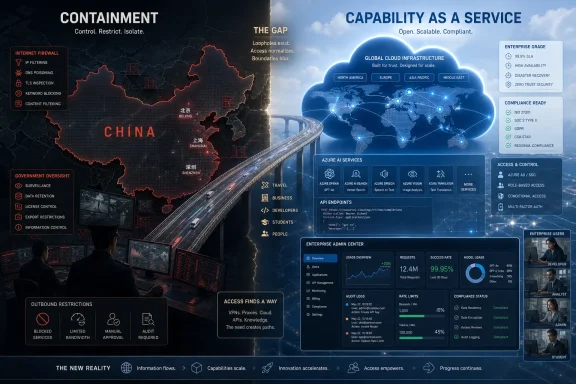
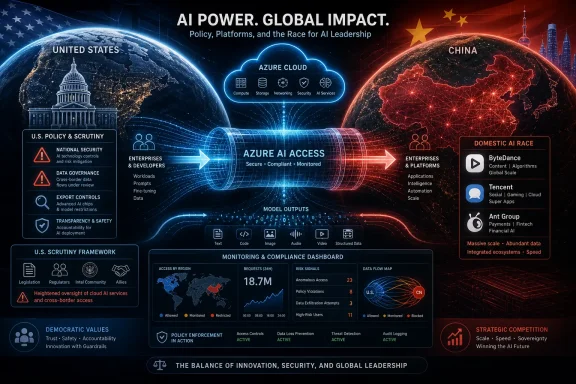
Microsoft is reportedly selling OpenAI-powered AI services to major Chinese companies through Azure, with ByteDance, Ant Group, Meituan, and Tencent among significant customers, despite OpenAI itself not offering direct API access in mainland China. The arrangement exposes the awkward middle ground of the AI cold war: Washington talks about containment, frontier labs talk about safety, and cloud platforms still sell what enterprise customers will buy. Microsoft is not merely caught between two systems. It is monetizing the seam between them.
The story is not that Chinese companies can access powerful American AI models. Anyone who has followed the gray-market API economy, proxy services, and enterprise cloud workarounds knows that technological borders are porous long before politicians admit it. The sharper point is that Microsoft appears to have turned that porosity into a formal business.
According to reporting cited by The Business Times from Bloomberg, ByteDance has generally been Microsoft’s largest AI customer in China in recent years and is on track to spend more than $1 billion annually on Microsoft AI and cloud services. Other Chinese technology giants, including Ant Group, Meituan, and Tencent, are described as major spenders on AI models via Azure. That is not hobbyist leakage. That is hyperscale cloud commerce.
Microsoft’s China business is small in corporate terms. President Brad Smith has said China accounted for roughly 1.5 percent of Microsoft revenue in 2024, a number often used to argue that the company has limited financial exposure there. But AI changes the meaning of “small.” A strategically sensitive business does not need to dominate a balance sheet to dominate a policy fight.
The company’s argument, as described in the reporting, is familiar: Microsoft maintains a China presence to serve multinational customers and to keep visibility into local innovation. That is the standard cloud-provider case for remaining engaged. Yet the emergence of OpenAI models as a commercial product in China makes this less like selling Office licenses and more like exporting access to a strategic capability.
Because of its unique partnership with OpenAI, Microsoft can offer OpenAI models through Azure under Microsoft’s own commercial policies. That separation matters. It means OpenAI can claim a restrictive posture toward China while Microsoft can still sell access to OpenAI-derived capabilities through enterprise cloud channels.
This is the kind of distinction lawyers love and policymakers hate. On paper, the model is not being sold by OpenAI in China. In practice, Chinese companies can reportedly access GPT-series models through Microsoft’s Azure infrastructure, subject to Microsoft’s own controls and China-market operating constraints.
The result is a split-screen AI economy. One screen shows frontier labs warning that advanced models could be misused, copied, or incorporated into rival systems. The other shows a major cloud platform offering those same capabilities to some of the world’s most sophisticated Chinese technology firms.
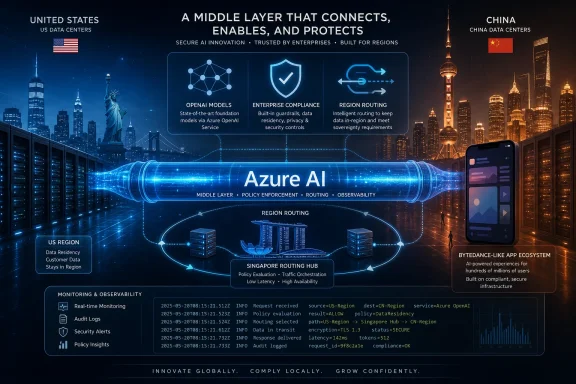
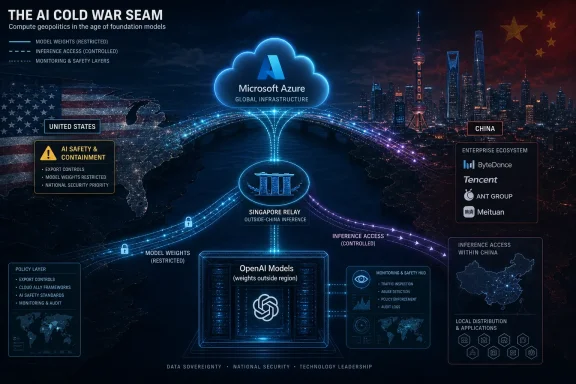
Instead, customers in China reportedly access the models over the internet from facilities in other countries, including Singapore. That design is clearly meant to reduce IP exposure. It also gives Microsoft a plausible compliance posture: the China cloud business exists, but the most sensitive model weights are not sitting in China.
That distinction is operationally important but politically fragile. From a security-engineering standpoint, keeping the model outside China reduces one class of risk. From a policy standpoint, access can matter almost as much as location. If a Chinese company can query a frontier model at scale, use it in workflows, benchmark it, and generate synthetic data from it, then the practical capability has crossed the border even if the servers have not.
This is why the debate quickly turns to distillation, the process by which outputs from one model can help train or improve another. Microsoft reportedly uses automated monitoring to prevent customers from using AI services to build competing products. But no serious observer believes monitoring can eliminate the risk entirely, especially when the customers are large, technically advanced companies that already train their own models.
The reporting says much of the Chinese companies’ Azure spending supports expansion outside China. That may be true, and it matters. A Chinese company selling services globally may use Azure because Azure is a global cloud, not because it is trying to route around OpenAI’s country restrictions. But the distinction does not dissolve the concern.
If ByteDance spends heavily on Microsoft AI and cloud services, and if those services include access to OpenAI models, Microsoft is providing a major Chinese AI player with commercial access to frontier American model capabilities. The uses may be mundane, such as software development, translation, moderation, customer service, or internal automation. They may also be competitively useful in ways outsiders cannot see.
Ant Group’s statement that it independently develops its own AI models and that core products do not rely on external models is carefully worded. It does not deny using Azure AI services. It instead draws a boundary around dependency. That is exactly how large companies talk when AI is both a tool and a strategic asset.
The better question is not whether China is material to Microsoft’s total revenue. It is whether Microsoft’s AI access has become material to Chinese technology companies. If ByteDance alone is on a path toward more than $1 billion a year in Microsoft AI and cloud spending, then Microsoft is not a peripheral vendor in this ecosystem.
That dynamic creates strategic asymmetry. Microsoft can tell Washington that China is a small business. Chinese customers can treat Microsoft as a useful bridge to Western AI capability. Both can be true at the same time.
This is the recurring pattern of globalization in strategic technology. A business line can be immaterial to headquarters and indispensable to customers. Policymakers tend to notice only after the dependency has already formed.
But OpenAI’s commercial reality is entangled with Microsoft. Microsoft is not merely a cloud reseller. It is OpenAI’s most important infrastructure partner, investor, and route into enterprise markets. That makes any gap between OpenAI policy and Azure availability more than a footnote.
The reporting says OpenAI has privately complained that Microsoft has not done enough to prevent Chinese companies from copying its models through distillation. If accurate, that suggests a deeper tension inside the alliance. OpenAI wants distribution, compute, and enterprise reach. Microsoft wants cloud revenue and platform leverage. The two goals overlap until they do not.
For WindowsForum readers, this should sound familiar. Microsoft has spent decades turning platform control into ecosystem power. In the AI era, the platform is not Windows alone, or Office, or even Azure in the old infrastructure sense. The platform is access to intelligence as a metered service.
That is why cloud access matters. The model does not need to be physically transferred to be strategically useful. A sufficiently large customer can turn usage into learning, and learning into competitive improvement.
Microsoft’s automated monitoring can catch obvious abuse. If a customer sends prompts that look like systematic model extraction, creates suspiciously structured datasets, or violates explicit usage policies, the provider can intervene. But the hardest cases are not cartoonish theft attempts. They are normal-looking enterprise workloads that produce data useful for model improvement.
This is where the debate becomes uncomfortable. The same practices that make AI useful inside a company — evaluation, feedback loops, synthetic data generation, prompt testing, agent workflows — can also make it easier to learn from a frontier model. The boundary between productivity and competitive transfer is not always visible from the cloud provider’s console.
That access model undermines the intuition behind export controls. If the United States blocks advanced chips from reaching China but allows Chinese firms to rent capabilities enabled by those chips through foreign cloud regions, the policy has a hole. If it blocks direct model sales but allows functionally similar access through a partner’s cloud, the hole widens.
This does not mean every Chinese enterprise use of Azure AI is a national-security threat. That would be lazy analysis. It does mean the policy architecture is lagging the commercial architecture.
Cloud providers have spent years convincing customers that geography should become an abstraction. Regulators are now rediscovering that geography still matters, especially when the abstraction carries frontier AI capability across borders.
That changes the policy calculus. Restricting access to U.S. models may slow some workflows, but it can also accelerate substitution. OpenAI’s earlier tightening of access helped create an opening for Chinese model providers to court displaced developers. Anthropic’s more aggressive restrictions may reduce direct exposure, but they also reinforce the Chinese market’s incentive to build around domestic alternatives.
Microsoft is betting on a different theory: engagement preserves relevance. If Chinese companies are going to build and deploy AI anyway, Microsoft would rather be the cloud provider that sells them tools, observes demand, and captures revenue. That is commercially rational.
The problem is that commercial rationality and national-security rationality no longer align as neatly as they did in the old software era. Selling productivity software to Chinese firms and selling access to frontier AI models are not the same act, even if both appear on an invoice as cloud services.
That complexity creates compliance problems for multinational firms. Data residency, export controls, AI governance, vendor risk, and intellectual-property protection are converging. IT departments that once treated cloud AI as an application-development decision now have to treat it as a cross-border risk decision.
Microsoft’s enterprise customers will want clarity on several fronts: where inference runs, which model provider’s policies apply, what monitoring exists, what data is retained, and whether usage can create exposure under future U.S. or Chinese rules. The answers may differ by region, model, contract, and customer category.
This is exactly the kind of ambiguity that sysadmins and compliance teams hate. The business wants a model endpoint. Legal wants a jurisdictional map. Security wants auditability. Procurement wants a discount. AI turns all four into the same meeting.
If sensitive models are not hosted in China, Microsoft can argue that it has separated local cloud operations from frontier model IP. But customers, regulators, and competitors will still ask who controls the service path, who can inspect metadata, who handles support, and what obligations local partners may have under Chinese law.
Even if the technical architecture is sound, the optics are difficult. A U.S. company selling OpenAI model access to Chinese firms through a China-facing business, while OpenAI itself blocks direct access, looks like a loophole. In technology policy, appearance often becomes reality once lawmakers notice.
The pressure will not necessarily produce an immediate ban. More likely, it will produce disclosure demands, licensing proposals, customer-screening requirements, and new compliance burdens for cloud-hosted AI. That is how Washington usually moves when a strategic technology slips through an older regulatory frame.
In the 1990s, that layer was Windows. In the 2000s, it was Office and enterprise licensing. In the 2010s, it was Azure and identity. In the 2020s, it is AI infrastructure, model access, and the enterprise control plane around them.
Seen that way, Microsoft’s China AI business is not an aberration. It is the logical expression of the company’s platform strategy under geopolitical stress. Where OpenAI sees a restricted market and Anthropic sees unacceptable risk, Microsoft sees a managed channel.
The question is whether managed channels are enough when the product is not a spreadsheet or a database but a general-purpose intelligence engine. Microsoft’s answer appears to be yes, with monitoring, customer screening, and careful infrastructure placement. Critics will argue that the only safe answer is no.
The Microsoft-Azure story points to the next front: inference access. Training gets the headlines, but inference is where models become products, workflows, and competitive advantage. If a company can use frontier models at scale, it can improve software development, automate operations, test product ideas, support customers, and generate data.
That matters for Windows and enterprise administrators because AI is rapidly being embedded into the everyday stack. Copilots, coding assistants, analytics tools, security platforms, and customer-service agents all depend on model access. The policy debate will increasingly determine which models can be used by which companies, in which regions, under which logs and controls.
The era when AI governance could be handled by a procurement checkbox is ending. The next version will look more like cloud security, export compliance, and software supply-chain management fused into one discipline.
But their incentives are not identical. OpenAI benefits from scarcity, safety positioning, and control over where its models appear. Microsoft benefits from ubiquity, enterprise adoption, and turning model access into cloud consumption. The China issue exposes that difference.
If OpenAI believes Chinese companies may use Azure access to improve competing models, it has reason to worry. If Microsoft believes it can safely sell to established enterprises while keeping model IP outside China, it has reason to keep going. Both positions are internally coherent.
The tension is unlikely to vanish because it is structural. Every frontier lab that partners with a cloud giant faces the same problem: the lab wants principled control, while the cloud wants global scale. The richer the model becomes, the more valuable the exceptions become.
That role will invite scrutiny. Lawmakers who already question Microsoft’s China presence after security incidents and espionage concerns are unlikely to ignore reports of rapid AI revenue growth in the country. Rival AI labs will use the story to argue for stricter controls. Chinese companies will quietly keep buying whatever gives them an edge until someone stops them.
The uncomfortable truth is that no actor in this story is behaving irrationally. Microsoft is selling a profitable cloud service. Chinese companies are buying advanced tools. OpenAI is trying to protect its models and reputation. U.S. policymakers are trying to preserve an advantage in a technology they barely know how to regulate.
That is why the story matters. It is not a scandal in the simple sense. It is a preview of how messy AI containment becomes when the most important technologies are sold as services rather than shipped as boxes.
 Microsoft Found the Narrow Lane Through the AI Cold War
The story is not that Chinese companies can access powerful American AI models. Anyone who has followed the gray-market API economy, proxy services, and enterprise cloud workarounds knows that technological borders are porous long before politicians admit it. The sharper point is that Microsoft appears to have turned that porosity into a formal business.According to reporting cited by The Business Times from Bloomberg, ByteDance has generally been Microsoft’s largest AI customer in China in recent years and is on track to spend more than $1 billion annually on Microsoft AI and cloud services. Other Chinese technology giants, including Ant Group, Meituan, and Tencent, are described as major spenders on AI models via Azure. That is not hobbyist leakage. That is hyperscale cloud commerce.
Microsoft’s China business is small in corporate terms. President Brad Smith has said China accounted for roughly 1.5 percent of Microsoft revenue in 2024, a number often used to argue that the company has limited financial exposure there. But AI changes the meaning of “small.” A strategically sensitive business does not need to dominate a balance sheet to dominate a policy fight.
The company’s argument, as described in the reporting, is familiar: Microsoft maintains a China presence to serve multinational customers and to keep visibility into local innovation. That is the standard cloud-provider case for remaining engaged. Yet the emergence of OpenAI models as a commercial product in China makes this less like selling Office licenses and more like exporting access to a strategic capability.
Azure Turns Policy Ambiguity Into Product Strategy
OpenAI does not directly sell its services in mainland China, and it has taken steps to block API access from unsupported regions. Anthropic has gone further, tightening restrictions on Chinese-controlled companies and framing the issue as one of legal, regulatory, and national-security risk. Microsoft, however, occupies a different contractual universe.Because of its unique partnership with OpenAI, Microsoft can offer OpenAI models through Azure under Microsoft’s own commercial policies. That separation matters. It means OpenAI can claim a restrictive posture toward China while Microsoft can still sell access to OpenAI-derived capabilities through enterprise cloud channels.
This is the kind of distinction lawyers love and policymakers hate. On paper, the model is not being sold by OpenAI in China. In practice, Chinese companies can reportedly access GPT-series models through Microsoft’s Azure infrastructure, subject to Microsoft’s own controls and China-market operating constraints.
The result is a split-screen AI economy. One screen shows frontier labs warning that advanced models could be misused, copied, or incorporated into rival systems. The other shows a major cloud platform offering those same capabilities to some of the world’s most sophisticated Chinese technology firms.
The Geography Is the Loophole and the Defense
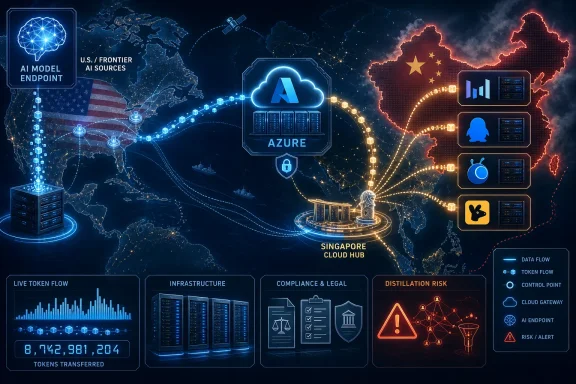
Microsoft’s China cloud presence is not simple. Like other foreign technology companies operating in the country, Microsoft must work through local partners, and it operates data center regions near Beijing and Shanghai. But the reported OpenAI model access does not appear to mean Microsoft is hosting OpenAI’s intellectual property inside Chinese server farms.Instead, customers in China reportedly access the models over the internet from facilities in other countries, including Singapore. That design is clearly meant to reduce IP exposure. It also gives Microsoft a plausible compliance posture: the China cloud business exists, but the most sensitive model weights are not sitting in China.
That distinction is operationally important but politically fragile. From a security-engineering standpoint, keeping the model outside China reduces one class of risk. From a policy standpoint, access can matter almost as much as location. If a Chinese company can query a frontier model at scale, use it in workflows, benchmark it, and generate synthetic data from it, then the practical capability has crossed the border even if the servers have not.
This is why the debate quickly turns to distillation, the process by which outputs from one model can help train or improve another. Microsoft reportedly uses automated monitoring to prevent customers from using AI services to build competing products. But no serious observer believes monitoring can eliminate the risk entirely, especially when the customers are large, technically advanced companies that already train their own models.
ByteDance Is Not Just Another Cloud Customer
ByteDance’s reported role is what makes the story politically explosive. The company is not a random enterprise experimenting with chatbots for customer support. It is the parent of TikTok, a central player in U.S.-China technology tensions, and the operator of Doubao, one of China’s most prominent AI chatbot products.The reporting says much of the Chinese companies’ Azure spending supports expansion outside China. That may be true, and it matters. A Chinese company selling services globally may use Azure because Azure is a global cloud, not because it is trying to route around OpenAI’s country restrictions. But the distinction does not dissolve the concern.
If ByteDance spends heavily on Microsoft AI and cloud services, and if those services include access to OpenAI models, Microsoft is providing a major Chinese AI player with commercial access to frontier American model capabilities. The uses may be mundane, such as software development, translation, moderation, customer service, or internal automation. They may also be competitively useful in ways outsiders cannot see.
Ant Group’s statement that it independently develops its own AI models and that core products do not rely on external models is carefully worded. It does not deny using Azure AI services. It instead draws a boundary around dependency. That is exactly how large companies talk when AI is both a tool and a strategic asset.
Microsoft’s China Bet Is Smaller Than It Looks and Bigger Than It Sounds
The 1.5 percent revenue figure is Microsoft’s shield. It allows the company to say that China is not central to its financial model and that it is not bending the corporation around Beijing. For a company of Microsoft’s size, however, even a small slice of revenue can represent a large operational footprint, especially in cloud and AI.The better question is not whether China is material to Microsoft’s total revenue. It is whether Microsoft’s AI access has become material to Chinese technology companies. If ByteDance alone is on a path toward more than $1 billion a year in Microsoft AI and cloud spending, then Microsoft is not a peripheral vendor in this ecosystem.
That dynamic creates strategic asymmetry. Microsoft can tell Washington that China is a small business. Chinese customers can treat Microsoft as a useful bridge to Western AI capability. Both can be true at the same time.
This is the recurring pattern of globalization in strategic technology. A business line can be immaterial to headquarters and indispensable to customers. Policymakers tend to notice only after the dependency has already formed.
OpenAI’s Posture Looks Cleaner Than Its Supply Chain
OpenAI’s official China stance is relatively straightforward: its API services are not supported in mainland China, and it has moved to restrict access from unsupported regions. The logic is obvious. China is a rival AI power, U.S. officials are increasingly concerned about model misuse, and frontier labs face reputational and regulatory risk if their tools are seen as helping competitors accelerate.But OpenAI’s commercial reality is entangled with Microsoft. Microsoft is not merely a cloud reseller. It is OpenAI’s most important infrastructure partner, investor, and route into enterprise markets. That makes any gap between OpenAI policy and Azure availability more than a footnote.
The reporting says OpenAI has privately complained that Microsoft has not done enough to prevent Chinese companies from copying its models through distillation. If accurate, that suggests a deeper tension inside the alliance. OpenAI wants distribution, compute, and enterprise reach. Microsoft wants cloud revenue and platform leverage. The two goals overlap until they do not.
For WindowsForum readers, this should sound familiar. Microsoft has spent decades turning platform control into ecosystem power. In the AI era, the platform is not Windows alone, or Office, or even Azure in the old infrastructure sense. The platform is access to intelligence as a metered service.
Distillation Is the Risk Nobody Can Fully Police
The word “distillation” can make the controversy sound more exotic than it is. At its simplest, it means using the behavior or outputs of one model to help train another. If a company can ask a frontier model enough questions, observe enough answers, and generate enough training material, it may be able to improve its own systems without ever stealing the underlying model weights.That is why cloud access matters. The model does not need to be physically transferred to be strategically useful. A sufficiently large customer can turn usage into learning, and learning into competitive improvement.
Microsoft’s automated monitoring can catch obvious abuse. If a customer sends prompts that look like systematic model extraction, creates suspiciously structured datasets, or violates explicit usage policies, the provider can intervene. But the hardest cases are not cartoonish theft attempts. They are normal-looking enterprise workloads that produce data useful for model improvement.
This is where the debate becomes uncomfortable. The same practices that make AI useful inside a company — evaluation, feedback loops, synthetic data generation, prompt testing, agent workflows — can also make it easier to learn from a frontier model. The boundary between productivity and competitive transfer is not always visible from the cloud provider’s console.
Washington’s Export-Control Mindset Has Not Caught Up With Cloud AI
U.S. technology controls have been built around things that can be counted, shipped, licensed, and seized: chips, lithography machines, semiconductor tooling, and certain software. Cloud AI is slipperier. The customer does not need to possess the GPU cluster or the model weights. The customer needs reliable access.That access model undermines the intuition behind export controls. If the United States blocks advanced chips from reaching China but allows Chinese firms to rent capabilities enabled by those chips through foreign cloud regions, the policy has a hole. If it blocks direct model sales but allows functionally similar access through a partner’s cloud, the hole widens.
This does not mean every Chinese enterprise use of Azure AI is a national-security threat. That would be lazy analysis. It does mean the policy architecture is lagging the commercial architecture.
Cloud providers have spent years convincing customers that geography should become an abstraction. Regulators are now rediscovering that geography still matters, especially when the abstraction carries frontier AI capability across borders.
The China AI Market Is Not Waiting for Permission
There is another reason Microsoft’s position is complicated: Chinese AI companies are not passive recipients of American technology. ByteDance, Tencent, Alibaba, Baidu, Moonshot, Zhipu, DeepSeek, and others have invested heavily in domestic models. China’s AI ecosystem has become faster, cheaper, and more self-confident.That changes the policy calculus. Restricting access to U.S. models may slow some workflows, but it can also accelerate substitution. OpenAI’s earlier tightening of access helped create an opening for Chinese model providers to court displaced developers. Anthropic’s more aggressive restrictions may reduce direct exposure, but they also reinforce the Chinese market’s incentive to build around domestic alternatives.
Microsoft is betting on a different theory: engagement preserves relevance. If Chinese companies are going to build and deploy AI anyway, Microsoft would rather be the cloud provider that sells them tools, observes demand, and captures revenue. That is commercially rational.
The problem is that commercial rationality and national-security rationality no longer align as neatly as they did in the old software era. Selling productivity software to Chinese firms and selling access to frontier AI models are not the same act, even if both appear on an invoice as cloud services.
For Enterprise IT, the Lesson Is Not About China Alone
The immediate story is geopolitical, but the operational lesson is broader. AI supply chains are becoming harder to map. A company may think it is buying a cloud service from Microsoft, using a model from OpenAI, routing through Singapore, serving users in Europe, and employing developers in China. All of those statements may be true at once.That complexity creates compliance problems for multinational firms. Data residency, export controls, AI governance, vendor risk, and intellectual-property protection are converging. IT departments that once treated cloud AI as an application-development decision now have to treat it as a cross-border risk decision.
Microsoft’s enterprise customers will want clarity on several fronts: where inference runs, which model provider’s policies apply, what monitoring exists, what data is retained, and whether usage can create exposure under future U.S. or Chinese rules. The answers may differ by region, model, contract, and customer category.
This is exactly the kind of ambiguity that sysadmins and compliance teams hate. The business wants a model endpoint. Legal wants a jurisdictional map. Security wants auditability. Procurement wants a discount. AI turns all four into the same meeting.
The Local-Partner Model Is Showing Its Age
Microsoft’s China operations rely on local partnerships because foreign cloud providers cannot simply operate in China the way they do in the United States or Europe. That structure has long been treated as a necessary compromise for market access. In the AI era, it becomes a trust problem.If sensitive models are not hosted in China, Microsoft can argue that it has separated local cloud operations from frontier model IP. But customers, regulators, and competitors will still ask who controls the service path, who can inspect metadata, who handles support, and what obligations local partners may have under Chinese law.
Even if the technical architecture is sound, the optics are difficult. A U.S. company selling OpenAI model access to Chinese firms through a China-facing business, while OpenAI itself blocks direct access, looks like a loophole. In technology policy, appearance often becomes reality once lawmakers notice.
The pressure will not necessarily produce an immediate ban. More likely, it will produce disclosure demands, licensing proposals, customer-screening requirements, and new compliance burdens for cloud-hosted AI. That is how Washington usually moves when a strategic technology slips through an older regulatory frame.
Microsoft Is Acting Like Microsoft
There is a temptation to cast Microsoft as uniquely cynical here. That misses the continuity. Microsoft has always been a platform company first. Its instinct is to be the layer through which everyone else’s strategy must pass.In the 1990s, that layer was Windows. In the 2000s, it was Office and enterprise licensing. In the 2010s, it was Azure and identity. In the 2020s, it is AI infrastructure, model access, and the enterprise control plane around them.
Seen that way, Microsoft’s China AI business is not an aberration. It is the logical expression of the company’s platform strategy under geopolitical stress. Where OpenAI sees a restricted market and Anthropic sees unacceptable risk, Microsoft sees a managed channel.
The question is whether managed channels are enough when the product is not a spreadsheet or a database but a general-purpose intelligence engine. Microsoft’s answer appears to be yes, with monitoring, customer screening, and careful infrastructure placement. Critics will argue that the only safe answer is no.
The Policy Fight Will Move From Chips to Inference
For the past several years, the most visible front in the AI competition has been hardware. The United States has tried to restrict China’s access to advanced chips, especially the GPUs needed to train and run frontier models. China has responded by investing in domestic alternatives and squeezing more performance from available hardware.The Microsoft-Azure story points to the next front: inference access. Training gets the headlines, but inference is where models become products, workflows, and competitive advantage. If a company can use frontier models at scale, it can improve software development, automate operations, test product ideas, support customers, and generate data.
That matters for Windows and enterprise administrators because AI is rapidly being embedded into the everyday stack. Copilots, coding assistants, analytics tools, security platforms, and customer-service agents all depend on model access. The policy debate will increasingly determine which models can be used by which companies, in which regions, under which logs and controls.
The era when AI governance could be handled by a procurement checkbox is ending. The next version will look more like cloud security, export compliance, and software supply-chain management fused into one discipline.
The Real Story Is the Alliance Under Strain
Microsoft and OpenAI have needed each other. OpenAI needed compute, capital, enterprise distribution, and credibility. Microsoft needed a generational platform shift that could make Azure more than the second-place cloud and make Copilot the new interface layer for work.But their incentives are not identical. OpenAI benefits from scarcity, safety positioning, and control over where its models appear. Microsoft benefits from ubiquity, enterprise adoption, and turning model access into cloud consumption. The China issue exposes that difference.
If OpenAI believes Chinese companies may use Azure access to improve competing models, it has reason to worry. If Microsoft believes it can safely sell to established enterprises while keeping model IP outside China, it has reason to keep going. Both positions are internally coherent.
The tension is unlikely to vanish because it is structural. Every frontier lab that partners with a cloud giant faces the same problem: the lab wants principled control, while the cloud wants global scale. The richer the model becomes, the more valuable the exceptions become.
The Microsoft-China AI Story Has Already Outgrown the Invoice
The most concrete facts in the reporting are commercial: large Chinese customers, Azure AI spending, OpenAI model access, and infrastructure routed outside China. But the implications are political and strategic. Microsoft is becoming a gatekeeper not just for enterprise AI adoption, but for how U.S. AI capability flows through the world.That role will invite scrutiny. Lawmakers who already question Microsoft’s China presence after security incidents and espionage concerns are unlikely to ignore reports of rapid AI revenue growth in the country. Rival AI labs will use the story to argue for stricter controls. Chinese companies will quietly keep buying whatever gives them an edge until someone stops them.
The uncomfortable truth is that no actor in this story is behaving irrationally. Microsoft is selling a profitable cloud service. Chinese companies are buying advanced tools. OpenAI is trying to protect its models and reputation. U.S. policymakers are trying to preserve an advantage in a technology they barely know how to regulate.
That is why the story matters. It is not a scandal in the simple sense. It is a preview of how messy AI containment becomes when the most important technologies are sold as services rather than shipped as boxes.
The Azure Loophole Leaves Five Hard Facts on the Table
The details will keep shifting as Microsoft, OpenAI, Chinese customers, and regulators adjust their positions. But the direction of travel is already visible: access to frontier AI is becoming a geopolitical control point, and cloud platforms sit directly in the middle.- Microsoft reportedly sells access to OpenAI models and other AI services through Azure to major Chinese technology companies, even though OpenAI does not directly offer its API services in mainland China.
- ByteDance is reportedly Microsoft’s largest AI customer in China and may spend more than $1 billion annually on Microsoft AI and cloud services.
- Microsoft’s reported architecture keeps OpenAI models outside Chinese data centers, but customers in China can still access them remotely through infrastructure in other regions.
- The main unresolved risk is not only theft of model weights, but large-scale use of model outputs to improve competing systems through distillation or synthetic-data workflows.
- The controversy will likely push policymakers toward rules governing cloud-based AI inference, not just chip exports and model releases.
References
- Primary source: The Business Times
Published: Wed, 17 Jun 2026 23:33:00 GMT
Microsoft makes big AI inroads in China by selling OpenAI models - The Business Times
The company operates multiple data centre regions in the country, near Beijing and Shanghai Read more at The Business Times.www.businesstimes.com.sg
- Related coverage: techradar.com
OpenAI says suspected fake China-linked accounts tried to sway the debate about US data centers | TechRadar
China abused existing political flashpointswww.techradar.com - Official source: help.openai.com
OpenAI API - Supported Countries and Territories | OpenAI Help Center
List of countries we support. help.openai.com
- Related coverage: unanswered.io
Is OpenAI API Available in China? Access Rules 2024
OpenAI blocks API access in China since July 2024. Learn about restrictions, Azure OpenAI for enterprises, VPN workarounds, and Chinese model alternatives.unanswered.io - Related coverage: scmp.com
Microsoft has limited exposure to China, but US lawmakers still raise questions | South China Morning Post
Microsoft has come under the spotlight amid rising geopolitical tensions, as US lawmakers questioned the company over its ties to the world’s second largest economy.www.scmp.com - Related coverage: tomshardware.com
Anthropic blocks Chinese-controlled firms from Claude AI — cites 'legal, regulatory, and security risks' | Tom's Hardware
Anthropic has updated its terms of service to block access to its Claude AI models for any company that’s majority-owned or controlled by Chinese entities.www.tomshardware.com
- Related coverage: engadget.com
OpenAI will block people in China from using its services
Although OpenAI's services are available in more than 160 countries, China isn't one of them.www.engadget.com - Related coverage: gzeromedia.com
OpenAI blocks access in China
On Tuesday, OpenAI blocked API access to its ChatGPT large language model in China, meaning developers can no longer tap into OpenAI’s tech to build their own tools.www.gzeromedia.com - Related coverage: axios.com
China-linked groups used ChatGPT to target US tariff, AI data center debates
The campaigns show how pro-China actors are testing AI tools.www.axios.com
- Related coverage: gigazine.net
OpenAI's AI models remain available via Microsoft Azure even after OpenAI restricts access from China - GIGAZINE
OpenAI blocked access from China on July 9, 2024. However, OpenAI's AI models remain available from China via Microsoft's cloud computing service 'Azure.' OpenAI's China Ban Doesn't Apply to Microsoft's Azure China — The Information...gigazine.net - Related coverage: theinformation.com
OpenAI Takes Further Steps to Block Developers’ Access in China — The Information
OpenAI is taking new steps to restrict China-based developers’ access to the U.S. company’s services through an application programming interface. While users in mainland China cannot directly register with OpenAI’s services such as ChatGPT, Chinese developers have managed to gain access...www.theinformation.com