

Microsoft’s decision to make Baidu the default homepage and search engine for Microsoft Edge in China marked a deliberate — and pragmatic — concession to local market realities, one that reshaped how Windows 10 would be distributed and experienced in the world’s largest internet market.
Microsoft announced the China-focused partnership on September 23, 2015, during a series of country-specific Windows 10 initiatives. The company said Baidu.com — then cited as having over 600 million active users — would become the default homepage and search provider for the new Microsoft Edge browser on Windows 10 in China. Microsoft framed the move as a localization strategy to make Windows 10 more attractive to Chinese users and to help Baidu deliver a native Windows experience through a distribution channel the companies branded “Baidu Windows 10 Express.” At face value, the partnership married two complementary needs: Microsoft needed better local reach in a market where Bing was effectively non‑existent, and Baidu wanted tighter integration with Microsoft’s desktop platform and a vehicle to push Windows 10 upgrades to its large user base. Multiple outlets reported the agreement and quoted Microsoft’s announcement, confirming the core facts of the deal.
From a product strategy angle, the deal delivered three lessons:
That pragmatism, however, comes with structural consequences that are not trivial. Routing defaults to a local search provider changes data flows, regulatory exposure, and the long‑term growth prospects for Microsoft’s own search and AI services in that market. It also deepens an important truth for platform companies: defaults are powerfully influential, and tailoring them to local markets can be both an effective product tactic and a long‑term strategic concession.
Readers and practitioners should treat the partnership as a case study in pragmatic localization: a clear win for short‑term product fit and distribution — and a reminder that localization choices should be made with eyes open to privacy, sovereignty, and competitive implications.
Conclusion
Microsoft’s decision to make Baidu the default search and homepage for Microsoft Edge in China — and to let Baidu shepherd Windows 10 adoption via Windows 10 Express and UWP apps — was a practical recognition of local market realities and distribution economics. The move demonstrates how platform owners will sometimes trade control for relevance, and it remains a useful precedent for how global software vendors can adapt to local markets while balancing privacy, regulatory, and long‑term product strategy trade‑offs.
Source: BetaNews Surprise! Microsoft Edge ditches Bing for Baidu in China
 Background
Microsoft announced the China-focused partnership on September 23, 2015, during a series of country-specific Windows 10 initiatives. The company said Baidu.com — then cited as having over 600 million active users — would become the default homepage and search provider for the new Microsoft Edge browser on Windows 10 in China. Microsoft framed the move as a localization strategy to make Windows 10 more attractive to Chinese users and to help Baidu deliver a native Windows experience through a distribution channel the companies branded “Baidu Windows 10 Express.” At face value, the partnership married two complementary needs: Microsoft needed better local reach in a market where Bing was effectively non‑existent, and Baidu wanted tighter integration with Microsoft’s desktop platform and a vehicle to push Windows 10 upgrades to its large user base. Multiple outlets reported the agreement and quoted Microsoft’s announcement, confirming the core facts of the deal. What Microsoft actually agreed to
The headline items
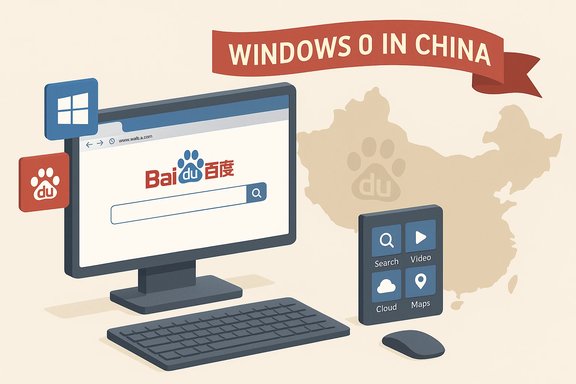
- Default homepage and search in Edge (China only): Edge’s default new‑user experience and homepage would point to Baidu.com for users whose systems are set to the China region. This applied specifically to the Microsoft Edge browser shipped with Windows 10.
- Baidu Windows 10 Express distribution channel: Baidu agreed to promote a one‑click or otherwise simplified Windows 10 download route to its Chinese users called Windows 10 Express, designed to surface the official Microsoft upgrade and distribution experience.
- Universal Windows Platform (UWP) apps: Baidu committed to delivering Universal Windows Applications for Search, Video, Cloud and Maps to the Windows 10 Store, improving the native app experience for Chinese users on the platform.
What Microsoft said about Bing
Microsoft was explicit that the move to Baidu was a regional, localized decision and that Bing remained a global priority. The company framed the partnership as locally relevant experiences rather than a global abandonment of Bing. That distinction was emphasized in Microsoft’s messaging at the time.Why Microsoft did this: strategy and pragmatism
Tianxia: local market dynamics matter
China is unique in terms of search and platform dynamics: Google’s core services have been restricted for years, and domestic players — led by Baidu — dominate search and related verticals. Microsoft’s move was a pragmatic concession to that reality: promoting Windows 10 adoption in China is materially easier if the system and first‑run browser feel familiar and useful to Chinese users. Baidu’s scale and brand recognition give Microsoft a distribution partner that speaks directly to local consumers and OEM channels.Productized distribution and app integration
By enabling Baidu to deliver UWP apps and a Windows 10 Express distribution path, Microsoft gained local distribution muscle to complement its global channels. The technical promise of native apps — search, maps, cloud storage and video — also made the Windows platform more relevant to users who expect tightly integrated, app‑centric experiences on their devices. The partnership was as much about product placement and app parity as it was about search engine defaults.A calculated trade
From Microsoft’s perspective, the trade was straightforward:- Sacrifice Bing as Edge’s default in a country where it was not competitive.
- Gain a distribution partner with deep local reach and the ability to nudge hundreds of millions of users toward Windows 10 upgrades and UWP apps.
- Keep Bing for global markets and services like Cortana where Microsoft still needed a consistent backend.
Immediate technical and user‑experience effects
For users in China
- First‑run Edge installs on local Windows 10 devices would present Baidu as the homepage/search experience, increasing the likelihood that users would use Baidu search and Baidu UWP apps instead of Bing.
- Baidu’s UWP apps promised tighter integration with Windows features such as Live Tiles, notifications, and system search integration where local apps are used.
For developers and ISVs
- Developers targeting Chinese users had clearer incentives to support Baidu integrations and UWP packaging that leveraged Microsoft Store distribution and Windows‑specific features.
- International developers had to consider that behavior and discoverability might differ substantially between local and global users because default search and homepage behavior impacts traffic sources.
For Microsoft services
- Microsoft retained Bing where it mattered globally and for OS services, but the Edge browser in China would route normal web searches to Baidu — a notable localization divergence that changed telemetry, partnership models, and monetization flows within China.
Cross‑checking the record (what’s verifiable)
The central facts of the partnership are verifiable through multiple independent sources:- Microsoft’s own Windows Experience blog post dated September 23, 2015 contains the core announcement text and the wording about Baidu becoming the default homepage and search engine for Edge in China.
- International news organizations and tech outlets reported the same arrangement at the time (CNN Money, China Daily, Engadget, Computerworld), confirming the public announcement and summarizing the agreement’s content.
- Archived discussion and community threads (uploaded files and forum archives) include the same Microsoft blog content and mirror the company’s phrasing about Windows 10 Express and UWP apps.
The benefits Microsoft and Baidu expected
- Faster Windows 10 adoption in China: Baidu’s reach and branded distribution path (Windows 10 Express) were expected to drive upgrades and new installs.
- A more relevant out‑of‑box experience for Chinese users: Local defaults usually improve perceived product fit; an Edge + Baidu combo reduces friction for many Chinese users.
- Stronger UWP ecosystem in China: Baidu’s commitment to UWP apps for core services expanded the app catalogue and helped Microsoft demonstrate Windows 10’s cross‑device app model.
- Commercial upside for Baidu: Exclusive placement in Edge provided a high‑value channel for Baidu’s search and ad ecosystem inside Windows.
Risks and trade‑offs — what the partnership left exposed
1) User privacy and data flows
Routing default search and homepage functionality to Baidu in China means search queries and usage telemetry are more likely to terminate in Baidu’s ecosystem and Chinese jurisdiction. That raises realistic questions about data handling, cross‑border data access, and compliance with local law, including government requests for information. While Baidu operates under Chinese law and local compliance frameworks, users and third parties should understand that data governance differs substantially from the EU or U.S. models. This is a structural consequence, not an allegation, and should be recognized as a risk vector when routing defaults to local platforms.2) Censorship and content control
Any search provider operating in China must follow local regulations and content filtering requirements. For Microsoft, placing Baidu front and center inside Edge in China effectively delegates search result policies and content moderation behavior — including necessary governmental compliance — to Baidu. For consumers and certain types of enterprises, that may be acceptable or expected; for others, it reduces the visibility of alternative viewpoints and external sources by design.3) Fragmented user experience
The Windows 10 experience became regionally non‑uniform in a deeper way than usual: default handlers, search backends, and integrated apps could diverge by country. That introduces complexity for application developers, corporate IT administrators, and support teams who must account for region‑specific behavior in their documentation, telemetry interpretation, and troubleshooting steps.4) Business and competitive implications
Microsoft ceded search placement in one of the world’s largest markets to a local player — a move that, while practical, reduces Bing’s footprint and long‑term scale in China. For Microsoft’s search monetization strategy and ambitions for global AI search models, that localization limits direct data and usage capture within China for those services. Microsoft argued Bing would remain important globally, but the China concession materially reduced Bing’s reach in a key market.5) Perception and regulatory optics
Historically, large technology platforms that favor local partners or bundle defaults have drawn regulatory scrutiny in other jurisdictions. While this specific deal is a localization move rather than an obvious anti‑competitive bundling, it still fits into broader debates about platform defaults, user choice, and the influence of preinstalled or default software on competition. Expect regulators and privacy advocates to view such arrangements through the lens of user choice and market power.How this played out (brief retrospective and lessons)
Historically, Microsoft’s Baidu agreement is an example of a major software vendor acknowledging regional realities by adapting default settings and local partnerships. The immediate outcome was predictable: Windows 10 installations in China would be fronted with local services more familiar to Chinese consumers, and Baidu gained strong placement and app distribution inside Windows.From a product strategy angle, the deal delivered three lessons:
- Default settings shape user behavior: Preconfigured defaults and first‑run experiences remain powerful levers for adoption and usage patterns, particularly among less technical users.
- Local partnerships can be faster than localizing a global service: Rather than trying to build Bing usage in a market where local alternatives are entrenched, Microsoft prioritized Windows adoption and product fit by co‑opting a strong local partner.
- Tradeoffs are inevitable: Local relevance comes at the cost of uniformity, control over data, and potential long‑term platform monetization for services like search.
Practical guidance for Windows users and administrators
- If you or your organization manage devices across regions, expect and test for region‑specific defaults: search engines, homepages, and preinstalled apps may vary by localization and OEM settings.
- For privacy‑conscious users, verify local default search providers and investigate the provider’s privacy policy and data handling practices in your jurisdiction.
- IT administrators should explicitly document the default search and homepage settings for localized builds of Windows 10 and include remediation steps for users who want to change defaults.
- Developers and digital marketers targeting China should treat Baidu as the primary desktop search channel in China and plan resources accordingly for SEO and app integration.
What to watch for now (broader implications)
- Defaults and antitrust scrutiny: Regulators worldwide continue to question how default settings influence competition. While this specific Baidu‑Edge arrangement was a localization decision, similar default nudges elsewhere have triggered regulatory attention and public debate.
- Data governance and localization pressures: Governments increasingly press for data residency and local control. Partnerships that redirect defaults to local providers naturally intersect with these legal and policy trends; organizations should track how local rules evolve and what that implies for cross‑border data flows.
- Search market fragmentation and AI search models: As search platforms evolve with AI, regional leaders who control large datasets in their jurisdictions (and can integrate AI services into closed ecosystems) may establish powerful local moats. For global platform operators, losing default status in a major market can limit the richness of training data available for models unless new data strategies are negotiated.
Final analysis: smart pragmatism with structural consequences
The Microsoft‑Baidu deal was a smart, pragmatic move to accelerate Windows 10 adoption in China and deliver a more locally relevant user experience. Microsoft correctly recognized that insisting on a marginal global product (Bing in China) would hamper the larger strategic objective: getting Windows 10 distributed, used, and embraced.That pragmatism, however, comes with structural consequences that are not trivial. Routing defaults to a local search provider changes data flows, regulatory exposure, and the long‑term growth prospects for Microsoft’s own search and AI services in that market. It also deepens an important truth for platform companies: defaults are powerfully influential, and tailoring them to local markets can be both an effective product tactic and a long‑term strategic concession.
Readers and practitioners should treat the partnership as a case study in pragmatic localization: a clear win for short‑term product fit and distribution — and a reminder that localization choices should be made with eyes open to privacy, sovereignty, and competitive implications.
Conclusion
Microsoft’s decision to make Baidu the default search and homepage for Microsoft Edge in China — and to let Baidu shepherd Windows 10 adoption via Windows 10 Express and UWP apps — was a practical recognition of local market realities and distribution economics. The move demonstrates how platform owners will sometimes trade control for relevance, and it remains a useful precedent for how global software vendors can adapt to local markets while balancing privacy, regulatory, and long‑term product strategy trade‑offs.
Source: BetaNews Surprise! Microsoft Edge ditches Bing for Baidu in China
