

Microsoft used Build 2026 in San Francisco on June 2 to introduce a new Microsoft Agent Platform, seven in-house AI models, expanded Microsoft IQ context services, and developer tools meant to move AI agents from demos into governed enterprise software. The headline is not simply that Microsoft has more AI products. It is that the company is trying to make agents feel like the next default computing abstraction inside Microsoft 365, GitHub, Azure, Windows-adjacent devices, and eventually scientific and quantum workflows. For WindowsForum readers, the practical question is whether this becomes useful infrastructure or another layer of cloud dependency wrapped in keynote language.
For the last two years, “agent” has been the software industry’s favorite overworked noun. It has described everything from a glorified chatbot that can call an API to a semi-autonomous workflow runner that can read documents, write code, open tickets, and make decisions under policy constraints. At Build 2026, Microsoft tried to narrow the definition by doing what Microsoft always does when a technology category matures: it wrapped the idea in identity, governance, deployment surfaces, management controls, and developer tooling.
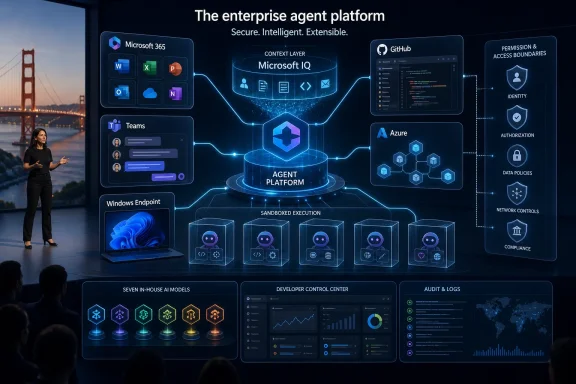
The Microsoft Agent Platform is the most revealing announcement because it gives shape to the company’s broader AI strategy. Agents are not being positioned as standalone bots. They are being presented as managed software actors that understand organizational context through Microsoft IQ, run through Microsoft Foundry, and appear where workers already spend time, especially Teams, Microsoft 365, GitHub Copilot, and Copilot Studio.
That is a very Microsoft answer to a very Microsoft problem. The company knows that enterprise AI does not fail only because the model is too weak. It fails because the model does not know enough about the business, sees too much of what it should not, cannot be audited cleanly, and does not fit into the IT estate without frightening security teams.
The pitch, then, is not “our agent is smarter.” The pitch is “our agent knows where it works, who it works for, what it may touch, and where IT can put a leash on it.” That is less glamorous than a leaderboard score, but it is much closer to the problem administrators and developers face when someone upstairs asks why the company’s expensive AI pilot has not become production software.
This is a powerful idea, and also a dangerous one. An AI model without context is often generic. An AI model with enterprise context can be genuinely useful. But an AI model with poorly governed enterprise context can become a faster, smoother way to leak internal knowledge, amplify bad assumptions, or act on stale information with impressive confidence.
Microsoft’s framing tries to avoid the old trade-off between usefulness and control. Work IQ is meant to understand how work happens across Microsoft 365, organizational systems, and outside sources. Web IQ is billed as an AI-first search stack for real-time grounding. In plain English, Microsoft wants agents to combine what your company knows, what the wider web says now, and what the user is trying to do in the moment.
That is the heart of the platform bet. If Microsoft can make IQ the trusted context layer for agents, it does not need to win every model benchmark or every app interface. It can make the Microsoft cloud the place where business context becomes usable, permission-aware AI fuel.
But there is a familiar Windows-era pattern here. The more valuable the context layer becomes, the harder it is for an organization to imagine leaving it. Exchange, Active Directory, SharePoint, Teams, Intune, Entra, Purview, Defender, GitHub, Azure, and Microsoft 365 already form a dense enterprise mesh. Microsoft IQ could turn that mesh into something even stickier: not just the place where work is stored, but the place where work is interpreted.
Foundry gives Microsoft a production-facing story. Agents can be built, deployed, monitored, and managed at cloud scale rather than scattered across notebooks, ad hoc scripts, SaaS dashboards, browser extensions, and internal experiments. That is the kind of plumbing developers often dislike discussing until it fails.
The timing matters. Many organizations are past the “Can we make a chatbot answer HR questions?” phase. They are now asking whether an agent can handle a procurement workflow, triage incidents, assist developers across repositories, or perform research over regulated data. At that point, the issue is not whether an LLM can produce fluent text. The issue is whether the system can authenticate, authorize, log, evaluate, roll back, and stay within policy.
Microsoft is also positioning Foundry as a model-flexible environment. That matters because enterprise AI buyers increasingly want optionality. They may use OpenAI for one workload, Microsoft’s own models for another, a smaller open model for cost-sensitive tasks, and specialized models for coding, speech, images, or science. Microsoft’s ideal outcome is obvious: customers can choose among models, but the switching takes place inside Microsoft’s platform.
That is both a benefit and a trap. A unified deployment surface can reduce operational complexity. It can also make the deployment surface the real point of dependency. Microsoft does not have to force customers into one model if it controls the place where models meet data, identity, tools, monitoring, and billing.
That does not mean Microsoft is walking away from OpenAI. The relationship remains strategically important, commercially deep, and technically embedded across many Microsoft products. But Build 2026 made the direction of travel clearer: Microsoft wants credible first-party models for cost control, product differentiation, latency, licensing clarity, and leverage.
MAI-Thinking-1 is especially important because reasoning models have become the prestige layer of AI marketing. They are pitched as systems that can plan, decompose tasks, work through multi-step problems, and handle harder coding or analytical workloads. Whether Microsoft’s model is frontier-class is less important than whether it is good enough, cheap enough, and integrated enough to make sense for Microsoft-controlled workflows.
That last point is where the model story gets interesting. Microsoft does not necessarily need to beat every rival in open-ended tests if its models are tuned for GitHub, VS Code, Microsoft 365, Foundry, Teams, Windows-related development, and enterprise context. A model that is merely competitive in the abstract can become highly valuable when placed inside a distribution machine that reaches hundreds of millions of users and countless businesses.
For developers, MAI-Code-1 and its related coding capabilities may be the most immediate signal. GitHub Copilot has already changed expectations around code completion and AI-assisted development. The next step is not just better autocomplete; it is agent-driven development that can inspect a repo, propose changes, run tests, open pull requests, and explain trade-offs. That is also where trust becomes harder. A suggestion is one thing. An agent that edits a production-adjacent codebase is another.
Developers already live across terminals, IDEs, browsers, issue trackers, CI dashboards, local files, cloud consoles, chat, and documentation. If Copilot becomes an app that can coordinate across these surfaces, the user interface for development starts to shift. The developer does not only ask for a completion. The developer assigns work, reviews outputs, intervenes when needed, and decides what enters the actual codebase.
This will make some programmers more productive and others more nervous, often for good reasons. AI coding tools can accelerate boilerplate, test generation, migration work, and unfamiliar API exploration. They can also introduce subtle bugs, hallucinate dependencies, misunderstand architecture, or produce code that passes a narrow test while violating the spirit of the system.
The native-app direction also raises a Windows question. Microsoft did not need to make every Build announcement explicitly about Windows for the Windows implications to be obvious. If agentic development, local sandboxes, identity-aware context, and cloud-connected copilots become central to software work, Windows becomes not merely an operating system but one endpoint in a distributed agent environment.
That is where long-time Windows users may feel a familiar tension. Microsoft is good at integrating. It is also good at making integration feel unavoidable. The Copilot app could become a genuinely useful tool for developers, but it also tightens the loop between GitHub, Microsoft identity, cloud-hosted agents, and local workflows.
This is not just a developer convenience. It is a recognition that agentic software changes the threat model. Traditional apps act when users click buttons or scheduled tasks run. Agents may act after interpreting natural-language instructions, reading ambiguous context, calling tools, and deciding the next step in a chain. That creates more room for prompt injection, accidental overreach, data exfiltration, and tool misuse.
A secure sandbox does not solve those problems by itself. It does, however, give administrators and platform engineers a boundary they can reason about. If an agent needs to run untrusted code, fetch web content, process documents, or generate and test scripts, the execution environment matters enormously.
Windows veterans have seen Microsoft attempt many containment models over the decades, from User Account Control and AppContainer to Windows Sandbox, WDAG-style isolation, virtualization-based security, and containerized workloads. Execution Containers fit into that lineage, but with a new AI-driven reason for being. The question is whether Microsoft can make them easy enough for developers to adopt by default and strict enough for security teams to trust.
The risk is that agent sandboxes become like many security features: available, documented, praised, and unevenly used. The success of Execution Containers will depend less on preview-stage architecture and more on whether Microsoft bakes them into the natural path of building and deploying agents.
A pilot can be built with a powerful model, a few documents, and a motivated team. Production requires identity integration, data classification, tenant boundaries, observability, incident response, legal review, procurement, accessibility, localization, reliability, and cost control. The AI industry often talks as if better models automatically dissolve those obstacles. They do not.
Microsoft’s advantage is that it can sell AI as an extension of systems enterprises already use. Teams is not just chat. Microsoft 365 is not just Office. Entra is not just login. Purview is not just compliance. GitHub is not just repositories. Azure is not just compute. In Microsoft’s hands, all of these become pieces of an agent operating environment.
That is a compelling proposition for CIOs who want to reduce fragmentation. It is also exactly why competitors and open-ecosystem advocates will be wary. If Microsoft succeeds, the enterprise AI layer could become another Microsoft-controlled substrate, much as Windows and Office defined earlier eras of corporate computing.
There is a practical upside for administrators. A centrally managed agent ecosystem is easier to audit than a thousand browser plug-ins and department-level SaaS experiments. There is also a practical downside. Centralization concentrates failure modes, licensing leverage, and architectural dependency.
That breadth is classic Microsoft. The company rarely bets on a new computing paradigm with a single product. It surrounds the category, waits for enterprise requirements to harden, and then offers a platform that looks less exciting than the startup version but more deployable at scale.
The danger is bloat. A developer watching Build 2026 could be forgiven for wondering how many product names, context layers, agents, copilots, studios, foundries, services, containers, and model families one company can introduce before the architecture becomes its own tax. Microsoft’s enterprise customers will tolerate complexity if it maps to real control. They will resent it if it becomes licensing fog.
There is also the problem of user agency. Microsoft says the announcements give developers and workers more agency. That may be true when AI removes toil and exposes better tools. It becomes less true if organizations use agents to automate oversight, normalize always-on monitoring, or push employees into opaque workflows they cannot inspect.
For WindowsForum’s audience, the right stance is neither cynicism nor credulity. The platform pieces are real enough to matter. The marketing language is inflated enough to deserve pressure.
That matters because Microsoft’s center of gravity has shifted over the last decade. Windows remains enormous, especially for business desktops, gaming, development, and endpoint management. But Microsoft’s strategic control increasingly comes from identity, cloud services, productivity data, GitHub, security tooling, and management planes.
An agent-first world may accelerate that shift. If the agent is the thing users interact with, the operating system becomes one part of the agent’s environment rather than the primary experience. A user might begin on a Windows PC, continue in Teams on a phone, approve an action from a wearable, and rely on cloud state throughout. Microsoft can win that world even if every endpoint is not running Windows.
That should not be read as Windows being irrelevant. Quite the opposite: Windows becomes a high-value local surface for agents, development, enterprise security, and managed execution. But the Windows-first mental model is less useful than it used to be. Microsoft is building for a world where the platform boundary is the tenant, the identity, the context graph, and the agent runtime.
For traditional Windows power users, this can feel like a loss of locality. For enterprise IT, it may feel like the logical continuation of modern management. Either way, Build 2026 reinforces that the action is no longer confined to the PC.
That is a more ambitious claim than summarizing a meeting or drafting an email. Scientific work is full of uncertainty, specialized knowledge, reproducibility demands, and domain-specific tooling. If AI agents are useful there, the value proposition becomes much larger than white-collar productivity.
It is also a field where Microsoft can connect multiple strategic bets. Azure provides compute. Foundry provides model orchestration. Microsoft Research contributes credibility. Discovery provides a product frame. Quantum computing provides a moonshot narrative. The company can present AI not merely as a productivity assistant but as an accelerator for science and engineering.
The Majorana 2 announcement fits that narrative. Microsoft says its next-generation quantum chip improves reliability and supports a path toward a scalable quantum system later this decade. Quantum claims should always be read carefully, especially given the history of overpromising in the field and the technical difficulty of proving durable, scalable advantage. But the pairing of Discovery and Majorana 2 is telling: Microsoft wants AI to be seen not just as software that writes software, but as a tool that helps build the next hardware frontier.
For most WindowsForum readers, the quantum angle will not change tomorrow’s patch cycle or next quarter’s endpoint plan. But it does show how Microsoft wants to connect its AI platform to long-horizon infrastructure bets. The story is not only Copilot in Office. It is AI as the connective tissue for research, cloud, chips, and enterprise workflows.
Microsoft has some advantages here. It already has mature identity systems, device management, compliance tooling, security products, and developer platforms. It can tie agent permissions to organizational roles, data boundaries, audit logs, and administrative policy in ways that many AI-native startups cannot easily match.
But the hard part is not only infrastructure. It is interface. Users need to understand what an agent is allowed to do. Administrators need to understand what an agent actually did. Developers need predictable tool-calling behavior. Security teams need to see how prompt input, retrieved context, model output, and external actions combine into a traceable chain.
This is where Microsoft’s history cuts both ways. The company knows enterprise administration deeply. It also has a habit of hiding complexity behind portals, licenses, defaults, and product names that take specialists years to fully understand. If agent governance becomes another dense administrative maze, customers may technically have control while practically lacking clarity.
The best version of Microsoft’s platform would make safe behavior the path of least resistance. The worst version would let every department create semi-autonomous software actors whose permissions are technically documented but socially misunderstood.
Software developers have always encoded logic, handled errors, protected data, and designed user experiences. Agent developers must also think about instructions, retrieval quality, model selection, evaluation, policy enforcement, tool boundaries, escalation paths, and observability. The craft is expanding.
That expansion can be exciting. A small team may be able to build workflows that previously required large integration projects. Internal tools may become easier to create. Legacy processes may finally get usable interfaces. Developers may spend less time wiring boilerplate and more time defining outcomes.
It can also be messy. Natural-language instructions are not the same as deterministic code. Model behavior shifts. Context can be incomplete or misleading. Tool calls can fail. Evaluation is harder when outputs vary. The developer’s responsibility does not disappear because the system is “intelligent.” If anything, responsibility increases because the system may act in ways users perceive as authoritative.
Microsoft’s platform announcements implicitly acknowledge this. Foundry, Execution Containers, IQ, Copilot, and in-house models are not just shiny layers. They are the scaffolding required when developers stop building passive apps and start building systems that act.
Microsoft is trying to define the enterprise architecture of agentic AI before the category becomes chaotic. It wants developers to build agents through Microsoft tools, ground them in Microsoft-managed context, run them through Microsoft deployment infrastructure, secure them with Microsoft controls, expose them in Microsoft productivity surfaces, and eventually extend them to Microsoft-influenced devices and research workflows.
That is not a side quest. It is a bid to own the control plane of AI work.
This is why the in-house models matter even if they are not always the best models in every benchmark. This is why IQ matters even if most users never say the product name. This is why Execution Containers matter even in preview. This is why Foundry matters more than any individual demo. Microsoft is assembling the boring parts that make a technology enterprise-standard.
The company has done this before. Sometimes it produces durable platforms that administrators and developers rely on for decades. Sometimes it produces overlapping brands, confusing SKUs, and half-finished experiences. Build 2026 contains both possibilities.
 Microsoft Is Turning the Agent From Feature Into Platform
For the last two years, “agent” has been the software industry’s favorite overworked noun. It has described everything from a glorified chatbot that can call an API to a semi-autonomous workflow runner that can read documents, write code, open tickets, and make decisions under policy constraints. At Build 2026, Microsoft tried to narrow the definition by doing what Microsoft always does when a technology category matures: it wrapped the idea in identity, governance, deployment surfaces, management controls, and developer tooling.The Microsoft Agent Platform is the most revealing announcement because it gives shape to the company’s broader AI strategy. Agents are not being positioned as standalone bots. They are being presented as managed software actors that understand organizational context through Microsoft IQ, run through Microsoft Foundry, and appear where workers already spend time, especially Teams, Microsoft 365, GitHub Copilot, and Copilot Studio.
That is a very Microsoft answer to a very Microsoft problem. The company knows that enterprise AI does not fail only because the model is too weak. It fails because the model does not know enough about the business, sees too much of what it should not, cannot be audited cleanly, and does not fit into the IT estate without frightening security teams.
The pitch, then, is not “our agent is smarter.” The pitch is “our agent knows where it works, who it works for, what it may touch, and where IT can put a leash on it.” That is less glamorous than a leaderboard score, but it is much closer to the problem administrators and developers face when someone upstairs asks why the company’s expensive AI pilot has not become production software.
Context Becomes the New Lock-In
Microsoft IQ is the part of the announcement that deserves the most attention from IT pros, because it is where the company is trying to turn its existing enterprise gravity into an AI advantage. Microsoft says IQ is now generally available across GitHub Copilot, Microsoft Foundry, and Copilot Studio, giving developers a unified context layer across enterprise and external data. That sounds abstract until you translate it into the language of daily work: emails, meetings, documents, repositories, tickets, line-of-business data, intranet content, and web results all become raw material for agent behavior.This is a powerful idea, and also a dangerous one. An AI model without context is often generic. An AI model with enterprise context can be genuinely useful. But an AI model with poorly governed enterprise context can become a faster, smoother way to leak internal knowledge, amplify bad assumptions, or act on stale information with impressive confidence.
Microsoft’s framing tries to avoid the old trade-off between usefulness and control. Work IQ is meant to understand how work happens across Microsoft 365, organizational systems, and outside sources. Web IQ is billed as an AI-first search stack for real-time grounding. In plain English, Microsoft wants agents to combine what your company knows, what the wider web says now, and what the user is trying to do in the moment.
That is the heart of the platform bet. If Microsoft can make IQ the trusted context layer for agents, it does not need to win every model benchmark or every app interface. It can make the Microsoft cloud the place where business context becomes usable, permission-aware AI fuel.
But there is a familiar Windows-era pattern here. The more valuable the context layer becomes, the harder it is for an organization to imagine leaving it. Exchange, Active Directory, SharePoint, Teams, Intune, Entra, Purview, Defender, GitHub, Azure, and Microsoft 365 already form a dense enterprise mesh. Microsoft IQ could turn that mesh into something even stickier: not just the place where work is stored, but the place where work is interpreted.
Foundry Is Microsoft’s Answer to Agent Sprawl
The Foundry Agent Service, now in preview, is Microsoft’s attempt to keep agent development from becoming the next shadow IT explosion. Any technology that lets workers automate tasks, call tools, summarize documents, generate code, and make decisions will eventually create a governance headache. The question is whether enterprises get ahead of that headache or discover it during an audit.Foundry gives Microsoft a production-facing story. Agents can be built, deployed, monitored, and managed at cloud scale rather than scattered across notebooks, ad hoc scripts, SaaS dashboards, browser extensions, and internal experiments. That is the kind of plumbing developers often dislike discussing until it fails.
The timing matters. Many organizations are past the “Can we make a chatbot answer HR questions?” phase. They are now asking whether an agent can handle a procurement workflow, triage incidents, assist developers across repositories, or perform research over regulated data. At that point, the issue is not whether an LLM can produce fluent text. The issue is whether the system can authenticate, authorize, log, evaluate, roll back, and stay within policy.
Microsoft is also positioning Foundry as a model-flexible environment. That matters because enterprise AI buyers increasingly want optionality. They may use OpenAI for one workload, Microsoft’s own models for another, a smaller open model for cost-sensitive tasks, and specialized models for coding, speech, images, or science. Microsoft’s ideal outcome is obvious: customers can choose among models, but the switching takes place inside Microsoft’s platform.
That is both a benefit and a trap. A unified deployment surface can reduce operational complexity. It can also make the deployment surface the real point of dependency. Microsoft does not have to force customers into one model if it controls the place where models meet data, identity, tools, monitoring, and billing.
Seven Models Mark a Quieter Break From the OpenAI Era
The announcement of seven in-house Microsoft AI models is the part of Build 2026 that will attract the easiest headlines. MAI-Thinking-1 is Microsoft AI’s first reasoning model, aimed at complex multi-step tasks. Other models span coding, image generation, transcription, and voice. Taken together, they show Microsoft trying to build a full AI stack that does not rely solely on its OpenAI partnership.That does not mean Microsoft is walking away from OpenAI. The relationship remains strategically important, commercially deep, and technically embedded across many Microsoft products. But Build 2026 made the direction of travel clearer: Microsoft wants credible first-party models for cost control, product differentiation, latency, licensing clarity, and leverage.
MAI-Thinking-1 is especially important because reasoning models have become the prestige layer of AI marketing. They are pitched as systems that can plan, decompose tasks, work through multi-step problems, and handle harder coding or analytical workloads. Whether Microsoft’s model is frontier-class is less important than whether it is good enough, cheap enough, and integrated enough to make sense for Microsoft-controlled workflows.
That last point is where the model story gets interesting. Microsoft does not necessarily need to beat every rival in open-ended tests if its models are tuned for GitHub, VS Code, Microsoft 365, Foundry, Teams, Windows-related development, and enterprise context. A model that is merely competitive in the abstract can become highly valuable when placed inside a distribution machine that reaches hundreds of millions of users and countless businesses.
For developers, MAI-Code-1 and its related coding capabilities may be the most immediate signal. GitHub Copilot has already changed expectations around code completion and AI-assisted development. The next step is not just better autocomplete; it is agent-driven development that can inspect a repo, propose changes, run tests, open pull requests, and explain trade-offs. That is also where trust becomes harder. A suggestion is one thing. An agent that edits a production-adjacent codebase is another.
The Copilot Desktop App Is a Small Preview With Big Implications
The GitHub Copilot app, now in preview, sounds like a modest product announcement compared with in-house models and an agent platform. It may turn out to be more important than it looks. A native desktop experience for agent-driven development changes the ergonomics of AI coding from a sidebar inside an editor to something closer to a workbench.Developers already live across terminals, IDEs, browsers, issue trackers, CI dashboards, local files, cloud consoles, chat, and documentation. If Copilot becomes an app that can coordinate across these surfaces, the user interface for development starts to shift. The developer does not only ask for a completion. The developer assigns work, reviews outputs, intervenes when needed, and decides what enters the actual codebase.
This will make some programmers more productive and others more nervous, often for good reasons. AI coding tools can accelerate boilerplate, test generation, migration work, and unfamiliar API exploration. They can also introduce subtle bugs, hallucinate dependencies, misunderstand architecture, or produce code that passes a narrow test while violating the spirit of the system.
The native-app direction also raises a Windows question. Microsoft did not need to make every Build announcement explicitly about Windows for the Windows implications to be obvious. If agentic development, local sandboxes, identity-aware context, and cloud-connected copilots become central to software work, Windows becomes not merely an operating system but one endpoint in a distributed agent environment.
That is where long-time Windows users may feel a familiar tension. Microsoft is good at integrating. It is also good at making integration feel unavoidable. The Copilot app could become a genuinely useful tool for developers, but it also tightens the loop between GitHub, Microsoft identity, cloud-hosted agents, and local workflows.
Execution Containers Show Microsoft Knows Agents Need Restraints
Microsoft Execution Containers, now in preview, may be one of the most technically consequential announcements for security-minded readers. The idea is straightforward: agents need places to execute code, inspect files, run commands, and manipulate artifacts without being allowed to roam freely across the host system. Operating-system-enforced sandboxes are one answer.This is not just a developer convenience. It is a recognition that agentic software changes the threat model. Traditional apps act when users click buttons or scheduled tasks run. Agents may act after interpreting natural-language instructions, reading ambiguous context, calling tools, and deciding the next step in a chain. That creates more room for prompt injection, accidental overreach, data exfiltration, and tool misuse.
A secure sandbox does not solve those problems by itself. It does, however, give administrators and platform engineers a boundary they can reason about. If an agent needs to run untrusted code, fetch web content, process documents, or generate and test scripts, the execution environment matters enormously.
Windows veterans have seen Microsoft attempt many containment models over the decades, from User Account Control and AppContainer to Windows Sandbox, WDAG-style isolation, virtualization-based security, and containerized workloads. Execution Containers fit into that lineage, but with a new AI-driven reason for being. The question is whether Microsoft can make them easy enough for developers to adopt by default and strict enough for security teams to trust.
The risk is that agent sandboxes become like many security features: available, documented, praised, and unevenly used. The success of Execution Containers will depend less on preview-stage architecture and more on whether Microsoft bakes them into the natural path of building and deploying agents.
The Enterprise Promise Is Governance Without Friction
Microsoft’s Build messaging repeatedly returns to a set of paired tensions: context versus governance, security versus speed, models versus tools. These are not invented tensions. They describe exactly why enterprise AI projects stall after the proof-of-concept stage.A pilot can be built with a powerful model, a few documents, and a motivated team. Production requires identity integration, data classification, tenant boundaries, observability, incident response, legal review, procurement, accessibility, localization, reliability, and cost control. The AI industry often talks as if better models automatically dissolve those obstacles. They do not.
Microsoft’s advantage is that it can sell AI as an extension of systems enterprises already use. Teams is not just chat. Microsoft 365 is not just Office. Entra is not just login. Purview is not just compliance. GitHub is not just repositories. Azure is not just compute. In Microsoft’s hands, all of these become pieces of an agent operating environment.
That is a compelling proposition for CIOs who want to reduce fragmentation. It is also exactly why competitors and open-ecosystem advocates will be wary. If Microsoft succeeds, the enterprise AI layer could become another Microsoft-controlled substrate, much as Windows and Office defined earlier eras of corporate computing.
There is a practical upside for administrators. A centrally managed agent ecosystem is easier to audit than a thousand browser plug-ins and department-level SaaS experiments. There is also a practical downside. Centralization concentrates failure modes, licensing leverage, and architectural dependency.
The “Ubiquitous Intelligence” Pitch Needs a Reality Check
Microsoft’s phrase for the Build 2026 moment is “ubiquitous intelligence,” and it is easy to mock because it sounds like a phrase assembled for a keynote teleprompter. Still, the phrase usefully captures what the company is attempting. AI is not being treated as one product. It is being pushed into every layer: models, context, developer tools, cloud deployment, productivity apps, devices, science, and quantum research.That breadth is classic Microsoft. The company rarely bets on a new computing paradigm with a single product. It surrounds the category, waits for enterprise requirements to harden, and then offers a platform that looks less exciting than the startup version but more deployable at scale.
The danger is bloat. A developer watching Build 2026 could be forgiven for wondering how many product names, context layers, agents, copilots, studios, foundries, services, containers, and model families one company can introduce before the architecture becomes its own tax. Microsoft’s enterprise customers will tolerate complexity if it maps to real control. They will resent it if it becomes licensing fog.
There is also the problem of user agency. Microsoft says the announcements give developers and workers more agency. That may be true when AI removes toil and exposes better tools. It becomes less true if organizations use agents to automate oversight, normalize always-on monitoring, or push employees into opaque workflows they cannot inspect.
For WindowsForum’s audience, the right stance is neither cynicism nor credulity. The platform pieces are real enough to matter. The marketing language is inflated enough to deserve pressure.
Project Solara Hints That Windows Is No Longer the Whole Stage
Although the Irish report emphasizes the Agent Platform, Microsoft IQ, models, Execution Containers, Foundry, Copilot, Discovery, and Majorana 2, Build 2026 also fits into a broader story about agent-first devices and distributed computing. Project Solara, announced at Build, points toward devices designed around agents rather than traditional app launchers. Some reporting indicates the platform uses Microsoft’s device ecosystem work and cloud-hosted agent services rather than simply extending classic Windows.That matters because Microsoft’s center of gravity has shifted over the last decade. Windows remains enormous, especially for business desktops, gaming, development, and endpoint management. But Microsoft’s strategic control increasingly comes from identity, cloud services, productivity data, GitHub, security tooling, and management planes.
An agent-first world may accelerate that shift. If the agent is the thing users interact with, the operating system becomes one part of the agent’s environment rather than the primary experience. A user might begin on a Windows PC, continue in Teams on a phone, approve an action from a wearable, and rely on cloud state throughout. Microsoft can win that world even if every endpoint is not running Windows.
That should not be read as Windows being irrelevant. Quite the opposite: Windows becomes a high-value local surface for agents, development, enterprise security, and managed execution. But the Windows-first mental model is less useful than it used to be. Microsoft is building for a world where the platform boundary is the tenant, the identity, the context graph, and the agent runtime.
For traditional Windows power users, this can feel like a loss of locality. For enterprise IT, it may feel like the logical continuation of modern management. Either way, Build 2026 reinforces that the action is no longer confined to the PC.
Microsoft Discovery Makes the Science Pitch Less Abstract
Microsoft Discovery, now generally available as an enterprise AI solution for the full scientific workflow, is one of the more interesting parts of the announcement because it moves agents away from office productivity and into research. Microsoft is arguing that agentic systems can help coordinate scientific literature review, hypothesis generation, simulation, experiment planning, data analysis, and materials discovery.That is a more ambitious claim than summarizing a meeting or drafting an email. Scientific work is full of uncertainty, specialized knowledge, reproducibility demands, and domain-specific tooling. If AI agents are useful there, the value proposition becomes much larger than white-collar productivity.
It is also a field where Microsoft can connect multiple strategic bets. Azure provides compute. Foundry provides model orchestration. Microsoft Research contributes credibility. Discovery provides a product frame. Quantum computing provides a moonshot narrative. The company can present AI not merely as a productivity assistant but as an accelerator for science and engineering.
The Majorana 2 announcement fits that narrative. Microsoft says its next-generation quantum chip improves reliability and supports a path toward a scalable quantum system later this decade. Quantum claims should always be read carefully, especially given the history of overpromising in the field and the technical difficulty of proving durable, scalable advantage. But the pairing of Discovery and Majorana 2 is telling: Microsoft wants AI to be seen not just as software that writes software, but as a tool that helps build the next hardware frontier.
For most WindowsForum readers, the quantum angle will not change tomorrow’s patch cycle or next quarter’s endpoint plan. But it does show how Microsoft wants to connect its AI platform to long-horizon infrastructure bets. The story is not only Copilot in Office. It is AI as the connective tissue for research, cloud, chips, and enterprise workflows.
The Real Test Is Not the Demo, It Is the Permission Boundary
The most important unresolved issue in Microsoft’s agent push is permission. An agent that cannot act is a chatbot with better branding. An agent that can act too freely is an incident waiting to happen. The entire category lives or dies in the narrow space between those failures.Microsoft has some advantages here. It already has mature identity systems, device management, compliance tooling, security products, and developer platforms. It can tie agent permissions to organizational roles, data boundaries, audit logs, and administrative policy in ways that many AI-native startups cannot easily match.
But the hard part is not only infrastructure. It is interface. Users need to understand what an agent is allowed to do. Administrators need to understand what an agent actually did. Developers need predictable tool-calling behavior. Security teams need to see how prompt input, retrieved context, model output, and external actions combine into a traceable chain.
This is where Microsoft’s history cuts both ways. The company knows enterprise administration deeply. It also has a habit of hiding complexity behind portals, licenses, defaults, and product names that take specialists years to fully understand. If agent governance becomes another dense administrative maze, customers may technically have control while practically lacking clarity.
The best version of Microsoft’s platform would make safe behavior the path of least resistance. The worst version would let every department create semi-autonomous software actors whose permissions are technically documented but socially misunderstood.
Developers Get More Power, and More Accountability
Build is a developer conference, and Microsoft’s message to developers is clear: the next application you build may not look like an application. It may be an agent that uses models, tools, context, policies, and execution environments to complete work across systems. That changes the developer’s job.Software developers have always encoded logic, handled errors, protected data, and designed user experiences. Agent developers must also think about instructions, retrieval quality, model selection, evaluation, policy enforcement, tool boundaries, escalation paths, and observability. The craft is expanding.
That expansion can be exciting. A small team may be able to build workflows that previously required large integration projects. Internal tools may become easier to create. Legacy processes may finally get usable interfaces. Developers may spend less time wiring boilerplate and more time defining outcomes.
It can also be messy. Natural-language instructions are not the same as deterministic code. Model behavior shifts. Context can be incomplete or misleading. Tool calls can fail. Evaluation is harder when outputs vary. The developer’s responsibility does not disappear because the system is “intelligent.” If anything, responsibility increases because the system may act in ways users perceive as authoritative.
Microsoft’s platform announcements implicitly acknowledge this. Foundry, Execution Containers, IQ, Copilot, and in-house models are not just shiny layers. They are the scaffolding required when developers stop building passive apps and start building systems that act.
The Irish Framing Gets the Product News Right, but the Strategic Story Is Bigger
The Irish Tech News report correctly captures the core announcements: the Agent Platform, Microsoft IQ general availability, Work IQ and Web IQ, seven in-house models, MAI-Thinking-1, Execution Containers, Foundry Agent Service, the GitHub Copilot app, Microsoft Discovery, and Majorana 2. But the strategic story underneath is larger than a list of Build updates.Microsoft is trying to define the enterprise architecture of agentic AI before the category becomes chaotic. It wants developers to build agents through Microsoft tools, ground them in Microsoft-managed context, run them through Microsoft deployment infrastructure, secure them with Microsoft controls, expose them in Microsoft productivity surfaces, and eventually extend them to Microsoft-influenced devices and research workflows.
That is not a side quest. It is a bid to own the control plane of AI work.
This is why the in-house models matter even if they are not always the best models in every benchmark. This is why IQ matters even if most users never say the product name. This is why Execution Containers matter even in preview. This is why Foundry matters more than any individual demo. Microsoft is assembling the boring parts that make a technology enterprise-standard.
The company has done this before. Sometimes it produces durable platforms that administrators and developers rely on for decades. Sometimes it produces overlapping brands, confusing SKUs, and half-finished experiences. Build 2026 contains both possibilities.
The Build 2026 Bet Comes Down to Control, Cost, and Trust
Microsoft’s announcements are broad, but the practical reading for WindowsForum’s audience is fairly concrete. The company is not just adding AI to products; it is building an enterprise agent stack that ties together models, context, tools, deployment, security, and user surfaces.- Microsoft Agent Platform is intended to make agents manageable enterprise software rather than isolated chatbot experiments.
- Microsoft IQ is the strategic layer because enterprise context is what makes agents useful and what makes them risky.
- The seven MAI models give Microsoft more control over cost, performance tuning, licensing, and independence from outside model providers.
- Execution Containers show that Microsoft understands agentic software needs operating-system-level restraint, not just policy language.
- Foundry Agent Service and the GitHub Copilot app point toward a world where developers supervise AI workers as much as they write every line themselves.
- Microsoft Discovery and Majorana 2 extend the same platform story into scientific research and long-term computing bets, even if the near-term impact will be uneven.
References
- Primary source: Irish Tech News
Published: 2026-06-04T13:12:09.730061
Microsoft unveils AI agent platform, new models and developer platform advancements at Build 2026 - Irish Tech News
New capabilities include Work IQ, which captures how work happens across Microsoft 365, organisational systems and external sources, and Web IQ, an AI-firstirishtechnews.ie - Related coverage: tomshardware.com
Microsoft unveils Project Solara AI, a chip-to-cloud platform built to power a new generation of 'agent-first' enterprise devices — hardware designed to run AI agents instead of traditional apps | Tom's Hardware
Microsoft ditches Windows to build OS on Androidwww.tomshardware.com - Related coverage: axios.com
Microsoft debuts Scout agent, homegrown reasoning model
Microsoft is seeking to show it is a serious player in AI.www.axios.com
- Related coverage: windowscentral.com
Microsoft outlines its vision for “the next computer” with Project Solara, an agentic platform that exists liminally in your pocket and on your desk | Windows Central
After Windows Phone, Microsoft is eager to get ahead of the next paradigm shift in computing, and it's betting big on an agentic hardware and software future.www.windowscentral.com - Related coverage: techradar.com
‘We need an AI that places humanity first’: Microsoft AI CEO outlines hopes to build “humanist superintelligence” - and has seven new models to help him do it | TechRadar
Microsoft unveils seven new AI models to keep developers buildingwww.techradar.com - Related coverage: tomsguide.com
Biggest Microsoft Build 2026 announcements — agentic AI, RTX Spark Dev Box, GitHub Copilot app, new MAI models, and more | Tom's Guide
All the big news from Microsoft's AI-focused eventwww.tomsguide.com
- Official source: news.microsoft.com
Majorana 2, made more reliable with Microsoft Discovery agentic AI
How Microsoft’s new quantum chip was made 1,000x more reliable with the help of Microsoft Discovery's agentic AI.news.microsoft.com - Official source: blogs.microsoft.com
Microsoft Build 2026: Be yourself at work - The Official Microsoft Blog
Platforms shift when developers build. We explore, choose tools, dream, create. This platform shift comes with more information than ever, ready at your fingertips. This shift, it’s about building fast AND THEN: it’s about building, operating, optimizing and observing. Securing your...blogs.microsoft.com - Related coverage: techtimes.com
Microsoft Build 2026: MAI-Thinking-1 Is First In-House Reasoning Model, Trained Without OpenAI Data
Microsoft Build 2026 launched MAI-Thinking-1, the company’s first in-house reasoning model, trained without OpenAI data. MAI-Code-1-Flash rolls out to all GitHub Copilot plans today. Independentwww.techtimes.com - Official source: microsoft.ai
- Related coverage: elsolitario.org
Microsoft Build 2026: modelos MAI, Solara y Majorana 2
Microsoft Build 2026 confirmó el giro a la IA propia: siete modelos MAI, la plataforma de agentes Project Solara y el nuevo chip cuántico Majorana 2.elsolitario.org - Related coverage: enterprisedna.co
Microsoft Launches 7 Homegrown AI Models at Build 2026 — Enterprise DNA
Microsoft's MAI family: 7 in-house models at Build 2026, trained without OpenAI data. Here's what enterprise AI buyers need to know.enterprisedna.co - Related coverage: euronews.com
Microsoft launches its own AI models to take on OpenAI and Anthropic | Euronews
Seven in-house models unveiled at Build 2026 signal Microsoft's push to cut costs and compete directly on the AI frontier as its biggest investees plan to launch record-breaking IPOs.www.euronews.com - Related coverage: constellationr.com
Why Microsoft AI's approach is right time, right place | Constellation Research
Microsoft AI launched seven in-house foundation models at Microsoft Build 2026, but comparing benchmarks and the freedom the company has now that it's out of its OpenAI contract is the easy storyline. Microsoft is playing catch-up in foundational models, but the bigger story is that the...www.constellationr.com
- Official source: microsoft.com
YES AND: A Generative AI Multi-Agent Framework for Enhancing Diversity of Thought in Individual Ideation for Problem-Solving Through Confidence-Based Agent Turn-Taking
- Human-centred computing -> Interactive systems and tools.www.microsoft.com

